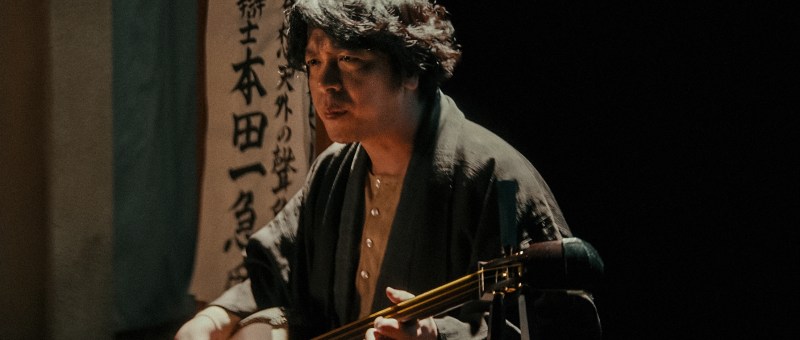
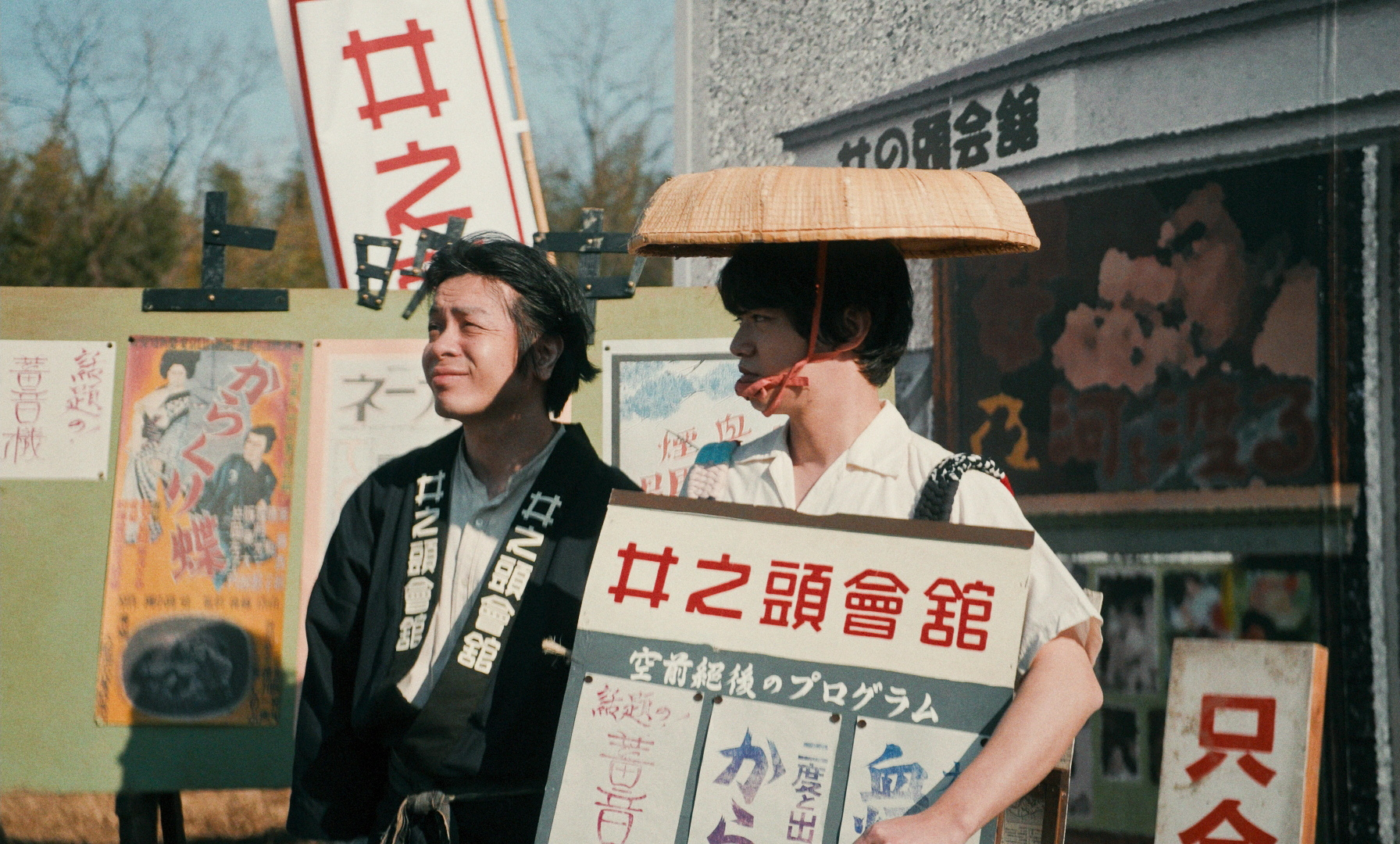
BAUS: The Ship’s Voyage Continues (BAUS 映画から船出した映画館, Hokimoto Sora, 2025)

According to the hero of Sora Hokimoto’s BAUS: The Ship’s Voyage Continues (BAUS 映画から船出した映画館, Eiga kara Funadeshita Eigakan), films are born of man’s battle against time and the desire to extend one moment into eternity. Yet his father was always looking for a new “tomorrow” and a path towards the future that ironically kept him from being fully in the  present. Inspired by the memoirs of Takuo Honda, the film is effectively a people’s history of cinema culminating in 2014 with the closure of the Baus Town cinema amid a climate in which film itself seems to have entered a terminal decline.

Indeed, Takuo’s father Shigeo (Shota Sometani) becomes almost a ghost himself. Having come to Tokyo insisting that movies were his “tomorrow,” the war leaves him a shadow of his former self and a spectral presence in the auditorium. Though Takuo’s mother (Kaho) and others at the cinema have discovered a new community eating together every night after the final screening, Shigeo is often out drinking with the chamber of commerce and rarely returns home. Still looking for “tomorrow,” he appears lost for direction despite opening a new, more modern cinema fit for the post-war era. 

As the mother of Shigeo’s wife Hama says, men are focused on past and future while it’s women who are forced to face the present leaving most of the more practical problems for Hama to deal with. Shigeo’s brother Hajime (Kazunobu Mineta) had perhaps been overly obsessed with the past and ultimately unable to move forward. After coming to Tokyo with Shigeo, he became an unsuccessful benshi only to be rendered obsolete by the arrival of talkies. Despite being drawn to the anti-capitalist rhetoric of the migrant workers, he later falls hard for militarism and becomes a casualty of the war both literally and spiritually. Shigeo laments the increasing censorship of the late 1930s complaining that it has become impossible to make or show films, but it’s little better afterwards as the Occupation forces push Hollywood movies at the expense of the European or Japanese.

Hajime had snapped back that entertainment wouldn’t change anything and that war purified the world, but Shigeo insists that films are a window from which the local population can learn about other lives and other places, a means of “building the heart” that might a save a soul. The older Takuo envisages a world in which watching a film normally or loving someone normally might become political acts in themselves. He weaves his personal history of film, which is also that of his family, with the political realities of the mid-20th century in which beautiful forests are cut down to make coffins for the endless dead and unexploded incendiaries lurk like ticking time bombs both literally and psychologically as, as one old man puts it, the nation’s struggles to reckon with its role in the war or its traumatic consequences. 

Nevertheless, even if Takuo is closing Baus Town for reasons stemming from his own traumatic loss, he continues to look for tomorrow despite his old age. Asked what his dream was, he replies only that he wanted his children to have better lives than he did, though he worries he may have failed. In any case, he remains lost within the labyrinths of cinema. The building itself, originally surrounded by fields in a much smaller Kichijoji, becomes a haunted space in his memory, half dream and longed-for place of warmth and salvation in which he remains a small child searching for his father in the empty auditorium.

The name for Baus Town is taken from the bow and stern of a ship, echoing Takuo’s own search for other horizons and a constant process of moving through the world. He too is trying battle time and make a moment last an eternity while admitting that there’s nothing so beautiful as smoke in the projector beam. He asks his daughter if smoke, like movies, isn’t connected to the afterlife and there are ways in which Takuo has also become a ghost, both haunted and haunting while films are themselves a kind of other world of the living past and a way of communing with those no longer here. Taking over production after Shinji Aoyama passed away, Sora gives the film an elegiac, poetic quality while asking if cinemas too might be resurrected in the same way as film even as Takuo ponders new directions while continuing to sail ahead in search of tomorrow.


BAUS: The Ship’s Voyage Continues screened as part of this year’s Nippon Connection.

Original trailer (no subtitles)

Images: ©Honda Promotion BAUS/boid 
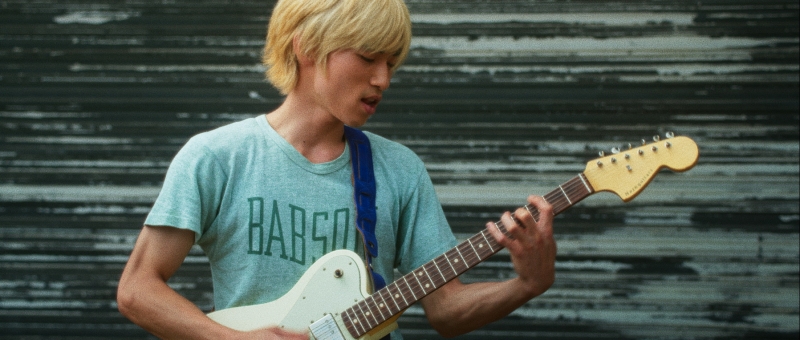
Plastic (Daisuke Miyazaki, 2023)

A young couple bond over their shared love of an obscure 70s glam rock band, but soon find their youthful romance eroded by the realities of impending adulthood in Daisuke Miyazaki’s warmhearted coming-of-age tale, Plastic. Emotional distance becomes a persistent theme as mediated through a message into space that might take light years to arrive not to mention the reply, which seems to echo the couple’s inability to communicate despite their star-crossed connection.

Jun (Takuma Fujie) and Ibuki (An Ogawa) bond after realising they are both fans of 70s band Exne Kedy, talking for hours at a small cafe only leaving when the place closes. Having recently relocated to Nagoya from Tokyo, Jun enrols at Ibuki’s high school and joins her after school club much to the chagrin of her two friends. The pair eventually become a couple going on a series of wholesome dates including a trip to watch Sad Vacation in a cinema and are apparently very much in love but a year later the novelty has begun to wear off. Ibuki is studying for university exams and bound for a top institution in Tokyo while Jun is planning to drop out and pursue music full-time. 

Perhaps slightly more conventional, Ibuki berates Jun for his impracticality asking how likely it is he’ll be able to support himself with the kind of music he makes. Later she has some kind of flash forward in which she imagines herself supporting him financially while he’s not even playing guitar anymore and they’re arguing about responsibilities for rent and living costs. She breaks up with him in the carpark of a convenience store but perhaps regrets it, keeping up a half-hearted friendship while he remains lost and lovelorn pursuing music on the side while working part-time. “Plastic” becomes a kind of metaphor for their relationship, something which should have lasted forever but has been subtly undermined by the microorganisms of conventionality and contemporary capitalism until it eventually broke apart. 

The distance between them is likened to that of the space radio broadcast which might not reach its target for 25,000 light years. The message was sent the same year that Exne Kedy broke up, and may well be delivered a little more than 50 years later at their reunion concert only as the narratorial voice over explains, that’s largely up to chance. Swapping notes on studying in the same way Jun’s mother and grandfather had talked about seeing Exne Kedy in concert, Ibuki’s parents had compared their flashcards to modern apps and joked that maybe someday education would all be online as in fact happened during the pandemic. Having swapped her rural home for the bright lights of Tokyo, all her classes are online which ironically gives her more time to spend with her friends but also leaves her exhausted and distant. 

When Jun wonders if his music is like the broadcast, destined not to arrive for thousands of years so he’ll never know who got it. Another school friend, Ayumu, asks him if he’s sure he hasn’t just missed a reply 25,000 years in the making which is sort of ironic because he’s clearly missed that she’s been trying to answer his message only he’s too hung up on his ex to notice. Later she asks him to move in with her, pointing out that she’s right there not 25,000 light years away like Ibuki who is now living with a DJ who doesn’t even know who Exne Kedy are. The two of them are far apart but somehow still connected, not least by their love for the band which may eventually reunite them. 

Exne Kedy is modern day creation by Ide Kensuke who had previously released the album Kensuke Ide With His Mothership ― Contact From Exne Kedy and the Poltergeists and makes a self-cameo in the film in a surreal scene featuring the band whom Ibuki and Jun unexpectedly run into doing an impromptu performance in the middle of a forest singing a song that echoes the state of the couple’s relationship in which a lighthouse no longer illuminates and cannot light the way. Yet there is always a sense of the couple as a pair of flashing beacons waiting to pass close enough to each other to be able to convey a message. Featuring cameo appearances from (former pop star) Kyoko Koizumi and Machiko Ono, Miyazaki’s strangely charming youth movie is surprisingly sincere in its romanticism but equally in its critique of the world that frustrates it while suggesting that music may once again save the day.


Plastic screened as part of this year’s JAPAN CUTS.

Original trailer (no subtitles)

Girl in the Sunny Place (陽だまりの彼女, Takahiro Miki, 2013)

girl in the sunny placeThe “jun-ai” boom might have been well and truly over by the time Takahiro Miki’s Girl in the Sunny Place (陽だまりの彼女, Hidamari no Kanojo) hit the screen, but tales of true love doomed are unlikely to go out of fashion any time soon. Based on a novel by Osamu Koshigaya, Girl in the Sunny Place is another genial romance in which teenage friends are separated, find each other again, become happy and then have that happiness threatened, but it’s also one that hinges on a strange magical realism born of the affinity between humans and cats.
25 year old Kosuke (Jun Matsumoto) is a diffident advertising executive living a dull if not unhappy life. Discovering he’s left it too late to ask out a colleague, Kousuke is feeling depressed but an unexpected meeting with a client brightens his day. The pretty woman standing in the doorway with the afternoon sun neatly lighting her from behind is an old middle school classmate – Mao (Juri Ueno), whom Kosuke has not seen in over ten years since he moved away from his from town and the pair were separated. Eventually the two get to know each other again, fall in love, and get married but Mao is hiding an unusual secret which may bring an end to their fairytale romance.

Filmed with a breezy sunniness, Girl in the Sunny Place straddles the line between quirky romance and the heartrending tragedy which defines jun-ai, though, more fairytale than melodrama, there is still room for bittersweet happy endings even in the inevitability of tragedy. Following the pattern of many a tragic love story, Miki moves between the present day and the middle school past in which Kosuke became Mao’s only protector when she was mercilessly bullied for being “weird”. Mao’s past is necessarily mysterious – adopted by a policeman (Sansei Shiomi) who found her wandering alone at night, Mao has no memory of her life before the age of 13 and lacks the self awareness of many of the other girls, turning up with messy hair and dressed idiosyncratically. When Kousuke stands up to the popular/delinquent kids making her life a misery, the pair become inseparable and embark on their first romance only to be separated when Kosuke’s family moves away from their hometown of Enoshima.

“Miraculously” meeting again they enjoy a typically cute love story as they work on the ad campaign for a new brassiere collection which everyone else seems to find quite embarrassing. As time moves on it becomes apparent that there’s something more than kookiness in Mao’s strange energy and sure enough, the signs become clear as Mao’s energy fades and her behaviour becomes less and less normal.

The final twist, well signposted as it is, may leave some baffled but is in the best fairytale tradition. Maki films with a well placed warmth, finding the sun wherever it hides and bathing everything in the fuzzy glow of a late summer evening in which all is destined go on pleasantly just as before. Though the (first) ending may seem cruel, the tone is one of happiness and possibility, of partings and reunions, and of the transformative powers of love which endure even if everything else has been forgotten. Beautifully shot and anchored by strong performances from Juri Ueno and Jun Matsumoto, Girl in the Sunny Place neatly sidesteps its melodramatic premise for a cheerfully affecting love story even if it’s the kind that may float away on the breeze.


Original trailer (no subtitles)

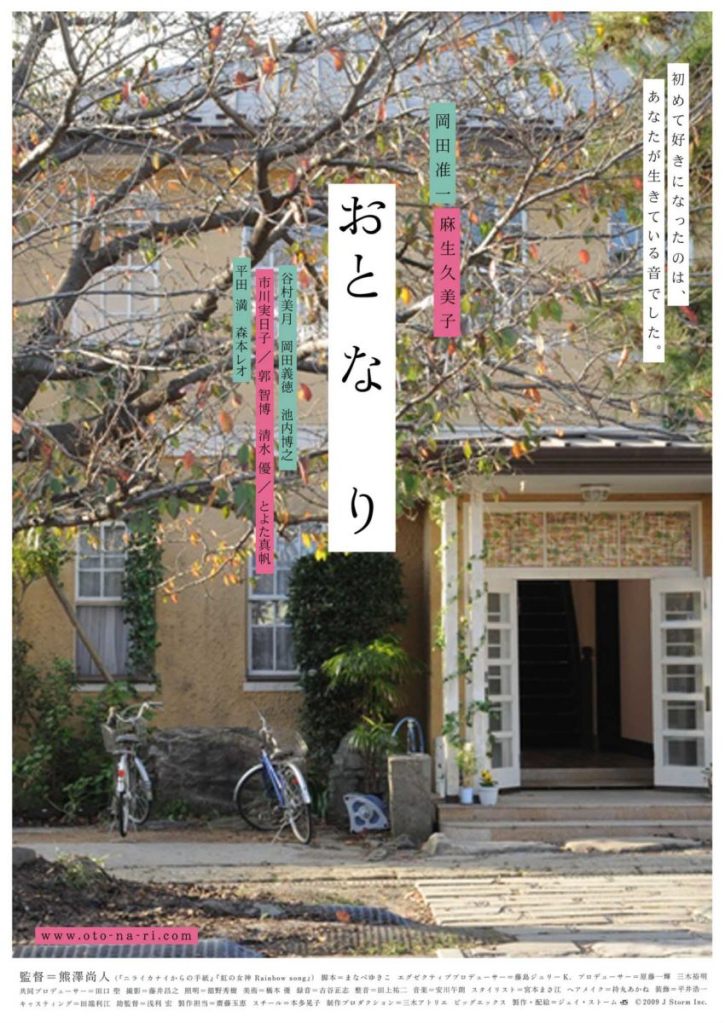
Romantic Prelude (おと・な・り, Naoto Kumazawa, 2009)

otonariSometimes when you live in the city it’s difficult to build meaningful connections with other people. You might find yourself a little lost, caught between the rat race and what it was that brought you to the city in the first place, but if you just close your eyes and listen, you can hear that you’re not alone. Romantic Prelude (おと・な・り, Oto-na-ri) is the story of two such people who build up a strange connection even though they’ve never really met.

Satoshi (Junichi Okada) and Nanao (Kumiko Aso) are next door neighbours in a small apartment block where the walls are paper thin. They’re both vaguely aware that a person of the opposite sex and around the same age lives next door, but they don’t know each other – in fact, they wouldn’t even recognise each other if they passed in the street. Still, they’re each aware of the other person through their particular soundscapes – Nanao hears Satoshi’s keys jangling on his belt as he leaves each morning and his rice cooker beeping in the evening, where as he thinks of Nanao as the humming girl and enjoys getting a free French lesson as he hears her language tapes through the wall.

Both are beginning to get frustrated with their lives in the city. Satoshi is a professional photographer doing fashion shoots but his real passion is landscape photography. He’s planning to go to Canada for a photo project but keeps getting held back as he only got into the fashion stuff because his childhood friend became a model and the two have now become entirely dependent on each other to keep working. When the friend, Shingo, finds out about Satoshi’s Canada plans, he goes missing causing his pregnant girlfriend Akane to come crashing into Satoshi’s life for a while.

Likewise Nanao is a lonely woman in her early thirties who works in a florist’s shop and plans to go to France to study flower arrangement after she’s passed the highest rank of exams. The guy at the local combini she often shops at seems to have developed a crush on her and Nanao isn’t really sure what to do with that but uses all of her time pursuing her dream of becoming a top florist.

Satoshi and Nanao are both feeling adrift, as if their lives are passing them by and it’s getting too late to not be getting anywhere. Just hearing the familiar sounds coming through the wall provides a comforting presence to not feel so alone. Though they don’t know each other, each has perhaps built up an image in their minds of the other person based on the sounds they create – keys, coffee, cooking vs French, classical music and humming an all too familiar song. Feeling the other person’s presence becomes reassuring and an absence of a familiar sound at its expected hour is unexpectedly disconcerting even if you really have no right to expect it.

Though Nanao is annoyed by the noisy and unprecedented arrival of Akane (who is not a good match for the rather uptight Satoshi) and slightly confused by her friendly greeting from the adjacent balcony, she still continues to derive comfort from the gentle presence of her neighbour. After having undergone a cruel humiliation and in something of a crisis, Nanao breaks down inside her apartment. Hearing her distress, Satoshi places his hand on the wall as if in comfort but rather than going next door to see if everything’s OK, he begins to hum and then sing the song he’s heard Nanao humming all along and eventually she too comes to sit beside the wall singing the song back to him.

As implied in the film’s English title, Romantic Prelude, music, and more particularly the symphony of sound that makes up a city, is the film’s major motif. This is further brought out by the original Japanese title which is a perfectly composed sonata of its own – Oto-na-ri. “Otonari” is Japanese for neighbour but the syllables which make up the word also have their own distinct meanings in that “oto” on its own means “sound” but put together “otona” means adult and then “nari” can also mean “to become”. Satoshi and Nanao are engaged in a blind slow dance where they’re falling in love with a stranger based on nothing other than a feeling of connection coupled with bond created by their shared soundscape.

Less a romance than an urban character study, Romantic Prelude is that rare case of a genuinely intriguing love story in which you’re really not sure which way things are going to go. This could just be another story of a tragic missed connection where Nanao heads off to France and Satoshi to Canada and they never even meet or it could give the audience the satisfying true love ending that it almost certainly wants but could have made either direction work. In the end, the important thing is seeing the pair work through their own difficulties and sort things out for themselves in the absence of each other before they finally begin to live the lives they’ve been yearning to lead.


The Japanese release of Romantic Prelude contains English subtitles.

Unsubtitled trailer:

and here’s the song they both keep singing – Kaze wo Atsumete by Happy End