Roaring Fire (吼えろ鉄拳, Norifumi Suzuki, 1981)

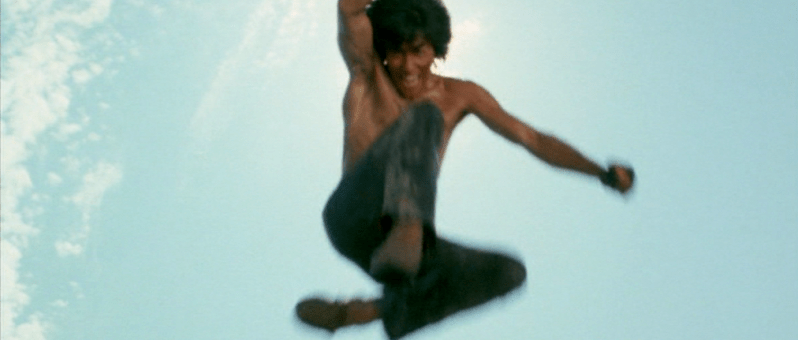
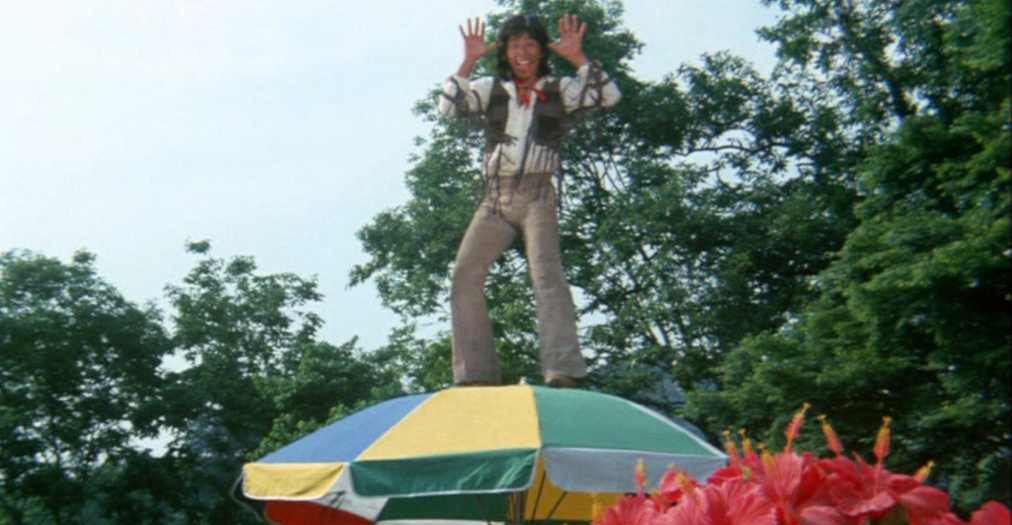
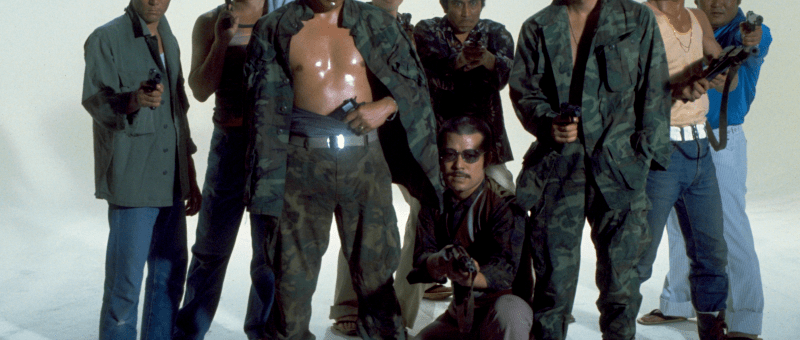
If Chiba’s karate films and the Sister Streetfighter series had been influenced by Shaw Brother’s kung fu films, Roaring Fire (吼えろ鉄拳, Hoero Tekken) is an homage to contemporary action and in some senses anticipates Jackie Chan and heroic bloodshed though in other ways harking back to the classic serial with its diamond-themed MacGuffin. A vehicle for rising action star Hiroyuki Sanada, the film reflects a new internationalist Japan but also confronts the toxic legacy of the feudal past in the fall of a once noble house.

Joji (Hiroyuki Sanada) has spent his entire life on a ranch in Texas only to discover from a deathbed confession by the man that he thought was his father that he had been kidnapped as an infant and is actually the son of the wealthy Hinohara family. But on travelling there, he immediately finds himself in the middle of a conspiracy. His twin brother Toru has gone missing after going to London to study ophthalmology in order to cure his sister Chihiro’s (Etsuko Shihomi) eye condition. Though his uncle, Ikki (Mikio Narita), welcomes him with open arms, a weird ventriloquist act by a man called Mr. Magic (Shinichi Chiba) that he’s taken to see suggests that the plane crash his parents died in may not have been an accident and his uncle killed them to take over the family business. 

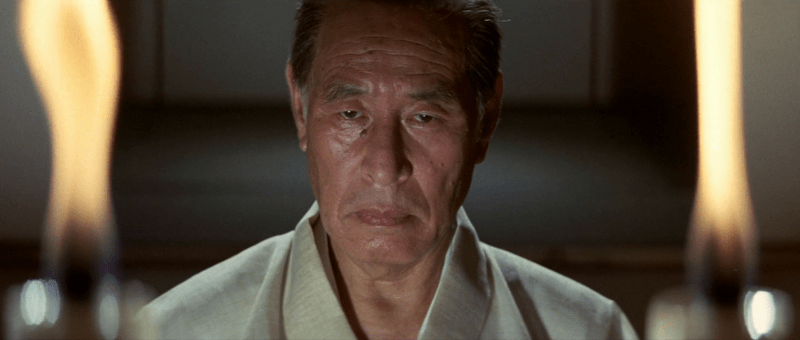
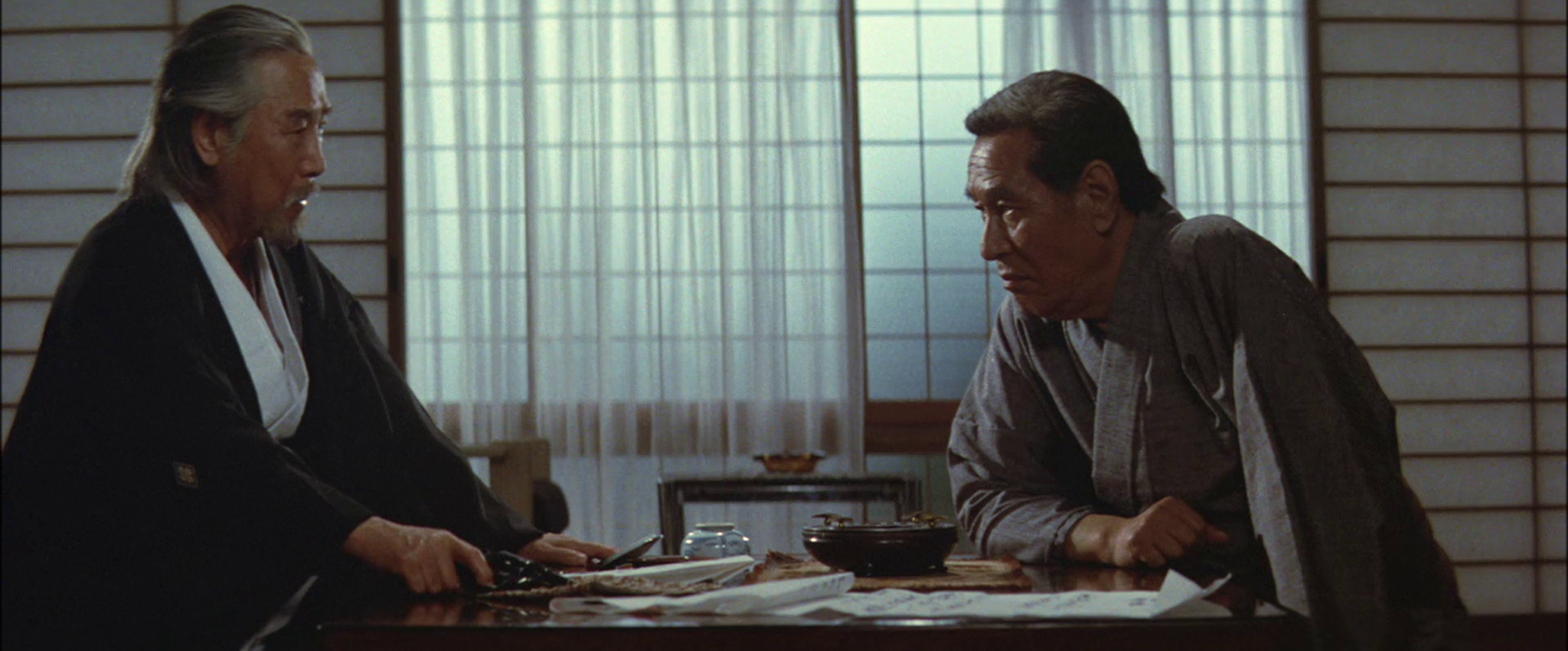
Ikki is mixed up in the drugs trade with Hong Kong Triads and in keeping with Suzuki’s other films, we once again have a new solution to smuggling in hiding drugs in underripe banana skins. Lured to Ikki’s underground lair which has a large photo of Hitler on the wall and other Nazi memorabilia scattered around, Joji is given the “join us or die” speech, but ultimately manages to escape with some help from Abdullah the Butcher who is working as some kind of bodyguard but apparently takes a liking to Joji and declares they will be the best of friends forever after their initial fight. In any case, we soon realise that Ikki’s purpose in life is feudal revenge in that his mother was a geisha who died young because of her poverty and the nature of her work while staring at the Hinohiras’ giant mansion though his father apparently took no responsibility for him until after his mother died. His only goal in life is to take over the estate and otherwise destroy the rest of the family that never fully accepted him. 

Of course, Joji is in his way, but Joji doesn’t really want this legacy either and only wants to save his sister who turns out to be a kung fu ace despite her blindness but is otherwise unable to escape. In his final confrontation with Ikki, he reclaims the name of the man who raised him, Hibiki, and rejects that of Hinohara as if symbolically refusing his feudal inheritance. Mr Magic, really an Interpol agent, makes an executive decision to let him go which is also a representative authority figure setting him, and the younger generation, free from the feudal legacy to live a more international life. 

Nevertheless, Suzuki fills the film with a series of high-impact action sequences and extreme stunt work such as a crazy bus chase through Hong Kong which predates that in Police Story by a few years. The shuttles back and forth between Hong Kong and Japan, but it’s clear here that Ikki and his weird Nazi cohorts are the villains rather than the Hong Kong gangsters who really just exist and otherwise only factor into the story because of their desire for Queen of Sheba diamond that Joji’s birth father hid before he died so Ikki wouldn’t get his hands on it. A possibly poor taste allusion to the holocaust aside, Suzuki sticks to the plucky teen adventure format in which Joji gets into fights with the local guys and is quickly befriended by Chihiro’s teenage friends who all hang out at the mansion, rather than opt for a gloomy sense of paranoia and conspiracy even as Joji finds himself at the centre of a Hamlet-esque plot in which his uncle has usurped the throne and he must return to set it right. Yet rather than restoring the existing order, Joji effectively resets it by ending the family’s influence and then moving on into a freer existence shorn of filial responsibilities. 


Trailer (no subtitles)
The Pit of Death (怪談おとし穴, Koji Shima, 1968)

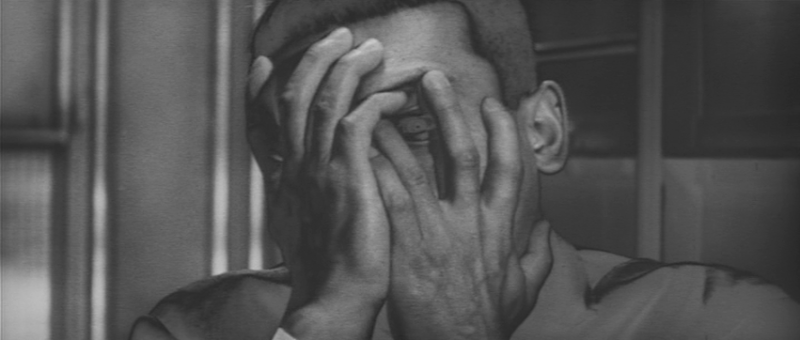
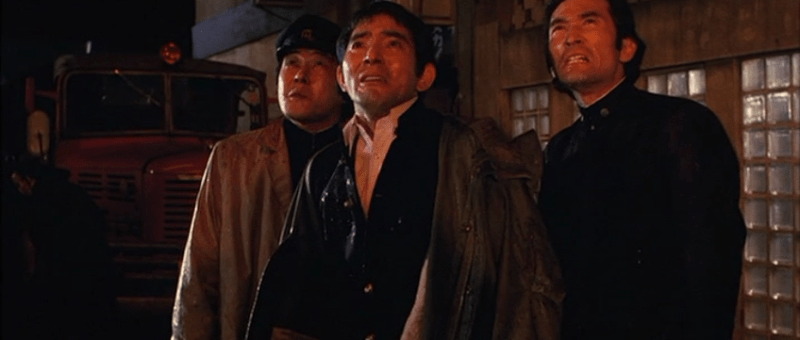
The building at the centre of Koji Shima’s dread-fuelled horror noir Pit of Death (怪談おとし穴, Kaidan Otoshi Ana) is said to be haunted by the spirits of the many people who died during its construction. In his opening voiceover, anti-hero Kuramoto (Mikio Narita) likens the city to a hornet’s nest, the salaryman drones mindlessly buzzing around the business district as if driven by some supernatural force. In that sense, the office building itself becomes an eerie place, the nexus of the salaryman dream which in the end drags all to hell. 

Largely a retelling of Yotsuya Kaidan for the mid-20th century with a little A Place in the Sun thrown in, the film finds Kuramoto an ambitious man deluded by consumerism and resentful of the classism and snobbishness which limit his prospects as a man who has otherwise been able to pull himself out of poverty. His boss pointedly speaks of his talents which include the ability to speak several languages despite only having attended night school rather than university while it’s unusual for a man of his background to hold this kind of position even if he’s only a secretary and not yet an executive. Nevertheless, his boss clearly sees him as a potential successor and plans to marry him to his daughter (Mako Sanjo) who has in some ways inexplicably developed a crush on him.

But Kuramoto is already in a relationship with typist Etsuko (Mayumi Nagisa). In fact, the reason the boss is so pleased with him is largely down to her in that he asked Etsuko to sleep with their foreign client, Mr Hancock, to seal the deal which she duly did. Kuramoto plans to throw her over in order to pursue his dream of taking over the company so he can look down on those who once looked down on him. He tells Etsuko that the marriage will be in name only, that he isn’t attracted to the boss’ daughter Midori, and their relationship will continue as before only to be confused when Etsuko is not totally on board with the plan. She tells him she’s pregnant with his child though he callously points out it could be Hancock’s and insists on an abortion thereafter determining he must kill her so that he can fulfil his destiny by joining the executive class. 

His desires are obvious when he steps into Midori’s home and gazes at a painting crassly asking how much it’s worth, admitting that he’s the kind of poor person who has a fascination with luxury. His forward propulsion is driven by a fear of poverty, the trauma of the hard life he’s had and the futility he felt in his inability to escape it. Yet it’s also a kind of class rebellion motivated by resentment for the prejudice held against him as a man without means in a highly stratified society. Paradoxically, he will do anything and everything to be accepted as a member of the elite class including murdering Etsuko, the symbol of the working class past he fears will drag him down.

Etsuko does indeed drag him down eventually in her own revenge against his callousness and the double standards of a patriarchal society. Her relationship with Kuramoto seems to be a secret in the office while he uses and discards her when no longer useful to him. She too is trapped within this building of a newly corporatised society but can rise no further alone and is in a fairly bleak position without Kuramoto for she has already thrown away her only bargaining chip by entering a sexual relationship with him. Should she attempt to raise his child alone as a never married single mother, her life would be very difficult indeed if not actually impossible. Nevertheless, she does have real power over Kuramoto in her ability to expose the affair and ruin his chances of career advancement through dynastic marriage destroying any possibility of his future success. 

In Kuramoto’s mind, Etsuko cackles like a witch or evil spirit. Her hair billows out into the wind like a vengeful ghost, though the first few times Kuramoto only imagines her death. He sees himself push her off a roof, only to be surprised to see her still standing over him. Etsuko haunts Kuramoto while alive as an image of his destruction all while he silently plots hers. He plans to use the building against her, hiding her body inside it where he assumes no one will see. In the end, it’s as if this building, an edifice of soulless corporatising capitalism, consumes them both, drawing them in with their unfulfilled desires until they fall into the bottomless pit of post-war ambition. Shima makes frequent use of solarisation and film noir lighting to destabilise Kuramoto’s world as his mental state starts to fracture along with innovative use of split screens to lend the space a sense of eerie continuity but ultimately posits the salaryman society as a kind of death trap beckoning greedy souls towards their demise with an inexorable fatalism.


Hoodlum Soldier (兵隊やくざ, Yasuzo Masumura, 1965)

The opening voiceover of Yasuzo Masumura’s Hoodlum Soldier (兵隊やくざ, Heitai Yakuza) explains to us that the settlement we’re looking at is effectively a huge prison in the desert inhabited only the Japanese military from which there is no escape. To ram the point home, the camera lingers on the decomposed skeleton of Japanese infantrymen half-buried in the mud only a short distance from the fort’s borders. This is the fate of the soldier, it seems to tell us with nihilistic futility as if in effect all of these men are already dead while imprisoned inside the death cult that is militarism. 

Yet, our heroes will eventually escape. At least that’s how it seems at the end of the film though there are a further eight instalments in this series. A mismatched pair who develop something akin to a sadomasochistic relationship, they each resist this system in opposing ways. “College boy” Arita (Takahiro Tamura) is just waiting out the end of his contract, continually refusing promotions so that he will be discharged at the end of his three-year term and allowed to return to Tokyo a free man. Omiya (Shintaro Katsu), by contrast, is a man who has no real concept of hierarchy or authority. As he later says, he doesn’t do anything he doesn’t want to do and it’s not so much that he resists authority but is simply indifferent to it.

As Arita explains, the the army is a hierarchy that’s founded on violence. The mildest infraction is dealt with through a process of slapping in which those of higher status assert their authority by inflicting violence on those below. We’re told that laws have recently been put in place to regulate the violence implemented as disciple with excessive force now apparently frowned upon leaving this culture of slapping as the only accepted form of judging an action right or wrong though it’s also clear that these rules are not always respected even by those who made them. The very system is then itself corrupt and unfair, which Arita knows and therefore contrives to live outside of it in so much as he does not participate in this chain of violence.

Neither does Omiya but in an opposing way. On joining the unit, he simply does not react to being slapped by his superior officer and in that way makes it clear that he cannot be controlled by violence. He does not fight back, but only uses to violence to oppose what he sees as injustice and it’s this refusal to just accept the unfairness of army life that makes him a thorn in the side to army command. They assign a reluctant Arita as his mentor, much to his chagrin because he fears that Omiya will get him into trouble and damage his chances of making it to his discharge without incident. But the funny thing is that Omiya does submit himself to Arita’s authority precisely because he does not brutalise him and never uses violence as a means of control. Omiya respects Arita, and therefore listens to him when he explains why a particular course of action is disadvantageous to himself and will only result in further violence. 

To Arita, Omiya at times seems like a bullheaded brawler who thinks a fight is over when someone is knocked out or surrenders and is unable to see the potential for reprisals, but he’s smarter than he gives him credit for and the bond between them is quite genuine even at times homoerotic as they each declare they don’t want to be parted from each other seemingly the only two sane men marooned amid the folly of war in Manchuria. Omiya respects Arita because he does not use violence against him, but in other senses perhaps craves it and is willing to inflict violence on himself in order to save Arita from being forced to do so by the system under which they live which would obviously cause him mental anguish. The power dynamics between them shift as the fortunes of the war decline with Arita eventually declaring that Omiya is now his superior and may issue him orders which he will then obey.

The statement may however be ironic in that they are in the process of escaping the hierarchal society by hijacking its most potent symbol, a train. Omiya declares themselves free of it in pointing out that China stretches to the borders of Russia and Europe as if the whole world were now open to them that they are no longer bound by the walls of the literal prison that is the army camp and the symbolic ones of the militarist society ruled by violence. As Arita had pointed out, the camp ran itself like a prison and was akin to a yakuza society with the different factions often at war with each other. Goverened by macho posturing, every transgression must be solved through violence to approve each man’s status with Omiya’s perpetually high in part because he doesn’t really care very much for the hierarchy only for what he sees as righteousness. 

The two men bond with a Japanese sex worker who they realise is just as trapped as they are by the force that underpins militarism, violent patriarchy. She also feels her situation to be futile, that even if she should return to Japan there will no future for her because of her past in sex work while she currently has no more control than they do and is simply pulled around by her employers to wherever the army goes now that the frontlines are in constant flux and the retreat south has begun. Arita and Omiya free themselves by decoupling from the train leaving the sleeping soldiers yet to awake from the cruel spell of militarism inside while they seek freer futures. Our heroes are men who in effect simply choose to remove themselves from an absurd and destructive social order which speaks just as well to the contemporary society of docile salarymen living in a different kind of prison but perhaps no more free than previous generations while tied to a feudalistic, patriarchal social hierarchy. 


Hoodlum Soldier screened as part of this year’s Camera Japan.

Original trailer (no subtitles)

The Geisha (陽暉楼, Hideo Gosha, 1983)

The coming of the railroad spells doom for one of the most prestigious geisha houses in Japan in Hideo Gosha’s adaptation of the Tomiko Miyao novel, The Geisha (陽暉楼, Yokiro). Miyao’s novels had often provided the inspiration for Gosha’s films and she had herself been the daughter of a “flesh broker” in pre-war Kochi though later escaping to another town to be a substitute teacher. Though the English title may focus more on plight of the the individual geisha at its centre, the Japanese hints more at the destructive cycle of the Yokiro itself in the persistent legacy of exploitation.

Then again as he later points out, if you’re looking for a villain in this story then the responsibility lies largely with Daikatsu (Ken Ogata) himself. In a prologue set in 1913, Daikatsu has eloped with geisha Otsuru but the pair are discovered by gangsters sent after them by the Yokiro. Daikatsu kills all of their assailants and assures Otsuru that they are finally “free” but it appears to be too late. Holding their baby daughter in one arm, Otsuru collapses into his other and presumably dies either then or shortly after while Daikatsu is later sent to prison for 10 years. 20 years later in 1933, the daughter, Fusako (Kimiko Ikegami), has become the number one geisha at the Yokiro under the name Momowaka though her career flounders because she is regarded as too emotionally distant to keep a patron. 

Daikatsu is also himself in Kochi at this point and working as a procurer brokering the sale of young women to the Yokiro and other geisha houses and brothels. When a school teacher comes to him to sell his wife, he taps her teeth to check for malnutrition much as one would examine a horse before running a hand underneath her kimono to check everything is at is should be before offering a valuation. Her husband only looks at him anxiously enquiring if a body such as hers which has as he later reveals born three children will fetch a good price. Daikatsu lets them go so the woman, Masae, can spend a final night with her family explaining that he cannot force someone to work if they do not want to do so and is well aware they will likely take his money and never be seen again which is what almost what happens. As it turns out the husband is killed in a fight and the woman ends up becoming a geisha anyway, only in the pay of prominent Osaka yakuza led by Inaso. 

Inaso (Mikio Narita) and buddies want in on the construction of the railroad that will shortly be coming to Kochi, but need to take over the town first which means getting around the mistress of the Yokiro, Osode (Mitsuko Baisho), who is apparently running every game town. The entire local economy is underpinned by female exploitation and facilitated by a woman, a former geisha, seizing the only power that is available to her. Isano later uses Masae as a kind of spy, getting her to initiate a relationship with Osode’s weak willed husband in an attempt to humiliate her which largely backfires as Osode boldly reclaims her man through a violent brawl in a hot spring though it does not appear that she is especially fond of him so much as he serves a particular purpose.

The brawl emphases the way in which women are pitted against each other by the nature of a patriarchal society along with the ways in which they are forced to mediate their power through men. Fusako also gets into an intense physical fight with Tamako (Atsuko Asano), a surrogate daughter of Daikatsu’s and emblem of a coming modernity, who insists on becoming a sex worker at the area’s most prominent brothel. In a strange moment of confrontation, both the geishas of the Yokiro dressed in their traditional regalia, and the sex workers of Tamamizu, arrive at a modern club where the heir to a banking empire courted by the Yokiro, Saganoi, dances the Charleston he learned while studying abroad in America. The geisha who dances with him struggles to pick up the moves, Saganoi lamenting that the dance is just not suited to a woman wearing a heavy kimono, elaborate wig, and clumsy geta. Tamako immediately gets up from her table and kicks off her shoes, gathering the hem of her own kimono to free her legs for the high level kicks of the modern dance. 

Fusako reclaims her authority by interrupting the dance immediately before its conclusion and insisting on retrieving their guest. Tamako appears to resent Fusako, perhaps frustrated in her relationship with Daisuke who does not appear to have had much contact with the daughter he sold at 12 years old. They too end up in an elaborate brawl in which Tamako rips off Fusako’s wig and splits her lip, symbolically freeing her to transcend the constraints of her “geisha” persona. Meeting Saganoi at Western-style bar, she boldly dances on the counter and sleeps with him of her own volition. But in doing so she conceives a child and leaves herself in a difficult position. She has betrayed her patron, and though she could simply have kept the fact from him and allowed him to think the baby was his, Fusako does not want to bring her child up in lies while simultaneously hanging on to a naive dream that Saganoi will one day return to her despite being made aware he has left for Europe. 

“All men are enemies of women,” she writhes in childbirth while swearing that no one will take her child from her, but she is still an indentured woman and her daughter is by rights the property of Osode. Her illness, presumably consumption, began long before her pregnancy and seems to an echo of the suffering she has been forced to endure as a geisha. As her health weakens, so the Yokiro declines. First it is ravaged by a literal storm, but also under threat from the Osaka gangsters desperate to take over Kochi to gain access to the lucrative construction contracts extending in its direction. Even so, as Daikatsu admits much of the fault lies with him. He chose to elope with Otsuru and was unable to protect either her or their daughter whom he allowed meet the same fate by entering the geisha world. He continued to earn his money by selling women into what is essentially slavery, and cannot escape his part in their continued exploitation while his entanglement with gangsters later disrupts the more settled life Tamako has begun to build for herself. 

“Wait all you want, the train’s not coming,” Tamako is later told, as if signalling that there really is no way out of this destructive and disappointing existence. Truly epic in scope, Gosha’s pre-war drama draws together patriarchal exploitation and societal corruption to critique a burgeoning modernity, but ends exactly as it started among the vibrant cherry blossoms only this time undercutting the melancholy of the oft repeated song with a more cheerful scene hinting at least symbolically at a long-awaited reunion. 


Original trailer (English subtitles)

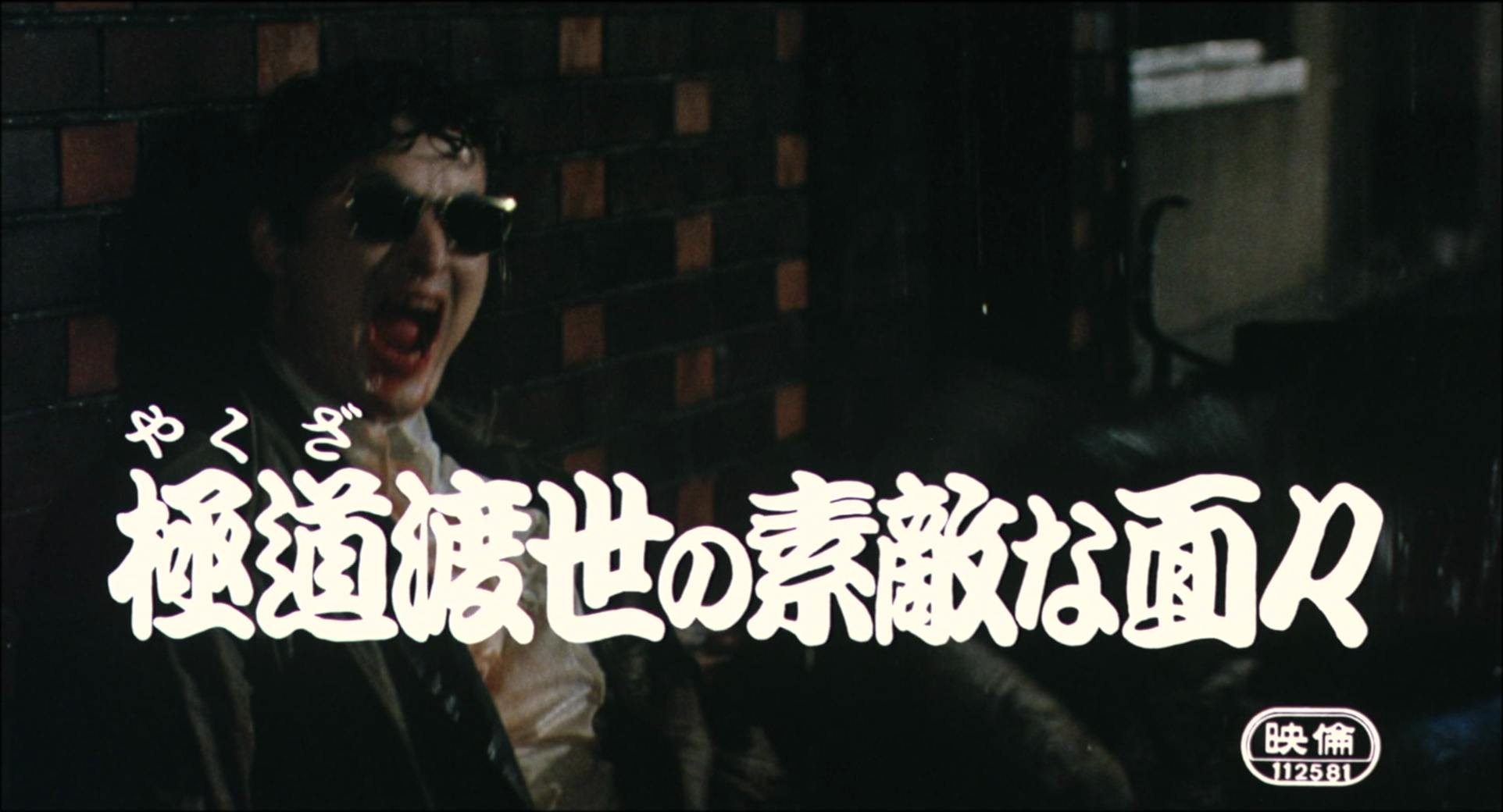
Those Swell Yakuza (極道渡世の素敵な面々, Seiji Izumi, 1988)

The yakuza movies of the post-war era had largely depicted the gangster world as being one of internecine desperation and even if the hero was a pure-hearted defender of a traditional honour code those around him were anything but honourable. By the late 1980s, however, the yakuza were increasingly seen as an outdated institution amid the high rise office blocks of a prosperous Bubble-era Japan in which the street thug had given way to more corporatised kinds of organised crime. 

This might help to explain the ironic title of Seiji Izumi’s 1988 comedy Those Swell Yakuza (極道渡世の素敵な面々, Yakuza Tosei no Sutekina Menmen) which simultaneously presents a nostalgic view of gangster cool and a way of life which is more rooted in the everyday existence of a contemporary petty outlaw. The hero, 24-year-old Ryo (Takanori Jinnai), is a former banker who evidently rejected the heavily corporatised nature of the Bubble-era society and left his stable job to open a record store which subsequently went bankrupt leaving him with huge debts to yakuza loansharks. It’s these debts he’s trying to escape by wandering into a mahjong parlour and getting carried away with his early success despite the advice of steady hand Nakagawa (Takeshi Kusaka) who eventually covers his losses when it turns out that Ryo started playing without any stake money. A ageing yakuza, Nakagawa takes him outside to teach him a lesson explaining that the parlour is run by Taiwanese gangsters and he’s lucky to be leaving with his life. Nevertheless, Nakagawa is impressed by his hutzpah and leaves his business card in case Ryo has the desire to get in touch. 

Ryo’s decision to become a yakuza reflects both a sense of emptiness in the Bubble-era society and a nostalgic longing for post-war gangsterism and the theoretical “freedom” is represents to a man like Ryo though of course there’s not so much autonomy to be had in the life of a petty footsoldier who is always beholden to the whims of his boss. Nakagawa becomes to him a kind of father figure, though he’s also someone who has largely lost out in having achieved little in the realms of gangsterdom while his friend and contemporary Kanzaki (Hideo Murota) has successfully climbed the ladder to become a high ranking officer. Kanzaki takes him to task for visiting the mahjong parlour in part because the Taiwanese gang has gained a reputation for dealing with drugs of which their organisation does not approve and it would present a problem if his connections to them were to come out during any potential anti-drug action by the police. By the film’s conclusion, Nakagawa has become something of a tragic figure more or less excluded from the yakuza world while his body is ravaged by alcoholism and his finances by gambling addiction. 

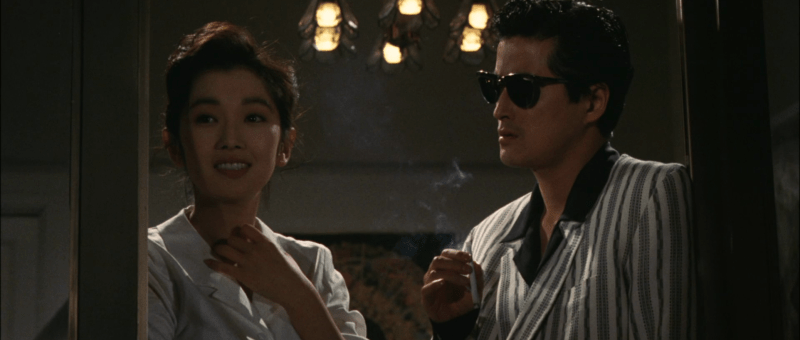
Ryo, meanwhile, seems to live the yakuza dream. He gets stabbed while defending a bar hostess from a yakuza from a different gang and then meets the love of his life, Keiko (Yumi Aso), who similarly rejects the constraints of the contemporary society by refusing the marriage arranged by her father for his own benefit to spend three years waiting for Ryo who goes to prison after shooting Kanzaki in the arm to avenge a slight against Nakagawa who also cuts off his finger to fulfil the codes of yakuza honour. Wandering around in sunshades and flashy suits, Ryo soon attracts a fiercely loyal band of followers of his own and despite the tragedy of losing one of his men to an assassin proves adept in navigating the yakuza world to present an idealised image of masculine cool perfectly tailored to the Bubble era.

Despite the shooting that landed him in prison and the mission of revenge he leaves his own wedding (after the ceremony) to complete in the film’s conclusion, Ryo’s yakuza existence is otherwise fairly non-violent and based in a kind of trickery that makes him seem clever rather than exploitative given that as Nakagawa had suggested the way forward for the modern yakuza is scams not drugs. As one of his prison buddies puts it, there are old school gangsters like Ryo ready to die for the clan, and then there are those like himself intent on filling their boots. Largely, most of these guys are old school yakuza who do obey the code and have some kind of scruples about how they make their money which adds to their aspirational allure as Ryo seems to lead a fairly charmed life of idealised masculinity with a pretty wife and fancy apartment seemingly free of the petty oppressions faced by workaday salarymen. Izumi makes frequent reference to classic Toei gangster pictures from a decade previously with appearance from from genre stalwarts such as Hideo Murota, Nobuo Ando, and Mikio Narita, but lends the action a contemporary spin in the ironic sense of cool even if the implications of ambiguous ending may be far less upbeat.


Break Out (行き止まりの挽歌 ブレイクアウト, Toru Murakawa, 1988)

Good cop or bad cop? A maverick detective crosses the line in the name of justice in Toru Murakawa’s hardboiled thriller, Break Out (行き止まりの挽歌 ブレイクアウト, Ikidomari no Banka: Break Out). Like many of Murakawa’s films throughout the ‘80s, the main villain turns out to be political corruption along with a complicit police force which the hero must in a sense divorce realising that he can enforce the law only by breaking it but tragically failing to protect those most in need of his care. 

Kaji (Tatsuya Fuji) is indeed the archetype of the lone wolf cop. Stumbling out of bed with an obvious hangover and fuzzy beard that stands in stark contrast to his clean-shaven colleagues, he immediately butts heads with follow officer Sakura (Renji Ishibashi) who is technically in charge of the latest homicide case which Kaji believes may be connected to the death of a young woman at a hotel that the force has so far proved reluctant to investigate. To him, it all seems to point to local gangster Nakai (Kiyoshi Nakajoe) with whom he seems to have an ongoing rivalry which might be why Nakai has implicated Kaji’s ex wife Saeko (Saiko Isshiki) in his drug smuggling operation. 

Kaji quickly identifies the body as a bass player, Shimada, who just happens to have played at a club connected to Nakai, and soon realises that a young woman, Miki (Yoko Ishino), who belongs to a local biker gang, is most likely responsible for his death. But, somehow feeling sorry for her and suspecting she may have access to information that would help him take out Nakai for good, Kaji actively helps Miki evade the police by harbouring her in his own apartment while they are both stalked by a mysterious, Terminator-esque hitman who seems intent on recovering some kind of evidence obviously harmful to his client whoever that may be. 

Murakawa’s greatest successes had occurred in the 1970s partnering with the great Yusaku Matsuda who had at this point moved away from genre films though he would later reunite with the director in his final screen appearance, a television movie in which he played an earnest policeman investigating a terrorist incident, before sadly passing away of bladder cancer at only 39. In any case the image of Matsuda hangs heavy over Murakawa’s subsequent films and it’s quite obvious that the menacing hitman has a distinctly Matsuda-esque silhouette, while Tatsuya Fuji plays a similar role to that he’d inhabited in Yoichi Sai’s Let Him Rest in Peace only this time as a world weary ‘80s cop who has his own particular code of righteousness he feels the world has failed. 

His more cynical boss, played by Murakawa stalwart Mikio Narita, is quick to tell him that he should have resigned after a previous incident and that if he had done so his wife would not have left him, a sentiment which she later confirms which is in part surprising because the incident involved him fatally shooting her father. The implication is that Kaji is a true defender of justice who refused to surrender to institutional corruption even at great personal cost. Yet we do definitively see him cross the line, coldly executing a suspect who goads him by claiming he has already killed someone he cared about and thereafter little caring for conventional morality deciding to take the bad guys down with him no longer having anything left to lose except perhaps the girl, Miki, with whom he has developed a paternal bond. 

Meanwhile his earnest partner, Nishimura (Hiroaki Murakami), who originally disapproved of Kaji’s old school, maverick policing has changed his tune now seeing the value in his belligerence not least when his own wife is taken hostage by Nakai leaving him equally powerless at police HQ. Kaji is constantly told to back off the hotel case because of pressure from above, eventually discovering a connection to a sleazy politician but knowing that he can’t touch him or Nakai while bizarrely ordered to continue investigating Shimada’s death despite the evidence that suggests they are quite clearly connected. Still as the rather more poetic Japanese title which means something more like “elegy for a dead end” implies, this world is already beyond redemption and the only recourse open to Kaji is to make a sacrifice of himself in the name of justice. A good bad cop, all he can do is pass on his outrage to those left behind. Shot with Murakawa’s trademark hardboiled mist, and a noirish sense of fatalism the film paints a bleak picture of infinite corruption in Bubble-era Japan in which the only hero on offer is a morally compromised cop prepared to die for an illusionary justice. 


Yakuza Graveyard (やくざの墓場 くちなしの花, Kinji Fukasaku, 1976)

“We don’t resort to violence. We observe the law.’ The hero of Kinji Fukasaku’s Yakuza Graveyard (やくざの墓場 くちなしの花, Yakuza no Hakaba: Kuchinashi no Hana) is berated by a superior officer for excessive use of force, but his criticism is in some senses ironic because it is the police force itself which becomes a symbol of the societal violence visited on those who can find no place to belong in the contemporary society. By this time the yakuza was already in decline and in the process of transforming itself into a corporatised entity while as a police chief explains increasing desperation has led to escalating gang tensions. 

Recently transferred maverick cop Kuroiwa (Tetsuya Watari) finds himself caught between two worlds in attempting to enforce the law through methods more familiar to yakuza. Soon after he’s had his gun taken away for exercising excessive force on a suspect he’d been independently tailing in the street on whom he’d found bullets designed to be used with a remodelled toy gun, Kuroiwa is pulled aside by another senior officer, Akama (Nobuo Kaneko) who takes him to a meeting with local yakuza boss Sugi (Takuya Fujioka). It seems obvious that Akama has cultivated a relationship with the Nishida gang which may not be strictly ethical for a law enforcement officer and hopes to bring Kuroiwa on board as a potential asset. They attempt to bribe him in return for information on the Yamashiro clan, the dominant organised crime association in the area, which has been hassling Nishida in an attempt to take over their territory. But Kuroiwa ironically tells them that they should “act like yakuza” and sort out their own problems rather than relying on the police before dramatically walking out much to to the consternation of everyone else present. 

Nevertheless, he eventually comes to sympathise with them as a symbol of the little guy increasingly crushed by corporate and authoritarian forces outside of their control. He finds out from a briefing that the police’s goal is the disbandment of the Nishida gang but when he asks why they aren’t going after the Yamashiro too he’s told to mind his own business and begins to realise that the police are in cahoots with organised crime. Whether they justify themselves that managing the Yamashiro to prevent a turf war is the best way to protect the public or are simply corrupt and in the pocket of big business, Kuroiwa can’t help but balk at the blatant hypocrisy of the law enforcement authorities. 

Later Kuroiwa reveals that he became a police officer after being bullied as a child in order to exert power over his life, or perhaps becoming an oppressor in order to avoid being oppressed. He was bullied because he had been born in Manchuria and even years later remains a displaced person at least on a psychological level. It’s this sense of displacement which allows him to bond with the Nishida gang’s accountant, Keiko (Meiko Kaji), whose father was Korean. Kuroiwa agrees to accompany Keiko to visit her husband (Kenji Imai) who is serving a lengthy prison term in order to tell him that the gang want to promote someone else to a position he viewed as his by right. The husband explodes in rage and uses a word some would regard as a slur to reference Keiko’s Korean heritage while she later attempts to walk into the sea feeling that there really is no place for her in the contemporary society. 

Just as she claims that she is neither Korean nor Japanese or much of anything at all, Kuroiwa is neither cop nor thug and similarly excluded from society at large. He ends up bonding with old school Nishida footsoldier Iwata (Tatsuo Umemiya), who is also ethnically Korean, for many of the same reasons and attempts to mount a doomed rebellion against their mutual oppression, but is hamstrung by his otherness which is only deepened when he’s taken prisoner by loan shark Teramitsu (Kei Sato) and given a mysterious truth drug developed by the nazis later becoming a user of heroin. Already marginalised, forced into crime by economic necessity and social prejudice, Iwata and Keiko like Kuroiwa himself struggle to escape their displacement while pushed still further out by systemic corruption and the amoral capitalism of an era of high prosperity. Shot with jitsuroku-esque realism and characteristically canted angles, Fukasaku injects a note of futility even within the hero’s tragic victory as he quite literally sticks two fingers up to the corrupted “brotherhood” that has already betrayed him.


Yakuza Graveyard is released on blu-ray on 16th May courtesy of Radiance Films. On disc extras include an in-depth appreciation of the film and the work of screenwriter Kazuo Kasahara from Blood of Wolves director Kazuya Shiraishi, and an informative video essay from Tom Mes on the collaborations of Meiko Kaji and Kinji Fukasaku. The limited edition also comes with a 32-page booklet featuring new writing by Miko Ko plus translations of a contemporary review and writing by Kasahara.

Original trailer (no subtitles)

Dead Angle (白昼の死角, Toru Murakawa, 1979)

The jitsuroku yakuza movie which had become dominant in the mid-70s had often told of the rise and fall of the petty street gangster from the chaos of the immediate post-war era to the economically comfortable present day. The jitsuroku films didn’t attempt to glamourise organised crime and often presented their heroes as men born of their times who had been changed by their wartime experiences and were ultimately unable to adjust themselves to life in the new post-war society. Adapted from a serialised novel by Akimitsu Takagi which ran from 1959 to 1960, Toru Murakawa’s Dead Angle (白昼の死角, Hakuchu no Shikaku) by contrast speaks directly to the contemporary era in following a narcissistic conman who has no need to live a life of crime but as he says does evil things for evil reasons. 

Prior to the film’s opening in 1949, the hero Tsuruoka (Isao Natsuyagi) had been a law student at a prestigious Tokyo university where he nevertheless became involved in the Sun Club, a student financial organisation launched by mastermind Sumida (Shin Kishida) who eventually commits suicide by self-immolation when the organisation collapses after being accused of black market trading. An unrepentant Tsuruoka resolves to start again, rebuilding in the ashes as a means of kicking back against hypocritical social institutions and rising corporate power by utilising his legal knowledge to run a series of cons through the use of promissory notes to prove that the law is not justice but power. 

In this Tsuruoka has an ironic point. He doesn’t pretend what he’s doing is legal, only that he’s safeguarded himself against prosecution. When a pair of yakuza thugs break into his office and threaten him in retaliation for a con he ran on a shipping company, he reminds them that as they’ve had him open the safe it would make the charge of killing him robbery plus murder which means automatic life imprisonment rather than the few years they might get for simply killing him without taking any money. He always has some reason why the law can’t touch him, while implicitly placing the blame on his victims who were often too greedy or desperate to read the small print and therefore deserve whatever’s coming to them. In at least one case, Tsuruoka’s victimless crimes end up resulting in death with one old man whom he’d double conned, pretending to give him the money he was owed but getting him drunk and talking him into “re-investing” the money with him, takes his own life by seppuku in the depths of his shame not only in the humiliation of having been swindled but losing his company, who had trusted him, so much money. 

You could never call Tsuruoka’s rebellion an anti-capitalist act, but it is perhaps this sense of corporate tribalism symbolised by the old man’s extremely feudalistic gesture that Tsuruoka is targeting. As his wife Takako (Mitsuko Oka) tells him, Tsuruoka should have no problem making an honest living. After all he graduated in law from a top university, it’s not as if he wouldn’t have been financially comfortable and it doesn’t seem that the money is his primary motive. While Takako continues to insist that he’s a good person who wouldn’t do anything “illegal”, his longterm geisha mistress Ayaka (Yoko Shimada) knows that he’s an evil man who does evil things for evil’s sake and that’s what she likes about him. Elderly businessmen are always harping on about the “irresponsible youth” of the day but all are too quick to fall for Tsuruoka’s patter while he is essentially nothing more than a narcissist who gets off on a sense of superiority laughing at the law, the police, and the corporate landscape while constantly outsmarting them. 

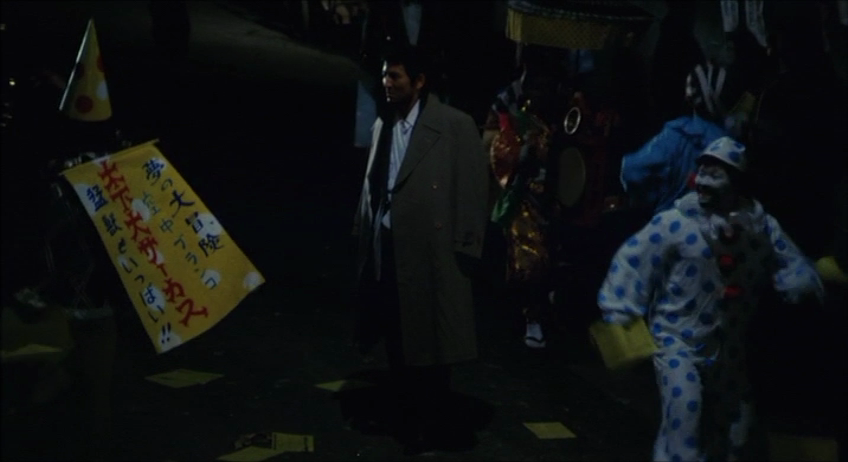
In this, the film seems to be talking to the untapped capitalism of the 1970s. Like Tsuruoka, the nation now has no need to get its hands dirty and should know when enough is enough but is in danger of losing sight of conventional morality in the relentless consumerist dash of the economic miracle. That might explain why unlike the jitsuroku gangster pictures, Murakawa scores the film mainly with an anachronistic contemporary soundtrack along with the ironic use of saloon music in the bar where Tsuruoka’s associates hook an early target, and the circus tunes which envelope him at the film’s opening and closing hinting that this is all in some ways a farce even as Tsuruoka is haunted by the ghosts his narcissistic greed has birthed. Then again perhaps he too is merely a product of his times, cynical, mistrustful of authority, and seeking independence from a hypocritical social order but discovering only failure and exile in his unfeeling hubris. 


Original trailer (no subtitles)

Terror of Yakuza (沖縄やくざ戦争, AKA Okinawa Yakuza War, Sadao Nakajima, 1976)

An old-school yakuza finds himself cornered on every side while caught in the confusion of Okinawa’s reversion to Japan in Sadao Nakajima’s jitsuroku gangster movie Terror of the Yakuza (沖縄やくざ戦争, Okinawa Yakuza Senso, AKA Okinawa Yakuza War). Where similarly themed Okinawa-set gangster pictures such as Sympathy for the Underdog had largely presented the islands as an appealing place for mainland gangsters because the conditions of the occupation which had allowed them to prosper were still in place, Sadao reframes the debate in terms colonisation and conquest as the hero finds himself increasingly marginalised as an island boy contending with amoral city elitists. 

Nakazato (Hiroki Matsukata) has just been released from prison after serving seven years for the murders of two rival gang bosses that allowed his boss, Kunigami (Shinichi Chiba), to rule the roost in Koza. But now that Okinawa has reverted to Japan, everything has changed. Kunigami has formed a loose alliance with another regional gang to oppose the incursion of mainland yakuza but behind the scenes the higher-ups are intent on a mutually beneficial alliance with the Japanese perhaps seeing the writing on the wall and assuming that it’s better to work with the new regime that against it. For his part, Nakazato is more loyal to the clan than he is opposed to Japan but he’s also resentful towards to Kunigami for failing to live up to his side of the bargain now that he’s been released while fearing the influence of his new sidekick Ishikawa (Takeo Chii) whom he suspects of murdering one of his former associates while he was inside. 

As such, much of the drama unfolds as in any other yakuza picture with Nakazato, regarded by some of the other bosses as a loose cannon and potential liability, reluctant to move against Kunigami for reasons of loyalty even while Kunigami becomes increasing unhinged and dangerous, deliberately running over an Osakan foot soldier who was apparently just on holiday with no particular business in town. Kunigami’s recklessness in his hatred of the Japanese threatens to start a turf war the Okinawan gangs fear they couldn’t win, sending snivelling yakuza middleman Onaga (Mikio Narita) along with Nakazato to negotiate in Osaka only to be told the price of peace is Kunigami’s head. Inspired by the Fourth Okinawa War which was still going on at the time of the film’s completion (in fact, the release was blocked in Okinawa in fear that it would prove simply too incendiary), the conflict takes on political overtones as the mainland gangsters assume their conquest of Okinawa is a fait accompli while those like Onaga are only too quick to capitulate leaving Kunigami and Nakazato as two very different examples of resistance. 

Yet Nakazato finds himself doubly marginalised because he is from one of the smaller islands with most of his men also hailing from smaller rural communities (one uncomfortably wearing extensive makeup to ram the point home that he is from the southern reaches) with the result that they are often pushed around by the city gangsters who view them as idiot country bumpkins. On his trip to Osaka, Nakazato even describes himself as such in an attempt to curry favour apologising in advance should he make a mistake with proper gangster etiquette. Like a good platoon leader, Nakazato’s primary responsibilities are to his men which is one reason why he takes so strongly against Ishikawa, one of the new breed of entirely amoral yakuza who care nothing at all for the code and think nothing of knocking off his guys for no reason. Consequently he finds himself caught between the invading mainlanders, the unhinged chaos of Kunigami, the coldhearted greed of Ishikawa, and the spineless venality of turncoats like Onaga. 

It’s no wonder that he eventually loses his cool, going all out war and like Kunigami dressing in vests and combats in an internecine quest for vengeance precipitated in part by Kunigami’s attempt to discipline one of his men for encroaching on his territory by removing his manhood with a pair of pliers. “Someone will get to you someday too” Nakazato is reminded though having lost everything including his loyal wife who insisted on selling herself to a brothel to get the money to fund his war of revenge he may no longer care so long as he cleans house in Okinawa to the extent that he is really able to do so. “Okinawa is such a scary place” one of the Japanese guys admits, though showing no signs of backing off in this maddeningly chaotic world which turns stoic veterans and hotheaded farm boys alike into enraged killers fighting on a point of principle in a world which no longer has any. 


Terror of Yakuza screens at Japan Society New York May 20 at 7pm as part of Visions of Okinawa: Cinematic Reflections

Original trailer (no subtitles)

Images: Terror of Yakuza © 1976 Toei

Step on the Gas! (新宿アウトロー ぶっ飛ばせ, Toshiya Fujita, 1970)

A recently released former gangster and the bored son of a CEO look for new directions in early ‘70s Japan in Toshiya Fujita’s Step on the Gas! (新宿アウトロー ぶっ飛ばせ, Shinjuku Outlaw: Buttobase). Released between his two instalments in the Stray Cat Rock series, Fujita’s freewheeling underworld drama is high on irony and shot in a surprisingly warm colour palate replete with pastels seemingly eschewing the seriousness of Nikkatsu’s earlier youth dramas for sense of youthful ennui eventually granting its mismatched heroes if not the direction they seek then at least possibility in their forever floating existence. 

“Angel of Death” Yuji (Tetsuya Watari) waltzes out of prison to be met by no one, only for another man it later transpires he does not know to attempt to flag him down in his military jeep. Ignoring him, Yuji jumps in a taxi and asks to go to Shinjuku, presumably his old stomping ground, before changing his mind and travelling on to Yokohama instead. This would indeed be a fantastically expensive journey, Yuji ironically taking the cabbie for a ride only for the mysterious man to appear and pay his fare for him. Giving his name as Nao (Yoshio Harada), he eventually explains that he’s trying to recruit Yuji for a job hoping to make use of his fearsome reputation to help him recover some missing drugs and get a gang of bikers off his back. 

As we later discover, however, Nao is not some street punk but the son of a wealthy businessman if one obviously at odds with this conservative father. That might be why he seems so hopelessly out of his depth in his relationship with the delinquent bosozoku motorcycle gang led by Rikki (Masaya Oki) who is perhaps equally in over his head in his rather naive approach to criminal enterprise. Nao and his friend Shuhei were supposed to handle a shipment of marijuana for the gang, but the deal went south and the drugs went missing along with Shuhei so now Nao owes them big time. He wants to use Yuji’s “Angel of Death” skills to find out what happened to Shuhei and retrieve the drugs to settle things with Rikki. 

Inevitably, events have a connection to Yuji’s former Shinjuku life Nao employing a woman he used to know, Shoko (Meiko Kaji) who is also Shuhei’s sister, to run his bar, while the icy enforcer working for the big enemy, corporatised yakuza, also turns out to be someone he knew before in the aptly named and distinctly creepy “Scorpion” (Mikio Narita) a former policeman turned amoral gangster. “His power lies not in fearlessness or being a good shooter but in the fact he doesn’t care about anything” Yuji later explains, describing him as the kind of man willing to knock off anyone in his way without a second thought be it a woman or a partner. One might have thought the same of Yuji in his breezy insouciance, but he is at heart noble despite his fearsome nickname displaying compassion and empathy for those around him along with old-fashioned values like loyalty siding with Nao against the twin threats of Scorpion and the biker gang with whom he later proposes a mutually beneficial alliance. 

Skipping between strangely whimsical folk music and a melancholy jazz score, Fujita’s freewheeling crime drama hints at a kind of aimless ennui Yuji and Nao both in differing ways emerging from a obsolescent past into a new and confusing world, Yuji realising the kind of life he lived before is no longer viable while Nao rejects his wealthy upbringing for a life of unglamorous crime engaging in drug use which he at one point hints has left him impotent. Meanwhile, the fading grandeur of old school yakuza is very much apparent in the cowardliness of the gang’s corporatised boss who hires a man like Scorpion to protect him because he cannot defend himself, planning to make off with the stolen money in a helicopter he has waiting rather than honourably facing off against Nao and Yuji in their quest to retrieve what was stolen from them. Constant red and white imagery recalling the Japanese flag clues us in to the sense of futility in their violence, but even so Fujita closes on an ironic note cementing the friendship of the two men but leaving them free floating with no clue how to land floundering for direction above an increasingly confusing society.