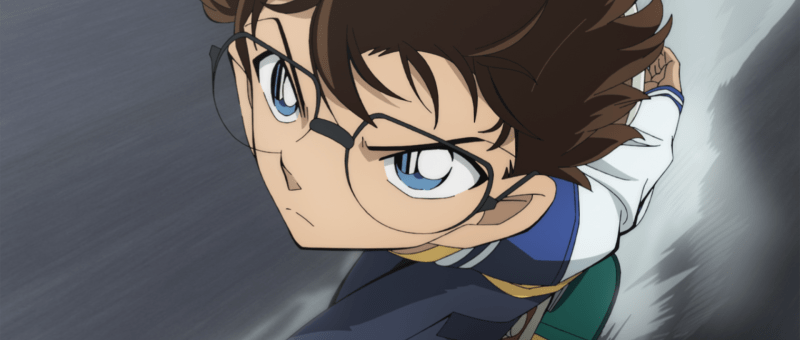
Detective Conan: One-Eyed Flashback (名探偵コナン 隻眼の残像(フラッシュバック), Katsuya Shigehara, 2025)

Detective Conan (Minami Takayama) returns for the 28th instalment in the long-running animated film series, Detective Conan: One-Eyed Flashback, (名探偵コナン 隻眼の残像(フラッシュバック), Meitantei Conan: Sekigan no Flashback) as he finds himself embroiled in another mystery revolving around Inspector Yamato’s (Yuji Takada) near fatal collision with an avalanche, a potential terrorist attack on a radio observatory, and the murder of one of Kogoro Mori’s (Rikiya Koyama) old friends. Meanwhile, justice is under fire as the government are working on reforming the plea deal system which leaves some feeling short-changed by justice and that the criminals are getting off too lightly while victims of crime continue to suffer.

Indeed, there’s a kind of symmetry between Conan’s guardian Kogoro, who took him in after he was shrunk to the size of a child by the evil Black Organisation, and bereaved father Funakubo who blames himself for what happened to his daughter Maki because he sent her back to his gun shop where she got caught up in a robbery. Before she left, she said she had something to tell him, but he never got to hear what it was, just as Kogoro never heard what his former colleague from his police days, Croco, wanted to tell him when he set up a clandestine meeting in a local park but was killed by a mysterious assassin before he could say anything. 

Once again, Conan is on the case, though Kogoro more or less sidelines him and insultingly repeatedly reminds Conan that this is not a game. Nevertheless, Inspector Yamato specifically asks for his help, while Conan begins to suspect something bigger is motion when he’s unsubtly bugged by someone he assumes is probably an undercover Public Security officer. All roads lead back to Amuro (Takeshi Kusao), who handles the situation from the cafe in Tokyo where he works to maintain his cover identity. 

Nevertheless, it all links back to the gun shop robbery and its lingering effects on the victims. Not only was one of the thieves not caught, but the other got off on a plea bargain which has left Mr Funakubo on a constant quest for justice in which he is forever hassling the Nagano Police for updates on his case. Meanwhile, there’s interpersonal drama in play in the relationship between police officers Yamato and Yui (Ami Koshimizu) who are also wrestling with unspoken feelings and the fallout from Yamato’s presumed death in the avalanche in which he lost his memory and wasn’t found until a few months later. The wound to his eye is symbolic of his inability to recall the whole of what happened before he was overcome by the snow. He must have seen the face of the man he was chasing at the time, but he can’t remember it. 

Though the mystery itself may not be as complicated as others in the series, involving few clues or difficult puzzles to be solved and relying instead on Conan’s keen intuition and people skills, it leans heavily into a sense of conspiracy and paints Public Security in an unflattering light as they attempt to bug Conan and then in a post-credits scene, are seen to offer another “plea deal” to a suspect in return for keeping Public Security out of their testimony while blackmailing them that, should they choose to speak out, all their secrets will also be revealed to the public and those close to them will suffer. In any case, Conan gets a few more opportunities to use his all-powerful skateboard amid the film’s increasingly elaborate action sequences as he squares off against the crazed villain hellbent on vengeance and an ironic defence of the law.

Where Public Security come in for scrutiny, the police are depicted as universally good, reminding the suspect that it’s the police’s job the enforce the law without fear or favour while protecting ordinary people both physically and emotionally. As messages go, it might be a little authoritarian, but it’s also true that the police take Conan seriously in ways others may not. While they’re all busy with the crime(s), Conan’s friends are also all in Nagano along with Ran (Wakana Yamazaki) enjoying what’s supposed to be a stargazing holiday before being dragged into the case and providing important backup for Conan. As the tagline says, the truth won’t stay buried forever and Conan does his best to play off Public Security and the police in order to solve the case, avenge Kogoro’s friend, and also protect justice in Japan as the courts debate the plea bargain issue and its effect on criminals and victims alike as they try to rebuild their lives in the wake of crime.


Detective Conan: One-Eyed Flashback is in UK cinemas from 26th September courtesy of CineAsia.

Trailer (Japanese / Traditional Chinese subtitles)

Detective Conan: The Million-Dollar Pentagram (名探偵コナン 100万ドルの五稜星, Chika Nagaoka, 2024)

Now a sprawling multi-media franchise, Detective Conan began with Gosho Aoyama’s manga which published its first instalment in 1994 and is still going strong 30 years later. The series was released in the US in the 2000s under the name Case Closed and in a decision which was perhaps more common then than today anglicised all of the character’s names and settings (the Japanese publisher then began releasing its own English language translation of the manga maintaining all the original Japanese names and plot details). Meanwhile Detective Conan remains hugely popular across Asia and regularly tops the Japanese box office with the annual release of a feature film revolving around a major case for Conan in addition to the ongoing anime and manga.

Which is all to say it has a very well developed universe and vast cast of characters which weave in and out of Conan’s various adventures. The main thing to note about Conan himself, which is explained very briefly in a short introductory sequence to the movie, is that he’s actually a 17-year-old high school detective but his body was shrunk to the size of a small child when he was drugged by the mysterious Black Organisation after witnessing to of their agents getting up to something shady in a park. Only a handful of people know his true identity while he often works with the police solving crimes, and is common with Japanese crime fiction more often than not locked room mysteries.

The Million-Dollar Pentagram (名探偵コナン 100万ドルの五稜星, Meitantei Conan 100-man Dollar Michishirube), the 27th Conan movie, is somewhat different in this regard as it’s more of a treasure hunt in which Conan (voiced by Minami Takayama) and his associate Heiji (Ryo Horikawa) must attempt to figure out the mystery of some missing treasure which might have something to do with a pair of swords stolen by one of Conan’s arch nemeses, Kid the Phantom Thief (Kappei Yamaguchi). Like many of these kinds of stories, the mystery turns on historical detail in this case stemming back to the Meiji Restoration and legendary Shinsengumi boss Hijikata Toshizo, if by way of a long-dead industrialist who got rich quick during the pre-war goldrush in Hokkaido. Some of his estate apparently went missing after his death and now his grandson, who’s messed up the family business, wants to find it and so does Conan but for slightly different reasons. In any case, no one even knows what the treasure is and they may be disappointed when they find out especially as it might not show grandpa Onoe in a particularly good light. 

There is undoubtedly quite a lot going on with a prominent subplot focusing on Heiji’s crush on love interest Kazuha (Yuko Miyamura) and his rivalry with Kid the Phantom Thief with his big plan to finally confess his feelings aligning with the climax of the mystery taking place on Mount Hakodate. A port town in Hokkaido, Hakodate has not often been well served by cinema often appearing in indie films such as And Your Bird Can Sing, Sketches of Kaitan City, and Over the Fence as a moribund post-industrial centre the protagonists can’t escape, but here seems pleasant and relaxed as a kind of Northern Kyoto rich in period history. The film’s success has apparently spiked a mini tourist boom in the area.  

The filmmakers apparently did not want to destroy any of the town’s architecture even in animation, hoping to make the most of the city’s famous night scenes and beautiful scenery. Nevertheless, there are the usual series of impressive action sequences including one of Conan riding a jet-powered skateboard not to mention taking out a suspect with a football while Heiji fights another on the wings of a biplane. As for the mystery itself, it’s not the kind where the audience will be able to work it out seeing as it depends on very specific cultural knowledge that even Conan needs a hint to key into but eventually broadens into something more international involving arms dealers and corrupt businessmen. Long-standing fans of the franchise will want to stay put for a very interesting post-credits sequence and even newcomers will get a kick out of an unexpected punchline to the film’s closing moments. All in all another classic case for the Conan team peppering its key mystery with the humour and warmth the franchise is known for.


Detective Conan: The Million-Dollar Pentagram opens in UK cinemas 27th September courtesy of CineAsia.

Original trailer (Traditional Chinese & English subtitles)

Lonely Castle in the Mirror (かがみの孤城, Keiichi Hara, 2022)

Kokoro isn’t “lying” when she complains of a stomach ache to avoid going to school, it’s just that it’s the anxiety she feels at the prospect that is making her physically ill. Based on a novel by Mizuki Tsujimura, Keiichi Hara’s fantasy-infused anime Lonely Castle in the Mirror (かがみの孤城, Kagami no Kojo) explores the effects of school phobia in uniting a series of teenagers who each for one reason or another have turned away from education often because of bullying or the rigidity of the contemporary schools system. 

As we discover, Kokoro (Ami Toma) gradually stopped going to school after her life was made a misery by manipulative popular girl Sanada who operates a small clique of bullying minions yet appears all sweetness and light with the teaching staff. Unable to fully explain what’s been going on, Kokoro largely remains at home while her understanding mother (Kumiko Aso) explores opportunities in alternative teaching and tries to support her as best she can. Though the film is very sympathetic towards Kokoro and the children in insisting that it isn’t their fault they can’t attend school but the fault of an unaccommodating system, it perhaps misses an opportunity to fully commit to educational diversity when the end goal becomes getting Koroko back in class undaunted by the presence of her bully. 

Nevertheless, it offers her another outlet when the mirror in her bedroom suddenly becomes a magic portal that transports her to a fantasy fairytale castle where she meets six other school phobic teens who are all dealing with similar issues. A young girl in wolf mask informs her that they have until the end of the school year to locate a key which if turned will grant one, but only one, of their wishes. When the key is turned, they will all lose their memory so it’s unclear if they will know whether or not the wish was granted but in any case are left with a choice between achieving their dreams and the new friendships they’ve formed at the castle. The issues that plague each of them are various from bullying to dealing with grief, purposelessness, a feeling of not fitting in, parental expectations, and an implication of sexual abuse at the hands of a close relative. As the Wolf Queen tells them “collaboration is beautiful” and it is the connections they forge with each other that give them strength to go back out into the world while each vowing to pay it forward and make sure to stand up to injustice by protecting other vulnerable kids like themselves when they’re able to. 

Even so, Kokoro takes her time on even deciding whether or not to use the mirror and for some reason the castle is only open business hours Japan time. If they stay past five they’ll be eaten by wolves! Many things about the fantasy land do not add up and Kokoro begins to worry that it’s all taking place in her head, her new friends aren’t really real, and she’s being driven out of her mind by the stress of being the victim of a campaign of harassment she can’t even escape by staying home minding her own business. But through her experiences she is finally able to gain the courage to speak out against her bullying while supported by her steadfast mother and an earnest teacher who is keen to find the best solution for each of her pupils rather than trying to force them back into a one size fits all educational system. 

In any case, Kokoro’s quest is to find her way back through the looking glass to rediscover her sense of self and take her place in mainstream society free of the sense of loneliness and inferiority she had felt while being bullied by Sanada and her clique of popular girls though in an ironic touch the film does not extend the same empathy to her or ask why Sanada has an apparent need to need to pick a target to destroy. A variable animation quality and occasional clash of styles sometimes frustrate what is at heart a poignant tale of finding strength in solidarity and learning to take care of each other in a world powered more by compassion than an unthinking devotion to the status quo.


Lonely Castle in the Mirror screened as part of this year’s Nippon Connection.

International trailer (English subtitles)