LUPIN THE IIIRD: The Movie – The Immortal Bloodline (LUPIN THE IIIRD THE MOVIE 不死身の血族, Takeshi Koike, 2025)

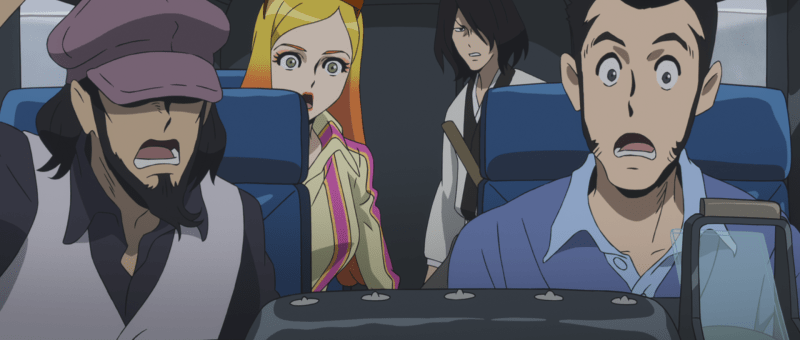
Lupin and the gang find themselves in a race against time after being lured to a mysterious private island in Takeshi Koike’s latest instalment in the classic franchise, LUPIN THE IIIRD: The Movie – The Immortal Bloodline (LUPIN THE IIIRD THE MOVIE 不死身の血族, Fujimi no Ketsuzoku). A sequel to a series of specials, the film opens with a lengthy recap explaining that each member of Lupin’s team has been targeted for assassination and seen off their adversaries using their own particular skills. Now Lupin’s home has been destroyed taking most of his loot with it, so he too is in hot pursuit looking for answers about who might be trying to kill them and why, along with some treasure, of course.

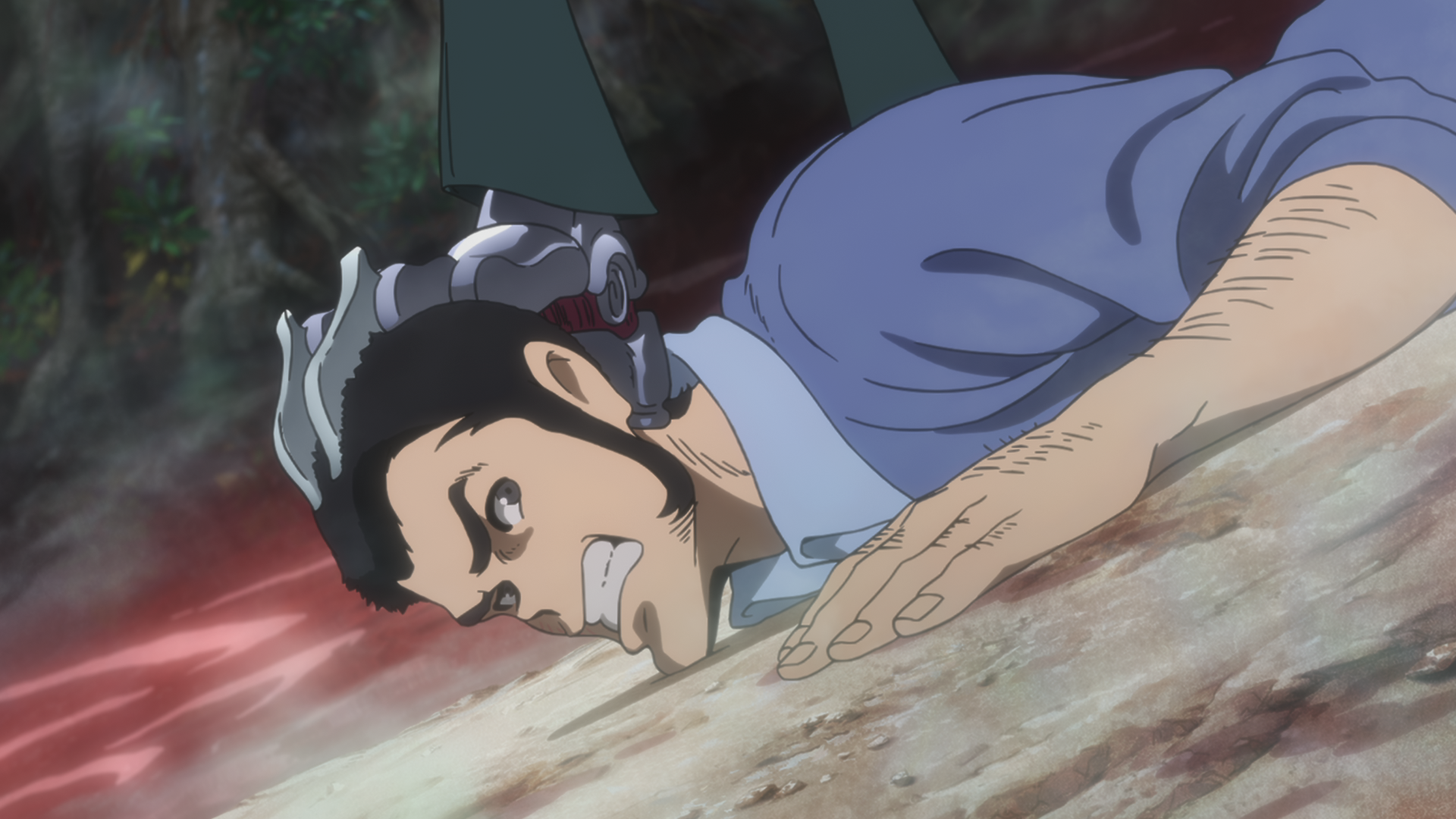
What he discovers, however, is that the island is a kind of graveyard for the unwanted. The place is full of mindless men in masks, the hitmen who didn’t make it reduced to animalistic predation. Disused military equipment scatters the landscape as if in reminder of mankind’s folly. But Lupin (voiced by Kanichi Kurita) is here because according to apparent mastermind Muom (Kataoka Ainosuke VI), he’s trash too and doesn’t belong in the new world Muom is trying to create by making the earth immortal. The air on the island is toxic to people like Lupin and unless he and his friends find a way off it within the next 24 hours, they’re destined to become zombie-like masked men too or else fade away into oblivion leaving not even a legacy behind them. 

The war is then against a notion of obsolescence or the idea that a person can become somehow unnecessary. The gang were followed to the island by Zenigata (Koichi Yamadera) who is still trying to catch Lupin but ends up becoming trapped too. Lupin is obviously very necessary to Zenigata as without him he doesn’t really have a reason to exist. That’s one reason he ends up ironically teaming up with him, protecting Fujiko Mine (Miyuki Sawashiro) and breaking his own code to shoot some bad guys in an attempt to keep Lupin alive to face justice. 

But as it turns out, Interpol might not be the best place to turn for back up as there’s some sort of blackout code on all things related to the island which is marked on no maps. Zenigata’s contact describes it as “sacred” and rather than sending the helicopter he asked for, explains everyone who sets foot on it will have to die because they know too much. As weird as Muom’s plans to make the earth immortal sound, it appears it’s locked into something bigger. All of which is quite good for Lupin who starts to realise there might not be much treasure here after all, but he’s found something more precious in a lead on even greater riches just waiting to be plundered.

This might be his way out of the purgatorial space of the island, the “hell for those burdened by karma” as Goemon (Daisuke Namikawa) describes it, in kicking back against Muom’s plans by identifying his nature and, quite literally, heading straight to the heart of the matter while reclaiming his identity as the gentleman thief from those who think he’s an unwelcome presence. Returning to the lair, he burns the history of himself and declares that life is a fiction to be enjoyed while immortality is a worthless gift that robs existence of its meaning. Separated on the island, the team must face their personal traumas alone before reuniting to try and figure out how to defeat their seemingly immortal captor and fight their way off the island before being consumed by its toxic gases.

The last in Koike’s Lupin cycle, the film is, in some ways, intended as a prequel to Mystery of Mamo, the very first Lupin anime released in 1978. As such it continues the style Koike has established in the series so far complete with kinetic action sequences and retro jazz score. Though this may seem like the end of the line for the gentleman thief, it is really just another beginning in returning the franchise to its point of origin. Lupin is, in a sense, reborn to steal back everything that was taken from him, with Zenigata hot on his heels and the world set to rights again, saved by his very particular brand of chaos.


LUPIN THE IIIRD: The Movie – The Immortal Bloodline opens in UK cinemas 21st February courtesy of Anime Limited.

International trailer (English subtitles)

Images: © MP / T
The Legend of the Stardust Brothers (星くず兄弟の伝説, Macoto Tezka, 1985)

Stardust Brothers poster 2More or less out of fashion today, concept albums were all the rage back in the ‘70s and ‘80s but few of them ever made it to the big screen. Macoto Tezka’s The Legend of the Stardust Brothers (星くず兄弟の伝説, Hoshikuzu Kyodai no Densetsu), apparently drawing inspiration from The Who’s Tommy, is a rare exception though you’d be forgiven for never having heard of it seeing as it’s been mostly forgotten since receiving a decidedly frosty reception from critics on its 1985 release. Tezka would revisit the Stardust Brothers in 2016 with a Brand New Legend, but this now fully restored “director’s cut” distributed by Third Window Films who are also co-producing Tezka’s latest work – an adaptation of a manga by his legendary father Osamu Tezuka starring Fumi Nikaido, is the first opportunity many will have to reappraise the film in 34 years.

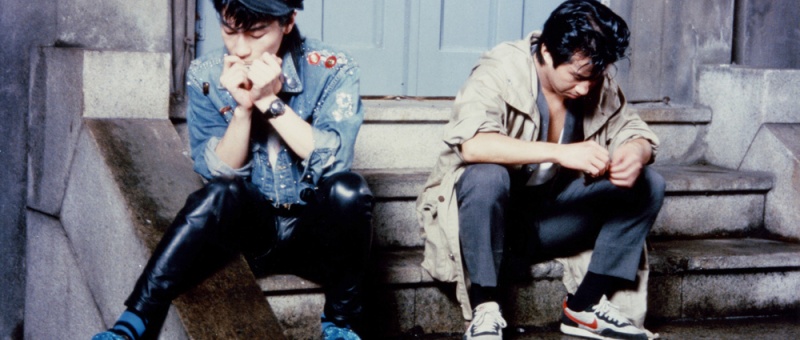
Inspired by an “imaginary soundtrack” composed by Haruo Chicada, The Legend of the Stardust Brothers concerns itself with aspiring musicians Shingo (Shingo Kubota) and Kan (Kazuhiro Takagi) who seem to have a healthy rivalry in the intense 1980s Japanese underground club scene. Their luck changes one day when they are each handed a card for a shady-looking management company, Atomic Promotion, where the manager, Minami (played by voice of the ’70s crooner Kiyohiko Ozaki), promises to make them stars beyond their wildest dreams but only on one condition – they have to form a band of two, or it’s no dice.

On their first arrival at Atomic Promotion, the boys are introduced to a young woman, Marimo (Kyoko Togawa) – an aspiring singer who has been repeatedly kicked out of Minami’s office because he doesn’t hire girls (seemingly a satirical reference to an all powerful agency controlling most of Japan’s A-list male idols). Kan comes to her rescue and, in a throwaway comment, casts himself as Urashima Taro rescuing the “turtle” from, in this case, belligerent security guards. It is tempting, in an impish sense, to read the rest of the ongoing tale as an extended retelling of the Urashima Taro myth as the boys find themselves catching a ride to another kingdom filled with untold wealth and unimaginable pleasure only to tire of their newfound luxury and discover that while they were trapped within a tiny champagne bubble of success other stars were also rising.

It is indeed the “plateau” of success which highlights the differences between the two guys and threatens to send each of them on different paths as they contemplate the demands of showbiz life. Shingo, an insecure rocker, begins to resent the presence of the ultra modern Kan whose punkish energy and zeitgeisty features have captured the hearts of the youth. Numbing the emptiness with drink and drugs, he dreams himself swallowed whole by his sworn brother before being chased by creepy zombies emerging from their human suits to suck whatever of his soul remains right out of him.

Bored by their fame, the boys resent the implication that their “stardom” comes only at the price of their artistic integrity. They long to break free of the corporate straightjacket which attempts to strip them of their individuality in order to replace it with a manufactured, marketable persona in another jab at the increasingly commodified idol world of the burgeoning bubble era. Meanwhile, the corporate machine moves on, mass media is exposed as yet another medium of propaganda with a (perhaps conflicted) Minami propositioned by a politician with a son keen to get into the business. Fearing the Stardust Brothers are too “vulgar”, the powers that be want a new face to sell the message of love and peace to the young, which sounds much more positive than it really is. The boys’ rival, Kaworu (visual kei pioneer Issay), is very much a figure of the age – an androgynous, Bowie-like counter culture personality who is in essence the face of entrenched privilege insidiously camouflaged to infiltrate alternative youth subculture. 

Yet the political message is not perhaps the point so much as anarchic, absurdist fun. Perfectly in tune with lo-fi late punk / early New Wave sensibilities, Tezka’s script freewheels from one surreal set piece to another following the flow of Chicada’s expertly composed score which encapsulates the variety of the age while remaining absolutely of its time. Filled with youthful energy and true punk spirit, The Legend of the Stardust Brothers is the strange tale of the dust that stars are made on and its unexpected ability to find its way home even if it takes a little longer than expected.


The Legend of the Stardust Brothers is released on blu-ray later in the year courtesy of Third Window Films. It will also be screened as part of the 2019 Nippon Connection Film Festival on 1st June, 22.30.

Trailer (English subtitles)

Bonus:

Kiyohiko Ozaki’s 1971 hit Mata Au Hi Made

And its fantastic use in Isshin Inudo’s La Maison de Himiko