Japanese Summer: Double Suicide (無理心中日本の夏, Nagisa Oshima, 1967)

Japanese summer double suicide posterThe youth of Japan can’t get no satisfaction in Nagisa Oshima’s 1967 absurdist odyssey Japanese Summer: Double Suicide (無理心中日本の夏, Muri Shinju: Nihon no Natsu). A liberated woman craves sexual pleasure but can find no man willing to satisfy her, so obsessed are they with their solipsistic concerns of death, violence, and the search for self knowledge. The nymphomaniac and disillusioned warrior yearning for a death that will restore his sense of self meet on an empty highway only to wander on aimlessly until reaching their mutually “satisfying” yet inevitable conclusion.

Nejiko (Keiko Sakurai), a sexually frustrated teenage woman, watches some municipal workers scrub at the word Japan graffitied on a bathroom wall but takes off when she realises no one here is going to give her what she wants. Throwing her underwear off a bridge in a symbolic act of abandon she catches sight of naked swimmers trailing a Japanese flag before running into collections of marching soldiers and chanting monks. She takes up with a deserter, Otoko (Kei Sato), who is on a quest for death though his desire is not so much for the act of non-existence as it is for self knowledge. He does not want to kill himself, but to be killed by another person in whose eyes he will see himself reflected and, in his final moments, reach a realisation of everything he is.

After wandering arid, sunbaked deserts the pair are picked up by a mysterious paramilitary group who keep them prisoner in a kind of bunker where they eventually meet a gun crazed teen who just wants to kill, a middle-aged man who gets his kicks through the penetrative act of stabbing, and a wise old gangster who knows what it is to carry the weight of a weapon of death. Meanwhile, once a vengeful guy with a TV turns up, they become aware of a crisis in the outside world involving a rampaging foreigner loose with a rifle on a random shooting spree.

Guns and knives are persistent obsessions. These men are obsessed with phallic objects but indifferent to their phalluses. Nejiko pleads with each of them to satisfy her sexual frustrations but none of them is interested. Her need is for pleasure and relief, seemingly free of social or cultural taboos and born of naturally given freedom. The male urge is, by contrast, destructive – they chase death and violence without pretence or justification. When questioned, one of the bunker henchmen retorts that the situation outside is not war but only killing. All there is is violence without cause or explanation, existing solely because of male destructive impulses.

The situation outside is eerie in the extreme. This is a Japan of silence and emptiness where monks chant on the motorway and shadows people the landscape. Nejiko and Otoko find themselves frequently trying to fit in to human shapes cut into the Earth, finding them far too big or in someway constraining. Yet they also become these shadow figures, birthing new shades of themselves to leave behind as they shed evermore aspects of their essential selves. What caused this situation is not revealed, but everyone seems to be carrying on as normal. There is a crazed killer on the loose and the police have asked civilians to remain in their homes but civilians have ignored them for the most characteristic reasons for uncharacteristic insubordination – they all went to work.

Eventually Nejiko manages to convince some of the men to make love to her, but she remains unsatisfied. Likewise, the teenage “gang member” who wandered into the bunker looking for a gun gets one and succeeds in an act of random killing but discovers that it was not “exciting” after all. Desire is misplaced or its satisfaction unattainable. In this world of pure nihilism there is no pleasure and no relief, no need can be met and no peace brokered. All there is is senseless violence, devoid of meaning or purpose and born of nothing more than a desperation to quell a need which can never be fulfilled.

Death and Eros approach the same end – the “double suicide” of the title though even this is essentially passive and desperate. Youth wanders blindly towards its inevitable conclusion, lacking the will or the strength to fight back. There is no self, there is no higher purpose. All there is is a great expanse of emptiness peopled by shadows, fading slowly from a world gradually falling apart.


Original trailer (no subtitles)
https://www.youtube.com/watch?v=hzEMh-PmWqc

Sing a Song of Sex (日本春歌考, Nagisa Oshima, 1967)

20120910022716257Aimless youth wastes its potency on repressed desires in Oshima’s avant-garde treatise on power dynamics and political fallacies. Sing a Song of Sex (日本春歌考, Nihon shunka-ko), less the bawdy romp the title promises than an irony tinged journey through music as a weapon against oppression, is the first of three films Oshima would make in the late ‘60s examining Japan’s complicated relationship with Korea. Its “heroes” however are about as depoliticised as it’s possible to get – they interrupt protests they don’t understand and obsess over a single pretty girl they fantasise about raping in an elaborate classroom based piece of erotic wish-fulfilment. All that matters to them is their craving for physical satisfaction which knows no morality or greater purpose save satiation, conquest, and implied humiliation.

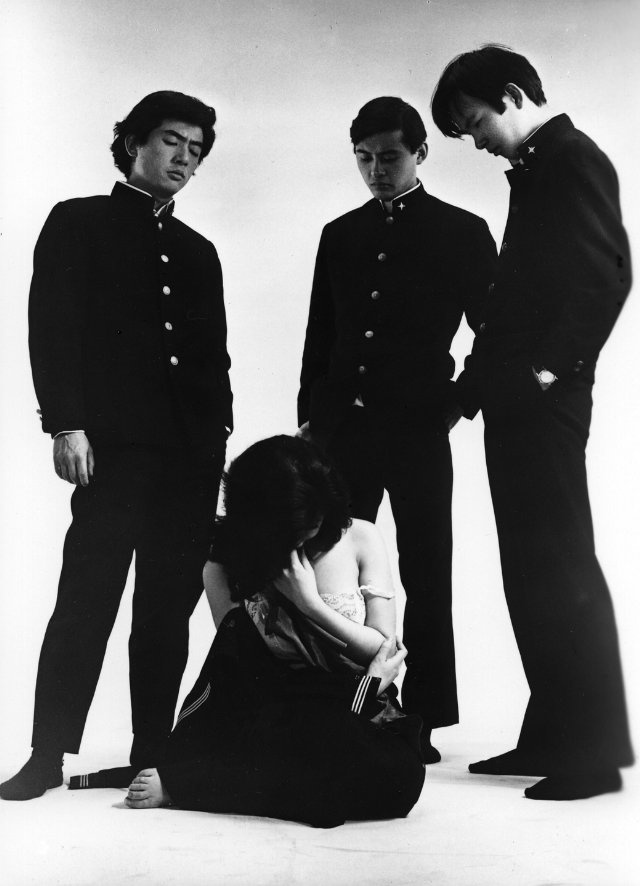
Japan, spring, 1967. Four boys sit their university entrance exams with (externally at least) less seriousness than might be expected. Huddling together away from the snow they smoke cigarettes and gossip about miss 469 whose name they don’t know but caught their eye in the exam hall. The boys, along with three girls, are nominally under the care of their teacher, Mr. Otake (Juzo Itami), who takes them to a pub to “celebrate” before getting extremely drunk and kicking off on an inappropriate lecture about bawdy folk songs and their lasting legacy as the voice of the poor and the oppressed who have no other way of expressing their needs and desires. Lamenting that the young people of today lack the capacity for real feeling, Otake offers to put the kids up in a local inn, perhaps hoping to provoke some kind of awakening among his teenage charges but the loss of innocence he inspires in them is of a very different nature. Still extremely drunk, Otake falls asleep next to a faulty gas heater and dies of carbon monoxide poisoning.

One of the boys, Nakamura (Ichiro Araki), went to see Otake during the night and saw him keeled over in a room that smelt of gas but did nothing. The girls, wailing and distraught, attempt to make their way home while the boys joke about having murdered their teacher and continue to exchange increasingly lewd and disturbing banter about their female classmates including collective rape fantasies (but only of the pretty one). The “other” girl that they collectively decide they don’t fancy, Kaneda (Hideko Yoshida), is disturbed enough by the boys’ murderous joke that she comes back to make sure it isn’t true, accidentally finding out about their dreamscape rape of no. 469 and pushing Nakamura towards paying a visit to Otake’s girlfriend, whom the boys have also been fantasising about, to apologise to her about his possible contribution to Otake’s death.

While Kaneda and the other three set off to track down 469, Nakamura splits off for Otake’s wake where he finds himself alone among a collection of former student protestors with differing views about Otake’s legacy and relation to the cause. The protestors break into a traditional Japanese leftwing anthem, but Nakamura isn’t having any of it. That’s not the Otake he knew. He resists their politicisation of his mentor’s funeral by loudly singing the bawdy drinking song Otake taught them at the pub. The song becomes something like an anthem for Nakamura and his friends who sing it at every conceivable opportunity, delighting in its inappropriateness and ironic similarity to the acts they frequently discuss but seemingly do not directly engage in. Like the peasants Otake idolised, Nakamura takes up the song as a weapon against his own oppression and the unwilling repression of his physical desires.

The battle becomes one of audience and agency. Nakamura sings his song over the hymn of protest being offered by the defeated left while Kaneda later attempts to counter with a female tale of exploitation, snatching a microphone away from some Americanised hippies singing Woody Guthrie and protesting the Vietnam war while dancing round the stars and stripes. Kaneda eventually gets her moment in the spotlight but she pays a heavy and ironic price for it, partly at the hands of miss 469 who re-enters the boys’ rape fantasy after it is directly revealed to her and she dares them to realise their baser desires. Suddenly back in an empty classroom presided over by Otake’s girlfriend, Miss Tanigawa (Akiko Koyama), and the silent spectre of Kaneda now dressed in a sparkly white hanbok, the boys get an intense lesson in Japanese history and more specifically the origins of the Japanese state in the royal courts of Korea.

The songs of the youthful protestors, some Japanese some co-opted from abroad, have lost their meaning and their fire. Their protest is affected and purposeless, as solipsistic as the boys’ destructive desires. On the one hand, youth embraces the pop culture of rebellion – joining the flower power revolution and adopting the Americanised protests against a foreign war and (perhaps tangentially) their nation’s complicity in it, while age fixes its sights on a recently revived imperial holiday and a rejection of the fascist past (though not a rejection of the imperial past or a recognition of its lingering legacy). Painted in tones of red and white, the rising sun occasionally replaced with the blackened flag of protest, Sing a Song of Sex is a paradoxically nihilistic condemnation of post-war youth who allow their oppression to push them into senseless acts of violence rather towards the noble causes of revolution and social change which might finally set them free.


Original trailer (no subtitles)

Violence at Noon (白昼の通り魔, Nagisa Oshima, 1966)

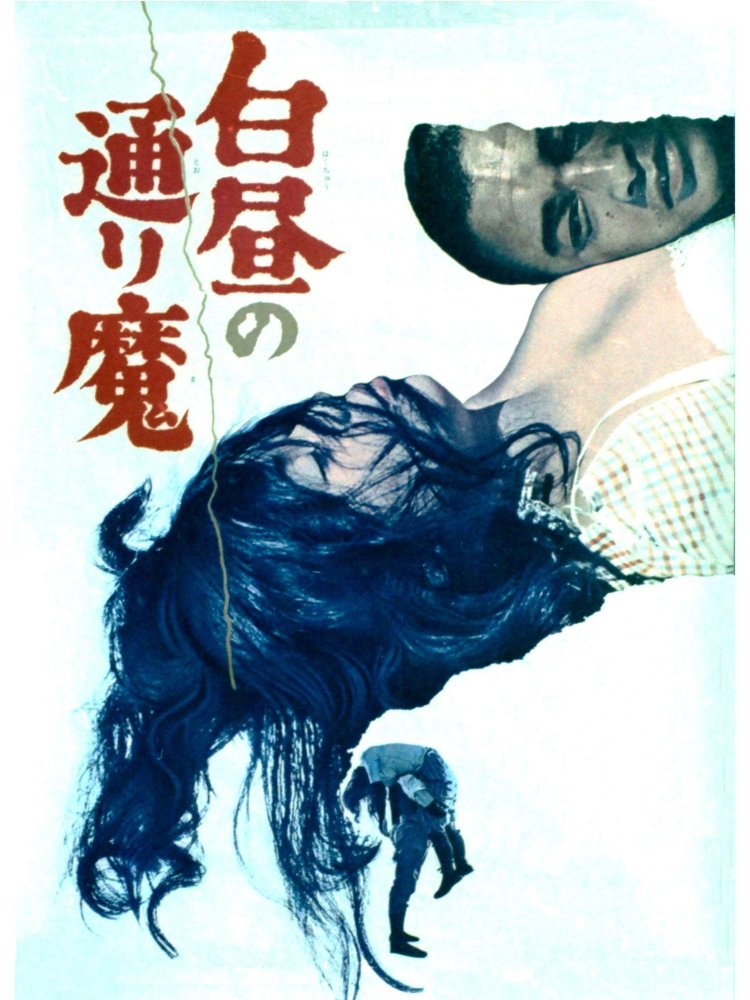
Violence at Noon posterFor Nagisa Oshima, the personal is always political and urges for destruction and creation always inextricably linked. Violence at Noon (白昼の通り魔, Hakuchu no Torima), a noticeable shift towards the avant-garde, is a true crime story but the murder here is of idealism, the wilful death of innocence as manifested in the rampage of a disaffected sociopath whose corrupted heart ties together two women who find themselves bound to him in both love and hate. Each feeling responsible yet also that the responsibility for action belongs to someone else, they protect and defend the symbol of their failures, continuing on in despair and self loathing knowing that to turn him in is to accept the death of their idealism in its failure to reform the “demon” that won’t let them go.

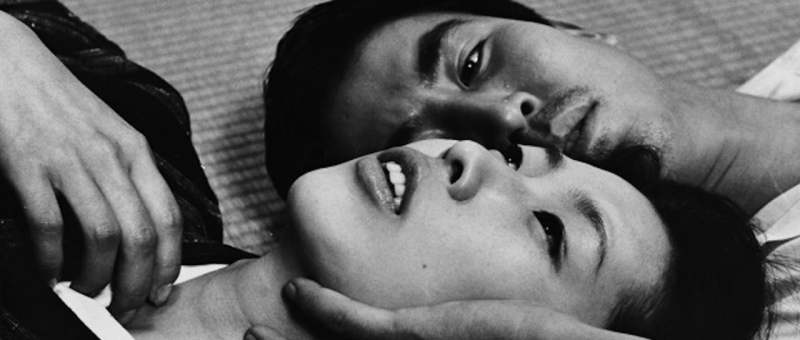
Bright white gives way to the shadow of a man lurking behind bars. He opens a door and gazes at a woman doing the washing, lingering on her neck before he forces himself in. The woman, Shino (Saeda Kawaguchi) – the maid in this fancy household, knows the man – Eisuke (Kei Sato), a drifter from her home town, but her attempts at kindness are eventually rebuffed when she tells him to go back to his wife and he violently assaults her causing her to pass out at which he point he decides to spare her and murders her employer instead. Rather than explain to the police who Eisuke is, Shino offers only cryptic clues while writing to Eisuke’s wife, Matsuko (Akiko Koyama) – an idealistic schoolteacher, to ask for permission to turn him in and end the reign of terror her husband is currently wreaking as a notorious serial rapist and murderer.

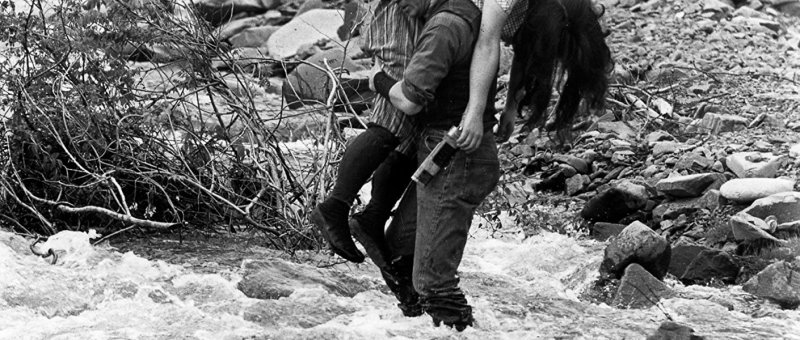
Eisuke, Shino, and Matsuko are all inextricably linked by an incident which occurred in a failing farming collective the previous year. Matsuko, a kind of spiritual leader for the farming community as well as its schoolteacher, preaches a philosophy of absolute love, proclaiming that those who love expect no reward and that through the eyes of love all are equal. Meanwhile, Shino – daughter of a poor family, contemplates suicide along with her father after their lands are ruined by a flash flood and they are left without the means to support themselves. She enters into a loose arrangement with the former son of a village elder, Genji (Rokko Toura), exchanging a loan for sexual favours, later beginning develop something like a relationship with him but one which is essentially empty. Nevertheless when Genji suggested a double suicide she felt compelled to accompany him, only to survive and be “saved” by Eisuke who, believing her to be dead, raped what he assumed was her corpse before planning to dump her body in a nearby river.

It is this original act of transgression that underpins all else. Shino believes herself in someway responsible for Eisuke’s depravity, that his rape of her “corpse” was the trigger for the death of his humanity. Matsuko, meanwhile, sees herself as the embodiment of love – she “loved” Eisuke and thought her love could cure his savage nature and bring him back towards the light and the community. Matsuko was wrong, “love” is not enough and perhaps what she has come to feel for the man who later became her husband on a whim is closer to hate and thereby a total negation of her core philosophy. To admit this fact to herself, to consider that perhaps love and hate are in effect the same thing, is tantamount to a death of the self and so she will not do it. She and Shino are locked in a spiral of inertia and despair. They each feel responsible for Eisuke’s depraved existence, but each also powerless to stop him. Shino in not wishing to overstep another woman’s domain, and Matsuko in being unwilling to admit she has given up on the idea of forgiving the man who has dealt her nothing but cruelty.

Literally seduced by nihilism, Eisuke finally rejects both women. He claims they are responsible – that if Shino had married him instead of attempting double suicide with Genji he might not have “gone astray”, going on to characterise his crimes as “revenge” against his wife’s “hypocrisy”, but then he calmly states that he is the man he is and would always have done these terrible things no matter where and when he was born. Passivity has failed, blind faith in goodness has allowed a monster to arise and those who birthed him remain too mired in solipsistic soul-searching to do their civic duty. Too afraid to let go of their ideals and take decisive action, Shino and Matsuko choose to watch their society burn rather than destroy themselves in an act of personal revolution – Oshima’s thesis is clear and obscure at the same time, “Sometimes cruelty is unavoidable”.


Original trailer (no subtitles, incorrect aspect ratio)

https://www.youtube.com/watch?v=MIkhTaJOpNg&t=33s

Pleasures of the Flesh (悦楽, Nagisa Oshima, 1965)

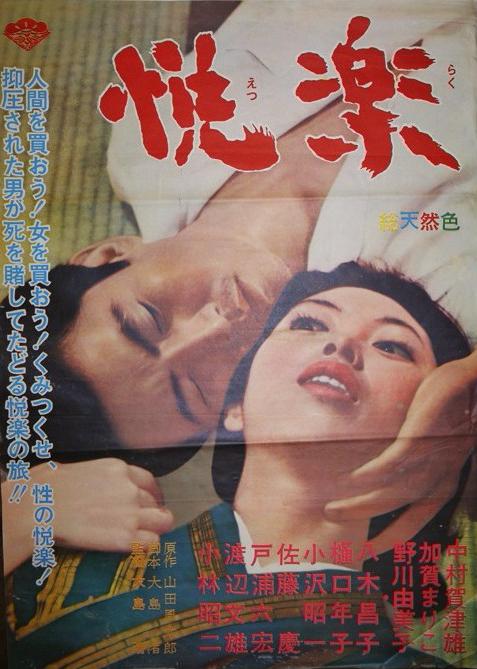
Pleasures of the Flesh posterHaving joined Shochiku apparently on a whim, Nagisa Oshima dramatically walked out on his home studio when they abruptly shelved his incendiary film Night and Fog in Japan citing political concerns following the assassination of the Socialist Party president by a right wing agitator. Oshima’s decision to abandon the studio system and form his own independent production company would eventually develop into a small movement, leading into that which would retrospectively be termed the “Japanese New Wave”. The first film produced by Sozo-sha, Pleasures of the Flesh (悦楽, Etsuraku), was perhaps a shift towards “pink film” aesthetics though, as in much of Oshima’s work, eroticism is more tool and trap than it is a mechanism for liberation. Ironically titled, Pleasures of the Flesh is a tale of desire frustrated by an oppressive society provoking nothing more than nihilistic need for psychological abandon.

Wakizaka (Katsuo Nakamura), an unsuccessful young man, pines for his first love – a young girl he tutored when he was a college student and she a precocious high schooler. Shoko (Mariko Kaga) has, however, married – her new husband someone more in keeping with her class and social standing. Wakizaka sees himself attend Shoko’s wedding, dreaming of her running away from the altar in her wedding dress to return to him but, no, he remains little more than a pleasant memory for the woman who has come to define his life. So devoted to Shoko was Wakizaka that when he learned from her family that a man who had molested her when she was just a child had returned to cause yet more harm by attempting to blackmail them, Wakizaka wanted to help. Seeing the man and paying him off convinced Wakizaka that the man would never give up and there would be no final payment or assurance of silence. Following him onto his train home Wakizaka took drastic action for justice, or perhaps it was revenge, or even out of a strange kind of jealousy, but nevertheless he transgressed by pushing the man from a moving train and thereby ending the threat posed to his beloved.

Wakizaka’s problems, however, are far from over. As ever in Japanese cinema, someone is always watching – in this case, a corrupt government official looking for a likely stooge with whom to stash a large amount of embezzled cash. Irony, a minor theme of the picture, rears its head as Wakizaka finds himself blackmailed over the murder of a blackmailer. The official makes a deal with him – Wakizaka must keep living in his same old horrible apartment and hang on to the suitcase full of money without opening it until he gets out of jail which is where he assumes he will shortly be headed now that his scam is reaching the tipping point. Wakizaka has little choice but to agree but when Shoko marries someone else he comes to believe his original transgression has been in vain, his life is now meaningless, and all that remains for him is a lonely death. Hence, he might as well go in style by spending all of that stolen doe, committing a bizarre act of revenge against Shoko and an unkind society by enjoying a year of debauchery followed by suicide before the official gets out of jail and turns him in as another act of retaliation.

Rejected in love, Wakizaka’s quest becomes one of continual search for conquest as he attempts to force himself on various women he wants to pretend are Shoko though of course knows are not. His approaches are many and various but begin with the obvious – he rents a fancy apartment and convinces a bar girl who looks a little like Shoko to live with him as his wife in return for a generous salary and the promise that the arrangement will only last a year. Hitomi (Yumiko Nogawa) is willing enough to submit herself to Wakizaka’s demands but he is dissatisfied by the inescapable hollowness of the relationship, uncertain who is using whom in this complicated series of transactions. His second choice is a married woman whose ongoing misery arouses in him a taste for sadism, convinced that the only way to make her “happy” is to plunge her into pain and suffering. The third woman, Keiko (Hiroko Shimizu), proves his biggest challenge – a feminist doctor afraid of men, she keeps him at arms length until he finally attempts to rape her, though this too she manages to frustrate insisting that he marry her even if they divorce a month later when Wakizaka’s time limit rolls around. Sick of Keiko’s resistance, Wakizaka opts for a mute prostitute who literally cannot talk back to him but finally makes her own defiant act of self actualisation despite Wakizaka’s attempt to assert total dominance over her existence.

Wakizaka uses the money for a life of “pleasure” but finds only despair and emptiness in each of his manufactured relationships. Having failed to “earn” it, he tries to buy love, but what he really chases is death and oblivion along with a way out of his ruined life and the humiliation he feels in his perceived failure to win Shoko’s heart. An idealised figure of elegance and purity, Shoko is an unattainable prize – the parents gentle pressing of an envelope into his hands following his “handling” of the blackmail case a subtle reminder that he is a servant, and now one perhaps cast out as tainted with a scandal they all wish to forget. Money, another recurrent motif, brings with it only sorrow and resentment. The embezzled cash didn’t do anyone any good, and neither of the blackmailers manages to make their scheme work out for them. Wakizaka is a haunted man, not so much by his crime which he sees as morally justified and feels no particular guilt over, but by his unresolvable desires as surfacing in his frequent hallucinations of Shoko who echoes in and round each and every woman in a form created entirely by her adoring suitor. In the end, reality betrays where the simulacrum remains true, but it is Wakizaka who betrays himself in allowing his pure love to become perverse revenge in the ultimate individualist act of self harm.


Original trailer (no subtitles)

The Man Who Left His Will on Film (東京戰争戦後秘話, Nagisa Oshima, 1970)

man-who-left-his-will-on-filmEvery story is a ghost story in a sense. In every photograph there’s a presence which cannot be seen but is always felt. The filmmaker is a phantom and an enigma, but can we understand the spirit from what we see? Whose viewpoint are seeing, and can we ever separate that subjective vision from the one we create for ourselves within our own minds? The Man Who Left his Will on Film (東京戰争戦後秘話, Tokyo Senso Sengo Hiwa) is an oblique examination of identity but more specifically how that identity is repurposed through cinema as cinema is repurposed as a political weapon.

The film begins with an anarchic scene in which two men argue over use of an 8mm Bolex camera. The man whose voice we can hear is angry with the cameraman who he claims has stolen his camera only to use it for “trivial” street scenes and landscapes whereas he needs it to “capture the struggle” by filming a nearby student protest. Eventually we can verify that there are two men as the protagonist, Motoki (Kazuo Goto), briefly moves in front of the camera in order to try and snatch it away from the filmmaker. The man holding the camera then runs off as breathless, handheld camera takes over. Motoki follows him and we follow Motoki as the scene takes on an ominous quality. The cameraman reappears atop a nearby building before plunging to his death camera in hand. Stunned, Motoki approaches the bloody scene and, noticing the camera is still intact, tries to retrieve it only to be picked up by the police who confiscate the camera as evidence.

Motoki then wakes up back at his left wing commune with his friends eager to know what happened. Strangely, they do not seem to be aware that one of their number has died and are more worried about the police being in control of one of their “means of production”. Even the dead man’s girlfriend, Yasuko (Emiko Iwasaki), begins to doubt the fact that he ever existed at all. Motoki and Yasuko begin investigating the mysterious presence together, chasing their elusive filmmaker and each taking possession of his form on more than one occasion but the question who owns these images, whose identity defines the narrative, proves an elliptical and ethical dilemma.

Oshima, evidently, was no right wing stooge but even if The Man who left His Will on Film takes the world of the student protests as its milieu, it does so to undermine them. Motoki’s comrades view filmmaking as a revolutionary act. They claim to turn the camera into a weapon by using it confront reality, but as Yasuko later admits much of this is a rationalisation which allows them to continue a “bourgeois” art form without abandoning their left wing principles. The cadre members spout marxist dogma and argue about who has the highest political consciousness, but all they ever do is film the ongoing struggle. Their fight is empty, their vision blank.

Notably, the first of several arguments over dogma relates to “ownership” of the camera itself and whether Motoki and another comrade fought hard enough to retrieve it from the oppressive state. Did Motoki chase after “his” camera, meaning he condones the idea of “private” property which is contrary to the communal nature of the group, or “their” camera which is a revolutionary tool? The camera itself is singular, but the group is plural. This commune is intended to work as a hive mind, the people as one with one vision and one identity but Oshima exposes this as an impossibility. The group is a collective of individuals with different ideas and opinions which do not necessarily conform to a common point of view.

This is further brought out when the camera is retrieved and revealed to contain a collection of seemingly apolitical landscapes and street scenes. The group members are quickly bored with the static shots of everyday subjects, some berating the filmmaker for his “bankrupt” politics and lack of artistry while others vow they must honour their comrade’s struggle by watching the film to its conclusion in order to derive the meaning. The unseen filmmaker has indeed left his “will” on film, not as a testament or embodiment of future policy, but his literal “will”. His individual spirit and vision are contained within the seemingly innocuous shots in a political act of revolutionary individualism. He is the film, the film is him.  His vision dominates, we must accept it or remake it as our own.

Motoki, constantly chasing shadows, attempts to remake the film in the mould of the original filmmaker but unexpectedly encounters aspects of his own life already existing within it. Yasuko’s approach is more proactive. She inserts herself into the film, makes her presence known and refuses to be invisible. She picks up the camera and fights for her place within the frame. Hers is the struggle of the true revolutionary filmmaker, imprinting herself and her vision onto the film.

Where does this leave us? We’re in the film too. We see the film and, in a sense, recreate it in our own minds, recasting ourselves as director and protagonist. We see the film subjectively yet we cannot divorce ourselves from the original vision. Motoki’s venture fails because he only sees the landscapes, whereas Yasuko takes the same images but repossesses them, remaking them in her own image in a true act of cinematic revolution. Yasuko has seized the means of production and overthrown the tyranny of anonymous images in refusing to be constrained by someone else’s will. The camera is a weapon, but it is we who choose what it sees, and in turn what it sees in us.


Original trailer (English subtitles, NSFW)

Merry Christmas, Mr. Lawrence (戦場のメリークリスマス, Nagisa Oshima, 1983)

Merry-Christmas-Mr-Lawrence-images-832f3814-1564-403a-a98a-313c5bb99deOf all the post-war Japanese filmmakers, the one who liked to twist the knife the most was surely Oshima. No subject too taboo, no pain too raw – he liked to find the sore spot and poke at it a little, if only in the hope of encouraging an accelerated healing, albeit one which would leave a scar to remind you that once you suffered. With Merry Christmas, Mr. Lawrence (戦場のメリークリスマス, Senjou no Merry Christmas) he takes an unflinching look at the treatment of Japan’s prisoners of war and contrasts the Japanese forces with the different attitudes of the (mostly) British soldiers held within the walls of the camp.

Based on a semi-autobiographical novel by Laurens Van der Post, The Seed and the Sower, much of the action takes place in a prisoner of war camp run by the Japanese in Java in 1942. The titular Lawrence (Tom Conti) is one of the British prisoners here but unusually speaks fluent Japanese as he lived in Japan for a time before the war. The camp is run by Captain Yonoi (played by Ryuichi Sakamoto who also composes the music for the film) but largely ministered over by the more sadistic Sergeant Hara (played by Takeshi Kitano in an early straight acting role and billed here solely as “Takeshi”). Things kick off once Yonoi is called away to help preside over a military trial for a “difficult” prisoner who refuses to talk. However, Yonoi is somewhat taken aback by the upright soldier he discovers there. Celliers (played by David Bowie) is sentenced to death only to have the firing squad deliberately miss before he’s transferred to Yonoi’s camp.

As expected the conditions at the camp are not particularly pleasant. The first scene we’re treated to is Lawrence being called to witness an altercation where a Korean/Japanese soldier is accused of raping a Dutch internee. Hara taunts both of them with homosexual slurs and berates the Dutchman for not having resisted strongly enough. Kanemoto, the accused man, has obviously been badly beaten and is eventually ordered to commit seppuku which he eventually tries to do at that very moment by impaling himself on a bayonet. Seppuku is not something to be taken so lightly though so he’ll be patched up now for a ritual suicide later to be witnessed by the wronged parties (whether they wish to watch or not). Homosexuality, or more precisely, homosexual acts, are not to be tolerated among prisoners even if Hara later protests that samurai are not afraid of “queers” whilst insinuating that the majority of Englishman are gay anyway.

Latent homosexuality continues to be an ongoing theme throughout the film. The attraction between Yonoi and Celliers passes beyond simple admiration or even fascination. There don’t seem to be any other particular reasons for Yonoi to continue trying to protect Celliers as he does when he saves him from the firing squad and later allowing him a greater degree of freedom than other prisoners. Both men feel themselves prisoners of their respective social systems – Yonoi as the cold hearted samurai, efficient and unfeeling, yet with an intellectual core and a conflicted heart, and Celliers as a man desperately trying to atone for having once betrayed someone he deeply cared for in a misguided attempt to fit in. That said, both men are on opposite sides of a war and in any case that kind attraction stands against both of their countries’ current social customs. Again, a man is betrayed by a kiss and another man pays an extraordinarily high price leaving the other powerless to save him.

As Lawrence says there are no winners here, wars are just men doing what they thought was right at the time even if they really know that every one of them is wrong. The Japanese are rigid, repressed and anxious whereas the British are obsessed with honour in other ways and lean more towards the side of pragmatism when the going gets tough. A Japanese soldier may prefer to die, even going so far as to commit suicide, rather than subject themselves to the humiliation of having been captured alive. A British soldier will accept becoming a prisoner but largely because he believes he has a duty to live on and serve to the best of his capacity. Once captured, his duty is to try and escape to return to fight and die for King and country until the bitter end.

What both sides have in common is the dehumanisation of its troops. When it comes down to it one man is as good as another. If a radio has been smuggled into the camp someone must be punished for that action, the exact identity of the perpetrator becomes almost an irrelevance. Likewise, if a war has been lost, someone must pay for wrongful acts committed by the losing side even if his actions are no worse than those of any other soldier.

Merry Christmas, Mr. Lawrence proves a beautifully sad condemnation both of the rigidity of war, of men who think they’re acting in righteousness when the very idea is the one which causes them to act unjustly, and of repressive social systems in general. Lawrence acts as the voice of reason whilst all the while admitting that he himself is also “wrong” and forced into certain actions and modes of behaviour with which he does not necessarily agree. Both of these empires are on the verge of crumbling, all this death and cruelty will prove to have been for nothing. War is a fruitless tragedy in which there are no winners, only losers on every side. “There are times when victory is very hard to take”, victors too need to abide by their own sense of decency without being swayed by vengeance masquerading as righteousness.


Merry Christmas, Mr Lawrence is available with English subtitles on blu-ray as part of The Criterion Collection in the US (and was previously released on blu-ray in the UK from Optimum/Studiocanal but appears to be currently out of print).

(That final voice over is needlessy creepy, isn’t it?)