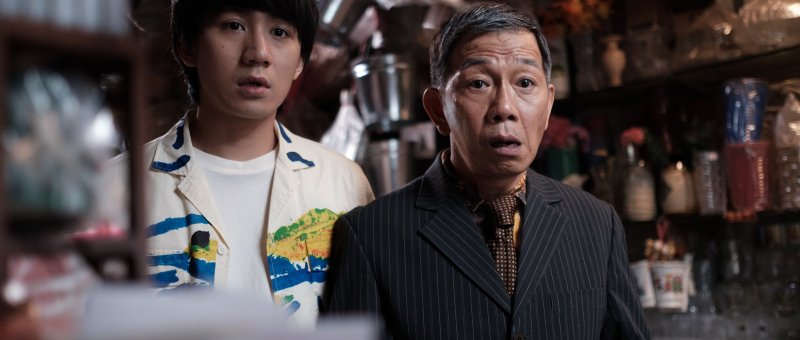
Table for Six 2 (飯戲攻心2, Sunny Chan Wing-Sun, 2024)

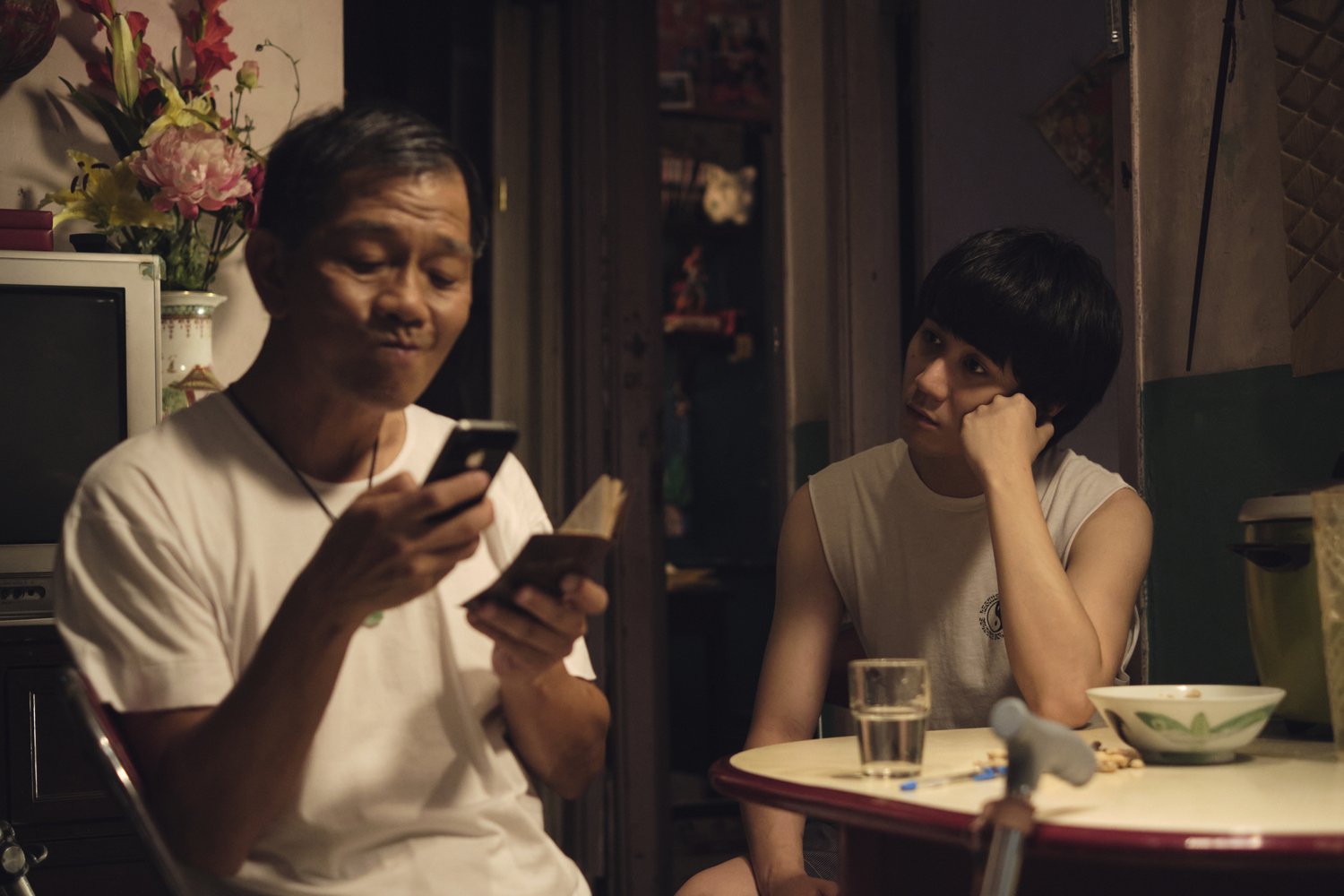
“It’s okay to be screwed, we’ll unscrew you later,” youngest brother Lung (Peter Chan Charm Man) comforts his dejected brother in an accidental advocation of what means to be a family in Sunny Chan’s followup to the phenomenally successful comedy  Table for Six. Like the previous film and in true Lunar New Year fashion, Table For Six 2 (飯戲攻心2) explores the concept of family in a wider sense along with contemporary attitudes to marriage and traditional gender roles.

Even so, it has to be said this table is now uneven as oldest brother Steve has literally run away from his romantic dilemmas taking off for Africa leaving new girlfriend Miaow (Lin Min-Chen) behind claiming she’s too far out of his league and it’s not fair of him to waste her youth. Ironically enough, Bernard (Louis Cheung) has now started a wedding business helping people pull off extravagant public proposals such as the sort of fake one he prepares for Monica (Stephy Tang Lai-yan) as a publicity stunt featuring him dancing in a 90s-style music video. As part of the campaign, they’ve set up Lung and Miaow as a fake couple hoping to build a following for their romance online much to unexpected chagrin of Josephine (Ivana Wong) who has begun to embrace her dreams by becoming a well-known quirky chef who makes food disguised as other food. Though they had agreed to separate so the could both follow three dreams at the end of the previous film, Josephine suddenly proposes leading Bernard to put on an extravagant wedding as promotion for his business. 

In a way, Bernard’s company symbolises the performative qualities of marriage as couples put themselves through a stressful and expensive ritual more out of obligation than real desire. When Lung is prevented from reaching the ceremony on time, Bernard ends up impersonating him in a full body costume making plain that the spectacle is more for show than sentiment and it could really be anyone up there simply fulfilling a role. In fact, no one even checks the certificates were properly signed. Then again, just as in Josephine’s cooking sometimes the “fake” and can actually contain the “real” just in a different way than expected. She may say that once a relationship has cooled the spark can’t be regained, but that doesn’t necessarily mean a new, different, spark couldn’t be found. 

Perhaps that’s what happened for Bernard and Monica who’ve now overcome the awkwardness of Monica having been in a longterm relationship with oldest brother Steve. Ironically enough, they’d more or less decided not to get married only to be blindsided by their reactions to the “fake” proposal but as it turns out more because of the emotional baggage from their parents’ failed relationships that have left them too afraid to get married. Monica is still traumatised by her father’s extra marital affair which resulted in a half-brother she’s never met but has since become a Cantopop star, while Bernard still has bad memories of being treated as a “red-headed” child and like Steve is preoccupied with a desire to keep the family together while worried that he isn’t really up to it. 

The lesson Bernard learns is that family is a burden that’s carried together so he didn’t need to save it on his own and that it’s alright to mess things up because his family will be there to take care of him. Miaow meanwhile is left in the same place as Steve had been in the first film, wondering how long she should wait for love or if Steve is ever coming back, trying to decide whether to accept a promising job offer in Japan or stay in Hong Kong. Part of her reluctance to move on is that she’s become wedded to the family and fears losing her place within it but as Monica says her status wasn’t dependent on blood or relationships and that she’s already been accepted into the family just for being herself. 

Then again, families can also be annoying as Bernard remembers after inviting his gangsterish uncles to one of the weddings only for them to muscle in as a major sponsor for another own insisting on designs the dress themselves complete with a par of shark fin wings to promote their business none of which meshes well with Monica’s passion for conservation. In any case, as Monica reflects family means you can embarrass yourselves together so maybe wearing a stupid dress for a few minutes isn’t such a big deal. Heartfelt and zany, Chan’s farcical drama shifts past the performative aspects of marriage and family to what lies beneath which, like Josephine’s cooking, may not always be what it first appears.


Table for Six 2 is in UK cinemas from 9th February courtesy of CineAsia.

UK trailer (English subtitles)
Stand Up Story (說笑之人, Amen Au Cheuk-man, 2023)

A lost young man tries to turn his grief into laughter while realising he might have more in common with his ageing father than he first assumed in Amen Au Cheuk-man’s poignant drama, Stand Up Story (說笑之人). Partially an exploration of the marginalisation of those with disabilities, the film is also a gentle tale of learning to stand up for one’s self and one’s family while gaining the courage to follow your dreams rather than holding back in fear of failure. 

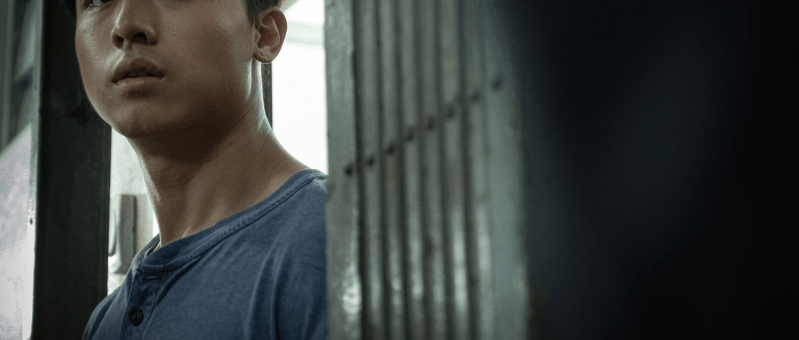
Manny’s (Ng Siu-Hin) dreams lie in stand up comedy, but he struggles to convince his father, who has learning difficulties due to a childhood illness, that telling jokes can be a real job. Wah (Ben Yuen Foo-Wa) raised him alone after the woman he married left the family once her Hong Kong residency was confirmed leaving them both with a sense of absence and lingering feeling of lonely abandonment. Though his father was very excited his son has graduated university, Manny is working as a delivery driver while floundering for direction half-heartedly pursuing standup but lacking the confidence to jump in and try it full-time while also unwilling to look for a steadier job because it would mean giving up on comedy.

As the former headmaster who employs him at his restaurant after he retires from his job as a high school janitor suggests Wah is also lacking in confidence and afraid to try new things in part because of his insecurity as someone with learning difficulties who may have encountered impatience and anger in the past. Though he manages well enough on his own, Wah has experienced prejudice and discrimination all his life and has made himself smaller because of it. Always cheerful he does his best to be useful and help others where he can even if they sometimes take advantage of him accidentally or otherwise like the thoughtless Fourth Auntie who gets him to do a lot her work for her and place bets on her behalf pledging to chip in with her share of the money if they win. 

Manny is quick to warn him about such people, but as the master suggests may also be guilty of underestimating his father while insensitive to his fear of loneliness. As a teenager, Manny had also been somewhat embarrassed by his father and did little to defend him when the other kids at school made of him. He also doesn’t invite him to his university graduation despite the excitement that has already seen Wah buy a new suit for the occasion. In a moment of anger he expresses his resentment, exclaiming that he feels trapped in their claustrophobic apartment and is fearful that he’ll stuck there forever but of course regrets it realising how much he’s hurt Wah’s feelings in the knowledge of how difficult his life has been raising him as a single father on a janitor’s salary. 

The irony is that Wah had wanted his son to become a teacher, a respectable, steady job he has a particular respect for because of the support he received from the headmaster, but becomes a kind of teacher himself albeit wordlessly. Manny can only progress his comedy career by wrestling with his life even if some of his routines feel as if the may be crossing a line between laughing at and with his father. Wah’s discomfort is evident on watching Manny telling jokes about him on stage, but so is his relief and thankfulness that people seem to be laughing and he might be able to make a career out of it after all. 

One of Manny’s colleagues suggests that stand up might just save Hong Kong, that now more than ever people need to find a way to channel their anxiety into comedy to able to carry on. That anxiety is only deepened by the pandemic in which even the headmaster’s restaurant is threatened by the economic reality and Wah’s world becomes even smaller. Warmhearted though also honest in Manny’s inner conflict and ambivalence towards his relationship with his father the film is essentially about giving things a proper chance while there’s time rather than giving up because it seems difficult or awkward be it in relationships or finding the courage to chase happiness doing something you love.


Stand Up Story screens in Chicago Sept. 16 as part of the 17th season of Asian Pop-Up Cinema. Pinnacle Career Achievement honoree Ben Yuen and Bright Star Award recipients Ng Siu Hin and Rachel Leung are scheduled to attend the award ceremony before the film and Q&A after

Original trailer (Traditional Chinese / English subtitles)

Back Home (七月返歸, Nate Tse Ka-ki, 2023)

“This place is cursed” according to an exasperated policeman dealing with yet another suicide at a rundown public housing estate in Hong Kong in Nate Tse Ka-Ki’s gripping supernatural thriller, Back Home (七月返歸). It’s true enough that this seems to be a fairly haunted land in which it has become quite difficult to tell the living from the dead, “they seem so real, I can’t tell the difference” a little boy admits while unfairly burdened by the ability to see things that others don’t or at least have become adept in not seeing. 

Wing (Anson Kong Ip-sang) too once had the ability to see ghosts, but apparently grew out of it after moving to Canada to live with his uncle a decade previously. All this place holds for him now is horror, he admits on being called home following his estranged mother’s attempt to take her own life. Now stable but in a coma, a doctor suggests it’s like her soul has gone wandering and they’ll have to wait to see if it ever comes back. Staying in his childhood home, Wing finds himself assaulted by painful memories of the past along with more literal ghosts he can’t really be sure aren’t manifestations of his trauma or symptoms of a fracturing mind. 

Then again, there is something very weird about this particular block. The people who remember Wing remember him as “spooky”, a boy who was rejected by the community around him after claiming to see ghosts. His embarrassed mother regularly railed at him, accusing him of lying and blaming him for his father leaving the family while seemingly suffering from mental health issues that have also seen her reduced to a figure of fun by the local kids. She tries all sorts of Taoist rituals including having him beaten with a burning stick to close his third eye all which understandably results in Wing deciding to remain silent and speak no more of ghosts while otherwise unseeing them in effort that must place extreme strain his own mental health. His plight is essentially one of repression in which he is haunted in more ways than one while forced to deny his authentic self because of a social taboo.

Even so, it’s a taboo others would quite like to break. In some ways we can’t quite tell if it isn’t Wing who’s dead and haunting his childhood home or if everyone else is actually a ghost. The ominous Uncle Chung who sells paper sacrifices hints as much when he unironically offers to make some for Wing while his overly cheerful wife’s constant offers of her special soup seem as if they may have some kind of ulterior motive. Complaining that there’s definitely something rotten in this apartment block, Wing discovers that there have been other victims besides his mother and hears from a little boy, Yu, that anyone who visits the forbidden seventh floor meets a sticky end. What’s waiting for Wing up there is a Lynchian world of repressed memory eager to confront him with his traumatic past and either set him free or trap him there forever. 

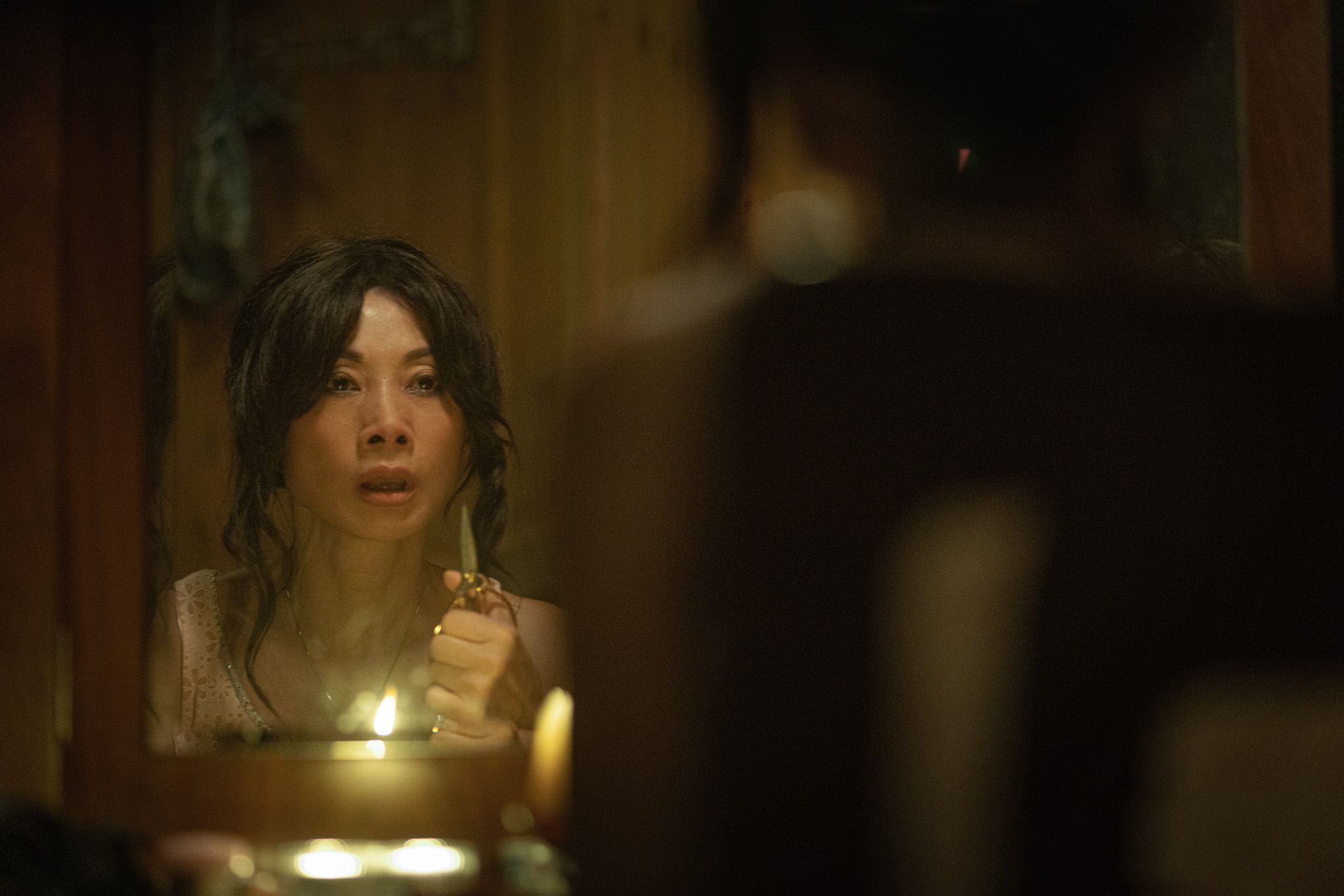
Bonding with Yu who is after all much like himself, a lonely little boy rejected by his peers while constantly “bothered” by wandering spirits, Wing starts to suspect there’s something more sinister going on. Director Nate Tse Ka-ki drops in repeated visual clues such as the distinctive pairs of scissors that seem to turn up in odd places while otherwise blurring the lines between the world of the living and the dead and alluding to other kinds of exile such as Wing’s life in Canada and estrangement from his family. On his return “back home”, he feels conflicted and resentful almost as if his mother had called him back and was refusing to let him go while grandma Chung ominously offers to look after Wing’s offspring when he eventually has one now that he’s where he’s supposed to be she assumes for good. It’s difficult not to read something sinister in her speeches about engineering a better future to “bring peace to this place” even before it becomes clear that it isn’t so much the lifting of a curse she’s interested in as its fulfilment. Some viewers may also detect something familiar in her delivery. In any case, in embracing a younger version of himself Wing may finally be able to escape his haunting even if it leaves him with a difficult choice between comforting fantasy and an objectively horrific “reality”.


Back Home screened as part of this year’s New York Asian Film Festival.

Original trailer (Traditional Chinese / English subtitles)

Images: ©️mm2 Studios Hong Kong

Mad Fate (命案, Soi Cheang, 2023)

“No one can stray from the path paved by fate.” a policewoman gasps while interrogating The Master (Gordon Lam Ka-Tung), a man whose mind was already strained even before he walked in on the murder of a woman he’d been trying to save only to end up losing to destiny. A noticeably lighter affair than his previous film Limbo, Mad Fate (命案) sees Soi Cheang (AKA Cheang Pou-soi) step into the Milky Way orbit directing a screenplay by Yau Nai-hoi produced by Johnnie To and very much bound up with the kinds of cosmic coincidences the studio is known for.

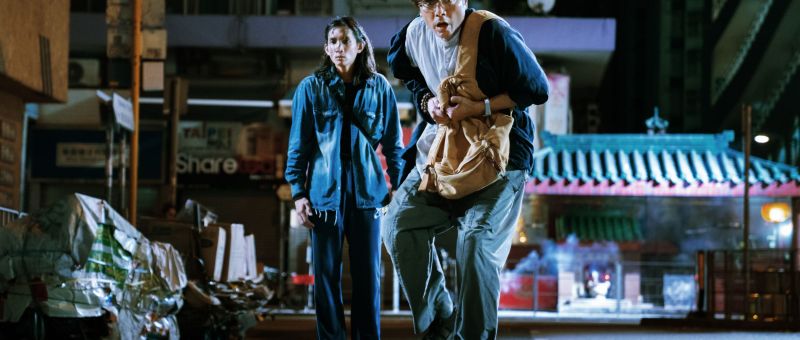
It’s Fate or maybe God that The Master is resisting, though what the difference between the two might be is never quite clear save for the implication that it’s God who is master of Fate which is otherwise without will. The Master insists that “Fate can be changed,” but he resolutely fails to do so. In the opening sequence, he’s in the middle of burying a woman, May, alive as part of a ritual to stave off a forthcoming “calamity” only he’s unable to complete it in part because of the woman’s understandable anxiety that it’s The Master who’s going to end up killing her, and in part because it starts raining which puts out the paper clothing that should have been burnt to change her fate. May runs off and climbs in a taxi home where she is accosted by a serial killer who has been targeting sex workers. The Master follows her but arrives just too late while the police later chase the killer but are unable to catch him. 

The Master sees his attempts frustrated but also does not consider that the rain itself was a manifestation of Fate or sign that in the end nothing can be changed. In an effort to atone for his inability to save May, The Master ends up taking under his wing a strange young man who also stumbled on the murder by coincidence while working as a delivery driver but is fascinated rather than repulsed by the bloody scene. Obsessed with knives and killing, Siu-tung (Lokman Yeung) is already known to the policeman investigating (Berg Ng Ting-Yip) because he arrested him for killing a cat in his teens. According to The Master’s reading of his fate, Siu-tung will eventually kill someone and end up in prison for 20 years. He doesn’t much like the sound of that so he ends up going along with The Master’s zany plans to make him a nicer person and save two lives in the process. 

Ironically most of The Master’s suggestions still involve Siu-tung being imprisoned in some way. To get him out of his “unlucky” flat, he rents him another place that very much feels like a prison cell and later does actually lock him up inside a shed fearing that he’s about to kill. As he explains, it can help to preemptively accept your fate so moving in somewhere that is “like” a prison can stop you going there for real, but it doesn’t do much to alleviate Siu-tung’s desire to kill and most particularly to kill the policeman who has been following him most of his life because he’s “sure” that he’s going to commit a serious crime. Repeatedly describing him as “vermin”, the policeman has no confidence that Siu-tung could “change” and thinks he’s already past redemption while The Master quite reasonably asks if it’s fair to persecute him in this way just because he happened to be born different.

The Master’s question provokes another about free will and responsibility and if anything is really anyone’s fault if it’s all down to Fate in which case the role of the policeman becomes almost moot. He is also resisting his own fate in his intense fear of mental illness which he worries he will inherit from his parents each of whom suffered from some kind of mental distress. This fear has caused him retreat from life and it seems may have contributed another’s suicide while his divination has an otherwise manic quality as he finds himself constantly trying to outwit Fate. The two men soon find themselves in a battle with the skies, remarking that God is striking back every time they make a move to try and change their destiny. 

Eventually The Master rationalises that a plant must wither before it fruits, allowing himself to slip into “madness” as means of rejecting his fate. His strategies become wilder and finally seem as if they might lead him to kill which would certainly be one way of altering Siu-tung’s destiny if ironically, while conversely something does indeed seem to change for Siu-tung who is understandably concerned by The Master’s increasingly erratic behaviour but has escaped his desire to kill. Then again, could this all not be Fate too, how would you know if you’d overcome it? As The Master comes to accept, the path maybe set but the way you walk it is up to you. Only by accepting his Fate can he free himself from it. There may be a more subversive reading to found in Cheang’s depiction of Hong Kong as a rain-soaked prison in which lives are largely defined by forces outside of their control, but he does at least suggest that his heroes have more power than they think even if it relies on a contradiction in the active choice to embrace one’s fate. 


Mad Fate screens July 22 as part of this year’s New York Asian Film Festival.

Original trailer (Traditional Chinese / English subtitles)

Images: © MakerVille Company Limited and Noble Castle Asia Limited

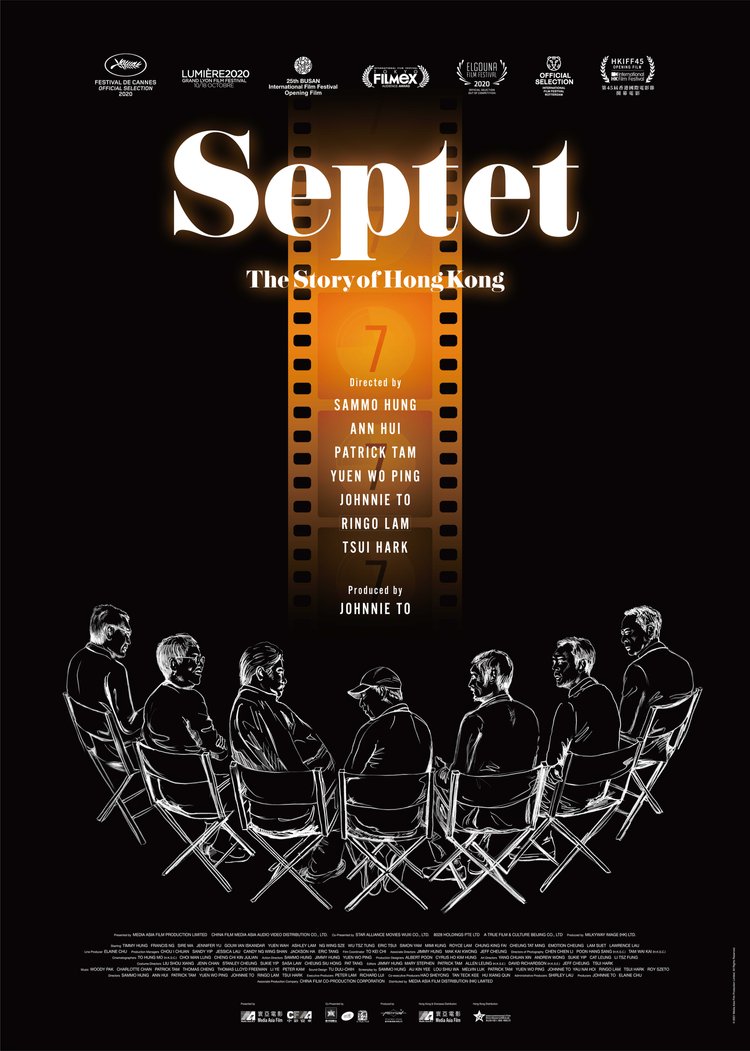
Septet: The Story of Hong Kong (七人樂隊, Sammo Hung, Ann Hui, Patrick Tam, Yuen Wo Ping, Johnnie To, the late Ringo Lam, Tsui Hark, 2022)

Seven of Hong Kong’s most prominent directors come together for a collection of personal tales of Hong Kong past and present in the seven-part anthology film, Septet: The Story of Hong Kong (七人樂隊). Produced by Johnnie To’s Milky Way, the film was first announced several years ago and originally titled Eight & a Half though director John Woo sadly had to leave the project due to his wife’s ill health which explains why there is no short set in the 1970s.

Each of the segments reflects the director’s personal nostalgia for a particular moment in time and there is certainly a divide between the 1950s and 60s sequences directed by Sammo Hung and Ann Hui respectively and those of the 80s and 90s which are imbued with a sense of Handover anxiety along with the closing meditation on the various ways the city has or has not changed. In any case, Sammo Hung’s opener Exercise is a slice of personal nostalgia which looks back to the heyday of Hong Kong kung fu as the young Sammo learns to buckle down and train with discipline under the guidance of his authoritarian teacher played by his own son, Timmy Hung. Similarly education-themed, Hui’s Headmaster echoes the documentary aesthetic seen in the later stages of Our Time Will Come in her naturalistic capture of a primary school reunion taking place in 2001 before flashing back to the early ‘60s as the headmaster and the children reminisce about a kind and idealistic young teacher who sadly passed away at 39 from a longterm illness exacerbated by misapplied traditional medicine. Essentially a tale of old-fashioned reserve in the unrealised desires of the headmaster and the teacher who elected not to marry because of her illness in the knowledge she would die young, Hui’s gentle melodrama harks back to a subtler age. 

Patrick Tam’s 80s segment, Tender is the Night, perhaps does the opposite in its incredibly theatrical tale of love thwarted by political realities as a lovelorn middle-aged man looks back on the failure of his first, and last, love for the teenage girlfriend who like so many of that time emigrated with her parents to escape Handover anxiety. Rich in period detail and imbued with the overwhelming quality of adolescent emotion, Tam’s maximalist romance is a tale of love in the age of excess but also of middle-aged nostalgia and personal myth making which nevertheless positions the looming Handover as a point of youthful transition. 

The 1997 sequence itself, Homecoming directed by Yuen Wo-ping, is in someways subversive in again presenting a young woman who firmly believes her future lies abroad rather than in post-Handover Hong Kong and placing her at playful odds with her traditionalist grandfather, a former martial arts champion who spends his days watching old Wong Fei-Hung movies. The eventual resolution that the girl, who insists on going by her Western name Samantha, returns to Hong Kong a few years later to care for the grandfather who has aged quite rapidly undercuts the sense of anxiety, yet there is something in the cultural and generational conflict that exists between them eased by mutual exchange as she teaches him basic English and he teaches her kungfu that hints less that the traditional is better than the modern than that there’s room for both hamburgers and rice rolls. 

Moving into the 2000s, Johnnie To’s Bonanza then takes aim at the increasingly consumerist mindset of the contemporary society in picking up a theme from Life Without Principle as three young Hong Konger’s become obsessed with getting rich quick through financial investment beginning with the dot-com bubble and shifting into property profiteering during the SARS epidemic. The trio fail every time before hitting the jackpot with some shares they bought by mistake during the 2008 financial crisis suggesting that it all just luck after all. One of the guys comically switches business opportunities in line with each of the crises/opportunities, firstly getting into mobile phones, then peddling healthcare products, and finally investing in self-storage in an echo of his society’s scrappy entrepreneurial spirit. 

The final film from Ringo Lam who completed his segment Astray shortly before passing away 2018 continues the theme in meditating on the modern city as its hero is literally killed by a sense of cultural dislocation after getting lost in a very changed Hong Kong having emigrated to the UK and returned with his family for a New Year holiday. While ironically remembering his own father complaining that times had changed, he finds himself bewildered by the absence of familiar landmarks and adrift in his home city. He dreams another life for himself in the countryside in which his son decides to emigrate to America while his wife would prefer he find a job in Hong Kong but his final message to him that it’s not difficult to live happily perhaps frees him of the sense of nostalgia which has led to his father’s death.

The best and final episode, however, Tsui Hark’s Conversation is set at no particular time and my in fact take place in the future as a mental patient, who might actually be a doctor pretending to be a mental patient, suddenly gives his name as Ann Hui followed by Maggie Cheung and a string of Hong Kong directors from Ringo Lan to Jonnie To and John Woo and challenges the doctor, who might be a mental patient, as he struggles to keep up with him. Tsui and Hui make reflective cameo’s at the segment’s conclusion perhaps hinting that this has been a deep conversation with the history not only of Hong Kong but its cinema through the eyes of those who helped to make it what it is.


Septet: The Story of Hong Kong screens in Chicago on Nov.6 as part of the 15th season of Asian Pop-Up Cinema.

Original trailer (English subtitles)

Tales from the Occult (失衡凶間, Fruit Chan, Fung Chih-Chiang, Wesley Hoi Ip-Sang, 2022)

A collection of Hong Kongers contend with the hidden horrors of the contemporary society in the first instalment in a series of anthology horror films, Tales from the Occult (失衡凶間,). Veterans Fruit Chan and Fung Chih-Chiang are accompanied by Wesley Hoi Ip-Sang making his directorial debut as the three directors each tackle lingering terrors as the protagonists of the three chapters are quite literally haunted by past transgressions from a pop singer on the edge consumed with guilt over a teenage trauma, to a sleazy financial influencer who might inadvertently have killed a hundred people, and the denizens of a rundown tenement who are too afraid to report a possibly dangerous presence to the police lest it damage the property value of their flats. 

In Wesley Hoi Ip-Sang’s opening instalment The Chink, a carefree high school girl chasing a stray cat stumbles on the body of a burglar who apparently fell from the rooftops and was trapped in a tiny cavity between two buildings. Some years later Yoyi (Cherry Ngan) has become a successful pop star but is still haunted by her failure to report the body to the police all those years ago worried that perhaps if she had he might have been saved though he had obviously been dead for some time when she found him. Her kindly psychiatrist uncle Ronald (Lawrence Cheng Tan-shui) tries to assuage her anxiety but fails to consider that there might actually be a dark presence in her new flat. Meanwhile, she’s also under considerable stress given that she’s in an ill-defined relationship with Alan, her married manager, who eventually brands her “mentally unstable”, and she’s somehow oblivious to the fact her high school best friend is clearly in love with her. Even so, as it turns out, perhaps you can also be haunted by the living while there are some threats that even the most well-meaning of psychiatrists is ill-equipped to cure. 

It’s ironic in a sense that Yoyi was provided with her new apartment as a path towards an illusionary freedom which is really only a means for Alan to exert greater control over her life while the heroine of Fung Chih-Chiang’s final sequence The Tenement has in a sense chosen seclusion in installing herself in a moribund tenement block in order to concentrate on her writing. The contrast between the two buildings couldn’t be more stark but even the tenement dwellers are paranoid about house prices while assuming the creepy, water-drenched presence encountered by author of pulpy internet novels Ginny (Sofiee Ng Hoi Yan) is an attempt by developers to scare them out of their homes amid Hong Kong’s horrifyingly competitive housing market. Still, like Yoyi they are each haunted by past transgressions but pinning the blame on former gangster Frankie Ho (Richie Jen) who was once accused of drowning a man. What began as a haunting soon descends into farce as they realise the “water ghost” seems to be a young woman who has passed away in their stairwell and decide to “dispose” of her with Frankie’s help to avoid a scandal destroying the value of their homes. But then, all is not quite as it seems as the sudden appearance of a journalist investigating a scandalous “love crime” makes clear. 

Fruit Chan’s middle chapter Dead Mall also takes aim at internet investigators and dodgy “influencers” as sleazy financial snake oil vlogger Wilson (Jerry Lamb) fetches up at a shopping centre surrounded by shoppers in masks to advertise that the mall is actually doing fine despite the economic downturn produced by the pandemic which he describes as worse than that of SARS. In reality the mall is “dead” with barely any customers and rows of shuttered stores, Wilson is simply doing a paid post in an attempt to raise its fortunes not least because the original mall was destroyed in a fire 14 years previously started by a carelessly discarded cigarette. Wilson is pursued not only by those who claim they lost money because of his terrible financial advice, but by a paranormal live streamer who has a separate grudge against him while he continues to refuse any responsibility for his actions answering only that investment carries risk and there’s no opportunity without crisis. What he discovers is perhaps that you reap what you sow, Chan frequently cutting to hugely entertained netizens baying for his blood while he attempts to outrun his fiery karma. 

In each of the increasingly humorous storylines, Chan’s being a particular highlight of wit and irony, there is a lingering dissatisfaction with the contemporary society from the pressures of the fiercely competitive housing market to the kind of financial desperation and longing for connection that fuels the consumerist emptiness of influencer culture. The jury might be out on whether there’s really any such thing as “ghosts” but the haunting is real enough even if it’s only in your mind. 


Tales from the Occult screens at the Garden Cinema, London on 9th July as part of Focus Hong Kong’s Making Waves – Navigators of Hong Kong Cinema.

Original trailer (English subtitles)

All U Need Is Love (總是有愛在隔離, Vincent Kok Tak-chiu, 2021)

All things considered, there are worse places to quarantine than a five star hotel especially if it’s free but then again forced proximity with those you love, or those you don’t, can prove emotionally difficult. An old school ensemble comedy, Vincent Kok’s All U Need Is Love (總是有愛在隔離) features a host of A-list stars each providing their talent for free in order to support the struggling Hong Kong film industry in the wake of the COVID-19 pandemic but as its name suggests eventually offers a small ray of hope that the enforced period of reflection may have fostered a spirit of mutual solidarity and personal growth. 

Kok opens, however, with a tense chase sequence as a shifty looking man runs from the authorities at the airport only to be picked up by the PPE-clad Epidemic Task Force who whisk him away to a secret location where he’s placed inside a weird bubble and interrogated by Louis Koo. Several more top HK stars including Gordon Lam fetch up in the bubble each implicating the Grande Hotel as the centre of of a coronavirus cluster at which point an order is given to place it under total lockdown requiring everyone inside to remain for a 14-day quarantine. 

Essentially a series of intersecting skits, Kok’s ramshackle drama nevertheless has its moments of satire as the hotel chief takes to the stairs for an inspirational speech in which he frequently slips into English and bizarrely likens himself to the captain of the Titanic because we all know how well that went. He spends the rest of the picture trying to escape without anyone noticing while his dejected security guard/brother tries to bump him off. Meanwhile, two gangsters develop a homoerotic bromance while plotting how best to profiteer off the pandemic through smuggling anti-COVID paraphernalia just as panic buying takes hold on the outside. 

Nevertheless, it can’t be denied that All U Need Is Love is also guilty of some rather old fashioned, sexist humour particularly in the antics of a pair of old men (Tony Leung Ka-Fai and Eric Tsang reprising their roles from Men Suddenly in Black) and their minions who misled their wives in order to embark on a sexual odyssey only to have their plans both improved and then ruined by the quarantine order. Meanwhile, a young couple who were in the hotel preparing for their wedding banquet ironically scheduled for the last day of the quarantine find themselves at loggerheads as the man gets cold feet over his fiancée’s bridezilla micromanaging, and her father undergoes a total makeover while continuously watching Japanese pornography in his room. 

Watching it all, a little girl, Cici, becomes the moral voice of the pandemic innocently hoping that nature will continue to heal itself even after the sickness ends. It’s she who shows the gangsters the error of their ways in pointing out that if they steal all the anti-COVID equipment then they will end up being more at risk because no one else is protected, while she also softens the heart of the hotel’s cynical manager to the point that he too makes a lengthy speech about becoming a better person thanks to his experiences during in the pandemic. 

During their enforced proximity friends and strangers have indeed needed to rediscover their love for their fellow man as they band together in mutual solidarity waiting for their freedom. Culminating in an oddly uplifting wedding decked out with balloons and messages from friends and family played via iPad, Kok’s anarchic ensemble farce does its best to discover a silver lining among the fear and anxiety of the pandemic as it ironically brings people together through driving them apart. Along with his A-list cast, Kok throws in a series of movie parodies and pop culture references from an impromptu rendition of Baby Shark to a surprise appearance from the Landlady from Kung Fu Hustle as well as a suitably random cameo from Jackie Chan. Repurposing the traditional Lunar New Year movie, All U Need is Love is a classic nonsense comedy designed to lighten the mood in these trying times while celebrating the essence of Hong Kong cinema through, arguably, its most idiosyncratic of genres. 


All U Need Is Love streamed as part of this year’s New York Asian Film Festival.

Original trailer (Traditional Chinese/English subtitles)