Kung Fu Soccer (功夫女足, Stephen Chow, 2026)

Seven years on from New King of Comedy, Stephen Chow returns with another reimagining of a past hit in Kung Fu Soccer (功夫女足, gōngfu nǚzú), a new take on the 2001 global sensation Shaolin Soccer. Throughout the ‘90s, Chow had been one of Hong Kong cinema’s most bankable talents with a series of mo lei tau or “nonsense” comedies. There’s no getting away from the fact that the Cantonese language is intrinsic to the genre which heavily relies on zany puns and wordplay in addition to slapstick humour, though the later phase of Chow’s career has largely been in Mainland-friendly Mandarin as is Kung Fu Soccer.

As such, the film struggles to achieve the kind of comedic rhythm that made Chow’s earlier work so popular while its nonsense gags such as a man burning his leg in order to get rid of unwanted hair after mistakenly thinking someone talking on the phone about cooking pork was talking to him play out less successfully. As in Shaolin Soccer, Chow turns subpar CGI into a kitsch feature, leaning in to the unreality of virtual stadia and the uncanniness of a CGI ball being knocked around the pitch to create a cartoon world where the normal rules of physics do not apply.

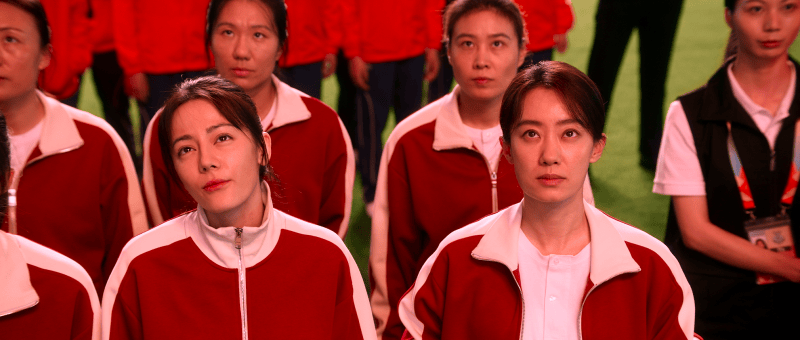
This time around, the action follows the Emei women’s football team who face ageism and sexism after making a belated bid to win an Asian championship. Headstrong captain Shuang (Zhang Xiaofei) and her childhood friend Jade (Dilraba Dilmurat) are struggling to overcome a falling-out over Jade’s decision to leave the sport and get married only to return following her divorce, while Shuang has dedicated her life to football and kung fu but now at almost 40 is beginning to realise that she may have missed out on other life experiences and has no plans for the future. Shuang is an orphan who found a place within the team and fears abandonment, whereas Jade is a wealthy heiress whose devil-may-care attitude is informed by her financial security.

As expected, part of the path for the team’s success is getting the pair to patch things up, which they eventually do after a little manipulation by “Grand Uncle” Xu Feng (Lay Zhang), another childhood friend with a longstanding crush on Shuang she in fact returns but is unable to act on due to being arrested emotionally having done nothing but sport and kung fu since she was a child. The conclusion that Shuang is gradually guided towards is that she’s too intense and has lost her love of playing the game. She has a lack of empathy for her teammates and an autocratic management style that alienates those around her, a criticism that has been levelled at Chow himself in the past. It’s this internalised pressure that makes it difficult for the players to perform. If they chilled out a bit and rediscovered the joy of it, they might be better placed to face their opponents who also have their own particular quirks.

The film has also come in for criticism for the ways that it depicts the other Asian nations in the competition, most particularly the South Koreans who are shown to be obsessed with beauty and play in underhanded ways while the Korean spoken in the film is delivered unconvincingly. The team from India similarly have some kind of super-stretchy ability and the Australians are defined by aggression and tactlessness. The Japanese team, coached by Takeru Satoh in a cameo appearance, are mainly just violent while the decision to make their goalie a figure of fun for not being considered conventionally attractive seems very outdated and undercuts the film’s other messages of female power and solidarity. The Emei team face questions of ageism and are forced to constantly prove themselves, but eventually come out on top after learning to trust each other, pool their respective strengths, and just have fun playing the game. Backed by Carina Lau’s mahjong-obsessed grandmaster, they have perhaps learned to integrate their martial arts abilities and love of sport to overcome not only the prejudice held against them, but their own internalised anxieties.


Kung Fu Soccer is in North American, UK, & Ireland cinemas from 23rd October.

Trailer (Simplified Chinese / English subtitles)

All U Need Is Love (總是有愛在隔離, Vincent Kok Tak-chiu, 2021)

All things considered, there are worse places to quarantine than a five star hotel especially if it’s free but then again forced proximity with those you love, or those you don’t, can prove emotionally difficult. An old school ensemble comedy, Vincent Kok’s All U Need Is Love (總是有愛在隔離) features a host of A-list stars each providing their talent for free in order to support the struggling Hong Kong film industry in the wake of the COVID-19 pandemic but as its name suggests eventually offers a small ray of hope that the enforced period of reflection may have fostered a spirit of mutual solidarity and personal growth. 

Kok opens, however, with a tense chase sequence as a shifty looking man runs from the authorities at the airport only to be picked up by the PPE-clad Epidemic Task Force who whisk him away to a secret location where he’s placed inside a weird bubble and interrogated by Louis Koo. Several more top HK stars including Gordon Lam fetch up in the bubble each implicating the Grande Hotel as the centre of of a coronavirus cluster at which point an order is given to place it under total lockdown requiring everyone inside to remain for a 14-day quarantine. 

Essentially a series of intersecting skits, Kok’s ramshackle drama nevertheless has its moments of satire as the hotel chief takes to the stairs for an inspirational speech in which he frequently slips into English and bizarrely likens himself to the captain of the Titanic because we all know how well that went. He spends the rest of the picture trying to escape without anyone noticing while his dejected security guard/brother tries to bump him off. Meanwhile, two gangsters develop a homoerotic bromance while plotting how best to profiteer off the pandemic through smuggling anti-COVID paraphernalia just as panic buying takes hold on the outside. 

Nevertheless, it can’t be denied that All U Need Is Love is also guilty of some rather old fashioned, sexist humour particularly in the antics of a pair of old men (Tony Leung Ka-Fai and Eric Tsang reprising their roles from Men Suddenly in Black) and their minions who misled their wives in order to embark on a sexual odyssey only to have their plans both improved and then ruined by the quarantine order. Meanwhile, a young couple who were in the hotel preparing for their wedding banquet ironically scheduled for the last day of the quarantine find themselves at loggerheads as the man gets cold feet over his fiancée’s bridezilla micromanaging, and her father undergoes a total makeover while continuously watching Japanese pornography in his room. 

Watching it all, a little girl, Cici, becomes the moral voice of the pandemic innocently hoping that nature will continue to heal itself even after the sickness ends. It’s she who shows the gangsters the error of their ways in pointing out that if they steal all the anti-COVID equipment then they will end up being more at risk because no one else is protected, while she also softens the heart of the hotel’s cynical manager to the point that he too makes a lengthy speech about becoming a better person thanks to his experiences during in the pandemic. 

During their enforced proximity friends and strangers have indeed needed to rediscover their love for their fellow man as they band together in mutual solidarity waiting for their freedom. Culminating in an oddly uplifting wedding decked out with balloons and messages from friends and family played via iPad, Kok’s anarchic ensemble farce does its best to discover a silver lining among the fear and anxiety of the pandemic as it ironically brings people together through driving them apart. Along with his A-list cast, Kok throws in a series of movie parodies and pop culture references from an impromptu rendition of Baby Shark to a surprise appearance from the Landlady from Kung Fu Hustle as well as a suitably random cameo from Jackie Chan. Repurposing the traditional Lunar New Year movie, All U Need is Love is a classic nonsense comedy designed to lighten the mood in these trying times while celebrating the essence of Hong Kong cinema through, arguably, its most idiosyncratic of genres. 


All U Need Is Love streamed as part of this year’s New York Asian Film Festival.

Original trailer (Traditional Chinese/English subtitles)