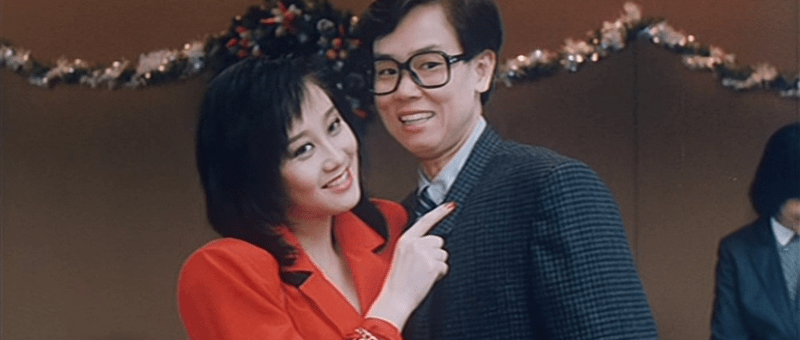
The shifting social codes of late ‘80s Hong Kong come under the microscope in Cinema City sex farce, Seven Years Itch (七年之癢). Loosely inspired by the 1955 Billy Wilder film, Johnnie To’s third directorial feature may in some senses suggest contemporary Hong Kong is little different from mid-50s America in its overly patriarchal gender politics but does in some senses at least attempt to redress the balance by turning the tables on the feckless husband if only to defiantly restore the status quo in the uncomfortable positioning of domestic violence as a means of social control.
The ironically named Willie (Raymond Wong Pak-Ming) is a rising executive in a quasi marriage with Sylvia Chang (Sylvia Chang Ai-Chia) which is to say they live together as man and wife but Wille has never bothered to put in the paperwork (something which continues to annoy his harridan of a not quite mother-in-law). The couple have been together for seven years and Willie is beginning to tire of the monotony of (not actually) married life, irritated by Sylvia’s early morning Chinese Opera practice sessions and the fact he’s had nothing but sausage and egg for breakfast every day since moving in. Consequently, he fantasises about having an affair but is too mild-mannered despite the gentle ribbing of his colleagues and constant attempts of his brother-in-law John (Eric Tsang Chi-Wai) to introduce him to the red light district.
In an early meeting with his colleagues after work, the men all discuss affairs suggesting that if a man isn’t chasing a woman it’s because he’s “sexually disabled” or gay quite clearly tying sexual prowess to masculinity. It’s also quite clear that the men view themselves as a group entirely separate from women, brother-in-law John evidently not thinking anything of it that he’s tempting his brother-in-law to cheat on his own sister implying that to him at least Willie’s masculinity is far more important than his sister’s feelings which in the end don’t seem to matter very much to him at all. John is also, however, a henpecked husband and moral coward. Challenged by his wife, sister, or mother, he immediately changes tack, dobbing Willie in when he’d tried to use him to placate Sylvia’s suspicions of an affair and quickly backtracking after having defended his decision not to file the papers by insisting “marriage is nonsense, old fashioned” only to counter with “I’m just saying for those silly men who try to overthrow the marriage tradition, I’m not one of them,”, “I absolutely agree with marriage. For women’s respect, I oppose living together”.
Both John, whose constant badgering for loans also places a financial strain on the (non) marriage, and Wille feel themselves emasculated by the constraints of a monogamous relationship as the constant references to wild meat imply. Meanwhile the women are also depicted as vain and parasitical, the collection of trophy wives at Sylvia’s cookery class forever showing off the expensive gifts their husbands have bought them while alternately complaining they feel ignored. The implication is that the men can’t win, if they seem indifferent the wife worries they’re playing around, but too much affection is also regarded as a sign of infidelity.
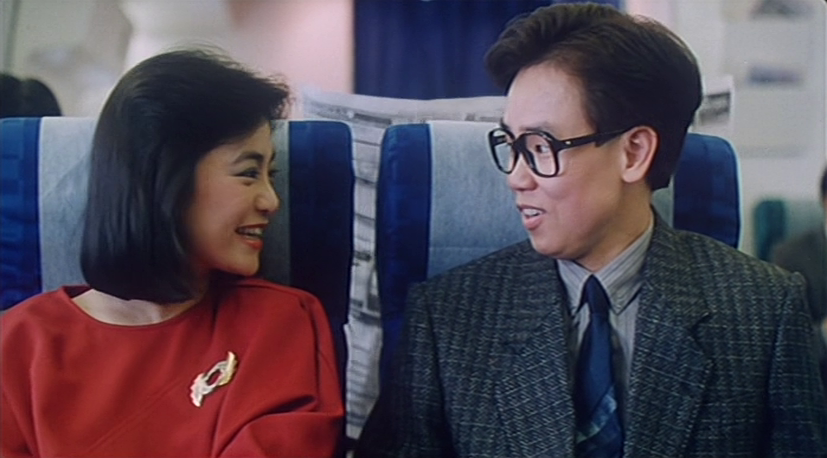
Even so it’s Sylvia who eventually gains the upper hand in refusing to play along with Willie’s games after he convinces her join him for a little Vertigo-esque role-play on a second honeymoon in Singapore, re-enacting his brief encounter with a foxy woman he met on a plane who was in fact conning him in order to facilitate a drug smuggling mission. Fed up with his ill-treatment, she falls asleep before the couple end up in an argument about her relationship with her “gay cousin” Chinese Opera partner with an inexplicably jealous Willie descending into an unpleasant homophobic rant. When he goes back to his own seat she has a meet cute of her own with a Chinese-American businessman literally named “Mr. Money” (Wu Fung) who took a liking to her in the departure hall and quite clearly needles Willie in the soft spots of his masculinity being both wealthy and cultured, able to take Sylvia off to a much more comfortable life in America with someone who is almost certainly going to treat her better than he ever intended to.
As in many subsequent To comedies, it’s then the man who is put on the back foot blindly flailing while trying to win back a woman he took for granted. But if it seemed as if Sylvia might actually have more power in this relationship that either of them had assumed, the notion is quickly knocked back, literally, when her henpecked father raises a hand to her mother at the airport in order to support Willie’s attempt to prevent her leaving not because he thinks his daughter will be happier but in support of Willie’s compromised masculinity while reaffirming his own. An uncomfortable suggestion to a policeman that if “you slap her everything will be OK” reinforces the idea that actually the harridan mother-in-law now respects him more because of his show of manly violence, rebalancing the relationship back towards patriarchal norms while the father-in-law then turns full on sleaze cavorting with young women in public parks.
It all adds to the impression that Willie is a sad sack, ineffectual man but largely because he turns back towards his wife while continuing to fantasise about other women seven years later claiming no longer to find her attractive and anticipating another itch this time presumably to escape his responsibilities as a father, his eyes following a pretty park jogger played by a then rising now iconic Hong Star who had appeared in the previous film Wong and To had made together. While To’s dancing camera shows glimpses of its future romanticism, it can’t quite escape the contradictions of the material even as it does its best to hand the balance of power back to Sylvia who could, it has to be said, do better.

 Windows on Worlds