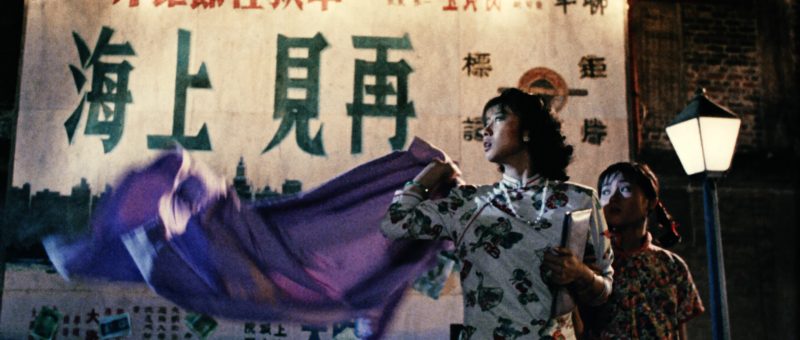
Shanghai Blues (上海之夜, Tsui Hark, 1984)

There’s a strange kind of melancholy optimism born of false courage and desperation that colours Tsui Hark’s Shanghai Blues (上海之夜). A clown soon to become a soldier tells a woman he meets in the dark under a bridge as the city burns and Shanghai falls to the Japanese to remember that they will win. 10 years later the wounded of that same war reassure each other that their time will come, they didn’t survive just to die here now seemingly cast out by the society they risked their lives to save.

The Shanghai Stool (Sally Yeh Chian-Wen) arrives in is in a moment of euphoric liberation caught between cataclysmic revolutions with the civil war and eventual coming of the communists hovering on the horizon. A wide-eyed country girl, she’s almost lost amid the hustle and bustle of the city in which the motion never stops. Like many, she is immediately displaced on her arrival, discovering that the relatives with whom she hoped to stay are no longer at their address and she is therefore homeless and alone. The clown, Do-re-mi (Kenny Bee), now a member of a marching band unable to play his instrument, thinks she’s the girl from the bridge in part because she’s wearing the same outfit but mainly because she has the same short hair cut and so he follows but loses her. Meanwhile, she has a kind of meet cute with Shushu (Sylvia Chang Ai-Chia), now a jaded nightclub showgirl still pining for the clown, in which they each believe the other is trying to take their own life but end up becoming best friends and roommates unwittingly living directly below Do-re-mi. 

In this 30s-style screwball world, identities are always uncertain and often obscured by darkness or else the continual march of the crowd. Yet there’s a kind of romanticism in this act of seeing and not seeing. Only in darkness do Shushu and Do-re-mi finally recognise each other and when their romantic moment is interrupted by the end of a power cut, they smash the neon lights opposite to reclaim it as if to reject the intrusion of this glaring modernity. To that extent, the implication may be that this innocent kind of romantic connection can’t survive the bright lights of the big city or that light blinds as much as it illuminates. In several sequences, the characters inhabit the same space but cannot see each other while a nefarious thief lurks on the edges of the frame unseen by all. On realising that Do-re-mi is the clown/soldier for whom she’s been waiting for the last 10 years, Shushu knows that she will have to break her friend’s heart or her own and that Stool’s dream of a family of three is unrealisable amid the constant rootlessness of this transient city. 

To that extent, Stool is an echo of herself as the innocent young woman she was on meeting Do-re-mi under the bridge rather than the more cynical figure she’s become due to her experiences in the wartime city. In the film’s closing moments, Stool meets another version of herself in the form of a wide-eyed young woman in a plain dress who asks her if this is Shanghai but the only reply she can give is that she wishes her luck because for her Shanghai is now a city of heartbreak just it has been one of sadness and futility for Shushu. “I have one hope, if I give it to you I won’t have any,” Shushu tells her lovelorn boss as an expression of the despair that colours her existence in which the distant possibility of romantic fulfilment is all she has to live for. 

The fact that the lovers later flee Shanghai for Hong Kong seems to take on additional import as those in Hong Kong consider a similar trajectory with their own revolution looming while adding to the sense of continual displacement, disrupted communities, and worlds on the brink of eclipse. This Shanghai is a bleak place too with its lecherous gangsters and seedy businessmen but has a sense of warmth even amid its constant motion in its serendipitous meetings and friendships born of the desire for comfort and company in the face of so much hopelessness. In the end, perhaps romanticism is the only cure for futility just as the only thing to do in a world of chaos is to become a clown.


Shanghai Blues screens Nov. 13 as part of this year’s San Diego Asian Film Festival.

Gallants (打擂台, Derek Kwok & Clement Cheng, 2010)

Gallants PosterLike the master at the centre of Derek Kwok and Clement Cheng’s Gallants (打擂台), old school martial arts movies have been in a deep sleep since their Shaw Brothers heyday. Drawing inspiration from the kung fu films of old, Gallants is a tale of buried heroism suddenly reawakening and the risks of writing off veteran challengers just because of their age. It’s also a tribute to those perhaps more innocent times and, in contrast to a prevailing trend, a true Hong Kong film filled with typically Cantonese (sometimes untranslatable humour) and meta references to the area’s long cinematic history.

For a brief moment in his childhood, Cheung (Wong You-nam) was the unbeatable superhero who never lost a fight. These days, he’s a nerdy loser who sometimes hides under his desk to escape his angry boss. Despatched by the shady real estate company he works for, Cheung is sent back to his rural hometown entrusted with the mission of convincing the local population to surrender their homes so the developers can build a large scale complex. Whilst there he gets attacked by local punks only to be saved by an old guy who has immense kung fu skills.

The old guy turns out to be one of two living in a ramshackle tea house that used to be a martial arts studio. Tiger (Leung Siu-lung) and Dragon (Chen Kuan-tai) turned the Gate of Law into a teahouse to make ends meet while their legendary sifu, Master Law (Teddy Robin), has been in a coma for the last 30 years. When a fight breaks out and the old guys get to strut their stuff against a local kingpin, Cheung decides to petition them to take him on as a pupil. In a classic case of bad timing, Cheung is around when the teahouse is raided again and someone attacks Master Law causing him to wake up and act as if the last 30 years never happened. He thinks Cheung is both of his young pupils, Tiger and Dragon, in one and that the real 30 years older versions of Tiger and Dragon are some random old guys Cheung has agreed to train out of pity.

If you don’t fight, you won’t lose quips Law, but if you fight you have to win. Like any good martial movie, Gallants is more about the journey than the destination. Rather than focussing solely on Cheung who experiences several conflicts of the heart when he realises that his adversary is the childhood friend he used to bully and that he was technically on the wrong side to begin with, Kwok and Cheng broaden the canvas to allow Tiger, Dragon, and Law to take centre stage. Still skilled martial artists, the guys give it their all in the knowledge that they’ll have to work far harder now that they aren’t as agile as they once were. Still, they have the true spirit of kung fu and resolve to keep getting back up each time they’re knocked down.

This oddly defeatist attitude which presupposes humiliation but insists on perseverance gives the film much of its warmhearted, ironic tone as the hapless martial arts heroes repeatedly fail yet refuse to back down. The other source of comedy lies in the hilarious performance of the tiny Teddy Robin as the supposedly all powerful Law. Law, as it turns out, is a wisecracking lecher who sets about flirting with just about every young girl he lays eyes on before decamping to a hostess bar and asking for the ladies from 30 years ago. Former starlet Susan Shaw makes an amusing cameo as the long suffering, lovelorn doctor apparently in love with Law since their youth who has continued to care for him throughout his illness but is entirely forgotten when Law wakes up in full on sleaze mode.

Bizarre gags including one about a missing preserved duck, jostle with impressive action sequences performed by two veterans proving they’ve still got what it takes all these years later. The aesthetic is pure ‘70s Shaw Brothers complete with speedy zooms and whip pans accompanied by an overly dramatic score, lovingly echoing the classic kung fu era rather than trying to attack it through parody. As funny as it all is, and it is, Gallants is also surprisingly warmhearted as it finds space to value the skills of its elderly protagonists as well as the enduring bonds of friendship which connect them.


Screened at Creative Visions: Hong Kong Cinema 1997 – 2017

Original trailer (English subtitles)