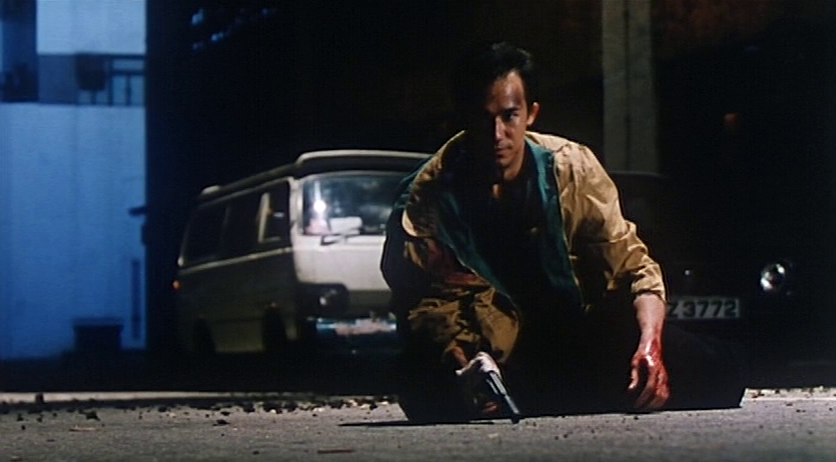
The Big Heat (城巿特警, Andrew Kam & Johnnie To, 1988)

A Hong Kong cop struggles with his sense of responsibility when faced with the fatalistic existential threat of the imminent Handover in Johnnie To’s first foray into the genre with which he would later become most closely associated outside of Hong Kong, the action crime drama. After a handful of Cinema City comedies, To is credited as a co-director along with Andrew Kam Yeung Wah though the production of The Big Heat (城巿特警), loosely inspired by the Fritz Lang film of the same name, was notoriously complicated passing through several hands over its unusually long gestation of almost two years, according to an interview with screenwriter Gordon Chan Kar-Seung, with producer Tsui Hark also heavily involved in the shooting. 

Tsui’s involvement is apparently responsible for the unusual level of explicit violence more usually found in horror exploitation rather than gangster noir, though there is perhaps something in the constant bodily destruction that aligns with the pre-Handover setting in which the “big heat” hanging over the city is an increasing existential panic which has created the maddening environment in which this surreal violence can occur as revealed in the opening dream sequence which features a drill piercing a man’s hand with small pieces of flesh speeding off it. The dream will turn out to be a prophecy foreshadowing the final shootout in which Inspector Wong (Waise Lee Chi-Hung) is shot thought the hand though at this point it signals both a psychological and physical fracturing. Owing to a neurological condition, Wong has lost full control over his right hand which leads him to question his ability to protect his city if he is unable to pull the trigger when needed which might also explain why he is frequently seen practicing his marksmanship at the firing range. 

Because of this anxiety, Wong had planned to resign but changes his mind on learning that his former partner who sustained an injury that Wong felt himself responsible for has been brutally murdered by Hong Kong gangsters in Malaysia after coming across a secret folder “by chance” containing photos used to blackmail a shipping magnate over his his homosexuality and an incriminating invoice. To do the right thing, Wong also temporarily breaks up with his forensic scientist girlfriend Maggie (Betty Mak Chui-Han) whom he was due to marry in a fortnight’s time suggesting that they not see each other until he’s solved his friend’s murder and then presumably plans to retire from law enforcement. 

Essentially, he deprioritises his personal, romantic relationships in favour of the homosocial brotherhood of the police both avenging his friend and dedicating himself to protecting Hong Kong from an oncoming threat represented by gangster Han (Paul Chu Kong) who is later revealed to be in cahoots with Russian mafia who ironically have a large portrait of Lenin on their boat and hammer and sickle flags everywhere while vowing to continue “selling drugs and capitalism” in the seemingly lawless environment of pre-Handover Hong Kong where everyone apparently wants to make enough money to be able to leave if the situation declines, “communist” Russians perhaps standing in for looming Mainland authoritarianism. Han even offers to sell “everything including Hong Kong” passing a list of names of “important people in the government” he apparently has access to in vast network of corruption. “Cheers to 1997” they ironically toast for their burgeoning business opportunity. 

It’s this corruption that is the source of Wong’s anxiety, fearing he doesn’t have the strength to stop it while his compromised hand is a symbol of both fate and an impotence that is later exorcised when he receives the corresponding physical injury yet is saved by a crucifix necklace that previously belonged to his girlfriend while in another instance of foreshadowing the corrupt policeman is eventually taken out by his own malfunctioning gun backfiring just like that which ruined an assailant’s hand in the drug bust in which Wong’s partner was injured. Having regained mastery over his hand, Wong is therefore more assured in his ability to protect Hong Kong from whatever it is that’s coming remaining within the police force while those who pay the heaviest price are an idealistic young rookie unable to adapt to the morally compromised world of pre-Handover Hong Kong, and Wong’s fiancée who becomes a symbol of that which he could not protect having prioritised his role as a police officer. Though somewhat disjointed having passed through so many hands, there are some typically To flourishes in the fluidity of the camerawork in the early stretches along with a gloomy romanticism in the fatalistic noir of the pre-Handover society even as he continues to find his feet as a purveyor of moody policier. 


Trailer (no subtitles)

Table for Six 2 (飯戲攻心2, Sunny Chan Wing-Sun, 2024)

“It’s okay to be screwed, we’ll unscrew you later,” youngest brother Lung (Peter Chan Charm Man) comforts his dejected brother in an accidental advocation of what means to be a family in Sunny Chan’s followup to the phenomenally successful comedy  Table for Six. Like the previous film and in true Lunar New Year fashion, Table For Six 2 (飯戲攻心2) explores the concept of family in a wider sense along with contemporary attitudes to marriage and traditional gender roles.

Even so, it has to be said this table is now uneven as oldest brother Steve has literally run away from his romantic dilemmas taking off for Africa leaving new girlfriend Miaow (Lin Min-Chen) behind claiming she’s too far out of his league and it’s not fair of him to waste her youth. Ironically enough, Bernard (Louis Cheung) has now started a wedding business helping people pull off extravagant public proposals such as the sort of fake one he prepares for Monica (Stephy Tang Lai-yan) as a publicity stunt featuring him dancing in a 90s-style music video. As part of the campaign, they’ve set up Lung and Miaow as a fake couple hoping to build a following for their romance online much to unexpected chagrin of Josephine (Ivana Wong) who has begun to embrace her dreams by becoming a well-known quirky chef who makes food disguised as other food. Though they had agreed to separate so the could both follow three dreams at the end of the previous film, Josephine suddenly proposes leading Bernard to put on an extravagant wedding as promotion for his business. 

In a way, Bernard’s company symbolises the performative qualities of marriage as couples put themselves through a stressful and expensive ritual more out of obligation than real desire. When Lung is prevented from reaching the ceremony on time, Bernard ends up impersonating him in a full body costume making plain that the spectacle is more for show than sentiment and it could really be anyone up there simply fulfilling a role. In fact, no one even checks the certificates were properly signed. Then again, just as in Josephine’s cooking sometimes the “fake” and can actually contain the “real” just in a different way than expected. She may say that once a relationship has cooled the spark can’t be regained, but that doesn’t necessarily mean a new, different, spark couldn’t be found. 

Perhaps that’s what happened for Bernard and Monica who’ve now overcome the awkwardness of Monica having been in a longterm relationship with oldest brother Steve. Ironically enough, they’d more or less decided not to get married only to be blindsided by their reactions to the “fake” proposal but as it turns out more because of the emotional baggage from their parents’ failed relationships that have left them too afraid to get married. Monica is still traumatised by her father’s extra marital affair which resulted in a half-brother she’s never met but has since become a Cantopop star, while Bernard still has bad memories of being treated as a “red-headed” child and like Steve is preoccupied with a desire to keep the family together while worried that he isn’t really up to it. 

The lesson Bernard learns is that family is a burden that’s carried together so he didn’t need to save it on his own and that it’s alright to mess things up because his family will be there to take care of him. Miaow meanwhile is left in the same place as Steve had been in the first film, wondering how long she should wait for love or if Steve is ever coming back, trying to decide whether to accept a promising job offer in Japan or stay in Hong Kong. Part of her reluctance to move on is that she’s become wedded to the family and fears losing her place within it but as Monica says her status wasn’t dependent on blood or relationships and that she’s already been accepted into the family just for being herself. 

Then again, families can also be annoying as Bernard remembers after inviting his gangsterish uncles to one of the weddings only for them to muscle in as a major sponsor for another own insisting on designs the dress themselves complete with a par of shark fin wings to promote their business none of which meshes well with Monica’s passion for conservation. In any case, as Monica reflects family means you can embarrass yourselves together so maybe wearing a stupid dress for a few minutes isn’t such a big deal. Heartfelt and zany, Chan’s farcical drama shifts past the performative aspects of marriage and family to what lies beneath which, like Josephine’s cooking, may not always be what it first appears.


Table for Six 2 is in UK cinemas from 9th February courtesy of CineAsia.

UK trailer (English subtitles)

One More Chance (別叫我”賭神, Anthony Pun Yiu-Ming, 2023)

A feckless gambler gets a final shot at redemption when he’s suddenly asked to take care of an autistic son he never knew he had in Anthony Pun Yiu-Ming’s nostalgic drama, One More Chance (別叫我”賭神). Previously titled “Be Water, My Friend”, the film has had a troubled production history only reaching cinema screen four years after filming concluded in March 2019 and has been retitled in the Chinese “Don’t Call Me the God of Gamblers” which seems to be a blatant attempt to cash in the audience’s fond memories of similarly pitched Chow Yun-fat vehicles from the ’80s and ’90s such as All About Ah Long.

In truth, Chow is probably a little old for the role he’s cast to play as the middle-aged barber Water who’s long since fled to Macao in an attempt to escape problems with loansharks caused by his gambling addition. Of course, Macao is one of the worst places someone with a gambling problem could go and so Water is already up to his neck in debt and a familiar face at the local casino. That’s one reason he ends up going along with the proposal of old flame Lee Xi (Anita Yuen Wing-Yee) to look after her grownup son, Yeung (Will Or Wai-Lam), who is autistic, for a month in return for 50,000 HK dollars up front and another 50,000 at the end assuming all goes well. She claims that Water is Yeung’s father and even provides forms for him to send off for a DNA test if he doesn’t believe her, but at this point all Water is interested in is the cash. 

To begin with, he pretty much thinks of Yeung as cash cow, descending on a Rain Man-esque path of using him to up his gambling game but otherwise frustrated by his needs and ill-equipped to care for an autistic person whom he makes little attempt to understand. For his part, Yeung adapts well enough and tries to make the best of his new circumstances but obviously misses his mother and struggles when Water selfishly disrupts his routines. For all that, however, it’s largely Yeung who is looking after Water, tidying the apartment and bringing a kind of order into his life while forcing him to reckon with the self-destructive way he’s been living. 

Picking up a casino chip in the opening sequence, Water describes it as a “chance” in an echo of the way he’s been gambling his life just as he decides to gamble on taking in Yeung. At one point, he wins big on the horses but takes his winnings straight to the casino where he’s wiped out after staking everything on a single bet only to realise he’s been played by another grifter at the table. It seems that Xi left him because of his gambling problem and the resultant change in his lifestyle that had made it impossible for her to stay or raise a child with him, causing Water to become even more embittered and cynical. Where once he provided a refuge for wayward young men trying to get back on the straight and narrow, now he’s hassled by petty gangsters over his massive debts.

Nevertheless, it’s re-embracing his paternity that begins to turn his life around as he bonds with Yeung and begins to have genuine feelings for him rather than just fixating on the money while simultaneously recognising that Yeung is already a man and able to care for himself in many more ways than others may assume. One could say that he gambles on the boy, staking his life on him rather than endless rolls of the dice to fill an emotional void but also rediscovering a sense of himself and who he might have been if he had not developed a gambling problem and left it up to chance to solve all his problems. Unabashedly sentimental, the film flirts with nostalgia in the presence of Chow and Anita Yuen and largely looks back the Hong Kong classics of the 80s and 90s if with half an eye on the Mainland censors board, Bruce Lee shrine not withstanding, but nevertheless presents a heartwarming tale of father and son bonding and paternal redemption as Water crosses the desert and finally reclaims himself from his life of dissipation. 


Original trailer (English subtitles)