Double Fixation (意亂情迷, Yonfan, 1987)

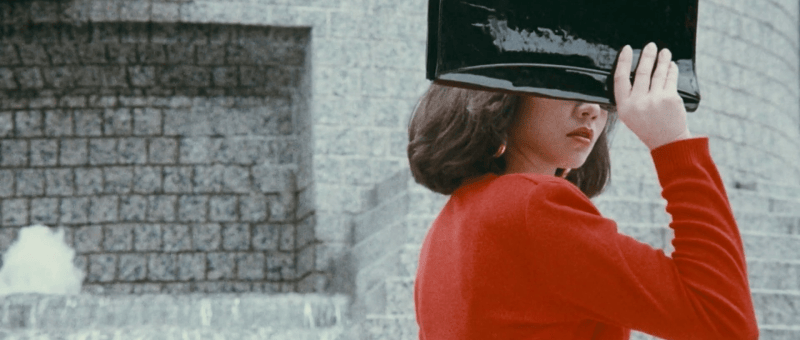
“The secret behind the secret is too mysterious for me to explain,” according to some kind of priest in Yonfan’s stylish tribute to the Hitchcockian thriller, Double Fixation (意亂情迷). The film does perhaps take the concept of the MacGuffin a little too far in its glowing blue orb which it makes no attempt to explain with no hint as to why the bad guys are so determined to get it back that they’ll even go to great lengths to retrieve a set of photos taken of it by a hapless photographer.

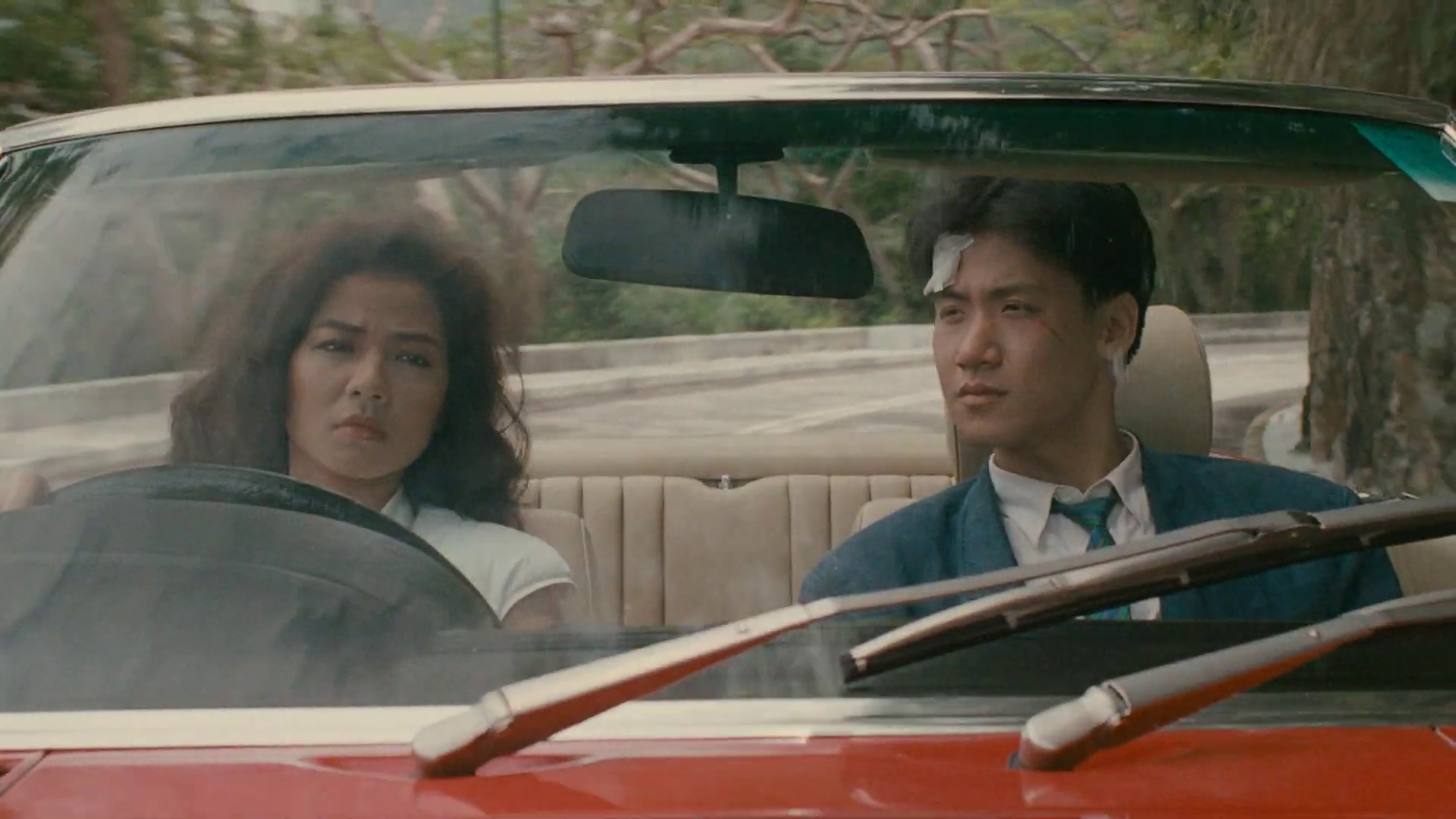
Jacky (Jacky Cheung Hok-Yau) is, to that extent, a classic “wrong man” who gets mixed up in a surreal conspiracy after being strong-armed into taking pictures of the orb by a wealthy businessman who wanted to give them to the priest so he could unlock its secrets. When Jacky goes to hand them over, he discovers the businessman has been murdered and laments his lost pay cheque, but, at the same time, is far more interested in some pictures he took of a stunning woman in red rather the mysterious blue orb. Jacky soon becomes the main suspect in a murder and is forced on the run, only to be rescued by the mysterious woman, Cherie (Cherie Chung Cho-Hung). Though Jacky falls for her, he can’t be sure she can be trusted. After Cherie disappears from his life, Jacky encounters another woman in San Francisco who looks just like her, but says her name is Jackie and claims to have no memory of him.

A riff on Vertigo, the film plays with identity and obsession as Jacky, abruptly cleared of suspicion as if the crime he was accused of committing may not have happened at all, continues to question his relationships with both Cherie and Jacky. Where Cherie had been a melancholy sophisticate living in a lonely mansion, Jackie is a down to earth aspiring actress whose fashion sense seems far more in the moment. She even seems to have Kim Novak’s hairstyle from the second half of Hitchcock’s movie. As Jacky gets closer to her, he’s honest about the fact that he can’t forget Cherie and the feelings he has for Jackie may be different in nature. Of course, this pains Jackie who can’t find a way to get through to Jacky who is still obsessed with a woman who may not have actually existed.

Jacky eventually comes to the conclusion that it doesn’t really matter who the mysterious woman is as long as she remains “herself” as a means of integrating his love for both Jackie and Cherie who are different but also the same. Yonfan also hints at Jacky’s own duality in often framing him with his reflection, while in a sense his gaze is doubled and refracted by his use of the camera. The film’s Chinese title may be that of Hitchcock’s Spellbound, echoing Jacky’s obsession and doubts about Cherie’s loyalties, but the English title too is reflective suggesting both Jacky’s fixation on a double of his lost love, and the fixation the villains seem to have with retrieving the photos for no clear reason. 

As such, the film has a rather surreal mentality what its unexplained magical orbs, weird priests, and a random comedy character in the form of a strange-looking, effeminate man who carries around a teddy bear and turns up at Jacky’s studio wanting to become a male model but later seems to be connected to the bad guys. Jacky has a naive sense of optimism, sure that all this will be sorted out quickly because he’s an innocent man and never quite taking the situation he’s in very seriously even as he’s chased by a pair of “CID officers” who don’t seem to be obeying police ethics. Yonfan then largely sidesteps the darkness at the centre of the story and dramatises it more as one of improbable adventure and romantic confusion in which Jacky struggles with his conflicted feelings for two women who might be one and the same. The film is just as enthralled by Cherie Chung as its protagonist appears to be as her ghostly presence seems to haunt every frame with her motivations constantly unclear until the very last second. 


Trailer (no subtitles)

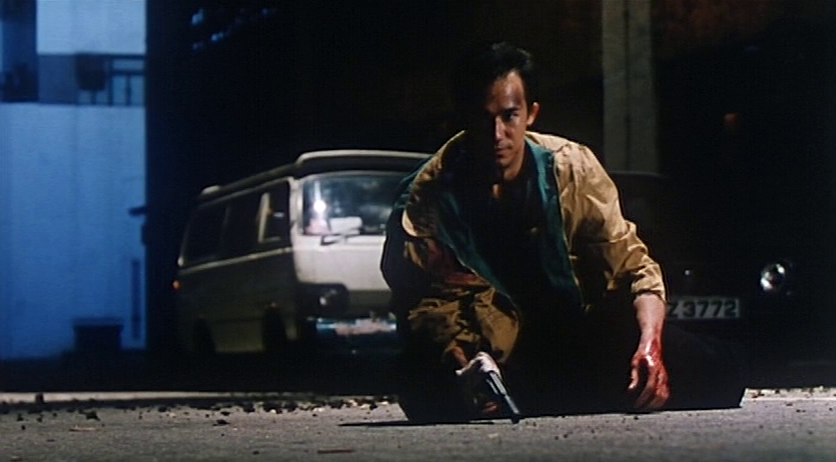
The Big Heat (城巿特警, Andrew Kam & Johnnie To, 1988)

A Hong Kong cop struggles with his sense of responsibility when faced with the fatalistic existential threat of the imminent Handover in Johnnie To’s first foray into the genre with which he would later become most closely associated outside of Hong Kong, the action crime drama. After a handful of Cinema City comedies, To is credited as a co-director along with Andrew Kam Yeung Wah though the production of The Big Heat (城巿特警), loosely inspired by the Fritz Lang film of the same name, was notoriously complicated passing through several hands over its unusually long gestation of almost two years, according to an interview with screenwriter Gordon Chan Kar-Seung, with producer Tsui Hark also heavily involved in the shooting. 

Tsui’s involvement is apparently responsible for the unusual level of explicit violence more usually found in horror exploitation rather than gangster noir, though there is perhaps something in the constant bodily destruction that aligns with the pre-Handover setting in which the “big heat” hanging over the city is an increasing existential panic which has created the maddening environment in which this surreal violence can occur as revealed in the opening dream sequence which features a drill piercing a man’s hand with small pieces of flesh speeding off it. The dream will turn out to be a prophecy foreshadowing the final shootout in which Inspector Wong (Waise Lee Chi-Hung) is shot thought the hand though at this point it signals both a psychological and physical fracturing. Owing to a neurological condition, Wong has lost full control over his right hand which leads him to question his ability to protect his city if he is unable to pull the trigger when needed which might also explain why he is frequently seen practicing his marksmanship at the firing range. 

Because of this anxiety, Wong had planned to resign but changes his mind on learning that his former partner who sustained an injury that Wong felt himself responsible for has been brutally murdered by Hong Kong gangsters in Malaysia after coming across a secret folder “by chance” containing photos used to blackmail a shipping magnate over his his homosexuality and an incriminating invoice. To do the right thing, Wong also temporarily breaks up with his forensic scientist girlfriend Maggie (Betty Mak Chui-Han) whom he was due to marry in a fortnight’s time suggesting that they not see each other until he’s solved his friend’s murder and then presumably plans to retire from law enforcement. 

Essentially, he deprioritises his personal, romantic relationships in favour of the homosocial brotherhood of the police both avenging his friend and dedicating himself to protecting Hong Kong from an oncoming threat represented by gangster Han (Paul Chu Kong) who is later revealed to be in cahoots with Russian mafia who ironically have a large portrait of Lenin on their boat and hammer and sickle flags everywhere while vowing to continue “selling drugs and capitalism” in the seemingly lawless environment of pre-Handover Hong Kong where everyone apparently wants to make enough money to be able to leave if the situation declines, “communist” Russians perhaps standing in for looming Mainland authoritarianism. Han even offers to sell “everything including Hong Kong” passing a list of names of “important people in the government” he apparently has access to in vast network of corruption. “Cheers to 1997” they ironically toast for their burgeoning business opportunity. 

It’s this corruption that is the source of Wong’s anxiety, fearing he doesn’t have the strength to stop it while his compromised hand is a symbol of both fate and an impotence that is later exorcised when he receives the corresponding physical injury yet is saved by a crucifix necklace that previously belonged to his girlfriend while in another instance of foreshadowing the corrupt policeman is eventually taken out by his own malfunctioning gun backfiring just like that which ruined an assailant’s hand in the drug bust in which Wong’s partner was injured. Having regained mastery over his hand, Wong is therefore more assured in his ability to protect Hong Kong from whatever it is that’s coming remaining within the police force while those who pay the heaviest price are an idealistic young rookie unable to adapt to the morally compromised world of pre-Handover Hong Kong, and Wong’s fiancée who becomes a symbol of that which he could not protect having prioritised his role as a police officer. Though somewhat disjointed having passed through so many hands, there are some typically To flourishes in the fluidity of the camerawork in the early stretches along with a gloomy romanticism in the fatalistic noir of the pre-Handover society even as he continues to find his feet as a purveyor of moody policier. 


Trailer (no subtitles)