Nameless (名無し, Hideo Jojo, 2026)

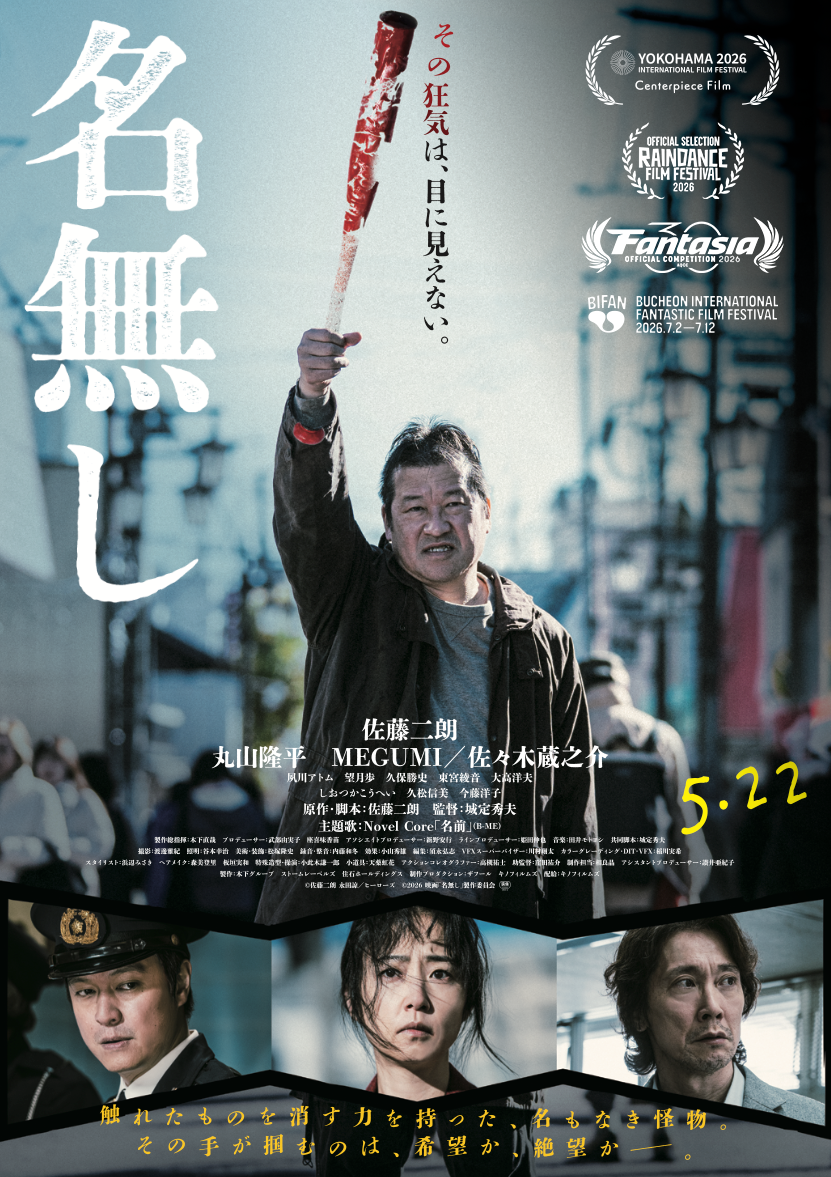
A man who can kill with a seemingly invisible weapon goes on the rampage after being harangued by a religious woman in a cafe, leaving police and witnesses baffled in Hideo Jojo’s adaptation of the manga by actor and comedian Jiro Sato who also stars in the title role. The nameless hero, given the generic moniker “Taro Yamada” by the well-meaning policeman who discovered him in childhood, has a mysterious supernatural ability that causes things he touches with his right hand to temporarily disappear. They return when he takes his hand away, but living creatures appear to have been changed as if they existed in a state between life and death and then generally pass away soon after.

Taro (Jiro Sato) seems to have lived well into his 40s deliberately refusing to use his right hand, so what prompted this sudden turn toward nihilistic and indiscriminate violence? The answers may not be entirely clear, just as there is no concrete explanation of where Taro might have come from or how he acquired these strange powers. But it seems to be a reaction against a society that he feels does not accept him, or at least his failure to connect with it. After experiencing a betrayal by someone close to him, he vows that he’s going to stop trying to connect with people and this murderous rampage seems to be an expression of his loneliness and frustration. 

Then again, society did attempt to reach out to him in some ways even if it does not appear to have made much of an effort to understand his condition or to help him to live with it. Despite the Christianising religious overtones that hang over the film, Taro never seems to consider cutting off his hand or making it unusable. As a child, he bound it with wire, presumably to prevent himself lashing out with it instinctively or accidentally causing harm to other people. His only companion, an equally nameless little girl of unknown origin given the generic moniker “Hanako”, begs him not use it even to protect them, which suggests that he may have done so previously with negative consequences. Perhaps there is some benefit to it which is why he doesn’t try to neutralise his arm, but it’s never clear where things go when he touches them or why they comeback changed or depleted. 

The main issue is that he has a choice about using it. Originally, he didn’t want to, and perhaps didn’t want to kill all those people in the cafe either but ended up doing so. The irony is that he wants to connect, but is literally prevented from reaching out. He has these almost Nosferatu-like ticks and grimaces and is largely mute. He can hear and understand, but barely speaks and when he does, it’s with great effort. His voice his horse and the words come out awkwardly in a strange order. Yet the elliptical quality of the tale seems to hint at a desire to reconnect with his childhood self thereby closing the circle and making himself disappear.

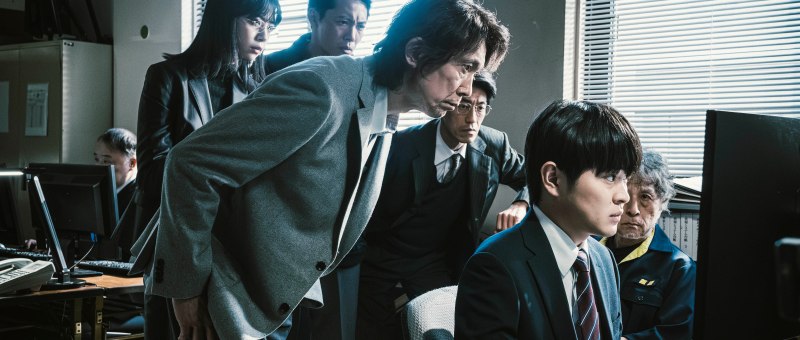
Others may in a way be trying to do the same, such as lead investigator Kunieda (Kuranosuke Sasaki) who suspects the case may be linked to something in his own past but has it taken away from him by the National Police Agency who question the team’s competency while themselves failing to make much of an effort to understand the reality of a man like Taro. Some joke that perhaps he is a ghost, and in a way he does seem to be a supernatural entity. His invisible weapons are visible in a reflected surface such as a mirror, but apparently not captured on camera. His tragedy, though, maybe that he doesn’t understand himself beyond the fact of his difference and is too afraid to open himself to potential rejection by those who might be able to help him if they wanted to, with the potential for exploitation by those with darker motivations. In that sense, his violence, depicted with bloody absurdity by Jojo, does seem to be an attempt at connection or to feel himself a part of this world. Nevertheless, the conclusion seems to suggest that in the end acceptance comes from within and in giving in to his basest instincts the adult Taro may only have disappointed his more innocent childhood self.


Nameless screens as part of this year’s Raindance Film Festival.

Trailer (no subtitles)
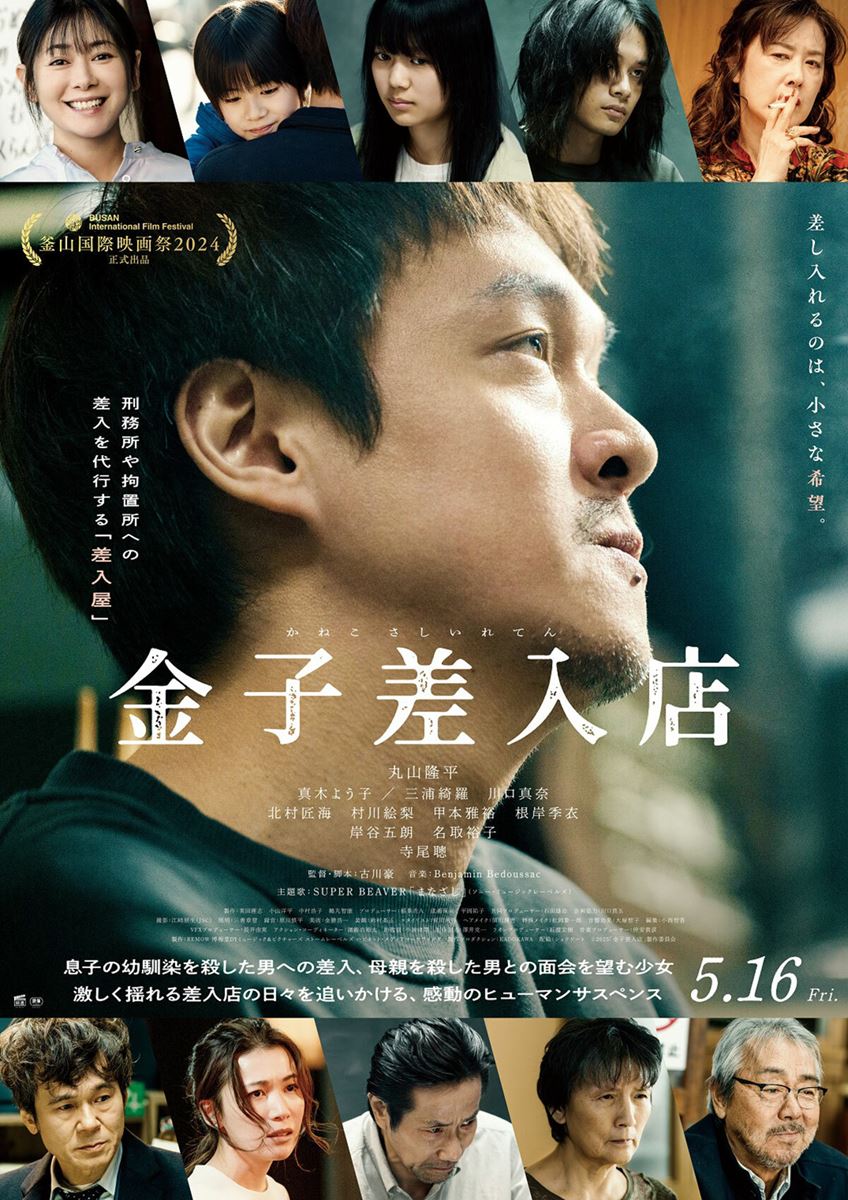
Kaneko’s Commissary (金子差入店, Go Furukawa, 2024)

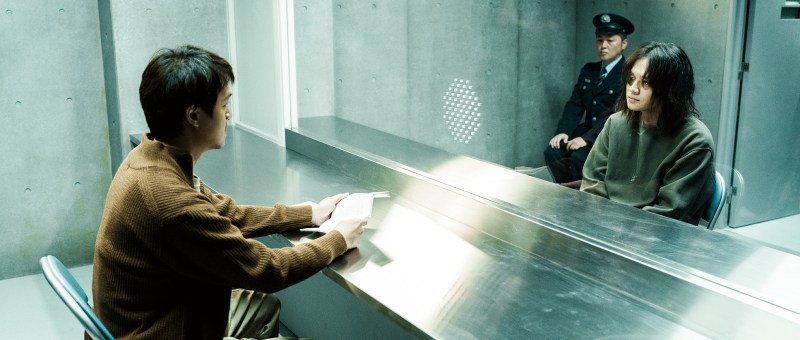
The tranquil life a man has built for himself after leaving prison is disrupted by unexpected tragedy in Go Furukawa’s social drama Kaneko’s Commissary (金子差入店, Kaneko Sashiireten). The commissary of the title refers to a service run by those like Shinji (Ryuhei Maruyama) which handles deliveries to people in prison and arranges visits by proxy. In Japan, visiting hours only take place during the day on weekdays making it difficult for visitors who work regular jobs or live far away. There’s no way to make an appointment, either. Visitors must simply show up and wait with the possibility that it might not be possible so see their friends and relatives after all given that there are only so many meeting rooms available.

The commissary service is intended to mitigate this inconvenience by acting as a bridge between the imprisoned and their families, educating them about the prison system and advising them on what can and can’t be delivered. For Shinji it seems to be a means of atonement. Sent to prison for a violent crime when his wife Miwako (Yoko Maki) was pregnant with their first child, he’d angrily lashed out her when she skipped a visit little knowing it was because she was busy giving birth. Nevertheless, several years later he’s bonded with his son and is living a happy, peaceful life. The film subtly suggests that his is partly because he’s gained a strong and supportive familial environment anchored by his formerly estranged uncle who occupies the paternal space Shinji may otherwise have been lacking. He has a complex relationship with his mother who mainly visits when he’s not home to pressure Miwako into giving her money which she fritters away on toy boys much to Shinji’s embarrassment. It’s these complex feelings towards his mother that seem to fuel his fits of rage and threaten the integrity of his new family.

But by the same token, there is external pressure too in the low-level stigma and prejudice which surrounds them simply by virtue of their proximity to crime. Though they appear to be well accepted by the community, when their son Kazuma’s friend Karin in murdered by a young man with mental health issues, it refocuses the rage of the community on them too. Someone keeps smashing the flower pots outside their home, while Miwako is ostracised by the other women in the neighbourhood and de facto sacked from her part-time job because the other employees refuse to work on the same shift as her. Kazuma starts getting bullied at school because someone found out his father had been in prison, though what his father did is obviously nothing at all to do with him. 

In Japanese society, the extended family of those who’ve committed crimes is dragged into the spotlight. The mother of Karin’s killer Takashi is hounded by the media though as she says, much as she can’t understand why he did something like this, he’s a grown man and she’s not really to blame for his actions. Though we might originally feel sorry for her, especially as Takashi coldly rejects all her efforts on his behalf, she quickly becomes entitled and almost threatening. She pressures Shinji for news about her son, while he tries to avoid telling her that Takashi rejects her gifts and isn’t interested in her letters. Being forced to visit him tests the limits of his compassion as he too wonders if the man who killed Karin is really worthy of this level of care.

At the prison, he runs into another young woman who repeatedly tries to get in to see a prisoner despite the fact he keeps denying her requests. The lawyer Shinji works with has a theory about the girl, Sachiko (Mana Kawaguchi), and the yakuza she wants to wants to see. Now institutionalised, the yakuza discovered there was no place for him on the outside. His old boss was no longer around and he had no status in the underworld, so he probably committed a crime to be put away again, but at the same time maybe there was more to it than that. People save each other in unexpected ways, even it’s just with gentle acceptance and patience with a world that it is itself often lacking in the same.


Kaneko’s Commissary screens as part of this year’s Japan Foundation Touring Film Programme.

Trailer (no subtitles)