The Killer (喋血雙雄, John Woo, 1989)

“We’re outmoded characters,” a dying man laments, having previously advanced that “nostalgia is one of our saving graces.” The heroes of The Killer (喋血雙雄) are indeed remnants of an earlier time, out of place amid the modern city and adhering to a code that has long since fallen by the wayside. “Our world is changing so fast,” hitman Jeff (Chow Yun-fat) exclaims of a Hong Kong hurtling not only towards the Handover but an increasingly amoral capitalism in which friendship and brotherhood no longer have any currency.

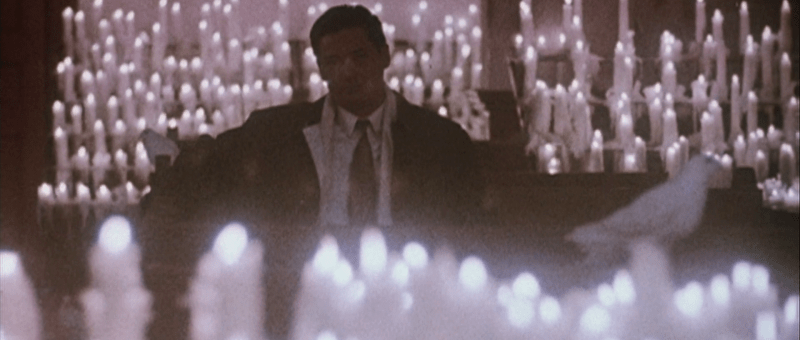
We can tell this straightaway from the fact that the man who ordered the hit on the drug lord Jeff took out at the dragon boat races was his own nephew, Weng (Shing Fui-on). To tie up loose ends, Weng also sends his own hitmen to take out Jeff, who can’t be sure if his handler and best friend Sidney (Chu Kong) is involved in the plot to knock him off. Later in the film, Inspector Li (Danny Lee) asks what Jeff will do if Sidney betrays him, but he merely says that he will still treat him as a friend because he has been good to him in the past. Jeff says this in an abandoned church, echoing not only the codes of jianghu brotherhood now largely absent in the contemporary society but Christianising notions of forgiveness and acceptance. 

Jeff claims that he isn’t a religious man but appreciates the tranquillity of the disused chapel. Inspector Li meanwhile is often pictured next a statue of the Buddhist god of war and dressed in black in opposition to Jeff’s white, but what emerges is that the two men are effectively the same and somewhat interchangeable. Jennie (Sally Yeh), the nightclub singer Jeff accidentally blinded during a a chaotic hit and subsequently falls in love with, first mistakes Li for Jeff while Woo also pictures him sitting in Jeff’s chair and pulling a gun on his partner in much the same way Jeff cooly dispatched an assassin sent by Weng. Chang had told Li that he looked exactly like what he was, an undercover policeman, which is obviously a problem, but Jeff remarks that he is a “very unusual cop,”while Li agrees he’s a very unusual killer. 

In some senses, Li will also become the killer of the film’s title in the closing moments, a man who believes in justice but is not himself believed and knows that there will be no real justice for a man like Weng. Both men share a code which is essentially the same, a more primal kind of morality largely incompatible with the modern society and in many ways rightly so. Li even says that Jeff does not look like a killer, that there’s something “heroic” about him, and that his eyes are full of passion as if he had a dream. His words have a kind of irony to them, but Jeff does indeed have a dream in the desire to gain redemption for himself by restoring Jennie’s eyesight, which is the reason for his last big job having now been reformed by her no longer believing that the people he killed deserved to die but that everyone has a right to live.

Despite the triangular relationship with Jennie, there is an undeniably homoerotic tension in the connection between Li and Jeff even if they are also two sides of the same coin. They train their guns on each other and lock eyes, but unexpectedly find a kindred spirit in a man who should be an enemy. “The only person who really knows me turns out to be a cop,” Jeff chuckles but has an equally deep relationship with handler Sidney just as Li has with parter Chang (Kenneth Tsang) while the homosociality that defines their world is subverted by Weng who simply shoots his own underling when he becomes inconvenient to him. 

Both Li and Jeff are effectively men left with “no way out” and “nowhere to go” because their code of brotherhood is no longer understood by the contemporary society. Jennie’s progressive loss of sight also echoes their dwindling futures as if the light were going out of their world long before Woo shatters the statue of the Virgin Mary and unleashes the doves of futility inside the no longer quite so tranquil church that becomes the final resting place of manly honour and brotherly love. “Perhaps we are too nostalgic,” Jeff sighs but nostalgia is indeed his saving grace in a world in which honour and friendship exist only in a mythologised past or may never have really existed at all.


Trailer (no subtitles)
Shanghai Blues (上海之夜, Tsui Hark, 1984)

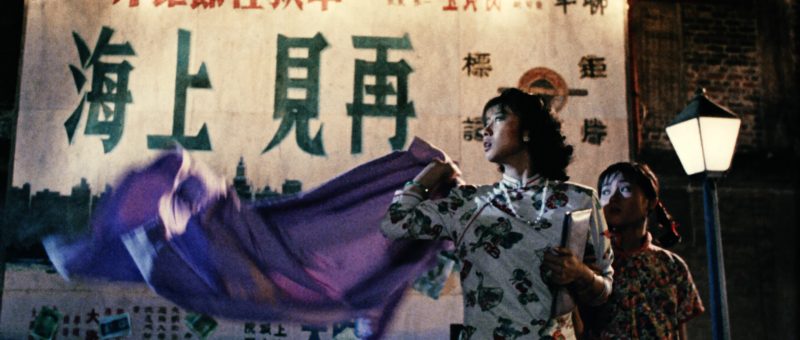
There’s a strange kind of melancholy optimism born of false courage and desperation that colours Tsui Hark’s Shanghai Blues (上海之夜). A clown soon to become a soldier tells a woman he meets in the dark under a bridge as the city burns and Shanghai falls to the Japanese to remember that they will win. 10 years later the wounded of that same war reassure each other that their time will come, they didn’t survive just to die here now seemingly cast out by the society they risked their lives to save.

The Shanghai Stool (Sally Yeh Chian-Wen) arrives in is in a moment of euphoric liberation caught between cataclysmic revolutions with the civil war and eventual coming of the communists hovering on the horizon. A wide-eyed country girl, she’s almost lost amid the hustle and bustle of the city in which the motion never stops. Like many, she is immediately displaced on her arrival, discovering that the relatives with whom she hoped to stay are no longer at their address and she is therefore homeless and alone. The clown, Do-re-mi (Kenny Bee), now a member of a marching band unable to play his instrument, thinks she’s the girl from the bridge in part because she’s wearing the same outfit but mainly because she has the same short hair cut and so he follows but loses her. Meanwhile, she has a kind of meet cute with Shushu (Sylvia Chang Ai-Chia), now a jaded nightclub showgirl still pining for the clown, in which they each believe the other is trying to take their own life but end up becoming best friends and roommates unwittingly living directly below Do-re-mi. 

In this 30s-style screwball world, identities are always uncertain and often obscured by darkness or else the continual march of the crowd. Yet there’s a kind of romanticism in this act of seeing and not seeing. Only in darkness do Shushu and Do-re-mi finally recognise each other and when their romantic moment is interrupted by the end of a power cut, they smash the neon lights opposite to reclaim it as if to reject the intrusion of this glaring modernity. To that extent, the implication may be that this innocent kind of romantic connection can’t survive the bright lights of the big city or that light blinds as much as it illuminates. In several sequences, the characters inhabit the same space but cannot see each other while a nefarious thief lurks on the edges of the frame unseen by all. On realising that Do-re-mi is the clown/soldier for whom she’s been waiting for the last 10 years, Shushu knows that she will have to break her friend’s heart or her own and that Stool’s dream of a family of three is unrealisable amid the constant rootlessness of this transient city. 

To that extent, Stool is an echo of herself as the innocent young woman she was on meeting Do-re-mi under the bridge rather than the more cynical figure she’s become due to her experiences in the wartime city. In the film’s closing moments, Stool meets another version of herself in the form of a wide-eyed young woman in a plain dress who asks her if this is Shanghai but the only reply she can give is that she wishes her luck because for her Shanghai is now a city of heartbreak just it has been one of sadness and futility for Shushu. “I have one hope, if I give it to you I won’t have any,” Shushu tells her lovelorn boss as an expression of the despair that colours her existence in which the distant possibility of romantic fulfilment is all she has to live for. 

The fact that the lovers later flee Shanghai for Hong Kong seems to take on additional import as those in Hong Kong consider a similar trajectory with their own revolution looming while adding to the sense of continual displacement, disrupted communities, and worlds on the brink of eclipse. This Shanghai is a bleak place too with its lecherous gangsters and seedy businessmen but has a sense of warmth even amid its constant motion in its serendipitous meetings and friendships born of the desire for comfort and company in the face of so much hopelessness. In the end, perhaps romanticism is the only cure for futility just as the only thing to do in a world of chaos is to become a clown.


Shanghai Blues screens Nov. 13 as part of this year’s San Diego Asian Film Festival.

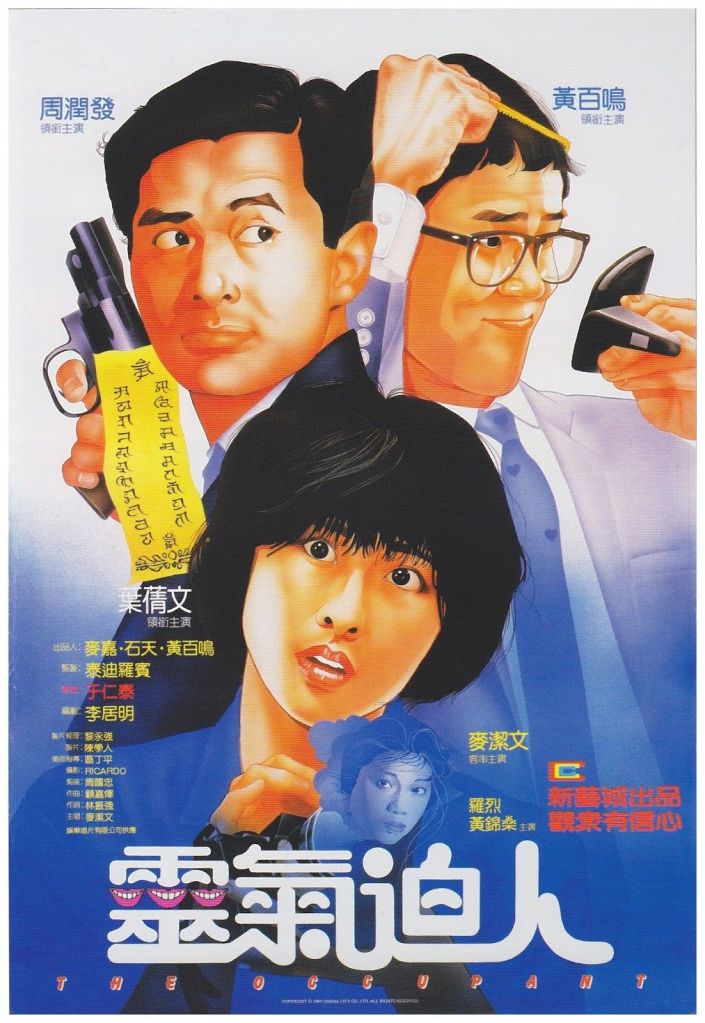
The Occupant (靈氣逼人, Ronny Yu Yan-Tai, 1984)

There’s no such thing as a reasonably priced apartment, and so when you find one that seems strangely spacious for the rent, it’s prudent to wonder why that might be. Yes, that’s right, your dream apartment may in fact be haunted! Going a bit meta, Ronny Yu Yan-Tai gets in on the comedy ghost game with The Occupant (靈氣逼人), a tale of supernatural suspense starring Taiwanese-Canadian actress and singer Sally Yeh as a young woman returning from Canada for a three week stay to work on her dissertation researching “Chinese superstition”.

Having not thought to book ahead for her accommodation, Angie (Sally Yeh Chian-Wen) is shocked to discover that hotel rooms in the Hong Kong of 1984 are in no way cheap. Locked out of even the cheapest flea pits, she decides to try renting an apartment only to run into the slimy Hansome Wong (Raymond Wong Pak-Ming), an unscrupulous estate agent/used car salesman. Angie spots an apartment sitting on his board that’s in her budget and asks to see it. Hansome is delighted because it’s been on the market ages, but what he doesn’t disclose is that the reason it’s so cheap is that the place is haunted. Angie is originally quite confused by the fact her furniture seems to move back to its original position all by itself, and irritated by loud noises such as a woman singing and a couple having an argument late at night, but on being told that she’s the only resident by the decidedly creepy caretaker (Yam Ho), decides she’s not really bothered if the apartment has another occupant besides herself and anyway it might be quite useful for her thesis. 

Very much in the Wong Jing vein, much of the early comedy revolves around Hansome’s cringeworthy attempts to worm his way into Angie’s life. Luckily for her, he says, Hansome is a very “superstitious” person and so offers to show her around all the best “superstitious” sights of the city, particularly a local temple where they seem to do every kind of taoist ritual going. The problem is that Angie can’t seem to get rid of him. He even pulls the trick of saying that he left something behind in her apartment so he can come in and retrieve it, only to get his arm trapped in a priceless vase. Hearing about the ghost he vows to stay the night and protect her from the boogeyman, but he didn’t count on the real thing turning up and expelling him from the apartment in exasperation with creepy men everywhere. 

Meanwhile, Angie is actually quite taken with a handsome policeman she runs into at the airport, but incorrectly assumes he’s a “sex maniac” because he was only hanging out with her as camouflage for surveilling another woman who turned out to be a pickpocket. Valentino (Chow Yun-Fat) is an honest cop, which is why he ends up getting asked to take some time off after discovering a fellow officer visiting an establishment they were raiding on a tip off that it was employing underage girls. Like Hansome, Valentino has also taken to Angie, if in a slightly less creepy way, and the three of them eventually get together to try and solve the ghost problem (not that Angie actually has much of a problem with it). 

On investigation, Angie discovers that the previous occupant of the apartment was a nightclub singer who apparently shot herself after a failed affair with a married man who wouldn’t leave his family. She becomes ever more obsessed with the dead woman, Lisa Law (Kitman Mak Kit-Man), despite the warnings from Valentino’s former policeman turned taoist priest buddy (Lo Lieh) who tells her that the ghost most likely bears a grudge and will try to engineer a reprise of her tragedy using a susceptible subject. Yu has fun parodying some of the genre staples like magical charms supposed to ward off ghosts which get mysteriously lost at critical moments, but edges towards a real supernatural dread as the curse takes hold, swallowing our trio in a bizarre recreation of the past which accidentally reveals a long hidden truth and helps to alleviate the ghost’s anger. In her frequent voice overs recorded on a dictaphone, Angie reveals that she came to Hong Kong with a low view of “Chinese superstition” but thanks to her experiences now has a new appreciation for the power of the supernatural. Ghosts it seems can’t be exorcised so much as appeased, ignore them at your peril.


Original trailer (no subtitles)