Four Hours of Terror (高度7000米 恐怖の四時間, Tsuneo Kobayashi, 1959)

It seems quite strange now to think of a time when air travel was both new and exciting and as easy as catching a bus. It’s this juxtaposition that Tsuneo Kobayashi’s hijacking thriller Four Hours of Terror (高度7000米 恐怖の四時間, Kodo Nanasen Metoru: Kyofu no Yojikan) plays with as an armed fugitive takes a passenger plane hostage in an attempt to escape after committing a murder while those on board struggle to accommodate themselves to this new form of transportation. 

This sense of exoticisation is obvious from the opening voiceover which sings the praises of Haneda airport as the gateway to a newly internationalised Japan though in actuality the flight in question is a domestic service travelling from Tokyo to Sapporo. The voiceover also introduces us to each of the passengers which come from differing strata of society and even includes a middle-aged American couple. There are in fact three generations of couples on board who seem to represent different stages of life from the newly wed students so wrapped up marital bliss that they barely notice anything else, to a long-married reporter and his wife on their first holiday together since their honeymoon, and an elderly couple returning from a trip to the capital who are mystified by this new age of mass media and air travel. The newlyweds apparently won this free trip on an aeroplane after agreeing to have their wedding broadcast on television in an early example of reality TV, reinforcing the sense of irony that they weren’t necessarily supposed to be on this doomed flight after all. 

Neither was car saleswoman Kazuko (Hitomi Nakahara) who has apparently been pulled away to Sapporo by a short notice business opportunity. She gets a standby ticket, as does her boyfriend/rival Fujio (Tatsuo Umemiya) who is also on track to the same opportunity. Weirdly, Kazuko is not overly sympathetic having randomly kicked a basket containing a little dog about to be smuggled on the plane by its doting owner, but does perhaps represent something of a more independent post-war womanhood even as she effortlessly deflects unwanted attentions from a client she may also have been exploiting in order to obtain his business. Having boarded the plane, she ends up sitting next to another man who requested a standby ticket and was using a surname that was the same as hers but evidently turns out to have been assumed. So lax is the security, you don’t necessarily have to travel under your legal name. In any case, she briefly flirts with him as an overture to a business relationship and also to annoy Fujio before overhearing a news report about the escaped fugitive on her portable radio.

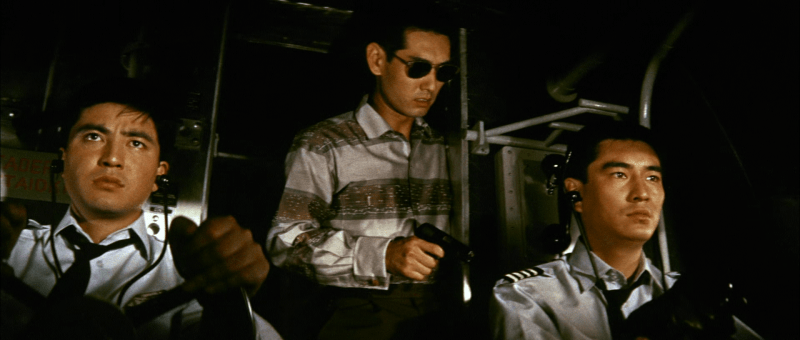
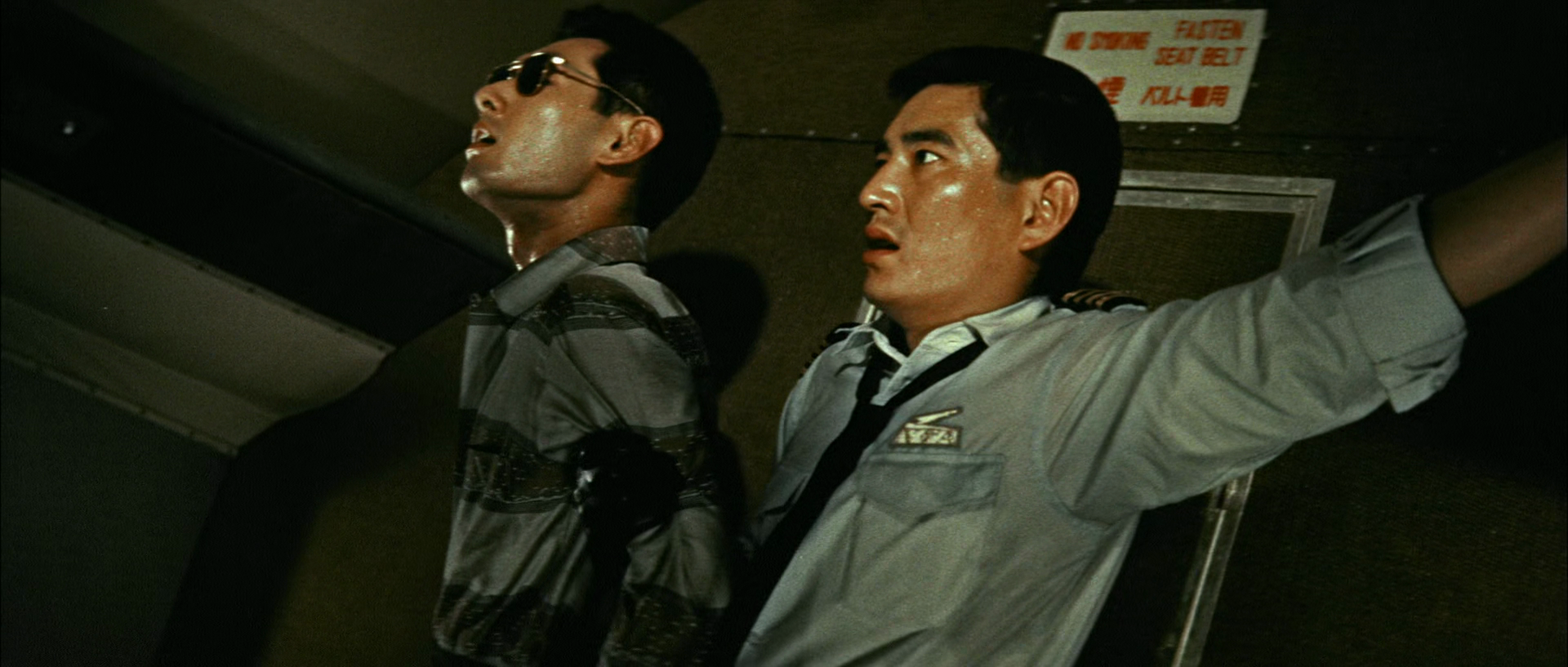
Kida (Fumitake Omura), the fugitive, is dressed like a stereotypical yakuza which makes it odd that no one treats him with suspicion until they spot he’s carrying a gun which he had no trouble at all bringing on board. Though hijackings are not exactly unheard of, they aren’t particularly common either so no one would really suppose anyone had any reason to take a domestic flight to the provinces hostage, and really that was never Kida’s intention merely a last resort after being discovered. Later he gives a partial justification for his life of crime in that his mother beat him and then threw him off a cliff which is why he has a false leg. In any case, there’s a small moment of potential redemption towards the end when the kindly old lady tells him he can’t undo what he’s done, but could still resolve to change assuming they all survive this difficult situation with the plane which now has mechanical problems thanks to the gun going off. 

Even so, it’s the passengers who tie Kida up after the pilot ,Yamamoto (Ken Takakura), manages to disarm him by weaponising the plane. By flying to a high altitude, they knock him out with the air pressure, but are then faced with the mechanical failure of the landing gear which seems to be linked to with Yamamoto’s wartime trauma. A secondary drama revolves around his stoical character with one of the stewardesses apparently in love with him while simultaneously wary of his iciness given that he apparently showed no emotion after receiving the news his wife had passed away but simply flew the plane home as normal. Some see this as his devotion to the aircraft which is in a way a commitment to his duty over his human feelings, the factor that perhaps allows him to save the plane and get the passengers home safely. He is however saved by his love for his late wife with the cigarette case that contains her photo saving him from the worst effects of a bullet. 

The same may go for the co-pilot Hara (Kenji Imai) who is dragging his feet over his marriage to Yamamoto’s sister because he wants to achieve 3000 flight hours before getting married so he can call himself a real pilot. Though the film plants the seeds of these random plot threads and the social commentary that goes with them, it does not particularly engage while the hijacking itself remains fairly low key given that Kida is not a particularly “bad” bad guy. He just wants to go to a random place where the police won’t be waiting for him, but otherwise refrains from harassing the passengers save threatening a little boy travelling on his own to return to his parents after visiting his grandfather in Tokyo. In essence, there’s a kind of innocence and naivety in play which speaks to something of post-war hopefulness and a wonder in the frantic pace of progress in which the day is saved by keeping calm and carrying on even in the face of severe adversity.


Trailer (no subtitles)
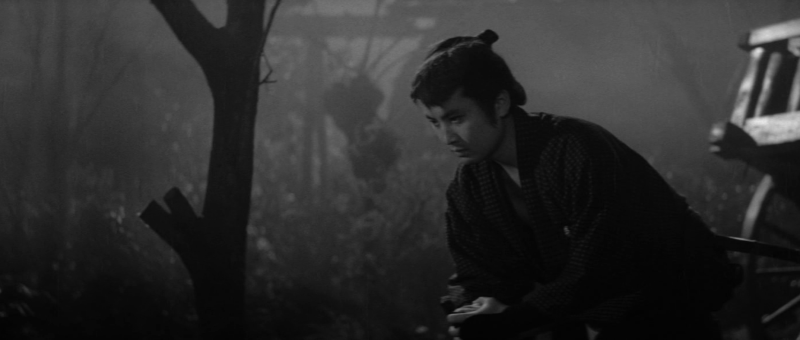
Wind, Woman and Road (風と女と旅鴉, Tai Kato, 1958)

Tai Kato joined Toei’s Kyoto studio in 1956 having made his directorial debut at the independent production house Takara Productions in 1951 shortly after being letting go from Daiei in 1950 during the Red Purge (he had been chief secretary for studio’s the labour union). Heavily influenced by and a great admirer of Daisuke Ito, Kato had a passion for chanbara and jidaigeki which were Toei’s mainstays at the time, but even while making what were essentially programme pictures his approach was anything but conventional. With 1958’s Wind, Woman, and Road (風と女と旅鴉, Kaze to Onna to Tabigarasu), Kato embarked on what would become a signature style of “realistic” period drama otherwise at odds with the formulaic nature of the genre. 

As he would continue to do, Kato instructed his cast not to wear makeup and while casting kabuki actor/chanbara megastar Kinnosuke Nakamura insisted on a more modern performance style than the sometimes mannered theatricality of the traditional samurai film. Ginji is cocksure young man living on the road after being kicked out of the hometown he is now travelling towards because of a crime supposedly committed by his long absent father. On the way, he runs into Sentaro (Rentaro Mikuni), a middle-aged man recently released from prison who is struck by his appearance and immediately asks how old he is realising that Ginji is about the same age as his own son who died as a result of a fight. 

The two begin walking together and Ginji tells Sentaro that his village sends gold to the governor around this time every year as a bribe to get lower taxes which doesn’t make a lot of economic sense but evidently works for them. Last year, the gold was stolen by notorious bandit Hanzo the Shark (Eitaro Shindo) and two villagers were killed during the robbery. Ginji half jokes about teaming up to steal it, and then playfully attacks Sentaro leading the entourage escorting this year’s payment to flee in terror leaving the gold behind. Sentaro encourages Ginji to take the money back to the village, but he is later shot by the returning villagers who think they must be Hanzo’s henchmen pulling the same stunt as last year. 

Unlike the typical chanbara hero, Ginji is petulant and resentful. He has a very modern way of speaking and is rebellious in character as you might well expect him to be given his life experiences. The other villagers are not happy to see him and continue tar him with his father’s brush, sure that the son of a thief can’t be any better while Ginji pines for his late mother claiming that the villagers’ harassment along with the inability to support herself economically led her to take her own life. Once a member of Hanzo’s gang he vacillates between a desire to be accepted by the village and that to take his revenge on it. Sentaro meanwhile is determined to save him, regretful that he could not save his own son from the life that he had led as a yazkuza and petty criminal. 

There is a persistent sense that everyone here is at heart a wanderer. The doctor’s daughter Ochika (Yumiko Hasegawa) who develops a fondness for both men relates that she was lured away from the village by an itinerant actor and fell into a life of ruin before returning to discover that her mother had passed away. The headman’s adopted daughter Oyuki (Satomi Oka) with whom Ginji falls in love tells him that she too is an orphan, her father was a medicine pedlar who dropped dead in the village which then took her in. Echoing a sense of rootlessness in the post-war world, they are all in someway displaced and looking to restore connections which have previously been broken but largely failing or unable to do so. Ginji is torn between his criminal past and the reformed future offered to him by the more positive paternal relationship he develops with Sentaro who, unlike his own father, is readily accepted by the village which is unaware that he previously spent time in prison. 

The final showdown takes place in a windswept clearing filled with Kato’s trademark mist as Ginji finally picks a side only to realise that that in the end he will always be a wanderer, a rootless figure whose only home is the road. Kato shoots a little higher than he would subsequently but still rests a little lower than the norm, emphasising a sense of destabilisation in Ginji’s volatility along with a painful longing that keeps him a lonely soul lost in the fog and on perpetual journey towards a long forgotten home. 


Law in Ghost Island (幽霊島の掟, Yasushi Sasaki, 1961)

The post-war world was one of increasing globalisation which brought with it anxiety as well as hope as Japan readied itself to step back onto the world stage. The populist cinema of the early ‘60s is marked by ambivalent attitudes to international influences, not just towards creeping Americanisation and its perceived costs but perhaps somewhat uncomfortably towards the wider world and Asia in particular with the same old prejudices which had marked the previous 20 years rearing their heads once again. Voice of the post-war era, the films of Hibari Misora are, by contrast, about as forward looking and progressive as it was possible to be but Law in Ghost Island (幽霊島の掟, Yurei-jima no Okite) in which she plays a noticeably smaller part, is a bizarre exception in which a “lawless” melting pot outpost must be “civilised” by Japanese influences else the creeping rule of thuggish Asian gangs finally reach Japan “proper”.

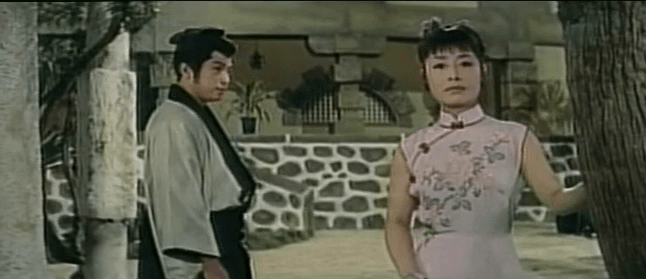
We’re deep in the Bakumatsu. The Black Ships have already arrived and there is considerable political trouble brewing back in Japan. That’s not our immediate concern however because we’re on a creepy boat with slovenly ronin Yagi Hanzo (Hashizo Okawa) and a mysterious woman wearing a cheongsam (Hibari Misora). Fellow petty gangster and slave trafficker Bunji (Chiyonosuke Azuma) is suspicious of Hanzo, but decides he’s probably just an unlucky retainer on the run from something or other and might prove useful. Therefore, on arrival at Dragon Island, Bunji starts on trying to recruit Hanzo for his boss Chou Yang Po (Isao Yamagata), but Hanzo’s his own man and he hasn’t come here looking for a job. Fearing Hanzo is a government official here to bring the law down on all their heads, Chou tries to force him to harm a man they have in custody and believe to be working for the state. Hanzo gets round this by breaking a chair over the man’s back but leaving him otherwise unharmed, keeping his cover (if that’s what it is) firmly intact.

During his stay on Dragon Island, Hanzo will meet several other shady characters, many of them dressed in outfits more usually associated with the Chinese, Indians, nondescript “islanders”, and strange movie pirates, but what must be assumed is that though Japan “owns” this distant island it is unable to police it and as such it has become a den of scum and villainy in which various tribal gangs vie for hegemony and control over the lucrative smuggling hub which has unwittingly formed in direct response to Japan’s unwise policy of internal isolation which is itself at breaking point thanks to Perry’s Black Ships which we later hear are also on their way to Dragon Island.

Our key into this conflict is the crazed child of the leading gangster, Isakichi (Hiroki Matsukata), who dresses like a cowboy and likes to showoff his hard-won saloon credentials as sharpshooting libertine and all round party animal. Hanzo is not as impressed by this as Isakichi was hoping though an awkward sort of camaraderie eventually arises between them. Meanwhile, Isakichi has fallen in innocent love with the sister of his childhood best friend who is deep into a putative resistance movement hoping to end the stranglehold the smugglers have placed over the previously peaceful island.

Misora’s Madame Song, for some reason posing as a Chinese sex worker, hints at the various ways nothing is quite as it seems in her astute observations of the world around her, sensing that Hanzo is hiding something but also assuming that he is on the “right” side. There is conspiracy everywhere – the putative revolution at home is sending its shockwaves all the way out here as our unscrupulous gangsters try to procure guns to send to various sides on the mainland, while Madame Song ironically laments that what Dragon Island needs is to be more like Japan which is to say ruled less by law itself than an internalised acceptance of the proper order of things. Uncomfortably, it also probably means sending the people who aren’t wearing kimono somewhere else and trying to stop them tricking nice women from Kyushu into coming to tropical islands where they discover they’ve been trafficked into sex work and are unable to leave.

Among Toei’s lower budgeted efforts, Law in Ghost Island bills itself as a supernatural tale and does indeed open with a creepy scene of a misty boat but Hanzo doesn’t end up anywhere like the isle of the dead only a fantasy tropical “paradise” filled with zany movie pirates. Somewhere between pirate fantasy and western, Law in Ghost Island is closer to the kind of spy spoofs Toho would start producing in a few years’ time and even ends with a strangely comic scene in which just about everyone reveals themselves as spy for the same side during the climactic final shootout having been too busy playing spy games to figure any of it out before.

The final messages too are uncomfortable and ambivalent as Hanzo affirms that if there were more “good samurai” Japan would not become lawless like it is here while also claiming Dragon Island for the mainland in fear external forces may use it as a base to attack Japan. The smugglers pay heavily for their “treachery” in contributing to internal mainland chaos while the revolutionary islanders declare their intentions to make the island a better place, which mainly seems to mean making it more “Japanese” which is a fairly ambivalent message whichever way you look at it. Misora only sings two songs and is relegated to a minor mystery in the strange goings on of Ghost Island which features absolutely no ghosts or supernatural intrigue. It does however perhaps shine a light on a strange moment of cultural flux however how unflattering that mirror may turn out to be.


Brief clip of some of Hibari’s songs (no subtitles)

https://www.youtube.com/watch?v=ryNk8dAVVnI

Ghost in the Well (怪談番町皿屋敷, Toshikazu Kono, 1957)

Ghost in the Well poster 2Love across the class divide threatens to overthrow the social order. Inspired by the classic folktale Bancho Sarayashiki, Ghost in the Well (怪談番町皿屋敷, Kaidan Bancho Sarayashiki) is indeed the story of a haunting though perhaps not altogether of the kind you might be expecting. This is a tale of romance, but also one of impossible love in which the only possible union is in death. The pure love of a servant girl is deemed incompatible with the oppressive world of samurai honour, and so she must die, but her lord cannot survive it. He cannot reconcile himself to having chosen to preserve his honour, his status, his lineage at the cost of her life and his love.

Rowdy samurai Harima (Chiyonosuke Azuma) loves making trouble in the streets. As the lord’s bannerman he knows he has a degree of status and likes to throw his weight around in the yoshiwara, much to the lord’s consternation. Harima has also taken a fancy to one of his maids, Okiku (Hibari Misora), who continues to reject his advances despite returning his affections because she knows the class difference makes a legitimate relationship between them impossible and a dalliance with her lord means losing the opportunity to marry anyone else. Harima tells her that there’s no such thing as status when it comes to love and that he doesn’t think of her as a passing infatuation. Eventually Okiku gives in and a kind of promise is made between them.

Nevertheless, it’s a promise which can’t be kept. The Aoyama family is in trouble and the obvious answer is to make a good match for Harima that will restore both status and wealth. When one of Harima’s friends is ordered to commit seppuku for the exact same petty punk antics Harima gets up to all the time matters come to a crunch. To keep him safe, Harima’s uncle arranges a marriage with an influential family. Harima tries to refuse but he too is more or less powerless even if he weren’t torn between the obligation to his samurai code and his illicit love for servant girl whom he would never be permitted to make his wife. To cement the match, Harima’s uncle has prepared 10 precious plates as a dowry, but Okiku, catching sight of Harima’s bride-to-be, drops one and breaks it in two. Her fate is sealed. Harima draws his sword on her and she backs away, eventually falling into the well and dying there.

The broken plate is, of course, a symbol of their broken covenant but also of Okiku’s shattered dreams as she watches a beautiful but haughty woman steal away her last hope of happiness solely through the accident of noble birth. As her friend tells her, a commoner cannot become the wife of a samurai and all Okiku can do is resign herself to her unhappy fate. Having broken the plate, however, all is lost. The men of the household admit their responsibility for entrusting the entirety of their future to a mere slip of a girl in the middle of intense heartbreak, but Okiku cannot go unpunished and Harima must claim his new life by destroying his past love.

Harima does what he’s supposed to do, if in passion and half by accident. Yet the marriage remains broken, the family in jeopardy, and Harima without hope of future. The ghost of Okiku, real or imagined, haunts him while he remains guilt ridden and filled with regrets. Despite his rowdiness and manly pride, he chose his samurai honour and condemned his one true love to a lonely death. Her love has, however, survived and resurrected her not as a demon of vengeance come to lead him to his doom but as a lovelorn woman keen to remind him of the promise he made and broke but which might be mended.

Harima pays for his transgressions, though more as a mischievous samurai who allowed his over inflated ego to convince him he had the right to oppress his fellow retainers than as a man who caused the death of an innocent woman, first by corrupting her and then by the same rigidity which has led to his present predicament. There can be no “love” in a such a society, let alone the love of a bannerman and a servant girl. Theirs is a blood wedding, uniting them in death, consumed by the impossibilities of the samurai era. At only 45 minutes, Ghost in the Well is perhaps a slight retelling of the tale and somewhat in imbalanced in its presentation of the fates of the two lovers but is nevertheless a refreshingly romantic take on an often dark story in which a scorned woman’s vengeance is reframed as a powerful condemnation of an oppressive society.


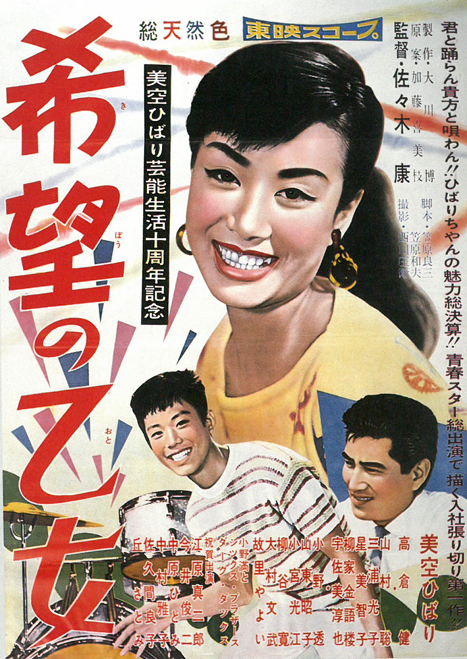
With Song in Her Heart (希望の乙女, Yasushi Sasaki, 1958)

song in her heartAnother vehicle for post-war singing star Hibari Misora, With a Song in her Heart (希望の乙女, Kibo no Otome) was created in celebration of the tenth anniversary of her showbiz debut. As such, it has a much higher song to drama ratio than some of her other efforts and mixes fantasy production numbers with band scenes as Hibari takes centre stage playing a young woman from the country who comes to the city in the hopes of becoming a singing star.

After beginning with a rural, almost cowboy-style number in which Hibari appears as the well dressed lady of the manor, Sayuri, riding her horse across the wide pastureland, the action quickly moves to the city when Sayuri’s mentor finally convinces her uncle that her future lies in showbiz and not an early marriage as he had envisioned. However, once she gets there she finds her potential tutor extremely unwilling to fulfil his promise to take her on. After winning him over, she quickly makes friends with the locals who also want the singing teacher to become the leader of a band they’ve formed in the hopes of raising some money to build a proper children’s playground to stop them playing in dirty ditch land nearby which is a well known health hazard. Soon enough the band takes off but there’s more trouble ahead for Hibari and co. as they are betrayed by those closest to them.

Working as a celebration of Hibari’s career so far With a Song on Her Heart is filled with excuses for Hibari to sing both as a music student and band vocalist as well as fantasy production numbers some of which are even bigger on dance than on song. The plot is quite simple but there is a lot of it, in contrast to other films of this kind, as Hibari sets about healing the grief stricken heart of her bandleader and fulfilling the hopes of the ordinary people turned musicians through the power of song. The romance element is a light one and not the focus of the film but bears mentioning as Hibari’s love interest is played by Ken Takakura – the archetypical star of the yakuza movie who was to marry fellow singing sensation (and frequent Hibari Misora co-star) Chiemi Eri the following year.

Despite its nature as a celebratory project, With a Song in Her Heart doesn’t quite meet the high production standards of other Misora starring films. Shot in colour and in 2.35:1, the majority of the film is studio bound (often very obviously so) with simple sets and a straightforward directing style. Nevertheless, even if it fails to impress on a technical level, With a Song in Her Heart knows what it’s about and so it makes sure to fill its relatively short duration with as many songs as possible, light romance and a cheerful atmosphere of people coming together to try and solve a social problem through spreading love and joy in the form of music. The musical styles are unusually varied embracing Hibari Misora’s regular ballads as well as mixing in world influences from mariachi to african drums with a strong big band jazz undercurrent.The overall feeling is one of goodnatured wholesomeness and even if low on impact With a Song on Her Heart is a decent showcase for Hibari Misora’s talents as she celebrates her tenth year in the business at the age of only 21.