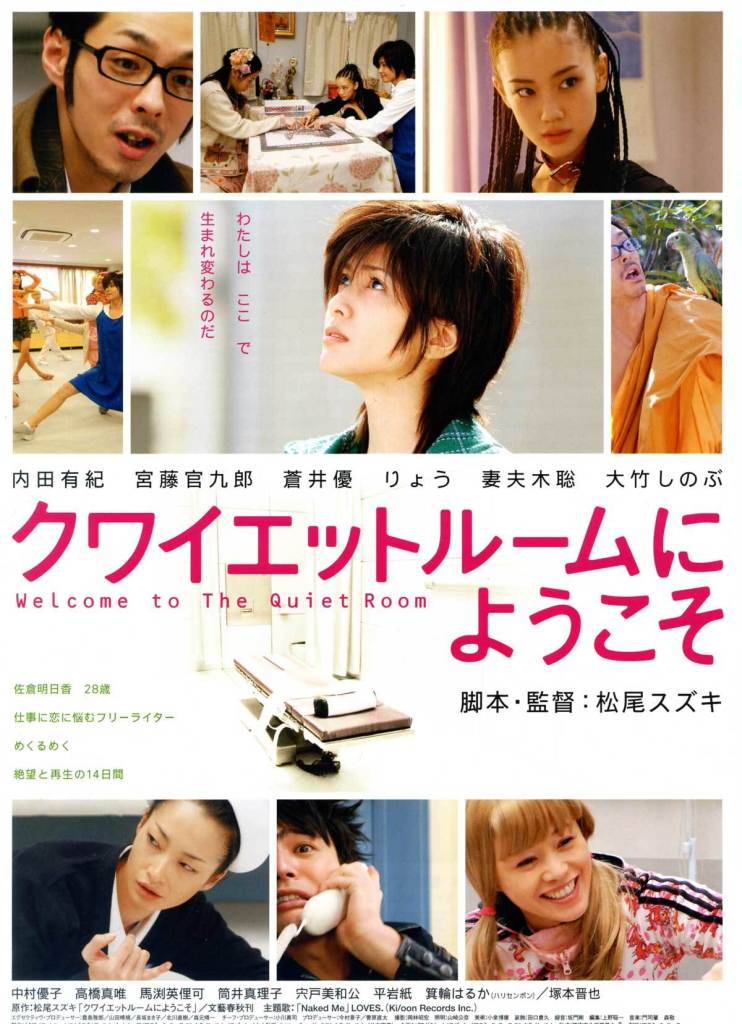
Welcome to the Quiet Room (クワイエットルームにようこそ, Suzuki Matsuo, 2007)

welcome-to-the-quiet-roomEveryone has those little moments in life where you think “how did I get here?”, but thankfully most of them do not occur strapped to a table in an entirely white, windowless room. This is, indeed, where the heroine of Suzuki Matsuo’s adaptation of his own novel Welcome to the Quiet Room (クワイエットルームにようこそ, Quiet Room ni Yokoso) finds herself after a series of events she can’t remember but which seem to have involved pills and booze. A much needed wake up call, Asuka’s spell in the Quiet Room provides a long overdue opportunity to slow down and take a long hard look at herself but self knowledge can be a heavy burden.

After her initial confusion, Asuka (Yuki Uchida) is informed by the no nonsense matron, Eguchi (Ryo), that she’s been brought in after an overdose. Everyone seems to assume it’s a suicide attempt, though Asuka can’t remember a thing. Apparently her roommate found her and called and ambulance and has now signed the committal papers which means Asuka is stuck here until the doctors say she’s fit to leave. Aside from the obvious, this is bad news because Asuka has a series of tight deadlines she’s been busting her gut to meet and is worried about losing her contracts. Whatever she might feel about it, it seems as if Asuka will have to rely on the kindness of strangers a little longer before she can finally get back to her exciting freelance world.

Aspects of Asuka’s previous life are illuminated gradually through flashback accompanied by her post-committal deadpan voiceover. After a brief career as a model, Asuka got married, divorced, and then hooked up with her present roommate, Tetsuo (Kankuro Kudo), who hooked her up with a series of freelance writing gigs which have only contributed to her stress levels with their ever present deadlines. Prior to her hospitalisation, Asuka was a rather silly, perky woman with a self confessed preference for “idiots” when it came to her circle of friends. Slowly and in the absence of her regular methods of self medication, all of Asuka’s illusions about herself and the way she was living her life begin to crumble. Finally able to cut through the noise, Asuka is forced to come to terms with a significant amount of guilt relating to a decision taken during her marriage whilst also acknowledging the effect crippling depression has had on her way of life.

Whilst in the hospital, Asuka comes in to contact with the other residents who have various needs and demands, each exemplifying the problems plaguing modern women. Tellingly, the majority of the women on the ward are younger – some just teenagers or young adults, all suffering with various kinds of eating disorders. One such patient, Miki (Yu Aoi), quickly befriends Asuka and teaches her how to survive in the increasingly surreal hospital environment. Asuka later makes friends with another recovering overdose patient around her own age, Kurita (Yuko Nakamura), but conversely finds herself harassed by the ward’s resident fixer, former adult video actress Nishino (Shinobu Ootake), while other residents make repeated escape attempts or go to great lengths to set their hair on fire.

Asuka’s Wizard of Oz inspired outfit, hair, and the silver Dorothy slippers which play into a repeated motif of Asuka’s memories of a high school culture festival, all reinforce the idea of the hospital as a strange otherworldly place in which Asuka will be residing temporarily until she completes her quest. The temporary nature of the space gives Asuka’s journey a rather melancholy atmosphere as she’s encouraged to forget all about her time there when transitioning back to the “real world” meaning that the fragile bonds and friendships created during in her hospital sojourn will have to be left behind. Finally learning to calm down and take charge of herself, Asuka rediscovers a long absent inner strength and the last image we see of her is in raucous laughter after an catching sight of an improbable event through a car window.

Matsuo opts for a less madcap treatment than the far out comedy of Otakus in Love but carefully balances an absurd sense of humour with dramatic weight as Asuka’s personal discoveries are intercut with increasingly surreal episodes. Yuki Uchida shines in a early comeback role as the two very different Asukas even if she almost has the show stolen out from her by another beautiful performance from Yu Aoi as the sensitive goth Miki. Tackling a weighty subject with warmth and good humour, Welcome to the Quiet Room is another characteristically off the wall character piece from Suzuki, but all the better for it.


Original trailer (no subtitles)
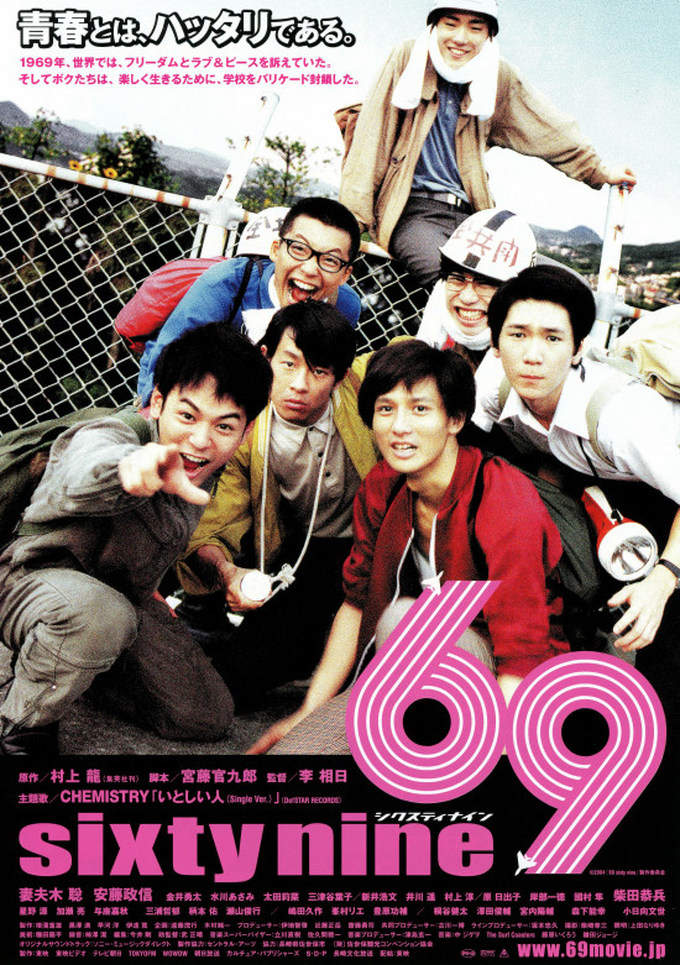
69 (Lee Sang-il, 2004)

69Ryu Murakami is often thought of as the foremost proponent of Japanese extreme literature with his bloody psychological thriller/horrifying love story Audition adapted into a movie by Takashi Miike which itself became the cornerstone of a certain kind of cinema. However, Murakami’s output is almost as diverse as Miike’s as can be seen in his 1987 semi-autobiographical novel 69. A comic coming of age tale set in small town Japan in 1969, 69 is a forgiving, if occasionally self mocking, look back at what it was to grow up on the periphery of massive social change.
The swinging sixties may have been in full swing in other parts of the world with free love, rock and roll and revolution the buzz words of the day but if you’re 17 years old and you live in a tiny town maybe these are all just examples of exciting things that don’t have an awful lot to do with you. If there’s one thing 69 really wants you know it’s that teenage boys are always teenage boys regardless of the era and so we follow the adventures of a typical 17 year old, Ken (Satoshi Tsumabuki), whose chief interest in life is, you guessed it, girls.

Ken has amassed a little posse around himself that he likes to amuse by making up improbable fantasies about taking off to Kyoto and sleeping with super models (oddly they almost believe him). He talks a big about Godard and Rimbaud, posturing as an intellectual, but all he’s trying to do is seem “cool”. He likes rock music (but maybe only because it’s “cool” to like rock music) and becomes obsessed with the idea of starting his own Woodstock in their tiny town but mostly only because girls get wild on drugs and take their tops off at festivals! When the object of his affection states she likes rebellious guys like the student protestors in Tokyo, Ken gets the idea of barricading the school and painting incomprehensible, vaguely leftist jargon all over the walls as a way of getting her attention (and a degree of kudos for himself).

69 is a teen coming of age comedy in the classic mould but it would almost be a mistake to read it as a period piece. Neither director Lee Sang-il nor any of the creative team are children of the ‘60s so they don’t have any of the nostalgic longing for an innocent period of youth such as perhaps Murakami had when writing the novel (Murakami himself was born in 1952). The “hero”, Ken, is a posturing buffoon in the way that many teenage boys are, but the fact that he’s so openly cynical and honest about his motivations makes him a little more likeable. Ken’s “political action” is merely a means of youthful rebellion intended to boost his own profile and provide some diversion at this relatively uninteresting period of his life before the serious business of getting into university begins and then the arduous yet dell path towards a successful adulthood.

His more intellectual, bookish and handsome buddy Adama (Masanobu Ando) does undergo something of a political awakening after the boys are suspended from school and he holes up at home reading all kinds of serious literature but even this seems like it might be more a kind of stir crazy madness than a general desire to enact the revolution at a tiny high school in the middle of nowhere. Ken’s artist father seems oddly proud of his son’s actions, as if they were part of a larger performance art project rather than the idiotic, lust driven antics of a teenage boy but even if the kids pay lip service to opposing the war in Vietnam which they see on the news every night, it’s clear they don’t really care as much as about opposing a war as they do about being seen to have the “cool” opinion of the day.

Lee takes the period out of the equation a little giving it much less weight than in Murakami’s source novel which is very much about growing up in the wake of a countercultural movement that is actually happening far away from you (and consequently seems much more interesting and sophisticated). Were it not for the absence of mobile phones and a slightly more innocent atmosphere these could easily have been the teenagers of 2003 when the film was made. This isn’t to criticise 69 for a lack of aesthetic but to point out that whereas Murakami’s novel was necessarily backward looking, Lee’s film has half an eye on the future.

Indeed, there’s far less music than one would expect in the soundtrack which includes a few late ‘60s rock songs but none of the folk/protest music that the characters talk about. At one point Ken talks about Simon & Garfunkel with his crush Matsui (Rina Ohta) who reveals her love for the song At the Zoo so Ken claims to have all of the folk duo’s records and agrees to lend them to her though his immediately asking to borrow money from his parents to buy a record suggests he was just pretending to be into a band his girl likes. Here the music is just something which exists to be cool or uncool rather than an active barrier between youth and age or a talisman of a school of thought.

Lee’s emphasis is firmly with the young guys and their late adolescence growth period, even if it seems as if there’s been little progress by the end of the film. There’s no real focus on their conflict with the older generation and the movie doesn’t even try to envisage the similar transformation among the girls outside of the way the boys see them which is necessarily immature. That said, the film is trying to cast a winking, wry look back at youth in all its eager to please insincerity. It’s all so knowingly silly, posturing to enact a revolution even though there’s really no need for one in this perfectly pleasant if slightly dull backwater town. They’ll look back on all this and laugh one day that they could have cared so much about about being cool because they didn’t know who they were, and we can look back with them, and laugh at ourselves too.


Ryu Murakami’s original novel is currently available in the UK from Pushkin Press translated by Ralph McCarthy and was previously published in the US in the same translation by Kodansha USA (but seems to be out of print).

Unsubtitled trailer:

and just because I love it, Simon & Garfunkel At the Zoo

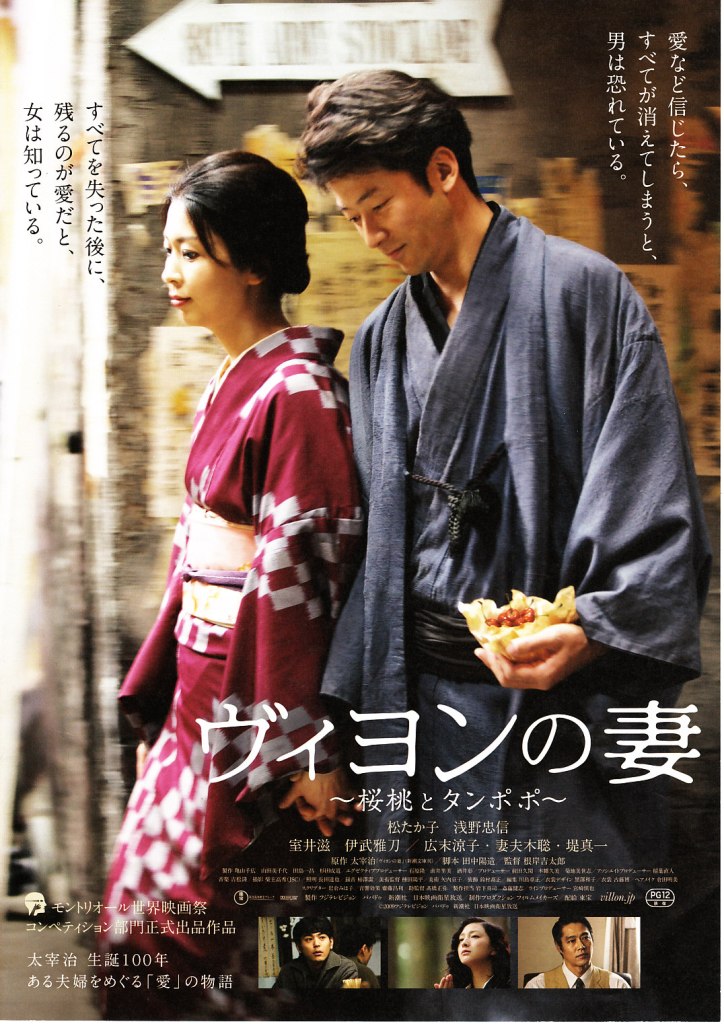
Villon’s Wife (ヴィヨンの妻 〜桜桃とタンポポ, Kichitaro Negishi, 2009)

Villon's Wife2009 marked the centenary year of Osamu Dazai, a hugely important figure in the history of Japanese literature who is known for his melancholic stories of depressed, suicidal and drunken young men in contemporary post-war Japan. Villon’s Wife (ヴィヨンの妻 〜桜桃とタンポポ, Villon no Tsuma: Oto to Tampopo) is a semi-autobiographical look at a wife’s devotion to her husband who causes her nothing but suffering thanks to his intense insecurity and seeming desire for death coupled with an inability to successfully commit suicide.
Beginning in the immediate post-war period of 1946, Sachiko (Takako Matsu) is a fairly ordinary housewife with a young son who generally waits around the house for her husband’s return. Only, she’s married to one of the most brilliant writers of the age, Joji Otani (Tadanobu Asano), whose book on the French poet François Villon is currently a best seller. Despite his obvious literary talents, Otani is a drunkard who spends most of his time (and money) in bars and with other women. When he crashes home one night only to be pursued by two bar owners who reveal that he ran off with their takings (around 5000 yen), Sachiko is not exactly surprised but still embarrassed and eventually takes matters into her own hands by volunteering to offer herself as a “hostage” by working at the bar until the debt is repaid.

“Men and women are equal now, even dogs and horses” says one customer, impressed with this sudden arrival of a beautiful woman in a low life drinking spot. To her own surprise, Sachiko actually enjoys working at the bar, it gives her purpose and proves more interesting than being stuck at home waiting to see what her drunken fool of a husband has got up to next. She’s good at it too – Sachiko is a beautiful and a fundamentally decent and kind person, in short the sort of woman that everyone falls a little bit in love with. That said, she isn’t a saint. She’s perfectly aware of the power she is able to wield over men and is unafraid to make use of it, though only when absolutely necessary.

Otani himself is a fairly pathetic figure. He may be a great artist but he’s a hollow human being. He admits the reason for all of his vices is fear – he’s a afraid to live but he’s also afraid to die. He seems to love his wife, though he’s insecure about losing her and dreads the embarrassment involved in becoming a cuckold. So afraid to face the possibility of failure, Otani satisfies himself in an underground world of drunks and easy women rather than facing his own self loathing as reflected in the faces of his unconditionally loving family.

Perhaps because Villon’s Wife is a commemorative project, the film has been given the prestige picture treatment meaning the darker sides of Dazai’s original novella have been largely excised. The chaos of the post-war city with its starving population, soldiers on the streets and generalised anxiety is all but hidden and some of the more serious travails Sachiko undergoes in devotion to her husband as well as Otani’s tuberculosis (from which Dazai also suffered in real life) have also largely been removed. What remains is the central picture of a self destructive husband and the goodly wife who’s trying to save him from himself but risks her own soul in the process.

The one spot of unseemliness of post-war life that the film lets through is in a brief scene which features a group of pan pan girls hanging around ready to try and snag some passing GIs. Sachiko buys some lipstick from them to use in attempt to convince an ex who is also a top lawyer to try and help her husband after his latest escapade lands him in jail on a possible murder charge. After visiting him, Sachiko wanders out slightly dazed to see the pan pans atop a military jeep cheerfully waving and shouting “goodbye” in English. Sachiko is confused at first but eventually shouts “goodbye” back in a way which is both excited and a little bit sad, perhaps realising she is not so different from them after all. Finally she wipes the lipstick from her face and leaves the small silver tube behind where the pan pans were sitting, hoping to bury this particular incident far in the past.

In actuality the pan pan girls are depicted in a fairly matter of fact way rather than in the negative light in which they are usually shown, just another phenomenon of occupation. At the end of the film Otani calls himself a monster whilst acknowledging that he’s a terrible father who would steal the cherries from his own son’s mouth. Sachiko replies that it’s OK to be a monster – as long as we’re alive, it’ll be alright. Oddly for someone so suicidal, this fits in quite well with Dazai’s tenet of embracing the simple gift of a dandelion. The film ends on an ambiguous note in which there seems to have been some kind of restoration but it’s far from a happy one as the couple remain locked in a perpetual battle between light and darkness albeit with the balance a little more equalised than it perhaps was before.


The R3 Hong Kong DVD release of Villon’s Wife includes English subtitles.

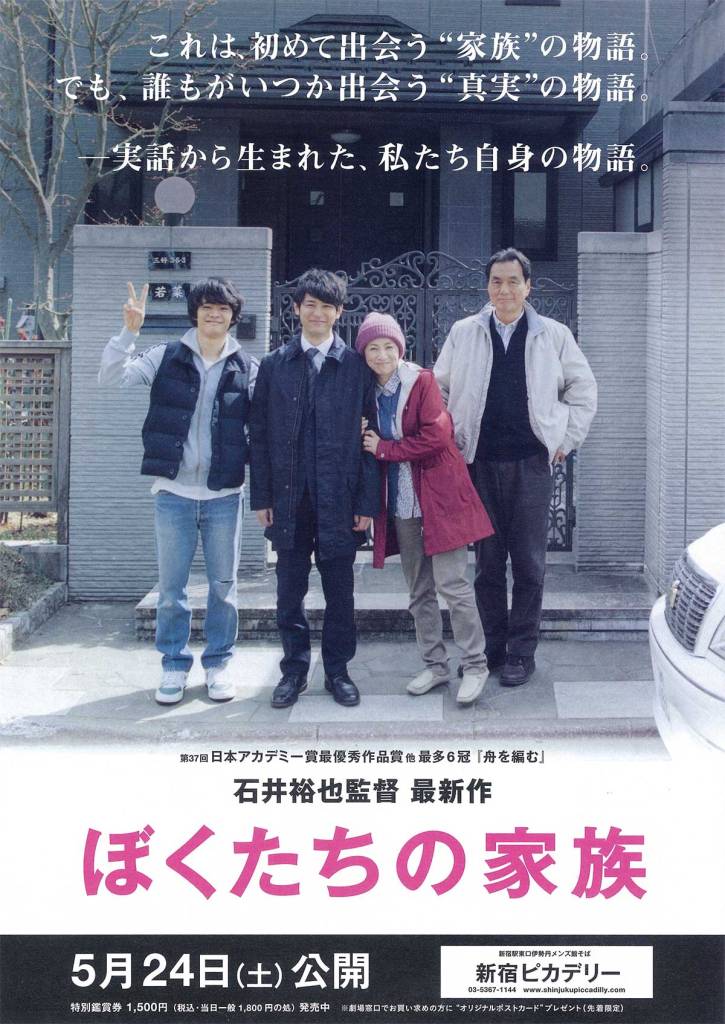
Our Family (ぼくたちの家族, Yuya Ishii, 2014)

Our FamilyYuya Ishii’s early work generally took the form of quirky social comedies, but underlying them all was that classic bastion of Japanese cinema, the family drama. If Ishii was in some senses subverting this iconic genre in his youthful exuberance, recent efforts have seen him come around to a more conventional take on the form which is often thought to symbolise his nation’s cinema. In Our Family Ishii is making specific reference to the familial relations of a father and two sons who orbit around the mother but also hints at wider concerns in a state of the nation address as regards the contemporary Japanese family.
Reiko (Mieko Harada) is an ordinary Japanese housewife in late middle age with a husband still working and two grown up children. She’s been worrying lately that she seems to forget things and she also has periodic trances almost like someone pressed the paused button. This all comes to a head when she and her husband Katsuaki attend a family dinner with their in-laws to celebrate the news that their eldest son, Kousuke (Satoshi Tsumabuki), and his wife are expecting their first child. Having behaved quite strangely all night long, Reiko finally ends by repeatedly addressing her daughter in law by the wrong name and muddling up details about the baby. Reiko’s still young but the natural assumption is perhaps that she’s slipping into senility, dementia or possibly even Alzheimer’s but a visit to the doctor turns up something that no one was expecting as they’re eventually made to understand that Reiko may only have a week left to live.

This devastating news of course sends shock waves through each member of the family and not least Kousuke who’s just learned he’s about to become a father. One of the things Reiko was most distressed about was that she’d wake up one day and her family would have fallen apart. It seems she grew up in an unhappy home and was determined not to replicate the experience for her children. Perhaps she did have cause to worry as there were definite cracks in the foundation of this household even before Reiko’s illness in that youngest son Shunpei (Sosuke Ikematsu) seems to have had a strained relationship with both his father and his older brother. In contrast to the other two men, Shunpei, still a student, is much more laid back and easy going though his father perhaps thinks him feckless and irresponsible. He meets his mother sometimes and she lends him money behind the father’s back but they talk more like friends than a mother and son.

Perhaps this division between the men in her life has been playing on Reiko’s mind but there are other problems too. Part of the bubble generation, Reiko and Katsuaki have been living well beyond their means for years and have amassed considerable personal debt. In fact, Katsuaki remortgaged the house a while back and made Kousuke a guarantor on their loan. Their best option would be to file for bankruptcy but doing that would leave Kosuke liable for the return of the mortgage so Katsuaki is reluctant to pursue that option. Now that Reiko’s in hospital money is at the forefront of everyone’s mind as they contemplate paying not only astronomical medical fees but potentially also paying for a funeral too.

This financial strain spills over into Kousuke’s new family as, when talking to his wife about needing to help out his parents, Kousuke discovers that Miyuki is just about as unsupportive as one could be. She brands Kousuke’s parents as irresponsible dreamers still living in the bubble era and suggests their predicament is both their own fault and their responsibility as, at their age, they should have been saving money for just these kinds of situations. Scornfully she insists that she doesn’t want to be “that kind of parent” and retires to bed in outrage. Having also refused to even accompany Kosuke to visit his mother in hospital (seeming to miss the point that he might be looking for her support rather than asking for appearance’s sake), poor Kousuke is left all alone trying to deal with the impending birth of his child and death of his mother all in a few short weeks.

The crisis does, at least, bring the three men a little closer together as it requires a kind of unilateral action that pushes previous resentments and ill feeling into the background. Reiko’s condition also means that she says some things that she would never have revealed directly to her family which both hint at some of her suffering over the last thirty years but also the deep love she has for her them. Katsuaki is revealed as a fairly ineffectual man who cares deeply but is blindsided by his wife’s condition and unable to face the facts leaving the bulk of responsibility to his oldest son. This kind of family abnegation is anathema in Japan – one would never want to be a burden to one’s children but Katsuaki is now both financially and morally dependent on Kousuke. Kousuke himself is not quite mature enough for this level of responsibility despite his impending fatherhood and his younger brother Shunpei may appear indifferent to everything but is merely putting a brave face on things though he may be the most dependable (and emotionally intelligent) of the three.

By the end, there is a glimmer of hope. The family can be repaired if you’re willing to work at it which means being willing to face the problems together and without any secrecy. Everyone, including the older generation, has in some senses “grown up”, facing the future together having accepted themselves and each other for who they are. Like applying a touch of kintsugi, their glittering wounds have only made them stronger and made each refocus on what’s really important. Neatly moving into a more dramatic arena, Ishii proves he’s still among Japan’s most promising young directors able to marry an idiosyncratic indie spirit with a more mainstream mentality.


The Hong Kong DVD/blu-ray release of Our Family includes English Subtitles!

Unsubtitled trailer:

http://www.youtube.com/watch?v=4D2dweKMgqQ

The Magic Hour (ザ・マジックアワー, Koki Mitani, 2008)

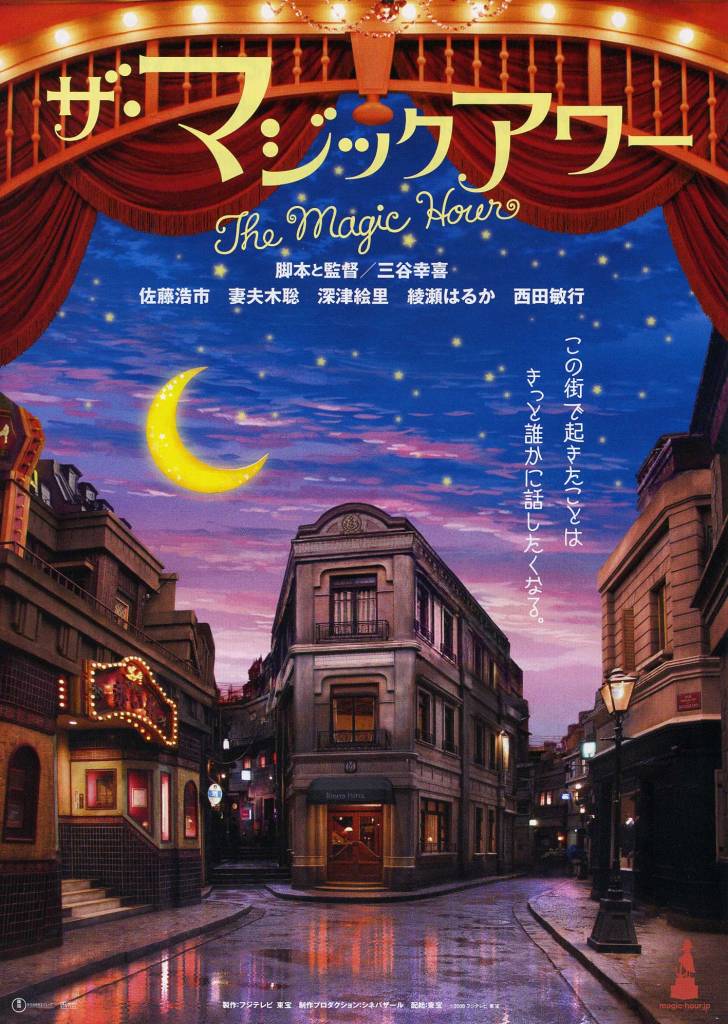
Magic Hour PosterIf there’s one thing you can say about the work of Japan’s great comedy master Koki Mitani, it’s that he knows his cinema. Nowhere is the abundant love of classic cinema tropes more apparent than in 2008’s The Magic Hour (ザ・マジックアワー) which takes the form of an absurdist meta comedy mixing everything from American ‘20s gangster flicks to film noir and screwball comedy to create the ultimate homage to the golden age of the silver screen.
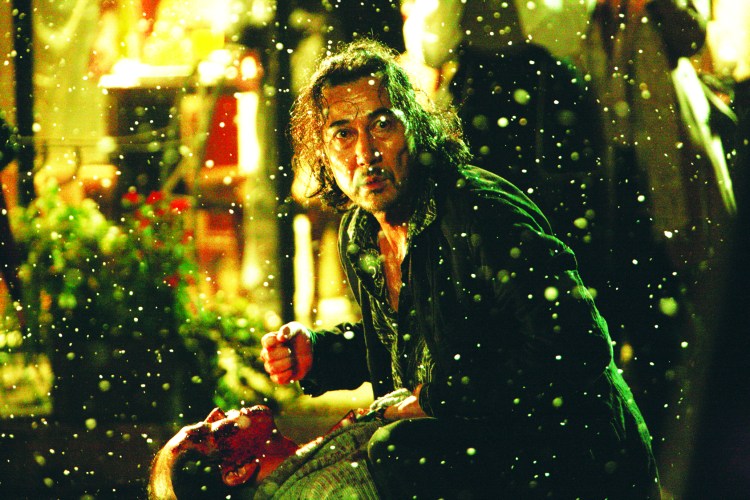
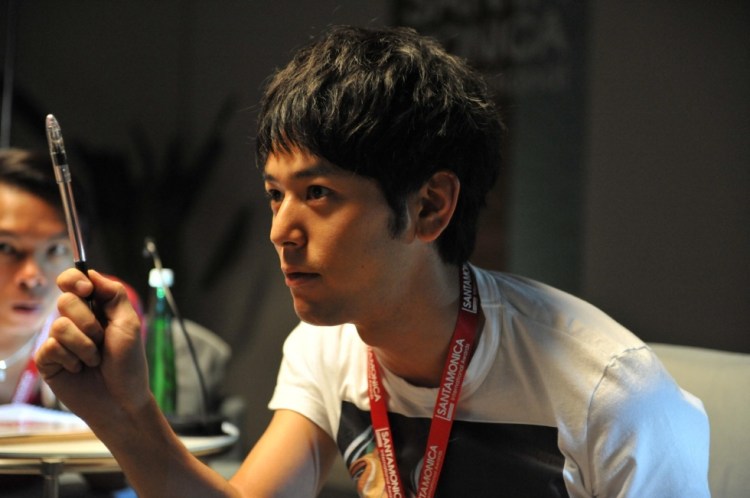
In classic style the film opens with a bunch of goons chasing a scantily clad club owner out of a hotel window. Bingo (Satoshi Tsumabuki) has been hitting the jackpot with the boss’ girl, Mari (Eri Fukatsu), so the two are about to be given a new set of kicks in the latest fashion – cement. Luckily Bingo overhead some of the other guys talking about looking for another gangster, Della Togashi, so he quickly starts talking about him as if he were a long lost friend. The boss, Tessio (Toshiyuki Nishida), gives the pair a reprieve on the condition Bingo tracks down Togashi and brings him in within five days. Slight hitch – Bingo had never heard of Togashi before today and has no idea where to start. Finally, with the help  of some of his bar staff he hatches on the idea of getting a random actor to play the part, seeing as no one knows what Togashi looks like. However, the actor, Murata (Koichi Sato), plays his part a little too well and gets hired to work for the gang all the while thinking it’s just a movie! Pretty much everyone is getting a little more than they bargained for…

If you’re thinking that the oddly American looking 1920s street scene looks a little fake and everyone seems to be overacting like crazy, you wouldn’t be wrong but like everything else there’s a reason for that. What originally looks to be the primary setting for the film is a strange bubble which seems to co-exist with the modern world only its filled with people straight out of The Public Enemy or Scarface who think cement shoes is an efficient way of dealing with traitors. Murata, by contrast, is from our world and is completely oblivious to the strangeness of this movie gangster sound stage universe.

Murata is fixated on the Casablanca-esque final scene of his favourite movie in which a dyed in the wool tough guy entrusts the love of his life to a loyal friend before heading off to face certain death. His own career has not been going particularly well and even if he originally turns down Bingo’s offer as working with a first time director on a film where there’s no script sounds pretty fishy to begin with, circumstances soon find him throwing himself into the mysterious leading role with aplomb. Indulging his long held gangster dreams, Murata becomes the archetypal movie hit-man. He’s giving the performance of his life but has no idea there is no film in the camera.

The “Magic Hour” of the title refers to the twilight time near the end of the day when the light is dying but the conditions are perfect for making a movie. Mitani doesn’t fail to remind us we’re watching a film with constant exclamations of “just like a movie” or “doesn’t this look like a film set”. It’s a Barnum & Bailey world, just as phoney as it can be – but somehow it all just works despite its rather arch, meta approach. By the point we’ve hit Mari sitting on a crescent moon to give us her rendition of I’m Forever Blowing Bubbles (we’re back to The Public Enemy again) we’ve hit peak ‘20s though we scarcely mind at all.

Though he is indeed sending a lot of these classic ideas up, there’s real love here particularly for those golden age Hollywood movies with their wounded tough guys and beautiful chorus girls in need of rescue. Mitani adopts a primarily theatrical tone which meshes well with the absurdist, artificial atmosphere but always makes sure to leave us a fair few clues in the way of laughs. However, probably correctly assuming we know these films as well as he does, Mitani doesn’t give us the typical narrative that would almost write itself (or allow Bingo to write it based on his own trips to the motion picture house). The “bad” guy turns out to be not so bad, the “hero” wasn’t who we thought he was and none of our central guys winds up with a girl. Beautifully silly yet intricately constructed, The Magic Hour is another comedy masterpiece from Mitani which is filled with his characteristic warmth, mild sentimentalism and plenty of off-centre humour of the kind only Mitani can come up with.


The Japanese DVD/blu-ray release of The Magic Hour includes English subtitles.


The World of Kanako (渇き, Tetsuya Nakashima, 2014)

WorldOfKanako-PAnother LFF review up at UK Anime Network – The World of Kanako. I was also lucky enough to interview the director, Tatsuya Nakashima, who was actually very nice and quite chatty in contrast to some of the other interviews I’d read with him! (The consequence being I had way too many questions so it’s sort of a front loaded interview, oh well.) Interview’s already transcribed and in the system so hopefully live soon.


Tetsuya Nakashima is probably best known for his 2010 film, Confessions, which saw a school teacher’s extremely convoluted bid to avenge the death of her daughter at the hands of her students spill out to reveal a whole host of other ‘confessions’ of varying natures from its out of control teenage cast. Though Confessions had its fair share of violence and blood, this is nothing compared to the hellish darkness which fills The World of Kanako. Corrupt cops, teenage femme fatales, wife beaters, child traffickers, pimps and drug dealers make up the cast of this grim exposé of just how wrong you can be about the people most close to you. Those of you with a weak disposition had better step off here – this journey is not for the faint of heart.

Disgraced former policeman Fujishima has a whole host of problems in his life, alcoholism and possible schizophrenia being but two of them. Suddenly he gets a call from his estranged wife who’s out of her mind with worry because their teenage daughter, Kanako, has not been home in a few days. On searching her room in true detective style, he finds a stash of illegal drugs hidden in her school pencil case. This alarming discovery sends Fujishima down an increasingly dark alley way that leads only to the heartbreaking realisation that the kind and beautiful straight A student he believed his daughter to be was no more than a figment of his own imagination.

Fujishima is not a nice guy. There’s not really any other way to put it – he’s an arsehole. A self aggrandising drunk who lives inside a dream where he’s a hero fighting for justice with a loving wife and adorable little daughter waiting for him in their beautiful home. Except that his wife wants nothing to do with him, he hasn’t seen his daughter in a very long time and he’s been kicked off the force and currently works in security. Often drunk and on medication he’s never quite in the moment and therefore neither are we – thrown between flashbacks and unreliable mental images, we begin to float just as freely as Fujishima. It’s testimony to the abilities of the great Koji Yakusho that somehow we still feel a degree of sympathy and a desire to understand Fujishima’s complex psychology despite his deep seated rage which is directed both at himself and others. Deluded beyond belief, his quest to find his daughter is really a thinly veiled attempt to save himself by resurrecting the idealised image he had of her as the one decent thing he’d been able to  build in his life.

His daughter turns out to be daddy’s little girl after all, just not in the way Fujishima originally thought. She may be beautiful and clever, but never kind and her attentions are always part of some grander plan. Like the femme fatales of old and despite her young age, Kanako knows how to get what she wants but what she wants is to cause other people pain. She too lives in a dream, or perhaps a nightmare, as she says at one point falling like Alice in Wonderland through a seemingly endless black hole. There aren’t any ‘decent’ people in this world, everyone is fighting to maintain some kind of delusional self image that will allow them to believe in their own goodness – often through projected images of an idealised family.

Coupled with this intensely dark world, the film wears its influences on its sleeve including ‘60s quirky cool action films, as evidenced by its psychedelic title sequence, and 50s Noir B-movies with their down at heel antiheroes who are often lost in worlds far darker than their imaginings. It’s also true the film is extraordinarily violent in way you don’t generally see in modern times but that doesn’t mean that Nakashima’s gift for intensely beautiful set pieces is entirely absent. The teenager’s world is full of extreme bubblegum pop and purikura garishness coupled with introspective retro tunes and animated sequences which contrast heavily with the adults’ universe of bespoke kitchens and ordered realities.

Ironically, Fujishima turns out to be quite a good detective, though the clues don’t lead him to the answers he really wanted to find. Where they do lead him is ever onward down a dark and dingy rabbit hole with no end in sight. It’s a gloriously bleak tale, but told with an ironic, detached eye that seems to be finding all of this cosmic lack of clarity ever so slightly amusing. The World of Kanako almost redefines the word ‘extreme’ but it does it with so much style that even the most jaded of viewers couldn’t help raising a wry, if slightly depressed, smile.


Dragon Head (ドラゴンヘッド, Joji Iida, 2013)

220992

Judging from the scene that surrounds Teru (Satoshi Tsumabuki) as he struggles to open his eyes, he’s either just waking up after the best party ever or something truly awful must have occurred. Where is he? Feeling around it seems like there are a lot of seats – a plane, or a train? Yes, a train. He remembers being on some kind of trip with his school mates – they were all on the train together so where is everyone? Struggling to get up, stumbling against walls he finds them – dead, all dead. Seemingly the only survivor of some kind of accident, Teru tries to get off the train to find out what’s happened and look for other survivors. It seems the train is trapped in a tunnel, both ends blocked by fallen rubble. Beginning to fear he really is all alone he comes across another boy perched in the window of an adjacent carriage. Small relief however as Nobuo (Takayuki Yamada) seems to be acting very strangely and muttering on about red lights and embracing the darkness. Evading him leads Teru further along the train where he finds another survivor, a girl – Ako, desperately hiding from Nobuo after witnessing him completely losing control whilst looking for survivors.

You might think this is where our three plucky teenagers club together to figure out how to escape the train wreck and get home, but no this is not that type of film. Quicker than you can say Lord of the Flies, Nobuo has gone completely crazy – painting a strange grin on his face with some lipstick he found and dotting his his chest with it too, he even makes a makeshift spear go with with new tribal outfit as a sort of dedicatory effort to his new red light god. He’s very much of the opinion that this stretch of tunnel is the only safe space left on earth and its three inhabitants have inherited a new eden, if they’d just learn to accept it. Teru and Ako though, clearly terrified by Nobuo’s transformation, do little other than wait for help to arrive. When serious tremors start to shake the tunnel and they no longer have any choice but to act they finally manage to climb out through a supply tunnel. What they find on the other side though is a vast desert of ash – all visible signs of human civilisation have been destroyed and they seem to be alone in the world.

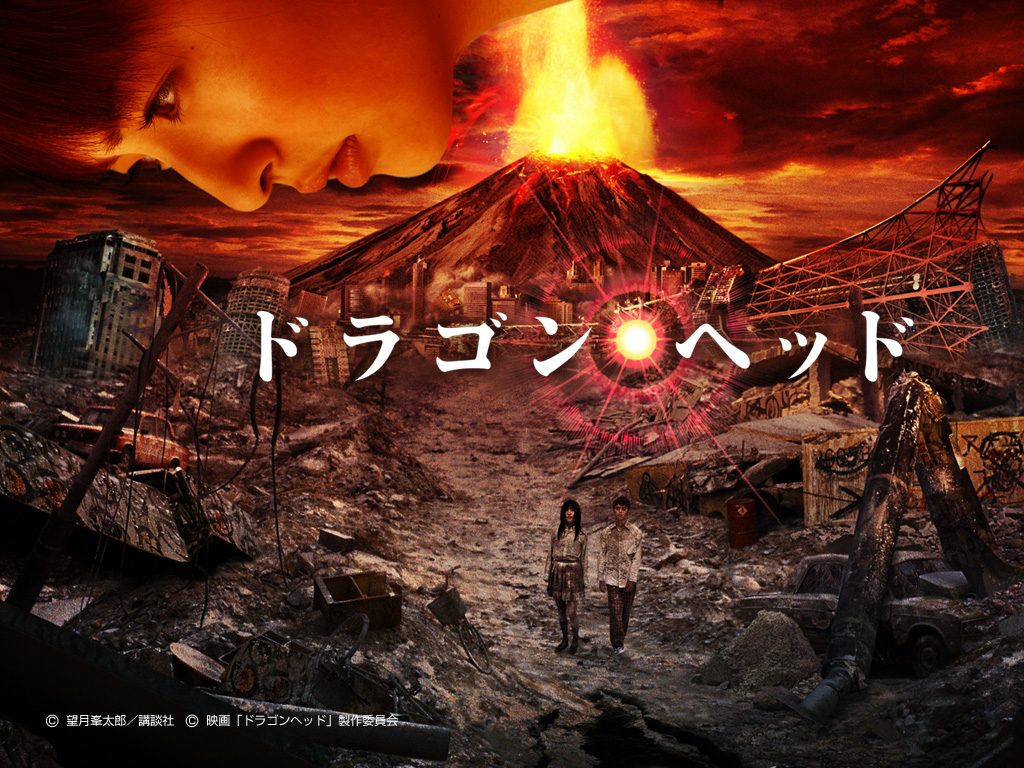
Dragon Head is a bleak, seventies style post-apocolyptic drama in which our ‘heroes’ discover that the threads that hold society together are incredibly weak and snap the moment the slightest pressure is placed upon them. Without spoiling too much, we never find out exactly what it is that has happened, only that whatever it was caused people to turn on each other in a terrible fashion and those few who have survived only want to forget. During in their travels our, frankly unbelievably clueless and incredibly lucky, duo come across a town full of men who’ve decided not to go on and don’t want anyone else to either; mercenary soldiers with dubious motivations; a pair of strange brothers who’ve been surgically altered to remove all trace of fear and sadness and myriad other examples of humanity’s darkest places.

In facing the successive crises, it has to be said that Teru and Ako are not exactly survival buffs. They react to each new situation in what might be termed a realistic fashion as far as two teenagers faced with seemingly impossible odds would do. Largely this means there is a fair amount of panic, crying, blind stumbling and a the recurrent idea of simply giving up. This realistic portrayal of ordinary people caught up in an extreme situation is quite refreshing and a direct contrast to the super smart, seemingly indestructible, level headed teens you often find in such movies. However, the vulnerability of the central couple may also be turn off those viewers who find them simply too whiny and wonder why they don’t get on with trying to find a better way to survive.

For what was seemingly quite a low budget picture shot on early digital, Dragon Head features some very impressive visuals. Making use of old school techniques like matte paintings alongside CG effects, the post apocalyptic landscape is rendered in an extremely convincing way and this is certainly one of those films that has made the best of what it had. In fact it benefits greatly from not relying on CGI to the extent other films of its era often did and so appears much less dated in comparison. Its real world effects and attention to detail mark it well above the some of the big budget disaster epics that began to appear around the turn of the century and help it become much more engaging as a result.

Dragon Head is not without its faults – it’s based on a manga which lends it an episodic structure which isn’t always conducive to good cinematic story storytelling. It’s also possible that some of the overarching mythology which isn’t really explored during the course of the film is more fully explained in the manga (not to mention the Seventies style ending) but really these are small problems. Dragon Head turns out to be much more impressive than you’d originally think it would be and offers a refreshing dose of bleakness that’s been absent from our screens for much too long.

Reviewed on R2 Japanese DVD release

For Love’s Sake (Ai to Makoto) – LFF 2012

Please click through to read my review of Ai to Makoto on uk-anime-net

I know, two links in a row, I’m so sorry! More original content coming soon, I promise (probably). The movie’s awesome though, a total delight!