Latitude Zero (緯度0大作戦, Ishiro Honda, 1969)

latitude zero1969. Man lands on the moon, the cold war is in full swing, and Star Trek is cancelled prompting a mass write-in campaign from devoted sci-fi enthusiasts across America. The tide was also turning politically as the aforementioned TV series’ utopianism came to gain ground among liberal thinking people who rose up to oppose war, racial discrimination and sexism. It was in this year that Godzilla creators Ishiro Honda and Eiji Tsuburaya brought their talents to America with a very contemporary take on science fiction in Latitude Zero (緯度0大作戦, Ido Zero Daisakusen). Starring Hollywood legend Joseph Cotten, Latitude Zero gives Jules Verne a new look for the ‘60s filled with solid gold hotpants and bulletproof spray tan.

International scientists Dr. Ken Tashiro (Akira Takarada) and Dr. Jules Masson (Masumi Okada) are in the middle of a bathysphere alongside American reporter Perry Lawton (Richard Jaeckel) when a volcano suddenly erupts. Rescued by a passing sub, the team soon notice there’s something very strange about this serendipitous crew. To begin with, the doctor treating their injuries is a svelte young blonde woman in a skimpy outfit, and then there’s that plaque on the bridge which says the boat was launched in 1805, and why won’t Captain McKenzie (Joseph Cotten) tell them which country this very expensive looking rig belongs to?

All these questions will be answered in due course but the major revelation concerns the futuristic city of Latitude Zero – a secret underwater world where top scientists and other skilled people who have been “disappeared” from the surface conduct important research free of political constraints. Despite the peace and love atmosphere, Latitude Zero is not without its villains as proved by exile Malec (Cesar Romero), McKenzie’s arch nemesis who has set out to kidnap a prominent Japanese scientist before he can make his way to the city. Malec is hellbent on taking McKenzie down and has drifted over to the scientific dark side by conducting brain transplant experiments to create his own army of bizarre creatures to do his bidding.

There may be a cold war going on but Latitude Zero is more or less neutral when it comes to its position on science and scientists though when push comes to shove it leans towards negative. Malec, played by Batman’s Ceasar Romero, is a moustache twirling villain of the highest order who will even stoop to transplanting the brain of his own lieutenant into a lion as well as making other strange creatures like giant rats and weird bats to try and destroy McKenzie’s enterprises yet those enterprises are the entire reason for the existence of Latitude Zero. Towards the end of the adventure, Lawton points out to McKenzie that his world is essentially selfish, stealing all the best minds for his underwater paradise and secreting their discoveries away rather than sharing them with the the surface. McKenzie sympathises but deflects his criticism with the justification that mankind is currently too volatile and divided to take part in his project, though they do try to drip feed the essentials all in the name of making the world a better place.

Lawton further shows himself up by trying to loot Latitude Zero which has an abundant supply of diamonds it barely knows what to do with. What is does with them is experiment – jewels are worthless baubles here, the value of the diamonds is purely practical. Similarly, they have a taste for solid gold clothing which might explain the skimpiness of their outfits were it not for the fact the precious metal holds no other value than being stylish.

Unlike other subsequent US co-productions such as Fukasaku’s Virus, Latitude Zero was filmed in English with the Japanese cast providing their own English language dialogue (with various degrees of success). A second cut running fifteen minutes shorter was later prepared for the Japanese market with the entire cast dubbed back into Japanese and dropping McKenzie’s often unnecessary voice over. Given a relatively high budget, Honda and Tsuburaya once again bring their unique production design to life with intricate model shots and analogue effects complete with a selection of furry monsters even if they’re operating on a level that owes much more to Star Trek than Godzilla. It’s all very silly and extremely camp but good clean fun with a slight layer of political subversiveness which displays a noted ambivalence to the neutrality of utopia even whilst hoping for the day when the world will finally be mature enough to pursue its scientific destiny without polarised politics getting in the way.


Original trailer (English version)
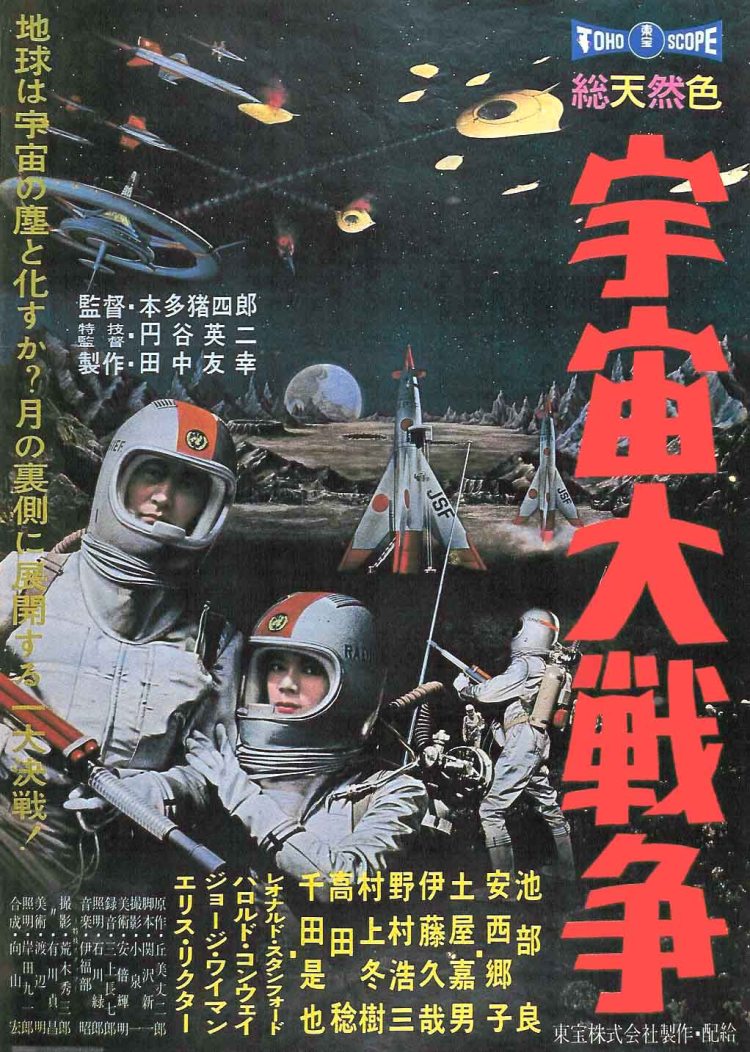
Battle in Outer Space (宇宙大戦争, Ishiro Honda, 1959)

battle in outer spaceIshiro Honda returns to outer space after The Mysterians with another dose of alien paranoia in the SFX heavy Battle in Outer Space (宇宙大戦争, Uchu Daisenso). Where many other films of the period had a much more ambivalent attitude to scientific endeavour, Battle in Outer Space paints the science guys as the thin white line that stands between us and annihilation by invading forces wielding superior technology. Far from the force which destroys us, science is our salvation and the skill we must improve in order to defend ourselves from hitherto unknown threats.

In 1965 Japan is a hit in space. Having launched their first space station, things are going well but after it is destroyed by flying saucers there is cause for concern. The problem intensifies as strange events occur across the Earth with bridges suddenly collapsing, boats being lifted from the sea and the waters of Venice conspiring to drown the town. World leaders gather in Tokyo to come up with a plan but one of the scientists’ key assets, Iranian professor Dr. Ahmed, is possessed by the Natalians via their high-tech remote control radio waves and procedeeds to do their dirty work for them. The Natalians will settle for nothing less than enslavement of the entire planet and have even set up a base on the moon to make it happen! Time to put those shiny new spaceships to good use!

Scientists may be the heroes of this particular story but the scientific basis for their actions is just as silly as your average B-movie. According to our top professor, the Natalians’ anti-gravity shenanigans can be put a stop to by means of a freeze ray – gravity is, of course, caused by the movement of atoms which is impeded by cold hence the freeze ray. A likely story, but it’s the best they’ve got. The other major problem is that the Natalians are able to possess various people and force them to do their bidding, apparently through “radio waves”. Less about the enemy within, the possibility of becoming a Natalian sleeper agent is more plot device than serious philosophical discussion.

Battle in Outer Space is, in this sense at least, one of the most straightforward of Toho’s B-movie leaning SFX extravaganzas. There is little hidden message here bar the importance of international collaboration as the whole world comes together to fight the alien threat – Middle Eastern and Indian scientists are at the forefront of research and Japan leads the charge flanked by Americans one side and Russians on the other.

Our intrepid band of scientists are the vanguard sent to see off the Natalian threat by jetting off into space and fighting them in their own territory. Honda and Tsuburaya outdo themselves with the special effects which are pretty astounding for 1959 making use of large scale models and matt painting. The scientists travel to the moon to look for the Natalians’ base only to encounter them in space and engage in exciting dogfight. Eventually landing they meet the Natalians face to face and discover they are very tiny and sort of cute but also hellbent on enslaving the Earth. Engaging them in a firefight using heat rays and laser guns, the scientists manage to escape but the Natalian threat follows them all the way back to Tokyo. In true Toho fashion, buildings are destroyed and people knocked flying as the Natalians take the city but our brainy scientists have thought of that and so the aliens have a whole barrage of heat ray guns to welcome them to Earth.

Battle in Outer Space might not have an awful lot going on in the background, but it makes up for it with sheer spectacle both in its effects and in production design. The Natalians are a scary bunch, until you actually meet them, but this time science is on our side as the good guys manage to figure out a way to save the Earth rather than destroy it through fear and angst. In the end it is determination and togetherness which finally lets the Natalians know humanity is not a good prospect for colonisation, only by coming together and making the best of their collective strengths is humanity able to triumph over a superior force – sadly a still timely lesson.


Original trailer (no subtitles)

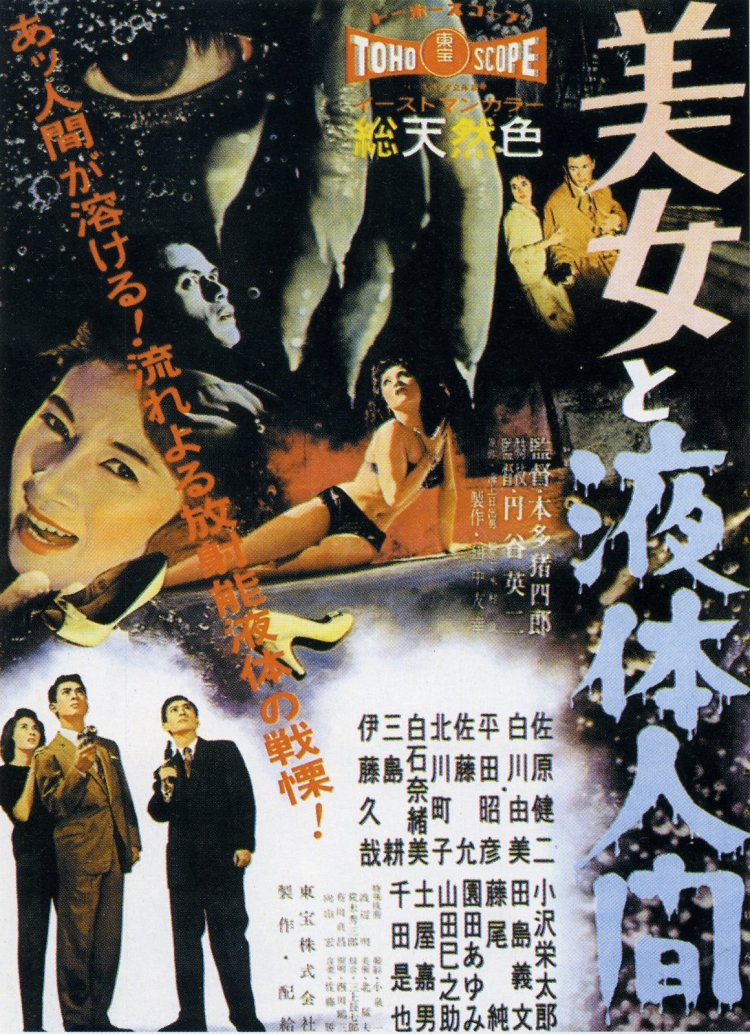
The H-Man (美女と液体人間, Ishiro Honda, 1958)

H-man
Toho produced a steady stream of science fiction movies in the ‘50s, each with some harsh words directed at irresponsible scientists whose discoveries place the whole world in peril. The H-man (美女と液体人間, Bijo to Ekitainingen), arriving in 1958, finds the genre at something of an interesting juncture but once again casts nuclear technology as the great evil, corrupting and eroding humanity with a barely understood power. Science may have conjured up the child which will one day destroy us, robbing mankind of its place as the dominant species. Still, we’ve never particularly needed science to destroy ourselves and so this particularly creepy mystery takes on a procedural bent infused with classic noir tropes and filled with the seedier elements of city life from gangsters and the drugs trade to put upon show girls with lousy boyfriends who land them in unexpected trouble.

Misaki (Hisaya Itou) is not a man who would likely have been remembered. A petty gangster on the fringes of the criminal underworld, just trying to get by in the gradually improving post-war economy, he’s one of many who might have found himself on the wrong side of a gangland battle and wound up just another name in a file. However, Misaki gets himself noticed by disappearing in the middle of a drugs heist leaving all of his clothes behind. The police immediatetely start hassling his cabaret singer girlfriend, Chikako (Yumi Shirakawa), who knows absolutely nothing but is deeply worried about what may have happened to her no good boyfriend. The police are still working on the assumption Misaki has skipped town, but a rogue professor, Masada (Kenji Sahara), thinks the disappearance may be linked to a strange nuclear incident…..

Perhaps lacking in hard science, the H-Man posits that radiation poisoning can fundamentally change the molecular structure of a living being, rendering it a kind of sentient sludge. This particular hypothesis is effectively demonstrated by doing some very unpleasant looking things to a frog but it seems humans too can be broken down into their component parts to become an all powerful liquid being. The original outbreak is thought to have occurred on a boat out at sea and the scientists still haven’t figured out why the creature has come back to Tokyo though their worst fear is that the H-man, as they’re calling him, retains some of his original memories and has tried to return “home” for whatever reason.

The sludge monster seeps and crawls, working its way in where it isn’t wanted but finally rematerialises in humanoid form to do its deadly business. Once again handled by Eiji Tsuburaya, the effects work is extraordinary as the genuinely creepy slime makes its slow motion assault before fire breaks out on water in an attempt to eradicate the flickering figures of the newly reformed H-men. The scientists think they’ve come up with a way to stop the monstrous threat, but they can’t guarantee there will never be another – think what might happen in a world covered in radioactivity! The H-man may just be another stop in human evolution.

Despite the scientists’ passionate attempts to convince them, the police remain reluctant to consider such an outlandish solution, preferring to work the gangland angle in the hopes of taking out the local drug dealers. The drug lord subplot is just that, but Misaki most definitely inhabited the seamier side of the post-war world with its seedy bars and petty crooks lurking in the shadows, pistols at the ready under their mud splattered macs. Chikako never quite becomes the generic “woman in peril” despite being directly referenced in the Japanese title, though she is eventually kidnapped by very human villains, finding herself at the mercy of violent criminality rather than rogue science. Science wants to save her, Masada has fallen in love, but their relationship is a subtle and mostly one sided one as Chikako remains preoccupied over the fate of the still missing Misaki.

Even amidst the fear and chaos, Honda finds room for a little song and dance with Chikako allowed to sing a few numbers at the bar while the other girls dance around in risqué outfits. The H-man may be another post-war anti-nuke picture from the studio which brought you Godzilla but its target is wider. Nuclear technology is not only dangerous and unpredictable, it has already changed us, corrupting body and soul. The H-men may very well be that which comes after us, but if that is the case it is we ourselves who have sown the seeds of our destruction in allowing our fiery children to break free of our control.


Original trailer (no subtitles)

Warning from Space (宇宙人東京に現わる, Koji Shima, 1956)

Warning_from_Space_1956
Taro Okamoto illustration from Japanese DVD liner notes

Apparently the citizens of Japan are a little more cautious than some of their contemporaries when it comes to extraterrestrial contact. After all, the kindly aliens who visit with helpful advice in The Day the Earth Stood Still end up leaving in a huff because humanity is just not ready to accept their offers of interplanetary research and is constantly trying eliminate the alien “threat”. Hence, though the people of Japan recoil in horror from the Pairans in their scary starman shape, they start paying attention when they come in the form of a pretty showgirl. Somethings never change, eh?

Mysterious flying objects have been spotted above the skies of Tokyo. Nobody knows what they are with some leaning towards aliens and others becoming paranoid that Japan is under attack from another nation who are positioning spy satellites above its capital city. There have also been sightings of mysterious creatures near sources of water, usually accompanied by blue flickering lights.

These strange creatures turn out to be a scientific delegation from the planet Paira (inconveniently located directly opposite Earth but behind the sun which is why it’s never been discovered). They are a race of star shaped bipedal creatures with a single eye in the middle of their chests. Actually, they are quite cute and completely non-threatening in appearance and seem quite hurt that the Earthlings think they are ugly and are too frightened to talk to them. Consequently, they send their best scientist through a special process to change his appearance to one humans find more appealing which just happens to involve copying that of a local superstar showgirl.

The Pairans have come in peace! With their advanced technology they can see a rogue planet is about to crash into Earth and destroy it forever. This is bad news for everyone so they’ve come to warn humanity and try to help, if only they could get someone to listen to them. They also know that Doctor Matsuda has been developing a nuclear weapon which is far more powerful than the atomic bomb. The Pairans think this is a very bad idea and he should stop, but only after they’ve used it to destroy the rogue planet before it’s too late.

Warning from Space (宇宙人東京に現わる, Uchujin Tokyo ni Arawaru) is Daiei’s first colour sci-fi film though it’s actually not all that colourful aside from that weird blue light. In contrast to many other films from the era and even those previously made by Daiei, Warning From Space seems to have an oddly ambivalent view on weapons of mass destruction. The Pairans have chosen Japan because they think the Japanese are the best placed to appreciate the destructive power of an atomic bomb and will therefore share their stance on the necessity of abandonment. Yet, they also know Dr. Matsuda has been working on an even more destructive weapon – the Pairans also discovered this power at some point in their history but abandoned it over fears of its power being misused. They supposedly developed a much safer way to harness nuclear energy but now need Matsuda’s research to destroy the rogue planet. Like much of the Pairan’s behaviour, this doesn’t make complete sense (at least, to those of us used to Earth logic).

The Pairans are very friendly, but a bit shy. Their idea of “making contact” seems to be running away when the humans spot them and start screaming. Seeing something so unusual is probably quite traumatising, but the Pairans are so cute with their starfish outfits and comical waddle that it’s strange to think anyone could find them threatening. The Pairans are even a little upset that Earthlings find them “ugly”. They think the best thing to do is appear in a more pleasing form so they freak everyone out by visiting a popular musical show and stealing a picture of the star to clone. Because every scientist on Earth is going to want to listen to the advice of a cabaret showgirl, right? That’s always how it happens. She doesn’t even care very much about maintaining her disguise and keeps doing alien stuff like jumping really high in the air or dematerialising in one place and rematerialising somewhere else, but then no one seems to find this that weird anyway.

Basically, the Pairans have come to tell the Earthlings not to go ahead with their weapons research because they don’t know what they’re getting into. However, they also need to use this research to destroy the rogue planet which is a bit contradictory. The Pairans are apparently too shy to actually talk to the UN and think the other nations are kind of mean anyway so Japan will have to sort this out on their own while the Pairans nod appreciatively in the background (other than when they randomly disappear for a whole month until coming back to sort everything out because humans are rubbish). Of course, evil corporations are also after Matsuda’s super weapon but he’s a proper scientist and doesn’t want to sell, so they kidnap him and tie him to a chair out of spite while the world simultaneously floods and burns thanks to the rogue planet’s effect on the atmosphere.

Finally, science saves the day in a quiet and methodical way! All the creatures of the Earth emerge from underground. The birds are singing, turtles are swimming, racoons are doing racoon stuff again all while the sun is shining brightly and children are singing, so it’s definitely all going to be OK and Earth has probably made a whole new set of star shaped friends! All in all it was probably worth near destruction. Warning from Space is the kind of science fiction film which is always 100% serious, with the consequence that it’s not serious at all. Not as much fun as some of other B-movies of the era it nevertheless adds its own charms particularly in the form of the completely batty Pairans and their cute star shaped suits but fails to offer anything memorable beyond them.


Original trailer (poor quality, no subtitles)

The adorable starfish-like Pairans were designed by iconic Japanese artist Taro Okamoto who is probably best known for the Tower of the Sun constructed for Expo ’70.

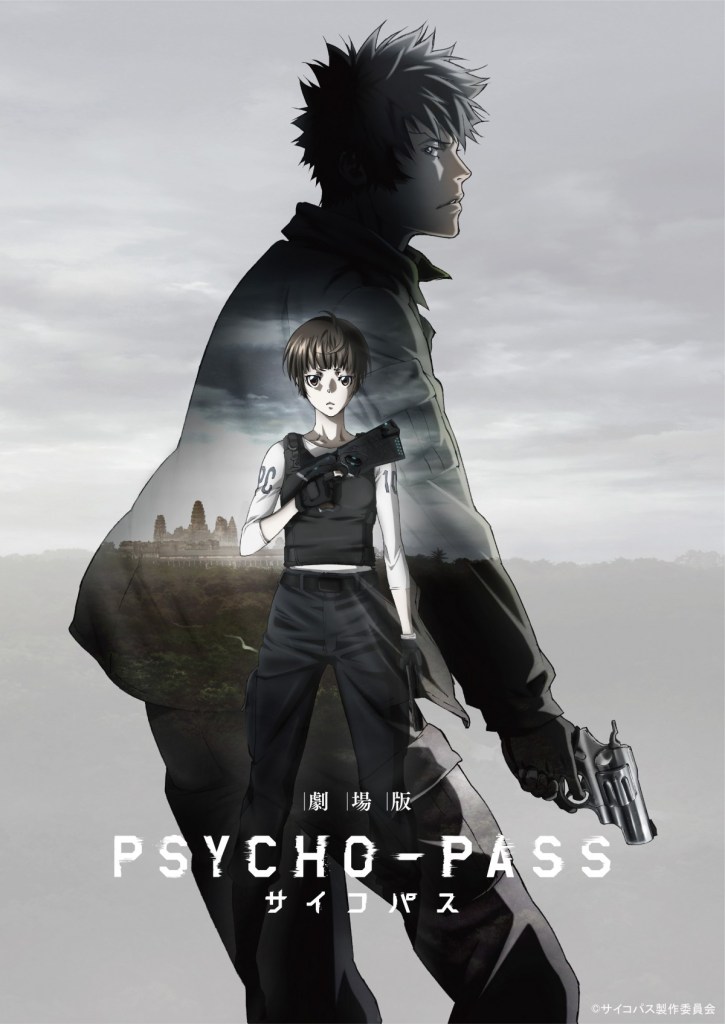
Psycho-Pass: The Movie (劇場版 PSYCHO-PASS サイコパス, Katsuyuki Motohiro & Naoyoshi Shiotani, 2015)

psycho-pass movieThe Japan of 2116 is a peaceful place. Crime is at an all time low thanks to the Sybil system which monitors the nation’s citizens issuing them a “Crime Coefficient” rating assessing how likely they are to commit a crime. When a potential criminal’s Psycho-Pass reaches an unacceptable level, the Public Safety Bureau are called in to hopefully put a stop to any criminal activity before it has the chance to occur.

However, the world outside of Japan is not quite so ordered and so its Sybil system has become an important political export. Things are about to get murky as the nearby SEAUn (South East Asia Union) is currently in a state of civil war and its de-facto leader has struck a deal with Japan for additional support in return for trialling the system in a new reclaimed land development. Not everyone is happy with sacrificing personal liberty for social safety and so an active resistance unit working against both the deployment of Sybil and the leader they see as a dictator is continuing to prove a destabilising force.

This all comes to a head when a group of so called “terrorists” manage to sneak in Japan hoping to  take the fight to Sybil itself. After a brief but intense shootout with the PSB, the gang is neutralised save for one which famed Inspector Akane Tsunemori manages to capture and take in for questioning. However, whilst Akane is waiting for the captive to come round from the sedative she gave him, her bosses have taken drastic action which amounts to lethal torture. Akane is horrified, but when the recovered information flags up the familiar face of her former colleague Kogami, she quickly finds herself at the centre of covert, international political machinations which cast her own nation in far from a positive light.

Psycho-Pass: The Movie (劇場版 PSYCHO-PASS サイコパス, Gekijo-ban Psycho-Pass) is the big screen outing for the hit TV anime which has so far spanned two series each with their own distinct narrative arcs. Series creator Gen Urobuchi handled the first season but sat out the second (handing the reign’s over to Murdock Scramble’s Tow Ubukata) in order to work on this film which takes place after season two but was actually developed at the same time so avoids direct reference to its events. For the most part, Psycho-Pass: The Movie works as a stand alone enterprise though it does make reference to plot elements from season one, or more exactly its villain, without further explanation which may leave newcomers feeling lost. Fans of the franchise already familiar with the characters and their relationships will undoubtedly get the most out of the set-up, but in depth knowledge of the series is never a prerequisite for understanding the action.

“Action” is an apt place to start when it comes to the themes of Psycho-Pass: The Movie as it acts more as an exciting side story to the main series than the grand conclusion that might be expected. Broadly speaking, the central concern is the increasing interference of powerful nations in the “domestic affairs” of smaller ones. Akane is as idealistic as they come despite everything she has already seen and is unprepared for the extent her own nation’s complicity in this very dirty, possibly proxy, war. In this country, those with flagged Crime Coefficients are forced to wear a standard issue collar which is designed to explode Battle Royale style and are treated as an underclass not permitted to board the same public transport or occupy the same “public” space as the general population. Once again this sits uncomfortably with Akane, but there isn’t a lot she can do about it.

Kogami, now a drifting mercenary since going on the run from the PSB, has become a rebel revolutionary trying to help the oppressed citizens fight for democracy in this war torn land. To some, he’s a terrorist (though the rebels are never shown targeting civilians or carrying out “terrorist action” so much as acting as a resistance group) but his sights are firmly set on hypocritical, oppressive regimes and especially those acting as puppet states for a third party. Akane and Kogami’s relationship status continues in the “it’s complicated” direction which has progressed throughout the series and they aren’t given very much time to build on that here though their mutual respect for each other adds to the tension as each comes to terms with being on opposing sides yet somehow still “together” in spite of external obligations.

Even if Psycho-Pass: the Movie proves disappointing in terms of its character development (betraying its side story origins), it excels in the action stakes with several impressive, high octane battle scenes not to mention the strange ballooning effect of the explosive Dominator weapons. Though it sets up a complicated, geo-political conspiracy of superpowers exploiting civil unrest to steal puppet states and install dictatorial stooges who oppress the local population into a sublime obedience with the promise of long desired peace, it wisely avoids expository dialogue preferring to keep things moving in a more urgent fashion. A minor entry into the Psycho-Pass world, Psycho-Pass: The Movie is nevertheless an exciting return to its increasingly dystopian universe and even if it adds little in terms of themes or characters, does at least point towards a promising continuation of the series.


Reviewed as part of the “biennial” Anime Weekend at BFI Southbank. Psycho-Pass: The Movie has also been licensed for UK distribution by All the Anime (and Funimation in the US).

English Subtitled trailer:

Dual City (デュアル・シティ, Yokna Hasegawa, 2015)

dual cityCyberpunk and Japan are a match made in heaven though, it has to be said, it’s often been much more an inherited influence in international pop culture than something which has originated directly in Japan. Yokna Hasegawa’s Dual City (デュアル・シティ) puts this to rights a little with a politically infused tale of Japan in 2034 – a nation divided and engaged in a wider information war with the little guy at the mercy of evil corporate giants.

The year is 2034, following a civil war Japan has been divided in two with a north/south border located at the feet of Mount Fuji. Our protagonist, Yoriko, is a nurse and mother working in the North sector which is definitely thought of as the least advantageous place to be. When her hospital is raided by guerrilla soldiers, Yoriko finds herself in the relatively lucky position of last survivor but is then charged with assisting this “resistance movement” by taking over from the soon to be dead insurgent, Gou, and completing his mission of carting a mysterious suitcase across the border.

Once in the south, we’re introduced to the rest of the band including the dynamic Ayumi who can’t seem to forgive Yoriko for the loss of Gou. The gang’s ultimate goal is to expose the shady Nephe corporation who, aside from their business interests of arms dealing and android production, have begun building a virtual world known as “information life” which is constructed through harvesting the memories of Northern corpses. Yoriko lost her daughter to terrorist aggression and the idea that she might be able to see her again, albeit in virtual form, is one which she is unable to pass up.

Adding to the intrigue is the love story between a resistance member and an android which may or may not come to be a liability and the hacker group’s involvement with the steady stream of illegal migrants somehow making the dangerous cross border journey into the relative safe haven of the South. Many of these people have injuries or ailments that would be best served by a doctor, but having no proper papers they can’t risk a hospital and so the care that Yoriko can provide becomes another useful asset for the group.

Drawing parallels with other “divided” nations, Dual City looks at a multitude of contemporary social and philosophical problems from dealing with refugees fleeing an oppressive regime to the power of multinational corporations and the eternal quality of a mother’s love. Nephe (represented in a futuristic ad campaign starring Third Window Films’ Adam Torel as its heinous CEO) commits the very worst kind of identity theft as it steals and repurposes the very soul of those that it has killed by sucking out their memories and using them to create artificial counterparts in their online world. Are these ghosts in the machine any less “real” than their flesh counterparts were? A standard question of the cyberpunk world and one which still has no clear answer, but Dual City continues to explore it in a mature and nuanced manner.

Though an undoubtedly low budget, indie movie Dual City makes a decent job of creating its realistically grimy cyberpunk world with its interactive video screens and invisible techno warfare. Special effects, though sparse, are effectively achieved and never call attention to themselves. Dual City is actually the second part of a projected trilogy with the overarching title of Japan Year Zero (following the 2014 short Illuminations) but is perfectly intelligible even without knowledge of the previous film and manages to create a sense of a bleak, oppressive society which travels along with Yoriko from the totalitarian North to the supposedly freer South. Eventually Yoriko’s love for her daughter transforms and becomes something larger, an eternal and infinite love for all mankind that represents our last, best hope for peace. It only remains to be seen if the troubled society of 2034 can can learn to follow a similar road.


Reviewed as part of the SCI-FI London Film Festival 2016.

On a side note, Illuminations seems to be the film Hoshi Ishida was talking about when I interviewed him (for UK Anime Network) a couple of years ago. Small world! I would like to see the movie but it doesn’t seem to be available anywhere, maybe one day. Here is a trailer for Illuminations:

You can also keep up with director Yonka Hasegawa’s work via her website and twitter feed!

Parasyte The Movie Part 1 (寄生獣, Takashi Yamazaki, 2014)

parasyte part oneReview of Takashi Yamazaki’s adaptation of Hitoshi Iwaaki’s manga Parasyte – Parasyte: The Movie Part 1 (寄生獣, Kiseiju) first published by UK Anime Network.


Humans – are we the biggest threat to our planet and ultimately our own survival? If the world population were halved, would we also halve the number of forests that are burned and the damage that we’re doing to our natural environment? These thoughts run as a voice over beginning the full scale blockbuster adaptation of Hitoshi Iwaaki’s classic manga which was also recently adapted into a critically acclaimed anime. The Parasyte of title most obviously refers to the extraterrestrial microbes which are climbing into the driving seat of an unsuspecting host’s brain with nothing less than the colonisation of our entire species on their “minds”, yet, is it we ourselves who are the real parasites feasting on the corpse of our dying planet? Parasyte is that rare blockbuster treat that is content to give us man-eating, shapeshifting, monsters and gore filled destruction but also wants us to dig a little deeper into our own souls at the same time.

Shinichi Izumi’s (Shota Sometani) mum (Kimiko Yo) probably told him not to sleep with his headphones on but luckily they’re about to save his life as a weird little bug tries to crawl into his ears but finding them blocked opts for the arm instead. Wrapping the cord around his elbow tourniquet style, Shinichi is able to stop the bug’s progress but the parasite has taken root and Shinichi is horrified to find his right hand is no longer his own but is now controlled by a dispassionate alien that eventually names himself “Migi”.

Shinichi and Migi develop an odd kind of partnership born of their mutual dependency which is threatened only by the presence of other Parasytes who have successfully infiltrated a human brain and can blend in with the general populace (aside from their cold and robotic natures). To his horror, Shinichi discovers a new teacher at his school is actually a Parasyte stooge who recognises the “research” potential of a hybrid team like Shinichi and Migi. Becoming very keen on “experiments” Ryoko Tamiya (Eri Fukatsu) has also mated with one of her fellow Parasytes in the hopes of exploring what will happen with the birth – will it be purely a human child seeing as it’s born of two human bodies or will something of the Parasyte get through? However, Ryoko’s “network” of Parasytes aren’t all as committed to scientific research as she is and Shinichi and Migi quickly find themselves becoming humanity’s last line of defence against the invading creatures.

Shinichi is the teenage lead of the picture but in this first part at least it seems to be Ryoko leading the show. She gives us the original voice over and it’s her burgeoning motherhood that gives the film its clearest ideological standpoint. As the dispassionate Ryoko comes to develop the beginnings of maternal pangs and a desire to ensure the survival of her child (or perhaps just her “experiment”), so Shinichi finds his humanity being erased by the parasitical “child” he is gestating in the form of Migi. At the same time Migi begins to take on a protective mentality towards his host which may be more than simple self preservation particularly after a traumatic near death experience bonds the two even tighter together, in a biological sense at least.

Though the film obviously references former genre classics, in particular Invasion of the Bodysnatchers with its difficult to detect pod people, it steers clear of the “red scare” inspired sense of paranoia and the feeling of intense mistrust that exists even between supposedly good friends. Migi is able to sense (to a degree) his own kind making the presence of potentially dangerous Parasytes easier to detect but the fact that the Parasytes are able to colonise and use the form of someone all too familiar to confuse their enemies restores something of their power to lurk unsuspected in the shadows.

All this seems to suggest that the big screen live action adaptation of Parasyte would be a fairly serious affair yet the tone is often lighthearted, maintaining the darkly humorous buddy comedy side of the relationship between normal teenager Shinichi and the almost omniscient yet strange Migi. Migi, as played by veteran actor Sadao Abe who is perhaps most closely associated with comedic roles, has a thirst for a different kind of “brains” than his fellow Parasytes and quickly devours any and all knowledge he can get his “hand” on though he lacks the emotional intelligence to make sense of everything he learns and thus is dependent on his host Shinichi to get a fuller understanding of the human world.

Like the blockbuster mainstream films of recent times Parasyte boasts generally high production values on a par with any Hollywood movie though it has to be said that the film is often undermined by unconvincing CGI. However, this is mainly a problem with the action scenes and Migi himself is generally well integrated into the action and oddly adorable to boot. In some ways it might have been interesting to see a fully “in camera” take on the effects ala Cronenberg whose spirit is most definitely evoked throughout the film which also harks back to ‘80s body horror with its synth score highlights and generally gruesome scenes of carnage. Though it’s hard to judge the overall effect from just this first instalment of a two part film which drops a decent number of threads to be picked up in part two, part one at least serves as a tantalising appetiser which only heightens expectations for its final conclusion.


Parasyte: The Movie Part 1 is currently available on DVD and blu-ray in the UK from Animatsu Entertainment with Part 2 to follow in June 2016.

Death Powder (デスパウダー, Shigeru Izumiya, 1986)

death powderCyberpunk, for many people, is a movement which came to define the 1980s and continues to enjoy various kinds of resurgences and rebirths even into the new century. Beginning the the ‘60s and ’70s in dystopian science fiction afraid of the impact of advancing technologies in society, it’s not surprising that the genre began to actively embrace influences from the East and especially that of the more technologically advanced and economically superior Japan. However, when Japan made its own cyberunk cinema, the “punk” element is the one that’s important. These movies sprang from the punk music scene and often star punk bands and musicians as well as featuring high energy punk rock inspired scores.

Death Powder (デスパウダー) is among the first of these tech themed experimental films and is the only feature to be directed by folk singer and poet Shigeru Izumiya who had also starred in Sogo Ishii’s massively influential Burst City in 1982. Hugely indebted to Blade Runner, it takes that film’s noir stylings and terminology to create an experimental surrealist film loosely themed around two bounty hunters in search of a “replicant”.

After beginning with a chase sequence past neon signs and through a contemporary Tokyo where the faces of passersby have been pixelated out, the story focuses in on the pair of street punk robot hunters, Kiyoshi and Noris, who have been charged with investigating a gang hideout which used to belong to an artist who keeps trying to come back. However, when the duo arrive they find that the reason the artist, Harima (played by Izumiya himself), keeps trying to attack the place is that they’ve been holding his girlfriend, Guernica – an android, in the basement. After Guernica is killed in the resultant fighting, her body turns into a kind of powder which Kiyoshi later snorts. This “Death Powder” allows Guernica to colonise his body producing changes in both his mind and physiology.

This is what passes for a plot summary, though in keeping with the best of cyberpunk film making from Japan the narrative is irrelevant. One character even says to another “Like life itself, this makes no sense” – that being the point in a sense, creating meaning from the meaningless. Though it starts off with a Blade Runner-esque aesthetic bearing all of the hall marks which would come to be associated with cyberpunk from the neon signs, darkened streets and noir tinged atmosphere right down to the shades and trilbies costuming, the film quickly moves into the experimental realm with strange robotic sperm flying across the screen and melting vistas of city scenes and memories.

Kiyoshi begins to merge with Guernica’s consciousness, inheriting her memories and what may or may not be android fears and emotions. He “remembers” a flashback sequence featuring the very strange figure of Dr. Loo – a rock god mad scientistic who built Guernica for some undisclosed reason and then passed her on to Harima on whom it, apparently, depends whether not not she can become human which requires showing her love that transcends human love and will become “memories”. Like the replicants in Blade Runner she has a limited four year lifespan but when she dies her body will become a powder which gives life to other things.

Guernica is a created being, devoid of human flesh, but can she become human through experiencing human emotions and can she overcome death by downloading her experiences into another being’s consciousness? All fundamental questions found in cyberpunk explorations of what in means to be human in a world of advancing technology but once again Death Powder offers no clear answers so much as a surrealist and experimental exploration of the individual changes undergone by the individual rather than the society in the face of increasing mechanisation.

The borders between life and death, consciousness and unconsciousness, man and machine have all become so hopelessly blurred that concept of reality itself has become corrupted and no longer carries any kind of currency. While it may not have the raw and sophisticated artistic power of Tsukamoto’s later Tetsuo the Iron Man which has come to define the genre, Death Powder is a surprisingly accomplished low budget cyberpunk body horror extravaganza which places sensory experience ahead of narrative. Undoubtedly hugely influential yet now little seen or remembered, Death Powder is an essential addition to the cyberpunk canon and one which deserves to be as widely distributed as the classics which later followed it.


Opening sequence of the film (very trippy but dialague free until right near the end. Fast forward to around four minutes in for the nighttime chase through Tokyo!):

Invisible Man Appears (透明人間現る, Nobuo Adachi, 1949)

Invisible man appearsReleased in 1949, The Invisible Man Appears (透明人間現る, Toumei Ningen Arawaru) is the oldest extant Japanese science fiction film. Loosely based on the classic HG Wells story The Invisible Man but taking its cues from the various Hollywood adaptations most prominently the Claude Rains version from 1933, The Invisible Man Appears also adds a hearty dose of moral guidance when it comes to scientific research.

Once again the action centres around an esteemed chemist, Professor Nakazato, who has been working on a serum to render living things invisible. So far he has a sample which works on animals but is reluctant to move on to human testing as A) he hasn’t found a way to reverse the procedure, and B) there are some unpleasant side effects in which the subject becomes increasingly violent and irrational. The professor currently has two top students who are helping him towards his goal and, inconveniently, both have taken a shine to his daughter, Machiko. Half joking, the professor remarks that whoever can solve the problem first will win his daughter’s hand.

A business associate of the professor, Kawabe, is also interested in Machiko and also in the rights to the professor’s important new discovery. The professor, however, is a responsible man and refuses to sell it in case it falls into the wrong hands. Shortly after the professor is kidnapped by a gang of armed thugs who plan to use the serum to steal a set of diamonds known as The Tears of Amour.

There’s plenty of intrigue with various twists and turns to the original story which keep the viewer on their toes as they try to figure out who exactly is the invisible man and what he’s really after. Actually, the solution is sort of obvious and heavily signposted but that doesn’t make it any less fun. Kawabe is a moustache twirling villain from the get go and it’s obvious he has various things going on in the background but there’s more to the story than a greedy business man trying to manipulate everyone around him for his own gains. There’s also an interesting subplot in which the younger sister of one of the scientists is a top actress at the Takarazuka Review and turns out to have a connection to the Tears of Amour.

All of the classic B-movie hallmarks are here from the slightly ridiculous sci-fi jargon to the classic women in peril shenanigans as the serum starts to take hold and the Invisible Man becomes increasingly paranoid. There’s nothing good or bad but thinking makes it so – so it would be for science as far as the film is concerned. According to the message at the film’s beginning and end, there is no scientific discovery which is innately “evil” but each is apt to be misused. It’s not difficult to see why this would be a popular, even essential, message in the Japan of 1949 and indeed it recurs in many films of this type including, of course, the original Godzilla. The professor takes responsibility for having invented something which, although not created with evil intent, has wrought such destruction on society but finds himself with nothing left to do other than apologise.

Director Nobuo Adachi uses a lot of classic silent cinema techniques such as dissolves and montages with a fair amount of handheld camera and some location shooting (though the majority of the film is studio bound). The special effects were supervised by Eiji Tsuburaya who would later become the founding father of tokusatsu and co-creator of the Godzilla franchise and are top notch for the time period. An enjoyably silly B-movie, The Invisible Man appears is a well crafted addition to the Invisible Man corpus and a fantastic example of Daiei’s post-war genre output.


Original trailer (English subtitles) – I wish all trailers were this much fun!

Summer Time Machine Blues (サマータイムマシン・ブルース, Katsuyuki Motohiro, 2005)

summertimemachineblues-2There ain’t no cure for the summer time blues! Unless, of course, you have a time machine. For the boys of the sci-fi club the long, boring summer vacation is just getting started. They mess around playing baseball while the two girls from the photography club who’ve been unceremoniously ousted from their club room in favour of the boys take photos of them. Then some weird stuff starts happening and their air con remote gets broken and it’s just so hot! When the boys somehow end up with a mysterious time machine, the solution is obvious…

Full of nostalgic charm, Summer Time Machine Blues is a fitting tribute to all those endless, golden summers of adolescence. Hanging out in the university club room even though they’re on their summer break, the kids waste time in distinctly old fashioned ways – playing baseball, going to the baths, working on a photo project etc. Though the guys are nominally the “science-fiction club” they actually aren’t very interested in science fiction and kind of make fun of the sort of people who would belong to the very club that they do, actually, belong to. Perhaps they just wanted the bigger room with the air conditioner and were lucky enough to get it as their two female friends are the only two members of the photography club and mostly hang out in the dark room at the back anyway.

The film began as a stage play put together by Europa Kikaku and though it makes the cinematic jump extremely confidently also maintains its youthful absurdist tones and theatrical comedy beats. The humour itself is cheerfully bizarre, full of fast comebacks and naturalistic sounding banter between a group of young guys. Added to this there are numerous references to other popular science fiction and time travel themed franchises such as the obvious homage to the Back to the Future series which is even prominently showcased in poster form at the local rep cinema. The cinema itself (a mini plot point in the movie) is run by a total sci-fi buff and time travel story expert who dresses (from the waist up) in a Star Trek: The Next Generation Command uniform complete with Communicator Badge. He seems to have something of a beef with the only actual scientist in the film who never has much success with his discoveries and only succeeds in boring everyone around him with his needlessly complicated theories.

Directed by Katsuyuki Motohiro who may be best known for the Bayside Shakedown series, Summer Time Machine Blues, also mixes in plenty of fun stylistic devices like the anachronistic tape rewinds or the elaborate disappearing of the time machine itself. He also makes good use of split screens to compare and contrast what’s happening where and pays especial attention to make sure everything works out in the most completely satisfying way.

Indeed, one of the most satisfying things about Summer Time Machine Blues is that despite essentially becoming a parody of time travel movies, all of its complicated paradoxes are internally consistent and even though it doesn’t really have an obligation to, it all makes sense no matter how hard you poke at it trying to find the holes. Of course, there’s also the more melancholic side of time on show as the scientist points out he’s riding a time machine as well – just one that will never go backwards, only very slowly into the future. This aimless summer will end at some point, as will college and eventually the universe too, one supposes.

However, that’s no reason not to enjoy the time you have, as one character realises towards the end as he fears his romantic desires may come to nothing going on some hints from the future. An enjoyably absurd and youthful farce, Summer Time Machine Blues is lives up to its name as a transporting delight which carts the viewer back to their own days of long and boring summers filled with improbable adventures. Smart, funny and beautifully crafted, Summer Time Machine Blues is the perfect way to while away an aimless afternoon at any time of the year.


http://www.youtube.com/watch?v=pX51ppP5wg0