Bridge of Japan (日本橋, Kon Ichikawa, 1956)

Punishment Room, released in 1956 as Daiei’s attempt to get in on the Sun Tribe phenomenon, had provoked a moral panic that brought the whole short-lived movement to a close. In considering his next film, Ichikawa consulted with Daiei executive Matsutaro Kawaguchi, who is also the father of Punishment Room’s star Hiroshi Kawaguchi, and was offered the chance to direct one of two relatively safe and subdued literary adaptations, either Izumi Kyoka’s Nihonbashi, or Kafu Nagai’s Okamezasa. Ichikawa chose Nihonbashi (日本橋), though his wife and screenwriter Natto Wada feared adapting it maybe beyond her capabilities.

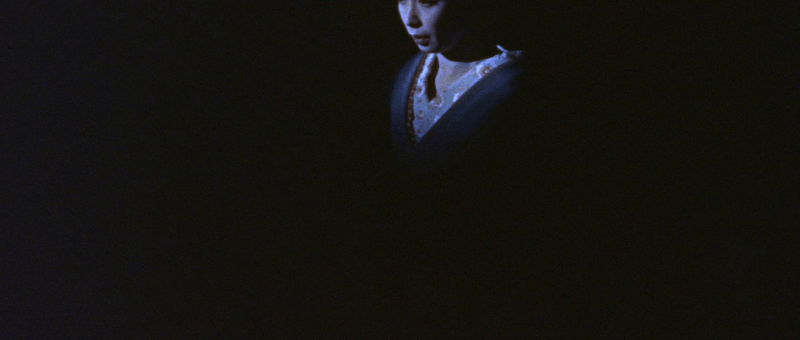
The film is generally known under the The Bridge of Japan in English-speaking territories. This is either an attempt to suggest a wider thematic importance that extends across the nation, or an overly literal translation of a place name. In any case, the significance of Nihonbashi is that, during the time the film is set, it was known as an area where there were many high-class geisha houses. On the other hand, Izumi was well known for incorporating supernatural themes in his work, which  is why the film opens like a ghost story with the curtain rising on a dark and gloomy alleyway through which a geisha walks until she finally dissolves leaving only a creepy song and the sound of her geta rattling along on the cobbles. 

The messages seems to be that this is a place that consumes women. The ghost is said to be that of Owaka who, according to rumour, cheated on her husband who left her after which she died of tuberculosis. Ambitious geisha Okoh (Chikage Awashima) has just moved into Owaka’s former giesha house, apparently unperturbed by its grim history or the the possibility that it is effectively cursed. Geisha come to a miserable end if they act selfishly, according to one of Okoh’s clients who will essentially prove correct further sealing Okoh’s unhappy fate. As is common in these tales she has an entirely one-sided rivalry with local favourite Kiyoha (Fujiko Yamamoto) who her is total opposite in terms of personality. Kiyoha is kind, gentle, and dislikes her life as a geisha, not because she disapproves of it, but because of the moral compromises it requires her to make and the happiness that it denies her.

She has taking a liking to a regular customer, university professor Shin, but when he asks her to marry him, she has no choice but to refuse. Then again, Shin’s proposal is seemingly driven by his incestuous desire for his older sister, who, perhaps having realised this, has disappeared from his life apparently in shame in having become the mistress of a married man to provide for his education. Shin then bears out a sense of hypocrisy in the relationship between men and geisha in that he insists he has never seen has as one but only as his sister who was of course another woman sexually exploited for material gain. As Kiyoha is unable to marry him because she must also financially support her mother and an illegitimate daughter, as well as being indebted to her primary patron, they will not meet again as a geisha and a client.

Okoh, meanwhile, has a tendency to pick up things Kiyoha as dropped as a way of getting back her meaning she is now determined to become Shin’s lover, though he is not interested in her. After she helps in him out with a predicament with a local policeman in which she claims to be his wife, she really considerers herself to be so, though again one-sidedly. She then faces the same thing with a clingy client, Daikichi, she nicknames “Red Bear,” who has convinced himself, one-sidedly, that she is his wife despite also having a legal wife and child.

Red Bear is presented somewhat grotesquely and really takes on the position of a monster within the story. He was once a wealthy seafood wholesaler from Hokkaido who set up shop in Tokyo before an economic downturn which has also impacted the geisha world. This, along with his foolish infatuation with Okoh has ruined him financially and may also have contributed to the later death of his wife which leads him to abandon his infant son ironically dropping him off at Kiyoha’s knowing she will care for him though she rejected Red Bear on the grounds of his ugliness. Driven into a kind of madness, he now subsists on grubs and maggots that live on his distinctive but poorly made bearskin coat.

Okoh is also driven into madness when Shin decides to become a wandering pilgrim and search for his sister in order to ease the tension between Okoh, Red Bear, and Kiyoha. For her, Shin may represent a way out of this geisha world as a respectable man’s wife, something which is otherwise unobtainable to her. While in some senses, a geisha could claim greater independence as a single woman through running her own house rather than being dependent on a patron, she may also be denied the possibility of a settled domestic life or romantic fulfilment. Even if Kiyoha cannot escape her life as a geisha, she does at least have her daughter and comes to dote on Red Bear’s son, though without knowing who his parents were. 

Her parting with Shin (Ryûji Shinagawa), who does not belong in this world and has undergone a religious conversion in deciding to become a monk permanently having given up on looking for his sister and symbolically accepting Okoh as his wife, is then bittersweet but not as much of a tragedy as the fate of Okoh. The geisha house appears to have been purified, released from its cursed legacy under the ownership of Kiyoha even if geisha gossiping about the constant flow of people in this ever changing area. The alleyway which was once dark and gloomy, is now brightly lit and has lost its sense of ominousness, if otherwise seeming rather ordinary.

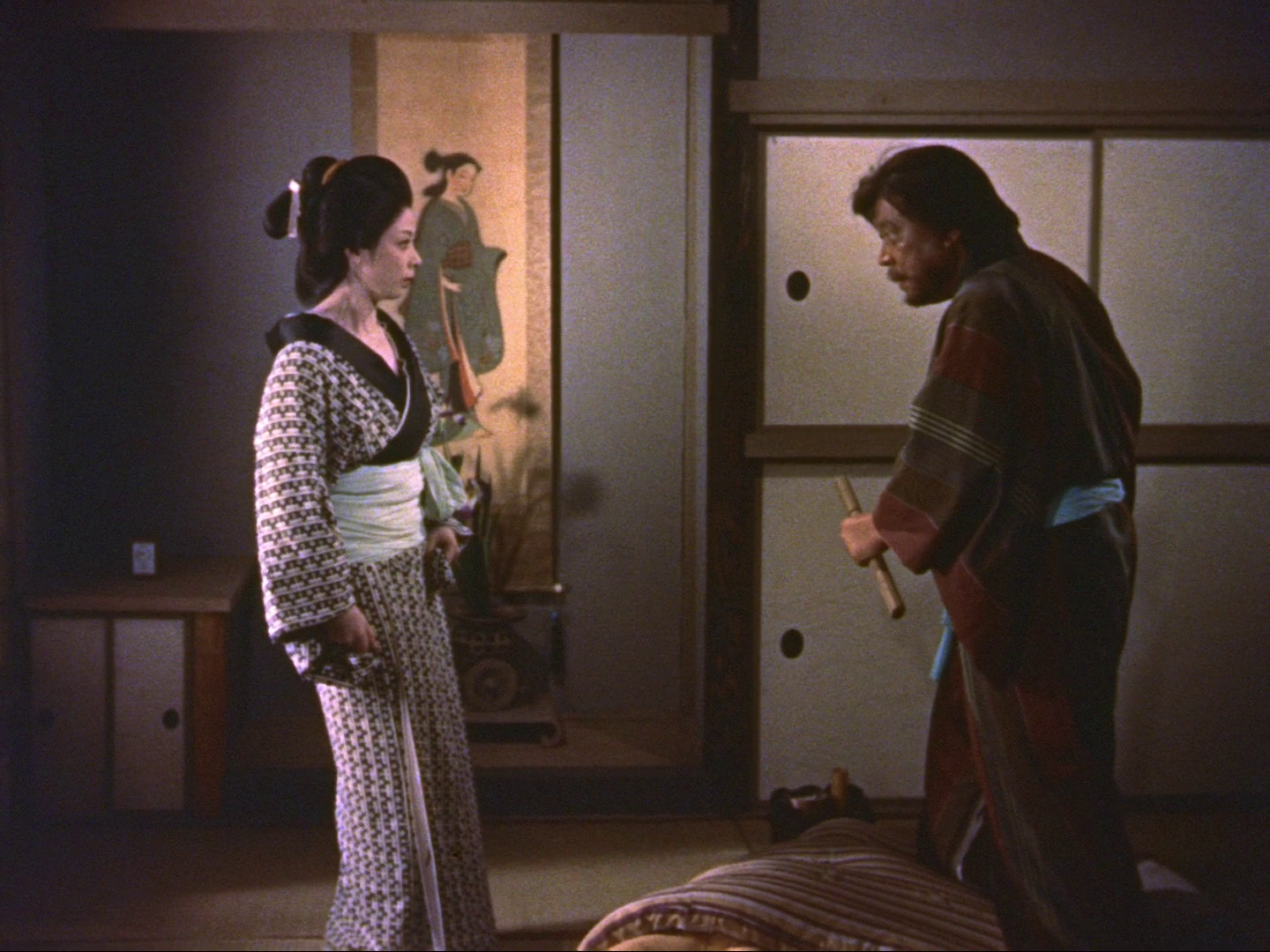
This was Ichikawa’s first colour film, though in order to recreate Izumi’s world he decided on a broadly grey colour palate for the props and sets, recreating all of the Meiji-era setting only to burn it down for real during the fiery climax. At that time, filming in colour also required additional lighting which meant that it was stiflingly hot on set. They eventually had to purchase industrial size air coolers of the kind that were only used in cafes, pushing up the production budget which was already high considering the painstaking attention to detail in the historical sets which included laying actual tracks to recreate the Meiji-era street car. Nevertheless, it all pays off in the exquisite visuals that bring that bring this world to life in all of its defeated hopes and melancholy. 


The Wandering Princess (流転の王妃, Kinuyo Tanaka, 1960)

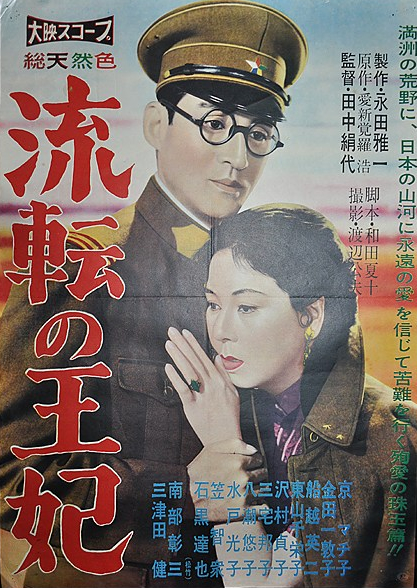
Wandering Princess posterAs in her third film, The Eternal Breasts, Kinuyo Tanaka’s fourth directorial feature, The Wandering Princess (流転の王妃, Ruten no Ouhi), finds her working with extremely recent material – in this case the memoirs of Japanese noblewoman Hiro Saga which had become a bestseller immediately after publication in 1959. Tanaka’s filmic adaptation arrived mere months later in January 1960 which was, in an ironic twist, a year before the real life tale would meet something like the conventional romantic ending familiar from classic melodrama. Nevertheless, working with Daiei’s top talent including Kon Ichikawa’s regular screenwriter (and wife) Natto Wada, Tanaka attempts to reframe the darkness of the preceding 20 years as the defeat of compassionate idealism at the hands of rigid austerity and unstoppable oppression.

Tanaka opens with a scene taking place in 1957 which in fact depicts a somewhat notorious incident already known to the contemporary audience and otherwise unexplained on-screen in which the older Ryuko (Machiko Kyo) tenderly bends over the body of lifeless schoolgirl. The camera then pulls back to find another girl in school uniform, Ryuko, twenty years earlier. A young woman with innocent dreams, Ryuko’s life encounters the usual kind of unwelcome disruption in the unexpected arrival of a marriage proposal but this is no ordinary wedding. Ryuko, as the oldest daughter of a prominent noble family, has been selected as a possible bride for the younger brother of the former Qing emperor now installed as the symbolic leader of the Japanese puppet state of Manchuria. Against the odds, Ryuko and her new husband Futetsu (Eiji Funakoshi) are well matched and endeavour to build a happy home together just as they intend to commit themselves to the creation of a new nation born from the twin legacies of the fallen Chinese empire and the resurgent Japan.

Foregrounding Ryuko’s experience, the film does its best to set “politics” aside but the inescapable truth is that each of our protagonists is a prisoner of the times in which they live. The second scene finds Ryuko in 1937 as an innocent schoolgirl gazing at the young men in uniform as they march past her. She remains out of step with them, walking idly and at her own uneven rhythm while they keep rigorous and seemingly unstoppable time. The family are understandably wary of the implications of the marriage proposal, especially as it comes with a military escort, with Ryuko’s beloved grandmother the only one brave enough to ask to see whoever’s in charge of this outrage only to be told that their fates are in the hands of the nebulous concept known as “army” which knows no individual will.

Assured by her family that the decision rests with her, Ryuko consents – not only to becoming a stranger’s wife (which would have been her fate in any case) but to being a kind of ambassador, the presentable face of imperial ambition. On her marriage she’s presented with a deep red cheongsam and continues to dress in Chinese fashion for remainder of her life in Manchuria where she learns to speak Mandarin and devotes herself to becoming as Chinese as it’s possible to be. Meanwhile, her husband Futetsu busies himself with a complementary desire to become Japanese, intensely worried that the sometimes degrading treatment he and his family receive is exclusively caused by his problematic nationality. When their daughter, Eisei, is born, the couple determine to raise her as the child of a new world, the embodiment of idealised cultural integration.

The world, however, is not so kind and the blunt force of militarism continues to present a barrier to familial harmony. Futetsu is prevented from seeing his brother by the officious forces of the military police while the lonely, paranoid “emperor” suspects that Ryuko is nothing more than a Japanese spy sent to undermine his rule. Ryuko was sent to Manchuria to be the bridge between two cultures. Her, in a sense, feminine energy which attempts to build connection through compassion and understanding is consistently contrasted with the prevailing male energy of the age which prizes only destruction and dominance. Filled with the naivety of idealism, she truly believes in the goodness of the Manchurian project and is entirely blind to the less altruistic actions of her countrymen engaged in the same endeavour.

Confronted by some children in a park while pushing the infant Eisei in a pram, Ryuko is identified as a Japanese woman by her accent while conversing in Mandarin. She assures the children that Eisei is Manchurian like them, and that seeing as she married a Manchurian she is now too despite her Japanese birth. The kids are satisfied, so much so that they warn her that some Manchurians were killed recently in this park by Japanese soldiers, adding a mild complaint that it upsets their parents when Japanese people come to their restaurant and leave without paying. Mortified, Ryuko decides to use some of her (meagre) resources to buy all of the kids and everyone else in the park some sweets from a nearby stand, fulfilling her role as a Japanese ambassador even while insisting that she is a proud citizen of the newly born state of Manchuria.

Nevertheless the Manchurian project is doomed to fail, the kind of idealism fought for by Ryuko and Futetsu crushed under the boot of militarism. Despite everything, Ryuko still wants to be the bridge if only to prevent a catastrophe of this kind happening again (while perhaps refusing to engage with some of the reasons it happened in the first place) but in Eisei’s eventual death, foreshadowed in the melancholy opening, a deeply uncomfortable implication is made that the kind of cross-cultural harmony that Ryuko dreams of may not be viable. In contrast to the salaciously reported real life events (somewhat alluded to by presence of a schoolboy’s cap next to the body) which hinted at a suicide pact or murder, Ryuko attributes Eisei’s decision to end her life to an inability to reconcile her twin heritage coupled with the heavy burden of being the last descendent of the Qing Dynasty. Despite this minor misstep of tying the fate of Eisei to the failure of the Manchurian dream and the loss of its misplaced idealism, Ryuko ends her account on a hopeful note in admiring the flowers she planted finally in bloom and looking forward to a more hopeful age governed by warmth and compassion rather than violence and austerity.


The Wandering Princess was presented by Japan Foundation London as part of a series of events marking the publication of Tanaka Kinuyo: Nation, Stardom and Female Subjectivity.

Warning from Space (宇宙人東京に現わる, Koji Shima, 1956)

Warning_from_Space_1956
Taro Okamoto illustration from Japanese DVD liner notes

Apparently the citizens of Japan are a little more cautious than some of their contemporaries when it comes to extraterrestrial contact. After all, the kindly aliens who visit with helpful advice in The Day the Earth Stood Still end up leaving in a huff because humanity is just not ready to accept their offers of interplanetary research and is constantly trying eliminate the alien “threat”. Hence, though the people of Japan recoil in horror from the Pairans in their scary starman shape, they start paying attention when they come in the form of a pretty showgirl. Somethings never change, eh?

Mysterious flying objects have been spotted above the skies of Tokyo. Nobody knows what they are with some leaning towards aliens and others becoming paranoid that Japan is under attack from another nation who are positioning spy satellites above its capital city. There have also been sightings of mysterious creatures near sources of water, usually accompanied by blue flickering lights.

These strange creatures turn out to be a scientific delegation from the planet Paira (inconveniently located directly opposite Earth but behind the sun which is why it’s never been discovered). They are a race of star shaped bipedal creatures with a single eye in the middle of their chests. Actually, they are quite cute and completely non-threatening in appearance and seem quite hurt that the Earthlings think they are ugly and are too frightened to talk to them. Consequently, they send their best scientist through a special process to change his appearance to one humans find more appealing which just happens to involve copying that of a local superstar showgirl.

The Pairans have come in peace! With their advanced technology they can see a rogue planet is about to crash into Earth and destroy it forever. This is bad news for everyone so they’ve come to warn humanity and try to help, if only they could get someone to listen to them. They also know that Doctor Matsuda has been developing a nuclear weapon which is far more powerful than the atomic bomb. The Pairans think this is a very bad idea and he should stop, but only after they’ve used it to destroy the rogue planet before it’s too late.

Warning from Space (宇宙人東京に現わる, Uchujin Tokyo ni Arawaru) is Daiei’s first colour sci-fi film though it’s actually not all that colourful aside from that weird blue light. In contrast to many other films from the era and even those previously made by Daiei, Warning From Space seems to have an oddly ambivalent view on weapons of mass destruction. The Pairans have chosen Japan because they think the Japanese are the best placed to appreciate the destructive power of an atomic bomb and will therefore share their stance on the necessity of abandonment. Yet, they also know Dr. Matsuda has been working on an even more destructive weapon – the Pairans also discovered this power at some point in their history but abandoned it over fears of its power being misused. They supposedly developed a much safer way to harness nuclear energy but now need Matsuda’s research to destroy the rogue planet. Like much of the Pairan’s behaviour, this doesn’t make complete sense (at least, to those of us used to Earth logic).

The Pairans are very friendly, but a bit shy. Their idea of “making contact” seems to be running away when the humans spot them and start screaming. Seeing something so unusual is probably quite traumatising, but the Pairans are so cute with their starfish outfits and comical waddle that it’s strange to think anyone could find them threatening. The Pairans are even a little upset that Earthlings find them “ugly”. They think the best thing to do is appear in a more pleasing form so they freak everyone out by visiting a popular musical show and stealing a picture of the star to clone. Because every scientist on Earth is going to want to listen to the advice of a cabaret showgirl, right? That’s always how it happens. She doesn’t even care very much about maintaining her disguise and keeps doing alien stuff like jumping really high in the air or dematerialising in one place and rematerialising somewhere else, but then no one seems to find this that weird anyway.

Basically, the Pairans have come to tell the Earthlings not to go ahead with their weapons research because they don’t know what they’re getting into. However, they also need to use this research to destroy the rogue planet which is a bit contradictory. The Pairans are apparently too shy to actually talk to the UN and think the other nations are kind of mean anyway so Japan will have to sort this out on their own while the Pairans nod appreciatively in the background (other than when they randomly disappear for a whole month until coming back to sort everything out because humans are rubbish). Of course, evil corporations are also after Matsuda’s super weapon but he’s a proper scientist and doesn’t want to sell, so they kidnap him and tie him to a chair out of spite while the world simultaneously floods and burns thanks to the rogue planet’s effect on the atmosphere.

Finally, science saves the day in a quiet and methodical way! All the creatures of the Earth emerge from underground. The birds are singing, turtles are swimming, racoons are doing racoon stuff again all while the sun is shining brightly and children are singing, so it’s definitely all going to be OK and Earth has probably made a whole new set of star shaped friends! All in all it was probably worth near destruction. Warning from Space is the kind of science fiction film which is always 100% serious, with the consequence that it’s not serious at all. Not as much fun as some of other B-movies of the era it nevertheless adds its own charms particularly in the form of the completely batty Pairans and their cute star shaped suits but fails to offer anything memorable beyond them.


Original trailer (poor quality, no subtitles)

The adorable starfish-like Pairans were designed by iconic Japanese artist Taro Okamoto who is probably best known for the Tower of the Sun constructed for Expo ’70.