Honeko Akabane’s Bodyguards (赤羽骨子のボディガード, Junichi Ishikawa, 2024) [Fantasia 2025]

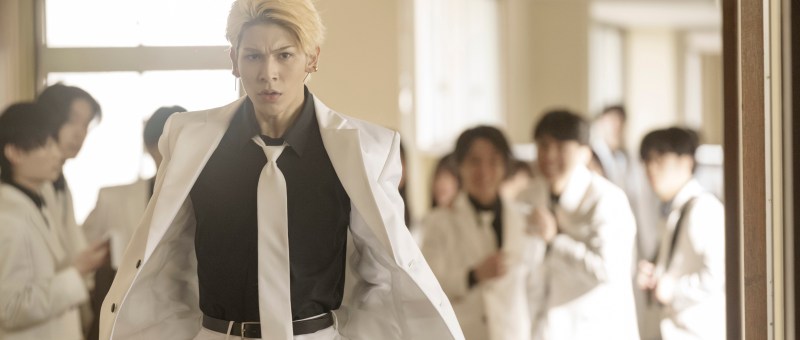
Unbeknownst to her, a high school girl’s entire class is actually made up of bodyguards hired by her distant father, whom she doesn’t know either, to keep her safe because his work makes her an easy target for international criminals. Adapted from the manga by Masamitsu Nigatsu, Junichi Ishikawa’s Honeko Akabane’s Bodyguards (赤羽骨子のボディガード, Akabane Honeko no Bodyguard) is in some ways fairly typical of the genre in its parade of unrealistic hairstyles and over-the-top humour, but also anchors itself in a genuine sense of friendship and youth solidarity as the class come together under a charismatic leader not only to protect Akabane but each other too.

That charismatic leader would be Ibuki, a cocksure delinquent and childhood friend of Akabane’s who’s also been carrying a torch for her all these years. Nevertheless, it comes as quite a surprise when he’s officially hired by Jingu (Kenichi Endo), a man who claims to be the head of Japan’s Security Services. After his wife died, he decided to place Akabane for adoption to keep her safe from the duplicitous world in which he lived. But now there’s a 10 million yen bounty on her head and every criminal enterprise he’s ever been after is desperate to get their hands on her. What Ibuki doesn’t know is that he’s hired the rest of the class too who all have various skills from rhythmic gymnastics to torture. It’s imperative that Akabane never find out that she’s a target, nor that Jingu is her biological father, and continues to live a “normal” carefree life.

She certainly appears to have no skills of her own other than her ability to quote legal infractions in her desire to become a lawyer like her adopted parents. While this may on some level remove her agency in making her dependent on her classmates for protection, it’s also Akabane that takes the initiative in romance by making overtures to the otherwise diffident Ibuki. Other the other hand, she’s painted as the mirror image of her sister, Masachika (Tao Tsuchiya), who has been raised as a boy and taught to be an assassin but craves the kind of love and affection Jingu pours on Akabane. 

This is one reason that she is eventually able to find unexpected common ground as she and Akabane are obviously both firmly on team Ibuki with Akabane thankful that someone else can see Ibuki’s good side even if most people mistake him for being a scary and dangerous person. Like his father, the late policeman, he believes that to protect someone you must protect everything they love which is why he’s desperate to protect the whole of the class too so that Akabane’s world remains consistent. Most of the other students aren’t too invested in their jobs and are only doing this for the paycheque, but eventually end up coming together thanks to Ibuki’s insistence that he won’t leave them behind. Not only does he need their help to protect Akabane, but genuinely respects their friendship and wants to save them too.

Then again, we’re presented with a series of images of paternal and hierarchal failure. Ibuki’s own father was killed in the line of duty and while alive had little time for his son, if like Jingu trying to keep his child out of the dangerous world in which he lives. Jingu gave up one daughter to keep her safe, but has a strained relationship with the second who feels like a failure and is desperate for a chance. Even the head of the class is compromised as he first proves himself willing to sacrifice the lives of his men in achieving their goal of protecting Akabane and then seems to commit several blunders including being unable to unmask a mole. Ibuki becomes a de facto leader, but at the same time what emerges under him is a relationship of equals and solidarity between those in a similar situation. They are no longer working for Jingu or following their leader’s orders but thinking for themselves and actively protecting each other. 

Ishikawa puts together some excellent action sequences that demonstrate what a well-oiled machine the students can be in standing up against criminality while maintaining the zany humour and making Ibuki an oddly pure figure of warmth and integrity as he resolves to protect all of those around him if most especially Akabane to whom he is unable to voice his real feelings. She meanwhile, admittedly a damsel in distress, is at least taking the lead when it comes to their romance even if she continues to needle him about his rough and uncouth behaviour. Honeko Akabane is it seems very well protected from any threats that come her way save perhaps that of her hidden past.                                                                                                                                    


Honeko Akabane’s Bodyguards screened as part of this year’s Fantasia International Film Festival.

Original trailer (no subtitles)

Ichiko (市子, Akihiro Toda, 2023)

If for some reason your name were taken from you and it became much easier to live by some other person’s name that you were compelled to use, would you be content to be them or be prepared to go to extreme lengths to reclaim your own identity? Based on his own play, Akihiro Toda’s Ichiko (市子) explores similar themes to his 2018 film The Name as the absent heroine fights to reassert herself just as we try to piece her together to a create semblance of the whole being we may never truly understand.

In many ways, it’s absence that defines Ichiko (Hana Sugisaki) who like the mysterious spirit of a fairy tale must be gone as soon as she is seen. Or at least, you could forgive Yoshinori (Ryuya Wakaba) for feeling this way when his girlfriend of three years suddenly disappears soon after he’d presented her with marriage papers. It’s not until he’s visited by a policeman, Goto (Shohei Uno), sometime later that he’s forced to admit he actually knew very little about her. He assumed she’d had a difficult past, and neither of them said too much about themselves so he doesn’t know if her parents are still alive, where she was from, or if she has any family or friends she might have gone to. What shocks him most, however, is that Goto informs him that on paper at least the woman named Ichiko Kawabe does not exist.

Flashing back across several years from Ichiko’s childhood to the present day, we see people call her by another name which she often tries to correct telling them that her name is Ichiko but it isn’t originally clear to us if this is because she’s being forced to live under false name or if she merely dislikes the name she was given and wishes to be “Ichiko” instead. In any case, she appears to have developed a healthy fear of letting anyone in thanks to her incredibly disordered home life. At times, would-be friends attempt to visit, but are either kicked out or merely horrified by what they see there and leave soon afterwards putting an end to the friendship. That might in itself explain why she may wish to be someone else, but in fact what she wants is the right to be herself.

Gradually it becomes clear that because of the way Japanese society works, Ichiko has been forced to live two lives as one and can live neither fully. It’s not quite right to call it a double life or to say that she multiple personalities but more that she cannot quite locate herself within herself and is increasingly distressed in being forced to answer to a name which is not her own and live someone else’s life for them. Later she explains that all she wanted was a “normal” existence though this is the very thing denied her in part because she is denied her rightful identity though there is something quite poignant in her remaining innocence. Her touching description of finding happiness in the scent of miso soup wafting from ordinary houses at dinner time expresses her desire for the comfort and safety of a conventional family she never really had or may perhaps have experienced for a brief moment in early childhood. 

Ironically enough, she exclaims that she likes walking in the rain because it washes everything clean though for her it will spell disaster in quite literally revealing the skeletons buried in her past and with them exposing the precarious web of lies on which her adult life was based in an attempt solely to recapture the authenticity of her essential identity. A further irony may be that the identity she ends up with may not even be her own but that of someone else who decided they no longer wanted theirs, perhaps because the world had also been unkind to them and so they did not understand its worth. As the policeman says, she did what she had to do survive whether that be lying about who she was or otherwise burying her other self literally or metaphorically. Dark and melancholy, Toda’s twisty psychological mystery has its poignant qualities but ultimately asks whether living as your true self is worth the price or it’s better just to accept the name that fate and society have dealt you.


Ichiko screened as part of this year’s Nippon Connection

Original trailer (English subtitles)

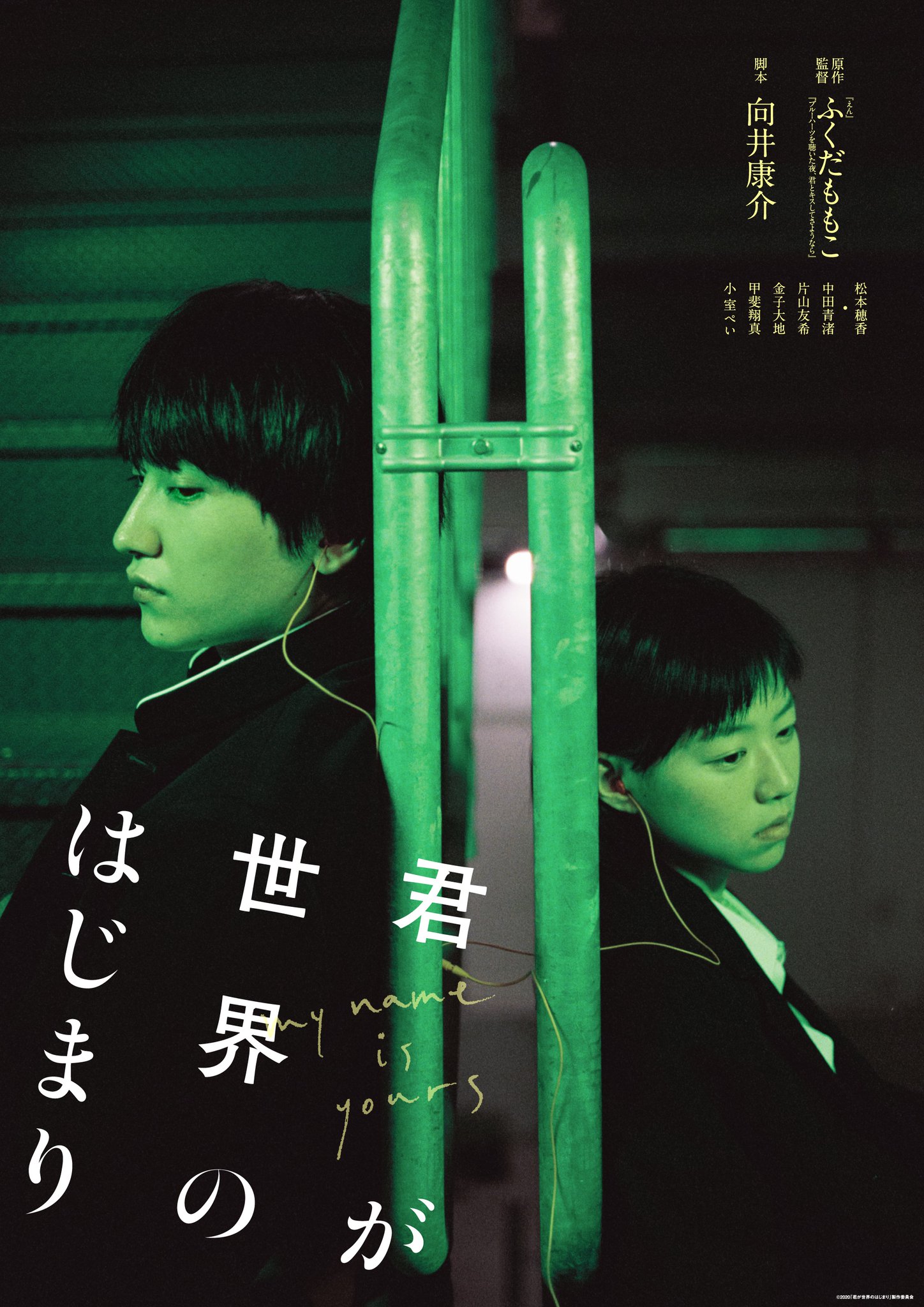
My Name is Yours (君が世界のはじまり, Momoko Fukuda, 2020)

A collection of Osaka teens process adolescent angst and generational anxiety but in the end find a gentle solidarity in their shared suffering while resolving to be kind in Momoko Fukuda’s adaptation of her own novel, My Name is Yours (君が世界のはじまり, Kimi ga Sekai no Hajimari). “People are unknowable” they solemnly resolve, admitting that you never really know anyone but later making an effort to share their secrets, if only gently, bonding in a new sense of openness as they begin to move forward into a brighter future. 

Fukuda opens however with a scene of crime as a high school student is arrested for the murder of their father. As we discover, several of the teens could be potential suspects, each in someway resentful of their dads though for very different reasons. Recently transferred Tokyo boy Io (Daichi Kaneko), mocked for his accent, is involved in some kind of hugely inappropriate sexual relationship with his middle-aged step mother as accidentally witnessed by moody classmate Jun (Yuki Katayama) hanging round the shopping mall in order to avoid going home to her overly domesticated dad (Kanji Furutachi ) whom she blames for her mother’s decision to leave the family. Narihira (Pei Omuro), meanwhile, was abandoned by his mother soon after birth and is sole carer to his father who seems to be suffering with early onset dementia. 

Childhood best friends En/Yukari (Honoka Matsumoto) and Kotoko (Seina Nakata) first encounter Narihira in their secret hideout, a disused school library, having a private cry leading Kotoko to fall madly in love publicly dumping her current boyfriend with extreme prejudice seconds later. Meanwhile, En becomes an accidental confidant to nice guy Okada (Shouma Kai) who has received a mysterious love letter he doesn’t quite understand because it’s come in the form of a classical poem only for Okada too to fall for Kotoko while Narihira seems to prefer En. 

Love triangles aside, each of the teens has their private sorrows some more secret than others but nevertheless producing chain reactions of their own in their inability to express themselves fully. But as angry and frustrated as they are, they still want to be kind if more to others than themselves. “If I only think about my own freedom how can I be kind to others?” Narihira sadly reflects confessing his occasional resentment in trying to care for his father. Even Io, seemingly realising how inappropriate his relationship with his step mother is, resolves that he wants to be kind to her despite the harm she may be doing him. “Wanting to hurt other people is absurd” he claims, unable to understand the impulse to exorcise his frustration through violence. 

Narihira attributes his salvation to having met En, explaining that in a sense she opened up a new world in giving him the courage to talk about his father sharing the secret with Okada who told the coach on their sports team who told him about a facility that might be able to help. Yet Narihira also begins to disrupt the previously close relationship between En and Kotoko, leaving Kotoko feeling jealous and En confused it seems on more than on level as the unexpectedly perspicacious Okada seems to have figured out forcing her in turn to reckon with and accept her own unspoken feelings. 

Taking refuge in a darkened shopping mall overnight, the teens unexpectedly bond through a musical performance of the classic Blue Hearts track Hito ni Yasashiku with its melancholy yet cheerful chorus encouraging each other to hang in there, remaining kind in a world which often isn’t. “Well, I can’t say for sure. Nobody can.” an amused secretary guard honestly answers asked by one of the teens if the mall will be torn down, his refreshingly direct answer perhaps adding to their new sense of confidence even in the face of the world’s uncertainty. A gentle, quietly nostalgic coming-of-age tale, Fukuda’s Osaka-set lowkey yet stylishly moody drama begins with violent darkness but ends in bright sunlight, the teens each finding a sense of equilibrium having come to new understandings about themselves and those around them bolstered by a youthful solidarity. Some secrets it seems still cannot quite be shared, but friendships resolve themselves all the same if in unexpected ways allowing a melancholy intensity to dissipate into a sad if fervent hope for the future. 


My Name is Yours screened as part of this year’s Camera Japan

Original trailer (English subtitles)

Hito ni Yasashiku music video

The Blue Hearts – Hito ni Yasashiku

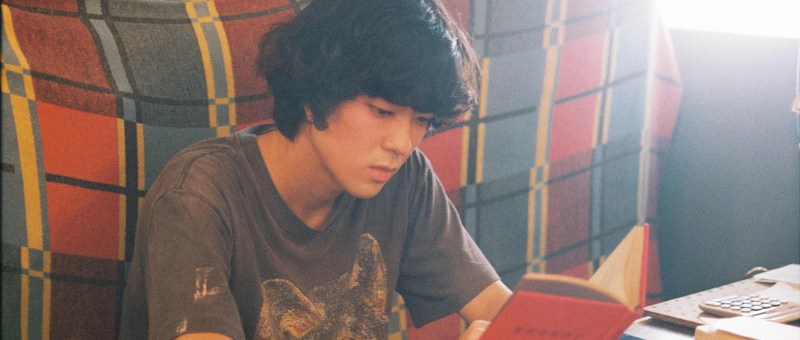
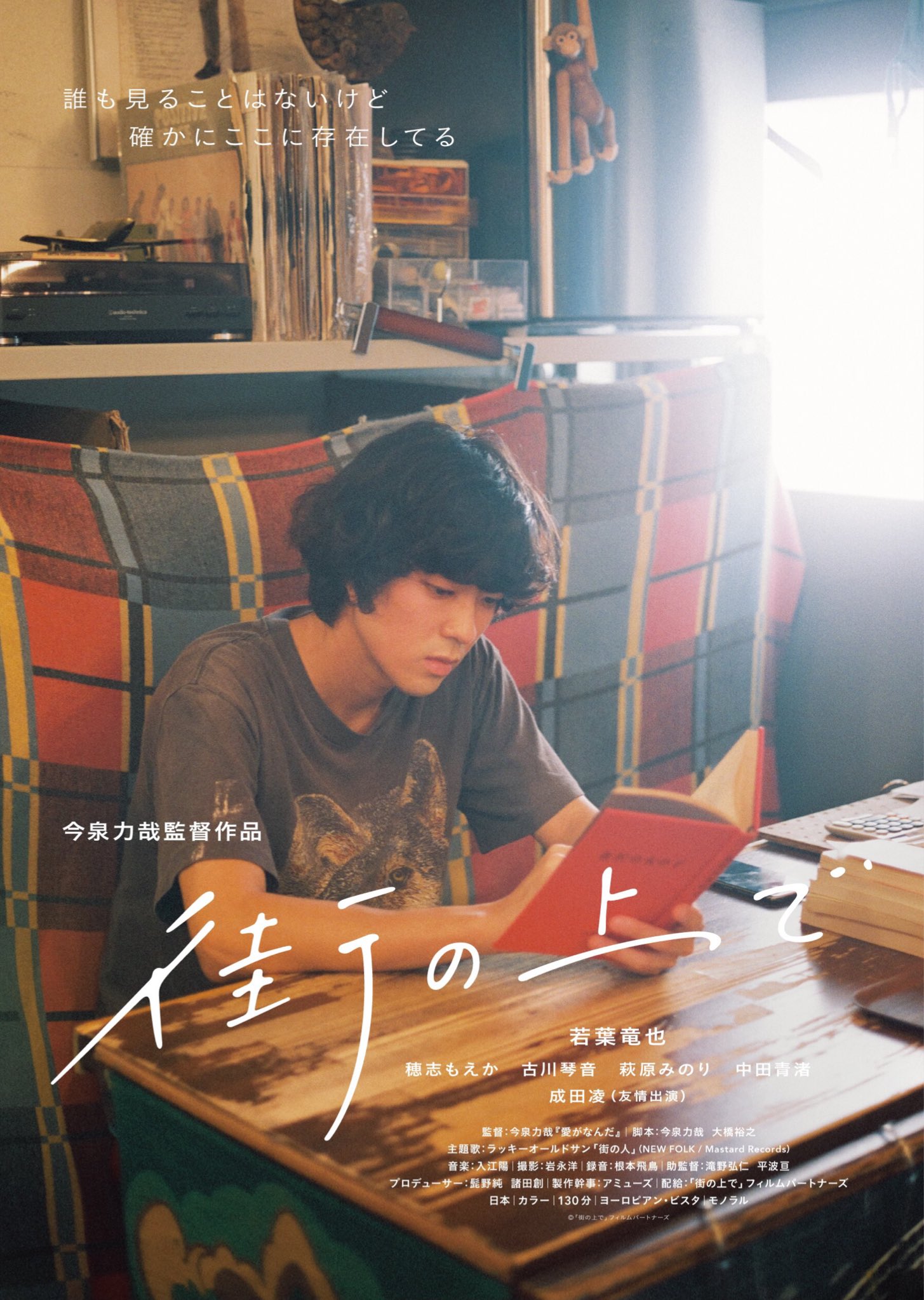
Over the Town (街の上で, Rikiya Imaizumi, 2019)

Frustrated youngsters chase an unrealisable dream of idealised romance in Rikiya Imaizumi’s ode to Shimokitazawa, Over the Town (街の上で, Machi no Uede). For the moment at least known as the bohemian, avant-garde artists quarter of the contemporary capital beloved for its slightly retro quality replete as it is with narrow lanes and period buildings, Shimokitazawa is also a place of constant change but as the hero later points out even if “parts change and disappear that doesn’t mean they never existed”. Nevertheless, he seems to be marked by a particular anxiety, as do many of his age struggling to make meaningful connections in an ever shifting world. 

Ao’s (Ryuya Wakaba) world begins to crumble when he’s unexpectedly dumped by his beloved girlfriend, Yuki (Moeka Hoshi), on her birthday. Unceremoniously telling him that she’s met someone else, Yuki rationalises that breaking up is the only option but Ao tries to resist only for her to tell him that he can go on deluding himself that he still has a girlfriend but from now on she’ll be hanging out with someone new. From then on, Ao seems to be surrounded by frustrated couples and worryingly outdated ideas of romantic politics such as those of the students who drop into the vintage clothing shop where he works. Ao assumes they’re a couple, but a row slowly brews as the girl, Asako, declares herself bored with helping the guy, Shigeru, try on clothes that turn out to be for the purpose of impressing a different girl altogether despite knowing that Asako fancies him. Eventually Shigeru makes a highly inappropriate suggestion, almost akin to a bet, that if the woman he has a crush on rejects him he’ll deign to dating her even though Asako is “a distant second” in his heart. The shocking thing is that Asako agrees, a slightly mournful look in her eyes as she finally reaffirms that she really hopes it works out with the other girl. 

Throughout the exchange during which Ao looks on as an awkward bystander, it becomes increasingly difficult to see what’s so great about Shigeru. Meanwhile, not even Ao comes off particularly well, struggling to deal with his breakup and refusing to accept Yuki has moved on. So hung up on her is he that she eventually ends up contacting the barman at his favourite haunt to ask him to have a word, explaining that it’s inappropriate to go on texting your ex even if she doesn’t reply. Meanwhile, he finds himself at the centre of romantic missed connection, captivated by a sad woman at a concert who gives him a menthol cigarette he keeps in his ashtray as a kind of talisman for the rest of the picture. Infinitely awkward, he talks himself out a potential date with the cute girl at his favourite used bookstore (Kotone Furukawa) by asking an inappropriate question, later doing something similar to a woman (Seina Nakata) with whom he makes a more platonic connection as they each reflect that for some strange reason it’s much easier to open up to someone you have no romantic interest in. 

Perhaps that’s why a melancholy policeman keeps stopping random people in the street to ask their advice on his peculiar romantic dilemma in having inconveniently fallen in love with his “niece” (by marriage and the same age as he is, so maybe it’s “OK”, he’d like to think). Shimokitazawa, which Ao rarely leaves, is indeed a small world, the various strands of his romantic entanglements strangely connected from a young woman’s unrequited longing for her sumo wrestler childhood sweetheart to a TV actor’s (Ryo Narita) troubled love life and a young film director’s (Minori Hagiwara) attempt to deflect her own sense of romantic disaffection. Just as Yuki used another man as an excuse to break up with Ao, Ao finds himself recruited as a fake boyfriend to help a young woman shake off a controlling ex whose refusal to accept the relationship is over in the absence of another man skews even darker than his own signalling perhaps like that first vintage shop exchange the dangerously outdated sexual politics which continue to underpin modern dating. Perhaps boring love is the real kind of fun, comfortable and balanced marked by true connection and mutual vulnerability rather than a giddy anxiety. A stubborn holdout where everything’s secondhand in a continual circulatory process of exchange and return, Shimokitazawa is the kind of place where love finds you even if it takes a while to wander on its way. A charming ode to this timeless yet ever-changing district, Imaizumi’s quirky dramedy keeps the neurosis of young love on the horizon but suggests that romance, like a well baked cake, keeps much better than you’d think when cooled.


Over the Town screened as part of the 2021 Osaka Asian Film Festival.

Original trailer (no subtitles)

Liverleaf (ミスミソウ, Eisuke Naito, 2018)

(C)押切蓮介/双葉社 (C)2017「ミスミソウ」製作委員会

Liverleaf poster“How have things turned out this way?” Asks the heroine of Eisuke Naito’s Liverleaf (ミスミソウ, Misumisou) after receiving a poignant (non)explanation for the cause of all her sufferings. Adolescence is cruel at the best of times, but when you’re stuck in a tiny no horse town with nothing to do, violence can become an easy pastime. The kids of Liverleaf take the art of bullying to all new heights, stopping not at humiliation, ostracisation, or conspiratorial acts of emotional ruin but allowing their petty games to run all the way to arson and murder.

Haruka (Anna Yamada), unlike most of her classmates, is a relatively new resident of a small rural town where she and her family have moved for her father’s job. Her only friend at school, and the only one to stand up for her against the gang of popular kids making her life a misery, is another transfer student, Aiba (Hiroya Shimizu), living alone with his grandmother for mysterious reasons. The usual high school girl tricks of making another girl feel unwelcome – stolen shoes, name calling, silent stalking etc eventually progress into direct violence at which point her father (Masahiro Toda) tries to go to the school to complain. Unfortunately, Haruka’s teacher (Aki Morita) is an almost absent, hollow source of authority who cannot control the kids and nor does she try. She tells Haruka’s dad that as the school will be closing down at the end of the academic year it’s hardly the time to make waves and she sees no need to get involved in such trivial matters. Matters come to a head when the kids, egging each other on, set fire to Haruka’s house with her mother (Reiko Kataoka), father, and little sister Shoko (Sena Tamayori) trapped inside.

It’s true enough to say Haruka reacted to her bullying in the way that society expects – she kept her head down and tried to put up with it without making a fuss. Some may read Liverleaf as a tale of vengeance, but it isn’t. As passive as she’s always been, Haruka’s acts of violence are a matter of extreme self defence. She doesn’t go looking for the ones who’ve done her wrong, but they come looking for her and thereafter pay a heavy price for their continued campaign of subjugation.

Haruka became an easy subject for bullying because she was a literal outsider – Aiba escaped this particular fate through being male, conventionally attractive, and with a confidence and maturity which set him apart from the bratty kids trying to prove their status by belittling others. Once Haruka decides to sit out the rest of the school term rather than put up with constant torment, she activates an extreme chain of events when the next likely target, a strange girl with a stammer (Rena Ohtsuka), decides to do whatever it takes to become one of the bullies rather than their latest victim. Morality goes out the window when fear takes over and some will to whatever it takes to make sure it’s someone else in the firing line rather than themselves.

Yet for all the fear and violence, there’s another, perhaps more interesting, story buried under all the senseless bloodletting. It’s not so much that teenage emotions are running wild, but that they barely have them at all and those they do have find no available outlet. Romantic jealousy spirals out of control, turning in on itself as love denied masquerades as hate. Unable to freely voice their innermost anxieties, the kids take their resentments out on each other, getting their kicks through cruel games which bind them with complicity in the absence of real feeling.

Naito attempts to lend an air of realism to the increasingly bizarre middle school warfare but cannot escape the manga origins of his source material. The violence itself is cartoonish and absurd, but there’s also an unpleasant layer of fetishisation which takes over as the blood starts flowing, almost revelling in acts of extreme cruelty as a young man exults in beating the face of a young girl to a bloody pulp. Unremittingly bleak, Liverleaf makes a bid for pathos in its closing coda as it takes us back to a case of ruined friendships and broken dreams but it can’t overcome the uneasy stylisation of all that’s gone before in swapping emptiness for wistful melancholy.


Liverleaf screens as part of New York Asian Film Festival 2018 on 8th July, 7pm with director Eisuke Naito in attendance for a Q&A.

Original trailer (English subtitles/captions)