The Killer (喋血雙雄, John Woo, 1989)

“We’re outmoded characters,” a dying man laments, having previously advanced that “nostalgia is one of our saving graces.” The heroes of The Killer (喋血雙雄) are indeed remnants of an earlier time, out of place amid the modern city and adhering to a code that has long since fallen by the wayside. “Our world is changing so fast,” hitman Jeff (Chow Yun-fat) exclaims of a Hong Kong hurtling not only towards the Handover but an increasingly amoral capitalism in which friendship and brotherhood no longer have any currency.

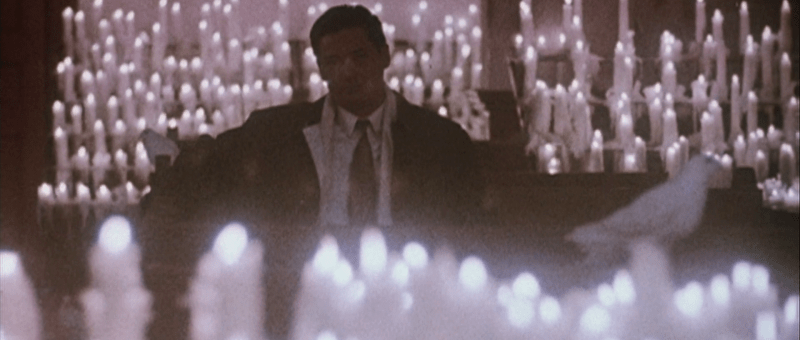
We can tell this straightaway from the fact that the man who ordered the hit on the drug lord Jeff took out at the dragon boat races was his own nephew, Weng (Shing Fui-on). To tie up loose ends, Weng also sends his own hitmen to take out Jeff, who can’t be sure if his handler and best friend Sidney (Chu Kong) is involved in the plot to knock him off. Later in the film, Inspector Li (Danny Lee) asks what Jeff will do if Sidney betrays him, but he merely says that he will still treat him as a friend because he has been good to him in the past. Jeff says this in an abandoned church, echoing not only the codes of jianghu brotherhood now largely absent in the contemporary society but Christianising notions of forgiveness and acceptance. 

Jeff claims that he isn’t a religious man but appreciates the tranquillity of the disused chapel. Inspector Li meanwhile is often pictured next a statue of the Buddhist god of war and dressed in black in opposition to Jeff’s white, but what emerges is that the two men are effectively the same and somewhat interchangeable. Jennie (Sally Yeh), the nightclub singer Jeff accidentally blinded during a a chaotic hit and subsequently falls in love with, first mistakes Li for Jeff while Woo also pictures him sitting in Jeff’s chair and pulling a gun on his partner in much the same way Jeff cooly dispatched an assassin sent by Weng. Chang had told Li that he looked exactly like what he was, an undercover policeman, which is obviously a problem, but Jeff remarks that he is a “very unusual cop,”while Li agrees he’s a very unusual killer. 

In some senses, Li will also become the killer of the film’s title in the closing moments, a man who believes in justice but is not himself believed and knows that there will be no real justice for a man like Weng. Both men share a code which is essentially the same, a more primal kind of morality largely incompatible with the modern society and in many ways rightly so. Li even says that Jeff does not look like a killer, that there’s something “heroic” about him, and that his eyes are full of passion as if he had a dream. His words have a kind of irony to them, but Jeff does indeed have a dream in the desire to gain redemption for himself by restoring Jennie’s eyesight, which is the reason for his last big job having now been reformed by her no longer believing that the people he killed deserved to die but that everyone has a right to live.

Despite the triangular relationship with Jennie, there is an undeniably homoerotic tension in the connection between Li and Jeff even if they are also two sides of the same coin. They train their guns on each other and lock eyes, but unexpectedly find a kindred spirit in a man who should be an enemy. “The only person who really knows me turns out to be a cop,” Jeff chuckles but has an equally deep relationship with handler Sidney just as Li has with parter Chang (Kenneth Tsang) while the homosociality that defines their world is subverted by Weng who simply shoots his own underling when he becomes inconvenient to him. 

Both Li and Jeff are effectively men left with “no way out” and “nowhere to go” because their code of brotherhood is no longer understood by the contemporary society. Jennie’s progressive loss of sight also echoes their dwindling futures as if the light were going out of their world long before Woo shatters the statue of the Virgin Mary and unleashes the doves of futility inside the no longer quite so tranquil church that becomes the final resting place of manly honour and brotherly love. “Perhaps we are too nostalgic,” Jeff sighs but nostalgia is indeed his saving grace in a world in which honour and friendship exist only in a mythologised past or may never have really existed at all.


Trailer (no subtitles)
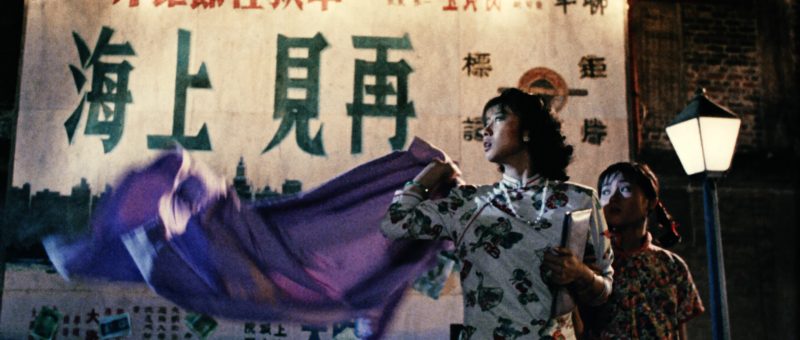
Shanghai Blues (上海之夜, Tsui Hark, 1984)

There’s a strange kind of melancholy optimism born of false courage and desperation that colours Tsui Hark’s Shanghai Blues (上海之夜). A clown soon to become a soldier tells a woman he meets in the dark under a bridge as the city burns and Shanghai falls to the Japanese to remember that they will win. 10 years later the wounded of that same war reassure each other that their time will come, they didn’t survive just to die here now seemingly cast out by the society they risked their lives to save.

The Shanghai Stool (Sally Yeh Chian-Wen) arrives in is in a moment of euphoric liberation caught between cataclysmic revolutions with the civil war and eventual coming of the communists hovering on the horizon. A wide-eyed country girl, she’s almost lost amid the hustle and bustle of the city in which the motion never stops. Like many, she is immediately displaced on her arrival, discovering that the relatives with whom she hoped to stay are no longer at their address and she is therefore homeless and alone. The clown, Do-re-mi (Kenny Bee), now a member of a marching band unable to play his instrument, thinks she’s the girl from the bridge in part because she’s wearing the same outfit but mainly because she has the same short hair cut and so he follows but loses her. Meanwhile, she has a kind of meet cute with Shushu (Sylvia Chang Ai-Chia), now a jaded nightclub showgirl still pining for the clown, in which they each believe the other is trying to take their own life but end up becoming best friends and roommates unwittingly living directly below Do-re-mi. 

In this 30s-style screwball world, identities are always uncertain and often obscured by darkness or else the continual march of the crowd. Yet there’s a kind of romanticism in this act of seeing and not seeing. Only in darkness do Shushu and Do-re-mi finally recognise each other and when their romantic moment is interrupted by the end of a power cut, they smash the neon lights opposite to reclaim it as if to reject the intrusion of this glaring modernity. To that extent, the implication may be that this innocent kind of romantic connection can’t survive the bright lights of the big city or that light blinds as much as it illuminates. In several sequences, the characters inhabit the same space but cannot see each other while a nefarious thief lurks on the edges of the frame unseen by all. On realising that Do-re-mi is the clown/soldier for whom she’s been waiting for the last 10 years, Shushu knows that she will have to break her friend’s heart or her own and that Stool’s dream of a family of three is unrealisable amid the constant rootlessness of this transient city. 

To that extent, Stool is an echo of herself as the innocent young woman she was on meeting Do-re-mi under the bridge rather than the more cynical figure she’s become due to her experiences in the wartime city. In the film’s closing moments, Stool meets another version of herself in the form of a wide-eyed young woman in a plain dress who asks her if this is Shanghai but the only reply she can give is that she wishes her luck because for her Shanghai is now a city of heartbreak just it has been one of sadness and futility for Shushu. “I have one hope, if I give it to you I won’t have any,” Shushu tells her lovelorn boss as an expression of the despair that colours her existence in which the distant possibility of romantic fulfilment is all she has to live for. 

The fact that the lovers later flee Shanghai for Hong Kong seems to take on additional import as those in Hong Kong consider a similar trajectory with their own revolution looming while adding to the sense of continual displacement, disrupted communities, and worlds on the brink of eclipse. This Shanghai is a bleak place too with its lecherous gangsters and seedy businessmen but has a sense of warmth even amid its constant motion in its serendipitous meetings and friendships born of the desire for comfort and company in the face of so much hopelessness. In the end, perhaps romanticism is the only cure for futility just as the only thing to do in a world of chaos is to become a clown.


Shanghai Blues screens Nov. 13 as part of this year’s San Diego Asian Film Festival.

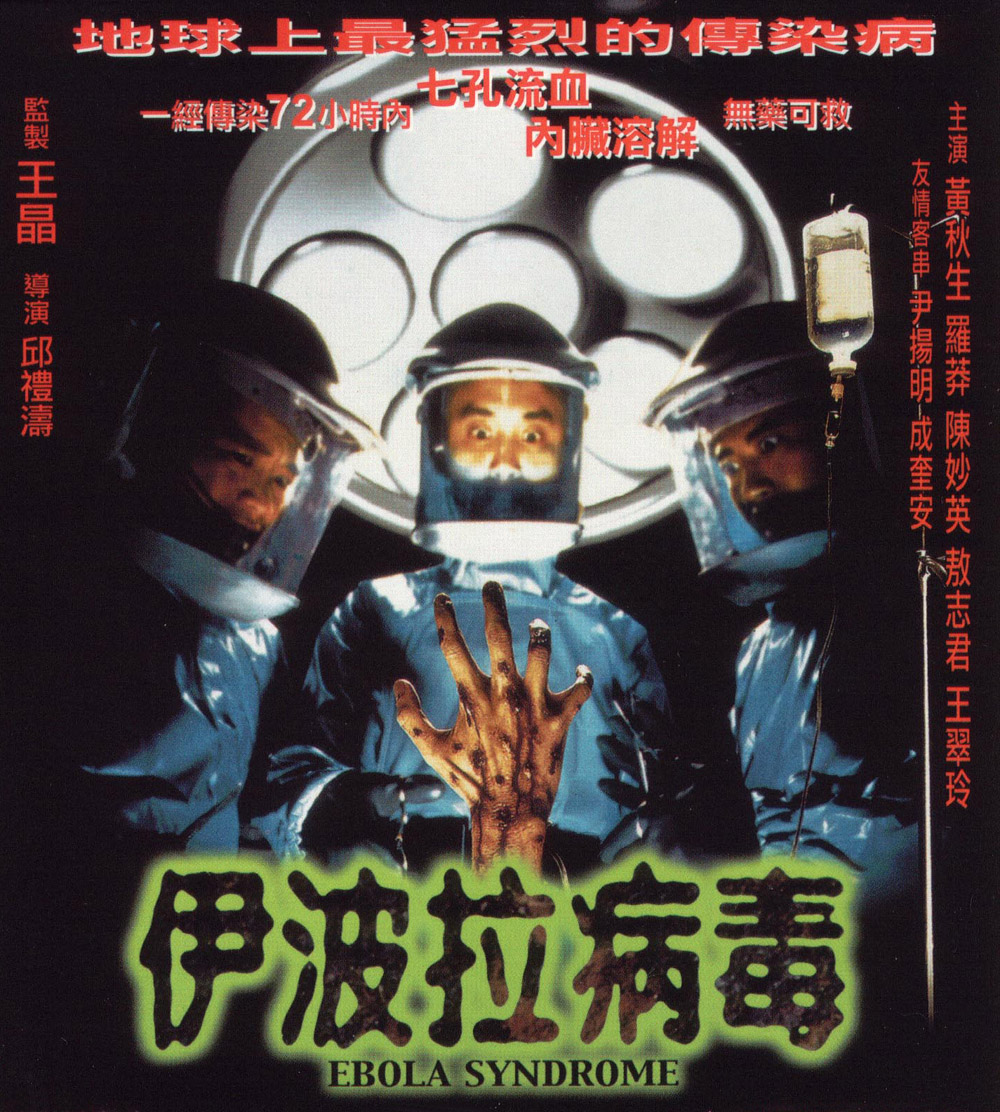
Ebola Syndrome (伊波拉病毒, Herman Yau, 1996)

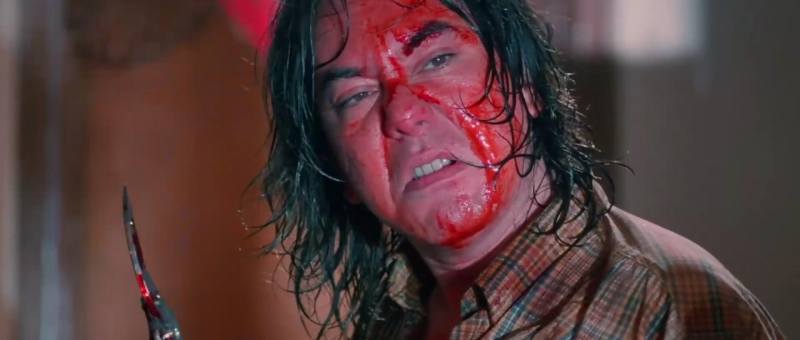
“I’ll fuck up whoever busts my balls!” snarls the protagonist of Herman Yau’s notorious 1996 Cat III exploitation film Ebola Syndrome (伊波拉病毒), seemingly filled with internalised rage in a sense of oppression as a little guy continually at the mercy of bosses who exploit and belittle him. Then again, Kai (Anthony Wong Chau-Sang) is not a nice guy and his various crimes are less those of an emasculated man towards an unfair society than a sociopathic disregard for conventional human morality. 

Even so, his first act of violence is a result of his attempt at petty class rebellion by sleeping with a mob boss’ wife only for the boss to come home and ritually humiliate him by ordering his wife to pee all over his treacherous underling before threatening to cut his bits off with a pair of secateurs. Kai, however, goes crazy and uses the shears to take out the boss, the associate, and the wife, pausing as he leaves to douse their terrified little girl in petrol in an ironic piece of foreshadowing only to be interrupted before he can light a flame. 10 years later in 1996, Kai is on the run working in a Chinese restaurant in Johannesburg where he is once again oppressed and belittled by the Taiwanese manager and his wife not to mention further displaced by the complicated racial politics of mid-90s South Africa. 

A minor comment on colonial corruptions in the anxiety surrounding Hong Kong’s imminent transition, Kai and his boss Kei (Lo Meng) find themselves in a difficult position in facing discrimination from all sides. Needing meat for their restaurant, they decide to strike a deal with the local indigenous community after being insulted by a white butcher but on their arrival walk into some kind of ritual conducted over the bodies of numerous locals who each have bloody welts all over their skin. On meeting with the leader, the pair immediately rip him off while he plays a grim joke on them as they discover two human bodies in place of the pig carcasses they’d intended to buy before he returns to set them straight.

This early moment of foreshadowing has its own dark irony as Kai will eventually end up once again murdering three people he accuses of busting his balls before mincing them up and turning them into “African Char-sui Bao” hamburgers. By this point Kai is already a “super spreader” having unknowingly contracted the ebola virus after raping a near comatose indigenous woman at the waterside who vomited white liquid in his face as he climaxed. In another instance of cruel cosmic irony, Kai turns out to be one of small amount of people effectively immune recovering quickly from what seems like flu but almost certainly having infected Kei and his wife and through them anyone who ate the African Char-sui Bao which is how ebola winds up in the city and eventually travels all the way to Hong Kong after Kai cuts his losses and goes home to live the high life on Kei’s savings. 

Yau does not hold back on the gore nor on the very real terror of the ravages of ebola as a doctor gruesomely dissects a human body remarking on the disintegration of its internal organs. At this point, Kai doesn’t know ebola’s what he has or that he’s passing it on but it’s unlikely he’d care. When the truth is finally revealed he runs anarchically through the streets with a meat cleaver shouting “ebola for everyone” and spitting at passersby as if taking his revenge against humanity itself. Yet he’s ultimately a wild animal trapped in civilised society caring for nothing other than the satisfaction of his immediate needs aside from his desperation to affirm his masculinity, not to be looked down on or bullied. We see him impassively chop up live frogs and witness the heads being torn off live chickens for others to drink their blood seeing him for what he is, an urban predator with no sense of conventional human value systems. 

Even so, the film seems to suggest this breed of malicious selfishness and amorality cannot be exorcised from the contemporary society while the infection continues to spread exponentially, the film’s bleak conclusion implying that the innocent will continue to suffer while the systemic causes of the disease go unexamined. Then again, Yau approaches his material with absurdly dark humour that implies that this really is some sort of cosmic joke in which all you can really do is laugh at life’s immense cruelties. 


Trailer (no subtitles)