The Mosquito on the Tenth Floor (十階のモスキート, Yoichi Sai, 1983)

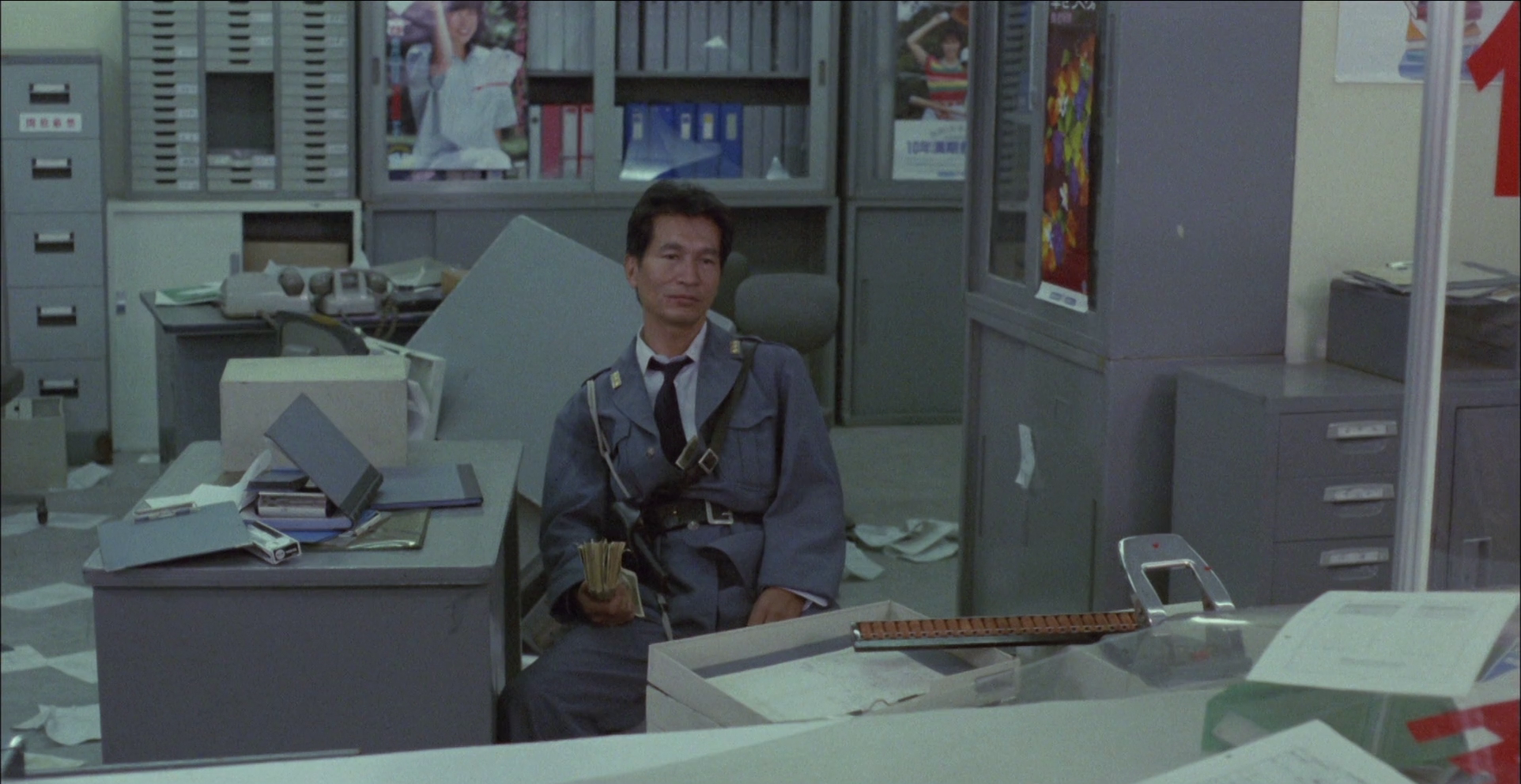
A beaten-down beat cop’s existential crisis progressively deepens after he throws himself into financial ruin to buy a computer in Yoichi Sai’s debut The Mosquito on the Tenth Floor (十階のモスキート, Jikkai no Mosquito). Like Pool Without Water, star Yuya Uchida conceived and co-scripted the film as a vehicle for himself and was apparently inspired by the sight of some blood, his own, on a wall where he’d squashed a mosquito though he also claimed the the 10 in the title is intended to reference the 10 commandments in addition to simply where the unnamed protagonist lives.

The fact that he lives on the 10th and top floor in a building with no lift is symbolic of his dismal circumstances. On the one hand he can rise no higher but on the other is stuck with an inconvenient living situation precisely because of his inability to rise socially. As it transpires the hero, a policeman, joined the force right out of high school with aspirations of rising to the rank of captain but has spent the entirety of his 20-year career manning a police box. He’s repeatedly failed the exam for promotion to lieutenant and realistically speaking is now simply too old to make much further progress. A man of few words, he listens as the other officers who took the exam with him outline the hierarchal structure of the police force while meditating that as a man on the wrong side of 40 his possibilities have decreased and it’s more than likely he’ll be stuck in the police box until he retires. 

His boss later says as much, sympathising with him but also pointing out that a policeman is also a public servant with a role to serve within the community. He is supposed to make people feel safe and contribute to the progress towards a crime-free society, but it’s clear that his life has spiralled out of control precisely because he cannot ally his career goals with the kind of life he wished to lead. His wife divorced him two years ago seemingly because she wanted a greater degree of material comfort and became resentful that he failed to progress in his career and could not move on from the low-salaried position of an ordinary street cop. She now makes a living selling golf club memberships, looking ahead to the oncoming Bubble-era and a society of affluent salarymen which is very much what her new boyfriend seems to be. Meanwhile, she lives in a very nice townhouse with their teenage daughter and constantly hassles the policeman for falling behind with his child support and alimony payments. He’s also racked up a healthy tab at a karaoke bar where he regularly hangs out and has a serious gambling problem with betting on boat races seemingly his only other form of social outlet.

As his daughter and others keep reminding him, the world is changing and his decision to buy a computer after unwisely taking out a payday loan is in part a symbol of his desire to progress into the modern society even if, somewhat ironically, others chastise him for spending what is then a huge amount of money on something they think of a child’s toy. Otherwise an upstanding policeman who irritatedly deflects a colleague’s joke about bribing someone to pass the exam, the policeman finds himself taking out one payday loan to pay another with loansharks constantly ringing him at the police box to remind him he’s behind on his payments. To overcome his sense of powerlessness, he begins by abusing his authority in catching a punk woman shoplifting and arresting her but then taking her back to his flat to play computer bowling and take advantage of her sexually. He later does something similar with a bar hostess, Keiko (Reiko Nakamura), who took him home when he was drunk. Though the encounter begins as rape, Keiko soon gives in and even comes back for more claiming that she’d never done it with a policeman before and it exceeded her expectations which is in many ways reflective social attitudes at the time. Emboldened, he invites danger by raping a female traffic cop, tearing her clothes as she fights back, screams, and cries though she presumably does not report him given the professional and social consequences that may adversely affect her life and career if she chose to. 

His ex-wife Toshie (Kazuko Yoshiyuki) says she’s not even sure if he’s human anymore, and his failed attempt to rape her after his boss reminds him that he advised against getting a divorce in the first place because it would negatively affect his chance of promotion may be a perverse way to prove he is though it obviously backfires. Having failed in every area of his life and with no prospect of ever getting back on track or starting again, he begins to go quietly insane typing rude words into his computer while the constant calls from loansharks take on a mosquito-like buzzing as does his own final wail of despair and powerlessness as he’s brought down by same authority he once served. His aloneness and confusion are palpable when he ventures into the city and discovers his teenage daughter Rie (Kyoko Koizumi) dancing in Harajuku staring at her intently but then walking away having invaded this space reserved for the young. “Police yourself!” one of the Rockabilly guys ironically instructs him on noticing that he’s dropped his ice cream cone, explaining that the police might shut them down if they’re discovered to be using the space irresponsibly by littering. Rie and her friends tell him to get a life, explaining that the world is changing while tapping him for cash he doesn’t have but is too embarrassed to refuse, laying bare the extent to which he and those like him have been left behind by the economic miracle, buzzing around maddeningly in mid-air with safe nowhere safe to land. 


Original trailer (no subtitles)

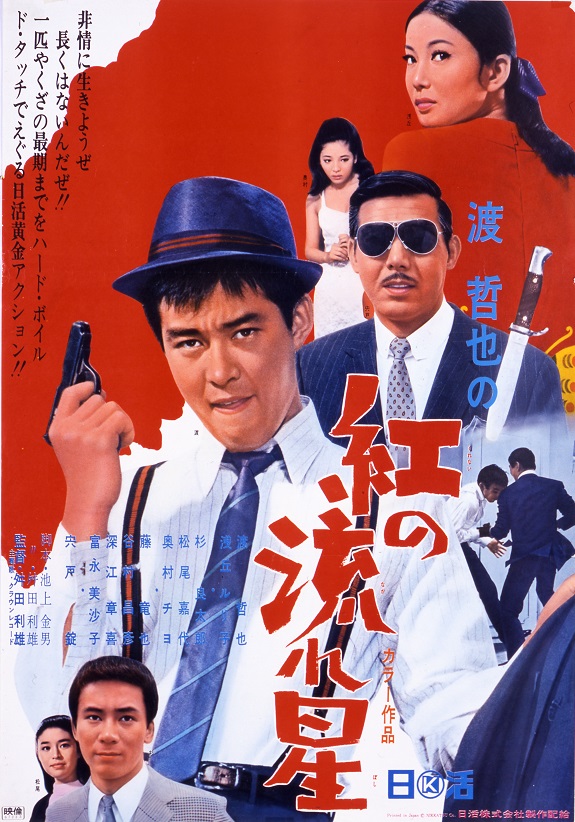
Velvet Hustler (紅の流れ星, Toshio Masuda, 1967)

Perhaps overlooked in comparison with his better known contemporaries, Toshio Masuda was a bankable talent at Nikkatsu directing some of the studio’s biggest box office hits largely thanks to his long association with tentpole star Yujiro Ishihara. Nine years on from their collaborative debut Rusty Knife, however, times had perhaps begun to change. Featuring vibrant colour production design by Tokyo Drifter’s Takeo Kimura, a frequent Seijun Suzuki collaborator, 1967’s Velvet Hustler (紅の流れ星, Kurenai no Nagareboshi, AKA Like a Shooting Star) is a reworking of Masuda’s own Red Pier, itself inspired by Julien Duvivier’s 1937 French thriller Pepé le Moko, with Tetsuya Watari in the role originally filled by Ishihara. Apparently drawing inspiration from Godard’s Breathless, Velvet Hustler is a thoroughly post-modern retake, a parodic tale of gangster ennui and post-war emptiness in which rising economic prosperity has brought with it only despair. 

When we first meet petty gangster Goro (Tetsuya Watari), he’s coolly standing by, leaning on a fencepost like a bored gunslinger as he waits for the perfect getaway vehicle. Jumping into a fancy red convertible which it seems has already been stolen by the young man who parked it in this packed car park, the wires handily hanging striped and exposed, Goro barrels along the highway and and performs an infinitely efficient drive-by shooting on a rival gang boss. According to the man who hired him, Goro was only supposed to cause serious injury, not death, but as he points out if the guy insists on dying that’s hardly his problem. Taking his paycheque, Goro agrees to lie low in Kobe for the next six months after which his boss will come and get him. A year later, however, and he’s still there doing not much of anything, hanging out with the local kids and acting as a procurer dragging sailors on shore leave into gang-run clubs where Americans get into fights with Vietnamese émigrés. So desperate for escape are they that Goro’s underling even suggests they go to war, later thinking better of it when he remembers seeing horrific photos from the front.  

In a convenient but unsatisfying relationship with bar hostess Yukari (Kayo Matsuo), Goro explains that it’s not that he doesn’t like her, but he’s bored, “bored with fooling around with women”, but also of the business of living. The sun comes up, the sun goes down, and then it comes up again, every day all the same. His life has become completely meaningless and he has no idea what to do about it. He longs to go back to Tokyo, but is trapped in this strange Kobe limbo land, an end of the line sea port in which there is ironically no sense of escape. He doesn’t know it yet, but there’s a killer (Jo Shishido) on his trail, a killer who eventually reminds Goro that even if he kills him first another man will come. The bullets you fire are aimed squarely at yourself, Goro’s destiny is already set. There is only one way out of Kobe and it doesn’t lead back to Tokyo. 

Meanwhile, another possibility presents itself in the beautiful Keiko (Ruriko Asaoka), a temporary visitor from the capital looking for her missing fiancé presumed to have done a bunk with her father’s money. Keiko is a distinctly cool yet self-assured figure, generating an instant connection with the affable gangster at once reassured by a sympathetic mama-san that Goro is good but also warned that he’s still a yakuza and as such no good for a smart young woman like her. Keiko thinks that Tokyo is pretentious and boring, confused by Goro’s insistence on getting back there but like him perhaps in waiting. “I love you to death” she later ironically confesses while simultaneously insisting that men and women are different. There is no escape for her. Goro is tired of running but refuses to be handcuffed, choosing perhaps the only path to freedom presented to him. 

A nihilistic tale of gangster ennui in which life itself no longer has value, Velvet Hustler is a curiously cheerful affair despite its essential melancholy, Goro and Keiko sparring in a romantic war of attrition while he almost flirts with the dogged detective (Tatsuya Fuji) determined to bring him down. The kitschy production design gives way to Antonioni-esque shots of a strangely empty city while an ethereal sequence of dissolves eventually leaves the pair alone on the dance floor as if to imply their single moment of romance is but a brief dream of emotional escape. The trappings of post-war success are everywhere from Keiko’s elegant outfits to the cute red sports car and the weird club where Goro dad dances in front of his minions, not so much older than them but clearly out of place in this distinctly unhip seaside bar, but finally all there is is a dead end and an infinite emptiness the embrace of which is, perhaps, the only viable path to freedom. 


On Wings of Love (大当り三色娘, Toshio Sugie, 1957)

vlcsnap-2016-06-01-01h48m32s675The Sannin Musume girls are growing up by the time we reach 1957’s On Wings of Love (大当り三色娘, Ooatari Sanshoku Musume). In fact, they each turned 20 this year (which is the age you legally become an adult in Japan), so it’s out with the school girl stuff and in with more grown up concerns, or more specifically marriage. Wings of Love is the third film to star the three Japanese singing stars Hibari Misora, Chiemi Eri, and Izumi Yukimura who come together to form the early idol combo supergroup Sannin Musume. Once again modelled on the classic Hollywood musical, On Wings of Love is the very first Tohoscope film giving the girls even more screen to fill with their by now familiar cute and colourful antics.
On Wings of Love does not have very much going for it in terms of plot (even compared to previous So Young, So Bright and Romantic Daughters). This time the three girls each work as maids in swanky households and have their eyes on the same guy who they think looks like James Dean (again played by Godzilla heartthrob Akira Takarada). Luckily, another two guys pop-up from somewhere so no one gets left on the shelf at the end when the completely non serious romantic difficulties work themselves out in time for the color coded waterskiing finale.

Like the other films in the series, On Wings of Love is not an integrated musical but one which is punctuated by musical numbers either given a real world context or portrayed as a fantasy sequence. In the previous two films the girls all went to the theatre and ended up watching themselves perform in one way or another, but this time the production number excuse is either a nap or a daydream whilst out on the river on a sunny day. Awkwardly, they each fantasise about Akira Takarada. Hibari goes all Madame Butterfly in an elegant sailor themed number, whereas Chiemi’s is all forlorn love with a melancholic, gothic ballad inspired by On London Bridge, but Izumi breaks all protocol here with a riotous cover of Bee-Bop-a-Lula which is sung entirely in English and becomes a high octane dance number (including the less successful involvement of Takarada).

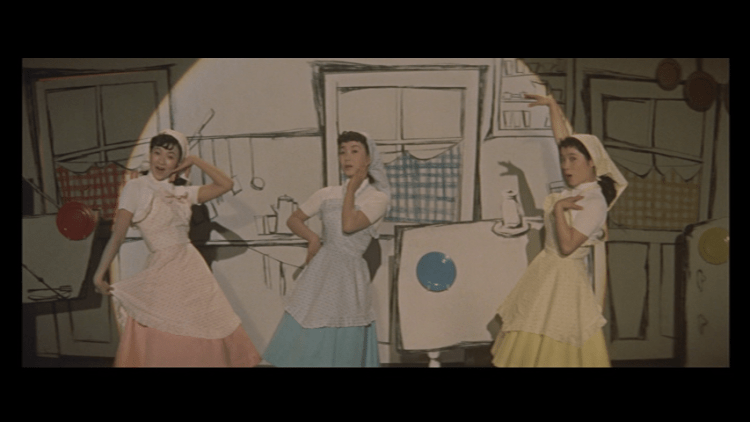
There are fewer musical numbers included in On Wings of Love than in either of the other two movies though there are two trio sequences including the longer opening which sees the girls again color coded and drying dishes together as well as the finale which features the girls waterskiing while their boyfriends drive the boats. Each of the girls gets two numbers each, one solo and one production plus the trio stuff though interestingly there is a more “integrated” love song towards the end and Chiemi’s early song as she walks into town isn’t quite a fantasy sequence either.

Somehow, On Wings of Love isn’t quite as charming as either of the other movies in the series despite the kitch appeal of the opening number. The girls don’t actually spend much time together and the tone is a little rougher than the cutesy approach that had previously dominated with fewer humorous episodes to boot. That isn’t to say the film isn’t successful, but it doesn’t have the same kind of comforting fluffiness that dominated the previous instalments. The switch to Tohoscope gives series director Sugie a different canvas to play with though the most obvious change he makes is a split screen sequence to cover a telephone call. This time the colours appear a little muted too (though this may be down to the quality of the DVD which doesn’t seem as high as the transfers of either So Young, So Bright or Romantic Daughters which are both excellent) limiting the effect of the full on sugar rush the film seems to be aiming for. Nevertheless ,even if it doesn’t live up to the promise of either So Young, So Bright or Romantic Daughters, On Wings of Love is another suitably entertaining outing for the Sannin Musume girls only one a little less filled with laughter and song.


Hibari Misora’s Madame Butterfly inspired routine featuring her song Nagasaki no Cho Cho-san:

https://www.youtube.com/watch?v=JiGdsXagOXU

Also Izumi Yukimura’s quite wonderful Bee-Bop-A-Lula in its release version:

So Young, So Bright (AKA Janken Musume, ジャンケン娘, Toshio Sugie, 1955)

Janken MusumePop stars invading the cinematic realm either for reasons of commerce, vanity, or just simple ambition is hardly a new phenomenon and even continues today with the biggest singers of the era getting to play their own track over the closing credits of the latest tentpole feature. This is even more popular in Japan where idol culture dominates the entertainment world and boy bands boys are often top of the list for any going blockbuster (wisely or otherwise). Cycling back to 1955 when the phenomenon was at its heyday all over the world, So Young, So Bright (ジャンケン娘, Janken Musume) is the first of four so called “three girl” (Sannin Musume) musicals which united the three biggest female singers of the post-war era: Hibari Misora, Chiemi Eri, and Izumi Yukimura for a music infused comedy caper.

As far as plot goes, it’s actually very simple and yet quite complicated at the same time as highschoolers Yumi (Chiemi Eri) and Ruri (Hibari Misora) end up on a school trip to Kyoto where they fall in a river because they’re laughing so much at their classmates’ excitement at spotting someone filming a jidaigeki on the riverbank (neat cameo from director Toshio Sugie). Breaking off from their group, they take their uniforms off to dry only to be disturbed by a young man who tries to take photographs of them at which point they pretend to be washing some clothes in the river. Later they head to an inn which is owned by a friend of Ruri’s mother (who is also an inn owner and former geisha) where they befriend an apprentice geisha, Piyo (Izumi Yukimura).

Piyo then turns up in Tokyo in a bit of a state as it turns out she will shortly be sold into prostitution! She’s fallen in love with someone from the city who she thinks could save her if only she can find him so the girls set out to help her, except the guy’s name is Saito which is the Smith of Japan. During all of this, Ruri also has a subplot about her long lost father who will shortly be moving abroad and apparently wants to actually meet her, opening lots of old wounds.

So Young, So Bright is not a musical in the classical sense, it’s not integrated, but allows ample space for its singing stars to do their thing. Yumi just loves to sing so she randomly starts singing songs she’s heard everywhere, Piyo sings as a geisha and Ruri is rehearsing for some kind of kabuki style performance she gives alone on stage at the climax of the film.

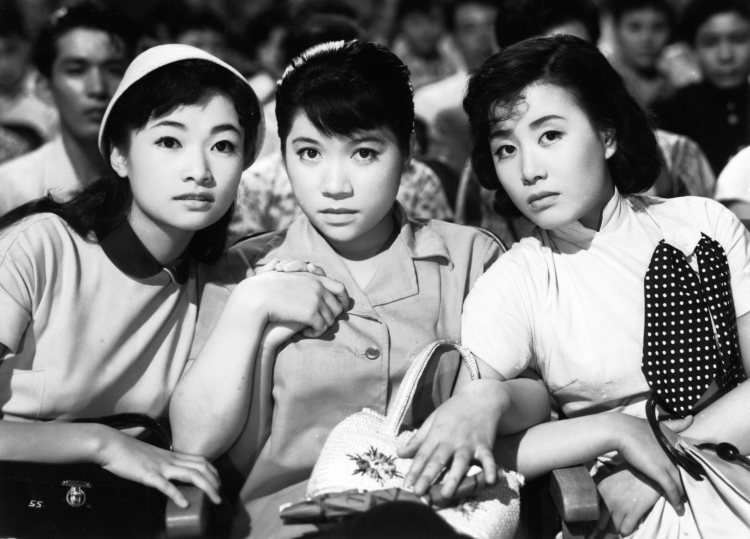
That aside, the main musical sequence comes towards the end where the three girls go to the theatre together and strangely end up seeing “themselves” performing on stage. It’s a neat kind of fantasy sequence in which each of the girls indulges in a little bit of daydreaming as they imagine themselves as stage stars with Piyo being given the cutest, most MGM style number which is then followed by a number from Yumi entitled “Africa” which is very much of its time…and then you get the elegant number from Ruri which is mostly the English version of La Vie en Rose. They also get a trio number to close the film which takes place entirely on a rollercoaster but celebrates each of their slightly different singing styles.

So Young, So Bright is not intended to be anything other than irrepressibly cheerful fluff (despite containing a subplot about possible forced prostitution), but succeeds in being exactly that. An early colour film from Japan it certainly makes fantastic use of its technicolour swirl to give Hollywood a run for its money in the sophistication of happiness stakes. Hollywood musicals are quite clearly the biggest influence though perhaps more those from the pre-war era even down to the only large scale dance sequence which has a distinct Busby Berkley vibe (even it only lasts twenty seconds or so). The rest of the film is actually quite light on dance but makes sure to showcase the singing talents of each of its leading ladies equally. Strangely innocent, even if darkness lurks around the edges with the betrayed geisha and possible prostitution subplots, So Young, So Bright lives up to its name as a completely charming musical comedy that is perfectly primed to banish even the bluest of blues far into the distance.


These movies are so much fun! No subtitles but here are some clips of the various musical numbers:

Izumi Yukimura’s Cha Cha number:

https://www.youtube.com/watch?v=4x-ThhiEpok

Chiemi Eri’s Africa number (not very PC by modern standards, just a warning)

https://www.youtube.com/watch?v=ddbJULH30hI

Hibari Misora’s take on the English language version of La Vie en Rose

https://www.youtube.com/watch?v=jm1-KXgPlvI

And the finale:

https://www.youtube.com/watch?v=mrbegS0LHrI