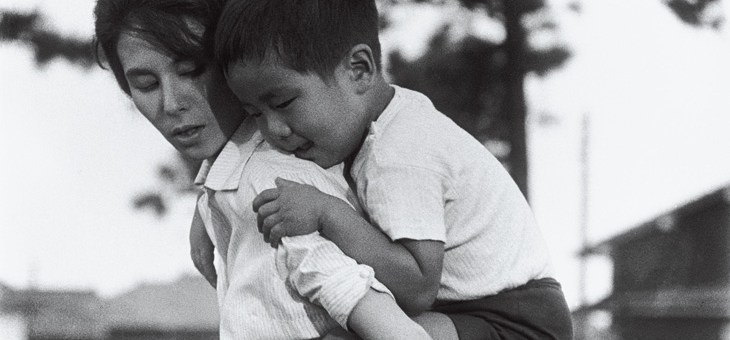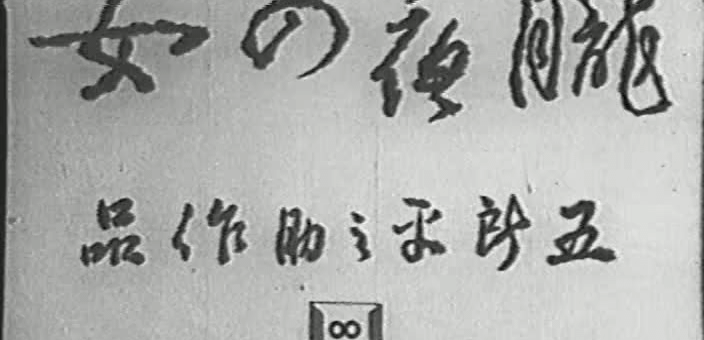
The Garden of Women (女の園, Keisuke Kinoshita, 1954)

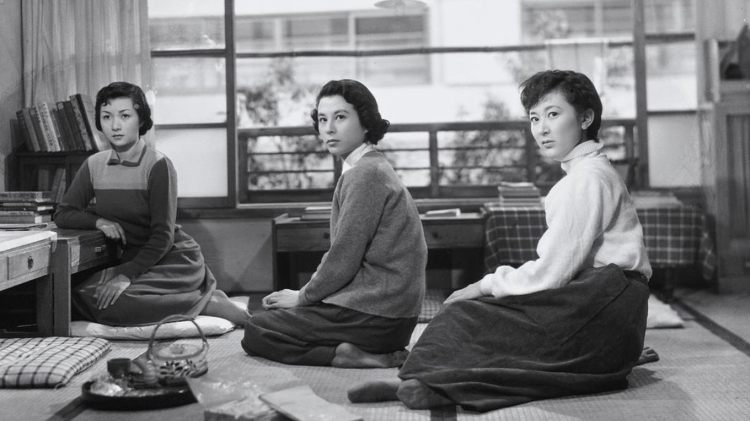
garden of women still 1Things changed after the war, but not as much as some might have hoped. Sadly still topical, Keisuke Kinoshita’s Garden of Women (女の園, Onna no Sono) takes aim both at persistent and oppressive patriarchal social structures and at a compromised educational system which, intentionally or otherwise, systematically stifles attempts at progressive social change. A short few years before student protests would plunge education into crisis, Kinoshita’s film asks why it is that the establishment finds itself in conflict with the prevailing moods of the time and discovers that youth intends to have its brighter future even if it has to fight for it all the way.

The setting is an exclusive private woman’s university in the elegant historical city of Kyoto. The ladies who attend this establishment are mostly from very wealthy families who have decided to educate their daughters at the college precisely because of its image of properness. As one student will later put it, there are two kinds of girls at the school – those who genuinely want to study in order to make an independent life for themselves and intend to look for work after graduation, and those who are merely adding to their accomplishments in order to hook a better class of husband. Everyone, however, is subject to a stringent set of rules which revolves around the formation of the ideal Japanese woman through strictly enforced “moral education” which runs to opening the girls’ private letters and informing their families of any “untoward” content, and requiring that permission be sought should the girls wish to attend “dances” or anything of that nature.

As might be expected, not all of the girls are fully compliant even if they superficially conform to the school’s rigid social code. Scolded for her “gaudy” hair ribbon on the first day of school, Tomiko (Keiko Kishi) rolls her eyes at the over the top regulations and enlists the aid of the other girls to cover for her when she stays out late with friends but her resistance is only passive and she has no real ideological objection towards the ethos of the school other than annoyance in being inconvenienced. Tomiko is therefore mildly irritated by the presence of the melancholy Yoshie (Hideko Takamine). Three years older, she’s come to college late and is struggling to keep up with classes but is, ironically enough, prevented from studying by the same school rules which insist she go to bed early.

Meanwhile, dorm mate Akiko (Yoshiko Kuga), from an extraordinarily wealthy and well connected family, is becoming increasingly opposed to the oppressive atmosphere at the school. However, as another already politically active student points out, Akiko’s background means there are absolutely no stakes for her in this fight. She has never suffered, and likely never will, because she always has been and always will be protected by her privilege. Fumie (Kazuko Yamamoto), a hardline socialist, doubts Akiko’s commitment to the cause, worrying that in the end she is only staging a minor protest against her family and will eventually drift away back to her world of ski lodges and summer houses. Despite her ardour, Akiko finds it hard to entirely dispute Fumie’s reasoning and is at constant battle with herself over her true feelings about the state of the modern world as it relates to herself individually and for women in general.

This is certainly a fiercely patriarchal society. Even though these women are in higher education, they are mostly there to perfect the feminine arts which are, in the main, domestic. They are not being prepared for the world of work or to become influential people in their own right, but merely to support husbands and sons as pillars of the rapidly declining social order that those who sent them there are desperate to preserve. For many of the girls, however, times are changing though more for some than others. Tomiko rolls her eyes and does as she pleases, within reason, and even if she eventually wants to see things change at the school it is mostly for her own benefit. She sees no sense in Akiko’s desire for reform as a stepping stone to wider social change, and perhaps even fears the kinds of changes that Akiko and Fumie are seeking.

Akiko and Fumie, and to an extent, Tomiko, seem to have a degree of agency that others do not as seen in the tragic story of Yoshie whose life has been largely ruined thanks to the selfish and heartless actions of her father. From a comparatively less wealthy family, Yoshie worked in a bank for three years during which time she met and fell in love with an earnest young man named Shimoda (Takahiro Tamura). However, her father, having become moderately successful, developed an appetite for social climbing and is determined she marry “well” to increase his own sense of superiority as a fully fledged member of the middle classes. He sees his daughter as nothing more than a tool or extension of himself and cares nothing for her thoughts or feelings. In order to resist his demands for an arranged marriage, Yoshie enrolled in school and is desperate to stay long enough for Shimoda to finish his education so they can marry.

Yoshie is trapped at every turn – she cannot rely on her family, she cannot simply leave them, she cannot yet marry, if she leaves the school she will be reliant on a man who effectively intends to sell her, but her life here is miserable and there is no one who can help her. All she receives from the educational establishment is censure and the instruction to buck up or get kicked out. She feels herself a burden to the other girls who regard her as dim and out of place thanks to their relatively minor age gap and cannot fully comprehend her sense of anxiety and frustration.

Finally standing up to the uncomfortably fascistic school board the girls band together to demand freedoms both academic and social, insisting that there can be no education without liberty, but the old ways die hard as they discover most care only for appearances, neatly shifting the blame onto others in order to support their cause. “Why must we suffer so?” Yoshie decries at a particularly low point as she laments her impossible circumstances. Why indeed. The oppressive stricture of the old regime may eventually cause its demise but it intends to fight back by doubling down and the fight for freedom will be a long one even if youth intends to stand firm.


Titles and opening scene (no subtitles)

Spring Dreams (春の夢, Keisuke Kinoshita, 1960)

vlcsnap-2019-01-10-00h23m29s867Let them eat sweet potato? The heartless bourgeoisie at the centre of Keisuke Kinoshita’s absurdist satire Spring Dreams (春の夢, Haru no yume) have found themselves accidentally engulfed by the revolution which seems to be attacking them on every front including from inside their palatial, Western-style mansion. Things are about to change in the Okudaira world, but then again maybe not all that much.

The Okudairas are the owners of a large scale pharmaceuticals firm. Widowed patriarch Shobei (Eitaro Ozawa) is the CEO, but he’s at the constant mercy of his mother-in-law (Chieko Higashiyama) who acts as the guardian of the family business’ legacy. Meanwhile, he has three problematic children – oldest daughter Tamiko (Yatsuko Tanami) who has become a promiscuous playgirl with a taste for “mothering” college students, Chizuko (Mariko Okada) who is the only “normal” one in the house and has fallen in love with an impoverished painter, and Mamoru (Yusuke Kawazu) who is a kind of melancholy Hamlet waxing on his existential angst while eating everything in sight.

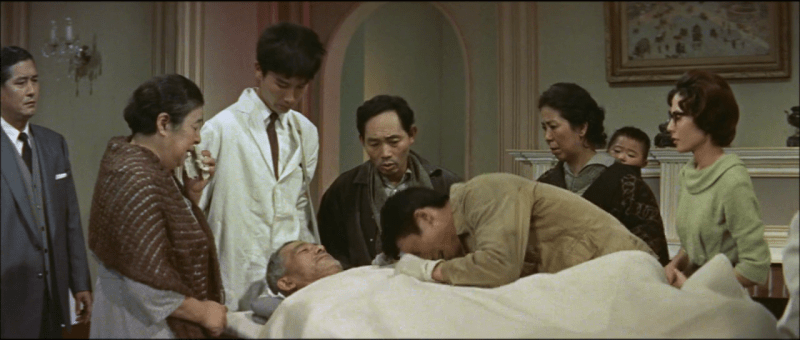
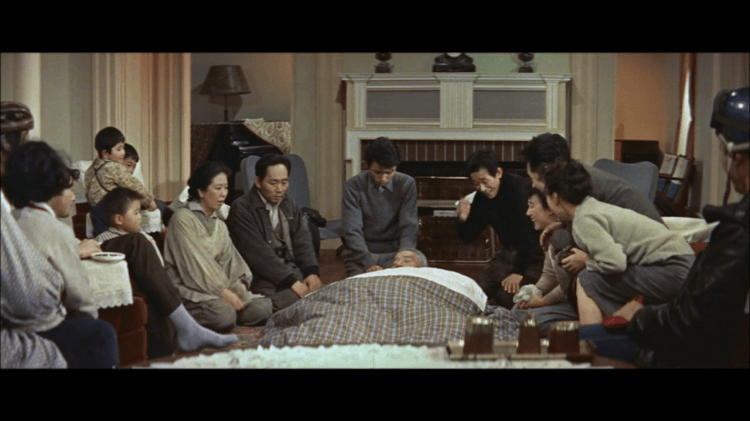
Into this already strained household comes the unexpected figure of sweet potato salesman, Atsumi (Chishu Ryu). With the house empty for a change, romantically conflicted maid Umeko (Yukiyo Toake) calls one of her boyfriends down at the fish shop to get the potato guy to come round. Kimiko (Meiko Nakamura), the other maid, goes out to pick some up but ends up flirting with a delivery boy so sends Atsumi inside where Umeko ropes him into helping shift some furniture which is how he ends up having a minor stroke in the Okudaira’s living room. Luckily for Atsumi, the person who finds him is Shobei’s compassionate spinster secretary, Kazuko (Yoshiko Kuga), who has some sad experience in this area as her father passed away after a stroke when she was a teenager, they say because someone moved him too early. A visit from the family doctor (Shuji Sano) backs up her advice and Atsumi will be staying put in the living room for the foreseeable future.

Of course, this doesn’t go down well with most of the Okudairas. Shobei wants him gone but what can you do? Atsumi stays because on balance it would be awkward if he ended up dying and staining the Okudaira name. Sadly, greed and indifference are not unique to the bourgeoisie as we discover when a parade of “well wishers” from Atsumi’s tenement house begin showing up to see how he is. Aside from the kindly, filial Eiichi (Shinji Tanaka) who has taken time off work to look after the old man, everyone else thinks Atsumi’s time has come. They know his tragic history, that he’s all alone now since both his sons were killed in the war and the rest of his family lost in the bombing. They want to get in with him to be remembered in the will, or even get their hands on his wallet for something like an advance. Poor old Atsumi is just an object fit for exploiting – a symbol of the Okudaira’s largesse, and of a potential windfall when the inevitable happens.

Meanwhile, the winds of change are blowing. Shobei is tied up with a labour dispute at the factory, obsessed with the idea of crushing the unions while the workers’ rousing chorus of the Internationale echoes ever more loudly in the distance. Grandma advises “just fire them all”, but things aren’t as easy as they were back in Meiji. Grandma thinks Shobei is a bit useless, especially since her daughter died and he’s been allowed to get off easy. She needs to find a successor seeing as Mamoru’s too weird to take over which means one of the girls needs to get married. Tamiko’s ruled herself out thanks to her eccentric love life, which leaves only Chizuko who wants to marry a painter and has no real interest in saving the family business. Chizuko is determined to oppose the idea of an arranged marriage, she’s a post-war girl after all, but grandma is firm. When she was a girl they made her give up on her first love, who happened also to be named “Atsumi”, to marry an Okudaira and so Chizuko is merely being unreasonable.

Nevertheless the presence of Atsumi begins to soften grandma’s heart with memories of her youth and the cruelty with which her youthful dreams were stripped away. Love blossoms in the cold Okudaira mansion, genuine bonds between people are recognised while the opportunist are rejected, and the young regain their freedom from the old who now recognise how destructive the old order could be. Will the house of the Okudaira’s fall? Probably not. Revolutions don’t take hold over night, but greed at least is on its way out paving the way for a better, kinder future for all.


Titles and opening (no subtitles)

Here’s to the Young Lady (お嬢さん乾杯!, Keisuke Kinoshita, 1949)

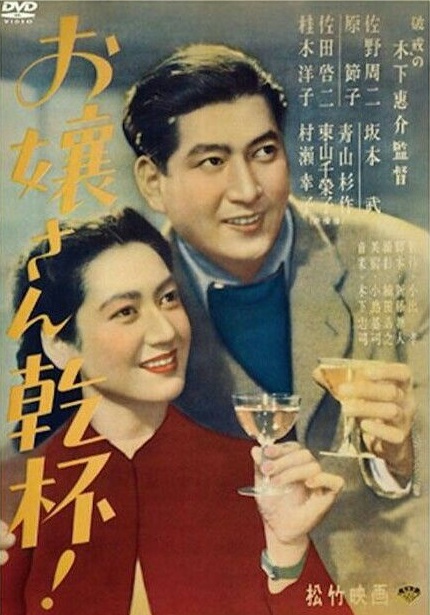
Here's to the young lady DVD coverLove across the class divide is a perpetual inspiration for melodrama, but what if the problem is less restrictive social codes and more emotional inertia and frustrated desire? Many things were changing in the Japan of 1949, racked by post-war privation and burdened with a scrappy desire to remake itself better and kinder than before. Keisuke Kinoshita, the foremost purveyor of post-war humanism, looks back to the 1930s for his 1949 cheerfully superficial romantic comedy Here’s to the Young Lady (お嬢さん乾杯!, Ojosan Kampai!). A tale of changing social codes and youth trying to find the courage to break free, Kinoshita’s easy romance is as breezy as they come but also hard won and a definitive step towards the freer, fairer world he so often envisages.

Keizo Ishizu (Shuji Sano), a 34-year-old self-made man and successful garage owner, is still single and seemingly pestered by his well meaning friends who keep finding matches for him that he doesn’t really want. Reluctantly, he acquiesces to the demands of his good friend Mr. Sato (Takeshi Sakamoto) who is desperate to introduce him to a pretty young woman from a wealthy family and agrees to meet Yasuko (Setsuko Hara) – a demure 26-year-old apparently keen to get married. Ishizu is instantly smitten, dumbstruck by her beauty and elegance. He begins to think all this marriage talk isn’t so silly after all, but then he is only a country bumpkin made good in the scrappy post-war economy. Yasuko is old money. How could he ever be permitted to enter her world and would she ever truly fit in his? Ishizu falls hard but his dreams of romance are eventually crushed when he discovers that the Ikedas, once a noble family, have hit upon hard times following half the family’s repatriation from Manchuria and the unwise business relations of Yasuko’s father which have landed him in jail as a co-conspirator in large scale fraud.

Despite his misgivings, Ishizu is talked into “dating” Yasuko for a few months during which he plans to find out if she could fall in love with him for real or if the marriage is likely to be an eternally one-sided affair which will make them both miserable. Ishizu resents being thought of as the cash cow, the classless nouveau riche upstart roped in to breathe new life into the fading aristocracy, but can’t let go of the hope that Yasuko might fall for his down to death charms even if not all of her family are very happy with this particular means of survival.

Yasuko’s grandparents are at great pains to emphasise (repeatedly) the immense gap in social class between Ishizu and their cultured, refined ingenue of a granddaughter who enjoys such elegant hobbies skiiing, tennis, and the ballet. Ishizu is into boxing and drinking at his favourite bar. He has no idea what the tune is that Yasuko plays on the piano that he bought for her and somewhat gauchely had delivered direct in front of the mildly scandalised family who can’t help feeling belittled by his generosity, but he finds it charming all the same even if his lack of refinement also stings with embarrassment. Nevertheless, the youngsters end up finding their own way – she takes him to the ballet where he is bored and then somehow moved, and he her to the boxing where she is frightened and then thrilled. They grow closer, but also not as Ishizu becomes increasingly frustrated (if in his characteristically good natured way) by Yasuko’s continuing aloofness.   

Perhaps unusually, it is Yasuko who struggles to move on from the idealised pre-war past in which she lived the romanticised life of a wealthy noblewoman who had not a care in the world and no need to worry about anything. The war has destroyed the nobility but this no Cherry Orchard-style lament for a declining world of elegance and rise of the unrefined in its place but a plea for rational thinking and a desire to move forward into a more egalitarian future. Yasuko’s grandparents cannot accompany her on this journey even if her parents and siblings are minded to be pragmatic, but it’s she herself who will need to make the decision to abandon her rigid ideas of what it is to be a fine lady and learn to embrace her own desires if she is to find happiness (as her father urges her to do) in the rapidly changing post-war world.

Then again, Ishizu is not entirely free of petty prejudice and the mild conservatism of the upwardly mobile as he shows in his intense hostility towards his best friend’s (Keiji Sada) tempestuous relationship with a club dancer (Naruko Sato). Nevertheless, after a good old fashioned case of fisticuffs and a proper consideration of all the obstacles he faces in winning the heart of Yasuko, Ishizu eventually reconsiders and urges his friend to chase happiness wherever it may lie. He vacillates and doubts himself, finds it impossible to approach the icy lady of the manor because of a feeling of social inferiority and finally decides to give up on an unrealistic idea of romance to spare them both pain, but then the obstacles were not all his to overcome and if there is a choice to be made it is Yasuko’s to make. A joyous throwback to the screwball ‘30s, Here’s to the Young Lady, banishes the darkness of the postwar world to the margins while its melancholy youngsters use romantic heartbreaks as a springboard to free themselves from the restrictive social codes of the past in order to choose happiness over misery and despair.


Titles and opening scene (no subtitles)

The Good Fairy (善魔, Keisuke Kinoshita, 1951)

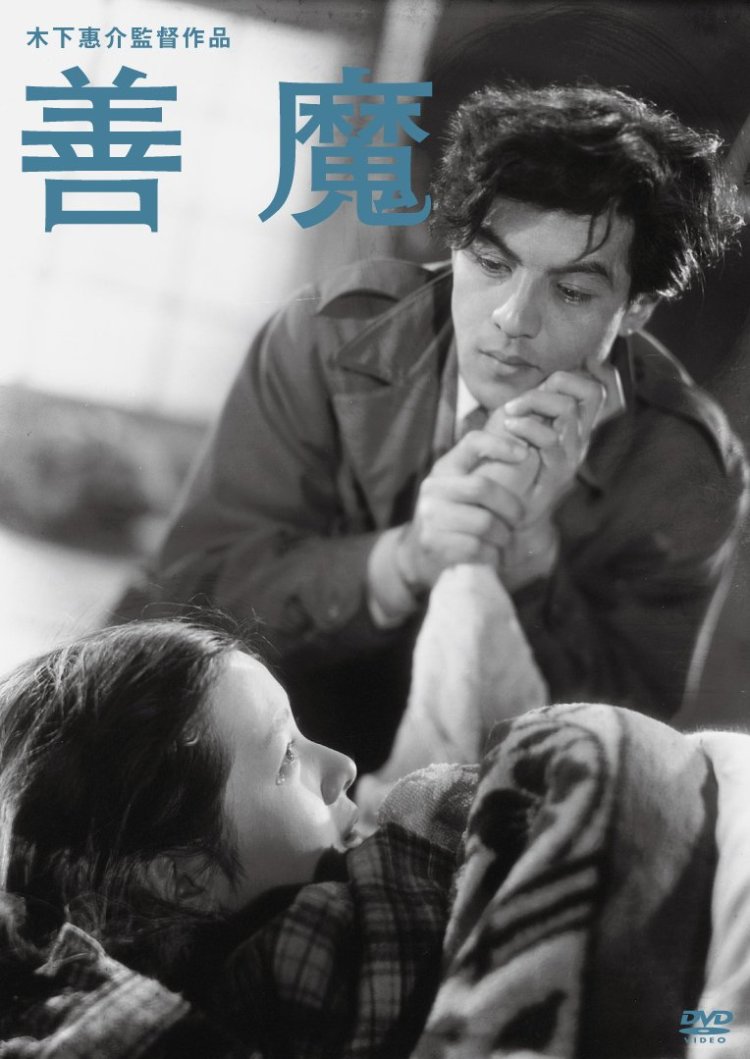
Good fairy DVDAlthough one of the more prominent names in post-war cinema, the work of Keisuke Kinoshita has often been out of fashion, derided for its sentimental naivety. It is true to say that Kinoshita values heroes whose essential goodness improves the world around them though that is not to say that he is entirely without sympathy for the conflicted or imperfect even if his equanimity begins to waver with age. 1951’s The Good Fairy (善魔, Zemma), however, working from a script penned not by himself but Kogo Noda and adapted from the novel by Kunio Kishida, seems to turn his life philosophy on its head, wondering whether the tyranny of puritanical goodness is an evil in itself or merely the best weapon against it.

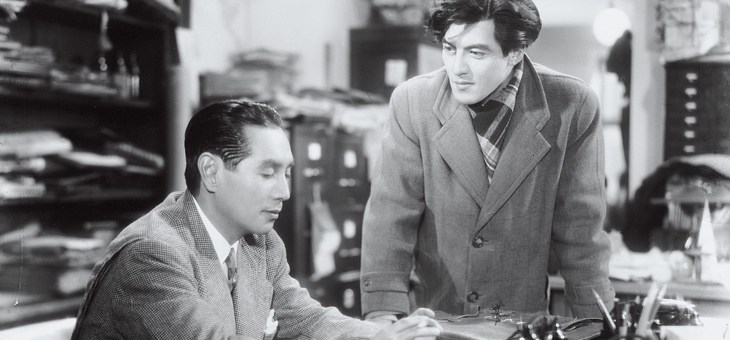
After beginning with a hellish, ominous title sequence set against the flames, the film opens with newspaper editor Nakanuma (Masayuki Mori) getting a hot tip regarding a politician’s wife who seems to have mysteriously disappeared. He hands the assignment to rookie reporter Rentaro Mikuni (played by the actor Rentaro Mikuni who subsequently took his stage name from this his debut role) who specialises in political corruption. Mikuni doesn’t like the assignment. He thinks it’s unethical and whatever happens between a man and his wife is no one’s business, but ends up going to see the politician, Kitaura (Koreya Senda), anyway and instantly dislikes him. Mildly worried by Kitaura’s lack of concern over his wife’s sudden absence, Mikuni stays on the case and visits the wife’s father (Chishu Ryu) up in the mountains where he also meets her sister, Mikako (Yoko Katsuragi), who eventually leads him to the woman herself, Itsuko (Chikage Awashima), who has taken refuge with a friend after becoming disillusioned with her husband’s “vulgar” pursuit of success at the continuing cost of human decency.

To pull back for a second, in any other Kinoshita film, Itsuko would be among the heroes in standing up against her husband’s corrupting influences, but for reasons which will later be explained she lingers on the borders of righteousness owing to having made a mistaken choice in her youth which was, in many ways, defined by the times in which she lived. Nukanuma had not been entirely honest with Mikuni in that he had known and secretly been in love with Itsuko when they were both students but he was poor and diffident and so he never declared himself, his only attempt to hint as his feelings either tragically or wilfully misunderstood. Where Itsuko, who married for money and status as a young woman was expected to do in the pre-war society, has mellowed with age and gained compassionate morality, Nakanuma who became a reporter to fight for justice against the background of fascist oppression has become cynical and selfish. Never having quite forgotten Itsuko, he has been in a casual relationship with a young actress, Suzue (Toshiko Kobayashi), for the last two years never realising that she has really fallen in love with him.

Thinking back on his college relationship with Itsuko, Nakanuma remembers talking with her about unsuccessful romances, that if a man tries his best to make a woman happy but isn’t able to then it must be because she doesn’t love him. Itsuko agrees, adding that men never seem to know what makes a woman happy in love but that friendship is a different matter. She says something similar when she tells him she’s getting married but doesn’t want to lose his friendship, and when he begins floating the idea of marriage hinting that he wants to marry her but perhaps giving the mistaken impression that there’s someone else in stating that it’s sad when a friend marries because the relationship with never be the same again and knowing that he intends to marry she now treasures their friendship even more. In a sense, Nakanuma thinks of Suzue as a “friend” with whom he occasionally sleeps, believing that their relationship is only ever liminal and temporary but mutually beneficial and capable of continuing even if the sexual component had to end.

Having failed once in love, Nakanuma is resolved not to do so again and determined to fight to win Itsuko rather than lose her through cowardice, but to do so he will cruelly wound Suzue who has treated him with nothing other than tenderness. By this time, Mikuni has fallen in chaste, innocent love with Mikako who reminds him of the parts of himself he feels are being erased by his compromising job as part of the mass media machine. Mikuni’s terrifying “goodness” is largely a positive quality which leads him to fight for justice against oppression even within his own organisation but his love for the saintly Mikako only intensifies his moral purity and threatens not only to turn him into an insufferable prig but to create in him a new oppressor, spreading guilt and unhappiness like the self-righteous hero of an Ibsen play.

Early on, following their mild disagreement about journalistic ethics, Mikuni and Nakanuma have dinner together over which they debate the power of the press to bring about social change and hold power to account. Nakanuma says he’s become cynical because hating injustice isn’t enough and there’s nothing that the individual can do against an oppressive system. What he’s telling Mikuni is that he used to be like him, but time has taught him righteousness is not an effective weapon against entrenched social privilege. He recounts a dark story from a Buddhist monk who told him that good can never win over evil because it isn’t strong enough, only evil is strong enough to fight evil and so in order to counter it you will need to affect its weapons. Later, crazed by grief and exhaustion, Mikuni’s “goodness” seems to pulse out of him with ominous supernatural force as he takes Nakanuma to task for his callous treatment of Suzue only for he and Itsuko to come to the conclusion that they’ve heard the voice of “evil” and are now condemned by their past choices to lives of morally pure unhappiness.

This central conundrum seems to contradict Kinoshita’s otherwise open philosophies in its unwelcome rigidity which says that there are no second chances and no possibility of ever moving on from the past with positivity. Itsuko made the “wrong” choice when she was young in choosing to marry for material gain, but she was only making the choice her society expected her to make in the absence of other options – it wasn’t as if she had any reason to wait around for Nakanuma whose regret over his romantic cowardice has made him cold and bitter. She realised her mistake too late and resolved to correct it, but the “Good Fairy” won’t let her, it says she has to pay (for the crimes of an oppressive society) by sacrificing again her chance of happiness in the full knowledge of all she’s giving up. Kinoshita’s films advocate the right to love by will, free of oppressive social codes or obligations but Itsuko is denied a romantic resolution despite having “reformed” herself and made consistently “correct” choices since discovering her husband’s “fraud”. She is denied this largely because of Nakunuma’s failing in being unkind to one who loved him, which is, in a round about way, still her fault for not having realised he loved her and deciding to marry him instead. In fact, the only one who seems to get off scot-free is Kitaura whose fraudulent activities will be covered up on the condition he consent to Itsuko’s divorce petition and sets her fully “free” so she can be fully burdened by the weight of her romantic sacrifice.

In the end, it’s difficult to see a positive outcome which could emerge from all this unhappiness which seems primed only to spread and reproduce itself with potentially disastrous consequences. Mikuni’s purity has become puritanical, unforgiving and rigid, condemning all to a hellish misery from which there can be no escape. The cure is worse than the disease. No one could live like this, and no one should. Goodness, tempered by compassion and understanding, might not be enough to fight the darkness all alone but it might be better to live in the half-light than in the hellish flickering of the fires of righteousness.


Title sequence and opening scene (no subtitles)

Home from the Sea (故郷, Yoji Yamada, 1972)

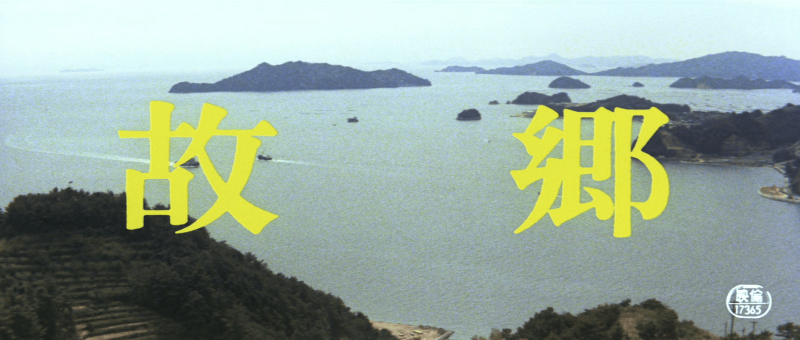
Home from the sea still 1By the early 1970s, Japan was well on its way to an economic recovery with memories of post-war privation fading and modern consumerism rapidly taking hold in the national mindset. Contemporary cinema understandably saw this as a good thing, that brighter times were coming and soon enough everyone would be enjoying a comfortable, prosperous life. The future, however, was not always evenly distributed and modernisation brought with it problems as well as solutions. Yoji Yamada’s Home from the Sea (故郷, Kokyo/Furusato*) paints a melancholy picture of a changing Japan as an earnest young couple are forced to consider leaving their beloved hometown to seek their fortunes elsewhere.

Seiichi Ishizaki (Hisashi Igawa) owns a small transport boat he uses to ferry rocks between construction sites. He is sometimes joined by his wife, Tamiko (Chieko Baisho), who serves as the boat’s engineer. The couple live with Seiichi’s elderly father (Chishu Ryu) and their two daughters on a small island in the Inland Sea. Times are hard. Fuel costs are increasing making Seiichi’s business much less profitable while his boat is old and slow. The maintenance costs alone are difficult to contemplate and the family cannot afford to invest in one of the new steel boats which are currently sucking up most of the available work. Seiichi’s younger brother who used to work on the boat with him has already given up and moved on, taking his wife and children to another town where he works in a factory. Many people seem to think Seiichi would do well to do the same, but he is stubborn. He refuses to be pushed out of his ancestral home and occupation simply because of the unfairness of his times.

A little way into the film, a friendly fishmonger, Matsushita (Kiyoshi Atsumi), who often stops by to have dinner with the family expounds on the beauty of the town. He can’t understand why anyone would want to leave somewhere as lovely as this. Unlike the Ishizakis, Matsushita wasn’t born on the island but in Korea – his parents died during the repatriation after the war and he’s been getting by on his own ever since. He’s done many different jobs and lived in many different places but has chosen to make his home here. A fishmonger’s job is probably always safe (to an extent, at least) in a small harbour town, but Seiichi’s isn’t and he needs money to feed his family. There is no other work on the island, and so there is no way to stay without making the boat pay.

The boat, however, is already 19 years old. Transport ships are only intended to last 10. The engine is faulty and the hull is in desperate need of repair but a visit to the original shipwright reveals that to do so would not be cost effective. The best thing to do would be to buy one of the shiny new steel vessels like their neighbour’s, but that’s far out of Seiichi’s reach. All along the shoreline, you can see the charred remains of boats belonging to those like Seiichi who’ve finally come to the conclusion that their era has passed.

“Can’t beat the Big” is a local mantra. In early ‘70s Japan, counterintuitively enough, size is everything. Not just the boats themselves, but the fleets and the architecture of life. You can’t survive as your own boss anymore because the little guy alone has no power when corporations and conglomerates are extending their reach even into tiny islands. Seiichi goes to have a look at the factory in Onomichi to which he’s been recommended by a friend. It’s not as bad as he thought, but it’s huge and filled with hundreds of identically dressed faceless men. The food is awful, and they’d have no friends. Nevertheless, needs must. If you can’t fight the Big you’ll have to become a part of it or it’ll swallow you whole.

Still the sadness of leaving one’s hometown behind against one’s will with one eye always looking back towards the shoreline is difficult to bear. Seiichi’s father, who had been looking after the children and was therefore extremely close to them, will be staying behind with no one left to look after him save the community itself. Progress might be a good thing, but there are costs too and small town Japan is one of them. It’s sad, but there’s nothing you can do about it. The post-war world might not require so much “gaman” anymore, but bearing the demands of modernity just might.


*According to Shochiku’s website and the narrator in the trailer, the official title is “Kokyo” which is the Sino-Japanese reading of the kanji (故郷) but it’s also often listed under the title “Furusato” – the slightly more emotive native Japanese reading.

Original trailer (no subtitles)

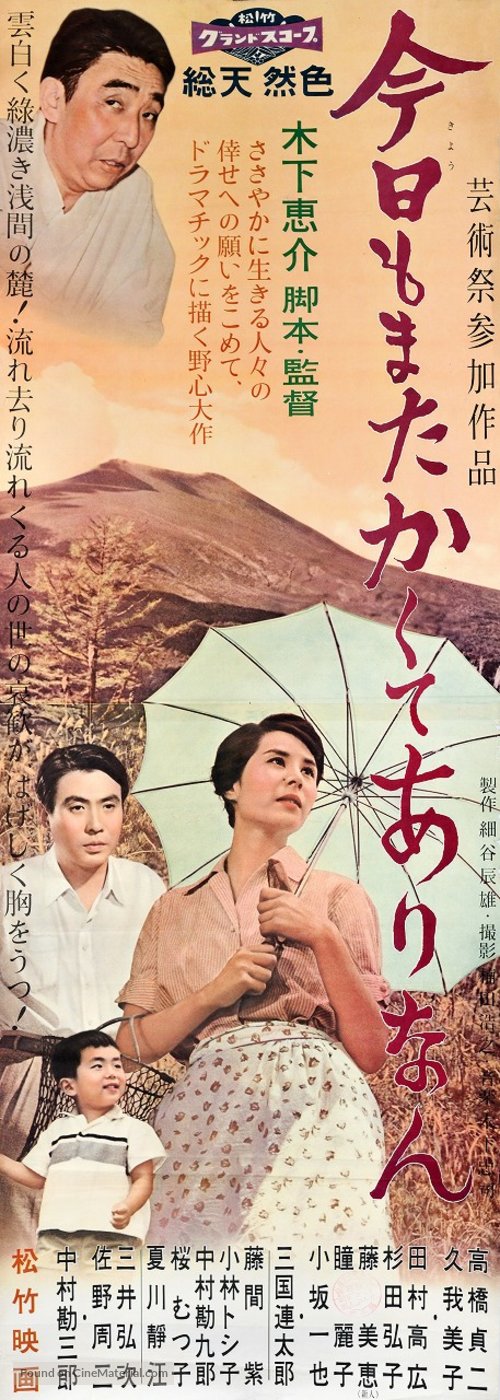
Thus Another Day (今日もまたかくてありなん, Keisuke Kinoshita, 1959)

Thus Another Day vertical bannerThe cinema of the immediate post-war era, contrary to expectation, is generally hopeful and filled with the spirit of industry. Keisuke Kinoshita might be thought of as the primary proponent of post-war humanism in his fierce defence of the power of human goodness, but looking below the surface he’s also among the most critical of what the modern Japan was becoming, worried about a gradual loss of values in an increasingly consumerist society which refuses to deal with its wartime trauma in favour of burying itself in intense forward motion.

The housewife at the centre of Thus Another Day (今日もまたかくてありなん, Kyo mo mata Kakute ari nan), Yasuko (Yoshiko Kuga), is a perfect example of this internal conflict. She and her husband Shoichi (Teiji Takahashi) have built a modest house way out of the city in the still underdeveloped suburbs for which they are still burdened by an oppressive mortgage. Shoichi has a regular job as an entry level salaryman but his pay is extremely low and Yasuko is forced to scrimp and save just to get by. The central conflict occurs one summer when Shoichi’s boss declares he’s looking to rent a summer house in the quiet area where the family live. Shoichi thinks it would be a great idea to rent out their house to his boss earning both money and favour. Yasuko can go stay with her family who live in a pleasant resort town while he will stay with a friend in a city apartment. Yasuko does not really like the idea, but ends up going along with it.

Shoichi is trying to live the salaryman dream, but it isn’t really going anywhere. Yasuko is home alone all day with the couple’s small son, Kazuo, who is too young to understand why the family lives the way it does and continuously asks probing questions which upset and embarrass his mother. Watching her painstakingly washing clothes by hand, Kazuo wants to know why they don’t have an electric washing machine like some of his friends’ mothers do. Yasuko tells him they’re saving money to get one, at which point he pipes up that he personally would rather have a TV set. Like his father, he is rather self-centred but being only four can perhaps be forgiven. Nevertheless, Yasuko is constantly embarrassed by the family’s relative poverty. When another neighbour spots her out shopping and decides to accompany her, she is visibly distressed that the stall she takes her to is a little more expensive than the one she had in mind. Wanting to save face, she buys expensive fish but is mindful of there being less money for the rest of the week.

Meanwhile, Shoichi is obsessed with “getting ahead” by ingratiating himself with his bosses – hence why he decided to let out his own house over the summer. The house is, after all, Yasuko’s domain and she perhaps feels family atmosphere isn’t something you should be selling. She resents that the family will be split up over the summer even if it gives her an opportunity to visit her mother and sister out in the country. Even when Shochi arrives to visit, he makes them trot out to a neighbouring town to visit his boss’ wife also on holiday in the area, and stays there all day playing mahjong while Yasuko and Kazuo are bored out of their minds sitting idly by. The second time he doesn’t even bother to invite them.

The small resort town itself is something of a haven from the demands of the city but there is trouble and strife even here. Shortly after her arrival Yasuko meets a strange, rather sad middle-aged man who is a stay at home dad to his beloved little girl, Yoko. Takemura (Nakamura Kanzaburo XVIII) came of age in the militarist era, attending a military university to become one of the elite. The world changed on him and he remains unable to reconcile himself to the demands of the post-war society. Experiencing extreme survivor’s guilt, Takemura is filled with regret and resentment towards the ruined dreams of his misguided youth in which he abandoned a woman he loved to marry a wealthy man’s daughter who he has also let down by refusing his military pension, forcing her into the world of work and eventually onto the fringes of the sex trade as a hard drinking bar girl.

As if to underscore the looming danger, a thuggish gang of yakuza have also decided to spend the summer in the resort, holing up at the inn where Takemura’s wife is working. The young guys terrorise the youngsters of the town, disrupting the well established social hierarchy with acts of violence and intimidation. The punks cause particular consternation to Takemura who remembers all the men their age who went to war and never came back only for the successive generation to live like this. Having lost everything which made his life worth living, Takemura decides to take a stand against modern disorder, hoping to die in battle the way he feels he ought to have done all those years ago.

Thus Another Day is among the darkest of Kinoshita’s post-war dramas, suggesting that there really is no hope and that past innocence really has been lost for good. The values of Takemura’s youth, however, would not perhaps line up particularly well with those most often advanced in Kinoshita’s cinema, as kind and melancholy as he seems to be. Yasuko goes back to her crushing world of unfulfillable aspirations with her obsequious husband and demanding son with only gentle wind chimes to remind her of happier days while she tries to reaccommodate herself to the soullessness of post-war consumerism .


Original trailer (no subtitles)

Shitamachi no Taiyo (下町の太陽, Yoji Yamada, 1963)

(C) Shochiku 1963

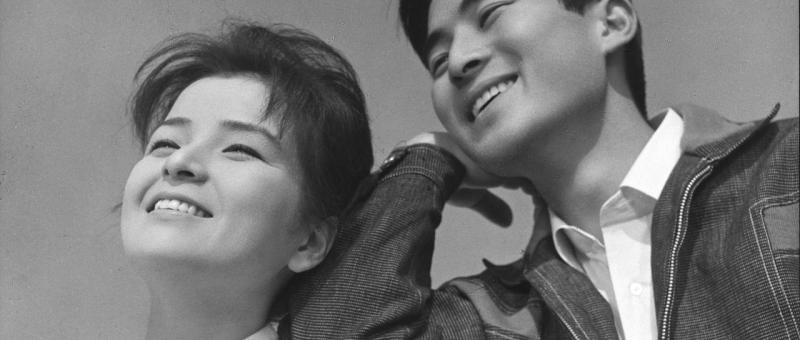
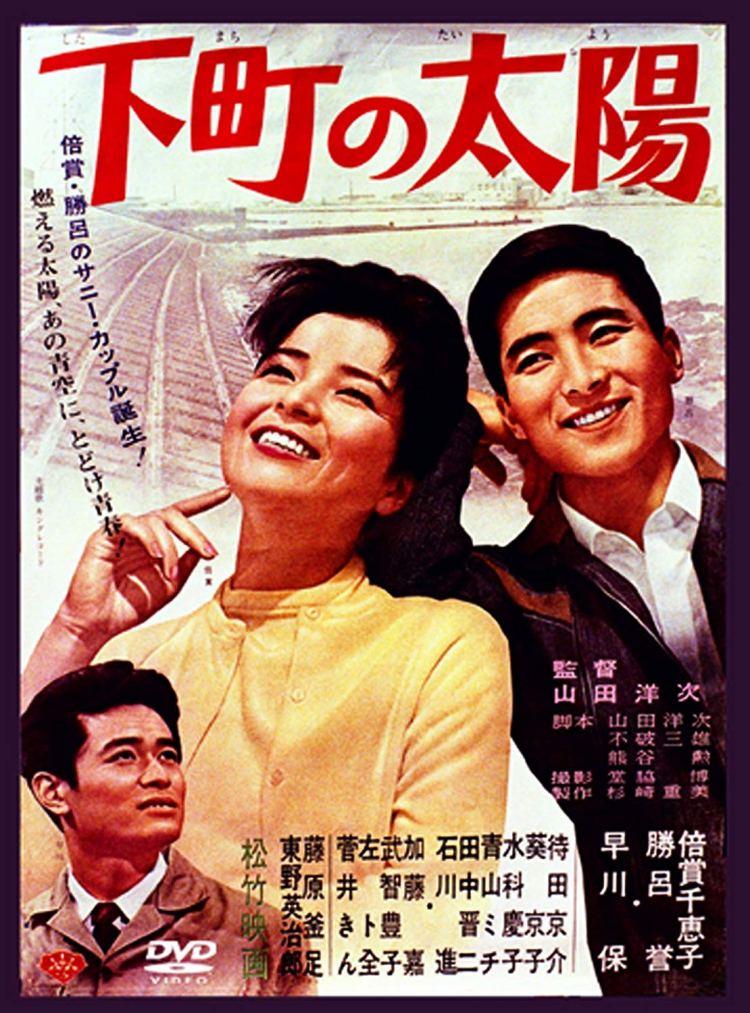
Shitamachi no Taiyou DVD coverYoji Yamada’s debut feature, The Strangers Upstairs, was very much of its time as it attempted to capture the aspirational fighting spirit of the post-war era through the struggles of a nice young couple who are trying to “get on” and escape their humble origins for the salaryman dream through achieving the goal of home ownership as quickly as possible. His second film, Shitamachi no Taiyo (下町の太陽, also known as The Sunshine Girl / Sunshine in the Old Neighbourhood), takes a slightly different look at a similar issue as a young woman from Shitamachi – a working class industrial area on the outskirts of Tokyo, agonises over her future prospects as she considers a marriage to her longterm boyfriend who has ambitions to join the salaryman revolution.

Yamada opens with shots of Shitamachi and its prominent smokestacks while the now famous song plays in an instrumental version over the credits, before abruptly shifting to visions of the upscale Ginza where Machiko (Chieko Baisho) and her boyfriend Michio (Tamotsu Hayakawa) are enjoying a demonstration of an extraordinarily expensive, state of the art radio before retreating to a cafe where they agree that sometimes its more fun to “aspire” to things than actually obtain them. After all, there’s no way they could ever afford the diamond rings they walked past on their way out of the department store unless they decided to rob the place. Both Machiko and Michio are residents of Shitamachi and work in a local soap factory. Michio, however, has his sights firmly set on the path to a middle-class life and is planning to take the exam for a promotion to head office – though he lacks qualifications, Michio is confident because he’s studying hard (though more so because his dad and his section chief served together in the war so Michio is sure a good word will be put in for him).

Despite her fondness for Michio, Machiko has her doubts about his overriding ambition to get out of Shitamachi. Since her mother died, Machiko has been the lady of the house and primary caregiver for her naughty little brother Kenji (Joji Yanagisawa) while her older brother Kunio (Toshio Suzuki) is the family brainbox and also planning to bust out only through the path of education rather than advancement. Having left education behind, Machiko is happily contributing to the family finances with her job on the packing line at the soap factory which is, all things considered, not too bad – the work may be dull and methodical but also relatively quiet and stress free, not to mention sweet smelling. Nevertheless, Machiko does not necessarily want to work on the shop floor all her life but knows her opportunities are limited.

This fact is one cruelly brought home to her by a moody Michio when descends into a major sulk on learning that he hasn’t passed the test for head office because another of his colleagues outdid him – both in terms of his study ranking and in one upping him in having a direct connection to the director. While Machiko tries her best to sympathise and put up with his moody petulance, Michio chooses to throw her sympathy back in her face by abruptly announcing that she can’t understand the pain he’s going through because careers are irrelevant to women who only use them as a stopgap until they get married. Thoroughly annoyed, Machiko leaves Michio to his wallowing before things get any worse but she can’t argue with the fact that he’s only said what most people think.

Still, Machiko isn’t even sure she wants to get married. One of her friends, Kazuko (Kyoko Aoi), recently won the jackpot – she married a nice man who did get a promotion to head office and won the housing lottery for a home on one of the shiny new “danchi” – brand new apartment complexes for upwardly mobile young couples and the very embodiment of post-war aspiration. However, when Machiko and a friend visit the new bride they find that she is not quite as happy as one might expect. Though married life is peaceful enough and she and her husband evidently get on, Kazuko is also intensely lonely. With her husband away at work all day and often out playing golf with colleagues on Sundays too (not to mention after hours drinking and miscellaneous get togethers), there’s precious little for Kazuko to do, stuck at home all day cooking and cleaning while waiting for her husband to return. Having moved to the danchi she’s also lost her community and is no longer close enough to her friends to see them very often.

Meanwhile, Machiko is also somewhat disturbed by Kazuko’s collection of expensive cosmetics which her husband has instructed her to buy because he’s “very particular” about her appearance. Kazuko makes sure her makeup is on point before her husband gets home because that’s apparently what he likes. Machiko, however, does not like this – to start with, she thinks Kazuko looks better without. Not that there’s anything wrong with wearing makeup because you want to wear it, but the idea of wearing it because someone told you to and you’re worried they’ll “get bored” with your face doesn’t strike her as a particularly healthy relationship dynamic. If this is what a love marriage is like, perhaps Machiko would rather do without.

Despite her otherwise close relationship with Michio, it quickly becomes obvious that she does not love him and if she decides to marry him it will be because it’s the “sensible” decision rather than any great romantic desire. Annoyingly enough, Michio hasn’t really even asked her, he just assumes they will marry once he gets his promotion. He also assumes that Machiko, like him, will want to shake the dust of Shitamachi off her feet for good for the bright lights of Tokyo. Machiko, however is not so sure. “Getting on” is one thing and there’s nothing wrong with “aspiration”, but that doesn’t mean you need to look down on the people who come from the same place as you – after all, the sun still shines even in Shitamachi and there’s nothing wrong in choosing to be happy here rather than always chasing an unattainable dream of conventional success.

Another possibility presents itself when Machiko meets an unrefined boy who has an ordinary job in the steelworks. Though their first meeting did not make a good impression – he creepily chased her off a train and then made a mess of trying to explain why, they later bond when she realises he has befriended her troubled little brother and the pair then end up spending a pleasant evening together which is far more romantic than any of her dull and conventional outings with Michio. Then again the choice she faces isn’t between two men but whether or not to embrace her own ability to make a definitive choice about her future. What she rejects is cold and selfish path of men like Michio who only want to get ahead and are willing to step on anyone who gets in their way to make it happen. Machiko doesn’t want fancy radios and diamond rings, she just wants to not have to worry too much about money and for someone to actually listen to what she’s saying. She doesn’t want to end up like Kazuko, all alone in a sparkling apartment with nothing to do but knit. When Michio tells her to shut up and do as he says because he’ll definitely make her happy, the choice seems clear. Hard work, community, and maybe the fiery boy who seems determined to get a yes rather than assuming he already has one. Who wouldn’t want to live here?


Original trailer (no subtitles)

https://www.youtube.com/watch?v=3GP13Tmm6TA

Famous title song performed by Chieko Baisho

The Rendezvous (約束, Koichi Saito, 1972)

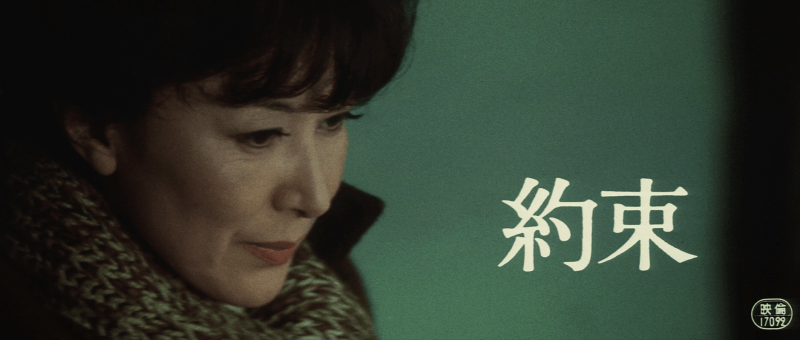
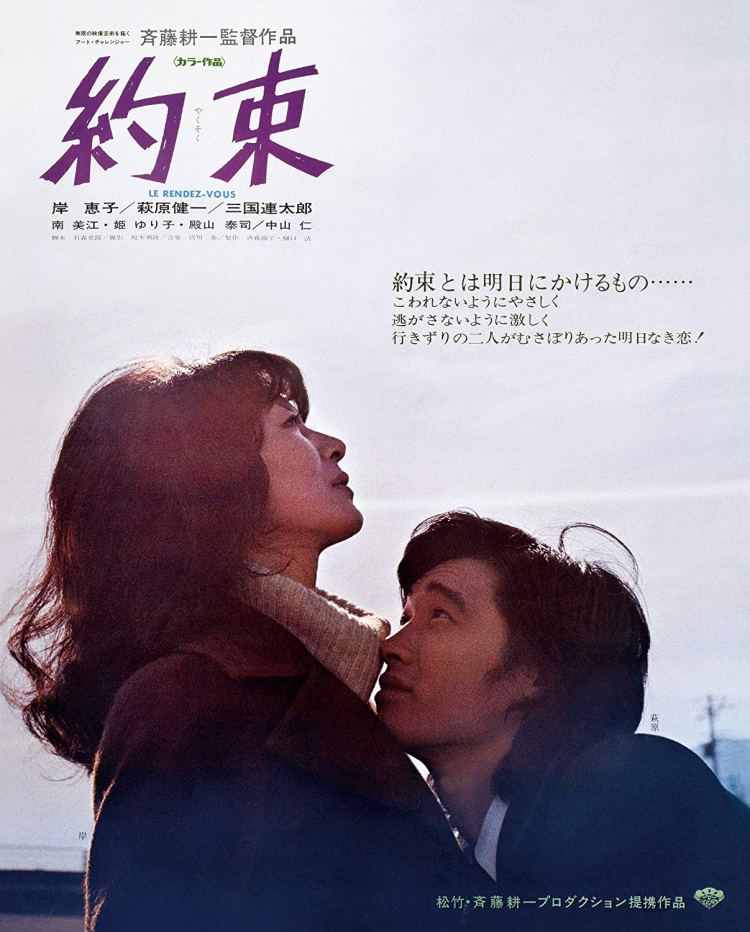
The Rendezvous poster“If human’s don’t trust each other, it’ll be the end of the world” – so says the cheerful hero at the heart of Koichi Saito’s The Rendezvous (約束, Yakusoku). Saito’s film is, somewhat unusually, a rare example of a Korean film remade in Japan. Inspired by Lee Man-hee’s Late Autumn (now sadly thought lost), The Rendezvous has been remade three times in Korea by such esteemed directors as Kim Ki-young (1975), Kim Soo-yong (1982) and most recently Kim Tae-young in 2010. There is indeed something particularly timeless in its tale of fate frustrating a fated love as each of our protagonists struggles to find the energy to rebel against their own sense of impossibility.

A brief framing sequence begins with a nervous, melancholy woman, Keiko (Keiko Kishi), sitting alone on a park bench, surrounded by the cheerful activity of athletes training, women pushing prams, and families enjoying the crisp sunshine. As she thinks back to what brought her here we travel back with her to a fateful train journey some years previously.

Keiko sits sadly by the window, impassively watching the sea stretch out as the train whizzes by. An older woman (Yoshie Minami) is sitting next to her, though they appear at least not to be on particularly friendly terms. At the first stop a younger man, Akira (Kenichi Hagiwara), gets on and sits down opposite Keiko, throwing a newspaper over his face, presumably to help him get some sleep (or, as we later wonder, perhaps just to better disappear). Intrigued, Keiko nevertheless shivers on catching sight of the paper’s headline – “Drunken Husband Stabbed to Death”. Knocking the paper off his head as she gets up to go to the bathroom, Keiko clips it back on for him with her hairpin – something that later gives him an excuse to talk to her when he eventually wakes up.

Akira, it turns out, is the chatty sort of person who enjoys making conversation with strangers. He makes a nuisance of himself trying to chat to Keiko and the old woman who ignore him, whilst accidentally frightening the bored little girl opposite by trying to entertain her. The ice finally thaws when Akira decides to buy everyone lunch – Keiko accepts and speaks to him if only to insist on paying him back (which the old lady then also feels compelled to do). Though very little actual conversation takes place on this first train journey, Akira is also travelling to the same small town as Keiko and continues to make a nuisance of himself by following her around. Nevertheless a connection begins to form between the pair, such perfect opposites in every way but one, though the time is always ticking and the encounter is one coloured by its impending end.

Keiko’s mysterious behaviour is later revealed to be more than just shyness or existential angst. Akira repeatedly asks for her trust, but she claims herself incapable of trusting anyone because in a sense she is already dead. Indeed, her entire aura is one of deliberate stillness, rarely speaking, and often leaning sadly against a more solid structure as if lacking the energy to fully support herself. Ironically enough, Keiko’s name is written with the character for “firefly” – a creature that burns out bright and then fades away. Keiko not only believes that her light has gone out, but that there are no more fireflies left. Akira, whose name is written not with the character for “bright” but with one for “cheerful”, begins to show her that there could be fireflies still, jokingly pointing to the lights from a nearby boat bobbing on the water.

We’re later told that the root of all Keiko’s suffering is “an absence of love”, that as passion cooled there was only emptiness in its place. “Emptiness” seems to be the force which defines Keiko’s existence, the reason her fire is out and her life apparently over. Though she feels a passionate attraction to Akira, she cannot bring herself to submit to it, both distrusting herself and afraid to face the possibility that it too will end. Both Keiko and Akira are fugitives from themselves, literally railroaded towards an inevitable conclusion they lack the courage to oppose. Akira wants to run, but Keiko knows she belongs on the train, incapable of escaping her self-imposed imprisonment and unwilling to step away from her unchanging destiny.

Fate follows them everywhere – violent headlines, prisoners being escorted, flashes of handcuffs, all reminding them that they are trapped, powerless in the face of an oncoming reckoning. Akira repeatedly asks Keiko to trust him, insisting that as long as she believes in him everything will be alright. Yet Akira is a flustered young man always in a hurry, running as if already late for the future. He makes Keiko a promise of a meeting and even gives her his watch to help her keep it, yet fails to appear. Akira’s heart may be trustworthy, but his body less so and even if he really wanted to come fate may have other plans. Love, it seems, is not enough. Saito returns to Keiko, sitting alone on the bench, waiting as the park empties and all the kids go home for tea. There’s no way to know if Akira can keep his promise even if he meant to, but perhaps there is something even so in the continued faith that he might simply bound in, hours late but as earnest as ever.

The central narrative seems to retain the Korean of sensibility of Lee’s original in its sense of dread and inevitability, and of passion repressed. Saito’s approach leans more towards misty European arthouse than your average Shochiku romance, making the most of its mystery as the time continues to run down for Keiko and Akira before they must prepare to meet their respective fates. Fate, at least, will wait for you and will always be there in the end. Impossibility defines the world of the defeated Keiko and the childlike Akira, but perhaps the most painful thing is hope itself, and the lingering faith that a promise will be kept despite the overwhelming odds.


Original trailer (no subtitles)

Farewell to Spring (惜春鳥, Keisuke Kinoshita, 1959)

(C) Shochiku 1959

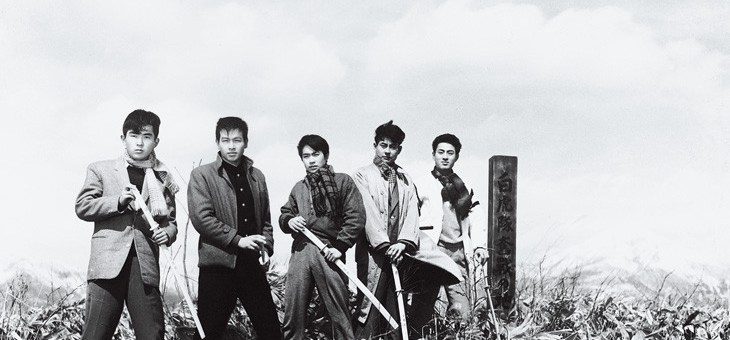
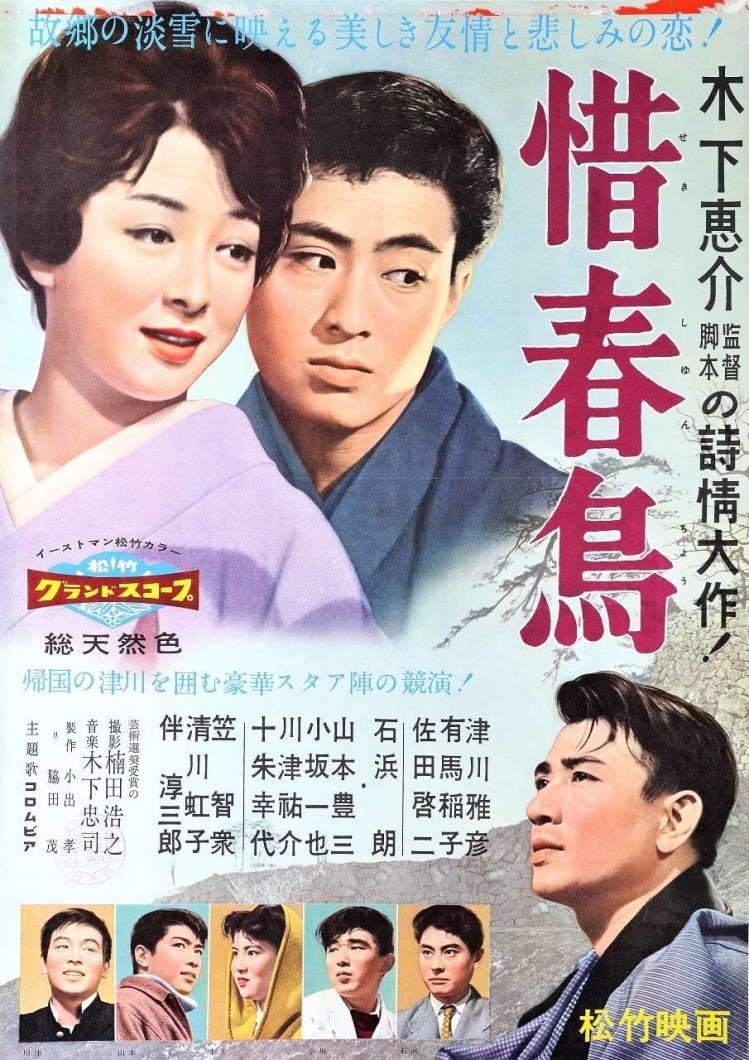
Farewell to Spring posterFor Keisuke Kinoshita, people are basically good even if the world around them often isn’t. Even so, there are limits to goodness. Can friendship survive if an intimate trust is abused, or will betrayal cut the cord once and for all? Unlike many of his contemporaries, “youth” was not a theme in which Kinoshita was particularly interested – or, at least, not quite in the same way. Farewell to Spring (惜春鳥, Sekishuncho) is in some senses an awkward fit for his usual concerns but then the concerns here are perhaps closer to the personal in examining the changing fortunes of a group of five male childhood friends who find themselves scattered in the complicated post-war landscape, facing their mutual troubles in solitary, manly fashion while their friendship withers under the weight of their individual sorrows.

The drama begins when Iwagaki (Yusuke Kawazu) returns to his Aizu mountain village after being away at university for the previous two years. As Iwagaki’s parents have died and his half-brother moved to Hokkaido with his family, Iwagaki has no “home” in his hometown as he sadly tells a familiar face spotted on the train. Nevertheless, his friends are very excited to see him and have all rallied round without even being asked. Iwagaki will be staying at an inn owned by the family of his friend, Minemura (Kazuya Kosaka). The other boys all stayed in the village – Makita (Masahiko Tsugawa), the illegitimate son of a bar owner is being primed to take over the family business while sort of dating the step-daughter of his estranged father; Teshirogi (Akira Ishihama), the younger son of an impoverished former samurai family, is working at a local factory and heavily involved in the labour movement; while Masugi (Toyozo Yamamoto), who is disabled with a lame leg thanks to a childhood accident, works alongside his parents in a traditional lacquerwork shop but finds his livelihood threatened by political troubles with China.

Once a tight group of small-town friends, none of the boys quite wants to acknowledge how far they have drifted apart – not just from each other, but from the young men they once were even though comparatively little time has actually passed. Nevertheless, the shadow of their old bond still exists – it is obvious to all the boys that Iwagaki has returned in some kind of disgrace. A favourite of their teacher, Iwagaki had been given a valuable opportunity to better himself by going to university in Tokyo but has apparently fallen out with his sponsor and into hard times. The story he tells his friends is dark – they’d heard it had to do with a “dalliance” with a maid which annoyed his patron but the way he describes it sounds more like a rape revenge followed by an unwanted romance which he eventually ran away from. Iwagaki is not making himself look good which might suggest that he trusts his friends enough to tell them the truth, or perhaps just doesn’t quite see the various ways in which his conduct discredits him, but either way there is deepening gulf between each of the men in which none is quite being honest with the other.

Iwagaki’s arrival doesn’t so much stir up old troubles as occur alongside them. The central drama revolves around a squaring off between Makita and Teshirogi over a girl, Yoko (Yukiyo Toake), who is the niece of Makita’s biological father – a nouveau riche pawnbroker with a steely wife, Tane (Teruko Kishi), who hates Makita’s mother for obvious reasons. The mistress and the wife are locked into an internecine battle of wills and resentments and so both are opposed to a marriage between Makita and Yoko even though they have fallen in love independently. As there is no son in the family, Makita’s father needs someone to marry in through marrying Yoko – it would obviously be ideal for him if his “real” son could inherit his estate, but Makita’s mother wants him to take over her bar and Tane is directly opposed to suffering the humiliation of a mistress’ son living under her roof and so they are at an impasse. Meanwhile, Tane has been trying to arrange a socially beneficial marriage and has settled on Teshirogi – the impoverished son of an aristocratic family.

A confluence of post-war problems, the first question pits the traditional arranged marriage against the youngster’s right to choose. Yoko doesn’t want the arranged marriage – she’s doing everything she can to fight it even if she ends up alone, but Makita has already given up believing the situation is futile. Teshirogi tries to ask him if it’s OK to pursue Yoko, but Makita doesn’t really answer. What he says is does as you see fit, but Teshirogi hears only what he wants to hear and fails to notice that Makita minds quite a lot and has only said that out of a sense of despondency and a possible romanticisation of his emotional suffering. Yoko is living in the post-war reality – she rejects the idea of arranged marriage and of her adoptive parents’ right to control her future, but she is unable to fully resist alone – she needs Makita to stand with her, but he doesn’t have her courage. Meanwhile, Makita is also consumed by thoughts of romantic impossibility thanks to the sad story of his melancholy uncle (Keiji Sada) who tried to run off with a geisha (Ineko Arima) only for her to be dragged back by her madam because of an outstanding debt.

Debt bondage is something else that’s thankfully on its way out in the post-war world thanks to the prostitution laws which are contributing to a decline in the fortunes of Minemura’s inn. Feudalism, however, is doing its best to cling on – especially in tiny mountain backwaters. Teshirogi may now be a proletarian factory worker flying the red flag and taking an active part in the labour movement as a striker protesting for better pay and conditions, but at heart he’s still a nobleman and has a natural sense of entitlement and superiority towards his friends which is only deepened by his resentment over his comparative financial inferiority. Yoko asks him to turn down the marriage proposal because she’s in love with Makita and fears her family won’t listen to her alone, but Teshirogi roughly tells her he doesn’t care much for her feelings and will make his own decision. Later he insists on giving his answer “the proper way” by going through his father, and submits himself entirely to the processes of the pre-war society. Making a half-hearted justification to Makita, Teshirogi confesses that his decision to push for the marriage was motivated by his poverty and a desire to regain his status if also partly because he too is attracted to Yoko and admires her spiky spirit even if it otherwise seems to contradict his conservative views.

Teshirogi breaks the bro code in favour of self interest, not actually caring very much if it costs him friendships which he appears not to value. As openly gay as it was possible to be in the late 1950s, Kinoshita creates an intensely homosocial world of male honour-based bonding, but makes a tragic hero of the innocent Masugi who is in a sense feminised by his disability which prevents him from participating in the manly rituals of the other boys – most notably in the coming of age sword dance in which he becomes narrator rather than sword bearer. Teshirogi, in an early instance of smug insensitivity, throws a mildly barbed comment at Masugi in tersely suggesting that his affection for Iwagaki runs beyond friendship – something which the group seems to be aware of but does not want to go into, or at least not really like this. Masugi and Minemura emerge as the most pure hearted and the most hurt among the friends, clinging on to the idea of their friendship even as they are betrayed by those closest to them while Makita wonders if betrayal is an essential component of connection or merely its inevitable end.

Despite the central betrayal, the boys eventually manage to salvage something of their friendships, leaving the field of battle together and alive if also wounded and sorrowful. Unlike the tragic White Tigers in the song which recurs throughout the film who elected mass suicide on believing their battle was lost, the boys move forward – Makita, at least, spurred on by his uncle’s tragic romance decides that love is worth fighting for after all and that he doesn’t have to blindly accept the profound inertia of small-town Aizu life or the natural authority if the hypocritical Teshirogi who shouts socialist slogans but insists on his social superiority. Friendship may not survive the compromises of adulthood, but perhaps the bonds between people aren’t so easily broken after all even if they consistently break your heart.


Original trailer (no subtitles)

So Goes My Love (愛より愛へ, Yasujiro Shimazu, 1938)

(C) Shochiku 1938Yasujiro Shimazu had been a pioneer of the “shomingeki” – naturalistic stories of ordinary lower middle class life, and his early career included several forays into the world of the “tendency film” which carried strong left-wing messages. By the late 1930s however his films have shifted upwards a little and often deal with the lives of the upper middle classes as they find themselves at another moment of transition during the turbulent militarist years. In contrast with many contemporary films, Shimazu’s may seem curiously apolitical but speak volumes solely through their subtlety and direct refusal to engage with the propagandist concerns of the ruling regime.

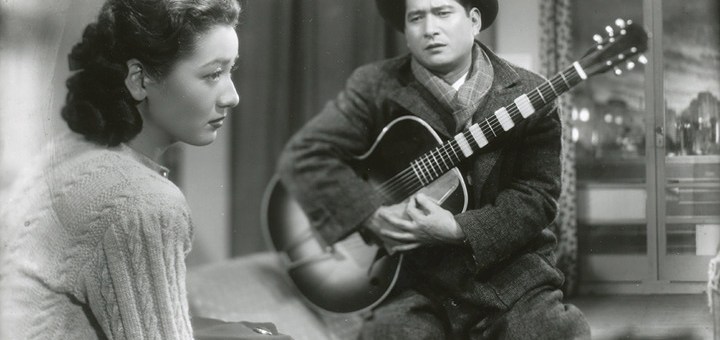
In So Goes My Love (愛より愛へ, Ai yori Ai e), our lead, Shigeo (Shuji Sano), is a struggling writer living with his girlfriend, Miyako (Sanae Takasugi), who supports them both with her meagre earnings as a bar hostess. As we later discover, Shigeo is the eldest son of a prominent family who have (temporarily) disowned him because they don’t approve of his relationship with Miyako. Realising his dreams of becoming a successful writer are unlikely to be fulfilled, Shigeo has become moody and taciturn. He wants to find a job but isn’t exactly equipped to get one especially when the times are as hard as they are. He asks his uncle for help and gets an interview at a newspaper, but quickly realises that his uncle has set him up – he can only have the job if he “legitimises” his living arrangements. Shigeo leaves in a huff but there’s no denying he’s in a financial fix.

Things start to change when Shigeo runs into his younger sister, Toshiko (Mieko Takamine), by chance at a cafe. Toshiko insists on coming back with him to his lodgings “for future reference” but also out of morbid curiosity as a kind of touristic exercise in surveying the lives of those less fortunate. Shigeo thought Miyako would have already gone out but walks in just as she’s leaving. Though Miyako is shy and quiet, a little perturbed over being suddenly ambushed with a visitor, she does her best to ease the awkwardness between herself and her potential sister-in-law with black tea (foregoing a cup herself) until Toshiko finally consents to sit on their floor cushion. Toshiko looks around the bare, depressing flat and spots Miyako’s sewing box with a pair of freshly darned socks sitting on top. It’s immediately clear to her that Miyako is not, as her parents had suggested, some kind of gold digger (no self-respecting gold digger darns their socks, after all). More than that, she seems “nice”, which is perhaps why she’s able to put up with the petulant Shigeo with so little complaint.

The central problem is a two fold one – Shigeo has attempted to choose his own bride and therefore “modernity” over the “traditionalism” of an arranged marriage. He doesn’t particularly care about being the head of a household or about living in relative squalor save for guilt and wounded male pride that he’s condemned Miyako to live there with him (not to mention sending her out to the degrading world of hostess bars and cabarets just so they can survive). The parents have reacted badly and produced a stand-off. Shigeo’s uncle is trying to manipulate the situation to his advantage by convincing Shigeo to leave Miyako and come home, but Shigeo is a proud young man, even if he leaves Miyako there’s no way he’ll come home with his tail between his legs. If the older generation wants to win the younger one over, it will have to compromise and learn to play by less stringent rules.

Making a knee-jerk judgment, Shigeo’s father and uncle have decided that Miyako is just a passing fad, a floozy or a gold digger best worked out of one’s system young and then forgotten about (preferably so that it wounds you so badly you’re ready to accept the cold comforts of a proper arranged marriage). Rather than the uncle, it’s Toshiko who becomes the bridge when she realises how kind and devoted Miyako really is. Shigeo’s mother is also sympathetic but, sadly, it’s still the men who have the final say and it’s not until uncle pays a Miyako a visit to try and persuade her to leave Shigeo that he too begins to see how “sweet” she is and that allowing her into their family wouldn’t be such a bad thing after all. In fact, as we later realise, Shigeo’s father perhaps wasn’t so opposed as he pretended to be and was simply playing his son at his own game, planning to consent to the match once he proved that it was really “serious” and not just a passing fling. Nevertheless, Miyako’s own meekness proves the final barrier as she finds herself suddenly afraid that Shigeo’s family might think her inherent goodness is some kind of trick and she’s been plotting all along. Only when Toshiko comes to fetch her and Shigeo himself calls her to come does she finally understand it’s going to be alright.

For 1938, this rather frivolous story might seem decadent especially with its warmhearted liberalism as the union of a lower-class woman and upper-class man is finally blessed through nothing more than common sense and empathy. Though Shimazu otherwise steers clear of political concerns, he does send Shigeo, Miyako, and Toshiko to the pictures where they end up watching part of a film made by Leni Reifenstahl featuring beautifully photographed visions of lithe young men in swimming trunks after which Shigeo gets up in a huff to smoke a cigarette. Toshiko didn’t seem to enjoy it much either and tries to improve Shigeo’s mood by insisting that the next one will be better but the message is clear – Shimazu didn’t like that film and he doesn’t think you did either. Among fans of Shimazu, at least, modernity is winning. It may not be perfect (Shigeo is an obvious prig whose self-conscious masculine posturing is almost a self parody), but it’s getting there and if everyone would just forget about the “rules” and treat others with respect, decency, and understanding then perhaps things wouldn’t be in such a mess.


Short scene in which the trio go to the cinema

https://www.youtube.com/watch?v=ZPJHmiNP_cM