
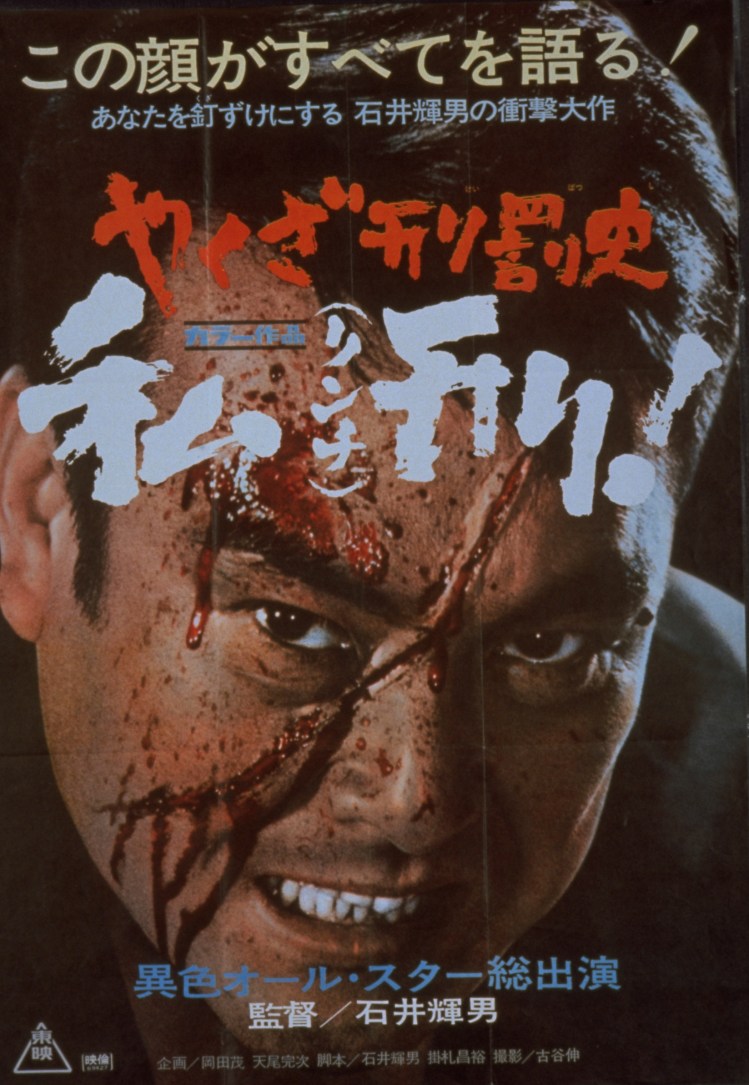
 One of the things that (supposedly) separates the “yakuza” from regular thugs is that they have a “code”. That code means many and various things, but in their grand mission to justify their existence it often means that they stand up for the little guy, all too often oppressed by the powers that be. Of course, a lot of people might feel themselves to be oppressed by yakuza thugs who like to throw their weight around and generally cause trouble for small business holders, but that’s beside the point. Teruo Ishii’s Yakuza Law (やくざ刑罰史 私刑!, Yakuza Keibatsushi: Lynch!) goes one step further and asks if the yakuza are themselves “oppressed” by their own code, or at least the various ways it is used and subverted by all who subscribe to it.
Set in three distinct time periods, Yakuza Law is also fairly unique in that the vast majority of those on the receiving end of its violence are male. The yakuza is an extremely homosocial world after all. Each of the three tales presented is preceded by a title card featuring the particular “laws” the unhappy gangsters are about to break and what kind of punishment they might expect for doing so.
The first and earliest, set in the Edo era, is a typical giri/ninjo tale that places the ideal of the yakuza code against the need to preserve a personal vision of justice. The “rules” here are that a yakuza does not steal and he does not fool around with married women. Our hero, Tsune (Bunta Sugawara), takes the heat for a nervous underling, Shinkichi (Hiroshi Miyauchi), who crumbled in the heat of battle, but incurs the wrath of his boss while a devious footsoldier, Viper (Renji Ishibashi), hides in the bushes and then stabs a corpse numerous times to make it look as if he’s done good service. Viper, not content with his ill-gotten gains, sets up Tsune and his superior Tomozo (Ryutaro Otomo) by implicating them in a gambling scam while Tsune falls for the boss’ girl Oren (Yoshiko Fujita) who is also desperately trying to protect the feckless Shinkichi.
The problem with all of this, it would seem, is not so much that the yakuza “law” has been broken but that’s it’s being misused in all quarters and is clearly in conflict with basic humanity. The boss uses the code to manipulate his underlings and keep a firm grip on his power, while Viper bends it to his own nefarious ways and a third underling, Shohei (Shhinichiro Hayashi), rests on the sidelines playing a little each way but remaining loyal to his brothers even as the axe falls on his head. The punishments meted out are suitably gruesome, escalating from finger cutting to eye gauging and ear removal in a senseless and counterproductive lust for violence which does eventually blow back on the boss who pushes his authority too far over too small a cause.
In tale two, however, which takes place in 20th century pre-war Japan, the “crime” is causing trouble and the punishment exile, but again the problem is not the code but the men who subvert it. Thus, hotheaded foot soldier Ogata (Minoru Oki) sets the cat amongst the pigeons by starting a gang war on his own and is sent to prison for three years during which time his gang prospers because of the movement he started. Even so, they aren’t keen to have him back when he gets out and immediately exile him from their territory. He sticks around waiting for his girl, Sayo (Masumi Tachibana), but she gets picked up by the evil boss who wants her for himself and delays her departure so that Ogata can be captured. Believing he’s dead, she hooks up with another goodhearted yakuza, Amamiya (Toyozo Yamamoto), who saves her from the bad guys only to have a romantic crisis when Ogata suddenly resurfaces. Amamiya and Ogata are, however, both “good” yakuza which means they both really love Sayo and want the best for her, each respecting the other for the old love and the new as they team up to kick the corrupt yakuza out of town and make sure she’s permanently safe whoever it is she eventually ends up with.
By the third tale we’ve reached the contemporary era, but we’re no longer in a traditional “yakuza” world so much as one seemingly ripped from a spy spoof in which the cardinal rule is that if you undermine the organisation you will be eliminated. More thugs than yakuza, this kind have no code and will stoop to the lowest kind of cruelty solely for money. Debonair, 007-esque international hitman Hirose (Teruo Yoshida) accepts a job from shady gangster Shimazu (Takashi Fujiki) to assassinate his boss, only Shimazu offs him first and then frames Hirose (which he finds very irritating). Hirose spends the rest of the picture teaching him a lesson while Shimazu tries to eliminate his competition in increasingly inhuman ways (including having someone crushed into a cube while trapped inside a luxury car).
Bar the third episode which isn’t really even about “yakuza”, what Ishii seems to be saying is that the yakuza are also oppressed because they are forced to live with fragmented integrity, torn between giri and ninjo in their adherence to an arcane set of values which are often overly enforced at the cost of true “justice”. To be fair, that is the idea behind every other yakuza film, but Ishii does is add a more cynical edge in suggesting the issue isn’t the code and conflicting value systems but individualised corruption (which is itself perhaps a kind of “ninjo”) in those who deliberately misuse the “noble” idea of the code for their own ends – something which has intensified since the Edo era though is apparently not a result of post-Meiji internationalism. All of that aside, despite the brutality of the title, Yakuza Law is fairly tame outing for Ishii which tempers its lust for blood with cartoonish irony as its deluded heroes battle themselves in service of a code which has never and will never truly serve them.
Available on blu-ray from Arrow Video in a set which also includes a new audio commentary by Jasper Sharp and a vintage interview with Teruo Ishii, as well as a booklet featuring new writing by Tom Mes.
Original trailer (no subtitles)
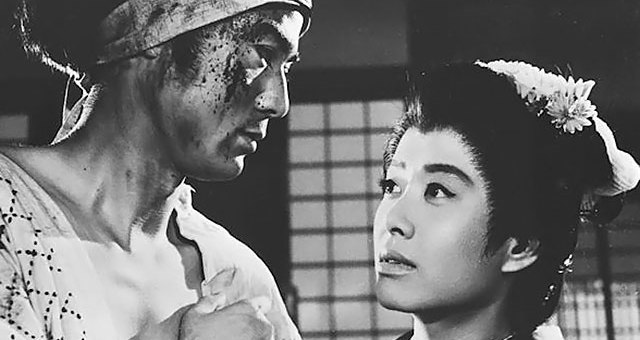
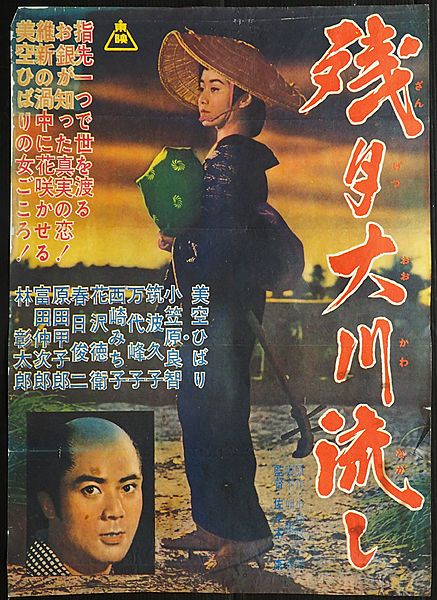
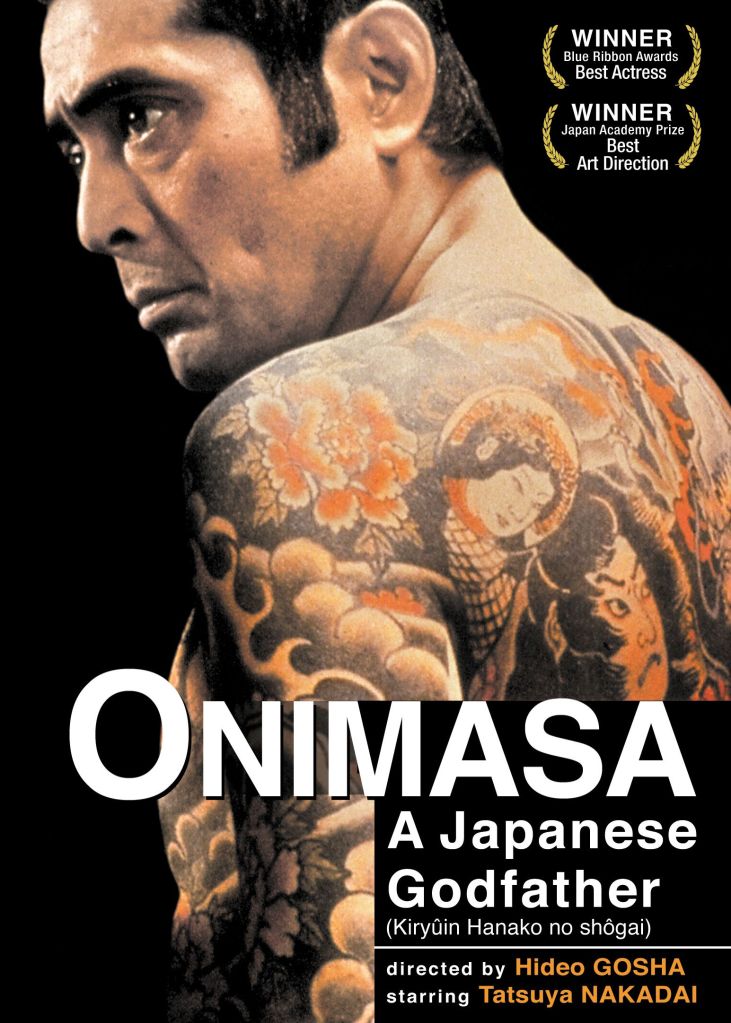 When AnimEigo decided to release Hideo Gosha’s Taisho/Showa era yakuza epic Onimasa (鬼龍院花子の生涯, Kiryuin Hanako no Shogai), they opted to give it a marketable but ill advised tagline – A Japanese Godfather. Misleading and problematic as this is, the Japanese title Kiryuin Hanako no Shogai also has its own mysterious quality in that it means “The Life of Hanako Kiryuin” even though this, admittedly hugely important, character barely appears in the film. We follow instead her adopted older sister, Matsue (Masako Natsume), and her complicated relationship with our title character, Onimasa, a gang boss who doesn’t see himself as a yakuza but as a chivalrous man whose heart and duty often become incompatible. Reteaming with frequent star Tatsuya Nakadai, director Hideo Gosha gives up the fight a little, showing us how sad the “manly way” can be on one who finds himself outplayed by his times. Here, anticipating Gosha’s subsequent direction, it’s the women who survive – in large part because they have to, by virtue of being the only ones to see where they’re headed and act accordingly.
 When it comes to the history of the yakuza movie, there are few titles as important or as influential both in Japan and the wider world than Kinji Fukasaku’s Battles Without Honour and Humanity (仁義なき戦い, Jingi Naki Tatakai). The first in what would become a series of similarly themed movies later known as The Yakuza Papers, Battles without Honour is a radical rebooting of the Japanese gangster movie. The English title is, infact, a literal translation of the Japanese which accounts for the slightly unnatural “and” rather than “or” where the “honour and humanity” are collected in a single Japanese word, “jingi”. Jingi is the ancient moral code by which old-style yakuza had abided and up to now the big studio gangster pictures had all depicted their yakuza as being honourable criminals. However, in Fukasaku’s reimagining of the gangster world this adherence to any kind of conventional morality was yet another casualty of Japan’s wartime defeat.
 Windows on Worlds