Travelling Actors (旅役者, Mikio Naruse, 1940)

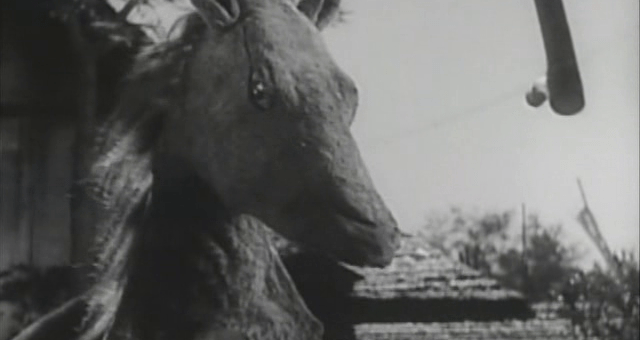
“You can’t have a horse without the ass” admits a travelling actor, inwardly preparing to meet his obsolescence. Anything’s an art if you care to practice it, but there is such a thing as taking yourself too seriously. A masterclass in tragicomedy, Naruse’s 1940 character study Travelling Actors (旅役者, Tabi Yakusha) finds two ends of a pantomime horse about to be torn apart when their act is unwittingly destroyed by a resentful punter whose drunken attempt to escape his sense of humiliation in being tricked by unscrupulous promoters leaves their horse without a head. 

Hyoroku (Kamatari Fujiwara) prides himself on being the “Danjuro of pantomime horses”, performing with the younger Senpei (Kan Yanagiya) who looks up to him as if he really were a great master of the arts. The guys are part of a group of travelling players touring rural Japan performing traditional skits for an audience starved of entertainment. The troupe is not, however, above exploitative business practices, proudly advertising the appearance of “Kikugoro” but neglecting to mention that it’s not the famous one, just another guy with the same name. Meanwhile, someone has to foot the bill for “producing” the show wherever the actors land, leading the exploitative producers to convince a local barber (Ko Mihashi) to invest, hoping to get a little free publicity because he’s known to be the town gossip and can spread the word through his shop. The plan backfires, however, when he travels to the station to see them arrive and immediately realises they are not a fancy acting company from Tokyo but a bunch of ragged bumpkins. Feeling thoroughly fed up, he demands to be allowed to perform in the show as the price of his silence before getting black out drunk and passing out backstage, crushing the papier-mâché horse’s head in his desperation to find somewhere soft to land. 

As “Kikugoro” points out, the “guy who plays the pantomime horse is really picky” so they know they’re in for some trouble as soon as he finds out what’s happened to his head. In fact, Hyoroku was just in the middle of some remodelling, trying to make the head look even more realistic to improve his art. While the barber is destroying his life’s work, Hyoroku and Senpei are drinking with a pair of geishas who are pretending to be interested in Hyoroku’s mini lecture about his process in which he tells them all about how he’s really captured the true essence of the horse through patiently honing his craft all these long years. 

There might be something in that, that Hyoroku is a workhorse of the theatre now more beast than man. Just occasionally, his horsey mannerisms come out in his offstage life, scratching the floor with his feet or pacing the room like a penned in pony. Though there are other sides of him which are painfully human. He makes a point of belittling Senpei in front of the geishas, insulting his art to assert his place as the teacher, always keen to keep his pupil in his place. But as Senpei points out, you can’t have a horse without the ass, and his “art” is no less important than Hyoroku’s. Continuing to take himself way too seriously, Hyoroku refuses to perform with the broken head, flatly objecting to the suggestion of substituting one from the fox costumes because he can’t get into character when his head’s in the wrong place. 

Faced with the prospect of cancelling the show, the producers come up with a radical idea – hiring a real horse. In a still more ironic touch, they even sell this horse who is making his stage debut as a star in his own right, only realising the dangers of their situation when it urinates right in the middle of the act. Weirdly, that only makes the horse a hit and convinces the troupe they’re on to a winner, which is bad news for the boys because who wants to see two guys in an ugly costume when they could be gazing at the real thing. The days of the pantomime horse are ending, but where does that leave a “great master” like Hyoroku who has spent his life becoming more horsey than a horse? Kicked out of the inn and forced to sleep backstage as non-performers, the guys eventually suffer the indignity of being offered jobs as stable boys, mere servants to the star who has replaced them. 

In an unguarded moment, Hyoroku and Senpei reflect on where they are as a young man in a soldier’s uniform leads a patient horse off to war. “That could be us” they sigh, though it’s not clear if they mean the man or the horse, before going back to horsing around eating shaved ice and flirting with the store owner. “I’m just the horse’s ass”, Senpei laments, secretly hoping to become a “real” actor at last, only for Hyoroku to uncharacteristically start encouraging him before dragging him off on another crazy adventure. Putting the fox’s head on to make a point, Hyoroku disappears into the role, chasing his rival right out of town, dragging his back legs behind him as he goes. 

Law in Ghost Island (幽霊島の掟, Yasushi Sasaki, 1961)

The post-war world was one of increasing globalisation which brought with it anxiety as well as hope as Japan readied itself to step back onto the world stage. The populist cinema of the early ‘60s is marked by ambivalent attitudes to international influences, not just towards creeping Americanisation and its perceived costs but perhaps somewhat uncomfortably towards the wider world and Asia in particular with the same old prejudices which had marked the previous 20 years rearing their heads once again. Voice of the post-war era, the films of Hibari Misora are, by contrast, about as forward looking and progressive as it was possible to be but Law in Ghost Island (幽霊島の掟, Yurei-jima no Okite) in which she plays a noticeably smaller part, is a bizarre exception in which a “lawless” melting pot outpost must be “civilised” by Japanese influences else the creeping rule of thuggish Asian gangs finally reach Japan “proper”.

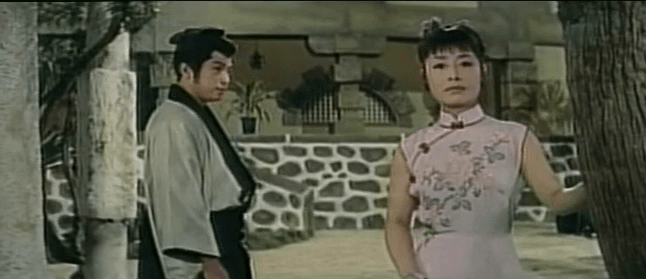
We’re deep in the Bakumatsu. The Black Ships have already arrived and there is considerable political trouble brewing back in Japan. That’s not our immediate concern however because we’re on a creepy boat with slovenly ronin Yagi Hanzo (Hashizo Okawa) and a mysterious woman wearing a cheongsam (Hibari Misora). Fellow petty gangster and slave trafficker Bunji (Chiyonosuke Azuma) is suspicious of Hanzo, but decides he’s probably just an unlucky retainer on the run from something or other and might prove useful. Therefore, on arrival at Dragon Island, Bunji starts on trying to recruit Hanzo for his boss Chou Yang Po (Isao Yamagata), but Hanzo’s his own man and he hasn’t come here looking for a job. Fearing Hanzo is a government official here to bring the law down on all their heads, Chou tries to force him to harm a man they have in custody and believe to be working for the state. Hanzo gets round this by breaking a chair over the man’s back but leaving him otherwise unharmed, keeping his cover (if that’s what it is) firmly intact.

During his stay on Dragon Island, Hanzo will meet several other shady characters, many of them dressed in outfits more usually associated with the Chinese, Indians, nondescript “islanders”, and strange movie pirates, but what must be assumed is that though Japan “owns” this distant island it is unable to police it and as such it has become a den of scum and villainy in which various tribal gangs vie for hegemony and control over the lucrative smuggling hub which has unwittingly formed in direct response to Japan’s unwise policy of internal isolation which is itself at breaking point thanks to Perry’s Black Ships which we later hear are also on their way to Dragon Island.

Our key into this conflict is the crazed child of the leading gangster, Isakichi (Hiroki Matsukata), who dresses like a cowboy and likes to showoff his hard-won saloon credentials as sharpshooting libertine and all round party animal. Hanzo is not as impressed by this as Isakichi was hoping though an awkward sort of camaraderie eventually arises between them. Meanwhile, Isakichi has fallen in innocent love with the sister of his childhood best friend who is deep into a putative resistance movement hoping to end the stranglehold the smugglers have placed over the previously peaceful island.

Misora’s Madame Song, for some reason posing as a Chinese sex worker, hints at the various ways nothing is quite as it seems in her astute observations of the world around her, sensing that Hanzo is hiding something but also assuming that he is on the “right” side. There is conspiracy everywhere – the putative revolution at home is sending its shockwaves all the way out here as our unscrupulous gangsters try to procure guns to send to various sides on the mainland, while Madame Song ironically laments that what Dragon Island needs is to be more like Japan which is to say ruled less by law itself than an internalised acceptance of the proper order of things. Uncomfortably, it also probably means sending the people who aren’t wearing kimono somewhere else and trying to stop them tricking nice women from Kyushu into coming to tropical islands where they discover they’ve been trafficked into sex work and are unable to leave.

Among Toei’s lower budgeted efforts, Law in Ghost Island bills itself as a supernatural tale and does indeed open with a creepy scene of a misty boat but Hanzo doesn’t end up anywhere like the isle of the dead only a fantasy tropical “paradise” filled with zany movie pirates. Somewhere between pirate fantasy and western, Law in Ghost Island is closer to the kind of spy spoofs Toho would start producing in a few years’ time and even ends with a strangely comic scene in which just about everyone reveals themselves as spy for the same side during the climactic final shootout having been too busy playing spy games to figure any of it out before.

The final messages too are uncomfortable and ambivalent as Hanzo affirms that if there were more “good samurai” Japan would not become lawless like it is here while also claiming Dragon Island for the mainland in fear external forces may use it as a base to attack Japan. The smugglers pay heavily for their “treachery” in contributing to internal mainland chaos while the revolutionary islanders declare their intentions to make the island a better place, which mainly seems to mean making it more “Japanese” which is a fairly ambivalent message whichever way you look at it. Misora only sings two songs and is relegated to a minor mystery in the strange goings on of Ghost Island which features absolutely no ghosts or supernatural intrigue. It does however perhaps shine a light on a strange moment of cultural flux however how unflattering that mirror may turn out to be.


Brief clip of some of Hibari’s songs (no subtitles)

https://www.youtube.com/watch?v=ryNk8dAVVnI

Ghost in the Well (怪談番町皿屋敷, Toshikazu Kono, 1957)

Ghost in the Well poster 2Love across the class divide threatens to overthrow the social order. Inspired by the classic folktale Bancho Sarayashiki, Ghost in the Well (怪談番町皿屋敷, Kaidan Bancho Sarayashiki) is indeed the story of a haunting though perhaps not altogether of the kind you might be expecting. This is a tale of romance, but also one of impossible love in which the only possible union is in death. The pure love of a servant girl is deemed incompatible with the oppressive world of samurai honour, and so she must die, but her lord cannot survive it. He cannot reconcile himself to having chosen to preserve his honour, his status, his lineage at the cost of her life and his love.

Rowdy samurai Harima (Chiyonosuke Azuma) loves making trouble in the streets. As the lord’s bannerman he knows he has a degree of status and likes to throw his weight around in the yoshiwara, much to the lord’s consternation. Harima has also taken a fancy to one of his maids, Okiku (Hibari Misora), who continues to reject his advances despite returning his affections because she knows the class difference makes a legitimate relationship between them impossible and a dalliance with her lord means losing the opportunity to marry anyone else. Harima tells her that there’s no such thing as status when it comes to love and that he doesn’t think of her as a passing infatuation. Eventually Okiku gives in and a kind of promise is made between them.

Nevertheless, it’s a promise which can’t be kept. The Aoyama family is in trouble and the obvious answer is to make a good match for Harima that will restore both status and wealth. When one of Harima’s friends is ordered to commit seppuku for the exact same petty punk antics Harima gets up to all the time matters come to a crunch. To keep him safe, Harima’s uncle arranges a marriage with an influential family. Harima tries to refuse but he too is more or less powerless even if he weren’t torn between the obligation to his samurai code and his illicit love for servant girl whom he would never be permitted to make his wife. To cement the match, Harima’s uncle has prepared 10 precious plates as a dowry, but Okiku, catching sight of Harima’s bride-to-be, drops one and breaks it in two. Her fate is sealed. Harima draws his sword on her and she backs away, eventually falling into the well and dying there.

The broken plate is, of course, a symbol of their broken covenant but also of Okiku’s shattered dreams as she watches a beautiful but haughty woman steal away her last hope of happiness solely through the accident of noble birth. As her friend tells her, a commoner cannot become the wife of a samurai and all Okiku can do is resign herself to her unhappy fate. Having broken the plate, however, all is lost. The men of the household admit their responsibility for entrusting the entirety of their future to a mere slip of a girl in the middle of intense heartbreak, but Okiku cannot go unpunished and Harima must claim his new life by destroying his past love.

Harima does what he’s supposed to do, if in passion and half by accident. Yet the marriage remains broken, the family in jeopardy, and Harima without hope of future. The ghost of Okiku, real or imagined, haunts him while he remains guilt ridden and filled with regrets. Despite his rowdiness and manly pride, he chose his samurai honour and condemned his one true love to a lonely death. Her love has, however, survived and resurrected her not as a demon of vengeance come to lead him to his doom but as a lovelorn woman keen to remind him of the promise he made and broke but which might be mended.

Harima pays for his transgressions, though more as a mischievous samurai who allowed his over inflated ego to convince him he had the right to oppress his fellow retainers than as a man who caused the death of an innocent woman, first by corrupting her and then by the same rigidity which has led to his present predicament. There can be no “love” in a such a society, let alone the love of a bannerman and a servant girl. Theirs is a blood wedding, uniting them in death, consumed by the impossibilities of the samurai era. At only 45 minutes, Ghost in the Well is perhaps a slight retelling of the tale and somewhat in imbalanced in its presentation of the fates of the two lovers but is nevertheless a refreshingly romantic take on an often dark story in which a scorned woman’s vengeance is reframed as a powerful condemnation of an oppressive society.


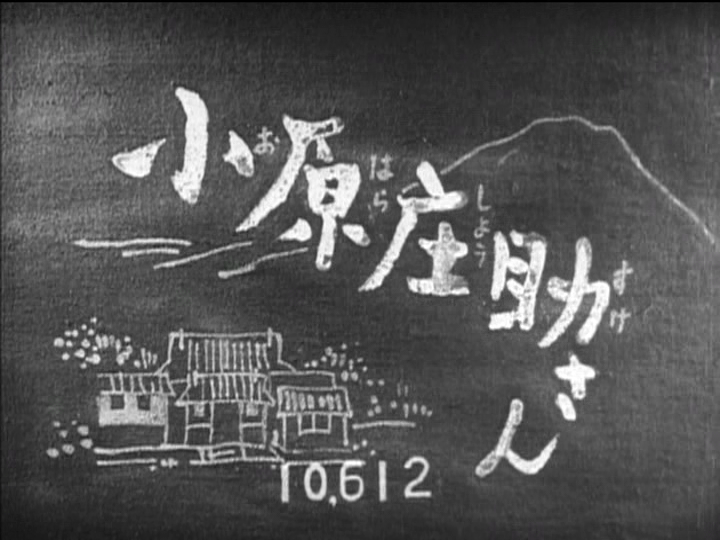
Mr. Shosuke Ohara (小原庄助さん, AKA Ohara Shosuke-san, Hiroshi Shimizu, 1949)

vlcsnap-2016-09-25-01h34m07s636Ohara Shousuke-san (小原庄助さん) is the name of a character from a popular folk song intended to teach children how not to live their lives. The Ohara Shosuke-san of Aizu Bandaisan has lost all his fortune but no one feels very sorry for him because it’s his own fault – he spent his days in idleness, drinking, sleeping in, and bathing in the morning. The central character of Hiroshi Shimizu’s 1937 film has earned this nickname for himself because he also enjoys a drink or too and doesn’t actually do very much else, but unlike the character in the song this a goodhearted man much loved by the community because he’s a soft touch and just can’t refuse when asked for a favour. An acknowledgement of the changing times, Shimizu’s Mr. Shousuke Ohara is a tribute to the soft hearted but also an argument for action over passivity.

If you turn up one day and ask for directions to the Sugimoto household, everyone will look at you with confusion but if you ask for Mr. Shousuke Ohara everyone will gladly walk you over and introduce you. Saheita Sugimoto (Denjiro Okochi) is the head of a once proud samurai household but his fortunes are far from those of his ancestors. Despite his pecuniary difficulties, Sugimoto is good hearted man who wants to help everyone that he can (out of a sense of altruism rather than duty or vanity). Consequently he is deeply in debt and nearing bankruptcy yet he can’t give up any of his three vices – drinking, gambling, and generosity.

The nature of the changing times is at the centre of this 1949 film. As Sugimoto is fond of telling people, his noble house used to stand for something but all of that historical influence is next to meaningless now. Though Western dress is not uncommon, the village is pretty much as it’s always been – children play in the fields and Sugimoto travels everywhere by donkey. Other than the tale of Sugimoto’s fall from grace, the central narrative concerns an election for a new village chief. Yoshida, a youngish man, wants Sugimoto’s support for his election campaign. His main campaign policy is modernisation – the introduction of electricity, modern transportation and communications, as well as greater cultural involvement starting with opening Western style ballroom dance classes for the children. Unfortunately his policies are not that firm and his motto seems to be “I’ll do that first!” to all aspects of his plan which is not very encouraging but still the desire is very much to move away from old fashioned village life towards a more sophisticated urbanism.

This of course also means an end to the inherited influence of idle nobleman such as Sugimoto. Though he’s a kind man who likes nothing other than helping other people, Sugimoto has been a passive steward, more consumed with his own idle pursuits than with making an active attempt at leading the village. This passivity has contributed to his downfall as he’s neglected the business of maintaining his own fortune. After taking out numerous loans which he only ever uses to help the villagers, Sugimoto has let the estate which ancestors founded, and which he was supposed to look after in the names of all that have gone before and all were to come after him, slip away. The ultimate failure and a disgrace to his ancestors, this loss of the ancestral home is an unforgivable betrayal yet there is something in Sugimoto which seems to regard it as right and proper that it should go.

Change is coming to the village, even if it isn’t coming with the speed that a young man like Yoshida may be hoping for. Change is also coming to Japan which is in the progress of rebuilding itself anew following long years of folly followed by confusion. There is no room for genial idleness anymore. “If you can work honestly with your hands you can make a living”, Sugimoto tells two would-be-burglars that he invites in for a drink as a apology for not having anything left for them to steal, but means the advice more for himself than anyone else. It’s time to say goodbye to Shousuke Ohara and the burden of inherited privilege and chart a new course as Seihata Sugimoto. Finishing on another of Shimizu’s much loved road shots, Sugimoto, like his nation, walks confidently along the road to an uncertain future yet he is not alone as he goes and may make something of himself yet.