May 18 (화려한 휴가, Kim Ji-hoon, 2007)

Following the assassination of president Park Chung-hee in 1979, many assumed that democracy would return and that the society would be liberated from its authoritarian past. That did not, however, come to pass. While the government floundered, general Chun Doo-hwan launched a coup that led to nothing other than a second military dictatorship. Citizens continued to press for democratisation and the lifting of the martial law that had been declared in the wake of Park’s death. In order to cement his authoritarian rule, Chun embarked on an oppressive crackdown of resistance activity, actually expanding martial law and sending troops to monitor universities where the majority of protests were taking place.  

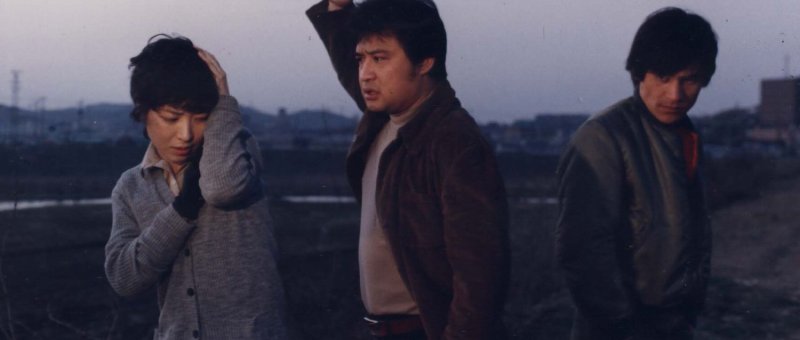
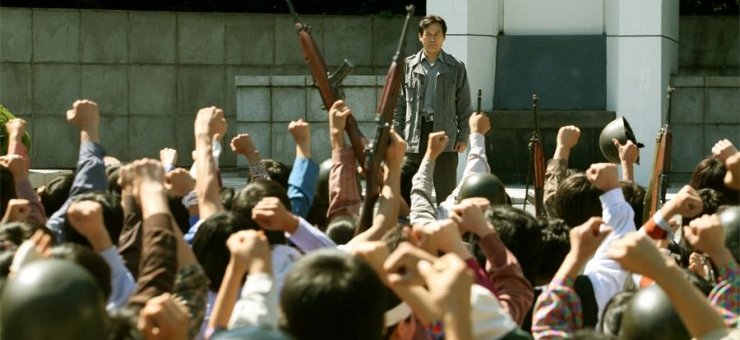
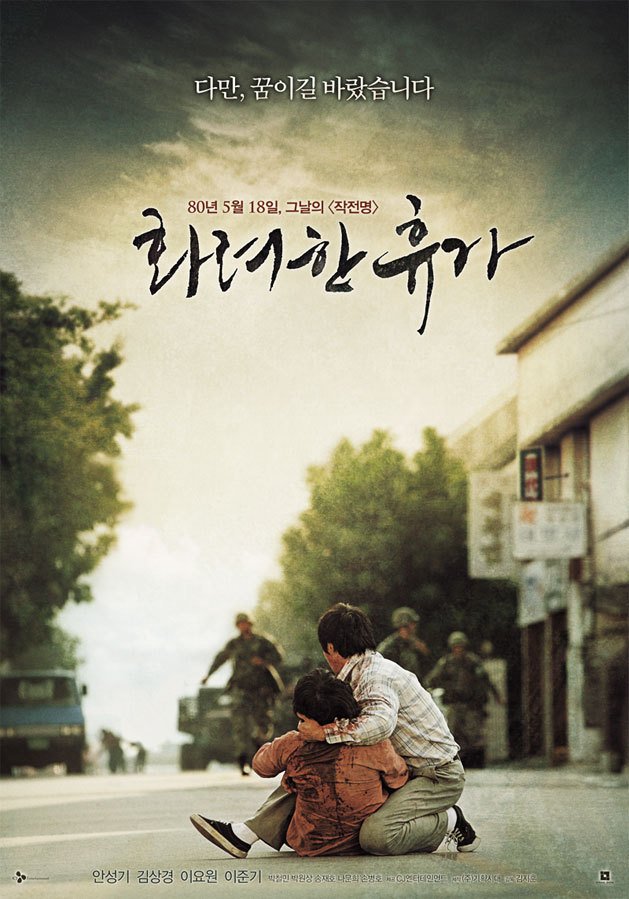
It’s against this backdrop that Kim Ji-hoon’s May 18 (화려한 휴가, Hwaryeohan hyuga) unfolds, so named for the first day of Gwangju Uprising in which citizens of the small provincial city were subject to beatings, torture, rape and murder at the hands of military forces. He opens however with pleasant scenes of the local countryside as taxi driver Min-woo (Kim Sang-kyung) heads back into the city eventually arriving to pick up his younger brother Jin-woo (Lee Joon-gi) from high school and deliver him to the local church. Min-woo also has a crush on mutual friend and fellow attendee, Shin-ae (Lee Yo-won), who works as a nurse at the local hospital. For some reason even though this is a fairly small place, Min-woo also seems to be unaware that Shin-ae is the daughter of his boss Heung-su (Ahn Sung-ki ), a former army captain now retired and running a taxi firm. 

In an attempt to make the political personal, Kim spends the first hour on Min-woo’s awkward romance which by modern standards is quite problematic in that he basically ends up following Shin-ae around and offering to give her free lifts even though she seems annoyed to see him and isn’t keen on him effectively deciding where she doesn’t and doesn’t go. Meanwhile, as he and his brother are orphaned he’s adopted a paternal role towards Jin-woo who is bright and studying hard with the aim of getting into Seoul University to study law while Min-woo most likely had to give up school to drive the taxi so he could support them both. This is also in its way a little uncomfortable in its emphasis on Jin-woo’s bright future which is about to be destroyed by the uprising as if his life is worth more because of all the ruined potential rather than just because he was an ordinary human betrayed by his government and trapped by hellish atrocity. Even so, it hints at a conflict within Min-woo as he wants to keep his brother safe but also has a natural desire to resist injustice and is moved when Jin-woo explains that one of his best friends has been murdered by state violence. 

Then again, the film’s framing is also in a sense reactionary in Jin-woo’s intense offence against being branded as a “rebel” or a “communist” rather refocusing on the fact the military’s actions are inhuman and the their attempt to slur the local people only a means of justification. As the local priest accurately suggests, the military provokes them in order to have an excuse to crack down with extreme prejudice ensuring that there will be no further resistance to increasing authoritarianism. Some army officers begin to ask questions but are quickly shut down by their overzealous commander who claims the North may be on its way to link up with these “communists” and is quite clearly prepared to wipe out the entire town rather than back down and risk a further escalation of their resistance. 

While the soldiers are faceless and implacable, the townspeople are sometimes depicted as naive bumblers with significant time spent on a “loudmouth” comic relief character who is nevertheless one of the first to pick up a gun and join the town’s civilian army led by Heung-su who like the priest is under no illusions and assumes troops will soon storm the town. The comedic tone and melodramatic undercurrent often undercut Kim’s attempts to depict the horror of the massacre even in the irony of their juxtaposition as bullets suddenly rip into a cheerful crowd which had been laughing and joking only seconds before. The closing scenes in which a man refuses to surrender and is killed are framed as heroic but in the end seem futile, as if he’s thrown his life away for no reason. Even so there is something Shin-ae’s loudspeaker pleas to remember the citizens of Gwangju who stayed strong and resisted to the last rather than consent to their oppression even if she is in a sense condemned to be the storyteller bearing the horror of it all alone along with the loss of her own happy future crushed under the boots of violent authoritarianism.


International trailer (English subtitles)
The Starting Point (원점, Lee Man-hee, 1967)

A hired thug and a sex worker dreaming of a new life are set on a collision course at mountain retreat in Lee Man-hee’s noirish thriller, Starting Point (원점, Wonjeom). A melancholy existential drama, the film nevertheless has a darkly comic absurdity and becomes for a time almost a satire of changing sexual mores and the anxiety surrounding the post-war population explosion while simultaneously hinting at corporate corruption in economically straitened times. 

Played in near total silence, the opening pre-credits scenes find the otherwise unnamed (the name given in the promotional material is never spoken) lackey (Shin Seong-il) raiding an office building with the intention of retrieving some mysterious documents the people who hire him later claim threaten to expose their “seven-year-secret”. The Lackey takes time to smoke a cigarette and read through some of the papers before putting them into a briefcase to make his escape but is soon met by a man with a rifle who challenges him. A fight ensues on the staircase from which the Lackey is able to escape, activating a rolling gate to get out of the building. But the other man keeps coming after him, managing to cling on the briefcase while his neck is crushed by the unstoppable motion of the shutter. 

Mirroring him, the unnamed Sex Worker (Moon Hee) is also intruded in a wordless sequence shot with the kind of realism seen in American independent and European arthouse cinema as she stares forlornly at the pretty dresses behind the glass in a small boutique before sadly making her way towards a streetlight near the Choseon Hotel where she wordlessly picks up a customer through suggestive looks and gestures. 

The Lackey knows too much, which is why his bosses want to take him out but for unclear reasons Mr Choi comes up with a bizarre and convoluted scheme which involves hiring the Sex Worker to pose as the Lackey’s wife during a honeymoon getaway to Mt. Seorak. What the Lackey thinks is going on or why the mountain is important is never really explained just like the nature of the seven-year-secret, but once there the film changes tack becoming a kind of ensemble mystery as the various guests each become suspicious of one another while the Lackey and the Sex Worker slowly fall in love for real perhaps bonding their mutual sense of existential peril and outsider status. 

In the liminal space of the mountain, both fear rejection by those around them who come to represent mainstream society, the Lackey because he has killed and Sex Worker because of her profession. Ironically, one of the other guests is a dodgy gynaecologist who makes a point of saying that most of his clients are sex workers from around the Choseon Hotel at least implying that he regularly performs abortions. He recognises the Sex Worker as a previous patient and tries to take advantage of her sexually but commits a breach of medical ethics by leaking her profession to the rest of the group who then shun her. When the planned camping trip encounters a snag seeing as only two tents have been provided and the obvious solution is for men to take one and the women the other, the women all immediately leave on the Sex Worker’s arrival refusing a share a space with a “fallen woman” in case they are somehow tainted by her shame. 

But then, the goings on at the mountain inn are strange in themselves. A middle-aged man who inexplicably doesn’t seem to have encountered a transistor radio before accidentally tunes into a news broadcast discussing the effectiveness of the contraceptive pill while the young people dance with wild abandon to music they don’t really understand. Meanwhile, the gynaecologist wades in when another of the women experiences terrible stomach pains insisting that he is “familiar with women’s issues” and informs the husband that his wife is pregnant which is confuses him because they only married the day before and he’s been a good boy so the news is perplexing. He spends the rest of the film counting dates on his fingers and at one point attempts to hang himself certain that his wife must have slept with another man before their wedding instead of maybe considering that the dodgy gynaecologist may be mistaken.  

When the couples are divided into separate tents, one guest quips that it’ll be good for keeping the birth rate down hinting at an anxiety about a new sexual freedom among the young coupled with the impact of the ongoing baby boom and its economic implications. The gynaecologist’s wife is the first to join in with the youngsters, but she’s also a rabid penny pincher making sure the newlywed husband pays for her husband’s treatment of his wife while intensely jealous constantly trying to keep the randy doctor’s attention off the other women. The sense of economic anxiety is echoed in the Sex Worker’s melancholy longing onto looking into the shop window while dreaming of opening her own hair salon though sex work is the only way she can support herself and leaves her with intense shame that like the Lackey exiles her from mainstream society. 

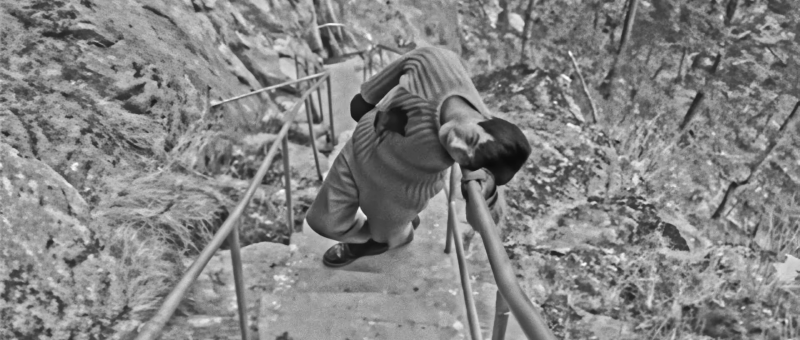
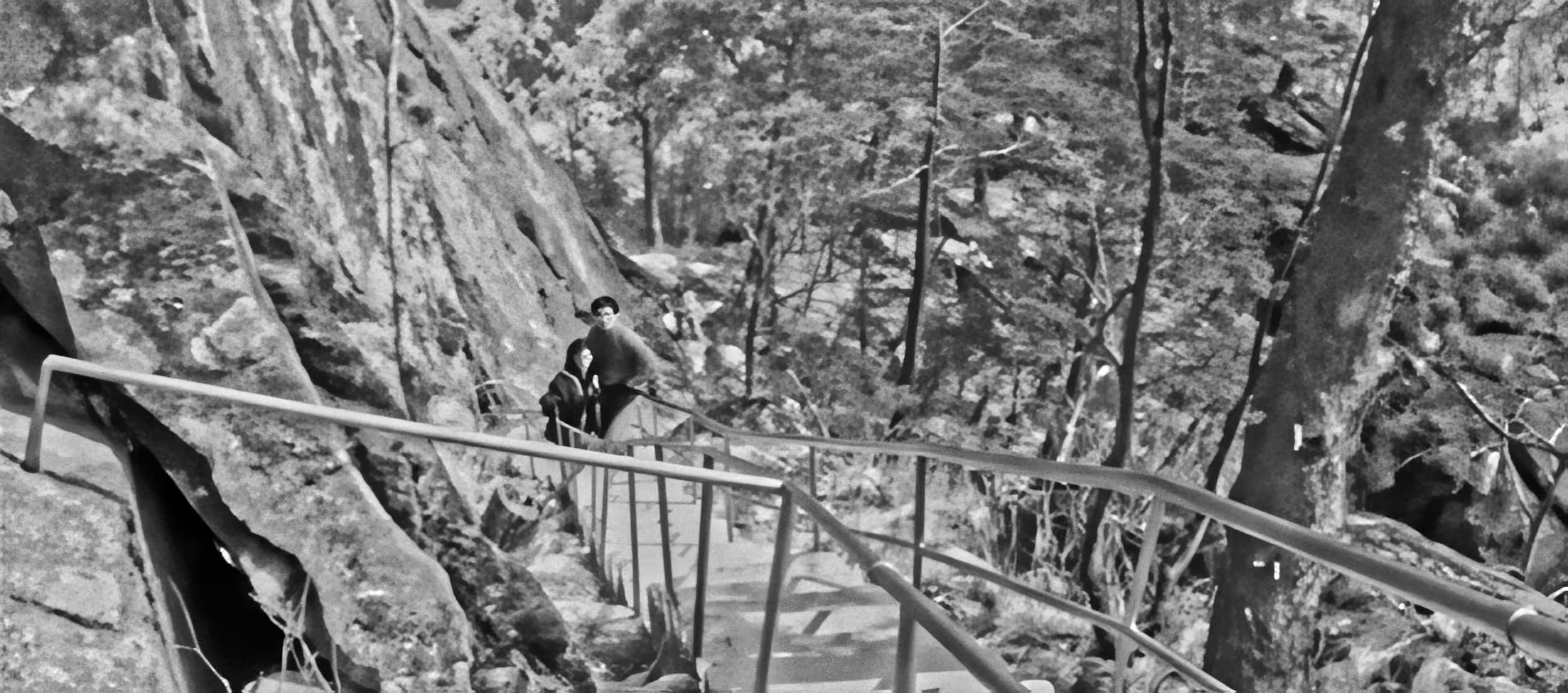
As she says while embracing her covert identity as a cheerful newlywed, she’s been looking up all her life and would like to look down for once which she ironically does atop the stairway on which the Lackey fights his existential battle with Choi and his minions. They each want to find a way to get off the mountain and return to the world, but are prevented from doing so by the forces that pursue them and will not let them go. Finally questioned, the Sex Worker is forced to admit that she knows nothing about the Lackey, not his name or where he lived or what he did for a living, only that he did not hate her which is as close to a declaration of love as it might be possible to get in this cold and dark world of exploitation and violence. Lee films with a noirish intensity and melancholy fatalism as the pair attempt to fight back against the forces which constrain them with the pureness of their love but later discover that, as they feared, all that is left to them are painful memories of momentary happiness. 


People in the Slum (꼬방동네 사람들, Bae Chang-ho, 1982)

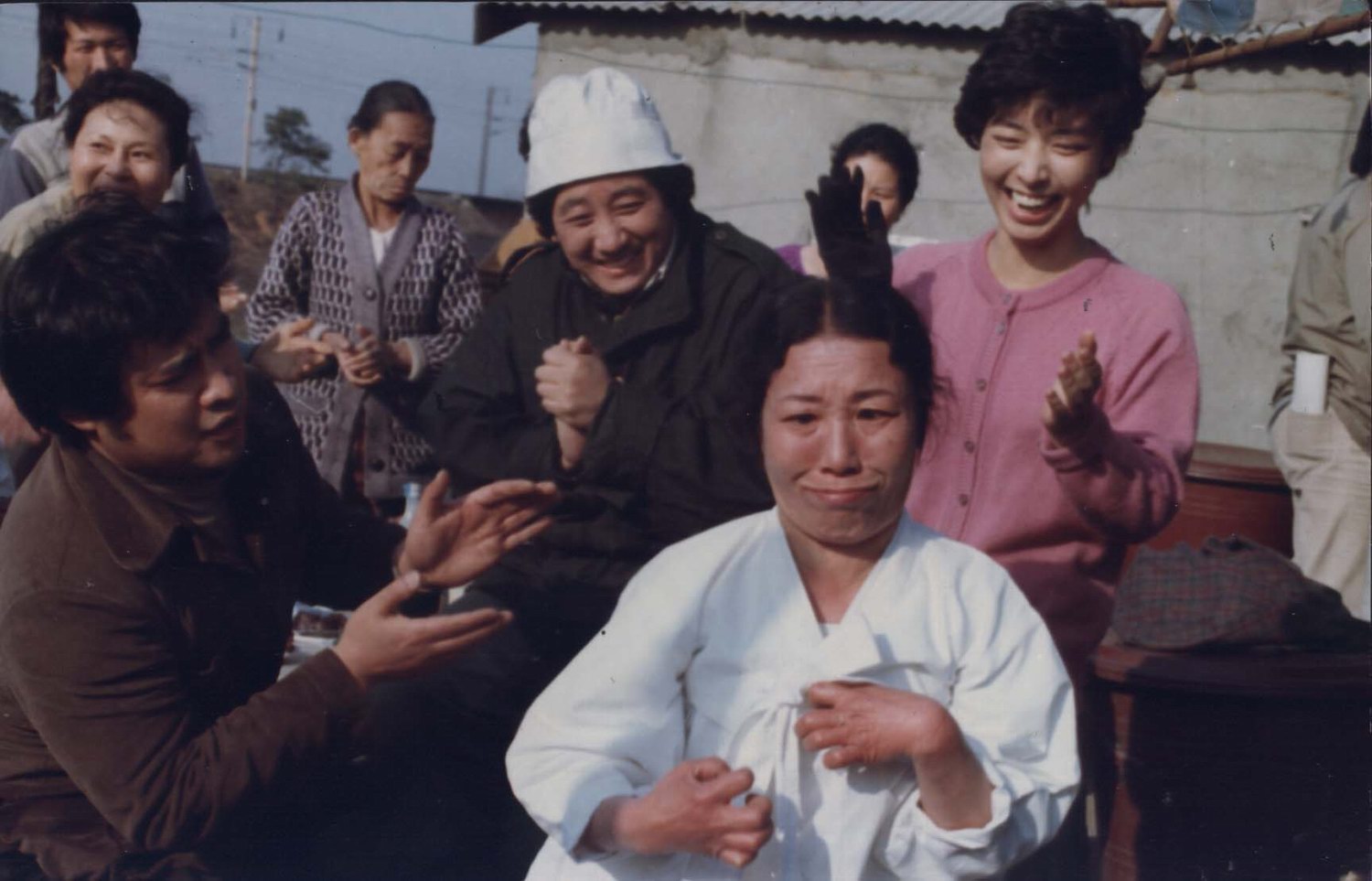
People in the slum still 2The Korea of the early ‘80s was not an altogether happy place. One dictator fell in 1979, but hopes of returning to democracy were dashed when general Chun Doo-hwan staged a coup and instigated martial law, brutally suppressing a large scale democracy protest in Gwangju in 1980 (though the news of the incident was also suppressed at the time it took place). People in the Slums (꼬방동네 사람들, Kkobangdongne Salamdeul), adapted from the best selling novel by Lee Dong-cheol, is not an overtly political film but takes as its heroes those who have lost out in the nation’s bold forward march into the capitalist future. Opening with a voice over from the author himself, the film dedicates itself to “the memory of neighbours of bygone days”, remembering both the hardships but also the fierce sense of community and warmth to be found among those living at the bottom of the heap.

Myeong-suk (Kim Bo-yeon), a still young-ish woman with a young son, lives in a slum outside of the city with her second husband, Tae-sub (kim Hee-ra). Nicknamed “Black Glove” because of the glove she always wears on her right hand, Myeong-suk is about to open her own business – a small grocery store serving the local residents, but her happiness is tempered with anxiety. Tae-sub, despite his promises, steals money from Myeong-suk to go drinking and gambling, is occasionally violent, and does not get on with her son, Jun-il, who refers to him as Mr. Piggy. Jun-il is also a constant worry because he’s picked up a habit of stealing things and generally causing trouble around the neighbourhood. When Myeong-suk’s former husband and the father of Jun-il, Ju-seok (Ahn Sung-ki), catches sight of her by chance one day, the past threatens to eclipse the small hope of her future.

Life in the slums is not easy. There are few resources, few people are working and there are lots of children with no money to feed and clothe them. Fights are frequent but often unserious. The community pull together to support each other, turning out in force for the grand opening of Myeong-suk’s shop or the 60th birthday celebration of a fellow resident. Besides Myeong-suk, her second husband, and son, the slum is home to a collection of unusual characters from a widow who dresses in white and does strange dances to entertain the locals, to the pastor who does his best to help where he can. A poor drunken woman makes a fool of herself all over town, nursing a crush on the pastor but seemingly unable to move past her dependency on alcohol and whatever it is that caused it and landed her in the slum.

Myeong-suk’s early life would not have suggested her current trajectory, as Bae reveals in Ju-seok’s flashbacks of his courtship to the woman who would become his wife. Ju-seok, a pickpocket, spotted Myeong-suk on a bus and it was love at first sight. Eventually he married her but never revealed his illicit occupation until he was finally arrested. For the sake of his wife and child, Ju-seok attempts to go straight but his efforts are frustrated by bad luck, temptation, and unforgiving policemen. No matter how hard Ju-seok tries to be a decent, hardworking, family man, the economic instability of late ‘70s Korea will not allow him to do it.

Myeong-suk waits for him, but there comes a point she cannot wait anymore. Her second husband is no better than her first and, just like Ju-seok, is hiding something from her. Tae-sub is a bully and a bruiser who is only using Myeong-suk as a convenient place to hide. She cannot rely on him for affection, protection, or financial stability. Ju-seok, at least, did love Myeong-suk even if that love was the very thing which kept leading him back into a life of crime which then took him away from her. Once again love is a luxury the poor cannot afford .

Where the general atmosphere may seem destined for a tragedy for the resilient, suffering Myeong-suk, her damaged son, and reformed taxi-driver former husband, Bae gives them hope for a warmer, if not a better, future. As Myeong-suk prepares to leave the slum, the pastor, encircled by the residents, reads out a passage reminding the locals that a neighbour’s suffering is one’s own suffering while the drunken woman who previously hated children appears to have sobered up and happily hugs a child. Myeong-suk makes a selfless gesture of atonement and solidarity in giving the money from selling her shop to another single mother whose youngest three all have different fathers, perhaps indicating the difficulty of her life since the father of her eldest passed away. Tae-sub too reforms, decides to face the past he’s been running from and make amends for his former life, facilitating a possible reunion for the star-crossed lovers Myeong-suk and Ju-seok. The future suddenly looks brighter, but it remains uncertain and who knows if love and a taxi-driver’s salary will be enough to keep Ju-seok on the straight and narrow as a responsible husband and father in turbulent ‘80s Korea.


People in the Slum screens as part of the London Korean Film Festival 2017 which is hosting a mini Bae Chang-ho retrospective of three films at each of which the director will be present for a Q&A.

The film was also recently released on all regions blu-ray courtesy of the Korean Film Archive. In addition to English subtitles on the main feature, the blu-ray also includes English subtitles for the commentary track by Bae Chang-ho and film critic Kim Sungwook, and comes with a bilingual booklet featuring essays by Jang Byung-won (programmer for Jeonju International Film Festival), Lee Yong-cheol (film critic), and Chris Berry (King’s College London).

You can also watch the entirety of the film legally and for free courtesy of the Korean Film Archive’s YouTube Channel.

The Suspect (용의자, Won Shin-yeon, 2013)

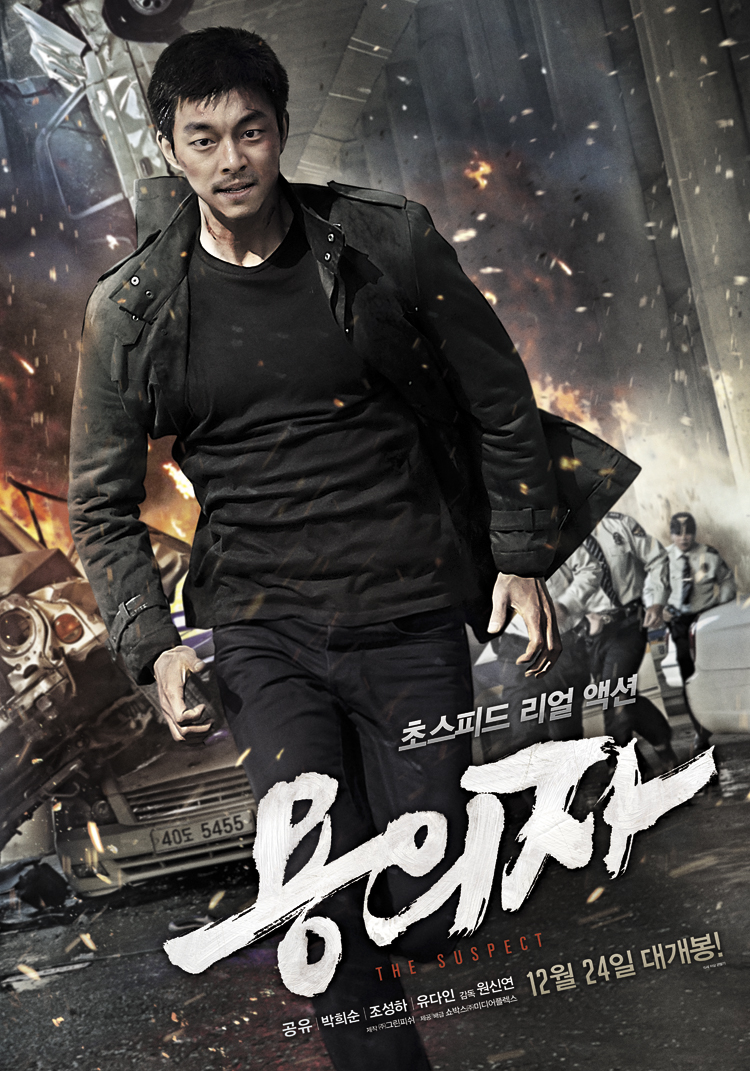
suspect posterNorth Koreans have become the go to bad guys recently, and so North Korean spies have become the instigators of fear and paranoia in many a contemporary political thriller. The Suspect (용의자, Yonguija), however, is quick to point the finger at a larger evil – personal greed, dodgy morals, and the all powerful reach of global corporations. Opting for a high octane action fest rather than a convoluted plot structure, Won’s approach is (mostly) an uncomplicated one as a wronged man pursues his revenge or redemption with no thought for his own future, only to be presented with the unexpected offering of one anyway alongside the equally unexpected bonus of exposing an international conspiracy.

Ji Dong-cheol (Gong Yoo) is former top North Korean asset now defected to the South and working as a driver for an important CEO. His boss thinks he ought to just go home, but Ji has a mission – he’s looking for a former friend, also defected, who was responsible for the deaths of his wife and daughter as part of a wide ranging purge following the accession of Kim Jong-un. Taking pity on him, the CEO eventually gives him the address of his target, adding that he hopes Ji can learn to forgive him (which seems unlikely), but is assassinated by other agents that same night. Arriving at the scene too late, Ji finds himself framed for the killing and charged with taking care of a secret message also in the CEO’s possession at the time of his death. Teaming up with a documentary filmmaker, Ji is now on the run and determined to find his former friend turned mortal enemy before the authorities catch up with him whilst also trying to work out what to do with his boss’ coded message.

Family, debts of honour, and bonds between men are at the centre of this fast paced thriller as Ji attempts to navigate this ever changing conspiracy torn between friends turned enemies and enemies who may become friends. His main adversary is a government agent, Min (Park Hee-Soon), whom he previously encountered during a mission in Hong Kong during which he made the decision to spare Min’s life after catching sight of a photo of his wife and son in his wallet. Min, however, is less than grateful as the failed mission greatly damaged his career prospects and so he has a personal grudge with Ji which he hopes to exorcise through arresting him. On the other side, Ji is also on the hunt for his former training buddy, Lee (Kim Sung-Kyun), whom he believes to have been responsible for the death of his own wife and child though later discovers that perhaps they have all merely been pawns in a much larger game.

The larger game appears to include worldwide arms sales by turns frustrated and conducted by North Korean agents. The conspiracy, however, is very much home grown in terms of its South Korean genesis but makes clear the complicated relationship between the two territories which is very much open to abuse by those who have access to both sides. The big bad turns out not to be the totalitarian regime with its constant purges and rigid enforcement of its political power, but the greedy and venal, power hungry petty officials of the democratic regime working in concert with big business.

Won has obviously drawn inspiration from the first Bourne film, offering several blatant homages including a long car chase referencing The Italian Job by proxy. His shaky cam aesthetic is perhaps overworked, but the fight scenes are undoubtedly impressive, anchored by the astounding performance of unlikely action star Gong Yoo – hitherto known as a sensitive leading man and frequent romantic lead. Having piled on the pounds, Gong is a credible vengeful presence apparently providing many of his own stunts including a strangely overblown sequence which sees him rock climbing bare chested only to emerge panting and glistening next to the flapping North Korean flag. Nevertheless, his near silent performance is a masterclass of physical acting, adding a much needed emotional dimension to the otherwise straightforward script which leaves little time for character development in between its admittedly impressive set pieces. Overlong yet moving at a rip roaring pace, The Suspect is a surprisingly well photographed action fest which manages to add a degree of pathos to its closing scenes even if failing to completely earn it whilst engaging in a series of subtle political allegories.


International trailer (English subtitles)
Memories of Murder (살인의 추억, Bong Joon-ho, 2003)

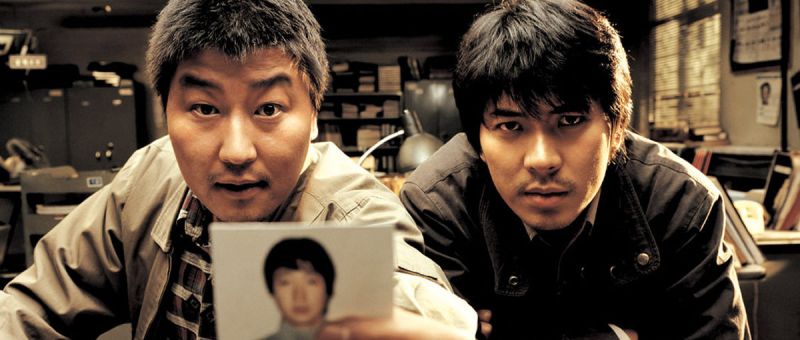
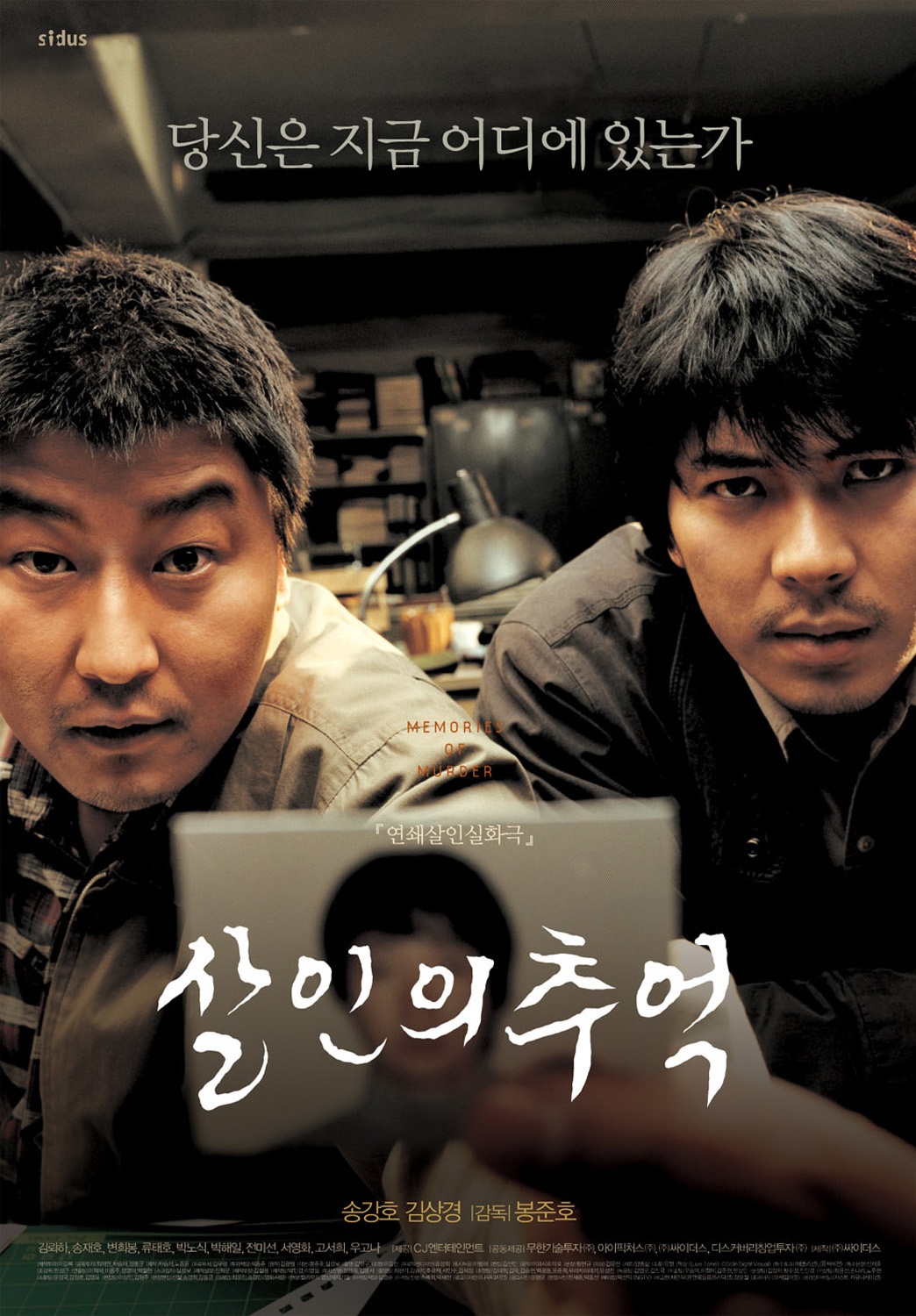
memories_of_murderThe Korea of the mid-1980s was a society in flux though you might not know it looking at the sleepy small town about to be rocked by the country’s very first publicised spate of serial killings. Between 1986 and 1991, at least ten women ranging in age from schoolgirls to grandmothers were murdered while the killer seemingly got away with his crimes, either dying, fleeing or perhaps getting arrested on other charges explaining the abrupt end to his crime spree. Bong Joon-ho’s fictionalised take on the case, Memories of Murder (살인의 추억, Salinui Chueok), is not so much interested in the killer’s identity, but wants to ask a few hard questions about why the crimes took place and why they were never solved.

In October of 1986, Inspector Park (Song Kang-ho) rides a junk cart out to a paddy field where a farmer has found the decomposing body of a woman blocking a drainage ditch at the edge of his land. Park quickly confirms that it is, in fact, the body of a murdered woman and tries to look unphased while a strange little boy distracted from his bug catching neatly echoes everything he says, playing policeman while the other children run roughshod over the crime scene trailing their butterfly nets behind them.

Needless to say Park and his bruiser partner, Cho (Kim Roe-ha), are ill equipped to handle a case of this magnitude, especially when it becomes clear that the murder is not an isolated episode. They are later joined by a more experienced officer from Seoul, Seo (Kim Sang-kyung), who is not used to country ways and finds it hard to adjust to their distinctly old fashioned and unscientific approach to law enforcement. Park, resentful at being saddled with a babysitter from the city and made to feel as if his small town skills aren’t good enough is determined to prove that he knows his stuff even as he begins to realise that perhaps policing really isn’t for him.

Park is the kind of policeman every small town has. Placing great faith in his detective’s instinct, Park is sure that he “just knows” who is naughty and who is nice. He asks suspects to look directly into his eyes so that he can assess whether they’re telling him the truth but it’s more of a party trick than anything else, looking into Park’s earnest gaze most suspects will crack. Early on Park’s boss gives him a test – two boys have been brought in and are patiently filling out forms. One caught the other in the middle of raping his sister, stopped him, and dragged him to the police station. Which one is the brother and which the rapist? Park feels sure he knows, and one could certainly make an educated guess based on the number and positioning of bruises on the suspects’ faces, but attempting to identify criminality based solely on perceived shiftiness or not liking the look of someone is crossing the line from professional instinct to ignorant prejudice.

The truth is that Park knows he’s no great shakes as a law enforcer. He was never meant to be – small town cops don’t generally do a lot of crime solving, they maintain order through the visible presence of authority. Thus he takes against city boy Seo because he instantly feels threatened by his urban sophistication and big city ways. Seo is perhaps not the best cop Seoul had to offer, but he is trained investigative techniques entirely alien to Park and Cho. The extent to which they’re out of their depth is obvious when they seem to know they’re supposed to secure the crime scene, but can’t, allowing valuable evidence to be carelessly destroyed.

Park’s investigative techniques involve making scrapbooks of shady local guys and browbeating suspects, eventually trying to railroad a young man with learning difficulties into confessing to the crime through a process of physical violence and mental attrition. Put out by Seo’s more concrete leads, Park’s only other contribution is to suggest they start looking for guys with no pubic hair which sees him waste more time hanging out in public baths and doing a lot of inappropriate staring. Wasting time is Park’s biggest crime though, amusingly enough, he and Seo end up in exactly the same place when Park consults a Shaman and Seo pursues a more rational line of enquiry lending credence to the idea that neither of them is really much better than the other.

What gets lost is that a woman, and then several more women, are dead and there is a man out there preying on wives, sisters, and mothers yet nothing much is being to protect them save reminding them to take care of themselves. Park wants the kudos of catching a killer but he barely thinks about the consequences of arresting the wrong man, it doesn’t seem to occur to him that the real killer would still be out there posing a threat to every woman in the town. Despite the fact that this is a small place where the victims are known to most people, there is little in the way of public grief or even sadness. The only sign of public feeling is in the small protest held outside the police station when a member of a local church is arrested.

The protest may be the key. In this strained era, Korea was reaching the end of its period under the control of a military dictatorship with the Olympics still a few years away and democracy the bright dream of brave radicals. Park and co. are the “friendly” face of the ruling regime, one of their secondary roles is doing the government’s dirty work. Hence when they really need extra manpower to chase a suspect they are denied it because everyone in the local area has been sent to suppress a protest in a nearby town. This is a scant few years after the Gwanju massacre, “suppression” means more than just standing around with riot shields designed to intimidate. Yes, there’s a crazed killer on the loose, but he is only a symptom and manifestation of a social order which has long since abandoned the idea of protecting its citizens in order to more effectively oppress them.

A woman can walk down a street in broad daylight and be terrified by a man trying to ask for directions because she has been taught to be afraid and knows the threat is real. A television news report on the trial of a policeman accused of violence and sexual assault reminds us why she can’t trust Park. Her government does not care about her. It could make more of an effort to solve these crimes, but it won’t, because the appearance of order is always preferential to its reality. The memories of murder run deep, they speak of all the stifled impulses of a life under a dictatorial regime. No one does anything because there is nothing to be done.

The identity of the killer is, in this sense, irrelevant – it is the society which is ultimately responsible for creating him and then for failing to put an end to his crimes. Park and Seo, eventually working together through a kind of cross pollination, think they’ve found their man but can’t prove it because Korea doesn’t have DNA testing facilities and they need to wait for results from an American lab. The evidence is circumstantial yet convincing, and one can’t be sure. The face of evil is “plain” and “ordinary”, much like your own. If you want to find the answer, start looking closer to home.


Original trailer (English subtitles)