The Stairway to the Distant Past (遙かな時代の階段を, Kaizo Hayashi, 1995)

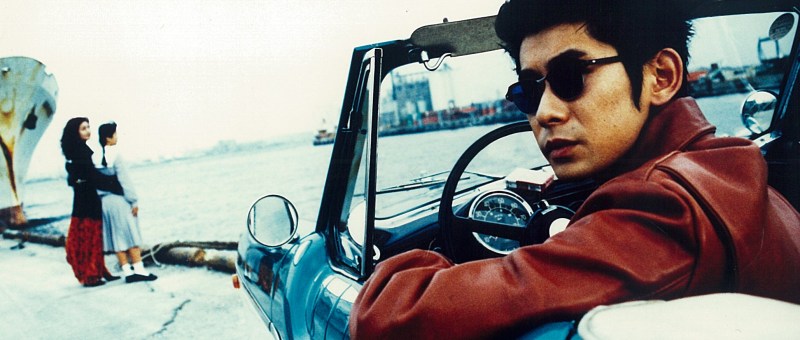
If The Most Terrible Time in My Life was channeling Nikkatsu Noir, Stairway to the Distant Past (遙かな時代の階段を, Harukana Jidai no Kaidan wo) sees Hayashi channel Fukasaku for a full-on confrontation with the legacies of the post-war era just as PI Maiku (Masatoshi Nagase) is forced to confront and attempt to cure the corrupted legacies of his own origins all while trying to save the city of Yokohama from drifting off to “another hell.” This time shooting in colour, Hayashi conjures a sense of mythic dread in the purple haze that hangs over a hidden city and the eerie blue of the path to get there.

But before all that, Maiku has fallen on such hard times his beloved car’s been repossessed and he’s stuck finding lost dogs for wealthy yet eccentric clients. Meanwhile, leader of New Japs gang Kanno (Shiro Sano) is running for political office while two of his underlings decide to freelance in order to take over the lucrative river trade which no one, not even the Taiwanese gang otherwise apparently in the ascendent, has ever dared to touch in fear of the mythic “White Man” who’s controlled the area since the post-war era with a ruthless efficiency that has seen any man challenge him not live to tell the tale. In the midst of it all is bigoted, and apparently pretty corrupt, policeman Nakayama (Akaji Maro) who first blackmails Maiku into helping him investigate a theft and smuggling ring on the river then apparently makes a deal with the White Man’s underlings who in turn blackmail him over his gambling debts but also claim they can make him chief of police if he chooses to play along.

Nakayama is a symbol of the rot in the contemporary city though he is in fact merely spineless, greedy, unpleasant and prejudiced. He asks Maiku for help because he’s hamstrung by the rules of policing which prevent him from doing the nefarious things he asks Maiku to do all of which leads to some pretty tragic consequences and a pair of orphaned children. The New Japs are perhaps a sign of further corruption still to come as Kanno tries to go legit as a politician but only as a means of increasing his influence and earnings. 

The river becomes a kind of nexus, the shore line between contemporary Japan and the “distant past” of the post-war era. Nakayama discovers that no one is technically policing it because it’s outside of everyone’s jurisdiction, while the White Man seems to have been in a position of unassailed power for half a century. As he later says, he’s the only one “living in the past” and perhaps quite literally so as Maiku has to transcend a literal stairway while guided by some kind of local prophet in order to travel to his world and finally risk his life to confront him. At the same time, Maiku is threatened by his own point of origin in the unexpected return of his mother, a now middle-aged stripper known as Dynamite Sexy Lily (Haruko Wanibuchi), who abandoned him and his sister and when he was just a child. 

Her name, along Maiku’s own, are perhaps hangovers from the Occupation era now even more out of place in a changed Japan. Making full use of the colour palate, Hayashi repeatedly flashes back to a pair of Lily’s red shoes as if signalling the unreality of the hidden city and the superimposition of past and present. His flashbacks to the late 1940s echo the cinematography of Fukasaku’s jitsuroku epics with their frenetic chases through black markets, but towards the conclusion the canted angles make it through to our era too and most particularly in the White Man’s lair, a blue-tinged industrial labyrinth that recalls the post-apocalyptic visions of a city still in ruins.

“Yokohama’s changed a lot,” Lily is told on her return and in fact several times after that. She likes it a little better now, the White Man no so much complaining that this city no longer has a place for him as if foreseeing his own eclipse and the oncoming end of an era. But then again, perhaps only the names have changed. All we’re left with is new gangsters with no code, and the White Man did at least stick to the rules even if he did so with ruthless authority. As for Maiku, his passage to the underworld seems to have brought him new clarity. His outfit now a little more sophisticated and mature, less an affectation borne of watching too many movies than an expression of himself. Nevertheless, Yokohama remains a small-town city, a cosy place with a generally friendly and easy going population albeit one with darkness hovering around the edges.


The Stairway to the Distant Past screens 18th/19th October at Japan Society New York.

Original trailer (no subtitles)
Escape from Japan (日本脱出, Kiju Yoshida, 1964)

Like many directors of his generation, Kiju (Yoshishige) Yoshida began his career at Shochiku working on the studio’s characteristically inoffensive fare before being promoted as one of their youth voices through which they hoped to capture a similar audience to that attracted by Nikkatsu’s Sun Tribe movies. Yoshida’s films may have spoken to youth but they were perhaps not quite what the studio was looking for nor the kinds of projects that he really wanted to work on, which is one reason why 1964’s Escape from Japan (日本脱出, Nihon Dasshutsu), an anarchic B-movie crime thriller of intense paranoia all maddening angles and claustrophobic composition, was his last for Shochiku, the final straw being their decision to change the ending without telling him and release the film while he was away on honeymoon. 

Set very much in the present, the film opens with a young man miming to American jazz which turns out to be part of the floor show being performed by the band on the stage below for whom he is a reluctant roadie. Tatsuo (Yasushi Suzuki) dreams of going to America to rediscover “real jazz” and subsequently bring it back to Japan. He has the strange idea that America is a true meritocracy where his talent will be recognised, unlike Japan where it is impossible for him to succeed because he is not particularly good looking or possessed of “star quality”. Feeling himself indebted to the band’s drug-addled drummer Takashi (Kyosuke Machida) for helping him get the roadie gig with the false promise of becoming a singer, Tatsuo agrees to help him commit an elaborate robbery of the “turkish bath” (low level sex services and precursor to the modern “soaplands”) where his girlfriend Yasue (Miyuki Kuwano) works. Only it all goes wrong. The guys kill a policeman during the escape, and the other hotheaded member of the gang becomes convinced that Yasue may talk now that they’ve got involved with murder so they should finish her off too by forcing her to take an overdose of sleeping pills. 

Absolutely everyone is desperate to escape Japan for various different reasons. Tatsuo because of his obsession with American jazz and the freedom it represents to him coupled with the sense of impotence he feels in an oppressive society which refuses to recognise his talent because he doesn’t look the part. He jokes with his next-door neighbour, a sex worker who has redecorated her apartment in anticipation of impressing the tourists arriving for the Olympics, that he envies women and wishes he could find a “sponsor” to take him to the States, but later can offer only the explanation that Japan doesn’t interest him when probed over why he was so desperate to leave. 

“Korea or anywhere else, it’s better than Japan” Yasue later adds, consoling Tatsuo as she informs him that their escape plan won’t work because all of the US military planes are being diverted to Korea to bring in extra help for the Olympics. Bundled into a van filled with chicken carcases as a potential stowaway, he discovers another escapee – a Korean trying to go “home”, or rather to the North (presumably having missed out on the post-war “repatriation” programs) where he claims there are lots of opportunities for young people only to lose his temper when Tatsuo explains that he wants to become a jazz singer. He doesn’t want decadent wastrels in his communist paradise and would rather Tatsuo not mess up his country. Yet they are each already dependent on the Americans even for their escape, making use of military corruption networks and getting Yasue’s friend’s GI squeeze into trouble through exposing his black-marketeering. 

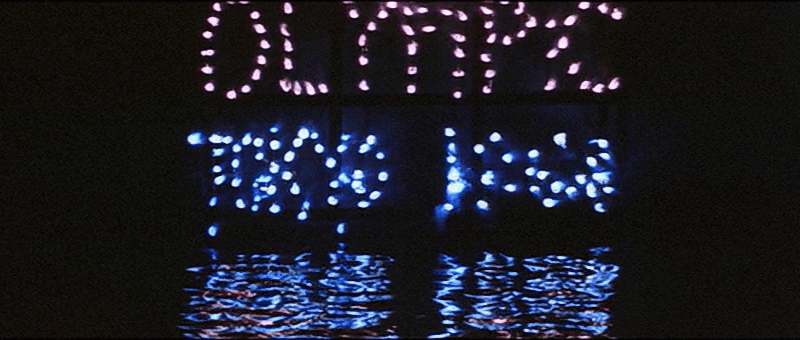
Tatsuo and Yasue find they have more in common than they first thought, both “deceived” by those like Takashi who turned out to be a feckless married man and father-to-be risking not only his own future but that of his unborn child solely to fuel his escapist drug habit (which was perhaps the reason for the lengthy hospital stay from which he had just returned). Yasue was just trying to save up enough money to open a hairdresser’s in her hometown, but Takashi told her he was a “famous jazz drummer” and presumably sold her the same kind of empty dreams as he did Tatsuo. Giving up on her own future, realising that even in America the sex trade is all that’s waiting for her, Yasue tries to engineer Tatsuo’s escape but he, traumatised by his crimes, descends further into crazed paranoia, eventually finding himself right in the middle of the Olympics opening ceremony. This is event is supposed to put Japan back on the map as a rehabilitated modern nation, but perhaps all it’s doing is creating an elaborate smokescreen to disguise all the reasons a man like Tatsuo and a woman like Yasue might want to be just about anywhere else. Yoshida seems unimpressed with the modern nation and its awkward relationship with the Americans, perhaps a controversial point in the immediate run up to the games. Shochiku neutered his attempt to depict a man driven to madness by the impossibilities of his times, but a sense of that madness remains as Tatsuo finds himself on the run and eventually suspended neither here nor there, trapped in a perpetual limbo of frustration and futility.


Original trailer (no subtitles)

The Ballad of Narayama (楢山節考, Shohei Imamura, 1983)

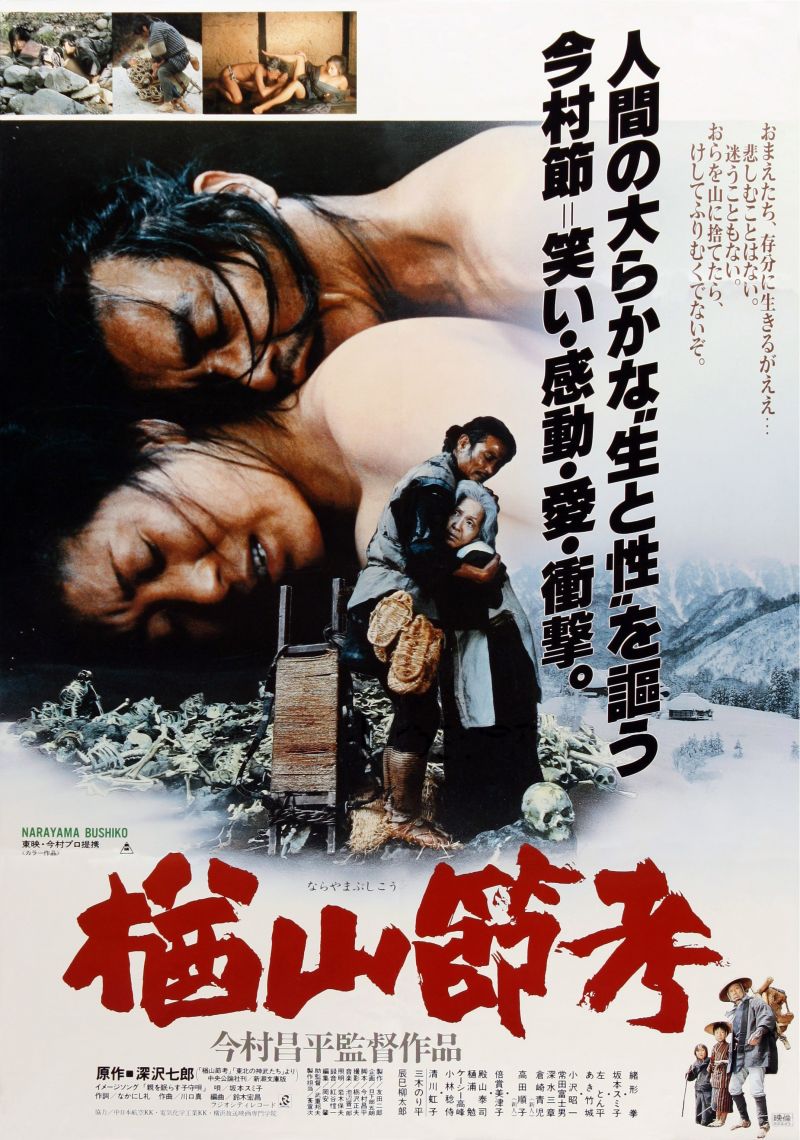
ballad of narayama imamura 1983 posterWhen Keisuke Kinoshita decided to dramatise The Ballad of Narayama (楢山節考, Narayama Bushiko), adapted from a recent novel inspired by the ancient legend of “ubasute”, he recast it is as myth – a parabolic morality play adopting the trappings of kabuki to tell a timeless tale of transience and sacrifice. As much as Kinoshita praised the heroine’s kindness and altruistic sense of duty, he also questioned her failure to question the cruel and arbitrary social codes which defined her life, sacrificing her deep familial love for the cold austerity of religious reward. Shohei Imamura, slightly younger than Kinoshita, had also read the novel when it came out though he was not sufficiently progressed in his career to have considered adapting it for the screen. Unlike Kinoshita’s highly stylised approach, Imamura opts for his trademark sense of realism, exposing nature red in tooth and claw as he attempts to restore rural earthiness to the rarefied cinema screen.

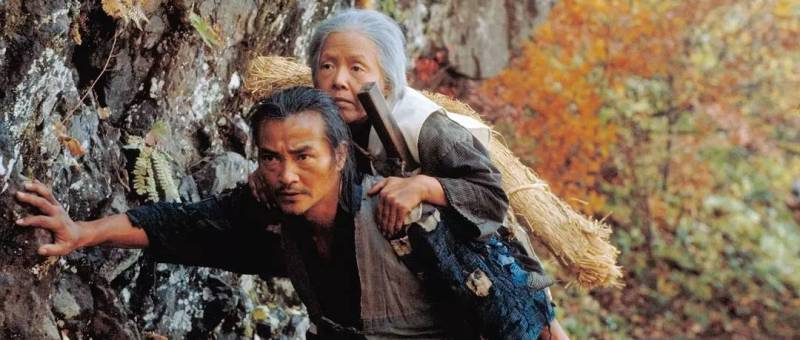
Deep in the mountains, a small village does what it can to survive in harsh terrain. 69-year-old Orin (Sumiko Sakamoto) is as strong as they come but she is preparing to meet her end. In the villages of these parts, men and women of 70 are carried by their children to summit of Mount Narayama where they are left as a sacrifice to the god, praying for snow to hasten an otherwise long and drawn out death. Orin’s husband disappeared 30 years ago, the laughing stock of the village for his sentimental aversion to carrying his own mother up the mountain, and her son, Tatsuhei (Ken Ogata) seems equally reluctant to accept that Orin will making her own journey as soon as the next snows arrive.

Existence is indeed cruel. The custom of “obasute” or “throwing away” one’s old people, originated because of a lack of food. There not being enough sustenance to support a large population, the old sacrifice themselves in the name of the young. Life is cheap and of little consequence. Tatsuhei’s simple-minded younger brother, Risuke (Tonpei Hidari), notices the body of a newborn baby emerging from the melting snow to the edge of his rice paddy but the sight does not disturb or sadden him – he is annoyed that someone has “dumped” their “rubbish” on his land. Baby boys, oddly, are worthless – just another mouth to feed until it becomes strong enough to work, but baby girls are a boon because they can be sold. Orin herself sold her baby daughter in desperation following a bad harvest, and when the salt seller calls in unexpectedly Orin is at pains to tell him they’ve still not made a decision as to whether to sell her granddaughter who has been left without a mother following the death of Orin’s daughter-in-law in a freak accident.

She needn’t have worried however because the salt seller is bringing good news – a new wife for Tatsuhei, meaning Orin can make her final journey with an unburdened heart knowing that the household will be taken care of. Tamayan (Aki Takejo), a kind and cheerful woman much like Orin herself, fits right in despite the objections of Tatsuhei’s teenage son, Kesakichi (Seiji Kurasaki), who has got his girlfriend pregnant and wants to “marry” her – bringing not one but two extra mouths into his household. Orin loves him dearly, but all Kesakichi can do is make fun of his granny for still having all her teeth and resentfully enquire if she isn’t needed somewhere up a mountain sometime about now.

Kesakichi’s coldness and selfishness is contrasted with the goodness and warmth of Orin and her son. Hardship, far from bringing people together in their shared struggle, has made beasts of all. Imamura splices in frequent shots of animals copulating or feasting on each other – rats gnawing on the body of a snake giving way to a snake swallowing the body of a twitching grey mouse. Yet it is nature that will win in the end. Early on the village men chase a hare in the snow, Tatsuhei shooting it dead, only for an eagle to swoop down and make off with the prize. On the mountain, strewn with bones, a host of flapping crows emerges from a battered rib cage. 

Catching a thief is no different to catching a hare. Convinced that the thief’s family is a curse on the village, the villagers determine that they must all be eliminated – the roots of a poisoned tree must be burned away. Breaking into the home, friends and former neighbours tie up and kidnap an entire family, burying them alive and then redistributing all their worldly goods in “recompense” for what they’d “lost”. The cycles of loss and redistribution continue, as Tatsuhei observes finding Orin’s belongings draped around other shoulders. Kesakichi, having lost one lover, quickly takes another forgetting the first while Tatsuhei struggles to come to terms with the loss of his mother and the knowledge that someday he too, and Kesakichi, and the sons of Kesakichi, will make this same journey to this same spot.

Kinoshita’s secondary concern had been with the cruelty of the custom and the mechanisms of social conformity which enforced it, but Imamura almost seems to be in agreement with the villagers, finding horror but also beauty in the sacrifice of Orin who accepts her fate with transcendent beatification and willingly sacrifices herself to the mountain gods. The world is cruel, and tender. A son’s acceptance of his mother’s sacrifice becomes the greatest expression of a love he must destroy by honouring.


Original trailer (no subtitles)