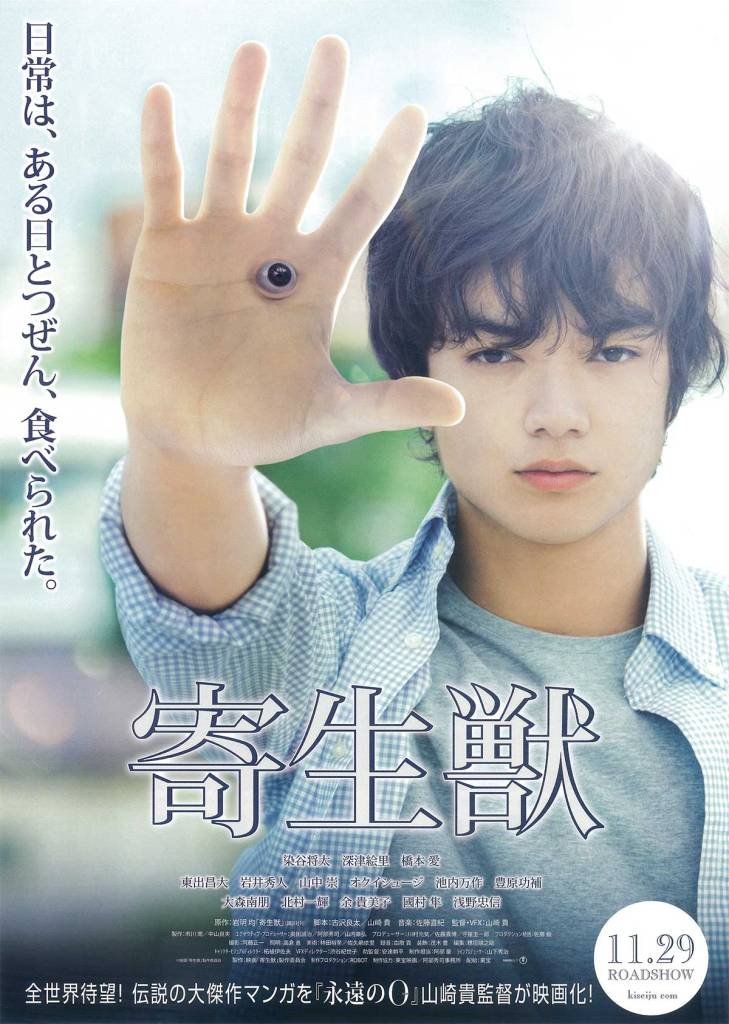
Parasyte The Movie Part 1 (寄生獣, Takashi Yamazaki, 2014)

parasyte part oneReview of Takashi Yamazaki’s adaptation of Hitoshi Iwaaki’s manga Parasyte – Parasyte: The Movie Part 1 (寄生獣, Kiseiju) first published by UK Anime Network.


Humans – are we the biggest threat to our planet and ultimately our own survival? If the world population were halved, would we also halve the number of forests that are burned and the damage that we’re doing to our natural environment? These thoughts run as a voice over beginning the full scale blockbuster adaptation of Hitoshi Iwaaki’s classic manga which was also recently adapted into a critically acclaimed anime. The Parasyte of title most obviously refers to the extraterrestrial microbes which are climbing into the driving seat of an unsuspecting host’s brain with nothing less than the colonisation of our entire species on their “minds”, yet, is it we ourselves who are the real parasites feasting on the corpse of our dying planet? Parasyte is that rare blockbuster treat that is content to give us man-eating, shapeshifting, monsters and gore filled destruction but also wants us to dig a little deeper into our own souls at the same time.

Shinichi Izumi’s (Shota Sometani) mum (Kimiko Yo) probably told him not to sleep with his headphones on but luckily they’re about to save his life as a weird little bug tries to crawl into his ears but finding them blocked opts for the arm instead. Wrapping the cord around his elbow tourniquet style, Shinichi is able to stop the bug’s progress but the parasite has taken root and Shinichi is horrified to find his right hand is no longer his own but is now controlled by a dispassionate alien that eventually names himself “Migi”.

Shinichi and Migi develop an odd kind of partnership born of their mutual dependency which is threatened only by the presence of other Parasytes who have successfully infiltrated a human brain and can blend in with the general populace (aside from their cold and robotic natures). To his horror, Shinichi discovers a new teacher at his school is actually a Parasyte stooge who recognises the “research” potential of a hybrid team like Shinichi and Migi. Becoming very keen on “experiments” Ryoko Tamiya (Eri Fukatsu) has also mated with one of her fellow Parasytes in the hopes of exploring what will happen with the birth – will it be purely a human child seeing as it’s born of two human bodies or will something of the Parasyte get through? However, Ryoko’s “network” of Parasytes aren’t all as committed to scientific research as she is and Shinichi and Migi quickly find themselves becoming humanity’s last line of defence against the invading creatures.

Shinichi is the teenage lead of the picture but in this first part at least it seems to be Ryoko leading the show. She gives us the original voice over and it’s her burgeoning motherhood that gives the film its clearest ideological standpoint. As the dispassionate Ryoko comes to develop the beginnings of maternal pangs and a desire to ensure the survival of her child (or perhaps just her “experiment”), so Shinichi finds his humanity being erased by the parasitical “child” he is gestating in the form of Migi. At the same time Migi begins to take on a protective mentality towards his host which may be more than simple self preservation particularly after a traumatic near death experience bonds the two even tighter together, in a biological sense at least.

Though the film obviously references former genre classics, in particular Invasion of the Bodysnatchers with its difficult to detect pod people, it steers clear of the “red scare” inspired sense of paranoia and the feeling of intense mistrust that exists even between supposedly good friends. Migi is able to sense (to a degree) his own kind making the presence of potentially dangerous Parasytes easier to detect but the fact that the Parasytes are able to colonise and use the form of someone all too familiar to confuse their enemies restores something of their power to lurk unsuspected in the shadows.

All this seems to suggest that the big screen live action adaptation of Parasyte would be a fairly serious affair yet the tone is often lighthearted, maintaining the darkly humorous buddy comedy side of the relationship between normal teenager Shinichi and the almost omniscient yet strange Migi. Migi, as played by veteran actor Sadao Abe who is perhaps most closely associated with comedic roles, has a thirst for a different kind of “brains” than his fellow Parasytes and quickly devours any and all knowledge he can get his “hand” on though he lacks the emotional intelligence to make sense of everything he learns and thus is dependent on his host Shinichi to get a fuller understanding of the human world.

Like the blockbuster mainstream films of recent times Parasyte boasts generally high production values on a par with any Hollywood movie though it has to be said that the film is often undermined by unconvincing CGI. However, this is mainly a problem with the action scenes and Migi himself is generally well integrated into the action and oddly adorable to boot. In some ways it might have been interesting to see a fully “in camera” take on the effects ala Cronenberg whose spirit is most definitely evoked throughout the film which also harks back to ‘80s body horror with its synth score highlights and generally gruesome scenes of carnage. Though it’s hard to judge the overall effect from just this first instalment of a two part film which drops a decent number of threads to be picked up in part two, part one at least serves as a tantalising appetiser which only heightens expectations for its final conclusion.


Parasyte: The Movie Part 1 is currently available on DVD and blu-ray in the UK from Animatsu Entertainment with Part 2 to follow in June 2016.
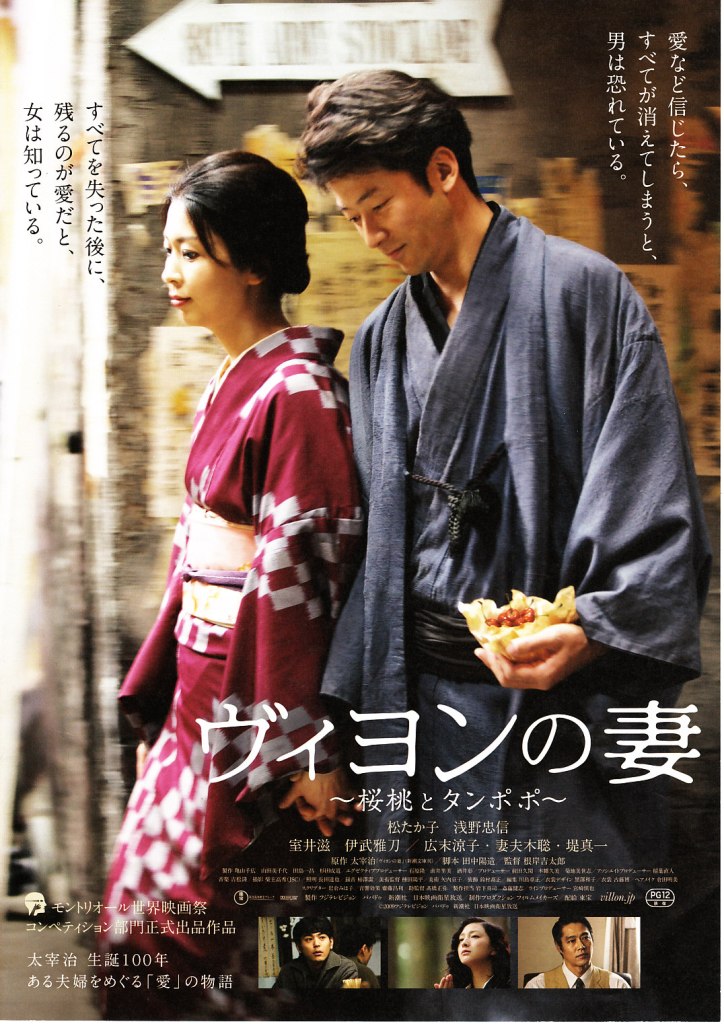
Villon’s Wife (ヴィヨンの妻 〜桜桃とタンポポ, Kichitaro Negishi, 2009)

Villon's Wife2009 marked the centenary year of Osamu Dazai, a hugely important figure in the history of Japanese literature who is known for his melancholic stories of depressed, suicidal and drunken young men in contemporary post-war Japan. Villon’s Wife (ヴィヨンの妻 〜桜桃とタンポポ, Villon no Tsuma: Oto to Tampopo) is a semi-autobiographical look at a wife’s devotion to her husband who causes her nothing but suffering thanks to his intense insecurity and seeming desire for death coupled with an inability to successfully commit suicide.
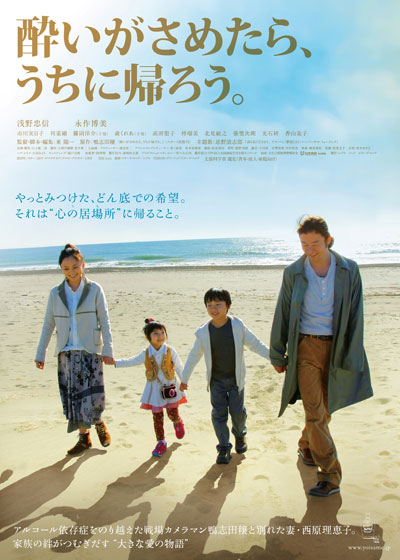
Beginning in the immediate post-war period of 1946, Sachiko (Takako Matsu) is a fairly ordinary housewife with a young son who generally waits around the house for her husband’s return. Only, she’s married to one of the most brilliant writers of the age, Joji Otani (Tadanobu Asano), whose book on the French poet François Villon is currently a best seller. Despite his obvious literary talents, Otani is a drunkard who spends most of his time (and money) in bars and with other women. When he crashes home one night only to be pursued by two bar owners who reveal that he ran off with their takings (around 5000 yen), Sachiko is not exactly surprised but still embarrassed and eventually takes matters into her own hands by volunteering to offer herself as a “hostage” by working at the bar until the debt is repaid.

“Men and women are equal now, even dogs and horses” says one customer, impressed with this sudden arrival of a beautiful woman in a low life drinking spot. To her own surprise, Sachiko actually enjoys working at the bar, it gives her purpose and proves more interesting than being stuck at home waiting to see what her drunken fool of a husband has got up to next. She’s good at it too – Sachiko is a beautiful and a fundamentally decent and kind person, in short the sort of woman that everyone falls a little bit in love with. That said, she isn’t a saint. She’s perfectly aware of the power she is able to wield over men and is unafraid to make use of it, though only when absolutely necessary.

Otani himself is a fairly pathetic figure. He may be a great artist but he’s a hollow human being. He admits the reason for all of his vices is fear – he’s a afraid to live but he’s also afraid to die. He seems to love his wife, though he’s insecure about losing her and dreads the embarrassment involved in becoming a cuckold. So afraid to face the possibility of failure, Otani satisfies himself in an underground world of drunks and easy women rather than facing his own self loathing as reflected in the faces of his unconditionally loving family.

Perhaps because Villon’s Wife is a commemorative project, the film has been given the prestige picture treatment meaning the darker sides of Dazai’s original novella have been largely excised. The chaos of the post-war city with its starving population, soldiers on the streets and generalised anxiety is all but hidden and some of the more serious travails Sachiko undergoes in devotion to her husband as well as Otani’s tuberculosis (from which Dazai also suffered in real life) have also largely been removed. What remains is the central picture of a self destructive husband and the goodly wife who’s trying to save him from himself but risks her own soul in the process.

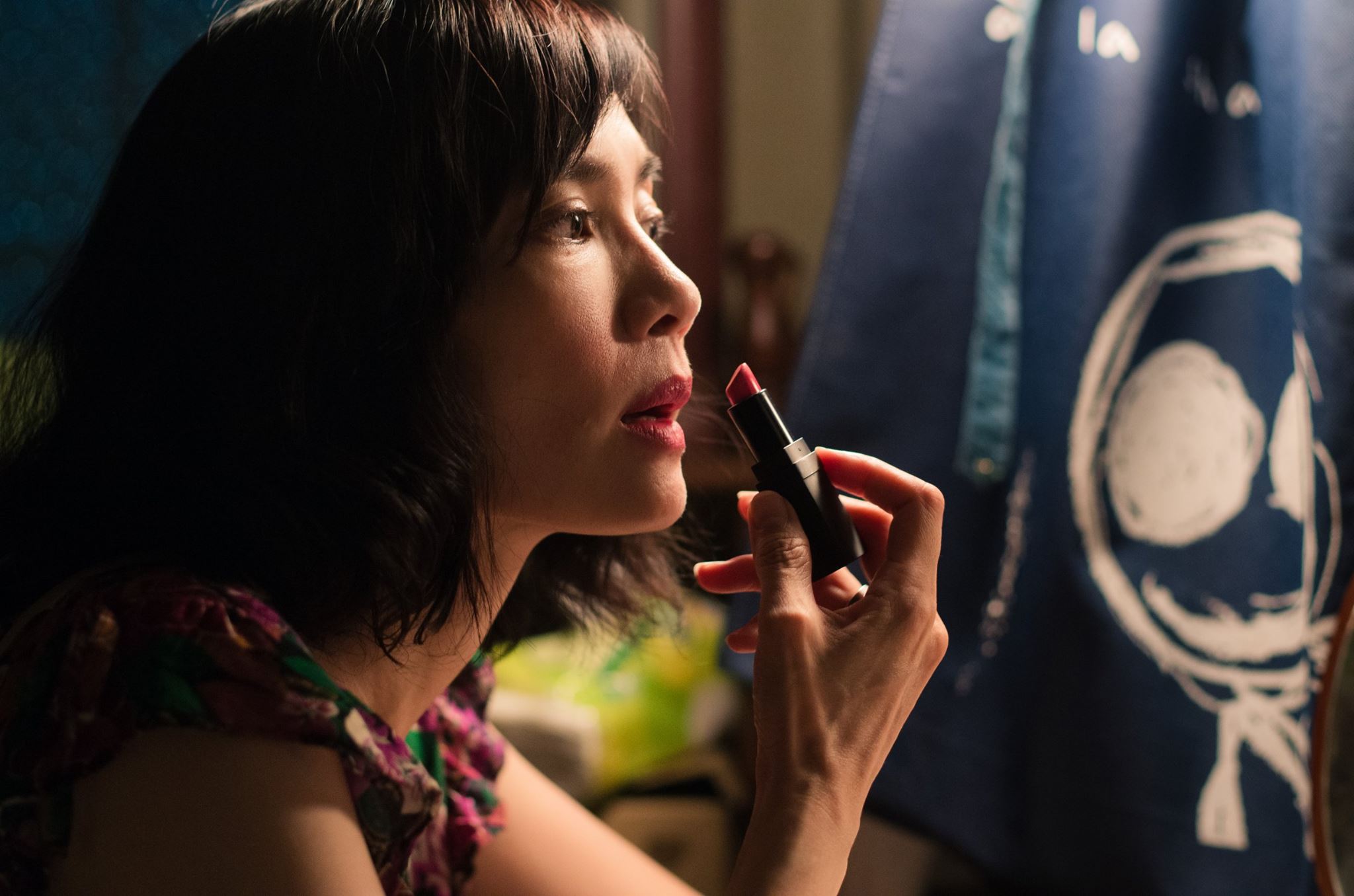
The one spot of unseemliness of post-war life that the film lets through is in a brief scene which features a group of pan pan girls hanging around ready to try and snag some passing GIs. Sachiko buys some lipstick from them to use in attempt to convince an ex who is also a top lawyer to try and help her husband after his latest escapade lands him in jail on a possible murder charge. After visiting him, Sachiko wanders out slightly dazed to see the pan pans atop a military jeep cheerfully waving and shouting “goodbye” in English. Sachiko is confused at first but eventually shouts “goodbye” back in a way which is both excited and a little bit sad, perhaps realising she is not so different from them after all. Finally she wipes the lipstick from her face and leaves the small silver tube behind where the pan pans were sitting, hoping to bury this particular incident far in the past.

In actuality the pan pan girls are depicted in a fairly matter of fact way rather than in the negative light in which they are usually shown, just another phenomenon of occupation. At the end of the film Otani calls himself a monster whilst acknowledging that he’s a terrible father who would steal the cherries from his own son’s mouth. Sachiko replies that it’s OK to be a monster – as long as we’re alive, it’ll be alright. Oddly for someone so suicidal, this fits in quite well with Dazai’s tenet of embracing the simple gift of a dandelion. The film ends on an ambiguous note in which there seems to have been some kind of restoration but it’s far from a happy one as the couple remain locked in a perpetual battle between light and darkness albeit with the balance a little more equalised than it perhaps was before.


The R3 Hong Kong DVD release of Villon’s Wife includes English subtitles.

Wandering Home (酔いがさめたら、うちに帰ろう, Yoichi Higashi, 2010)

wandering homeAlcoholism is not a theme which has exactly been absent from the history of cinema. From the booze drenched regret of Days of Wine and Roses to the melancholic inevitability of Leaving Las Vegas and the disdaining irony of Barfly, there has been no shortage of unsympathetic portrayals of drunkenness when it comes to the silver screen. Yoichi Higashi’s Wandering Home (酔いがさめたら、うちに帰ろう, Yoi Ga Sametara, Uchi Ni Kaerou) walks something of a middle road here as it embraces the classic “issue drama” mould but also aims for a naturalistic character study in adapting the true life memoirs of photojournalist Yutaka Kamoshida (husband of well known mangaka Reiko Saibara).
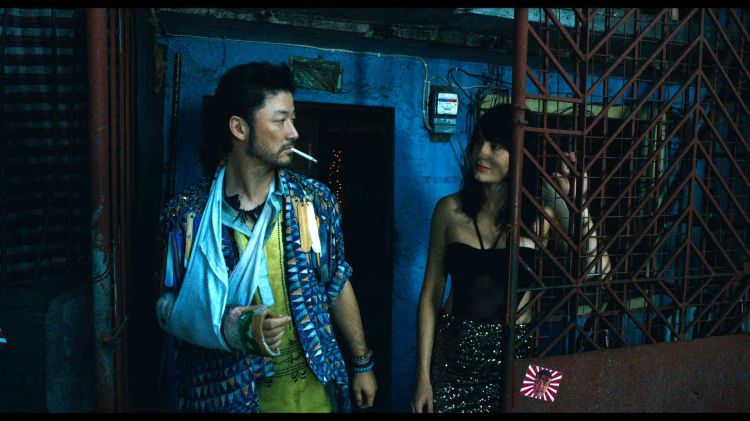
The film begins with a touch of magical realism as Tsukahara (Tadanobu Asano) literally falls off his barstool and has a vision of his wife and two children urging him to get up. Of course, they aren’t “real”. Tsukara lives with his mother after his marriage to a successful mangaka broke down due to his alcoholism. Returning home and ignoring his mother’s advice to get something to eat, Tsukarahara has another drink whilst swearing that this time he’ll be sober when he sees his kids but shortly after retreats to the bathroom to vomit where he experiences a massive haemorrhage and is taken to hospital. Things have already gone too far, he’s told he’s lucky to be alive and the next time this happens he will die.

Swearing to finally come off the booze, Tsukahara goes home but is immediately tempted by a side dish in a restaurant which contains alcohol. He makes the wise choice not to buy the vodka in the off-licence but eventually talks himself into buying beer which he drinks right away and then falls over and hits his head on the way home. His ex-wife, Yuki (Hiromi Nagasaku), and his long suffering mother have gone through this too many times before to even be disappointed. Eventually, they ship Tsukahara off to a residential facility in the hope that they can finally help him beat the booze for good.

Wandering Home is inspired by the real life story of a photojournalist which has also inspired a few other films including the following year’s Kaasan which told the same story from the point of view of Kamoshida’s mangaka wife. Therefore, the ending of this story might perhaps be known to you already but needless to say it isn’t an altogether happy one. The film doesn’t go into the reasons Tsukahara started drinking save for emphasising that it’s rarely one root cause that starts someone on the road to alcohol addiction. Tsukahara’s father had been an alcoholic and had also behaved violently in the home – something which Tsukahara despised and yet he ultimately became exactly like his dad. Having started to drink as a young teenager he drifted into an aimless life and then witnessed a number of traumatic events in his career as a photojournalist which also left their mark on him.

Though the film is never shy about the disruption Tsukahara’s drunkeness causes to his family, it mitigates the effects by casting them as surreal episodes such as the only scene in the film where Tsukahara is shown to be violent towards his wife in which another soot covered version of himself emerges from a zipper in his back to shout abuse and trash the place as his children retreat in horror to their bedroom. It’s not Tsukahara, it’s the alcohol, the film tries to say but actually lays the message on a little thick and often neglects the trauma that his behaviour is, in turn, causing to his own son and daughter.

That said, there is remarkably little animosity between Yuki and her ex-husband despite the way that he has behaved. Yes, the pair are divorced but Yuki is called right away when Tsukahara is taken to hospital and when she brings the children to visit him the couple talk warmly with no bitterness or recrimination. The children too are happy to see their father and do not seem afraid of him in any way at all.

Higashi does, however, fall into standard “issue drama” tropes and perhaps spends too much time exploring the rehab facility where Tsukahara is sent for treatment. Though hearing something of the other characters’ paths to alcohol dependency is enlightening, it can’t help but feel more like a public information film at times than the affecting character drama it should be. Small touches like Tsukahara’s longing for something a simple as being able to enjoy curry again like everyone else on the ward or his more frequent difficulties of being able to distinguish a hallucination from something he’s doing for real lend weight to the central story but they can’t quite save it.

Higashi’s tone is generally straightforward and mostly avoids melodrama or sentimentality except during the film’s ending. This sounds like a strength but turns out to be a weakness as something about Tsukahara’s plight never quite grabs the heartstrings in the way it seems to want to. The film’s unsentimental depiction of alcohol dependency and one man’s struggle to try and regain his place within his own family is an admirable one, but Wandering Home ultimately falls far short of its intended destination.


The Japanese dvd/blu-ray release of Wandering Home includes English subtitles!

Unsubtitled trailer:

Ruined Heart: Another Love Story Between a Criminal & A Whore

Ruined Heart
100% did not notice that sticker while I was watching the film…

Just “another love story between a criminal and a whore” –  so subtitles maverick Filipino film director Khavn his latest effort, Ruined Heart (Pusong Wasak: Isa na namang kwento ng pag-ibig sa pagitan ng kriminal at puta), though like much in the film you could read quite a lot more intro those few words than their subtext suggests. Light on conventional narrative and almost dialogue free, Ruined Heart is the deconstruction of the classic B-Movie. We have our noble, broken hearted outlaw and our damaged princess in need of rescue but what we’re denied is the sense of moral righteousness that generally pervades in a B-Movie and particularly in a film noir. The picture Kavn paints is of a hellish world where violence reigns and love will always be defeated.

There’s little point trying to tease out the plot bar the above ideas. What we are presented with at the beginning of the film is our dramatis personae – archetypes of this modern myth: The  Lover (Elena Kazan), The Criminal (Tadanobu Asano), The Friend (Andre Puertollano), The Whore (Nathalia Acevedo), and The Pianist (played by Khavn himself), each profiled against a butterfly patterned curtain neatly echoing Branded to Kill. Our hero, the Criminal, bonds with the Whore after offing one of her Johns, but their love is not to last after the Criminal decides to help The Friend rescue his Lover from the Godfather.

While all of this is going on we’re also treated to a far more surreal scene where the pianist reads out a street poem consisting of the repeated phrase “I am the poem of the world” before taking part in a bizarre ritual where he appears to resurrect the Godfather (Vim Nadera) who is now introduced for the first time. Is the pianist the god of this strangely operatic landscape, presiding over this violent world of song? For someone with such an elaborate introduction he makes relatively little impact thereafter. Is this hell, are we all dead already or merely doomed to relive these old stories over and over again to the point where names and language no longer have currency?

That said, there is something genuine to be found here in this otherwise cold landscape. The Criminal and The Whore find love against the odds though their romance is soon frustrated by the harshness of their world. They have fleeting moments of joy where they drink and dance and make music of all kinds. However, something is coming for them and however hard you try to escape there are things you cannot outrun.

Playing out more like an avant-garde opera than a conventional film, Ruined Heart offers little in the way of concrete explanations. Dripping with sometimes impenetrable symbolism the film paints an eerie, dream-like vision that often proves impossible to decode and like all the best poems, there are a hundred different ways to read it.

The score itself is an eclectic assault of catchy ’60s inflected broken heart ballads and electro pop, often repeating the same song in different arrangements (an apt stylistic choice given the nature of the film). Composed by a diverse collection of artists including French/German outfit Stereo Total who contributed to Third Window Films’ previous release pink musical Underwater Love, and Bing Austria & the Flippin’ Soul Stompers who provide the film’s catchy theme song, the musical element becomes the driving force of the film.

Shot with a youthful yet melancholy verve by Christopher Doyle, Ruined Heart is a high energy experience that proves difficult to digest, particularly on a first viewing. However, its extremely rich layers of symbolism and subversion of common archetypes lend it a mystifying and intriguing atmosphere that continues to fascinate long after the credits roll. More felt and experienced than understood, Ruined Heart may prove a difficult sell for some but comes bearing gifts for those that long to find them.


Ruined Heart is available on blu-ray in the UK now from Third Window films in a limited edition package which also includes a soundtrack CD (highly recommended for the CD alone). The blu-ray disc also includes Khavn’s short film with the same title and a similar theme (though filmed in an entirely different style and with a different cast).

First saw the film a couple of months ago and still can’t get this song out of my head.

Trailer for the film


Taiwanese Cinema About to Hit the UK in a Big Way

exit 1This is kind of another link post, but bear with me! First up Ang Lee’s first three films finally became available on DVD in the UK. Cunningly titled The Ang Lee Trilogy, you can now feast your eyes on Pushing Hands, The Wedding Banquet and Eat Drink Man Woman for the first time. Feast is the right word too as all the movies feature food in a very prominent way so make sure you have the proper supplies arranged before you sit down to watch them. You can read my review of the trilogy over at UK Anime Network. They’re all great, but I particularly like The Wedding Banquet because it’s just so funny!

Here’s an awful old school trailer for The Wedding Banquet (the film is better than this, I promise).

OK, moving on you can also pick up the award winning debut from Chienn Hsiang EXIT on DVD and VOD courtesy of Facet Films. I reviewed the film when it played at the Glasgow Film Festival and you can read that at UK Anime Network too. I also had the opportunity to interview the film’s star Chen Shiang-Chyi while she’s over here shooting The Receptionist. Contrary to expectations, Chen Shiang-Chyi was actually very chatty and super nice so the only reason the interview seems a little short is because she gave very long and detailed answers! You can checkout the interview over at UK Anime Network.

Which brings me on to the upcoming Hou Hsiao-Hsien season at the BFI which begins tomorrow. Pretty much everyone is expecting his new movie The Assassin starring his regular muse Shu Qi to appear in the film festival (it would be really strange if it didn’t right?) and I for one am really looking forward to seeing it.

Hou Hsiao-Hsien will be appearing in conversation at the BFI on 14th September (tickets apparently still available) ahead of a screening of one of his greatest films, The Time to Live and the Time to Die. I was lucky enough to see this one during the BFI’s extended season of Chinese films last year and though it’s not always an easy watch, Hou’s biographical tale of mainland refugees and their Taiwanese offspring is nevertheless a moving and fairly universal coming of age tale.

I’d also recommend Dust in the Wind 

and A City of Sadness

but I just have to post this scene from Three Times again because I love it so much

They’re also showing Hou’s Ozu tribute and Japanese set Café Lumière starring Tadanobu Asano if that’s more your speed.

That’s a lot of Taiwanese cinema all of a sudden right? It’s a good thing though! If you still want more I’ll direct you to the films of Edward Yang as mentioned in Chen Shiang-Chyi’s interview:

Yi Yi: A One and a Two

No trailers for a Confucian Confusion or A Brighter Summer Day though – both are a little more difficult to get hold of but worth the effort. A Confucian Confusion has a great Rom-Com style ending (though not as good as Comrades: Almost a Love a Story which has the best ending of any film, ever, but I digress) and A Brighter Summer Day which is an epic at four hours long but a total heartbreaker.


My Man 私の男 (Kazuyoshi Kumakiri, 2014)

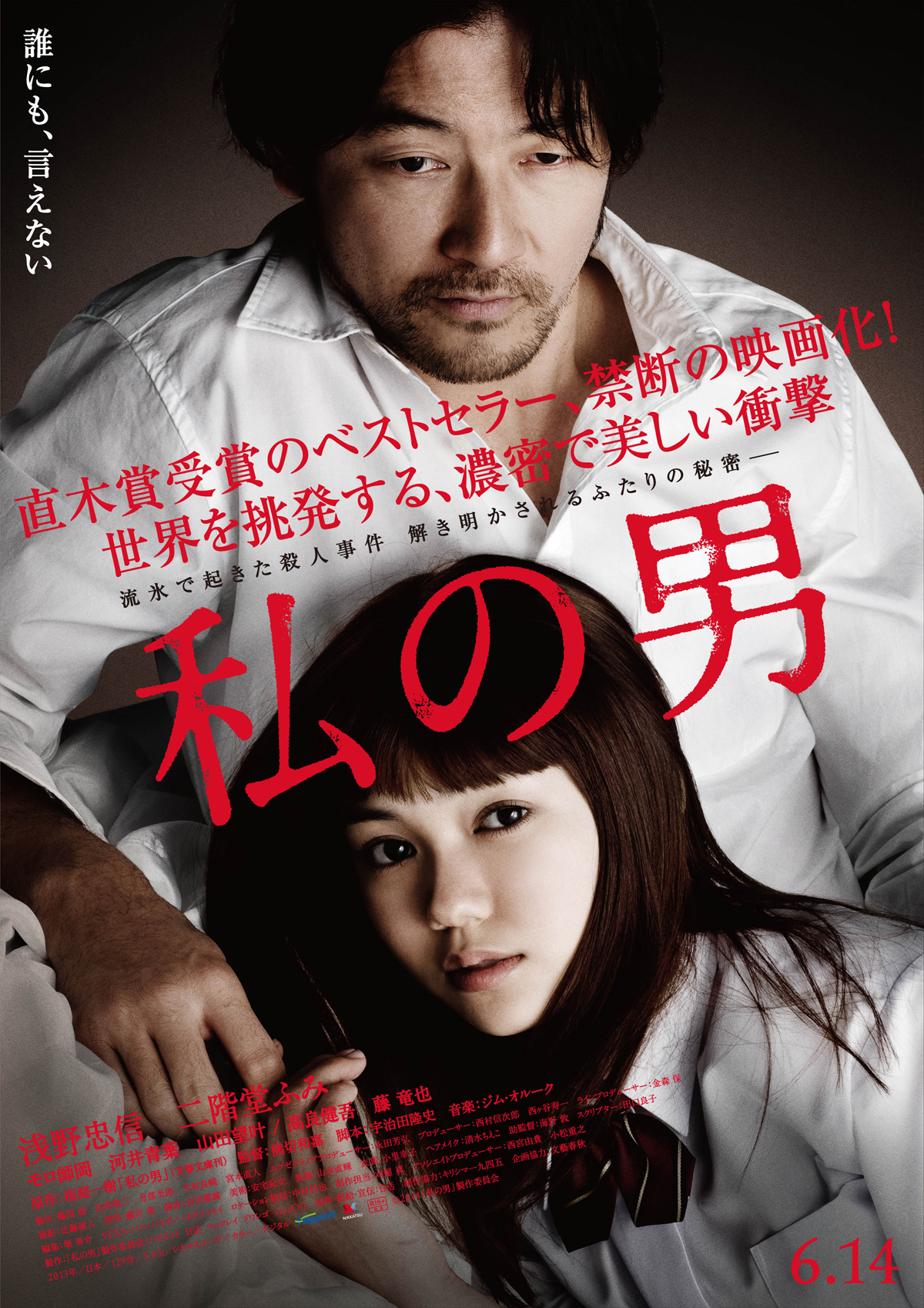
162276_02Based on the Naoki Prize winning novel by Kazuki Sakuraba, My Man tackles the difficult subject of a quasi-incestual “love” affair between a young orphaned girl and the “distant” relative who adopts her as his “daughter”. Though this taboo subject has never been far from Japanese screens (find me an art film from the ’60s which doesn’t involve incest in some way), My Man dares to examine in it in all its realistic muddiness and is marked by nothing so much as its raw intensity. Brought to the screen by Kazuyoshi Kumakiri whose last picture Summer’s End chronicled the romantic and existential dilemmas of a woman approaching middle age, My Man is a disturbing and unsettling film which poses a fair few unpleasant questions about the nature of familial and romantic relationships.

The film begins with a young girl, Hana, crawling away from a scene of intense devastation. Finally ending up at a refugee centre, it seems that Hana’s entire family have been killed in a natural disaster. Creeping back to her house, Hana is discovered by a rescue worker, Jungo, who by coincidence happens to be a distant relative of hers. Asked who the little girl is, Jungo immediately asserts that she is his daughter and there after claims her as his own. The pair continue to live together in a small, seaside Hokkaido town until Hana reaches middle school age at which point their relationship changes and the lines between father/daughter and husband/wife become exceedingly blurred. Only growing in intensity, the two will eventually even go so far as to kill to protect their illicit relationship which eventually takes them to the comparatively more anonymous Tokyo but what the outcome of their unconventional bond will ultimately be, only time will tell.

Hana and Jungo are both people in search of “family” and unbreakable bonds. Hana, having just lost her entire world in a tsunami is haunted by nightmares of being carried by her desperate father running from the coming storm but comes to see her new guardian Jungo as something more than a paternal figure. Jungo, as the kindly uncle Oshio remarks, is the sort of man who shouldn’t have a family. At this point, we don’t know why Oshio feels this way, merely that people seem uneasy in Jungo’s company and there’s something a little strange in his bearing and in his willingness to adopt an orphaned little girl with very little consideration. Though they are described as “distant” relatives, Jungo spent sometime in Hana’s familial home just before she was born and claims to have had a fondness for her mother – perhaps not such a “distant” relative after all.

In fact, Hana comes to feel an indestructible bond with Jungo precisely because of their blood ties. She believes he may be her true father and makes him also her carnal lover. Hana’s possessiveness begins almost at the beginning of their relationship with a repeated motif where she sucks on his fingers which takes on an increasingly erotic context as the film goes on. Seeing off Jungo’s more age appropriate girlfriend, Komachi, Hana delights in her triumphant ownership of Jungo decrying that he needs a blood relative and nothing else will do. Horrified, Komachi eventually leaves the area altogether and Hana and Jungo to their strangely intense “family” life. When Oshio accidentally discovers what exactly goes on in their household and comes to the conclusion Hana may once again need rescuing, talking may not quite be enough. Though their relationship has crossed social taboos the pair see nothing wrong in it yet are afraid of the possibility of being discovered and will go to great lengths to protect their illicit secret.

The tale starts to lose momentum a little after the move to Tokyo but it’s here that the central problem makes itself most plain. Jungo, having left the sea behind him, works as a cab driver in the city but eventually drifts into a life of aimless alcoholism as Hana grows up and away from him. “I just want to be a father” he cries after having just had a bizarre and humiliating encounter with a would be suitor of Hana’s. “You’re not good enough” he tells him, a repeated phrase offered to another of Hana’s men at the end of the film – fatherly words, but tinged with the jealousy of a rival. In the end, it seems as if Hana may have abandoned their “family” for a more conventional life, however, in a telling sequence set in a restaurant everything else appears to disappear leaving just the two of them isolated in their own world. Flirtatious and possessive, theirs is a bond which will truly never be broken, for better or worse.

Kumakiri shoots this bleak tale in a mostly naturalistic style occasionally giving way to expressionism and snaps of non-linear editing. In a pivotal scene as Jungo and Hana indulge their carnal passions one morning before school, the entire room rains blood – first falling as droplets on Hana’s back before becoming a torrent which leaves them both stained crimson. A blood wedding or presaging their further transgressions, this startling moment is only one of Kumakiri’s impressively nuanced symbolic touches. Though the film has its B-movie, melodramatic elements, Kumakiri has been able to integrate these into his slightly elevated tone with little difficulty to create a modern, melancholic mood piece which is rich with mystery and only hinted at implications.

Another interesting film from Kumakiri, My Man is an impressively directed dissection of its difficult subject matter. Anchored by extraordinary performances from Tadanobu Asano and particularly from Fumi Nikaido as the complicated and conflicted Hana, Kumakiri thankfully keeps the sleaze factor low though simmering enough for its necessary impact. It may not be a pleasant watch, but for those who can bear its unrelenting melancholy My Man offers a fascinating portrait of the modern family in crisis.