Stranger (夜のストレンジャー 恐怖, Shunichi Nagasaki, 1991)

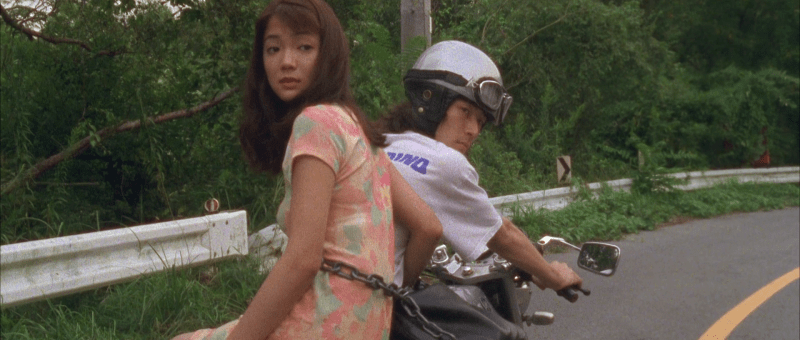
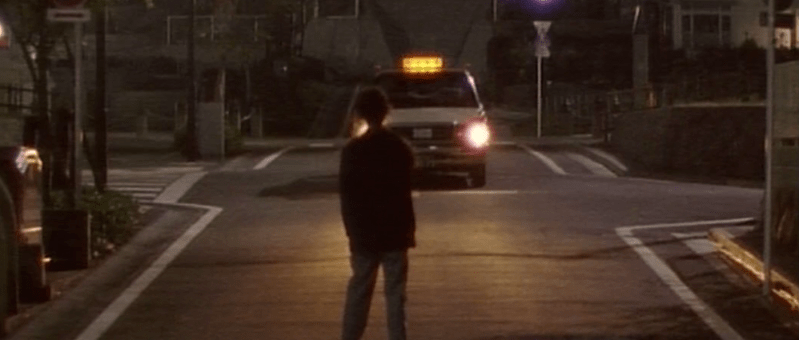
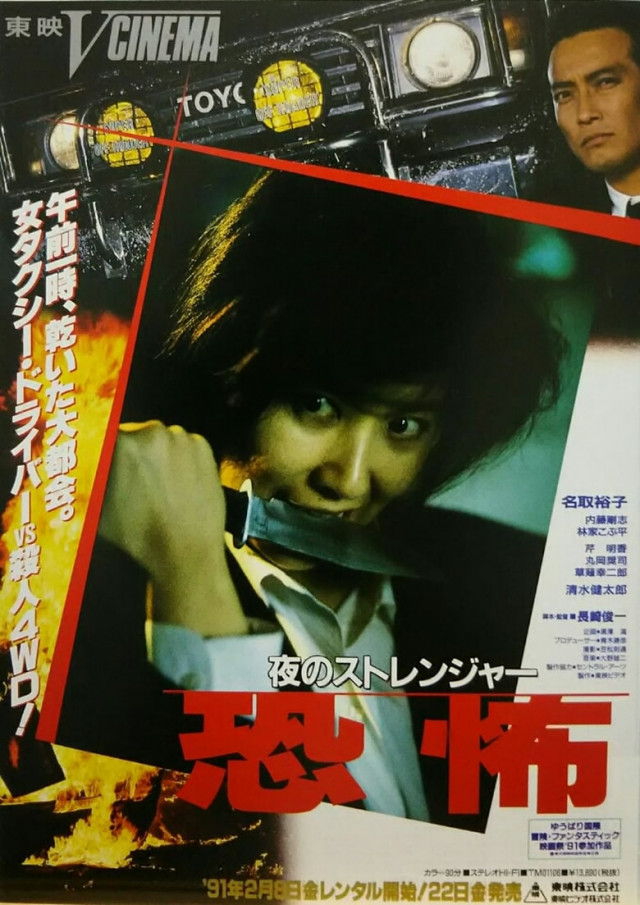
Driving through the city by night, a young woman finds herself plagued by a mysterious force while struggling to break out of her self-imposed inertia in Shunichi Nagasaki’s moody thriller, Stranger (夜のストレンジャー 恐怖). The film’s Japanese title, “night stranger terror”, perhaps more clearly hints at a sense of urban threat while surrounded by so many unfamiliar people, yet it is in many ways Kiriko’s (Yuko Natori) mistrust and suspicion that isolates her from the surrounding society and keeps her trapped in a kind of limbo unable to escape her past.

It might be tempting to read her aloofness as a direct consequence of her experiences, but in an early scene when she was still a bank employee we hear a colleague criticise her for being “anti-social” while Kiriko’s rejection of her seems born more of contempt than shyness or a preference for solitude. Working as a cashier at the bank at the tail end of the bubble is a pretty good job, especially given the still prevailing sexism of the working environment, that positions Kiriko firmly within an aspirant middle-class. She still lives at home surrounded by her family, but is in a relationship with a man who pressures her for money to invest in the stock market. She begins embezzling and lives as if there’s no tomorrow, splashing out on fancy sunglasses before meeting her boyfriend having left work early feigning illness. Unfortunately for her, she gets caught and her boyfriend predictably abandons her.

Just like the asset bubble, her life implodes and plunges her into a lower social stratum as a woman with a criminal conviction for financial impropriety and a hefty debt in needing to pay back the money she stole from the bank for her ex’s harebrained stock speculation schemes. All in all, you could say she’s been betrayed by economic forces, but also as she later admits, but her own uncertain desires in being wilfully deceived by Akiyama (Takashi Naito) and making a clear choice to defraud the bank. She realises that it might not have been a desire to please Akiyama that led her to do it, but the illicit thrill she felt in tapping away on her keyboard stealing the money and otherwise being in a position of economic power over a man, buying him things and taking him out for fancy food. Her sense of malaise is only deepened when she meets Akiyama by chance and tries to tell him all this, but he isn’t really interested. He seems to have moved on and planning to marry another woman. 

Kiriko tries to look at his hands to see if he has burn scars like the man who attacked her in her taxi, but he doesn’t. Perhaps there was a small part of her that wanted it to be him. At least if it was, it would mean he still felt something for her, which would also prove that he ever did. And it would make sense, which is less frightening than her stalker just being a nutty fare, another irate man with a nondescript grudge wandering the city. Taxi driver is one of the few jobs open to her with a criminal record, but it’s also an unusual profession for a woman which further isolates her in her working environment. Her boss keeps calling her “little lady,” while patronisingly offering to put her on the day shift because it’s less dangerous. Kijima (Kentaro Shimizu), an obnoxious colleague, picks at Kiriko for thinking everyone who strikes up a conversation must be sexually interested in her. But the truth is that they are and like Kijima demand her attention. When they don’t get it they’re pissed off. The cab is perhaps the place she feels the most safe, though she faces her fair share of weird fares from drunk men trying to flirt to religious maniacs proselytising from the back seat. 

Now living alone in an apartment, her aloofness is both a personal preference and means of punishing herself. When her brother calls, he encourages her to come home but she says she can’t even though she wants to because she hasn’t yet dealt with her past or taken steps towards being able to forgive herself. She tells Kijima, who in truth behaves in an incredibly creepy way that suggests she’s right to avoid him, that she wonders if she isn’t the only one who can see the mysterious Land Cruiser, as if she were really imagining it. The Land Cruiser does indeed come to stand in for the buried past by which Kiriko is haunted and her eventual besting of it is a symbolic act that suggests she’s finally managed to overcome her guilt and shame to be able to leave the past behind.

As she told Kijima, this was something only she could do by her own hand or none. Akiyama’s dismissiveness of her reflects the fact that he couldn’t give her this absolution either, she needed to find it for herself. Kijima accused her of still being hung up on the guy that scammed her, but that wasn’t quite it. The resolution might hint at his being right when he told her that she needed to learn to trust people more in that it seems to lead to a greater willingness to open herself up to the world. Once again, her sunglasses get broken as a new truth becomes visible to her. A lonely little boy she meets who, like her, enjoys driving in circles and going nowhere, probes her lack of human connection by suggesting that she doesn’t know what it’s like to love someone which is why she can’t understand his obviously inappropriate love for her, though it’s a fact that Kiriko has to acknowledge is truth in interrogating the reality of her relationship with Akiyama.

Nevertheless, in the end, she saves herself and embraces her solitude and independence looking out at the peaceful bay in a city that no longer seems so threatening even if the unseen threat in this case did turn out to be random and have no rational explanation. Nagasaki never again worked in the realms of V-Cinema and his entry is fairly atypical in starring an older, established actress as an action lead while requiring no nudity or sexual content, instead quite literally allowing her to grab the wheel and take control of her life to claim freedom and independence rather than solely romantic fulfilment.
Reincarnation (輪廻, Takashi Shimizu, 2005)

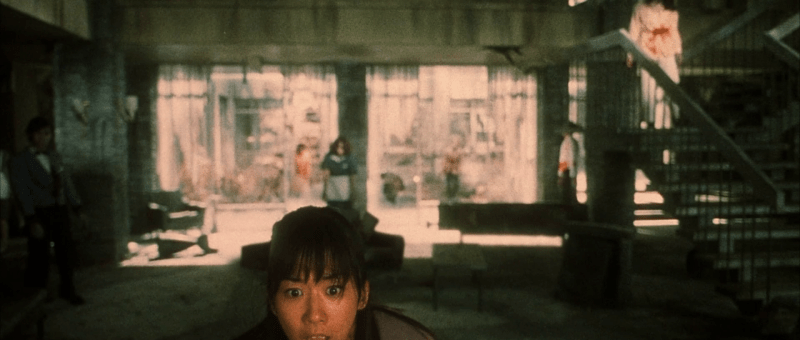
Do our memories just vanish when we die? The murderous professor at the centre of Takashi Shimizu’s Reincarnation (輪廻, Rinne) was apparently obsessed with just this question, along with that of where we come from when we’re born and where we go when our corporeal lives have ended. But there’s a curious irony at the film’s centre in the ways in which we consciously or otherwise seek to recreate the past that suggests we are locked into a karmic cycle even while within the mortal realm.

The most obvious sign of that is the director Matsumoto’s (Kippei Shina) obsession with the grisly murder case that took place 35 years previously. He means to recreate it literally by building an exact replica of the hotel where it took place, only he intends to refocus the tale on the victims, leaving the killer a mysterious force in the shadows. It’s clear that this traumatic incident has left a mark on the wider world, not only in its lingering mystery but the darkness with which it is enveloped, while Matsumoto seeks to exploit it either for commercial gain or reasons of his art. We’re told that, perhaps like Shimizu himself, Matsumoto is known for a particular kind of filmmaking, in his case one involving copious levels of blood and gore. 

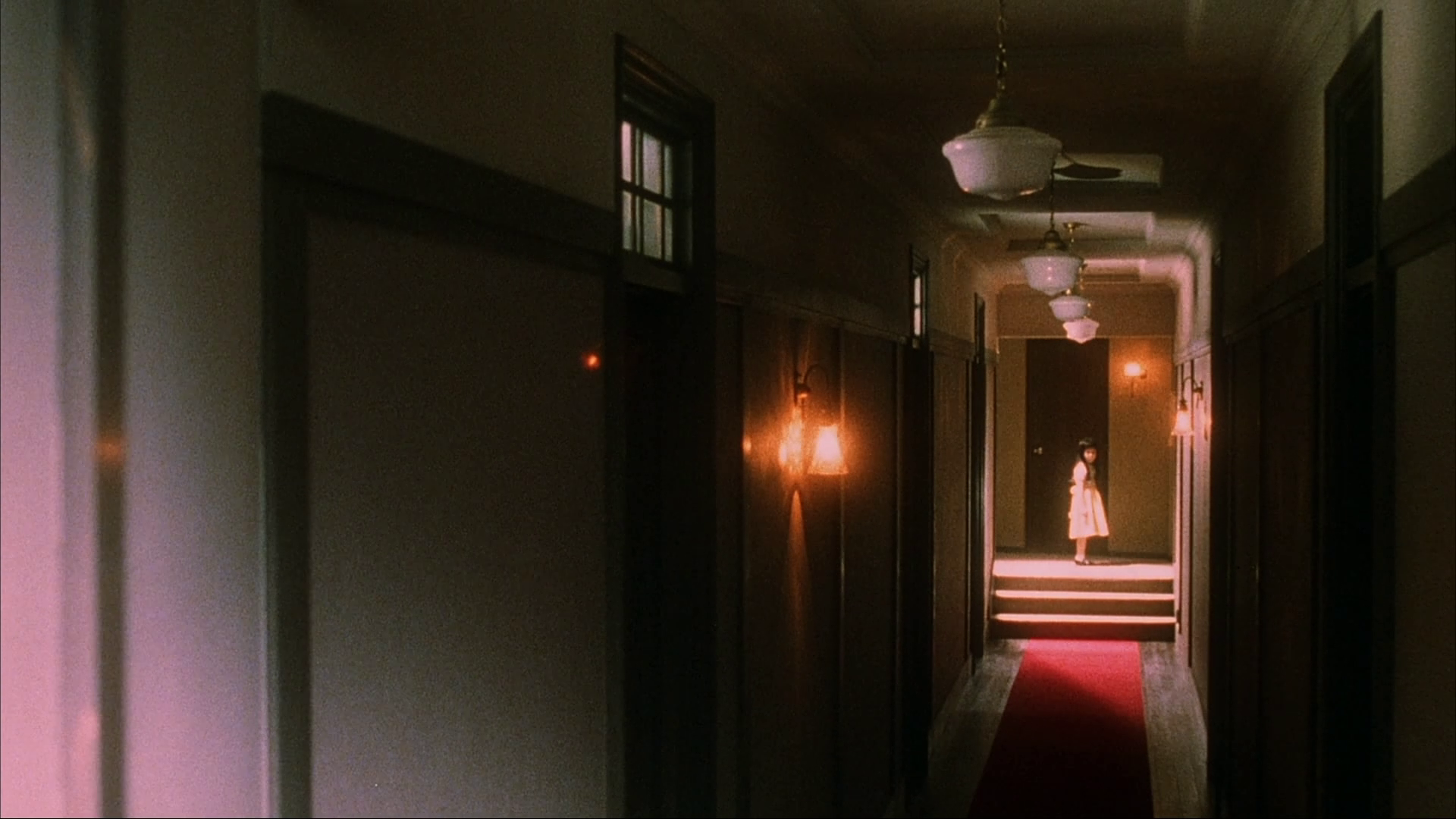
He’s drawn to aspiring actress Nagisa (Yuka) for unclear reasons, though her affinity for the material connects her intensely with this story as she too finds herself haunted by the figure of a little girl in a yellow dress carrying a huge and actually quite creepy doll. There is a sense that everyone is being drawn back here into the nexus of this trauma to play it out again, ostensibly for entertainment. Another actress at the audition, Yuka (Marika Matsumoto), seemingly kills her chances by bringing up that she has memories of being murdered in a past life and thinks that she might be able to put them to rest by acting them out. She too is connected to the hotel and possibly a reincarnation of a woman who was hanged during the incident, which is why she bears an eerie noose mark around her neck. 

Yuka is more literally scarred by a traumatic legacy, while those around her are merely curious or confused. Yayoi (Karina) has recurring dreams of the hotel which her parents can’t explain, leading to the suspicion that she too is a reincarnation of someone who died there, though all of the women were born long after the incident took place. Her professor at university (Kiyoshi Kurosawa) is cautious when it comes to the idea of the authenticity of memory. He teaches them about the concept of “cryptomnesia”, when a forgotten memory is recalled but not recognised as such, leading to accidental incidents of plagiarism in which the subject assumes their idea is original rather than a regurgitation of something they saw or heard long before but no longer “remember”. There is also, of course, the reality that many of our “memories” are effectively constructed from things others have told us of our childhoods that we don’t actually recall but are a result of our brain trying to fill in the blanks. Perhaps this might explain Yayoi’s dreams, that she came across the famous case at some point when she was too young to understand it and it’s implanted herself in her subconscious as an unanswered question.

Which is to say that perhaps it’s the memories that are being reincarnated in someone else’s head as much as it’s the disused hotel that’s become a place of trauma haunted by past violence and now inhabited by the pale-faced ghosts of those who died unjustly. The events themselves are constantly repeating just as the moments exist contemporaneously rather than in a linear cycle. Indeed, they are eventually preserved both through the film shot by the killer, witnessed as a document, and the film that Matsumoto was making, enjoyed as entertainment, but ultimately in Nagisa’s head where all concerned can indeed be “together forever” if now confined to eternal rest in the space of memory.


Trailer (no subtitles)

The Beast Hand (獣手, Taichiro Natsume, 2024)

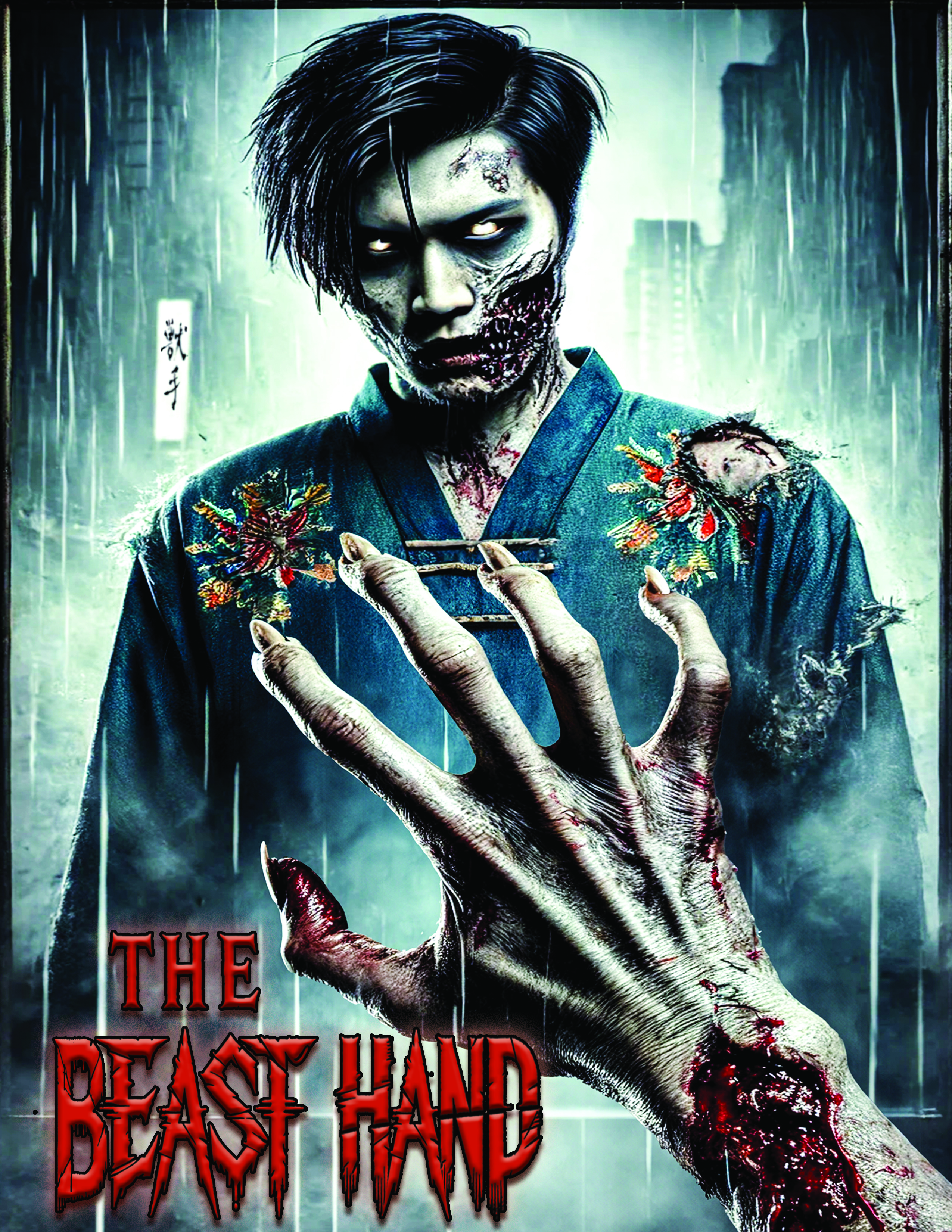
This world makes monsters of us all in Taichiro Natsume’s low-budget indie body horror Beast Hand (獣手, Kemonote). In many ways, Osamu (Takahiro Fukuya) is pursued by his own left arm in his continual powerlessness and tendency towards self-destructive acts of crime and violence. But it’s also true that it isn’t just his hand that makes him monstrous to the world around him and that his “deformity” is also symbolic of the ways in which he is excluded from mainstream society.

Indeed, Osamu already lives a marginal existence in a cramped, reclaimed space on the edges of a town. Having served time in prison, he gets by doing casual labour and quite literally kicking the can down the road, while we also seem him shoplift a can beer after paying for his dinner. His life appears to be defined by futility even before Inui (Yota Kawase), a man with whom he seems to have shared a criminal past, arrives on his doorstep and barges his way back into his life. Technically on parole but having absconded from his probation office, Inui forces Osamu to give up the contact details for his old girlfriend, Koyuki (Misa Wada), who stopped visiting him in prison and was apparently so desperate to get away from him that she had “full body surgery” to essentially become someone else and start a new life.

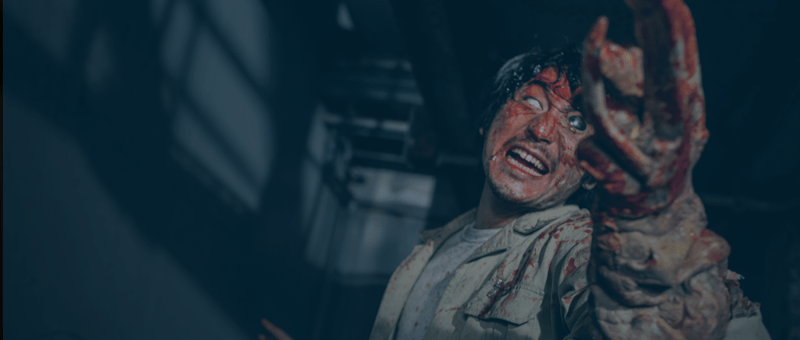
Starting a new life is it seems something that they both want to do but are each unable to shake off the hold that Inui has over them. He, however, is in the same position and though he bullies and assaults them both, bows down before a man he met in prison who gave him extra food from the canteen. The old prison friend wants help on a job robbing the woman who still hands out physical pay-packets to workers at a local factory, but Inui turns him down stating that he’s still on parole and it’s too risky though secretly plotting to have Osamu do the job on his own. Predictably, it all goes wrong and Osamu ends up losing an arm only for Koyuki to drag him to a backstreet doctor who first refuses to help but then apparently experiments on him with a drug he’s researching into regenerative health with the consequence that Osamu’s arm grows back but as a monstrous lump of throbbing grey muscle that he is no longer able to fully control. At moments of high emotion, the arm takes him over and he’s transformed into a mindless, thrashing beast to the extent that Koyuki has to chain him to the wall to ensure her own safety.

Having bonded in their shared sense of subjugation, they once again attempt to change by living a more normal life in a small town by the sea. But even here, Osamu is rejected in part because of the arm itself, which he keeps disguised in bandages and a sling as if it were broken, and otherwise because of his secrecy about it which sees him fired by the kindly older gentleman running a factory where Osamu found temporary employment. Koyuki becomes pregnant, but financial pressures and the lingering anxiety about what kind of child this world might produce eats away at them. Osamu isn’t sure if the baby’s his or Inui’s nor which of those two options is better given that the child might inherit whatever’s infected his arm, while Koyuki is no longer certain about the viability of raising a child in their present circumstances. Both from single-parent families, they lamented that neither of them had the experience of being taken to the beach by their parents which seems to be the idyllic picture of a carefree childhood they’re trying to recapture.

But still they find themselves hounded and pursued, this time by a shady businessman who doesn’t want cure Osamu but to exploit him by ripping off his arm and using the technology for his own nefarious ends. The remorseful doctor also wants a tissue sample, but promises a salve in return that would at least subdue his violent impulses and allow him to live a more normal life. The implication is, however, that the only way Osamu can have the semblance of a happy family is by wilfully sacrificing himself and accepting that he has no place within in it. Condemned by his monstrousness to the edges of the frame, he accepts his liminality rather than railing against it and resigns himself to self-isolation as a permanent exile from a continually unforgiving society.


The Beast Hand is released in the US on DVD and blu-ray May 13 courtesy of Cleopatra Entertainment and available from MVD.

Trailer (English subtitles)

Helpless (ヘルプレス, Shinji Aoyama, 1996)

A title card close to the beginning of Shinji Aoyama’s debut film Helpless (ヘルプレス) lets us know that this drama which spans a single day takes place on Sept. 10, 1989. It is indeed late summer for most of the protagonists, refugees from the Showa era living on borrowed time in Heisei and intensely resentful towards the contemporary society which appears to have no place for them while the glamour of the Bubble economy does not appear to have trickled down to their peaceful provincial existence. 

Yakuza, for example, are very much associated with the post-war past and one-armed foot soldier Yasuo (Ken Mitsuishi) is an old-school street thug who can’t accept that his former boss literally is as dead as the institution itself. He’s met at a train station by two former associates, but it’s clear the older at least is awkward around him finally telling Yasuo not to call “too often”. “It’s nice to be normal,” Yasuo sneers, realising his former comrade has gone straight and lives an ordinary life as a regular businessman which is why he really wants nothing to do with his yakuza past. Yasuo takes his as more than just a personal betrayal and shoots him dead with his own gun.

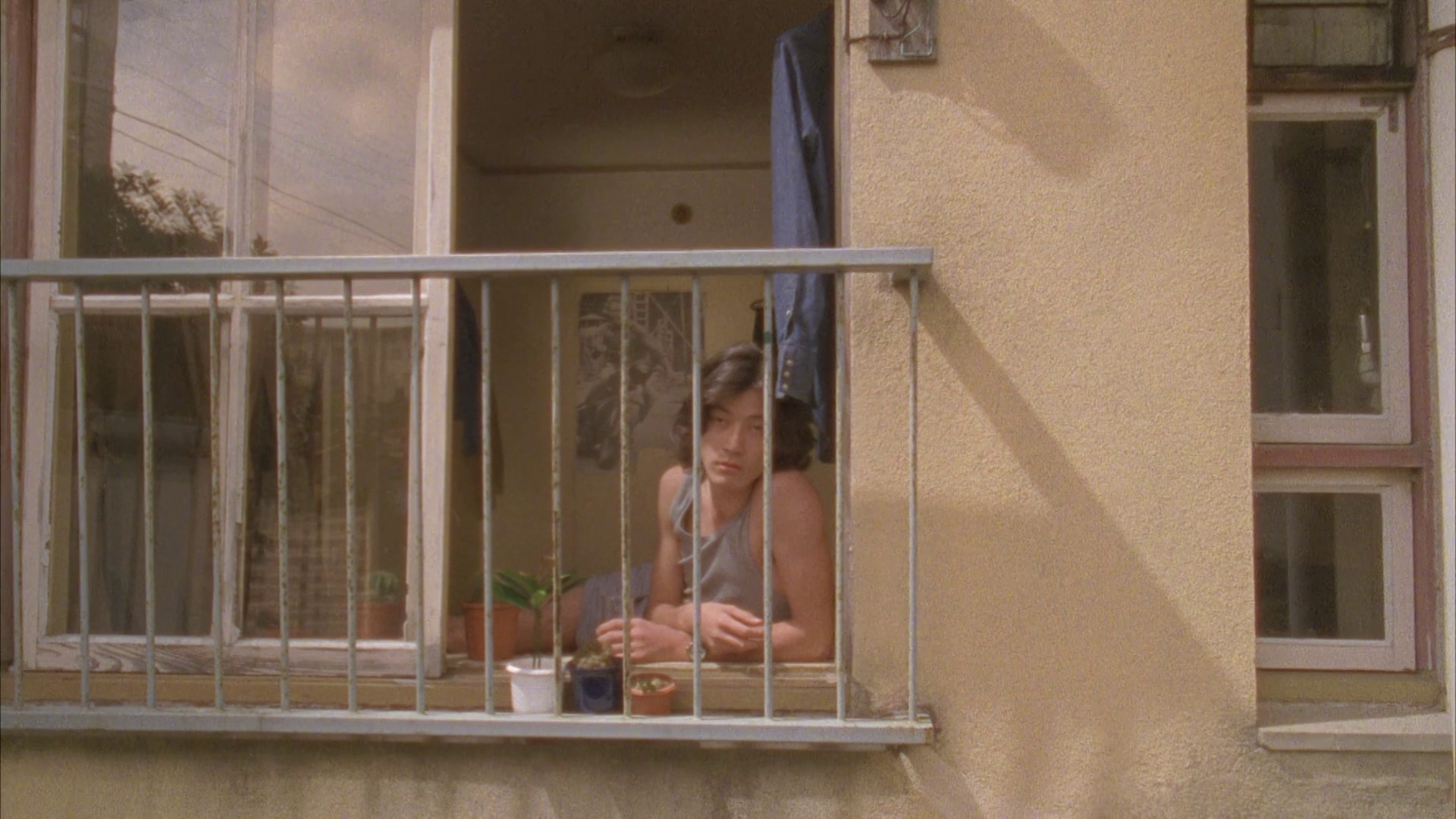
He is quite literally helpless, there’s no place for him in the contemporary society and his only hope is killing his old boss, who is already dead, so he can go back to prison. The only sticking point his younger sister Yuri (Kaori Tsuji) who has learning difficulties and had been living in residential care. Another of Yasuo’s former associates now longer a yakuza, Kenji (Tadanobu Asano), is similarly caring for his father who is in hospital for serious medical treatment. Kenji’s father hums the Internationale to himself and seems to have been consumed by the failure of his personal revolution muttering about blast furnaces while at home Kenji looks out on the now rusty aspirations of another “new era” in a moribund steel plant. He lies to his father that he has a received a job offer from there. 

The two men seem destined to collide, Kenji’s numbed resignation and Yasuo’s irrational rage, though it’s Kenji who later snaps after learning that his father has hanged himself while he was busy taking care of Yasuo’s sister. Even an old classmate he runs into is filled with resentment, talking about taking his “revenge” at the class reunion by poisoning the punch. He says he “forgives” Kenji because he once helped him find his PE kit, though Kenji claims he did it mostly for selfish reasons.The chef at the roadside diner where they wait for Yasuo also seems to be henpecked by his wife who calls him “weaker than a woman.” Kenji later says that he killed them because they ridiculed him, tipped over the edge by his own insecurity and sense of futility. 

Yasuo discovers something similar after being stopped at a roadblock, a policeman expressing sympathy that “they forgot about a punk like you.” Yasuo points the gun at his own head, discovering one last bullet, but it’s not quite clear what happens after that. Yasuo was a wandering ghost anyway, a man of the Showa era haunting the streets of Heisei with a mission to kill a man like himself already dead. On the severed arm Kenji later discovers in his bag, there’s a tattoo of a skull and the motto “help me” which might speak for them all desperately looking for some kind of way out but finding little support. 

But then again, Kenji proves unexpectedly kind caring for Yuri even while Yasuo selfishly considers a double suicide. Dressed in white though also in a T-shirt featuring the cover for Nirvana’s Nevermind which was released in 1991, Kenji is the light and Yasuo the dark despite their mutual violence one bound by nihilism and the other a strange positivity blithely searching for an escaped rabbit just as helpless as he himself may be. Filled with ironic whimsy the film takes place in a purgatorial space inhabited by those displaced by the Bubble who no longer have anything to pin their hopes on while living on borrowed time in a late summer rapidly drawing to a close. 


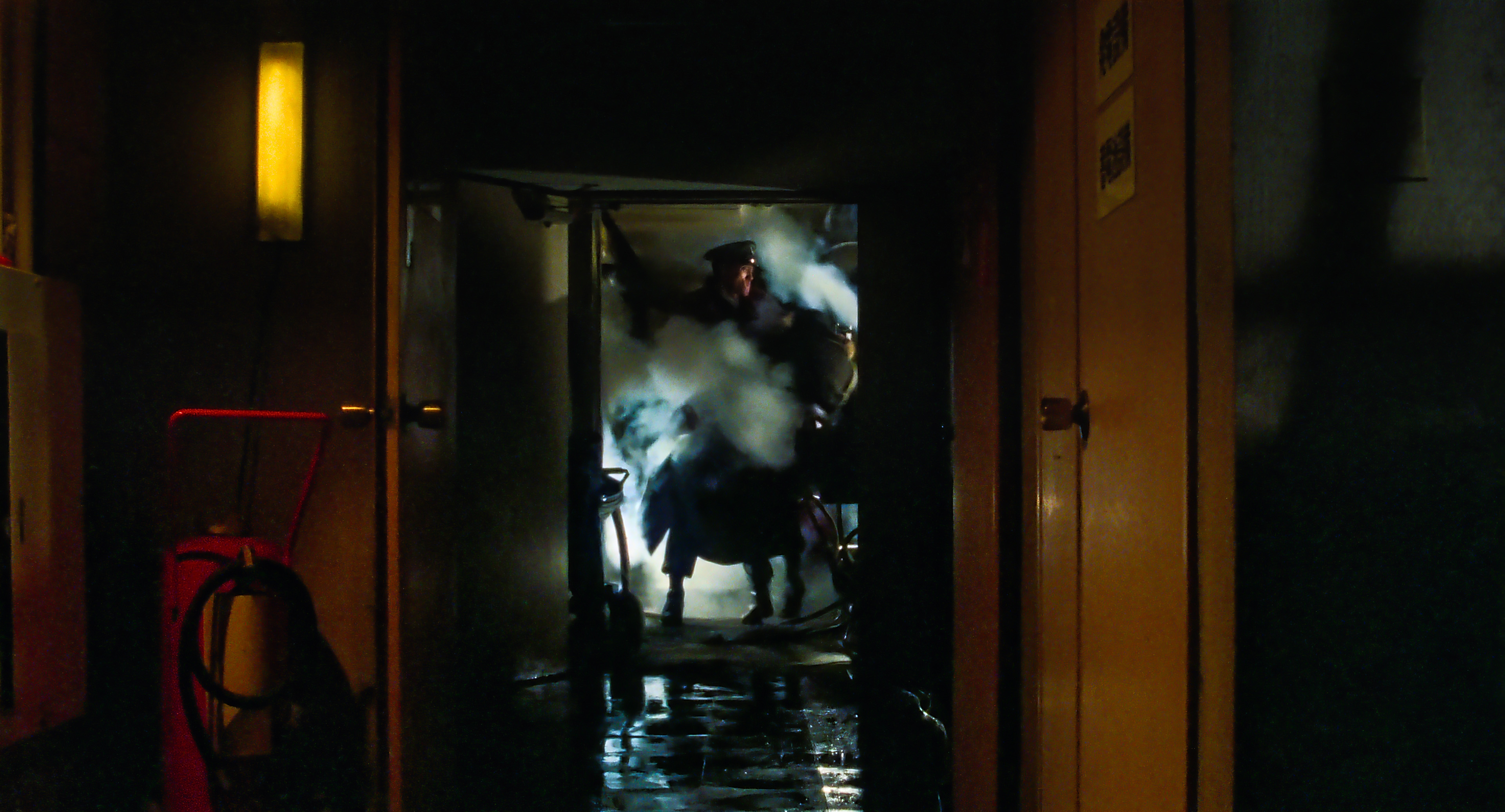
The Guard From Underground (地獄の警備員, Kiyoshi Kurosawa, 1992)

Ever feel like your job is trying to kill you? Released at the tail end of the Bubble era, Kiyoshi Kurosawa’s The Guard from Underground (地獄の警備員, Jigoku no Keibin) positions an office building as an industrial hell complete with a demon living in the basement but grimly suggests it’s just one of many hazards to be aware of for a woman in the corporate environment. Then again, the hellish guard himself has a sorrowful look in his eyes that speaks of true loneliness and might evoke pity if only in the fatalistic inevitability of his office-bound killing spree. 

It has to be said, Akebono Trading should have another look at its hiring procedures through in any case there’s something odd about this building which feels more like an abandoned hospital than a place of business while we might also wonder why we’re seeing signs for cargo depots and engine rooms and staff getting locked in the filing room is apparently not an uncommon occurrence. The new security guard has the same name as a former sumo wrester acquitted of the murders of his stablemate and lover on the grounds of temporary insanity, Fujimaru (Yutaka Matsushige), and is himself a hulking presence, tall but of medium build so who knows if it’s really the same guy or just the office rumour mill going into overdrive.  

Meanwhile, the other new recruit is a refined young woman, Akiko (Makiko Kuno), who’s been brought on as an art expert to help a new division recently diverted into prospecting with art sales to assess what is and isn’t a fair market price for a priceless piece of art. As Akiko admits, she’s not well placed to give that information because her background is in curation so she’s not particularly well versed in the collector market but presumably the job pays a bit better than the museums sector so she’s trying to do her best. Her new boss, Kurume (Ren Osugi), is a bit of a weirdo (like all the other men in the building) and crassly remarks that paintings like women have no value if there’s no buyer while she struggles to understand what the point of her job is. Meanwhile we’re left to wonder if Section 12 is actually a real department at all or a shady enterprise set up to help the enigmatic boss, Hyodo (Hatsunori Hasegawa), improve his investment portfolio which will probably serve him well when the bubble finally bursts. 

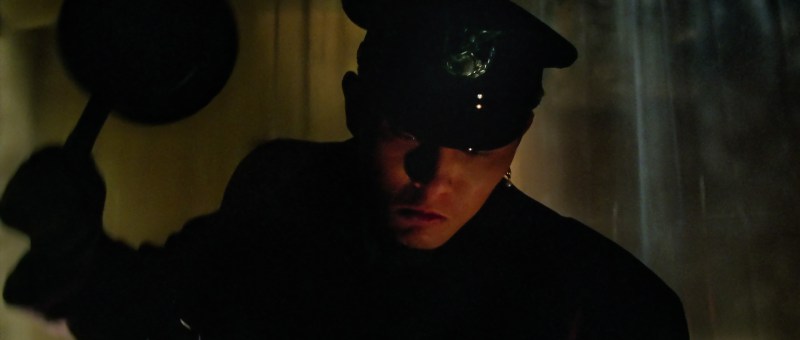
It’s tempting to read Fujimaru as a personification of corporate culture slowly picking off the employees and largely doing so by means of the building itself, electrocuting them by forcing their hand on the circuit breaker, bashing one inside a locker, or otherwise using his security guard’s truncheon to bludgeon them to death. To begin with, it seems as if he’s developed a fondness for Akiko and while that may be true in the same way King Kong develops a fondness for Fay Wray, it soon becomes clear that he isn’t in fact trying to protect her by taking out all the skeevy guys but seemingly killing for no reason. He looks a painting of Goya’s Saturn Devouring His Son with fascination, again hinting at his nature as the personification of capitalistic corporatism devouring the employees who might one day overthrow him, yet also lends the guard an eerie, mystical quality suggesting he merely enjoys the act of carnage though he does not actually eat anyone (that we see). More than that he seems almost like Frankenstein’s Monster, somehow lonely in identifying his otherness as he eventually confesses to Akiko remarking that “desolate time” flows through him unlike her “kind”. As he leaves, he pleads not to be forgotten. 

Akiko defeats him by refusing to believe his story and declaring herself disinterested in his truth possibly stood in good stead by the constant necessity of evading the attentions of the men around her such as those of Kurume who starts off giving paternalistic advice about looking after her parents and the preferential savings rates on post office accounts before randomly taking off his trousers. Anticipating his later career, Kurosawa makes the office a place of lurking dread and anxious eeriness only deepened by its industrial aesthetics along with the tiny windows leaking apocalyptic lighting from the oblivious outside world now cut off except for the new/old teletype text and ironic benefits of international time zones. “Traffic’s hell this time of day” a taxi driver chirpily advises, ironically delivering his passenger straight into its fiery depths. 


The Guard From Underground is released in the UK on blu-ray on 25th September courtesy of Third Window Films.

Trailer (English subtitles)

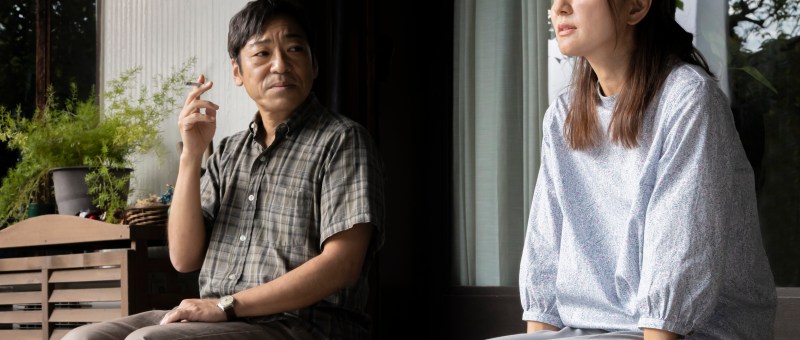
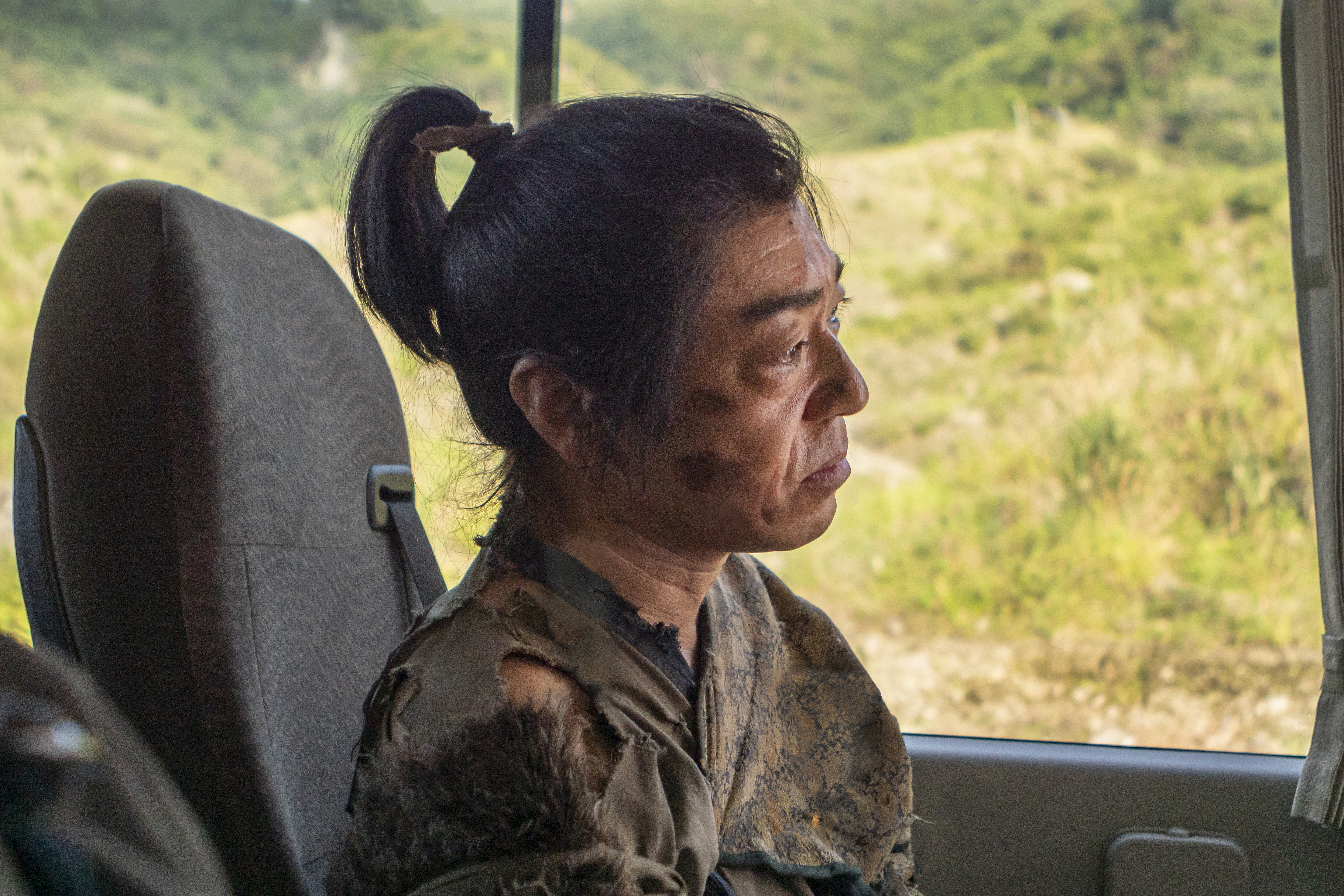
Roleless (宮松と山下, Masahiko Sato, Yutaro Seki, Kentaro Hirase, 2022)

Ever felt like a bit player in your own life? For the hero of Masahiko Sato, Yutaro Seki and Kentaro Hirose’s Roleless (宮松と山下, Miyamatsu to Yamashita), it’s more like he lives ten thousand lives if only for an instant in his life as an extra and may have, in a way, cultivated an image of himself as a blank canvas who no longer exists in an absolute form. In a way you could call it multiverse living, but when confronted with a possible point of origin, a lost selfhood he may have forgotten or wilfully rejected, it presents him with an existential question not so much of who he wants to be but if he wants to be at all. 

We first encounter him as an unlucky retainer in a jidaigeki who is quickly cut down only to rise again and run around the back to give his name as “Miyamatsu, a samurai” to the prop girl who gives him a different hat so can he go back out there and die a second time. Miyamatsu has an air of perpetual blankness in his often vacant expression as if he were both there and not. The film often wrong foots us and we can never be sure what is “real” and what part of a movie, except that it all obviously part of the movie we ourselves are watching. We see what we think are moments from Miyamatsu’s private life only to realise that the camera was rolling all along when someone shouts “Cut!” and it becomes apparent that Miyamatsu was not its main focus. 

Along the way he gives hints of his loss of selfhood, earnestly replying that he doesn’t know when a fellow extra quizzes him on the watch he’s wearing and how he got it but his discomfort could stem from several places and it’s never quite clear how much of an interior life Miyamatsu creates for his various roles, whether he really does just see them as performers of an action, is playing “himself” as he peers over a police cordon at a crime scene, or is a fully fledged person with an individual history. Later he tells a colleague who admires the way he fills in forms at his part time job working at a cable car that he’s always enjoyed the process of filling in a predetermined frame but also that he likes the floating sensation the cable cars give him. 

All of which might explain why he’s so destabilised when a man (Toshinori Omi) approaches him claiming that they worked together as taxi drivers more than a decade earlier and that his name is Yamashita. He apparently “disappeared” after sustaining a head injury and has been “missing” ever since. The man takes him back to the home of his much younger sister, Ai (Noriko Nakagoshi), who has since married and appears to be incredibly relived to see him even if it seems she might also be hiding something. He wonders if it’s suspicious that there are no photos of him in their family home, but is reminded that with the age difference he hadn’t lived there while she was a child and only came back after their parents died to take care of her because she was still in high school. Her husband, Kenichiro (Kanji Tsuda), seems to be constantly needling him though again, it isn’t always clear whether he actually wants him to remember or suspects that he already does and is choosing to pretend not to. 

Even so, Miyamatsu slides into the life of Yoji Yamashita as easily as any other role finding his way back into the character with unexpected moments of connection such as the muscle memory that grants him a perfect baseball swing, or the strangely familiar taste of cigarettes to a non-smoker. Then again, there’s obviously something sinister going on, a darkness underlying his “personal” history that might have made him want to absent himself from himself or else an oppressive sense of bullying that is reflected in Ai’s hesitant answer when Yamashita remarks on what a good husband Kenichiro seems to be. Miyamatsu claims that he’s ever only played one “real” role, and in a way this is it as he begins to claim something like a backstory even if it’s one he may not ultimately want that nevertheless renders him a little less vacant. Mysterious and unsettling, the film asks some probing questions about the nature of identity, whether it is self-defined or gifted, but also discovers a kind of serenity in Miyamatsu’s free floating life of transient realities.


Roleless screened as part of this year’s Nippon Connection

Clip (no subtitles)

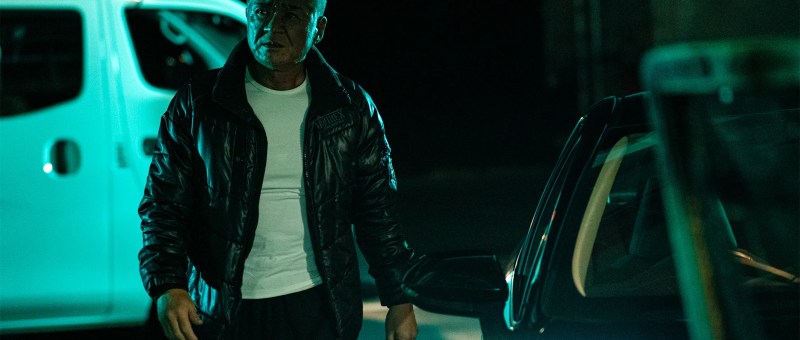
Bad City (バッド・シティ, Kensuke Sonomura, 2022)

V-Cinema legend Hitoshi Ozawa returns in a tale of big city corruption helmed by Hydra’s Kensuke Sonomura. Scripted by Ozawa himself and apparently created in part as a celebration of his 60th birthday, Bad City (バッド・シティ) is a clear homage to the classic yakuza dramas of the early ’90s while boasting some of the best action choreography in recent Japanese cinema performed by the likes of Tak Sakaguchi along with Ozawa himself who performs all of his own stunts. 

According to dodgy CEO Gojo (Lily Franky) who has just inexplicably been acquitted of extortion and colluding with the yakuza, Kaiko City is riddled with crime and violence which is why he’s announcing his candidacy for mayor. Meanwhile, behind the scenes, a mysterious assassin (Tak Sakaguchi) is cutting swathes through the Sakurada gang who dominate the city’s western district which Gojo has earmarked for a redevelopment project he claims will improve the lives of citizens but is in reality just an excuse to build a massive casino complex intended to enrich himself and his company. The previous mayor had won a landslide victory thanks to his opposition to the redevelopment plan which enjoys little support from the local population but Gojo isn’t exactly interested in winning hearts and minds in the community. 

Really just another gangster himself, Gojo’s machinations are also destabilising the existing underworld equilibrium in seducing treacherous minions from other gangs including vicious Korean gangster Kim Seung-gi whose loyalty to ageing gang boss Madam Kim is clearly waning. Then again, an enemy’s enemy is a friend allowing unexpected alliances to emerge between previously warring factions especially given that the sudden offing of a high status gang boss is frowned upon in the gangster play book. 

With police and judicial collusion the only possible explanation for Gojo’s miraculous escape from justice, an earnest prosecutor sets up a secret task force under the command of Public Security agent Koizumi (Mitsu Dan) and led by veteran officer Torada (Hitoshi Ozawa) who is currently in prison awaiting trial on suspicion of offing Mrs Kim’s only son, Tae-gyun. Torada is an unreconstructed violent cop operating under the philosophy that if you beat up a good guy that’s violence but if he’s bad then it’s justice. He has perhaps learned to see the world as morally grey, not believing himself to be necessarily on the side of right so much as resisting the forces of darkness by doing whatever it takes to survive in this city which is indeed already quite corrupt. Partnered up with two veterans and a junior female officer from violent crimes who were assigned to investigate the Sakurada boss’ murder, the gang do their best to trap Gojo legally by uncovering incontrovertible evidence of his dodgy dealings they can use to nail him in court, or failing that the court of public opinion, that cannot be swept aside by his friends in high places. 

Sonomura opens as he means to go on with a series of bloody assassinations culminating the massacre of the Sakurada gang in a bathhouse, while building towards the final mass confrontation in which Ozawa and his team face off against hordes of foot soldiers trying to fight their way towards a confrontation with Kim Seung-gi. Dynamically choreographed, the action sequences are surprisingly bloody and heavy on knife action but crucially also displaying a high level of characterisation and dramatic sensibility as the earnest cops square off against amoral gangsters willing even to sacrifice their own. 

Though there might be something uncomfortable in setting up the major villain as a rogue Korean gangster, the film paints his defection in part as a reaction to Mrs Kim’s initial loathing of the Japanese while in the end allowing a kind of cross-cultural solidarity to emerge as the Sakurada gang become accidental allies and Mrs Kim receives a lost letter from her son that allows her to change her way of thinking while helping to take down the destabilising force of Gojo, restoring a kind of order at least to the streets of Bad City Kaiko. Ozawa may be an equally dangerous extra-judicial force, but at least for the moment he’s standing in the light where everyone can see him taking out the trash and leaving those like Gojo no quarter in an admittedly violent place.


Bad City screened as part of this year’s Camera Japan.

Original trailer (dialogue free)

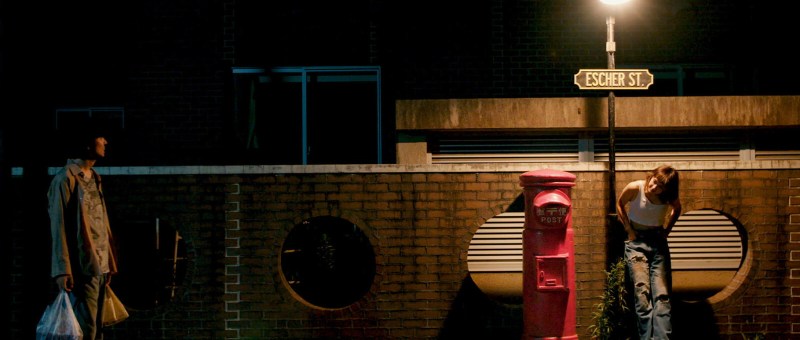
Red Post on Escher Street (エッシャー通りの赤いポスト, Sion Sono, 2020)

“Freedom is disappearing from our world. Everyone rise up!” screams an accidental revolutionary having achieved a kind of self-actualisation in wresting the leading role not only in the film within the film but in the film itself in an act of characteristically meta Sion Sono playfulness. Harking back to the earlier days of his more recently prolific career, Red Post on Escher Street (エッシャー通りの赤いポスト, Escher dori no akai post) is perhaps a thinly veiled though affectionate attack on the mainstream Japanese cinema industry, a defence not only of “jishu eiga” but a “jishu” life in the meditation that a crowd is composed of many faces in which we are all simultanteously extra and protagonist.

In a sense perhaps Sono’s stand-in, the director at the film’s centre, Tadashi Kobayashi (Tatsuhiro Yamaoka), is a festival darling who made his name with a series of critically acclaimed independent films but has since been dragged towards the mainstream while forced into a moment of reconsideration following the sudden death of his muse and lover. Kobayashi’s ambition is to produce another DIY film of the kind that first sparked his creative awakening, but it’s clear from the get go that his desires and those of his backers to not exactly match. Middle man producer Muto (Taro Suwa), sporting a sling and broken leg after being beaten up by the jealous boyfriend of a starlet he’d been “seeing”, is under strict instructions to ensure Kobayashi casts names and most particularly the series of names the studio want. To convince him, they go so far as to have the established “stars” (seemingly more personalities than actresses) join the open auditions at which the director hoped to find fresh faces, hoping he can be persuaded to cast them instead. The irony is that the studio want Kobayashi’s festival kudos, but at the same time deny him the freedom to make the kind of films that will appeal to the international circuit, the director frequently complaining the producers keep mangling his script with their unhelpful notes. 

A handsome young man, Kobayashi has also inspired cult-like devotion among fans including a decidedly strange group of devotees branding themselves the “Kobayashi True Love Club” who each wear Edwardian-style white lace dresses and straw hats while singing a folksong everywhere they go. Nevertheless, most of the hopefuls are ordinary young women with an interest in performing or merely for becoming famous. Their stories are the story, a series of universes spinning off from the central spine from a troupe kimono’d actresses performing a play about female gamblers, to a young widow taking on the mission of making her late husband’s acting dreams come true, and a very intense woman with an extremely traumatic past. The audition speech finds each of the hopefuls vowing to drag their true love back from “the crowd” into which he fears he is dissolving, only for them later to save themselves by removing their “masks” to reclaim their individual identity and agency as protagonists in their own lives rather than passively accept their relegation to the role of extra.

Then again, there are those who wilfully embrace the label such as a faintly ridiculous old man who commands near cult-like adoration from his disciples of professional supernumeraries for his ability to hog the screen even if his less than naturalistic acting is at best a distraction from the main action. Without extras, he points out, the screen would become a lonely place, lacking in life and energy though he at least seems to be content to occupy a liminal space never desiring the leading role but seizing his 15 seconds of fame as a prominent bystander. Others however are not, determined to elbow aside the vacuous leading players and reclaim their space. Subtly critiquing the seamier ends of the industry from the lecherous producers who always seem to be draped with a young woman eager for fame and fortune, to the machinations of star makers and manipulations of talentless celebrities, the film makes an argument for sidestepping an infinitely corrupt system in suggesting the jishu way is inherently purer but nevertheless ends on a note of irony as its defiant act of guerrilla filmmaking is abruptly shutdown by the gloved hand of state authority. 


Red Post on Escher Street streamed as part of this year’s Nippon Connection.

Original trailer (English subtitles)

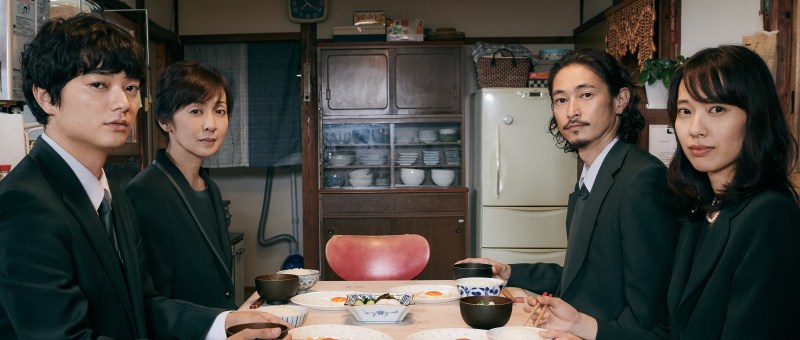
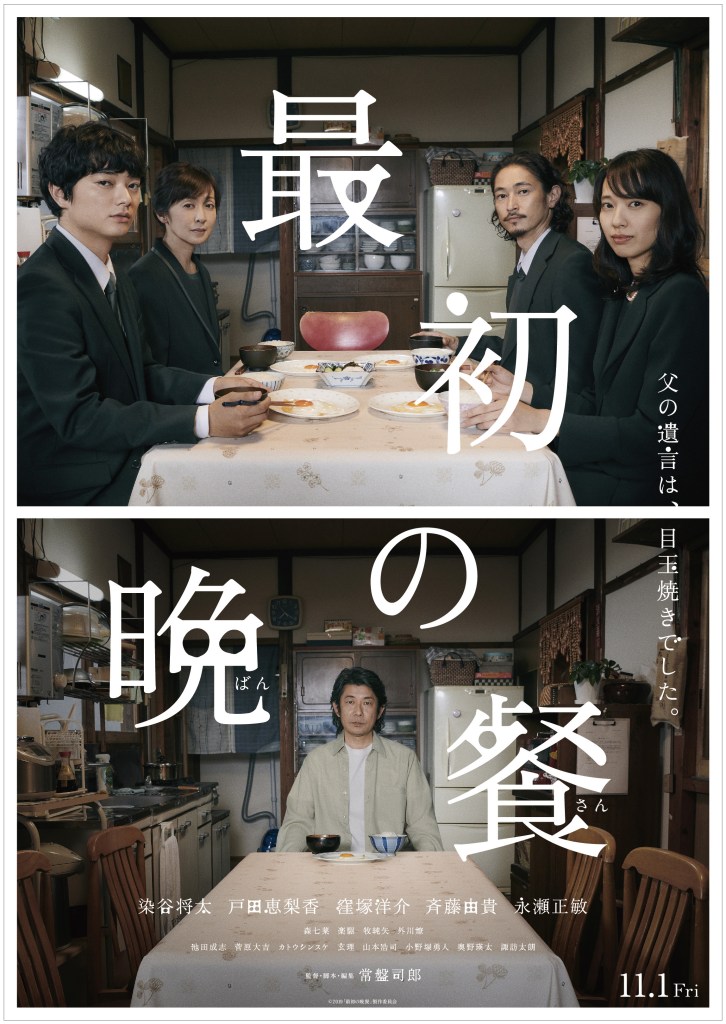
The First Supper (最初の晩餐, Shiro Tokiwa, 2019)

“Family” – what does it mean? The concept itself has been under examination for some time, at least as far as the “family drama” goes, but Shiro Tokiwa’s The First Supper (最初の晩餐, Saisho no Bansan) has it more positive than most as its somewhat emotionally distant hero begins to piece his back together and rediscover his place within it. He does so largely through the Proustian power of food as his lonely step-mother does her best to unite the family by reviving warm memories of the various meals they shared together. 

Yet, as Rintaro (Junya Maki / Shota Sometani), a Tokyo-based freelance photographer grappling with the art/commerce divide, is insensitively told at his father’s funeral, his is not an “ordinary” family. That would be (partly) because it was a blended one. Rintaro and his sister Miyako (Nana Mori / Erika Toda) were being brought up by their single father, Hitoshi (Masatoshi Nagase), their mother having apparently left the family, before he brought Akiko (Yuki Saito) and her teenage son Shun (Raiku / Yosuke Kubozuka) to live with them. As a grown man, Rintaro still claims not to be able to understand what his father was thinking, why he wanted to start a “new” family by bringing Akiko and Shun into their home, especially as it led to him giving up his lifelong love of mountaineering to get a steady job in a factory. It never seems to occur to him that perhaps his father simply fell in love again and wanted to share his life with a woman who loved him, becoming a father figure to her teenage son in welcoming an expansion to their family. 

There is, perhaps, still a resistance to the entire idea of blended families or even remarriages especially in the more conservative countryside. Dealing with an offensive uncle, Rintaro fires back that this kind of thing is perfectly normal and no kind of issue at all in Tokyo, so he’s not sure what the problem is but it’s clear that there is still a degree of disapproval of Hitoshi and Akiko’s union even 20 years later. Part of that might be to do with the circumstances of their meeting which we later discover had their share of moral ambiguity. That central secret, and the ones which spur off it, is the reason that Rintaro has never quite been able to put his family together, while Miyako, married at a young age and now the mother of two daughters, is experiencing a degree of marital strife with her mild-mannered husband (Shinsuke Kato) who accuses her of cheating with an old classmate at a reunion. 

Akiko stuns them all by abruptly announcing that she’s cancelled the caterers for the wake and is planning to cook herself, serving up a selection of dishes one wouldn’t usually expect at a funeral but which she claims are taken directly from Hitoshi’s will and each reflect a particular memory of their life together as a family. There is a gaping hole, however, in that we don’t see Shun. “Why should he come?” Miyako replies to Rintaro’s questions, “He’s an outsider here”. A rather cold cut-off for a step-brother, even one you haven’t seen in a long time, and a partial negation of the idea of families not bound by blood even if it’s snapped partly out of hurt. 

While Miyako struggles to reconcile herself to her place within her new family and her decision to form it, Rintaro chats on the phone to his sympathetic girlfriend, Rie (Hyunri), who has, perhaps surprisingly, not accompanied him on this emotionally difficult occasion. The problem seems to be, however, that he’s told her not to come even though she’d have liked to be there and it doesn’t seem as if anyone would have objected. An agent ringing him at a spectacularly bad time to tell him he hasn’t won a competition is forced to reveal, in the nicest possible way, that he narrowly lost out because his pictures are “cold”, he has no affection for his subjects and it shows. He remains diffident in his relationship with Rie because he hasn’t worked out this whole family thing for himself and is worried he simply doesn’t know how to fit into one. 

Through re-experiencing his childhood through the meals shared with his father, Rintaro begins to regain a sense of belonging, discovering what it was that lay at the heart of his family drama and why it eventually led to a painful breakup. Before all that, however, they’d been happy. Trying to quell a spat between Miyako and Shun over different kinds of miso soup not long after they moved in, Akiko declares that from now on she’s only making one, “blended”, kind for everyone though the choice is theirs whether or not they choose to eat it. Truths are shared, new understandings are reached, and the family is in some sense restored. Their childhoods explained, Miyako and Rintaro begin see a path forwards towards a happy family life of their own while taking their bittersweet memories with them, no longer burdened by anxious insecurity but strengthened by a new sense of belonging that has nothing to do with blood.


The First Supper screens in New York on Feb. 16 as part of this year’s New York Asian Film Festival Winter Showcase.

Original trailer (no subtitles)

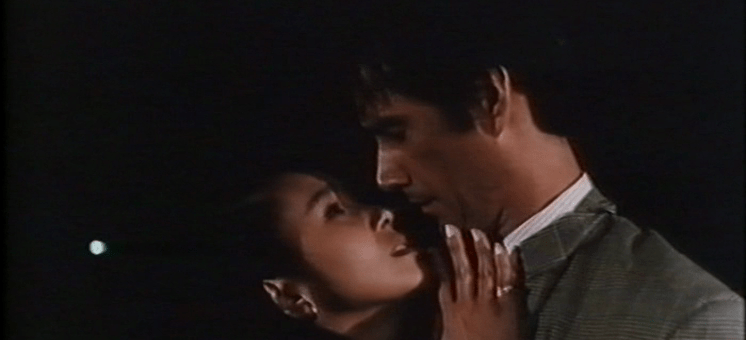
The Enchantment (誘惑者, Shunichi Nagasaki, 1989)

“A broken romance affects everybody” a sympathetic psychiatrist tries to reassure a patient suffering a dangerous romantic obsession with a possibly imaginary woman. Like so much of his work, they’re soft words offered casually as a path towards something deeper but in this case it’s not the patient we need to worry about but the doctor. The aptly named The Enchantment (誘惑者, Yuwakusha), somewhat less subtly titled “Temptress” in Japanese, takes its “hero” on a dark journey into fascination, the male need for domination, and the self delusions of irresolvable disappointment.   

The film opens with genial psychiatrist talking to a patient, Hirayama (Tsutomu Isobe), who proclaims himself more or less cured from a nervous breakdown born of a broken heart. Hirayama’s love affair may be largely imaginary, and he seems far from “cured”, but Doctor Sotomura’s (Masao Kusakari) failure to challenge him on his new affirmation that he’s over her because he’s realised she was “just a bitch” who treated him “like trash” might be a worrying oversight. Hirayama was supposed to be his last patient of the day, but a last minute walk-in, Miyako (Kumiko Akiyoshi), piques his interest enough to keep him in the office rather than on a planned date with his receptionist fiancée and surgeon best friend.

Miyako, nervous and reticent, tells him the appointment is “about a friend” and takes some coaxing before beginning to explain that she has been physically assaulted by her female roommate apparently jealous over the unwanted attentions of a man who developed an attraction for her at her job as a tour guide. Miyako does not spell it out, but somewhat implies that her relationship with her roommate Kimie is romantic while Sotomura has the good sense not to push the issue, only to urge her that perhaps she should think about staying with a friend a while if she doesn’t feel safe at home. Miyako, however, doesn’t want to do that and is only worried about what might have provoked this sudden and unexpected change, fearing most of all that she herself will fall out of love with Kimie if her moodiness continues to intensify.

Overstepping the mark, Sotomura is fascinated with his mysterious new patient, particularly after he becomes a kind of white night rescuing Miyako from a dangerous encounter with Hirayama who is under the delusion that she is the embodiment of his romantic obsession “Junko”. The fascination only intensifies after he makes a surprising discovery – Kimie is not “real” but a secondary personality inside Miyako. Infuriated by Sotomura’s romantic overtures, Kimie takes control and stabs him in the leg while Miyako continues to visit him in the hospital, unable to remember what exactly happened between them.

Sotomura’s obsession is both sexual and professional, after all how many sufferers of MPD is he going to meet in the course of his career? He is indeed ambitious, casually dating his receptionist Harumi (Kiwako Harada) mostly because she’s the daughter of his former professor. Though the couple live together, Harumi is constantly frustrated by his indifference to their relationship and foot dragging over making it official. Sotomura’s best friend, Shinbori (Takashi Naito), is facing much the same dilemma but has resigned himself to an arranged marriage to further his career and keep his family happy. Sotomura instinctively thinks he ought to do the same and tells Harumi that he’ll sort things out with her father, but remains fixated on the mysterious Miyako and her unconventional love life. 

A more cynical friend warns him that sex is the only thing that matters and it’s essential to avoid emotional entanglements. Nevertheless, Sotomura finds himself desperate to unlock the mystery of Miyako, but it remains open to debate which part of her he wants to “fix” – her MPD, or her sexual orientation. As we find out, Sotomura might assume that Miyako’s love for another woman has driven her “mad”, but in reality it’s more that a sense of impossibility led her to believe that there was no solution to her suffering other than death. Faced with unreconcilable loss, she internalised the figure of her fixation, literally becoming one with her lost lover in order to avoid facing that she was alone once again. Uninterested in Sotomura, Miyako/Kimie becomes fascinated with Harumi who eventually becomes so intensely obsessed with Miyako that she is willing to erase her own identity and become “Kimie” for her in order to support her sense of reality and protect the integrity of the Miyako personality.

Again, Sotomura has a few issues. The first is multi-layered sexual jealousy. Now that Harumi has moved on, found someone who “needs” her, and seems to be happier he is instantly irritated that she left him (for a woman) and desperate to win her back (along with the career boost he romanced her for in the first place). He resents Harumi’s differing vision of medical care, that she is willing to embrace Miyako’s delusion in order to keep her stable while wilfully abnegating her sense of self in a profound act of love. Sotomura the clinician wants to “cure” Miyako of her delusion, but his intervention is brutal, intruding on the mental space of her traumatic memory with physical violence designed to rip her from her safety of her artificial reality. He tries to insert himself between the two women, asserting his masculine “right” to dominate, but is eventually ejected by another knife blow to the thigh as the women assert their right to their own reality in the absence of men.

A strange psychosexual odyssey, The Enchantment spins a dark tale of obsession, delusion, and jealousy but ends on a broadly positive, if perhaps uncomfortable, note, in which the dominant psychiatrist is forced to recognise his irrelevance and the legitimacy of realities outside of his own. Broken romance affects everyone, as Sotomura said, but perhaps he doesn’t have the right to intrude on the broken hearts of others or judge the various ways in which they attempt to patch them back together again. A chronicle of bubble era Tokyo bathed in garish neon and a sense of infinite possibility, Shunichi Nagasaki’s heady feature is a surprisingly subversive affair in which trauma cannot be overcome but can perhaps become integrated in a mutually beneficial whole.