I Flunked, But… (落第はしたけれど, Yasujiro Ozu, 1930)

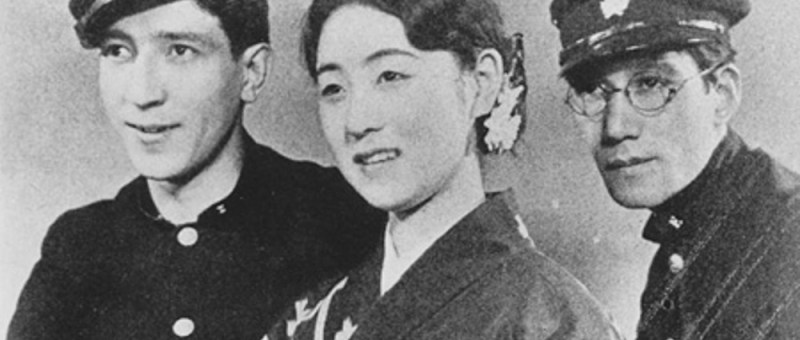
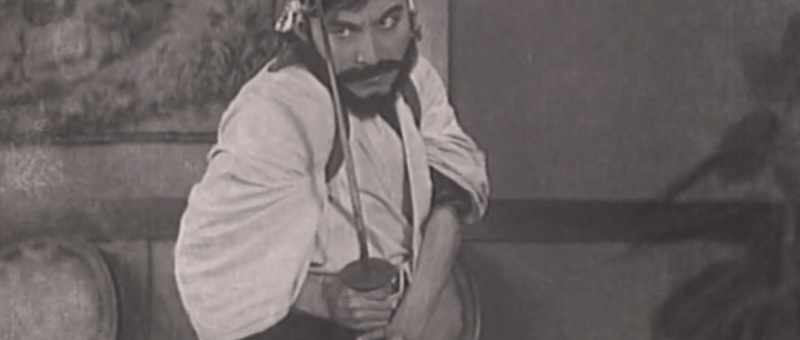
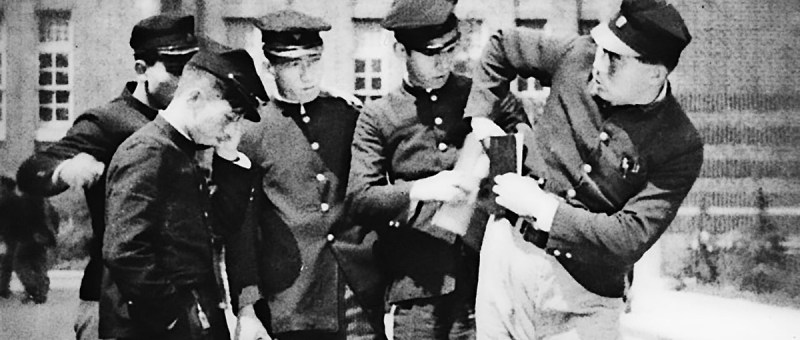
Yasujiro Ozu never went to college. By all accounts a poor student and rebellious young man, he took an early teaching position in a remote rural area precisely because it required no degree. Unsurprisingly, he didn’t last long in the job and eventually returned to Tokyo,  joining Shochiku as an assistant cameraman. Nevertheless, in his early career at the studio he found himself contributing to their popular brand of college comedies of which I Flunked But… (落第はしたけれど, Rakudai wa shitakeredo) is his third, directed when he was 26 years of age. 

Drawing inspiration from Hollywood campus movies and in particular Harold Lloyd’s The Freshman as we can see from the various US state college pennants seen hanging throughout the film, I Flunked But… follows a group of young men preparing for their final exams. They are all excited about the idea of graduating into the adult world as symbolised by the neat business suits they have each bought in preparation for their new lives and few seem burdened by anxiety about a potentially precarious future as members of a generation stepping into a world of reduced economic potential and growing political instability. 

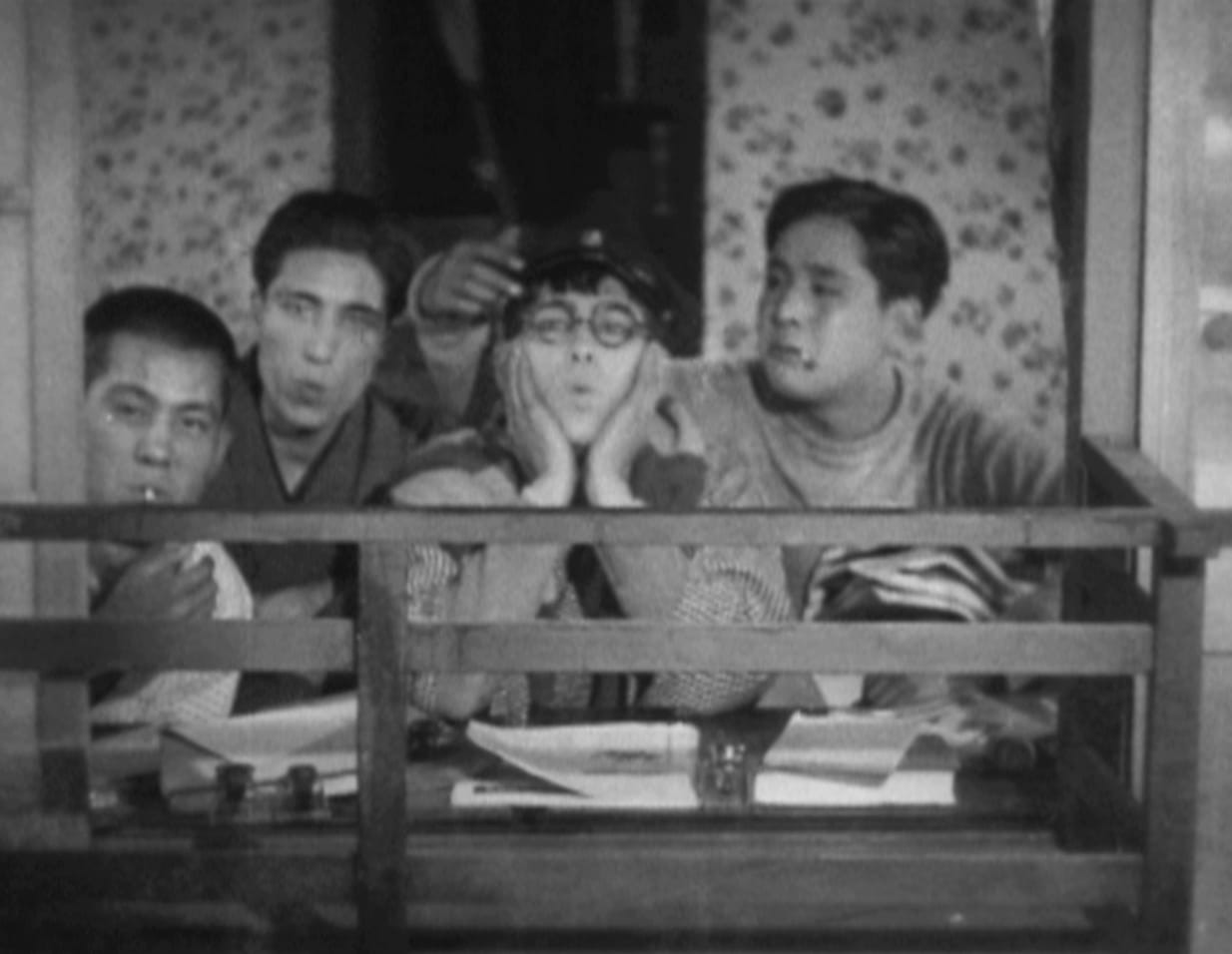
In fact they live the last days of their student lives to the full, greeting each other with silly dances, playing turntable roulette to decide who pays for dinner, and spending more time figuring out how to cheat on the exam than studying to pass it. There may be truth in the idea that passing exams is all about the knack, but our boys are overly invested in kicking back against the system rather than playing by its rules to get ahead. As the film opens, two students are arguing because one supposedly betrayed the other in promising to help him cheat and then not following through. Takahashi (Tatsuo Saito) is supposed to help his friends by wearing a shirt which has a cheat sheet scrawled on the back, but he oversleeps and the landlady swipes it for the laundryman. The others manage to scrape through on their own while Takahashi alone fails. 

The remainder of the film becomes a more melancholy mediation on the changing fortunes of Takahashi and his friends. Overcome with shame and disappointment, Takahashi is left out of the others’ cheerful graduation celebrations, left with the choice to drop out or repeat the year (amusingly, one of his perpetual failure friends appears to be much older, even middle-aged, and one wonders if he is a serial repeater). The suit he had bought is now a grim reminder of his defeated hopes, as is the tie his girlfriend (Kinuyo Tanaka) who works in the bakery next-door was making for him as a graduation present. He now feels unworthy of wearing it, a fraudulent human trapped in adolescence by embarrassing failure. The girlfriend, however, already knows all about it and reassures him that even if he has not graduated, he still has the right to wear his graduation suit. 

As time moves on, however, Takahashi realises that he might actually be the more fortunate. Still wearing his student uniform, he lives a carefree student life and is still receiving money for his upkeep which makes him the rich man among his dorm mates who are still living in the same rooms with him and have all had to pawn their graduation suits because there are no jobs for them to go to. “I heard it’s hard to get a job these days”, the girlfriend laments, and it’s clear the depression continues to bite. The college world was safe and easy. Takahashi carries on goofing off, silly dances and cheerleading the order of the day. In this sense at least, a perpetual childhood might not be so bad a thing. The graduates wistfully play with a student’s cap, wishing they could return to their carefree college days rather than stuck in their old dorm receiving nothing but rejection letters and hand outs from a slightly smug Takahashi. “If I’d known it would be like this I wouldn’t have graduated so hastefully” they lament. Maybe flunking is actually the smart choice, riding out economic instability until something better comes along. You might as well enjoy yourself while you can, Ozu seems to say, you’ll never have it so good again.
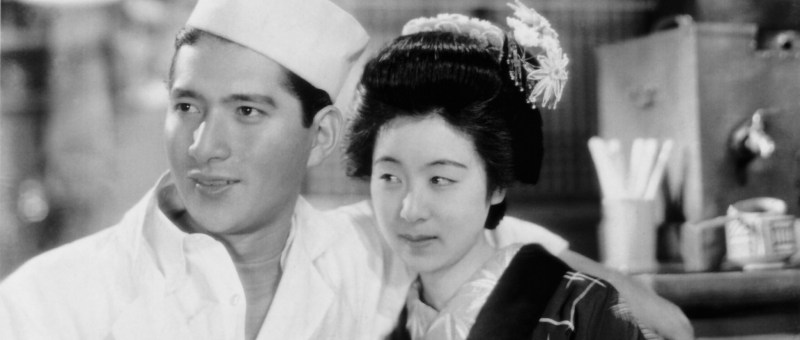
Let’s Have A Dream (九ちゃんのでっかい夢, Yoji Yamada, 1967)

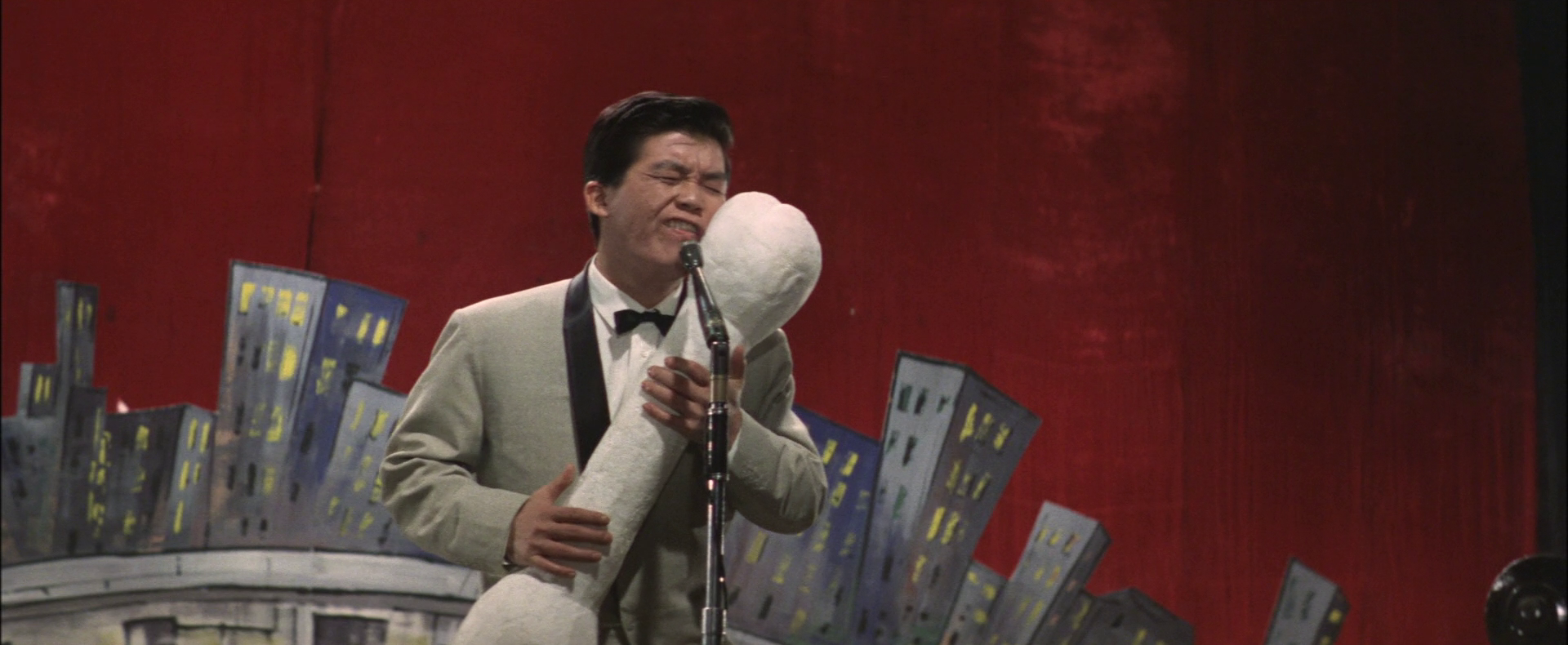
Convinced he’s dying of a terminal illness, a young nightclub singer yearns for death in Yoji Yamada’s romantic farce, Let’s Have a Dream (九ちゃんのでっかい夢, Kyu-chan no Dekkai Yume). In fact, the Japanese title is “Kyu’s Big Dream,” directly putting the name of the star into the name of the picture though he does in fact play a character called “Kyutaro” whose music career is starting to take off just as he convinces himself that his life is hopeless. Best known for “Ue o Muite Aruko”, Kyu Sakamoto was a huge singing star throughout the 1960s until his death in a plane crash at the very young age of 43.

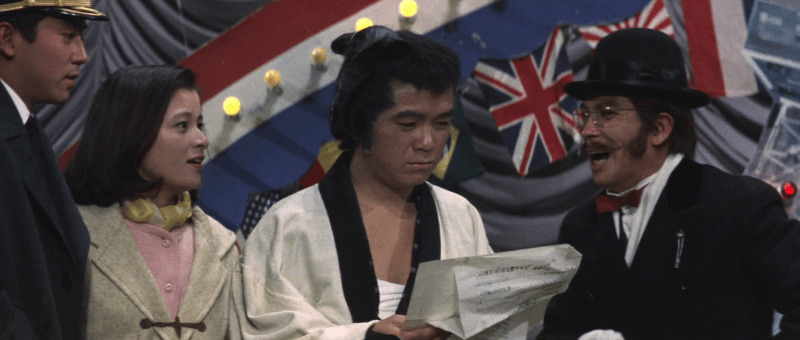
Based on a novel by Nobuhiko Kobayashi who was working with Sakamoto on a television show at the time (and asked for a pseudonym because he wasn’t sure how the movie would turn out), the film is however partly an exploration of the nation’s growing internationalism. Indeed, the film opens with the Pan Am logo and then immediately travels to Switzerland where an elderly lady is dying having apparently never married or had children but still attached to the memory of her first love, a man from Japan. Accordingly, she decides to leave her entire fortune to that man’s grandson, Kyutaro (Kyu Sakamoto), which comes as a total shock to her closest living relative, “The wicked Mr Edward Allan Poe.” Her butler then vows to travel to Japan to tell Kyutaro the good news, but ends up sitting next to the hit man Edward Allan Poe hires on the plane.

But Kyu has already hired a hitman to take himself out because he thinks he’s suffering from a terminal disease and feels nothing other than fear and hopelessness. Though all he wants to do is die, he is unable to take his own life and so has decided this is the best way. He’s also in love with a childhood friend who works in a diner at the docks, but unbeknownst to him Ai (Chieko Baisho) has just got engaged to their other friend Kiyohiko (Muga Takewaki), a sailor. To add to the sense of European romanticism, Kyu writes long notes to himself about his sadness and melancholy all while the countess’ right-hand man continues to refer to him as the luckiest man in the world. 

In a running gag, the hitman speaks mainly in French and the Countess’ butler in cod German hinting at a new kind of internationalism. The hitman Kyu hires through shady local guy Pon (Kanichi Tani) is, however, much less sophisticated. He can’t afford a gun and fails to kill Kyu several times in other ways usually injuring himself in the attempt which again makes Japan look somewhat inferior to the rest of the world just as the opulent vistas of the Countess’ castle contrast so strongely with the down and dirty nature of the docks where Kyu lives and works. 

Despite being so desperate to die, Kyu pulls away when the hitman he hired tries to kill him which along with his inability to take his own life may suggest that he really does want to live after all. Though she evidently does not return his romantic feelings, Ai clearly cares for him deeply describing Kyu as like oxygen for her while trying to get to the bottom of what’s with wrong with him but it takes Kyu a little longer to figure out that people care about him even if not quite in the way he was hoping they would. Even so, there’s no denying the farcical quality of all that’s befallen him as he finds himself “the luckiest man in the world,” caught between two hitmen, and staving off eventual romantic heartbreak.

Still, even this plays into the melancholy sense of romanticism and elliptical ending as Kyu eventually gets to fulfil one of his big dreams by going to Europe and getting to live the life of a heartbroken count from a 19th century romantic novel. As a vehicle for Sakamoto, the film also features several of his songs along with dance routines and some otherwise goofy clowning while Chieko Baisho also performs a short but sweet rendition of My Bonnie Lies Over the Ocean. It’s all undoubtedly very silly but somehow heartfelt and wholesome for all its buried melancholy and deeply felt romanticism. 


Original trailer (no subtitles)

Song of the Flower Basket (花籠の歌, Heinosuke Gosho, 1937)

The daughter of a tonkatsu shop finds herself with an overabundance of suitors in Heinosuke Gosho’s generally cheerful yet occasionally dark melodrama Song of the Flower Basket (花籠の歌, Hanakago no Uta). Adapted from a novel by Fumitaka Iwasaki and scripted by Kogo Noda, the film finds its heroine caught at a moment of social change as she battles her snooty aunt for the right to decide her romantic future while her impoverished student boyfriend does something much the same in defying his family’s attempts to micromanage his life dreaming of the bright lights of Ginza. 

Yoko (Kinuyo Tanaka) is the “kanban musume” of her father Keizo’s (Reikichi Kawamura) pork cutlet restaurant, attracting customers with her charm and beauty while the Chinese chef her father brought back with him from Shanghai, Lee (Shin Tokudaiji), is the culinary star. Lee is secretly in love with Yoko whom he continues to refer to largely as “the young lady” and has long been writing an ode in her honour. Yoko meanwhile is in love with a penniless student, Ono (Shuji Sano), who at the beginning of the film has just returned home after visiting his family whom he has alienated by declaring that he doesn’t want to work in an office in the country while refusing an offer to marry into another family as an adopted son-in-law. The reason for this is less his pride than his desire to stay in Tokyo amid the bright lights of Ginza, sighing as he looks out into the neon-lit night gazing at adverts for Club Hamigaki toothpaste and Meiji Chocolate. The second reason may also be that he’s fallen for Yoko but given his precarious financial situation and lack of prospects does not quite dare to imagine a future with her. 

He must however be serious as we later learn he’s given up going to hostess bars with his friends, a bar girl greeting him in the restaurant evidently not having seen him in ages asking where he’s been much to Yoko’s embarrassment. The encounter places a seed of doubt in her mind in a minor role reversal as she begins to resent Ono’s past irrationally annoyed by the idea he has dated other women. Meanwhile, at the memorial event marking 11 years since her mother passed away while working as a steward on a boat in Singapore, Yoko’s snooty aunt tries to set her up with an arranged marriage to an Osakan doctor who may or may not marry depending on the “negotiations” but has also been promised his own clinic by his wealthy parents if the marriage is confirmed. Okamoto (Toshiaki Konoe) has visited the restaurant to get a better look at Yoko making him the third suitor to encircle her even though the chief concern of the family is that Yoko is almost 24 and therefore ageing out of top tier matches.  

To his credit, Yoko’s father is fully in her corner trying to stand up to the domineering aunt who is definitely overreaching in trying to micromanage the romantic lives of her nieces in the absence of her sister. He determines to find out if Yoko has her eye on someone already to get the aunt off their backs, but the situation develops in an unexpected direction when Lee mistakenly assumes that she likes him back. Too shy to say himself, he advises Keizo to ask frequent customer and best friend of Ono, Hotta (Chishu Ryu), who is on track to become a Buddhist priest and take over the family temple, only Hotta obviously tells him, correctly, that Yoko is in love with Ono having completely forgotten that Lee had once confessed his feelings to him. 

The film does its best to present a more positive vision an internationalist Japan even in 1937 despite the Aunt’s obvious disapproval of the family’s wandering past and is largely sympathetic of the lovelorn Lee yet implies that a romance between he and Yoko is so unthinkable that no one really considered the possibility that he may be in love with her himself even though it is incredibly obvious given his ongoing attempts to write a love song while he’s even torn out a picture of Yoko which appeared in a magazine and hung it on his wall. Yoko is oblivious to his feelings, believing that he is in love with their waitress, Oteru (Yaeko Izumo), who is indeed in love with him, and perhaps doesn’t appreciate the effect moving Ono in as a trainee chef will have on him both professionally and emotionally. The message that is emerges accidentally or otherwise is that Lee’s place at the cafe is insecure despite his skill being a large part of its success as he falls into a deep depression and eventually decides it’s too painful for him to stay. 

The revelations surrounding Lee further destabilise Yoko’s confidence in her choice of Ono whom she constantly doubts even suspecting he may have committed a violent crime when carted off by the police after newspaper reports stating the bar hostess he introduced her to earlier has been murdered in her apartment. Perhaps it’s normal enough to be uncertain if you’ve made the right choice in the early days of a marriage, but believing your spouse capable of murder is a significant stumbling block as is her final admission that she doesn’t really trust him and isn’t ready to accept his past with other women in a further reversal of their roles given he has now married into her family and taken her name. Nevertheless, the crisis seems to be repaired by her father’s simple act of ordering a round of beers making clear that he plans to celebrate and obviously still has confidence in Ono while preparing to adapt their restaurant to their new circumstances by branching out into sukiyaki. Expressing some of the anxieties of the 1930s from the precarious economy and uncertainty of the future to changing social mores as young people reject the traditional to craft their own romantic futures, Song of the Flower Basket nevertheless ends on a note of melancholy in the wandering Lee’s ode to loneliness and heartbreak under the neon lights of Ginza.


The Vampire Moth (吸血蛾, Nobuo Nakagawa, 1956)

“You’ve become an evil beast that sucks blood!” intones ace detective Kindaichi, though just as his later The Lady Vampire featured no lady vampires, there is no literal bloodsucker involved in Noburu Nakagawa’s Vampire Moth (吸血蛾, Kyuketsuga). Inspired by one of Seishi Yokomizo’s mysteries featuring his iconic detective here played by the rather suave Ryo Ikebe cutting a very noirish figure in contrast to the famously disheveled eccentric from the original novels, the film is for a time at least a werewolf movie though as usual the villain turns out to be post-war greed and amorality. 

This is perhaps rammed home in the open sequence as the camera pans around the neon-lit nighttime city before entering a small cabaret bar where a fashion competition is currently in progress. A note of discord is immediately introduced by a white-haired grumpy old man (Eijiro Tono) sitting in the front row who appears to be in an incredibly bad mood, later exclaiming that the winning design by rising star Fumiyo Asaji (Asami Kuji) does not seem very original to him. Some of the models later complain about the strange spectator who’s evidently come to several other shows and has begun to creep them out. Meanwhile, an aloof, conservatively dressed woman brushes past them. Fumiyo’s assistant Toru (Ichiro Arishima) explains that she is Tazuko Kusakata (Chieko Nakakita) who had been the previous number one before Fumiyo returned to Japan after an extended stay in France. The real drama begins however with the arrival of a masked man with a box for Fumiyo who reveals his wolf-like face to Toru in an effort to convince him to deliver it. After opening the box and finding an apple with a few distinctive bite marks on the outside, Fumiyo promptly collapses.  

From the introduction of the three loose “suspects” an ominous atmosphere takes hold in the certainty that something untoward is about to happen. Soon enough some of the models start getting bumped off in quite bizarre and unpleasant ways. The first girl’s body is shipped back to the studio in a mannequin box which later leaks blood, while the gang are then delivered a cake with the next victim’s name on it in pretty icing with a butterfly moth motif above. There may not be any vampires, but there are certainly moths. The old creepy guy is revealed to be a moth specialist living a giant gothic mansion with a butterfly room in the middle full of specimens nailed to boards. His front door even has a moth motif above it like a coat of arms, while a butterfly mural lies behind it in the hallway. The killer places a decorative moth on each of his victims to cover their modesty which would seem to indicate the grumpy professor but, once he finally arrives, Kindaichi isn’t quite so sure. 

Though this is technically a Kindaichi mystery and he does finally get to unmask the criminal, he is not actually in it very much and as previously mentioned is nothing like later incarnations of the famous detective such as that of Kon Ichikawa’s series of Kindaichi movies released throughout the 1970s. In a common B-movie motif, the main detective work falls to a male and female team in dogged reporter Kawase (Minoru Chiaki) and intrepid model Yumiko (Kyoko Anzai) who eventually succeed in digging up clues at the creepy mansion while simultaneously stumbling across a subplot involving plagiarism in the world of fashion with Tazuko implying that Fumiyo stole her winning outfit from another designer and then passed it off as her own thereby robbing Tazuko of her rightful place as the best designer in Japan. Partly because of all this stress and the vast amounts of money apparently needed to sustain a career in the fashion industry, Fumiyo’s well-meaning boyfriend wants her to abandon the profession but also admits that asking her to give up fashion would be like asking her to give up her life. 

Nakagawa ramps up the tension with a series of elegantly presented reversals, making us think we’re witnessing the killer stalking Fumiyo before pulling back to reveal it’s someone else or presenting the same scene of a masked man ominously peering out from behind a tree. The presence of the “wolf man” links back to a Japanese traveller who supposedly fell victim to a supernatural curse in France described as being akin to possession by a fox in Japanese mythology causing the infected person to gain wolf-like characteristics, become violent, and eventually be consumed by an overwhelming desire for human flesh, but perhaps also hints at the sense of voracious greed that has overtaken the killer and caused them to abandon their sense of of humanity in favour of material riches. Filled with a sense of the gothic along with noirish dread in Nakagawa’s foggy, kilted angles eventually giving way to an atmospheric chase sequence strongly recalling that of The Third Man, The Vampire Moth presents a banal evil with palpable anxiety yet suggests justice will be done to those who however briefly stray from the path. 


Where Now Are the Dreams of Youth? (靑春の夢いまいづこ, Yasujiro Ozu, 1932)

It’s lonely at the top. Perhaps surprisingly, Japan’s depression-era cinema had considerable space for lamenting the complicated position of the young master and, as Hiroshi Shimizu’s The Boss’ Son at College would do the following year, Ozu’s Where Now are the Dreams of Youth (靑春の夢いまいづこ, Seishun no Yume Ima Izuko) follows a young man of privilege realising that inequality is bad for friendship and no matter how much you try to manipulate an inherently unfair system for the good of those you love it is the system itself which will always stand between you. 

Ozu begins, however, in familiar territory continuing in the vein of student comedy which was proving such a big hit for home studio Shochiku and in fact reusing a few gags from his previous films in the genre such as the guys’ persistent attempts to cheat on their exams. The opening sequence in which three of the four friends goof off rehearsing a cheerleading routine neatly sets up the already existing divisions between them as Saiki (Tatsuo Saito), the gang’s outlier, hovers on the sidelines attempting to study explaining to a young woman the guys know from the bakery, Shige (Kinuyo Tanaka), that he has only his mother and cannot afford to spend his time messing around. Despite that, however, we’re also told that Saiki is a hopeless case forever falling his exams and regarded as essentially feckless. 

The hero, Tetsuo (Ureo Egawa), is the son of a company president and even if he doesn’t notice it the guys are already deferring to him as a kind of leader though they are all, in one sense, still “equals” as students at the same university taking the same classes. They all wear the same universal student uniform and drink in the same cafe, though they perhaps have different fears and anxieties for their futures at this difficult economic moment. The friendship is suddenly disrupted by the unexpected death of Tetsuo’s father which necessitates his leaving university to take over the family firm, though it’s also clear that he is not quite in charge and his conservative uncle is in fact running the show. 

Tetsuo’s new status as a company president, now dressed in an expensive tailored business suit, forever sets him apart from his friends who eventually come to him for help on being unable to find jobs in the midst of an economic depression. He decides to use his privilege to help them but in an underhanded way, insisting they sit the company exam but giving them the answer sheet beforehand just like in their school days helping each other to cheat. Nevertheless, he fails to realise that you can’t be both friend and boss and it hurts him that they are now polite and deferent in his presence. Gone is their old camaraderie and foolishness, fear and dependency gradually erode their friendship. 

Meanwhile, Tetsuo has continued to carry a torch for Shige but again has failed to realise that they now live in different worlds. His uncle keeps trying to arrange suitable marriages for him which he delights in frustrating with childish pranks. Now settled in his professional life he tries to abide by a college era bro code in asking for the guys’ permission to ask for Shige’s hand, knowing that they had all taken a liking to her. He places himself on their level but only superficially, acting with a degree of self-confident entitlement which assumes firstly that the others will defer to him and back off, and that Shige is his for the asking. What hurts him most is that none of the guys, who must all know, were brave enough to tell him that Saiki and Shige are already engaged. Fearful for his job, Saiki would have sacrificed the woman he loves, essentially traded her for economic stability. Finding out from Saiki’s mother (Choko Iida), Tetsuo confronts Shige who tells him that she agreed to marry Saiki out of pity and despair after growing weary of waiting for him believing that a company president would never marry a woman like her. 

Tetsuo surrenders his love on the altar of friendship. Despite confirming their love for each other, he and Shige are separated by the great wall of social class in a hierarchal society along with the economic pressures of an ongoing depression. What Tetsuo chooses to save is his male friendship, striking Saiki, who does not fight back, for his moral cowardice in debasing himself by allowing those with power and privilege to rob him of his rights and freedoms. The guys sort things out with a fist fight, restoring an artificial “equality” that provokes a “happy” ending despite the fact that nothing has really changed. Tetsuo has to say goodbye to the dreams of youth in acceptance of the disappointments of adulthood but tries to salvage something as he moves forward in preserving what he can of cross-class friendship as bulwark against the inequalities of his age.


Currently streaming in the UK via BFI Player as part of Japan 2020. Also available to stream in the US via Criterion Channel.

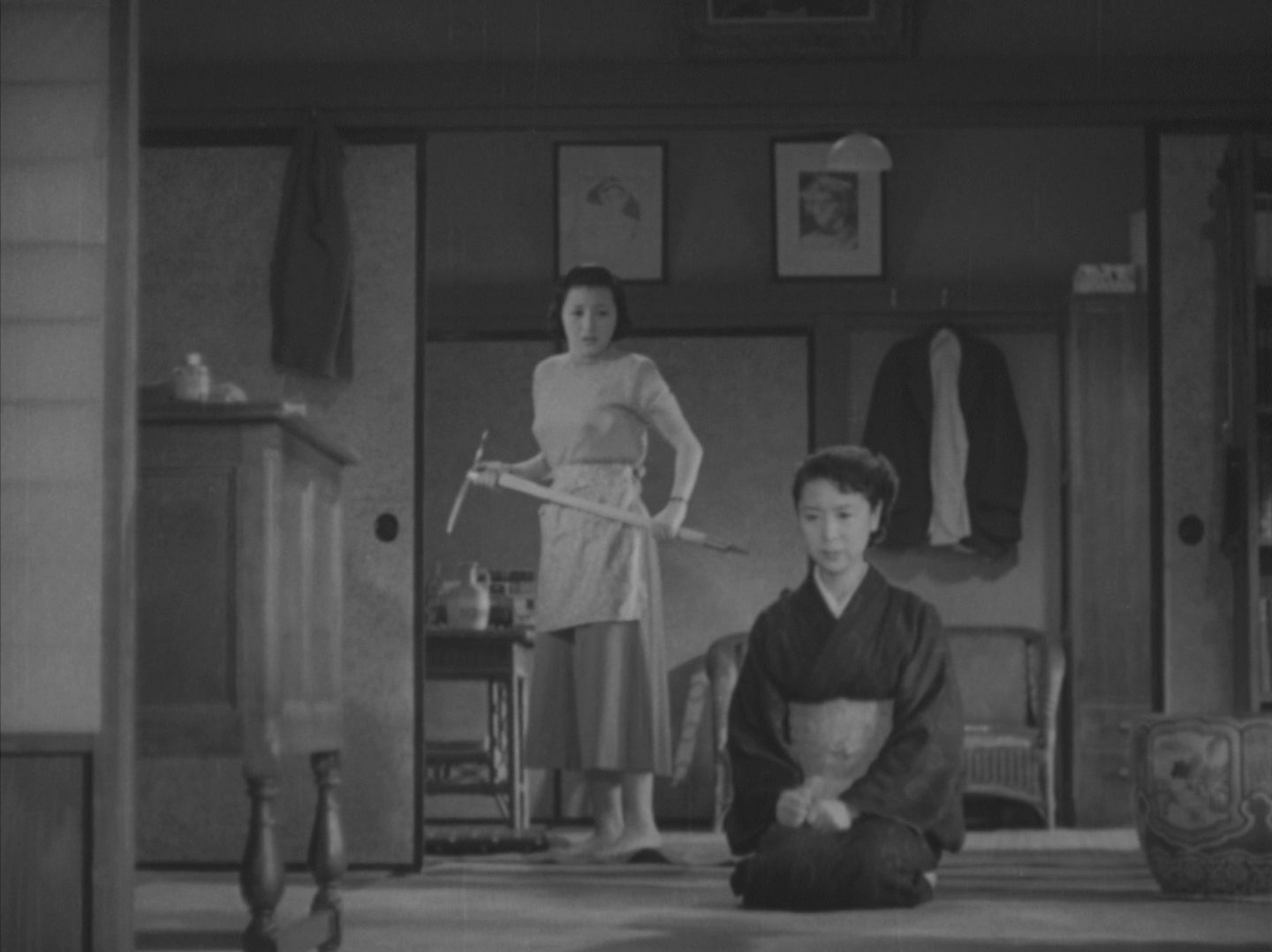
The Munekata Sisters (宗方姉妹, Yasujiro Ozu, 1950)

Though they may eventually turn melancholy, the films of Yasujiro Ozu are often cheerful affairs in which kindhearted people bear life’s troubles with stoic dignity. There are few villains, only those trying to live even while living is hard. The Munekata Sisters (宗方姉妹, Munekata Shimai) adapted from a story by Jiro Osaragi and produced for Shintoho rather than home studio Shochiku, however, strikes a much less happy tone, ambivalently condemning its heroine to unhappiness through her own adherence to the codes it otherwise insists are noble. 

The two titular sisters, Setsuko (Kinuyo Tanaka) and Mariko (Hideko Takamine), live in Tokyo where Setsuko runs a small bar which supports the family while her moody husband Mimura (So Yamamura) has long been out of work. Their father, Mr. Munekata (Chishu Ryu), has returned to Kyoto where, a doctor informs Setsuko in the opening scenes, he is suffering from terminal cancer but surprisingly healthy all things considered. Like his oldest daughter, Kyoto suits Mr. Munekata because as he puts it it is full of the beauty of old Japan, though Mariko has soon had enough of temples and palaces and longs to return to the modernity of the contemporary capital. Whilst in the city, however, they run into an old friend from Manchuria, Hiroshi (Ken Uehara), with whom Mariko soon realises her sister had been in love but he left for France before they could declare their feelings while she was already engaged to her present husband. 

Mariko, a youthful woman dressing exclusively in modern Western fashions, is quite taken with the idea of her sister’s failed romance and determines to get the pair back together. She has only resentment for her moody brother-in-law and has long been aware that Setsuko’s marriage is a failure. Within her seeming modernity, Mariko is surprisingly conservative when it comes to traditional gender roles, resenting Mimura for failing to provide for the family as a man is expected to do. Overcome with despair, he spends his days in a drunken stupor playing with stray cats rather than seriously looking for a job, defined by wounded male pride in his obvious discomfort with the fact that his wife is supporting him through the business that she operates herself. Mariko tells him to man up, tired of the way he leaves each of the women anxious in their own home, but Setsuko, more conservative still, reminds her younger sister that marriage isn’t all sunshine and rainbows and that sometimes all you can do endure. 

Mariko regards her sister’s way of thinking as “old-fashioned”, while Setsuko disapproves of her vacuous “modernity” which she sees as little more than social brainwashing that leads her to blindly follow only what is “fashionable” without thinking for herself. Mr. Munekata had said those who refused to see the beauty in old things were simply “ignorant”, but when asked to arbitrate between the sisters adopts a more equivocal position. You are you and your sister is your sister, he insists, you have your own ways of thinking and neither of you is wrong, you have simply to choose the path which suits you best. He does however caution against Mariko’s “fashionable” mindset, reminding her that it isn’t good to be mindlessly swayed by the prevailing trends, what’s important is to think deeply and value your own life. Those who only do what’s fashionable are boring, he tells her.

Later Mariko describes “modernity” as “not growing old despite the years” perhaps to counter Setsuko’s earlier dismissal that new things never become old because they don’t last. In any case, she is still in many ways a child with an underdeveloped appreciation for complex emotions which might explain why she suddenly proposes to Hiroshi herself as if she means to marry him on her sister’s behalf. She also unfairly takes against a wily widow, apparently a “friend” of Hiroshi’s from Paris who may or may not be in love with him but has obviously not replaced Setsuko in his heart. Setsuko however is conflicted, accepting financial help from Hiroshi to keep the bar open but resentful of her husband’s suggestion there is anything improper between them. She is an “old-fashioned” woman after all. Like What Did the Lady Forget?, Munekata Sisters also posits domestic violence as a reset button on a marriage as Mimura angrily slaps his wife across the face several times, but thankfully here it signals the death knell rather than rebirth of their relationship. Mimura has reasserted his manhood, but it has only shown him just how desperate and empty he has become. His wife no longer has respect for him, let alone love. 

Yet Mimura continues to control her feelings, implying that the failure of the relationship is her fault alone because she never loved him. He has slowly destroyed himself out of resentment and romantic disappointment. It seems that, though he was too cowardly to confess his feelings, Hiroshi has never forgotten his love for Setsuko and the possibility remains that she may be able to claim a happier future through abandoning her “traditional” way of thinking (“fashionable” in its own way), separating from her husband to marry for love. But in the end her code will not allow it. Guilt casts a shadow over her heart, leaving her feeling that she is no longer allowed happiness and must sacrifice her true desires to atone for the failure of her marriage. A glimmer of hope remains in Hiroshi’s determination to wait, trapping himself within the repression of patriarchal social codes, but in the end even Mariko is forced to recognise her sister’s nobility as she too tours the beauty of old Japan without complaint in new contemplation of its ambivalent charms.


That Night’s Wife (その夜の妻, Yasujiro Ozu, 1930)

Most closely associated with his late career family dramas, Yasujiro Ozu has acquired a reputation for geniality which may in a sense be slightly unfair. He was always an astute chronicler of his times, often choosing to view them through the frame of family, and was never as blind to the issues of the day as some would have it. Ozu’s ‘30s work, that which survives at least, is in a sense fiercely political in its critique of the inequalities of the depression-era society. One of his early crime movies, the silent That Night’s Wife (その夜の妻, Sono yo no Tsuma) insists that justice must be done but does so with compassion in its full and total empathy for a man driven to extremes by the depth of his paternal love. 

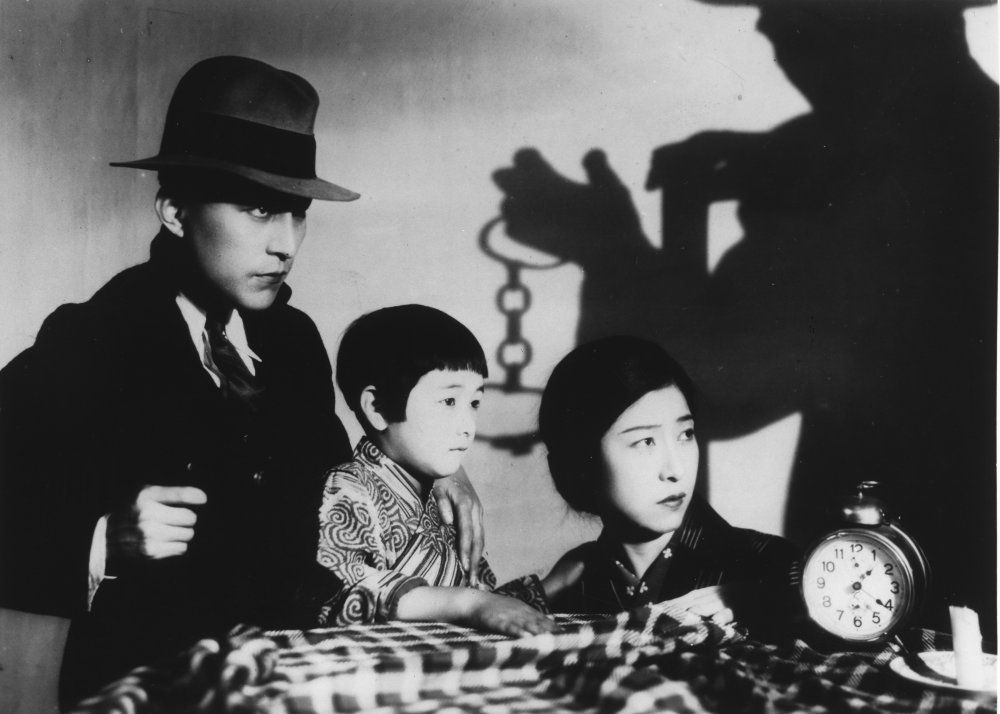
Indeed, the early part of the film is tense noir chase as the hero, desperate father Shuji (Tokihiko Okada), attempts to evade a police dragnet to make his way home after robbing a bank to get money to pay for his sick daughter Michiko’s (Mitsuko Ichimura) medical care. Meanwhile, loyal wife Mayumi (Emiko Yagumo) has been patiently waiting at home tending to the child who refuses to sleep because she only wants her father and constantly asks where he is. Shuji eventually makes it back and tells his horrified wife what he has done, agreeing that he will turn himself in to the police once Michiko is well, but he’s already out of luck. The taxi he darted into was being driven by an undercover cop (Chishu Ryu) who installs himself in the apartment but agrees to wait until the doctor comes in the morning before taking Shuji in. 

Out of keeping with the rest of Ozu’s career but very much in the vein of his depression-era silents, That Night’s Wife concerns a poor but happy family mustering what little resources they have in the face of despair. Filled with tension as the policeman waits impatiently, the camera pans around the one room apartment where the family live and finds it to be a homely, bohemian space, apparently an artist’s studio with foreign film posters and travel souvenirs hanging from the walls. By all indications a starving painter, Shuji is a poor man brought to ruin by accidental tragedy. His daughter is deathly ill and doctors cost money. We can see that, by the standards of the time, he is a very hands on father beloved by his little girl and is obviously willing to sacrifice himself and his future to ensure her survival

It’s Mayumi, however, to whom the film’s title refers and in her role as wife rather than mother. The doctor (Tatsuo Saito) worries that she has not slept in the last few days, how could she when her child is so ill, but it’s she who eventually picks up the gun to protect the family by disarming the policeman and, essentially, keeping him hostage until the morning when, she claims, Shuji will willingly go with him after confirming Michiko’s survival. The world is turned upside down, no one quite plays the role they’ve been assigned. The loving father, an effete artist, turns unconvincing master criminal, the loyal wife gangster’s moll, and the policeman a calm and compassionate guardian deeply moved by the family’s predicament but also knowing that the law must be served. 

In a typically Ozu touch, the policeman pretends to be asleep with the intention of letting Shuji escape, but he once again makes an atypical choice. He refuses to run, swearing off “crazy ideas” but unrepentant in his crime. Shuji determines to pay his debt to society so that he can return home as a redeemed father and hold his daughter as a man unburned by his transgression. The message isn’t so much that crime doesn’t pay as that crime must be paid for. Shuji is acquitted in the moral courts of the audience’s hearts and not even the policeman blames him for what he has done which is all he could do as a father in an oppressive and indifferent society. A strange complicity develops between the two men who are restored to their original roles, both acknowledging that of the other and sorry for what they each know must happen next but already resigned. The father saves his family only through accepting his exile from it, but unlike Ozu’s wandering fathers of the 1930s, seems destined to return after redeeming himself in the eyes of a society which had long since abandoned him. 


Currently streaming in the UK via BFI Player as part of Japan 2020. Also available to stream in the US via Criterion Channel.

The Lady and the Beard (淑女と髭, Yasujiro Ozu, 1931)

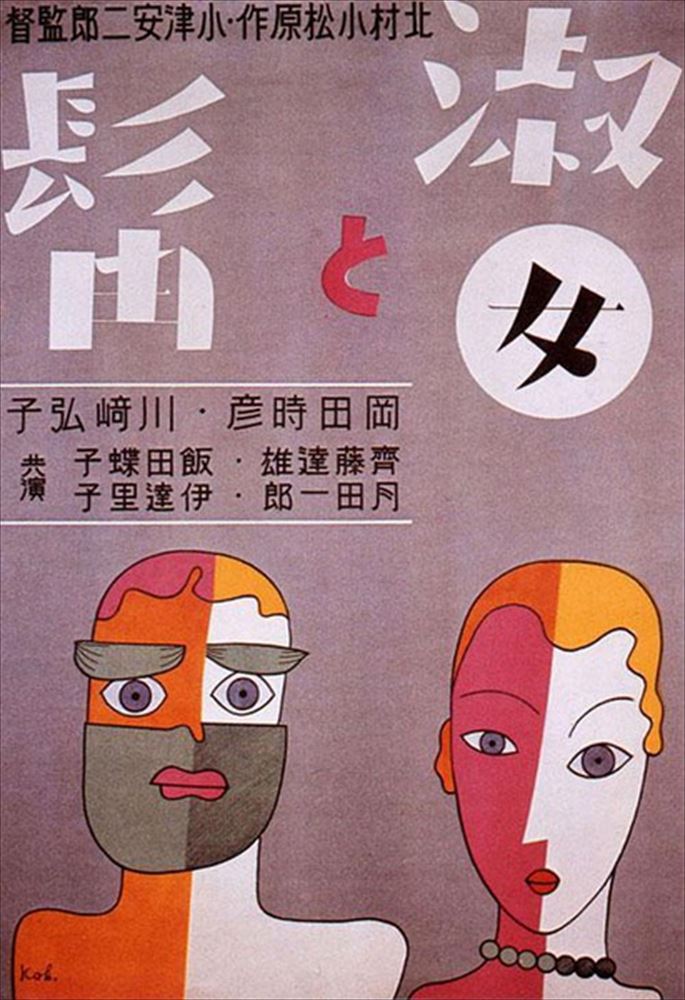
Yasujiro Ozu has sometimes been dismissed as middle of the road, particularly by the young radicals of the post-war generation who saw his, by then, rather conservative films as a symbol of everything they sought to reject in their national cinema. They may in some senses have had a point and, in 1931’s The Lady and the Beard (淑女と髭, Shukujo to hige), Ozu does indeed show us that the middle of the road might be the best place to be as his basically good yet rigidly traditionalist hero is cajoled towards modernity but ultimately rejects its extremes in pulling a “modern girl” back towards the path of righteousness. 

Recent graduate Okajima (Tokihiko Okada) is a kendo enthusiast with a rather unsettling beard which he has long refused to shave. Other than his strangely close friendship with nobleman Teruo (Ichiro Tsukida), he appears to have been rejected by mainstream society because of his odd appearance and socially awkward behaviour. Teruo invites him to his sister’s birthday party without bothering to ask her and consequently scandalises all of her friends who vow to humiliate Okajima as soon as he arrives. Okajima, however, has no idea he is being made fun of. He declines the invitation to dance with the young women in the modern fashion but volunteers to do a dance on his own, prancing about with a fan and waving his sword around in an unexpected display of traditional performance. When Teruo and his sister return after having a private argument, the party is ruined. All the girls have left, for reasons which Okajima seems not to understand. 

He is at least, however, chivalrous. Spotting a young woman in kimono being mugged in the street by a modern girl, he wades in to help, earning her eternal admiration while fending off the other members of the modern girl’s gang with his kendo skills. His heroism further pays off when he discovers that the woman he saved, Hiroko (Hiroko Kawasaki), is a typist at an office where he is interviewing for a job. Hiroko is able to explain to him that the reason he was turned down, despite the fact that the boss also had a big bushy beard, was his facial hair so he should try shaving it off. 

The beard is a symbol not only of Okajima’s traditional mindset but of a certain kind of masculinity which might not be welcome in the modern world. Teruo tries to defend it to his sister by showing her portraits of various great men from the past who all had facial hair while Okajima claims that his is inspired by Abraham Lincoln and is intended to put women off so that he doesn’t get distracted from becoming a great man himself. Okajima’s robust masculinity, avoidance of women, and intense friendship with Teruo, anxious should he get the wrong idea about women in his apartment, might hint at another possibility, but that soon goes out the window when he sheds the beard and instantly becomes irresistible to women. Not only is he developing a romantic relationship with the homely, traditional Hiroko but also becomes attractive to Teruo’s sister Ikuko (Toshiko Iizuka) and the modern girl Satoko (Satoko Date). 

Both Hiroko and Ikuko are attracted to Okajima because of his traditional masculinity in his capacity to protect them. Ikuko, rejecting a suitor who eventually exposes a problematic side to male dominance, tells him that she won’t consider anyone who’s not skilled in kendo because she is looking for a protector. He reminds her that’s what the police and the law are for, so she tells him fair enough, she’ll marry a policeman. Modernity codes “protection” into the system, depersonalised and in other ways perhaps problematic, where traditionalism relies on access to male strength. Ikuko disliked Okajima when he had a beard, but secretly desires those very qualities the beard was set to represent. 

Satoko, meanwhile, the modern girl, rejected Okajima because of his bizarre appearance while he rejects her for the same reason in a mirroring of the various ways we are the image we present. Kimono’d Hiroko is good, modern girl Satoko is bad. Even after shaving his beard, Okajima remains an undercover traditionalist, wearing his kendo clothes under his suit and chivalrous to the end. Not recognising him and possibly in the pay of Teruo trying to put his sister off marriage, Satoko seduces the clean shaven Okajima while he rejects her advances but tries to “save” her from an excess of modernity by getting her away from the gang. She fancies herself in love with him, but what he does is free her from the false image of the modern society to give her back the true freedom of her own agency. In the end he chooses the classically nice, middle of the road option in remaining with Hiroko who loved him with beard and without rather than modern girl Satoko or snooty aristocrat Ikuko. You trim it but it just keeps growing back, the final title card adds, but the message seems to be that too much of one thing be it nationalistic conservatism or hedonistic modernity is no good. The middle way it is, slow and steady and as wholesome as could be.


Currently streaming in the UK via BFI Player as part of Japan 2020. Also available to stream in the US via Criterion Channel.

What Did the Lady Forget? (淑女は何を忘れたか, Yasujiro Ozu, 1937)

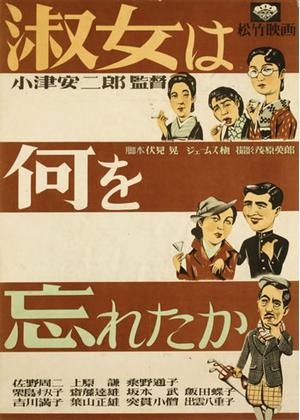
Japan was in a precarious position in 1937. Ozu’s What Did the Lady Forget? (淑女は何を忘れたか, Shukujo wa Nani wo Wasureta ka) was released in March of that year but by July the Second Sino-Japanese War would be in full swing and on the home front increasing censorship would render this kind of inconsequential comedy a much less easy sell. True enough, the film includes no “patriotic” content though it does eventually reinforce a set of patriarchal values in the remasculinisation of a henpecked husband while quietly sniggering at a new bourgeois social class.

The drama unfolds in the home of a medical professor, Komiya (Tatsuo Saito), and his austere wife Tokiko (Sumiko Kurishima). The couple have no children and mostly lead separate lives. Tokiko spends her days with two close friends, widowed single-mother Mitsuko (Mitsuko Yoshikawa), and wealthy older woman Chiyoko (Choko Iida) who is married to her husband’s friend, Sugiyama (Takeshi Sakamoto). The three women gossip about the usual things from fancy department store kimonos to new ways to laugh so you don’t get wrinkles along with the bizarrely difficult maths problems Mitsuko’s son has been studying in preparation for middle-school that none of them can answer. To help with the embarrassingly taxing homework, Tokiko offers to find a tutor, press-ganging her husband’s best student, Okada (Shuji Sano), into spending time with Mitsuko’s son Fujio (Masao Hayama) though it turns out that he too, a college graduate, is unable to solve these middle-school level problems. 

The real drama occurs when the couple’s neice, Setsuko (Michiko Kuwano), whom Tokiko had described as “proper” and “wholesome” rocks up from Osaka having become the epitome of a modern girl. Setsuko’s arrival further strains the Komiyas’ already fraying relationship as her surprising habits which include driving, smoking, drinking, and hanging out with geisha, continue to exasperate her aunt whose main objection to all of those things is that they aren’t appropriate because Setsuko is not yet married. To get away from his nagging wife who forces him to go golfing as usual when he doesn’t really want to, Komiya stashes his clubs with Okada and goes to a bar in Ginza where he meets Sugiyama who has also been forced outside by his wife. Sugiyama really does go golfing, promising to mail a previously written postcard to Tokiko on Komiya’s behalf, while he is eventually joined by Setsuko who has tracked him down to the bar despite being told to stay home and mind the house (the Komiyas have two live-in maids so the instruction seems unnecessary at best).  

As a “modern gal” Setsuko has some strangely old fashioned ideas even as she behaves like a 1930s ladette, striding around like man while drinking, smoking, and generally being almost as intimidating as Tokiko just in a more likeable fashion. Setsuko finds Komiya’s deferral to his wife embarrassing, encouraging him to be more masculine and stand up for himself even advising that he use violence to reassert his position as the man of the house. He seems uncomfortable with the idea but eventually does just that after a climactic argument once his lying about the golf and Setsuko’s nighttime adventures have been exposed. Caught in a moment of frustration, he slaps Tokiko across the face, leaving her to retreat in shock apparently “beaten”. The thing is, however, Tokiko likes it. She sees his slapping her as a sign of his love, as if she’s been needling him all this time in hope of a reaction while frustrated that perhaps he doesn’t care for her. Once he hits her, the marriage is rebalanced and repaired with traditional gender dynamics restored. She becomes more cheerful and deferent to his male authority, he acknowledges that he enabled her “arrogance” with his weakness as a man.  

Setsuko however, continues to shout at her uncle, disappointed that he apologised for his reaction and accusing him of giving away the victory he’d just won. He tells her that he’s simply using reverse psychology because wives like to believe they’re in charge and in the main it’s best to let them. Setsuko seems satisfied, but jokes with her new love interest Okada that he better not use reverse psychology on her. Or, he can, but she’ll just use reverse reverse psychology to get the upper hand, which perhaps undercuts the central message in praise of traditional gender roles. Nevertheless, What Did the Lady Forget? is full of Lubitschy late-30s charms from an unexpected sighting of real life star Ken Uehara at the Kabuki to Setsuko’s movie magazines featuring Marlene Dietrich and repeated references to Frederich March and William Powell proving that Ginza is open even in 1937, while the Komiya household descends into an oddly peaceful harmony of delayed marital bliss. 


Currently streaming in the UK via BFI Player as part of Japan 2020. Also available to stream in the US via Criterion Channel.

Tokyo Chorus (東京の合唱, Yasujiro Ozu, 1931)

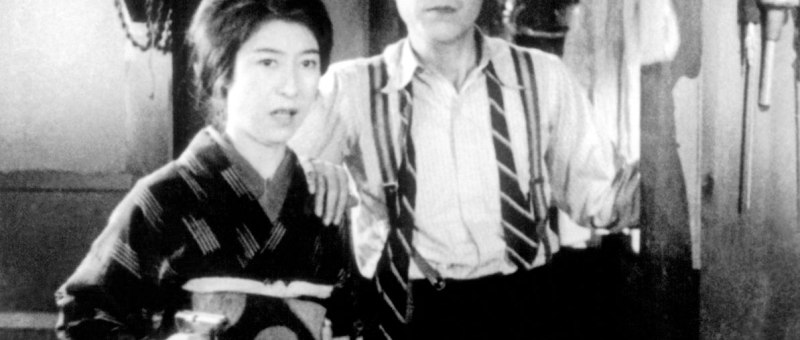
“Tokyo – city of the unemployed” runs a rather unexpected caption part way through Yasujiro Ozu’s depression-era silent comedy, Tokyo Chorus (東京の合唱, Tokyo no Chorus). Putting an unconventional spin on the reality of the contemporary capital, Ozu nevertheless retreats into his favourite themes as good people attempt to remain cheerful in the face of increasing adversity while embracing an often latent interest in class politics as the hero finds himself losing out at the hands of heartless capitalists when he alone is brave enough to stand up for a friend treated unfairly. 

Ozu opens however with an amusing prologue set some years before the main action in which the hero, Okajima (Tokihiko Okada), is a poor student goofing off during a military-style drill. While another boy arrives late to practice and is mocked for having arrived in geta, Okajima’s problem is that he didn’t want to take his jacket off because he isn’t wearing a shirt. A little less well off than some of the others, he brazens things out by ribbing the teacher, Mr. Omura (Tatsuo Saito). Flashforward some years and Okajima has become an insurance clerk, married with three children. His oldest child, a son, is desperate for a bicycle because the other kids have one and as Okajima is supposed to be getting his bonus today, the parents have decided to give in. 

Things do not, however,  go quite to plan. After picking up his pay packet, Okajima gets talking with an old timer who laments he’s just been fired. He thinks it’s because he sold some unlucky policies in which the beneficiary died shortly after signing the paperwork, but it seems obvious to Okajima that they’re firing him because they don’t want to pay his pension. He talks things over with the other employees who all agree it’s unfair, but is the only one brave enough to march into the boss’ office and say so. Unfortunately, Okajima gets nowhere and loses his own job in the proccess. Dejected, he buys his son a much cheaper scooter on the way home but the boy is unimpressed, as is his wife (Emiko Yagumo) when he hands her his notice of termination. 

It is of course a good and proper thing that Okajima stood up for colleague, but he’s lost out because of his pride, smugly explaining to his wife that he was in the right while arguing with his boss and resentfully refusing to admit the irresponsibility of his actions as a husband and a father. Pride becomes a persistent secondary concern as he tries to find another steady job in the economically straitened world of 1931. Despite telling his colleague he envied him for his job as a sandwichboard man and claiming that having a college degree makes him overqualified for casual work, Okajima struggles with himself intellectually knowing that any job will do to feed his family but embarrassed in having to resort to work he feels is beneath him. When he runs into Mr. Omura and he offers to help him with a job in the curry rice restaurant he now owns after retiring from teaching, Okajima is conflicted, telling him he won’t accept help if it’s offered out of pity but only if extended in friendship. When his wife spots him out delivering leaflets, however, she is scandalised and humiliated rather than proud or grateful, only later coming round and agreeing to help out in the Omuras’ restaurant herself. 

Meanwhile, family life is obviously strained by their ongoing financial predicament. When their daughter is taken ill and needs hospital treatment, Mrs. Okajima is upset to discover that her husband sold all her kimonos to pay the fees, their eyes aflash with anger and despair as they put on a brave face for the children but eventually brightening as they continue on with a family game of pat-a-cake. Despite her distress, Mrs. Okaijma maintains faith in her husband and the family is as happy as it can be under the circumstances. At a reunion organised for some of his former students now no longer the rambunctious young men they were at the film’s opening but wistful for the spent freedoms of their youth, Omura makes a toast hoping that everyone continues to prosper through “hard-work and self-reliance”, but it is the mutual solidarity which Okajima showed when he stood up for his mistreated colleague which eventually proves his salvation. Humbled by his experiences, no longer looking down on honest work, he gets the offer of another job which is not quite of the kind he was hoping for, but is perhaps a new start even if it means leaving Tokyo, city of the unemployed, behind for the greener pastures of provincial Tochigi and a simpler, but perhaps kinder, existence.