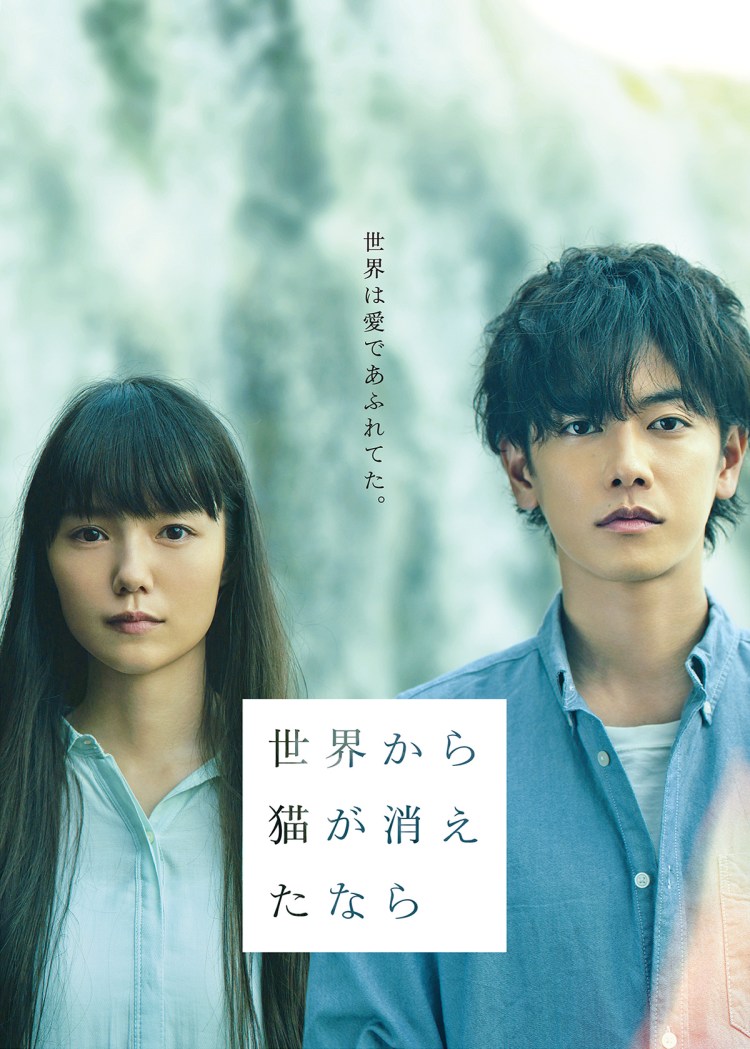
If Cats Disappeared From the World (世界から猫が消えたなら, Akira Nagai, 2016)

If Cats Disappeared from the worldWhat would you give to live another day? What did you give to live this day? What did you take? Adapting the novel by Genki Kawamura, Akira Nagai takes a step back from the broad comedy of Judge for an Iwai-inflected tale of life thrown into sharp relief by impending death. Less a maudlin meditation on the will to life, If Cats Disappeared from the World (世界から猫が消えたなら, Sekai kara Neko ga Kieta nara) is an existential journey into the mind of a man who believed himself an irrelevance, beloved by no one and living an unfulfilling existence, only to rediscover his essential place in the world at the moment he’s about to vacate it.
An unnamed 30 year old postman (Takeru Satoh) has a freak bicycle accident and is subsequently informed that he has an aggressive brain tumour which may take his life at any moment. Following this traumatic news, the postman returns home to discover his own doppelgänger there, waiting for him. The doppelgänger tells him that he will die tomorrow, unless the postman accepts the offer the doppelgänger is about to make him. There are too many unnecessary and irritating things in the modern world, in return for postponing the postman’s death sentence, the doppelgänger will erase one thing from human society – if only the postman will agree.

As in many similarly themed films of recent times, memories are stored not on hard drives or even in notebooks but in seemingly irrelevant objects with unexpected sentimental value. Quite literally “material culture”, it is the objects which provide the path back to the past and their destruction represents not only the severing of a connection but a kind of erasure of the past itself.

The doppelgänger sets about deleting various items at will which might previously have seemed irrelevant to the postman but turn out to have fundamental connections to the most important aspects of his life. The first item to go is phones (all phones, not just mobiles) which reminds him of his first love (Aoi Miyazaki) whom he met after she dialled a wrong number and recognised the score to Fritz Lang’s Metropolis which he happened to be watching at the time. Phones and movies – the second item on the doppelgänger’s hit list, brought the two together but it couldn’t have happened without the cinephile best friend (Gaku Hamada) the postman met at university who has been his movie mule ever since.  Delete the phone and the movies and the postman loses his first love and best friend to win the right to live on alone for just one day. Cats turn out to have an even more essential role in the postman’s life, one which is painful for him to consider but impossible to ignore.

The protagonist’s occupation, which becomes his name and defining feature, is an ironic one. A mere conveyor of items charged with other people’s memories. he feels like an empty vessel, trapped in an existence devoid of meaning. Yet his strange doppelgänger pushes him to reconsider his place in the world, re-entering a sphere he had long absented himself from. Remembering long forgotten yet life changing holidays with the love of his life or finally coming to understand the silent signs of devotion in his emotionally distant father (Eiji Okuda), the postman finally writes his own letter, the first and last of his life, answering the questions he never wanted to ask.

Finally learning to accept his fate, the postman rediscovers the meaning of life. He may leave with regrets and dreams never to be fulfilled, but wants to believe his life has made a difference, meant something at least. Only as he’s about to leave it does the postman feel himself connected to the world, finally noticing the beauty all around him.

On learning of his condition, the postman’s first thoughts turn to all the movies he’ll never see and the books he’ll never read. The doppelgänger’s determination to delete the movies provokes a quietly passionate defence of the arts but, apparently, they are not worth dying for. Nagai films with a low-key dreaminess as magical realism mixes with wistful nostalgia in the melancholy world of a man who has no future finally falling in love with the past. A celebration of the interconnectedness of all things in a world of increasing isolation, If Cats Disappeared from the World advises you make the most of your time, making the difference only you can make before it’s too late.


Hong Kong trailer (English subtitles)

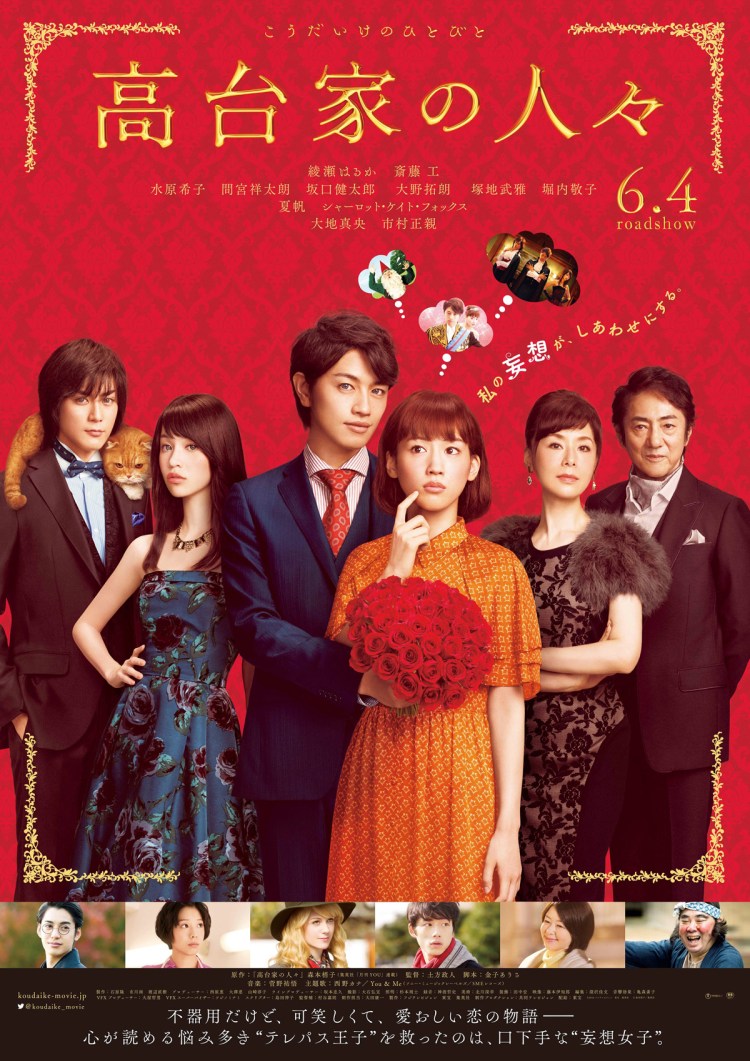
The Kodai Family (高台家の人々, Masato Hijikata, 2016)

kodai family posterFear of “broadcasting” is a classic symptom of psychosis, but supposing there really was someone who could hear all your thoughts as clearly as if you’d spoken them aloud, how would that make you feel? The shy daydreamer at the centre of The Kodai Family (高台家の人々, Kodaike no Hitobito) is about to find out as she becomes embroiled in a very real fairytale with a handsome prince whose lifelong ability to read minds has made him wary of trying to form genuine connections with ordinary people. Walls come down only to jump back up again when the full implications become apparent but there are taller walls to climb than that of discomfort with intimacy including snobby mothers and class based insecurities.
29-year-old Kie (Haruka Ayase) has a dull job as a regular OL in the successful Kodai company. A self-confessed shy person who finds it difficult to talk, Kei spends most of her time alone though she does have a few friends at work. Though Kei’s exterior life may appear dull she has a rich, even overactive imagination which she uses to entertain herself by heading off into wild flights of fancy guided only by a friendly (?) gnome.

Kei’s life begins to change when the oldest son of the Kodai family returns to the office after studying abroad. Mitsumasa (Takumi Saito) is a handsome, if sad-looking man who quickly has all of the office in a flurry of excitement thanks to his dashing good looks and confident stride. Mitsumasa, however, has a secret – the ability to read other people’s thoughts inherited from his British grandmother, Anne. Whilst walking down the corridor and trying to ignore the lewd and avaricious thoughts of some of the ladies (and the worried ones of some of the men now fearing more than one kind of competition), Mitsumasa is treated to one of Kei’s amusing fantasies and is quickly smitten.

For Kei who finds voicing her true feelings difficult, Mitsumasa’s ability seems like the perfect solution. Finally, someone who will just understand her without the need for conversation. However, what Kei hasn’t considered is that a deeper level of intimacy is being asked of her than she’d previously anticipated. From the merely embarrassing to the tactless and tasteless, it is no longer possible to withhold any part of herself other than by an exhausting process of trying to close her mind down completely. Mitsumasa is used to this particular phenomenon in which his enhanced powers of communication only result in additional barriers to connection. Somewhat closed off himself, resigned to the fact he’s going to “overhear” things he’d rather not know, Mitsumasa has made a point of keeping himself aloof from ordinary people who, once they know about his abilities, find him suspicious and threatening.

Yet Mitsumasa’s telepathic powers are not the only obstruction in this fairytale love story. Kei already can’t quite believe what’s happening is real and struggles with the idea someone like Mitsumasa might seriously be interested in her. Though Mitsumasa’s brother (Shotaro Mamiya) and sister (Kiko Mizuhara), who share his ability, are broadly supportive (and equally entertained by Kei’s innocent and quirky flights of fancy), his mother (Mao Daichi) is anything but. Kei’s prospective mother-in-law starts as she means to go on by mistaking Kei for a new maid and then proceeding to further erode her confidence by pointing out that she knows nothing about this upper class world of balls and tennis and horse riding.

When it all becomes too much, Kei does what she always does – retreats to safer ground. Papering over her cowardice with the weak justification that she thinks she’ll only make Mitsumasa miserable, Kei backs away from the idea of baring her whole, unfiltered soul even if she knows it will cost her the man she loves and the ending to her real life fairytale.

Though charming enough and filled with interesting manga-inspired effects, Kodai Family never makes the most of its interesting premise, falling back on standard romantic comedy tropes from parental disapproval to predictable misunderstandings. The irony is that Mitsumasa and his siblings are so busy listening to the thoughts of others that they often can’t hear their own and are so deep in denial that they need a third-party (telepathic or not) to push them into realising how it is they really feel. This is a world of double insulation, in which the walls are both thick and thin, but there is a way a through for those brave enough to kick them down by baring all for love, snobby mothers be damned.


Original trailer (English subtitles)

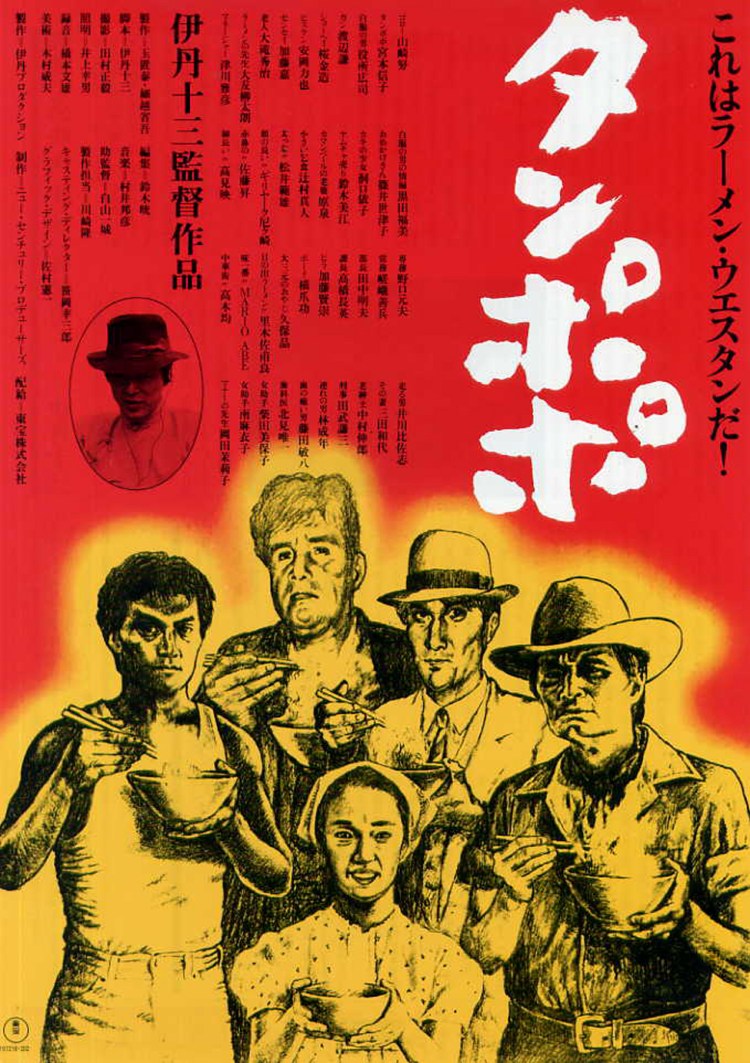
Tampopo (タンポポ, Juzo Itami, 1985)

tampopo posterSome people love ramen so much that the idea of a “bad” bowl hardly occurs to them – all ramen is, at least, ramen. Then again, some love ramen so much that it’s almost a religious experience, bound up with ritual and the need to do things properly. A brief vignette at the beginning of Juzo Itami’s Tampopo (タンポポ) introduces us to one such ramen expert who runs through the proper way of enjoying a bowl of noodle soup which involves a lot of talking to your food whilst caressing it gently before finally consuming it with the utmost respect. Ramen is serious business, but for widowed mother Tampopo it’s a case of the watched pot never boiling. Thanks to a cowboy loner and a few other waifs and strays who eventually become friends and allies, Tampopo is about to get some schooling in the quest for the perfect noodle whilst the world goes on around her. Food becomes something used and misused but remains, ultimately, the source of all life and the thing which unites all living things.
Goro (Tsutomu Yamazaki), a middle-aged man with a fancy hat, and his truck mate Gun (Ken Watanabe), younger, tight white jeans and colourful neckerchief, have become ramen experts thanks to their road bound life. Taking a break during a heavy rain storm, the pair run into a little boy being beaten up by three others and, after scaring the assailants off, escort him into the ramen restaurant where he lives with his widowed mother, Tampopo. Goro and Gun get the stranger in town treatment, but decide to sit down and order a bowl each anyway before a getting into a fight with another diner. Despite her skills as a home cook, Tampopo’s ramen is distinctly second-rate which explains why her business isn’t taking off. Goro and Gun spend some time helping her figure out where she’s going wrong leading Tampopo to beg them to stay, or at least come back when they have time, and teach her what it takes to make the perfect bowl.

Essentially a hybrid between a western and a sports movie, Tampopo has its fair share of training montages as the titular heroine tries to improve her stamina by taking intensive runs, carrying heavy pots of water from one place to another, and constantly trying get her cooking time down to three minutes. The lone woman on the “ranch” that is her restaurant, Tampopo may not be contending with boisterous cattle, threatening neighbours, or disapproving townsfolk but she is being mentored to become her own master as much as anything else. Goro is her strong and silent teacher, but, like Shane, he’s a man not meant to be tied down and is essentially teaching her how to survive alone however painful it may be for him to leave.

This is a fairly radical idea in and of itself. Tampopo’s goal is not another marriage and a man to mind the ranch, but the creation of a successful business which will support both herself and her son built on genuine skills and a lot of hard work. Goro, a ramen aficionado, takes charge but ropes in a few other “experts” to help him including a ramen loving former doctor now living on the streets, the private chef of a wealthy man the gang saved when he almost choked on mochi, and the guy Goro fought with in the beginning who also happens to be a childhood friend of Tampopo nursing a lifelong crush on her.  From each of these men, as well as friendly (or not) rivalry with local competitors, Tampopo learns everything she needs to succeed including the confidence in herself to carry it through.

Whilst Tampopo and co. are busy figuring out the zen of ramen, Itami wanders off for a series of strange vignettes examining more general attitudes to food beginning with Koji Yakusho’s white suited, cinephile gangster who vows bloody murder on anyone daring to eat noisy snacks during the movie. The gangster and his moll eventually retreat to a hotel room where they find new and actually quite strange ways of using food to enhance their pleasure but their story leads us to others in the hotel from a young man stuck in a business meeting who shows up his less cultured colleagues with his culinary knowledge and either doesn’t know or doesn’t care that you’re supposed to order the same as your boss lest you be implying his choice of dish is “wrong”, to a group of young women taking a class in the proper way to eat spaghetti. The instructor (played by veteran actress Mariko Okada), goes to great lengths to explain that it’s considered very uncouth to make any kind of noise whilst eating pasta, only for a westerner of undisclosed nationality to loudly slurp his noodles half way across the room.

While these two episodes showcase the ridiculousness of food etiquette, others take a more surreal direction such as in the strange episode of an old lady who likes to sneak into the local supermarket and torment the clerk by squeezing the fruits, cheeses, and pastries while he chases her round the shop. Here appetites are to be indulged, even if they’re strange, rather than suppressed in favour of someone else’s idea of the proper way to behave. Yet that doesn’t mean that food is something throwaway, to be consumed without thought – in fact, it’s the opposite as Goro’s tutelage of Tampopo shows. Skills alone are not enough, achieving the zen of cookery is a matter of touch and sensitivity, of shared efforts and interconnected strife. Like a dandelion blowing in the wind, Tampopo’s ramen shop gives as it receives, generously and without pretension.


Available now in the UK/US courtesy of Criterion Collection!

Original 1985 trailer (English subtitles)

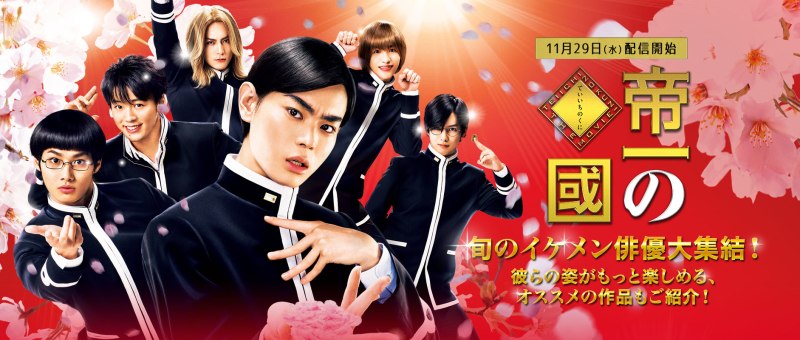
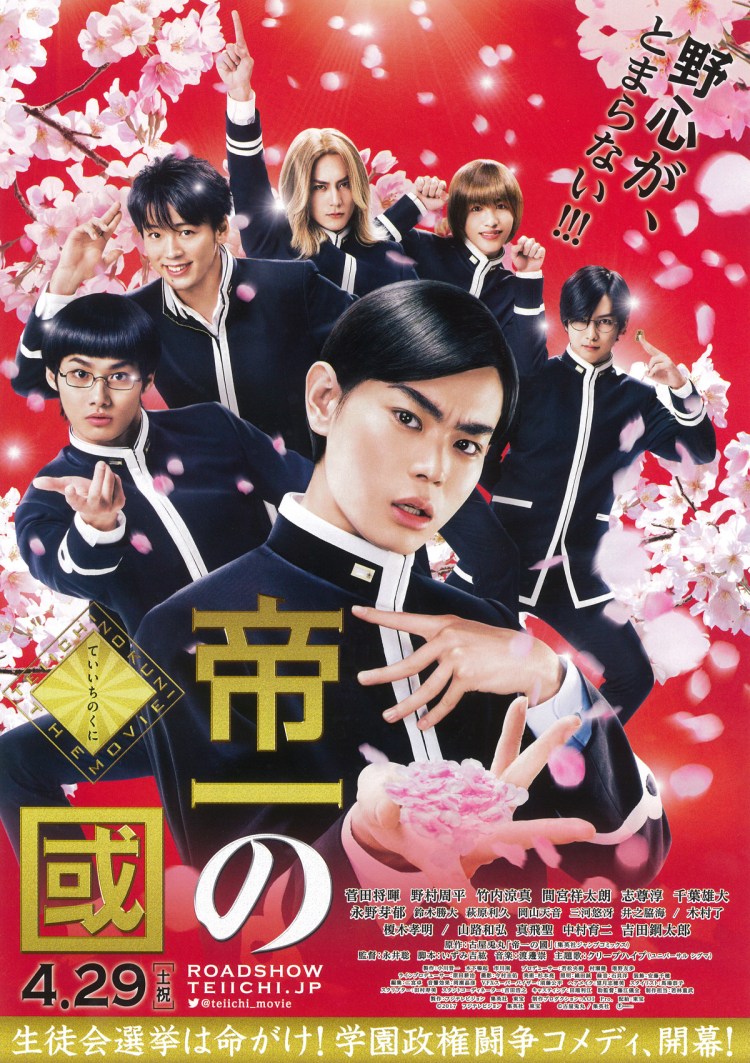
Teiichi: Battle of Supreme High (帝一の國, Akira Nagai, 2017)

teiichiBack in the real world, politics has never felt so unfunny. This latest slice of unlikely political satire from Japan may feel a little close to home, at least to those of us who hail from nations where it seems perfectly normal that the older men who make up the political elite all attended the same school and fully expected to grow up and walk directly into high office, never needing to worry about anything so ordinary as a career. Taking this idea to its extreme, elite teenager Teiichi is not only determined to take over Japan by becoming its Prime Minister, but to start his very own nation. In Teiichi: Battle of Supreme High (帝一の國, Teiichi no Kuni) teenage flirtations with fascism, homoeroticism, factionalism, extremism – in fact just about every “ism” you can think of (aside from altruism) vie for the top spot among the boys at Supreme High but who, or what, will finally win out in Teiichi’s fledging, mental little nation?

Taking after his mother rather than his austere father, little Teiichi (Masaki Suda) wanted nothing more than to become a top concert pianist. Sadly, his father finds music frivolous and forces his son towards the path he failed to follow in becoming a member of the country’s political elite. Thus Teiichi has found himself at Supreme High where attendance is more or less a guaranteed path to Japan’s political centre. If one wants to be the PM, one needs to become student council president at Supreme High and Teiichi is forging his path early by building alliances with the most likely candidates for this year’s top spot. The contest is evenly split between left and right. Okuto Morizono (Yudai Chiba) – a nerdy, bespectacled shogi champ proposes democratic reforms to the school’s political system which will benefit all but those currently enjoying an unfair advantage. Rorando Himuro (Shotaro Mamiya), by contrast, is the classically alluring hero of the right with his good looks, long blond hair and descent from a long line of previous winners.

Teiichi follows his “natual” inclinations and sides with Rorando but a new challenger threatens to change everything. Dan Otaka (Ryoma Takeuchi) is not your usual Supreme High student. A scholarship boy, Dan comes from a single parent family where he helps out at home taking care of his numerous younger siblings. From another world entirely, Dan is a good natured sort who isn’t particularly interested in politics or in the increasingly tribal atmosphere of Supreme High. What he cares about is his friends and family. Principled, he will do what seems right and just at the expense of the most politically useful.

For all of its posturing and petty fascist satire, there’s something quite refreshing about the way Battle of Supreme High posits genuine niceness as an unlikely victor. Teiichi, a politician through and through, has few real principles and is willing to do or say whatever it takes to play each and every situation for its maximum gain. Finding Morizono’s old fashioned socialism naive and wishy washy, he gravitates towards Rorando’s obviously charismatic cult of personality but Dan’s straightforward goodness eventually starts to scratch away at Teiichi’s attempt to put up a front of amorality.

The fascist overtones, however, run deep from the naval school uniforms to the enthusiastic singing of the school song and highly militarised atmosphere. Played for laughs as it is, the school’s defining characteristic is one of intense homoerotism as pretty boys in shiny uniforms flirt with each other in increasingly over the top ways. Teiichi does have a girlfriend (of sorts) who protects, defends, and comforts him even while able to see through his megalomaniacal posturing to the little boy who just wanted to play piano but he’s not above exploiting the obvious attraction his underling, Komei (Jun Shison), feels for him as part of his grand plan.

Teiichi has its silliness, but its satire is all too convincing as these posh boys vie for the top spots, reliving the petty conflicts of their fathers and grandfathers as they do so. No one one has much of a plan or desire to change the world, this is all a grand game where the winner gets to sit on the throne feeling smug, but then Teiichi’s nimble machinations hopping from one front runner to the next rarely pay off even if he generally manages to keep himself out of the line of fire. Rather than cold and calculating politics, the force most likely to succeed becomes simple sincerity and the unexpected warmth of a “natural” leader.


Teiichi: Battle of Supreme High was screened at the 19th Udine Far East Film Festival.

Original trailer (no subtitles)

Hirugao – Love Affairs In The Afternoon – (昼顔, Hiroshi Nishitani, 2017)

hirugao posterHiroshi Nishitani has spent the bulk of his career working in television. Best known for the phenomenally popular Galileo starring Masaharu Fukuyama which spawned a number of big screen spin-offs including an adaptation of the series’ inspiration The Devotion of Suspect X and Midsummer’s Equation, Nishitani has also brought his admittedly cinematic eye to other big screen transfers of small screen hits from Beautiful World to the European set Amalfi: Rewards of the Goddess and Andalucia: Revenge of the Goddess. Hirugao – Love Affairs in the Afternoon – (昼顔, Hirugao), is no exception to this trend and acts as a kind of sequel to a TV drama in which an unhappy housewife indulged in an intense yet doomed affair with a married schoolteacher. An old-fashioned romantic melodrama, Hirugao knows where it stands when it comes to conventional morality but is content to put its unhappy lovers through the ringer before meting out its judgement.
Three years after a passionate affair with her beloved professor Kitano (Takumi Saito), Sawa (Aya Ueto) has lost everything. She got a divorce, but Kitano went back to his wife and the terms of the settlement state that she is never to see, talk to, or in any way communicate with him ever again. Hoping to move on with her life, Sawa has done what many in her situation do and moved to a remote seaside town where no one knows her name, her history, or just why it is she looks so sad.

Eventually getting a job in a small cafe despite the obvious hostility of the long-standing staff, Sawa is making a go of things but no matter how hard she tries, she can’t get Kitano out of her mind. Only half alive Sawa lives out her days until one fateful afternoon she spots an advert for a lecture on fireflies – Kitano is coming to town. Sitting in the back, hunched down trying not to be seen Sawa listens to her lost love speak but accidentally catches his eye, once again sparking their long paused romance. Chasing, missing each other, retreating and advancing the pair eventually meet and go about the business of observing the local fireflies independently yet in the same space – obeying the terms of the settlement, at least in spirit. Gradually their old feelings resurface but Kitano stills goes home to his wife every day and a second chance for love after such a final judgement may require more than a simple act of faith.

Told more or less from the point of view of the unhappy Sawa, Hirugao’s main purpose is an exploration of her ongoing pain and inability to put the past behind her despite having moved to an unfamiliar place filled with unfamiliar faces. Not universally well liked by all on arrival, the cafe staff including a grumpy older woman and a cheerful if gossipy younger one eventually get used to Sawa though they both seem to resent the cafe owner’s affection for her. Later on, Sawa makes a critical mistake. She tells someone she thinks she can trust about her past – the affair, the divorce, her broken heart, and the frustrating possibility of starting a new life with a man who only ever half leaves his wife. Soon, the rumour gets out and Sawa might as well have painted a large red A on her forehead. Now she’s a hussy and a home wrecker, the women in the cafe want her out, the people in the market won’t serve her, and the cafe owner who was chasing her before suddenly turns cold.

This may not be the era of crucified lovers in which adultery is punishable by death, but it might as well be for all the unpleasantness Sawa must endure after being unmasked as someone who’s broken all the rules of social convention. Against the odds, the fuss dies down, her friends start to get over it and perhaps even like her a bit more now they know what it was that made her so closed off and mysterious – one even admits her anger was largely driven by personal regret over not pursuing the man she loved in her youth because he was already married and so she resented Sawa for having the courage to do what she never could. Sawa only wants one thing – to be with Kitano, and she’s willing to endure anything to stay by his side.

Kitano, however, is the nice kind of coward. Not wanting to hurt anyone he hurts everyone by keeping one foot with his wife and the other with Sawa. Though Sawa’s husband is well out of the picture, Kitano’s wife Noriko (Ayumi Ito) is descending into madness through jealousy and paranoia, unwilling to let her husband go. Having been one half of an adulterous couple, Sawa knows she can’t trust Kitano even if she loves him and soon enough jealousy, fear, and doubt begin to pollute their otherwise happy romance.

Illicit love cannot be allowed to succeed, there is always a price. Like the cruel flip side of jun-ai where fate cuts true love short before it’s allowed to turn sour, the furies are en route to deliver retribution to those who try to steal happiness by pursuing personal desires rather than adhering to social convention. Nishitani films with picturesque grandeur, capturing the sun-baked seaside town of Mihama in all its summery warmth and frosty hostility. An old-fashioned melodrama filled with grand emotions and overwrought symbolism, Hirugao is guilty of nothing so much as taking itself too seriously but nevertheless there is poetry in its pain even if the bitterly ironic closing coda seems to imply that love is a never-ending cycle of inescapable suffering.


Hirugao – Love Affairs in the Afternoon – was screened at the 19th Udine Far East Film Festival.

Original trailer (no subtitles)

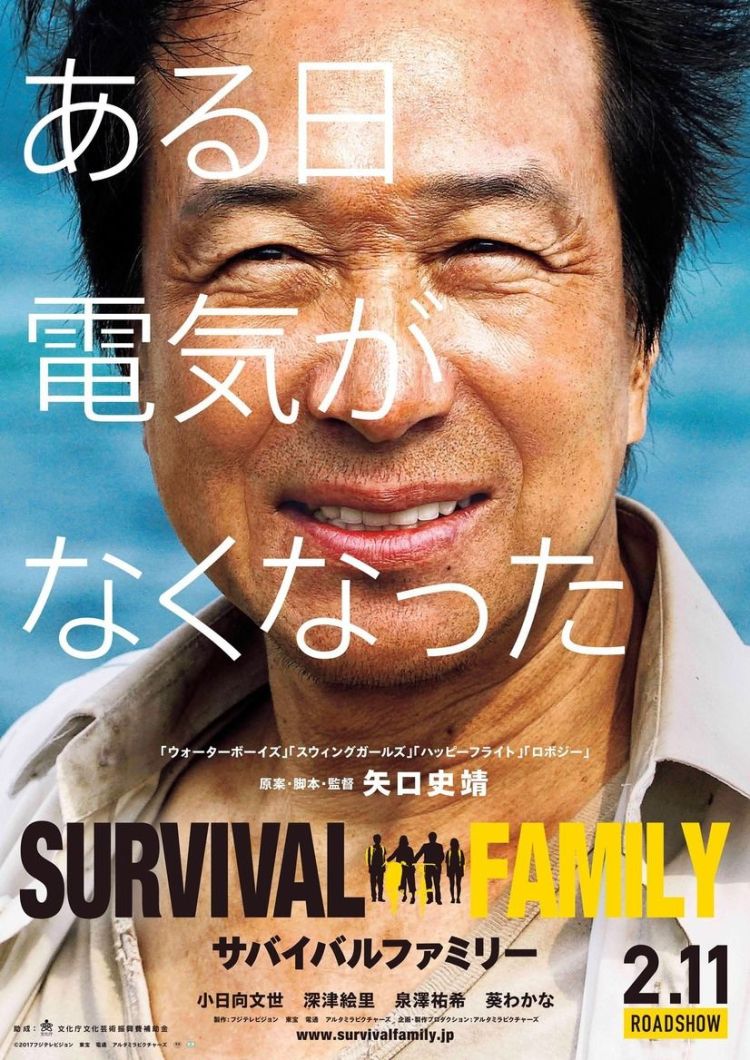
Survival Family (サバイバルファミリー, Shinobu Yaguchi, 2017)

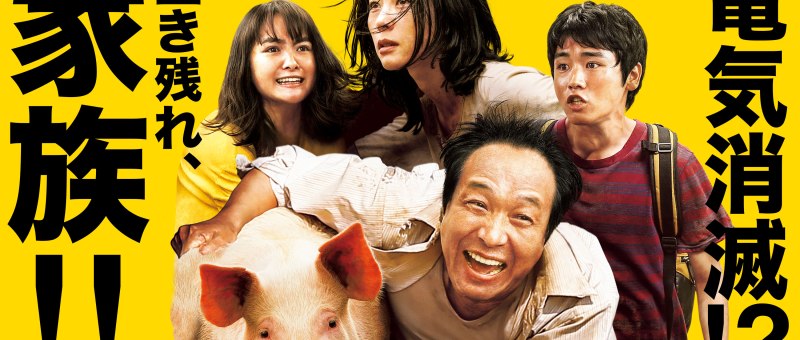
survival family posterModern life is full of conveniences, but perhaps they come at a price. Shinobu Yaguchi has made something of a career out of showing the various ways nice people can come together to overcome their problems, but as the problem in Survival Family (サバイバルファミリー) is post-apocalyptic dystopia, being nice might not be the best way to solve it. Nevertheless, the Suzukis can’t help trying as they deal with the cracks already present in their relationships whilst trying to figure out a way to survive in the new, post-electric world.

Receiving a package from grandpa fills the Suzukis with horror more than gratitude. Mum Mitsue (Eri Fukatsu) can’t bring herself to cut the head off a fish and the sight of the giant bug that crawls out of the lettuce is just too much to bear. Her teenage daughter, Yui (Wakana Aoi), is not very excited either, tapping her smartphone with her fake nails, while her son Kenji (Yuki Izumisawa) spends all his time alone in his room with headphones permanently attached. Mr. Suzuki, Yoshiyuki (Fumiyo Kohinata) – the family patriarch, is a typical salaryman, obsessed with work and often in bed early.

All that changes one day when Yoshiyuki’s alarm clock does not go off. There’s been a power outage – nothing works, not the TV, not the phone, not even the tower block’s elevator. Being the salaryman champ he is, Yoshiyuki tries to make it into to work in other ways but the power’s out across the city and there’s nothing to be done. Everyone is sure the power will come back on soon, but days pass with the consequences only increasing as supermarket shelves become bare and water frighteningly scarce. After his boss decides to take his chances in the mountains and a neighbour dies as a direct result of the ongoing power shortage, Yoshihyuki decides to take the family on the road to find Mitsue’s country bumpkin father in the hope that he will have a better idea of how to survive this brave new world.

Yaguchi is quick to remind us all of the ways electricity defines our lives, even if we’ve begun to forget them. Not only is it a question of mobile phones being out and lifts being out of order, but gas appliances are also electric ignition as are the pumps which drive the water system. So used to the constant stream of electricity, no one quite realises what its absence means hence Yoshiyuki’s big idea is to get a plane from Haneda airport. Ridiculous as it may seem, he’s not the only one to have underestimated the part electricity plays in flight and the aviation industry as the airport is swamped by people trying to escape the rapidly disintegrating city. Credit cards no longer work leading to long checkout lines as the old ladies with their abacuses make a startling return to checkouts while bemused shoppers attempt to use the ATM machine to get more cash.

Cash itself still has worth, at least for a time. Eventually the barter system takes over as food and water become top price commodities. A very flash looking man tries to trade genuine Rolex gold watch and later the keys to his Maserati for food but is roundly informed that none of his hard won prizes is worth anything in this new back to basics era. Thanks to Mitsue’s housewife skills of frugality and haggling, the family are able to get themselves a small stockplie of resources but find themselves tested when the less fortunate ask them for help.

The crisis brings out both the best and the worst in humanity. As the family make their escape from the city on a series of bicycles, they pass a succession of salesmen all upping the price of bottled water by 100% each time. Profiteering is rife as the unscrupulous procure ordinary foodstuffs to be sold for vast amounts of money. Yet the Suzukis rarely find themselves on the wrong side of trickery and even encounter a few kindly souls willing to help them on their journey such as a gang of cycle wear clad survival experts and a very forgiving farmer who takes the family in when they help themselves to one of his escaped pigs (a sequence which allows Yaguchi to go on another Swing Girls-style pig chase only without the slo-mo and classical music).

Forced to reconnect, the family become closer, gradually coming to know and accept each other whilst finding new and unknown talents. Living simply and harmoniously has its charms, ones that don’t necessarily need to disappear if the power ever comes back on. The only certainty is that you can’t survive alone, and who can you count on if you can’t count on family?


Screened as the opening night movie of the Udine Far East Film Festival 2017.

Original trailer (English subtitles)

The Secret of the Telegian (電送人間, Jun Fukuda, 1960)

The-Secret-of-the-Telegian-images-df0ac23f-302b-4e88-8ec7-5423f55f51cPlaced between The H-Man and the Human Vapor, The Secret of the Telegian (電送人間, Denso Ningen) is another in Toho’s series of “mutant” movies in which “enhanced” humans find themselves turning monstrous because of ill-advised scientific endeavours. Like many in the series, Telegian has an ambivalent attitude towards scientific research, both proud and fearful. This might be 1960, but the roots of the threat once again stem back to wartime crimes and the impossibility of trust as a man long thought dead teleports himself out of his fictitious grave to wreak a terrifying and bloody revenge on those who have wronged him.

People running screaming out of the “Cave of Horrors” might not be such an unusual sight but this time it’s not papier-mâché ghosts or fancy tricks which have produced such a reaction but a real life bloody murder. The dead man, Tsukamoto, has the end of a bayonet in his chest and a cryptic letter in his pocket asking him to come to this very spot in order to learn “the truth about what happened 14 years ago”. The police are baffled, as is science journalist Kirioka (Koji Tsuruta) who is excited to discover a strange wire at the crime scene. Eventually, the trail leads to a nationalistic, military themed cabaret bar run by former lieutenant Onishi (Seizaburo Kawazu).

The bar is more or less a front for Onishi’s smuggling operation but what has him worried is that a former associate, Taki (Sachio Sakai), may think that he and another former solider, Takahashi, may have reclaimed some stolen gold and declined to share the proceeds. Onishi, Takahashi, and Taki have all received ominous gold discs which seems to point back to their failed bid to pocket some of the Emperor’s gold during the last days of the war. Charged with looking after a top scientist working on teleportation technology, Onishi decided he’d rather have the cash instead stooping so low as to kill both the researcher, Nikki (Takamaru Sasaki), and one of his subordinates who tried to stop him – Tsudo (Tadao Nakamaru). The gang were interrupted stealing the gold but went back a year later only to find the bodies and the treasure vanished without a trace.

Tsudo, now living under an alias, is hellbent on revenge not only against the men who left him for dead but indirectly against their entrenched treacheries as betrayers of their duty, country, and morality. Unlike the the villain of The Invisible Man Vs Human Fly, Tsudo is not among those who feel themselves betrayed or abandoned by their country, left out in the cold in the new post-war world, but one who has a deep seated need to make those who’ve wronged him pay for their treachery. Onishi’s strange militarism themed bar only adds insult to injury given his extremely unpatriotic conduct, though it is perhaps in keeping with the traditionally opportunist nature of nationalists throughout history.

Despite the familiar setup, the science takes a back seat as Fukuda pushes the procedural over the sci-fi and so it remains unclear to what extent, if any, the presence of the teleportation equipment is responsible for Tsudo’s strange behaviour. The teleporting Tsudo is, it has to be said, an odd man. Turning up to complain about late deliveries of the refrigeration equipment he needs for the special metals involved in the experiments,  Tsudo’s manner is creepy in the extreme, robotic yet somehow malevolent. Predictably he develops a fondness for the saleswoman, Akiko (Yumi Shirakawa), who coincidentally lives near to the first murder victim and also becomes the love interest of intrepid reporter Kirioka.

Fukuda keeps things simple over all, stopping to pay an extensive homage to Jacques Tourneur’s Cat People, though there’s a wry sense of humour at play in the bizarre fairground beginning and odd production elements such as the incongruous club and its dancing girls who are, ironically enough, entirely painted in gold. Eiji Tsuburaya’s involvement is largely limited to the transportation effect which is extremely impressive in its execution and has an appropriately unsettling feeling. Not quite as coherent as other examples of its genre, The Secret of the Telegian has a slight tonal oddity in its almost nationalistic discussion of false nationalism, literally taking aim at those who preach patriotism yet cynically betray their country, robbing it not just literally but spiritually. Even so, Fukuda’s take on the mutant formula has enough tongue in cheek humour and sci-fi inflected drama to keep most genre fans happy.


Original trailer (no subtitles)

Latitude Zero (緯度0大作戦, Ishiro Honda, 1969)

latitude zero1969. Man lands on the moon, the cold war is in full swing, and Star Trek is cancelled prompting a mass write-in campaign from devoted sci-fi enthusiasts across America. The tide was also turning politically as the aforementioned TV series’ utopianism came to gain ground among liberal thinking people who rose up to oppose war, racial discrimination and sexism. It was in this year that Godzilla creators Ishiro Honda and Eiji Tsuburaya brought their talents to America with a very contemporary take on science fiction in Latitude Zero (緯度0大作戦, Ido Zero Daisakusen). Starring Hollywood legend Joseph Cotten, Latitude Zero gives Jules Verne a new look for the ‘60s filled with solid gold hotpants and bulletproof spray tan.
International scientists Dr. Ken Tashiro (Akira Takarada) and Dr. Jules Masson (Masumi Okada) are in the middle of a bathysphere alongside American reporter Perry Lawton (Richard Jaeckel) when a volcano suddenly erupts. Rescued by a passing sub, the team soon notice there’s something very strange about this serendipitous crew. To begin with, the doctor treating their injuries is a svelte young blonde woman in a skimpy outfit, and then there’s that plaque on the bridge which says the boat was launched in 1805, and why won’t Captain McKenzie (Joseph Cotten) tell them which country this very expensive looking rig belongs to?

All these questions will be answered in due course but the major revelation concerns the futuristic city of Latitude Zero – a secret underwater world where top scientists and other skilled people who have been “disappeared” from the surface conduct important research free of political constraints. Despite the peace and love atmosphere, Latitude Zero is not without its villains as proved by exile Malec (Cesar Romero), McKenzie’s arch nemesis who has set out to kidnap a prominent Japanese scientist before he can make his way to the city. Malec is hellbent on taking McKenzie down and has drifted over to the scientific dark side by conducting brain transplant experiments to create his own army of bizarre creatures to do his bidding.

There may be a cold war going on but Latitude Zero is more or less neutral when it comes to its position on science and scientists though when push comes to shove it leans towards negative. Malec, played by Batman’s Ceasar Romero, is a moustache twirling villain of the highest order who will even stoop to transplanting the brain of his own lieutenant into a lion as well as making other strange creatures like giant rats and weird bats to try and destroy McKenzie’s enterprises yet those enterprises are the entire reason for the existence of Latitude Zero. Towards the end of the adventure, Lawton points out to McKenzie that his world is essentially selfish, stealing all the best minds for his underwater paradise and secreting their discoveries away rather than sharing them with the the surface. McKenzie sympathises but deflects his criticism with the justification that mankind is currently too volatile and divided to take part in his project, though they do try to drip feed the essentials all in the name of making the world a better place.

Lawton further shows himself up by trying to loot Latitude Zero which has an abundant supply of diamonds it barely knows what to do with. What is does with them is experiment – jewels are worthless baubles here, the value of the diamonds is purely practical. Similarly, they have a taste for solid gold clothing which might explain the skimpiness of their outfits were it not for the fact the precious metal holds no other value than being stylish.

Unlike other subsequent US co-productions such as Fukasaku’s Virus, Latitude Zero was filmed in English with the Japanese cast providing their own English language dialogue (with various degrees of success). A second cut running fifteen minutes shorter was later prepared for the Japanese market with the entire cast dubbed back into Japanese and dropping McKenzie’s often unnecessary voice over. Given a relatively high budget, Honda and Tsuburaya once again bring their unique production design to life with intricate model shots and analogue effects complete with a selection of furry monsters even if they’re operating on a level that owes much more to Star Trek than Godzilla. It’s all very silly and extremely camp but good clean fun with a slight layer of political subversiveness which displays a noted ambivalence to the neutrality of utopia even whilst hoping for the day when the world will finally be mature enough to pursue its scientific destiny without polarised politics getting in the way.


Original trailer (English version)

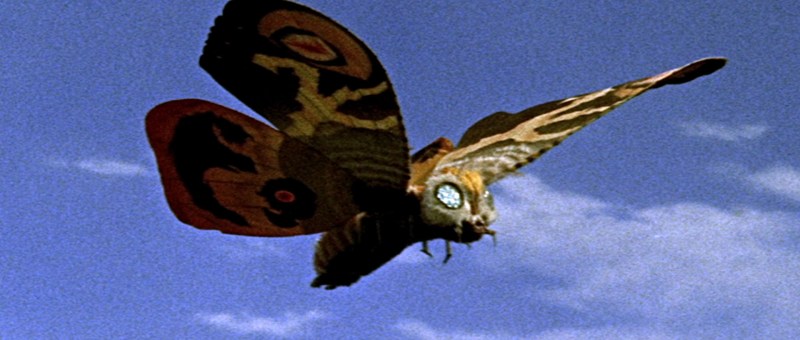
Mothra (モスラ, Ishiro Honda, 1961)

mothra-poster.jpgJapan’s kaiju movies have an interesting relationship with their monstrous protagonists. Godzilla, while causing mass devastation and terror, can hardly be blamed for its actions. Humans polluted its world with all powerful nuclear weapons, woke it up, and then responded harshly to its attempts to complain. Godzilla is only ever Godzilla, acting naturally without malevolence, merely trying to live alongside destructive forces. No creature in the Toho canon embodies this theme better than Godzilla’s sometime foe, Mothra. Released in 1961, Mothra does not abandon the genre’s anti-nuclear stance, but steps away from it slightly to examine another great 20th century taboo – colonialism and the exploitation both of nature and of native peoples. Weighty themes aside, Mothra is also among the most family friendly of the Toho tokusatsu movies in its broadly comic approach starring well known comedian Frankie Sakai.

When a naval vessel is caught up in a typhoon and wrecked, the crew is thought lost but against the odds a small number of survivors is discovered in a radiation heavy area previously thought to be uninhabited. The rescued men claim they owe their existence to a strange new species of mini-humans living deep in the forest. This is an awkward discovery because the islands had recently been used for testing nuclear weapons and have been ruled permanently uninhabitable. The government of the country which conducted the tests, Rolisica, orders an investigation and teams up with a group of Japanese scientists to verify the claims.

Of course, the original story of the survivors was already a media sensation and so intrepid “snapping turtle” reporter Zen (Frankie Sakai) and his photographer Michi (Kyoko Kagawa) are hot on the trail. Zen is something of an embarrassment to his bosses but manages to bamboozle his way into the scientific expedition by stowing away on their boat and then putting on one of their hazmat suits to blend in before anyone notices him. Linguist Chujo (Hiroshi Koizumi) gets himself into trouble but is saved by two little people of the island who communicate in an oddly choral language. Unfortunately, the Rolisicans, led by Captain Nelson (Jerry Ito), decide the helpful little creatures are useful “samples” and intend to kidnap them to experiment on. Refusing to give up despite the protestations of the Japanese contingent, Nelson only agrees to release the pair when the male islanders surround them and start banging drums in an intimidating manner.

The colonial narrative is clear as the Rolisicans never stop to consider the islanders as living creatures but only as an exploitable resource. Nelson heads back later and scoops up the two little ladies (committing colonial genocide in the process) but on his return to Japan his intentions are less scientific than financial as he immediately begins putting his new conquests on show. The island ladies (played by the twins from the popular group The Peanuts, Yumi and Emi Ito) are installed in a floating mini carriage and dropped on stage where they are forced to sing and dance for an appreciative audience in attendance to gorp.

Zen and Michi may be members of the problematic press who’ve dubbed the kidnapped islanders the “Tiny Beauties” and helped Nelson achieve his goals but they stand squarely behind the pair and, along with linguist Chujo and his little brother Shinji (Masamitsu Tayama), continue to work on a way to rescue the Tiny Beauties and send them home. The Tiny Beauties, however, aren’t particularly worried because they know “Mothra” is coming to save them, though they feel a bit sad for Japan and especially for the nice people like Zen, Michi,  Chujo, and Shinji because Mothra doesn’t know right from wrong or have much thought process at all. 100% goal orientated, Mothra’s only concern is that two of its charges are in trouble and need rescuing. It will stop at nothing to retrieve them and bring them home no matter what obstacles may be standing in the way.

The island people worship Mothra like a god though with oddly Christian imagery of crosses and bells. Like many of Toho’s other “monsters” it is neither good or bad, in a sense, but simply exists as it is. Its purpose is to defend its people, which it does to the best of its ability. It has no desire to attack or destroy, but simply to protect and defend. The villain is humanity, or more precisely Rolisica whose colonial exploits have a dark and tyrannical quality as they try to insist the islands are uninhabited despite the evidence and then set about exploiting the resources with no thought to the islanders’ wellbeing. The Japanese are broadly the good guys who very much do not approve of the Rolisicans’ actions but they are also the people buying the tickets to see the Tiny Beauties and putting them on the front pages of the newspapers. Nevertheless, things can only conclude happily when people start respecting other nations on an equal footing and accepting the validity of their rights and beliefs even if they include giant marauding moth gods.


Original trailer (no subtitles)

Battle in Outer Space (宇宙大戦争, Ishiro Honda, 1959)

battle in outer spaceIshiro Honda returns to outer space after The Mysterians with another dose of alien paranoia in the SFX heavy Battle in Outer Space (宇宙大戦争, Uchu Daisenso). Where many other films of the period had a much more ambivalent attitude to scientific endeavour, Battle in Outer Space paints the science guys as the thin white line that stands between us and annihilation by invading forces wielding superior technology. Far from the force which destroys us, science is our salvation and the skill we must improve in order to defend ourselves from hitherto unknown threats.

In 1965 Japan is a hit in space. Having launched their first space station, things are going well but after it is destroyed by flying saucers there is cause for concern. The problem intensifies as strange events occur across the Earth with bridges suddenly collapsing, boats being lifted from the sea and the waters of Venice conspiring to drown the town. World leaders gather in Tokyo to come up with a plan but one of the scientists’ key assets, Iranian professor Dr. Ahmed, is possessed by the Natalians via their high-tech remote control radio waves and procedeeds to do their dirty work for them. The Natalians will settle for nothing less than enslavement of the entire planet and have even set up a base on the moon to make it happen! Time to put those shiny new spaceships to good use!

Scientists may be the heroes of this particular story but the scientific basis for their actions is just as silly as your average B-movie. According to our top professor, the Natalians’ anti-gravity shenanigans can be put a stop to by means of a freeze ray – gravity is, of course, caused by the movement of atoms which is impeded by cold hence the freeze ray. A likely story, but it’s the best they’ve got. The other major problem is that the Natalians are able to possess various people and force them to do their bidding, apparently through “radio waves”. Less about the enemy within, the possibility of becoming a Natalian sleeper agent is more plot device than serious philosophical discussion.

Battle in Outer Space is, in this sense at least, one of the most straightforward of Toho’s B-movie leaning SFX extravaganzas. There is little hidden message here bar the importance of international collaboration as the whole world comes together to fight the alien threat – Middle Eastern and Indian scientists are at the forefront of research and Japan leads the charge flanked by Americans one side and Russians on the other.

Our intrepid band of scientists are the vanguard sent to see off the Natalian threat by jetting off into space and fighting them in their own territory. Honda and Tsuburaya outdo themselves with the special effects which are pretty astounding for 1959 making use of large scale models and matt painting. The scientists travel to the moon to look for the Natalians’ base only to encounter them in space and engage in exciting dogfight. Eventually landing they meet the Natalians face to face and discover they are very tiny and sort of cute but also hellbent on enslaving the Earth. Engaging them in a firefight using heat rays and laser guns, the scientists manage to escape but the Natalian threat follows them all the way back to Tokyo. In true Toho fashion, buildings are destroyed and people knocked flying as the Natalians take the city but our brainy scientists have thought of that and so the aliens have a whole barrage of heat ray guns to welcome them to Earth.

Battle in Outer Space might not have an awful lot going on in the background, but it makes up for it with sheer spectacle both in its effects and in production design. The Natalians are a scary bunch, until you actually meet them, but this time science is on our side as the good guys manage to figure out a way to save the Earth rather than destroy it through fear and angst. In the end it is determination and togetherness which finally lets the Natalians know humanity is not a good prospect for colonisation, only by coming together and making the best of their collective strengths is humanity able to triumph over a superior force – sadly a still timely lesson.


Original trailer (no subtitles)