
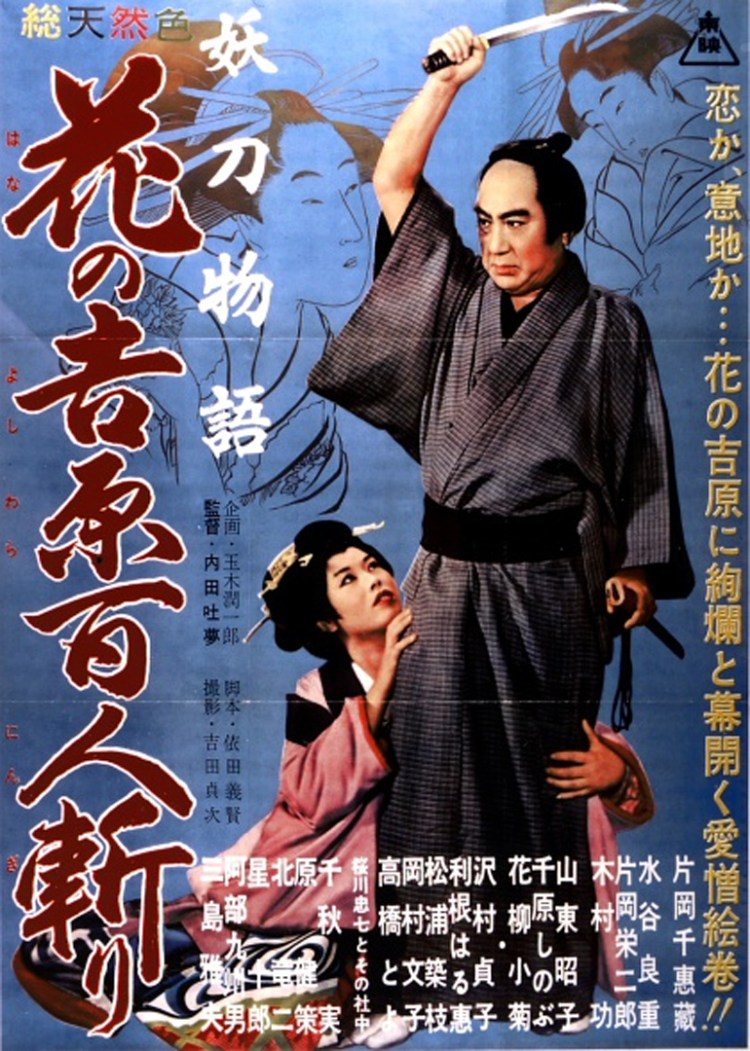
 Having led a somewhat floating life, Tomu Uchida returned to Japan in only in 1953 after a sustained period with the Manchurian Film Cooperative followed by a brief flirtation with Maoism. Before the war Uchida had been closely identified with the Keiko Eiga movement of broadly left-wing filmmaking but later fell hard for the inherent romanticism of militarist ideology during his time in Manchuria. Nevertheless it was apparently the Maoist doctrines of progress through contradiction that influenced his later dramatic philosophy in which he came to think of narrative as a series of conflicts which culminate in an explosive act designed to resolve them (or not, as we will see). 1960’s Killing in Yoshiwara (妖刀物語花の吉原百人斬り, Yoto Monogatari: Hana no Yoshiwara Hyakunin-giri, AKA Hero of the Red Light District) is perhaps a prime example as it takes a seemingly generic story inspired by a kabuki play and uses it to tell a melancholy tale of parallel yet mutually thwarted desires for vengeance against a cruel and oppressive society.
Ostensibly, our “hero” is Jiro (Chiezo Kataoka) – a successful silk merchant. A good and kind man, Jiro is beloved of all his staff for his careful consideration of them as people as well as employees. This concern is, however, perhaps not as wholly “good” as it seems. Jiro’s major problem in life is that he is an adopted child, taken in by his parents who auspiciously discovered him abandoned on the anniversary of their own child’s death. Jiro, apparently of noble birth, was abandoned because he has a prominent grey birthmark “staining” his face. This is the reason he has so far been unable to find a wife despite his good character and relative wealth. Desperately grateful to the couple who took him in “despite” his “imperfection”, Jiro feels this failure heavily in his current inability to provide them with a male heir to take over the family business.
Being good and earnest, Jiro has never dared to fritter money away in the red light district but is tempted when invited by a valued client whom he would not want to offend by refusing. Nevertheless, his first visit to the Yoshiwara is not an altogether pleasant experience as even the seasoned courtesans find it difficult to bear the sight of his “monstrous” face. Embarrassed, the innkeepers finally decide to employ a lowly servant, Otsuru (Yoshie Mizutani), who is not a trained courtesan but a woman convicted for illegal prostitution, to minister solely to Jiro. Otsuru does her work and is relatively unbothered by Jiro’s facial abnormality – something which endears her to Jiro’s heart and has the desired effect of hooking him through his weakness.
Otsuru, later “Tamarazu” the courtesan, is in many ways our villainess but she is also Jiro’s mirror and merely another outsider trying to escape oppression through any means possible. Uchida is careful to frame Otsuru not as a cruel and amoral adventurer, but someone who has decided to survive and can at least be honest about her intentions. We see her caged, imprisoned inside the Yoshiwara to do inside it what was declared “illegal” outside and acknowledging that she may well die here to met by a lonely funeral and rest unnamed in a communal grave. Otsuru decides that if she has to stay in the Yoshiwara then she will be its queen and then use that success to catapult herself into a more comfortable life even if she knows that it will be little more than a nicer kind of cage.
Jiro and Otsuru are each victims of the oppressive society in which they live as symbolised by the cruelly hypocritical worldview of the brothel owners who set out to exploit them both. Otsuru, worldly wise, is fully aware of the ways in which she is and will continue to be exploited but has chosen to be complicit within them as a means of effecting her escape. Jiro, meanwhile, is obviously aware that the “stain” across his face is the reason for his unhappy destiny but has only ever sought to minimise the distress his appearance causes to others. Thus he overcompensates by being relentlessly nice and infinitely humble, grateful for each and every concession which is extended to him as a fully human being rather than the “monster” which he is later branded by the innkeepers in a rare moment of candour which exposes their venial desires.
This extreme desire for acceptance is in itself a symptom of his self loathing and internalised shame regarding his appearance which is after all merely an accident of birth over which he had no control. Abandoned by his birthparents who left him with a “cursed” destiny in the form of an unlucky sword, Jiro has been working overtime to overcome social prejudice but finding his path continually blocked. He latches on to Otsuru simply because she was nice to him without understanding the peculiar rules of interactions within the Yoshiwara, or as she later puts it “no money, no love”. Jiro ruins himself out of frustrated loneliness and a forlorn hope of repaying the debt he owes the couple who took him in by being able to provide them with a male heir to inherit the family business.
It is these mutual conflicts which eventually lead to the explosive finale hinted at by the violence of the title. Otsuru’s star rises while Jiro’s falls – not only is he fleeced by the innkeepers and an unrepentant Otsuru, his business also fails thanks to an act of God while his reputation lies in tatters once his associates get to know of his “frivolous” behaviour in the Yoshiwara. This in itself is doubly hypocritical as it was this same major client who introduced Jiro to the “pleasure” quarters in the first place only to remind him that business is a matter of trust and that they no longer trust him because he has broken his promise of keeping away from the Yoshiwara.
Pushed to the brink by successive humiliations, Jiro’s rage erupts in a singular act of violence which takes the sword not only to the Yoshiwara but the entrenched systems of oppression and exploitation which it represents. Otsuru, now an oiran, is literally trapped by her ostentatious outfit (in reality the very purpose it is designed to serve) as she struggles to escape male violence, her hand on the gate of the Yoshiwara which refuses to release her. Their parallel quests for revenge eventually converge only to defeat each other in a staggering act of futility which remains unresolved as the curtain falls on a moment of unanswerable rage.


 Windows on Worlds