 Sad stories of single mothers forced to work in the world of low entertainment are not exactly rare in pre-war Japanese cinema yet Hiroshi Shimizu’s 1937 entry, Forget Love For Now (Koi mo Wasurete) , puts his on own characteristic spin on things by looking at the situation through the eyes of the young son, Haru (Jun Yokoyama). Frustrated by both social and economic woes, little Haru’s life is blighted by loneliness and resentment culminating in tragedy for all.
Oyuki (Michiko Kuwano) is a single mother and bar hostess in a port town. Her young son Haru loves his mum even though he’s often on his own but after he makes the mistake of inviting some of the other boys back to his mother’s apartment and they end up getting doused in her rather pungent perfume, the other kids’ mothers figure out what Oyuki does for a living. Predictably they forbid their kids from associating with Haru because his mother is “a bad woman”. After repeatedly trying to keep hanging out with the other children, Haru starts skipping school to avoid the constant exclusion entirely. When Oyuki finds out about this she is very upset and has him moved to another school but the old group of kids and the new group of kids are not entirely unconnected and so Haru is unable to escape the prejudice his old group of friends hold for him.
The film never goes into how Oyuki ended up on her own with a young child or what might have happened to Haru’s father but Oyuki’s role as a single mother is not the reason the pair are excluded from the other families. Lacking other opportunities, Oyuki is forced to into work as a bar hostess even though she clearly hates it and bears it only for her son’s sake.
Her job is to entertain men in the bar to keep the drinks flowing, always smiling and flirting to keep dull men trapped in the false hope of real connection. She gets paid very little for this as we find out early on when she tries to spearhead a kind of union movement in the bar by questioning why their work costs them so much – they have to pay for their outfits, food and drink out of their own wages when the girls working at other establishments get a share of the alcohol profits which they have helped to generate but Oyuki and her friends get only their meagre salaries. Their pleas fall on hard ears with the tough as nails mama-san who isn’t going to permit any kind of mutinies in her establishment. This is made clear later on when one employee tries to quit her job at the bar and move to Kobe in search of more lucrative employment but is beaten black and blue by the bar’s goons.
Oyuki’s single ray of hope comes in the form a sinister figure lurking in the shadows outside her apartment. Eventually becoming friends with Oyuki and her son, the man represents a possible happy ending in which he beats the depression, finds a better job and takes them both away from this world of poverty of degradation. Needless to say this is not to be – the man’s attempts to find a solution to everyone’s problems take to long and he is simply too late. Not only that, his well meaning words of advice to Haru that he should make sure to win against the bullies next time have disastrous consequences.
In essence, Forget Love For Now is “hahamono” in which Oyuki bravely sacrifices everything of herself in her son’s name, committed to the idea that he will progress through his education to university and repay all of her efforts by becoming a fine man. Society, whilst praising the idea of the self sacrificing mother, does not approve of the things she has to do in that very sacrifice she’s making and refuses to allow her success in her mission. The true tragedy is that the little boy, Haru, is aware on some level of everything his mother is doing for him and loves her so much that he is willing to sacrifice himself for her – rendering her long years of suffering entirely pointless.
In the end, Oyuki has nothing. As the title of the film tells us, not even love is permitted to her as she loses both her son and the possibility of romance as her well meaning man makes a now equally pointless sacrifice of his own. Forget Love For Now is somewhat atypical in Shimizu’s output as it ends with no hope in sight, strongly condemning this rigid society which forces women to act in a way of which it disapproves and then refuses to support them when they do. Shooting mostly on stage sets rather than the naturalistic settings featured in much of his other work, Shimizu crafts an emotionally devastating tale of maternal sacrifice cruelly frustrated by a cold and unfeeling society.
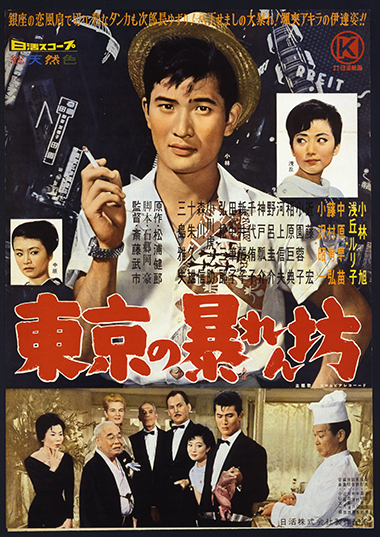 The bright and shining post-war world – it’s a grand place to be young and fancy free! Or so movies like Tokyo Mighty Guy (東京の暴れん坊, Tokyo no Abarembo) would have you believe. Casting one of Nikkatsu’s tentpole stars, Akira Kobayshi, in the lead, Buichi Saito’s Tokyo Mighty Guy is, like previous Kobayashi/Saito collaboration
  Windows on Worlds