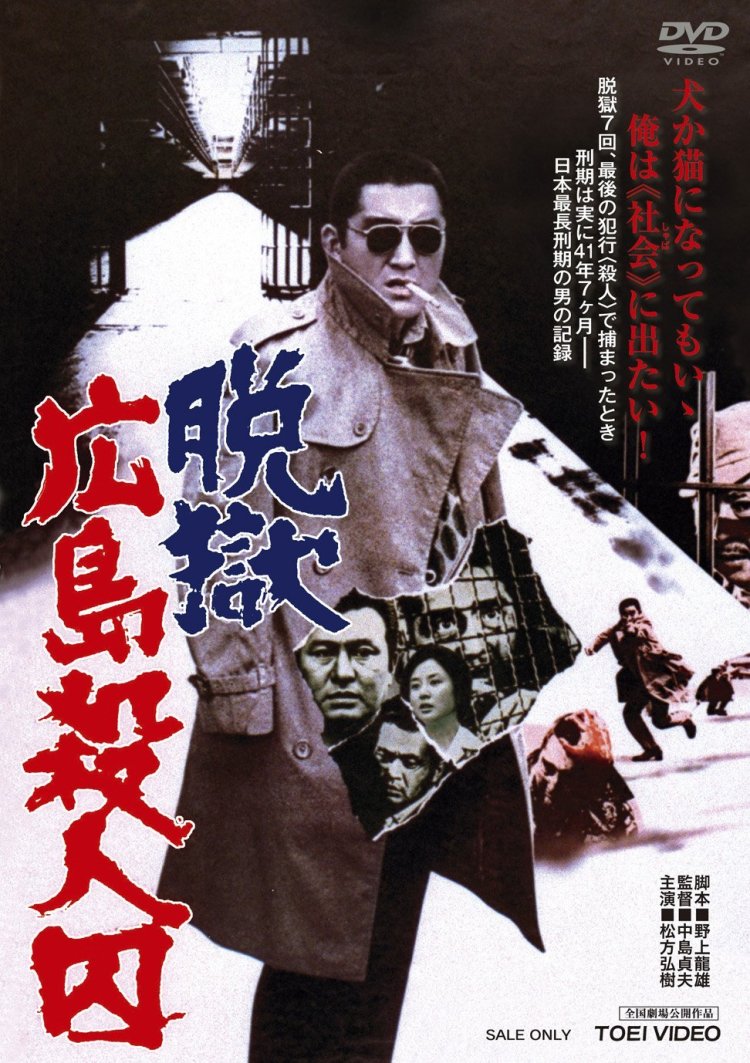
 Sadao Nakajima had made his name with Toei’s particular brand of violent action movie, but by the early seventies, the classic yakuza flick was going out of fashion. Datsugoku Hiroshima Satsujinshu (脱獄広島殺人囚, AKA The Rapacious Jailbreaker) follows in the wake of seminal genre buster, Battles Without Honour and Humanity, but also honours the classic Toei ganger movie past in its exploitation leaning, cynically humorous tale of a serial escapee and his ever more convoluted schemes to avoid the bumbling police force’s noose.
Kobe, 1947. Ueda (Hiroki Matsukata) and his buddy kill a drug dealer and his girlfriend in a robbery gone wrong. Landing himself a twenty year sentence, Ueda resigns himself to spending his prime years behind bars in a Hiroshima prison but then he starts getting a few ideas and his first escape attempt is a moderate success, until he’s recaptured after stupidly going home to his wife.
Nakajima spends quite a long time exploring the unusual environment of the prison in Hiroshima. The life is strictly ordered and run with precision but the prisoners are also forced to do a strange dance for the guards, waving their hands and shouting their ID numbers to prove there’s nothing interesting inside their mouths – a gesture which is hilariously turned back on the warden when a prisoner begins a mini riot after a sports game is turned off at crucial moment. The warden submits himself to the degrading dance but once the man surrenders, he does not honour any of the promises he made to convince him to come down from the tower he was occupying. The guards are corrupt, violent, and untrustworthy whereas the majority of prisoners are docile, resigned, and going mad through inactivity.
Ueda, like many “heroes” of yakuza films is a man who’s had a hard life, left to fend for himself after his father died and his mother left. He appears to love and care for his wife who pledges to wait for him, starting her own seamstressing business in the meantime, but his subsequent escape attempts take him further and further away from his home. Nevertheless, home is the first place he decides to go despite the danger even if his reunion with his wife is anything but romantic.
After being recaptured, Ueda’s desire for escape intensifies, requiring ever more complicated schemes to make it happen. These range from the traditional file hidden inside a lovingly prepared meal delivered by his wife, to simply running away when arraigned for a court date after committing another murder while inside. Seeing as Ueda intends to escape, he cares little for the prison rules and his 20 year sentence is soon doubled thanks to his ongoing crimes both inside and outside of the prison walls.
Other than his wife the other source of support Ueda turns to is his estranged sister with whom he’s had no contact since his mother left sixteen years previously. What he discovers is that the now widowed Kazuko (Naoko Otani) is involved in some dodgy business of her own concerning the local black market meat trade. Ueda decides Kazuko is not getting her fair share and more or less takes over, bending the local petty gangsters to his will, but once again he messes everything up for himself after getting into a fight at a brothel which lands him back at the police station.
Nakajima follows Fukasaku’s jitsuroku aesthetic using frequent onscreen text detailing names and conviction records for each of the major players though his approach owes far less to realism than b-movie action in its willingness to linger on blood and gore even if scenes of violence are generally few and executed quickly. Scenes of a cow being butchered in the woods, blood, skin, and bones dominating, introduce a note of sickening horror but are then echoed in Ueda’s animalistic murders committed with makeshift tools and an unforgiving heart. Despite this frightening coldness, Ueda’s humorous voiceover turns him into a roguish figure whose bumbling acts of self destruction and stubborn attempts to regain his freedom take on an oddly cartoonish quality. The situation may be hopeless, but Ueda does not give up. His story remains unfinished as he makes another (apparently) successful escape after being betrayed by a fellow criminal who is then himself betrayed by the police he mistakenly thought would help him, but as for how long he’ll manage to keep himself on this side of the bars, that remains to be seen…
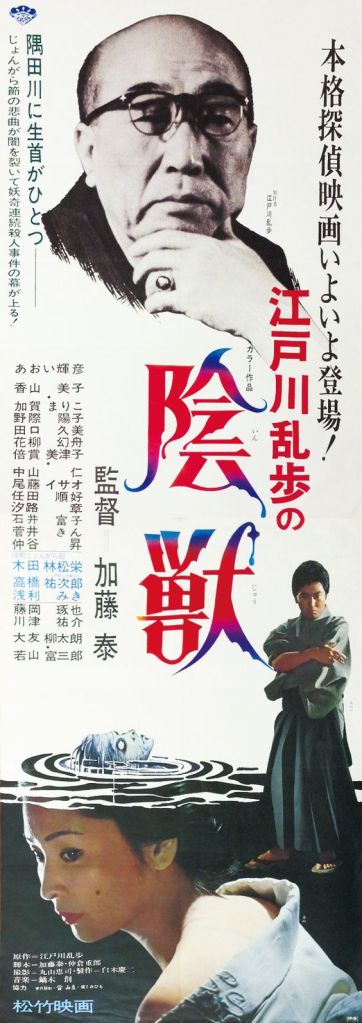 Edogawa Rampo (a clever allusion to master of the gothic and detective story pioneer Edgar Allan Poe) has provided ample inspiration for many Japanese films from
  Ogami (Tomisaburo Wakayama) and his son Daigoro (Akihiro Tomikawa) have been following the Demon Way for five films, chasing the elusive Lord Retsudo (Minoru Oki) of the villainous Yagyu clan who was responsible for the murder of Ogami’s wife and his subsequent framing for treason. The Demon Way is never easy, and Ogami has committed himself to following it to its conclusion, but recent encounters have broadened a conflict in his heart as innocents and seekers of justice have died alongside guilty men and cowards. Lone Wolf and Cub: White Heaven in Hell (子連れ狼 地獄へ行くぞ!大五郎, Kozure Okami: Jigoku e Ikuzo! Daigoro) moves him closer to his target but also further deepens his descent into the underworld as he’s forced to confront the wake of his ongoing quest for vengeance.
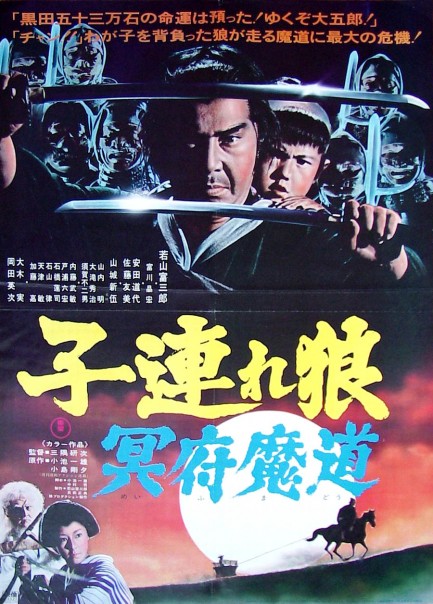 Ogami (Tomisaburo Wakayama), former Shogun executioner now a fugitive in search of justice after being framed for treason by the villainous Yagyu clan who are also responsible for the death of his wife, is still on the Demon’s Way with his young son Daigoro (Akihiro Tomikawa). Five films into this six film cycle, the pair are edging closer to their goal as the evil Lord Retsudo continues to make shadowy appearances at the corners of their world. However, the Demon’s Way carries a heavy toll, littered with corpses of unlucky challengers, the road has, of late, begun to claim the lives of the virtuous along with the venal. Conflicted as he was in his execution of a contract to assassinate the tragic Oyuki in the previous instalment,
 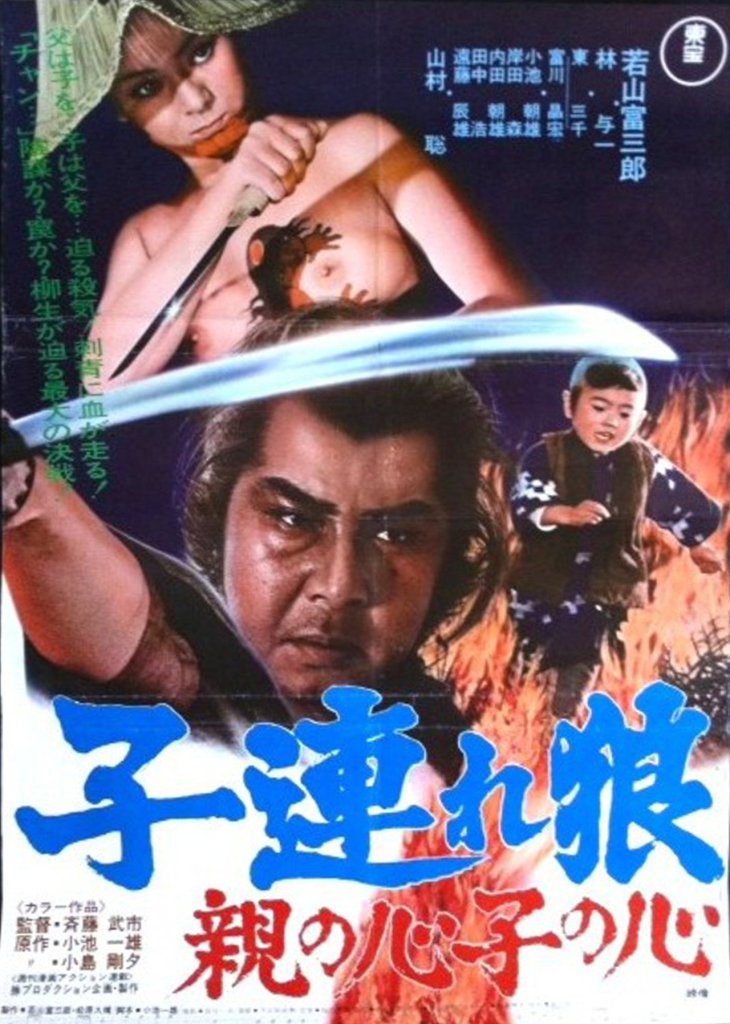 Now four instalments into the Lone Wolf and Cub series, Ogami (Tomisaburo Wakayama) and Daigoro (Akihiro Tomikawa) have been on the road for quite some time, seeking vengeance against the Yagyu clan who framed Ogami for treason, murdered his wife, and stole his prized position as the official Shogun executioner. Lone Wolf and Cub: Baby Cart in Peril (子連れ狼 親の心子の心, Kozure Okami: Oya no Kokoro Ko no Kokoro) is the first in the series not to be directed by Kenji Misumi (though he would return for the following chapter) and the change in approach is very much in evidence as veteran Nikkatsu director Buichi Saito picks up the reins and takes things in a much more active, full on ‘70s exploitation direction. Where
 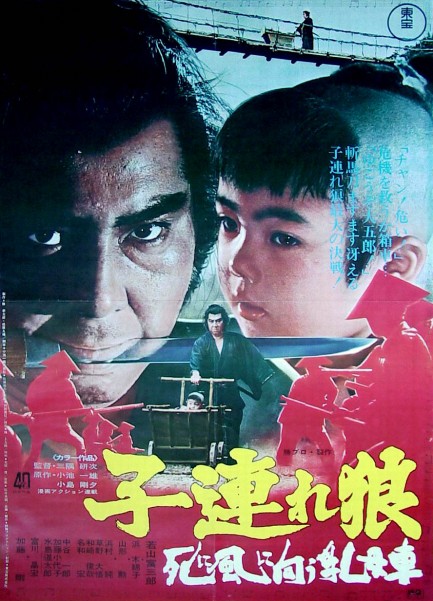 Ogami Itto (Tomisaburo Wakayama) and his (slightly less) young son Daigoro (Akihiro Tomikawa) are going to hell in a baby cart in this third instalment of the six film series, Lone Wolf and Cub: Baby Cart to Hades (子連れ狼 死に風に向う乳母車, Kozure Okami: Shinikazeni Mukau Ubaguruma). The former shogun executioner, framed for treason by the villainous Yagyu clan intent on assuming his position, is still on the “Demon’s Way”, seeking vengeance and the restoration of his clan’s honour with his toddler son safely ensconced within a bamboo cart which also holds its fair share of secrets. In the previous chapter,
 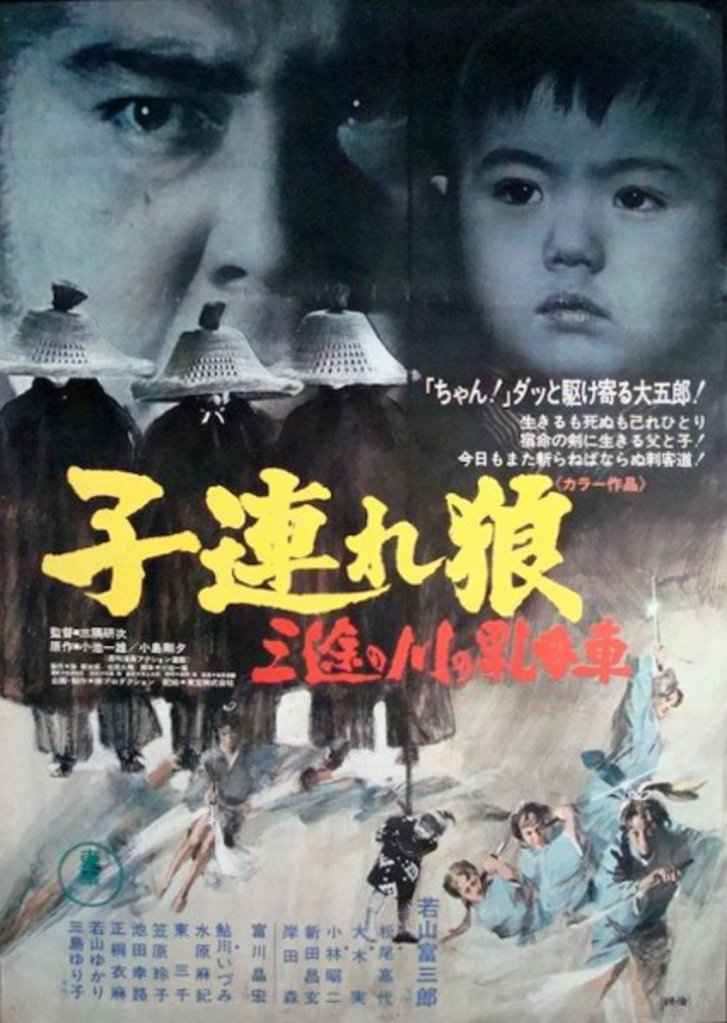 The first instalment of the
 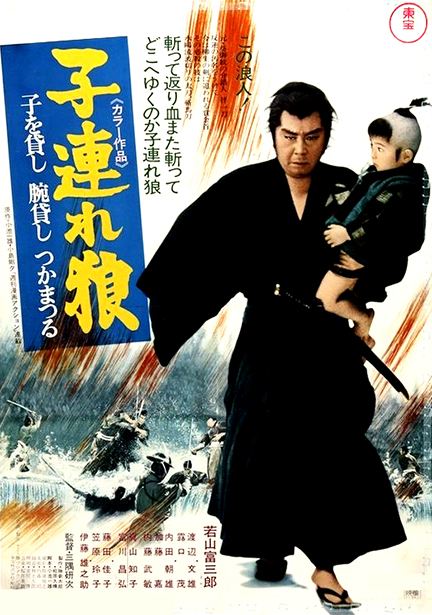 When it comes to period exploitation films of the 1970s, one name looms large – Kazuo Koike. A prolific mangaka, Koike also moved into writing screenplays for the various adaptations of his manga including the much loved Lady Snowblood and an original series in the form of Hanzo the Razor. Lone Wolf and Cub was one of his earliest successes, published between 1970 and 1976 the series spanned 28 volumes and was quickly turned into a movie franchise following the usual pattern of the time which saw six instalments released from 1972 to 1974. Martial arts specialist Tomisaburo Wakayama starred as the ill fated “Lone Wolf”, Ogami, in each of the theatrical movies as the former shogun executioner fights to clear his name and get revenge on the people who framed him for treason and murdered his wife, all with his adorable little son ensconced in a bamboo cart.
 Windows on Worlds