Being Two Isn’t Easy (私は二歳, Kon Ichikawa, 1962)

With the Olympics still two years away, the Japanese economy had begun to improve by 1962 and the salaryman dream was on the horizon for all. But for young couples trying to make it in the post-war society things were perhaps far from easy and having more to want coupled with the anxieties of a newly consumerist society only left them with additional burdens. A surprisingly moving evocation of the cycle of life, Kon Ichikawa’s Being Two Isn’t Easy (私は二歳, Watashi wa Nisai) is as much about the trials and tribulations of its toddler hero’s parents as they try to navigate their new roles in a world which now seems fraught with potential dangers. 

This difference in perspective is brought home in the opening sequence in which soon-to-be two Taro (Hiro Suzuki) recalls his own birth in a slightly creepy voiceover, lamenting his mother cooing over him excited that he is smiling for her though he is not yet able to focus and has no idea the vague shadow above him is his mother or even what a mother is. His smiling is simply involuntary muscle contraction as he learns how to manipulate his body. Nevertheless, little Taro is a definite handful taxing his poor mother Chiyo (Fujiko Yamamoto) with frequent attempts to escape, managing to get out of the apartment and start climbing the stairs the instant she’s turned her back. “Always finding fault, that’s why grown-ups are unhappy” Taro complains, irritated that even though he’s quite proud of himself for figuring out not only how to undo the screws on his playpen but the string his parents had tied around it for extra protection, he’s not received any praise or congratulation and it feels like they’re annoyed with him. 

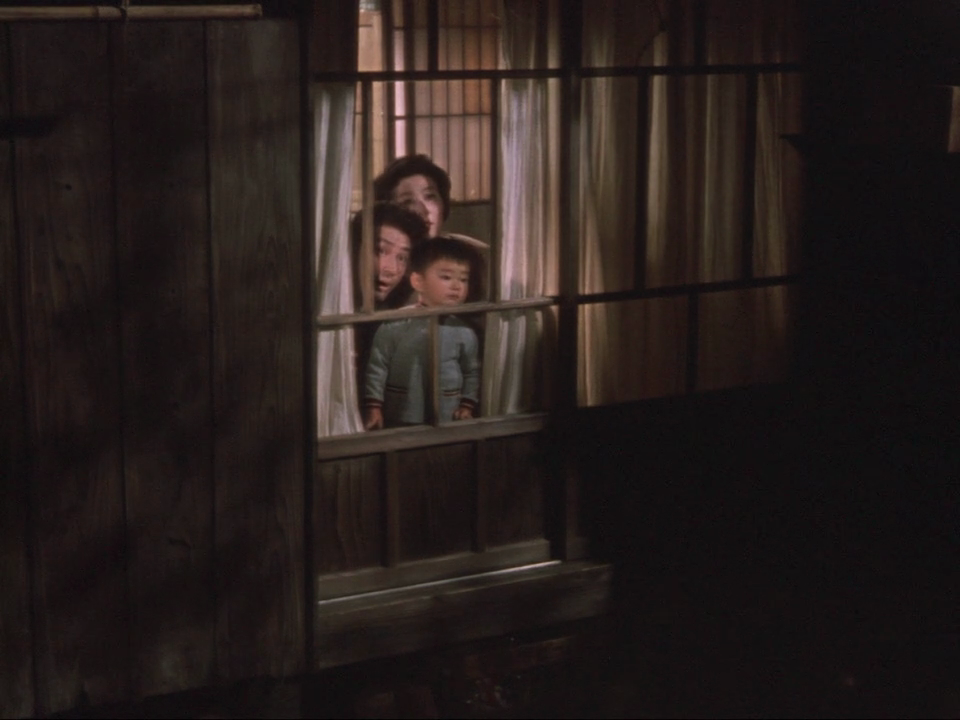
The landlord alerted by the commotion somewhat ironically remarks that “Japanese houses are best for Japanese babies” (being at least usually all on one level even if they also sometimes have their share of dangerously precipitous staircases), implicitly criticising the new high rise society. There do indeed seem to be dangers everywhere. Another baby playing on the balcony eventually falls because the screws are rusty on the railings only to be caught by a passing milkman in what seems to be an ironic nod to the film’s strange fascination with the new craze in cow’s milk to which Taro’s father Goro (Eiji Funakoshi) attributes Westerners’ ability to grow up big and strong. Taro does seem to get sick a lot, the doctor more or less implying that his sickliness is in part transferred anxiety from an overabundance of parental love. Visited by her older sister who lives on a farm in the country and has eight children, Chiyo becomes broody for a second baby (though not another six!) but Goro isn’t so sure, not just because of the additional expense or the fact that their danchi apartment is already cramped with the two of them and a toddler, but reflecting that he already lives in a world of constant fear why would you want to double it worrying about two kids instead of one?

Nevertheless, Goro is certainly a very “modern” man. He helps out with the housework and is an active father, taking on his share of the childcare responsibilities and very invested in his son. He accepts that his wife also “works” even if he also insists it’s not the same because she doesn’t have to bow to Taro and is not subject to the petty humiliations of the salaryman life. Tellingly, this changes slightly when the couple end up leaving the danchi for a traditional Japanese home to move in with Goro’s mother after his brother gets a job transfer. Grandma (Kumeko Urabe) is actively opposed to him helping out around the house, viewing it as distasteful and unmanly not to say a black mark against Chiyo for supposedly not proving up to her wifely duties. Living with Grandma also introduces a maternal power struggle under the older woman’s my house my rules policy which extends to criticising Chiyo’s parenting philosophy not to mention refusing to trust “modern technology” by insisting on rewashing everything that’s been through the washing machine by hand.

Yet when Taro becomes sick again it’s perhaps Grandma who has a surprisingly consumerist view of medical care. Exasperated by the couple’s failure to get Taro to take his medicine she offends the doctor by insisting on him having an injection as if you haven’t really been treated without one. Eventually she takes him to another clinic where they get on a conveyor belt of doctoring, rushed through from a disinterested receptionist to a physician who yells “bronchitis” to a nurse who violently sticks the baby in the arm. After that Taro vows never to trust grown-ups, though Grandma only gives in when she realises injections are not an instacure and didn’t do any good. 

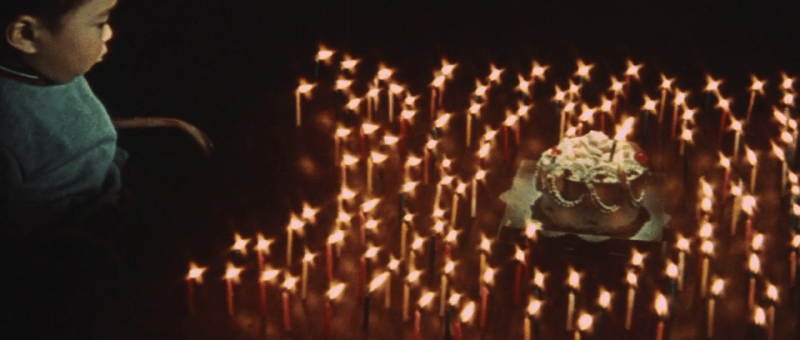
For all that however there’s a poignancy in Taro’s reflecting on his birthday cake with its two candles that Grandma’s must have many more and in fact be brighter than the moon with which he has a strange fascination. He’s just turning two. He used to be a baby but now he’s a big boy and soon he’ll be a man. Goro reflects on time passing, for the moment he’s a father but might be a grandad soon enough. The wheel keeps turning which perhaps puts the hire purchase fees on the TV he bought to keep Grandma occupied and out of the way into perspective. From the experimental opening to the occasional flashes of animation and that banana moon, Ichikawa paints a whimsical picture of the post-war world as seen through the eyes of a wise child but ironically finds a wealth of warmth and comfort even in an age of anxiety.


A Wife Confesses (妻は告白する, Yasuzo Masumura, 1961)

Mountains are dangerous places in Japanese cinema. Yasuzo Masumura’s tense, claustrophobic courtroom noir A Wife Confesses (妻は告白する, Tsuma wa Kokuhaku Suru) was released in the same year as Toshio Sugie’s Death on the Mountain, adapted from a popular story by legendary mystery writer Seicho Matsumoto in which a veteran climber is ushered towards his death through a series of machinations by his friend which might or might not be regarded as “murderous” depending on your point of view. Masumura wants to ask us a similar question but from another angle as he puts a woman on trial not quite for the “murder” of her husband but the fact of her survival.

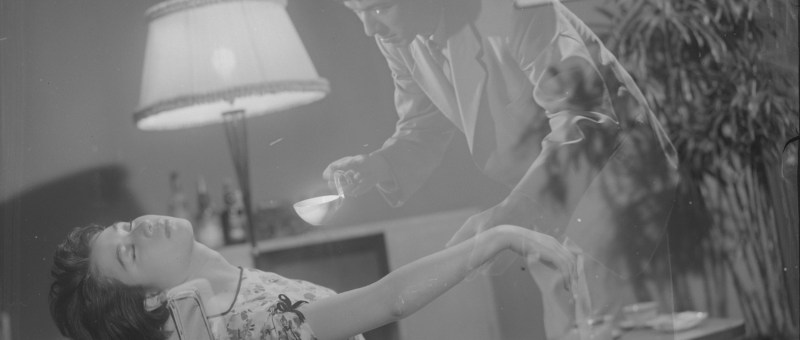
Opening outside the courthouse with a gum-chewing paparazzo, Masumura unwittingly makes us part of the baying mob watching intently as a young woman hides her face with her handbag while the press more than live up to their name, pinning her with questions about the salacious case at hand. Inside, however, he shifts the focus. We are now in the dock with Ayako (Ayako Wakao), looking up at the three men who will judge her for her “crime” from a literal moral high ground. A youngish widow, Ayako is charged with the murder of her husband who died during a freak mountain climbing accident. Caught between a handsome young man, Koda (Hiroshi Kawaguchi), and her abusive husband, Takigawa (Eitaro Ozawa), with no way up or down Ayako chose to cut the rope and let her husband fall. If she had not done so, both she and Koda would also be dead. Ayako is on trial because she refused to sacrifice herself for a wifely ideal. The question is, in many ways, if a woman’s or more to the point a wife’s life has worth, not just worth equal to that of her husband’s but any kind of worth at all. 

The first charge against Ayako is a lack of womanliness. A man at the scene testifies that they don’t usually allow wives or mothers to view bodies and Takigawa’s was in a particularly bad way but Ayako insisted on seeing it only to react with a calm he found suspicious. A policeman then echoes his sentiment, admitting that he arrested Ayako for her unwifeliness. “A wife should stick with her husband ’til the end no matter how tough it is” he says, adding that his own wife agrees with him. As her lawyer points out, had Ayako been a man, or the person below her on the rope a stranger, the policeman would not have arrested her but her refusal to die with her husband, which would have resulted in the “murder” of another man, is an arrestable offence. You can argue about the moralities of choosing to end someone else’s life to save your own, a kind of self defence permitted under Japanese law through the “necessity” legislation, but Ayako’s transgression is in believing that her life and her husband’s weigh the same and that she had a right to save herself. Many feel she should perhaps have cut the rope above her own head, saving Koda only in a lovers’ suicide with Takigawa. 

The policeman offers more grounds for suspicion having discovered that Ayako had taken out an insurance policy on her husband and hoped to profit from his “accidental” death, though as an act of premeditated murder this would certainly be quite an elaborate plot. Furthermore, the prosecution posit that she and Koda were having an affair but, for reasons which are not clear, Koda is not under suspicion or cited as a co-conspirator and is in fact testifying in her defence. He is also engaged to someone else, Rie (Haruko Mabuchi), though the marriage was arranged by his boss for strategic reasons because she is the daughter of a major client at their insurance firm and yes Koda drafted the policy which is currently being used as evidence against Ayako. All very Double Indemnity, but Ayako is certainly no cold and scheming Phyllis whether or not she made a conscious decision to free herself from a man who made her life a misery by literally cutting him loose. 

Yet Ayako’s victimisation is also used against her as further evidence of her unwomanly coldness. She testifies that she married Takigawa after he attempted to rape her and then proposed, confessing that she did so in order to escape a life of poverty that had already driven her into suicidal despair (she still has a vial of potassium cyanide she had taken from his office with just this in mind). She did not love him, but did her best to become a “good wife”, even beginning to wear kimono because he preferred it. Her predicament is no different than that of many other women who agreed to an arranged marriage and found themselves shackled to an unpleasant man with whom they could not get along but the marriage’s failure is laid squarely at Ayako’s feet for not trying hard enough and having insufficient love for the husband who treats her like a glorified maid, is cruel and emotionally abusive, and finally forces her to have an abortion against her will because he doesn’t want to spend money on a child. She asks for a divorce but he points out that as things stand a woman cannot escape a bad marriage without a husband’s consent and he has done nothing to break their marital contract and so to that extent he owns her. 

But for all she’s a cold woman who resented her husband and longed to be free of him, Ayako is also condemned for illicit passion in her secret love for Koda. Indeed we can see she is clearly fond of him, and in flashback we realise much of this is simply because he was kind to her though the extent of his kindness was only to the level of general civility. At heart, they are both “decent” people and so there is nothing more between them than unexpressed longing but still the kernel of their attraction remains and the prosecution has indeed found a grain of truth on which to found a motive for murder.

For his part, in another kind of film Koda would be the hero but here his “goodness” is intensely problematic in that he falls for Ayako precisely because of her suffering. His problem is that he later doubts her, swayed by arguments that paint her as a plotting femme fatale. Though amused by the whole affair, Koda’s boss warns him that women like Ayako are “trouble” and that he’s only been taken in because he is young and naive. Rie, meanwhile, is resentful and wounded, contemplating her own revenge but ultimately testifying in Ayako’s favour, she claims more for herself than for Koda or “justice” too embarrassed to take the stand and offer her own feminine “inferiority” as evidence against her romantic rival. Yet she later comes to admire her, seeing her as one who was bold enough to chase love at the expense of all else no longer caring what anyone might say or think. Ayako is the most liberated woman alive, and she would die for love but did not love her husband and so would not die for him. 

Koda is punished because he fell in love with an image of suffering womanhood but is afraid of Ayako’s transgressive femininity. He is conflicted in the knowledge that if she killed her husband her love for him may have been the reason, and is disturbed by her venality in that she would have taken the insurance money and lived well without finding it distasteful while he would have preferred to reject the settlement entirely lest it besmirch the innocence of their love. In real terms it doesn’t really matter why she did it, Ayako cut the rope and whether she did so out of an instinct for self preservation, in hate, or in love, the result is all the same. What she’s on trial for is defiance, that she acted, seized her own agency and made a choice to value her life over her husband’s which is still, as it turns out, a moral crime in the supposedly modern and democratic society of 1961. Masumura’s accusatory camera finds her pinned, confined, trapped at the edges of frames hiding her face with her single permitted feminine accessory while the subject of our judgemental gaze until the curtain finally closes leaving her in shadow but perhaps finally free of her cruel and oppressive society. 


Original trailer (no subtitles)

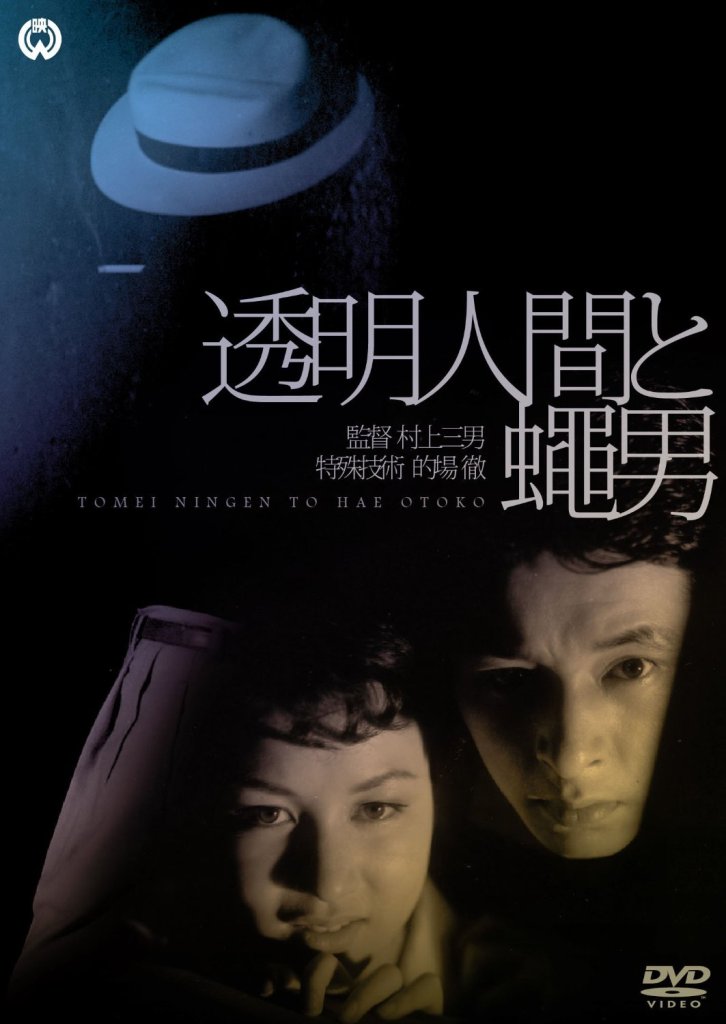
The Invisible Man vs The Human Fly (透明人間と蝿男, Mitsuo Murayama, 1957)

The Invisible Man Vs the Human FlyWho would win in a fight between The Invisible Man and The Human Fly? Well, when you think about it, the answer’s sort of obvious and how funny it would be to watch probably depends on your ability to detect the facial expressions of The Human Fly, but nevertheless Daiei managed to make an entire film out of this concept which is a sort of late follow-up to their original take on Invisible Man Appears from 1949. Like that film, The Invisible Man vs The Human Fly (透明人間と蝿男, Tomei Ningen to Hae Otoko) also adopts a deadpan, straightforward tone despite its rather ridiculous premise.

Tokyo is being plagued by a series of mysterious murders occurring in broad daylight in which the victim is stabbed through the back piercing the heart yet witnesses report seeing no suspicious activity near the crime scene. Perhaps The Invisible Man did it, hahaha….However, when the man sitting next to the professor in charge of researching the “imperceptibility device” is murdered in an aircraft toilet, the police get wise to a possibly surreal explanation for these bizarre crimes. The only other evidence they have is a connection between a sleazy nightclub owner, a friend of his and one of the murdered men who briefly served together during the war, the fact that one of the victims pointed at the sky before dying, and reports of a strange buzzing sound….

Interestingly, the major viewpoint here is from the policemen investigating the case and their attempts to get their heads around this extremely unusual series of events. As often happens with revisiting a form of technology which has been used for ill in the previous picture, here the “imperceptibility device” becomes a force for good as it might be able to help the powers at be stamp out The Human Fly. This time there’s not so much of the accompanying madness which is caused by going invisible but there’s still a heavy price to be paid as no one’s figured out a way of turning back which doesn’t involve rapid death from cancer immediately afterwards.

By contrast, The Human Fly is born of a man made serum developed by Japanese mad scientists during World War II and brought back by a man who was abandoned on an island by his comrades and subsequently left to take the wrap at a war crimes tribunal. He wants to use the technology to further his own success yet has a minion carrying out most of the dirty work. The Human Fly serum does, apparently, carry a number of psychological side effects including violent impulses, paranoia and addiction.

The special effects are not quite as good as in Invisible Man Appears though the invisible antics are not the focus of the film anyway. Bizarrely, The Human Fly is just a shrunken man who is somehow able to zip about like a regular fly even though he’s still dressed in his normal business suit and keeps his arms rigidly to his sides like some kind of human torpedo. Apparently, the buzzing sound is made because of his being very small (so says science) which gets around the inconvenient truth of him not having any wings or other fly-like characteristics other than the ability of flight.

It’s all very silly, though not quite silly enough in places. For the most part, the film plays out like a regular police procedural with slight noir undertones despite the obvious strangeness of the mysteries at hand. Though there’s obviously something to be made about the origin of the Human Fly serum and the anger of the “war criminal” who feels himself betrayed by his country, it’s a fairly subtle comment on post-war resentment. However, attitudes to the practice of scientific research do seem to have shifted with the researchers investigating the imperceptibility device cast as the good guys (though no particular reason for their work is ever offered) who can be relied upon to help catch the “bad guys” who are making use of “bad technology” to do “bad things”.

A fairly solid B-movie though one which is perhaps a little too po-faced for its genretastic title, The Invisible Man vs The Human Fly is an interesting mix of noir crime thriller with a little science fiction and even a few horror trappings thrown in. Thanks to its straightforward approach it may prove a little dull for genre enthusiasts but does offer its own kind of surreal iconography and it’s difficult to forget the sight of a tiny, angry looking besuited man flying around and committing random crimes while an invisible opponent stalks him from the shadows.