Table for Six 2 (飯戲攻心2, Sunny Chan Wing-Sun, 2024)

“It’s okay to be screwed, we’ll unscrew you later,” youngest brother Lung (Peter Chan Charm Man) comforts his dejected brother in an accidental advocation of what means to be a family in Sunny Chan’s followup to the phenomenally successful comedy  Table for Six. Like the previous film and in true Lunar New Year fashion, Table For Six 2 (飯戲攻心2) explores the concept of family in a wider sense along with contemporary attitudes to marriage and traditional gender roles.

Even so, it has to be said this table is now uneven as oldest brother Steve has literally run away from his romantic dilemmas taking off for Africa leaving new girlfriend Miaow (Lin Min-Chen) behind claiming she’s too far out of his league and it’s not fair of him to waste her youth. Ironically enough, Bernard (Louis Cheung) has now started a wedding business helping people pull off extravagant public proposals such as the sort of fake one he prepares for Monica (Stephy Tang Lai-yan) as a publicity stunt featuring him dancing in a 90s-style music video. As part of the campaign, they’ve set up Lung and Miaow as a fake couple hoping to build a following for their romance online much to unexpected chagrin of Josephine (Ivana Wong) who has begun to embrace her dreams by becoming a well-known quirky chef who makes food disguised as other food. Though they had agreed to separate so the could both follow three dreams at the end of the previous film, Josephine suddenly proposes leading Bernard to put on an extravagant wedding as promotion for his business. 

In a way, Bernard’s company symbolises the performative qualities of marriage as couples put themselves through a stressful and expensive ritual more out of obligation than real desire. When Lung is prevented from reaching the ceremony on time, Bernard ends up impersonating him in a full body costume making plain that the spectacle is more for show than sentiment and it could really be anyone up there simply fulfilling a role. In fact, no one even checks the certificates were properly signed. Then again, just as in Josephine’s cooking sometimes the “fake” and can actually contain the “real” just in a different way than expected. She may say that once a relationship has cooled the spark can’t be regained, but that doesn’t necessarily mean a new, different, spark couldn’t be found. 

Perhaps that’s what happened for Bernard and Monica who’ve now overcome the awkwardness of Monica having been in a longterm relationship with oldest brother Steve. Ironically enough, they’d more or less decided not to get married only to be blindsided by their reactions to the “fake” proposal but as it turns out more because of the emotional baggage from their parents’ failed relationships that have left them too afraid to get married. Monica is still traumatised by her father’s extra marital affair which resulted in a half-brother she’s never met but has since become a Cantopop star, while Bernard still has bad memories of being treated as a “red-headed” child and like Steve is preoccupied with a desire to keep the family together while worried that he isn’t really up to it. 

The lesson Bernard learns is that family is a burden that’s carried together so he didn’t need to save it on his own and that it’s alright to mess things up because his family will be there to take care of him. Miaow meanwhile is left in the same place as Steve had been in the first film, wondering how long she should wait for love or if Steve is ever coming back, trying to decide whether to accept a promising job offer in Japan or stay in Hong Kong. Part of her reluctance to move on is that she’s become wedded to the family and fears losing her place within it but as Monica says her status wasn’t dependent on blood or relationships and that she’s already been accepted into the family just for being herself. 

Then again, families can also be annoying as Bernard remembers after inviting his gangsterish uncles to one of the weddings only for them to muscle in as a major sponsor for another own insisting on designs the dress themselves complete with a par of shark fin wings to promote their business none of which meshes well with Monica’s passion for conservation. In any case, as Monica reflects family means you can embarrass yourselves together so maybe wearing a stupid dress for a few minutes isn’t such a big deal. Heartfelt and zany, Chan’s farcical drama shifts past the performative aspects of marriage and family to what lies beneath which, like Josephine’s cooking, may not always be what it first appears.


Table for Six 2 is in UK cinemas from 9th February courtesy of CineAsia.

UK trailer (English subtitles)

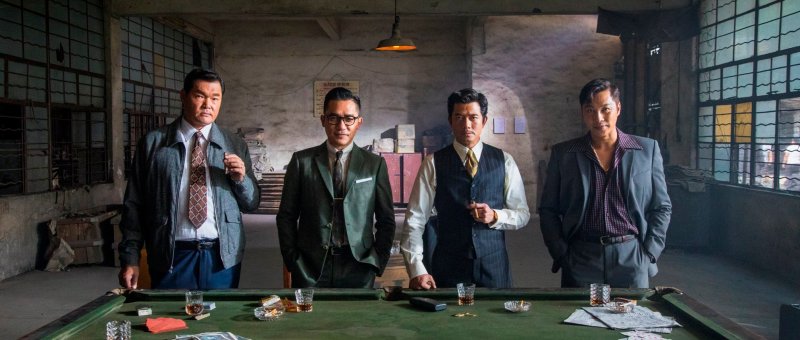
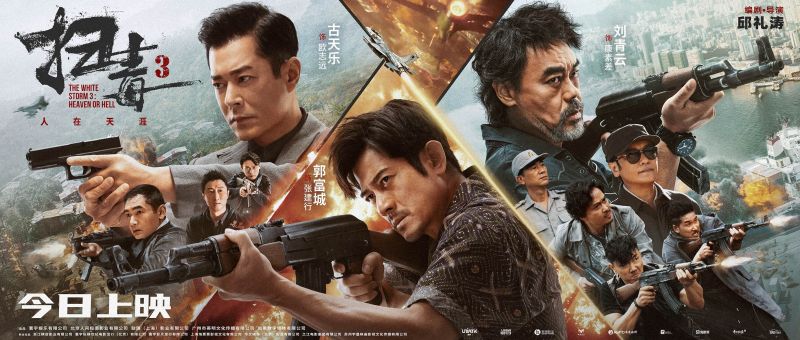
The White Storm 3: Heaven or Hell (掃毒3︰人在天涯, Herman Yau, 2023)

Who is the most foolish, the arch criminal who didn’t realise his two best buddies were undercover cops, or the cops that killed or took bullets for him? The latest in the White Storm series of standalone action thrillers with starry casts thematically dealing with drugs and organised crime, White Storm 3: Heaven or Hell (掃毒3︰人在天涯) like its immediate predecessor casts the net a little wider than just Hong Kong and is keen to stress the real victims of the international drug trade are the economically disadvantaged farmers who are left with no other option than to turn their fields to poppies. 

Back in Hong Kong, meanwhile, the film opens with local drug lord Suchat (Sean Lau Ching-Wan) retrieving a huge haul of drugs dropped in the ocean by helicopter only to be interrupted by the police who were watching all along. Suchat’s righthand man Yuen (Louis Koo Tin-Lok) blows his cover by pulling a gun to convince him to surrender, but Suchat chooses not to and in the firefight that ensues his other buddy, Hang (Aaron Kwok Fu-Sing), who is also an undercover cop and in fact very good friends with Yuen, is seriously wounded. In a show of loyalty, Suchat rescues Hang and manages to flee to Thailand where he sets up in his home village soon coming to the attention of the warlord who controls the local drug trade.

Describing the gang as the “rising stars of the Golden Triangle”, Suchat eventually cuts a deal with the general to provide security for his logistical operation in which drugs, mostly ice but also heroin, are transported inside fruit and other foodstuffs to be moved through the local market. Suchat had originally tried to set up his own operation only to fall foul of the general but also concedes that the margins in this game are fairly thin, no one in this area has any money to spend on drugs and there’s no point trying to produce them with the general in town so his only option is to provide a different service at another point in the chain. Hang becomes fond of the young woman who nurses him back to health, Noon, who explains that the only crop anyone is interested in is opium so aside from the food they grow for themselves it’s all they can produce to support themselves. There may a particular implication in her reply when Hang asks her if she’s ever considered moving that this even if this place is not a “home” because she has no remaining family members (her grandfather in fact seems to die of opium poisoning) it is still her hometown and why should she have to leave it. 

Before being taken to Thailand, Hang’s boss had worried that he might have spent too long undercover to successfully come back and it’s true enough that he seems to have become conflicted not only in his feelings for Noon but reflecting on the genuine brotherhood that exists between himself and Suchat whom he will eventually have to betray. Hang almost died for him, and Suchat repaid the favour by refusing to leave him behind. But on the other hand, there’s also a degree of homoerotic tension between himself and Yuen who rushes straight over to Thailand to rescue him once he’s able to make contact only to be frustrated when Hang tells him he has to go back to the village to save Noon who, as she’s already told him, does not actually want to leave despite the danger of constant violence from drug gangs and army raids. 

The film ends with the razing of the village of the Thai authorities who evidently decide the loss of life is justified in the necessity of stopping the general though it’s the ordinary farmers who lose their lives, families, homes and livelihoods because of their proximity to the trade in drugs. “I miss Hong Kong” Hang finally exclaims as if longing to shake off his undercover persona and recommitting himself to his role as a policeman but also perhaps hinting at a more subversive meaning as Yau ends on the clouds parting to reveal the famous city skyline amid picturesque terrain. Filled with a series of incredibly elaborate action sequences culminating in the all out warfare of the village raid, Yau’s heroic bloodshed subversion has its share of absurdity in the complicated relationships between its central trio and the ambivalent justice of its final resolution.


Original trailer (Traditional Chinese / English subtitles)

Full Strike (全力扣殺, Derek Kwok & Henri Wong, 2015)

A former badminton champ begins to rediscover herself after being permanently banned for bullying behaviour when charged with coaching a bunch of former bank robbers in Derek Kwok & Henri Wong’s zany sports comedy Full Strike (全力扣殺). Dedicated to “all the beautiful losers”, the film is less about literal winning as it is about learning to turn one’s life around in moments of profound despair and draw strength from even non-literal victories in simply refusing to be looked down or belittled.

It’s ironic in a sense that Dan (Ekin Cheng Yee-Kin), Kun (Wilfred Lau Ho-Lung), and Chiu (Edmond Leung Hon-Man) became bank robbers because they didn’t want to be bullied having grown up as friendless orphans. Former badminton champ Kau Sau (Josie Ho Chiu-Yee), meanwhile, was such as tyrannical diva that she gained the nickname “The Beast” before being banned because of her unsportsmanlike behaviour and treatment of her long-suffering assistant. But cast out of the sports world, she’s become a dejected layabout not quite working in her brother’s restaurant and otherwise hiding out from the world. Her life changes when she’s publicly mocked after running into her former assistant who has since gone to take her position as a reigning champion. Running out into the night, she spots a shuttle-cock-shaped meteor and is chased to a badminton club by what she assumes is an “alien” but might have just been a frightened homeless man.

In any case, she takes it as a sign she should pick up a racket once again which as Dan later points out she probably wanted to do anyway and was just waiting for an excuse. He can’t explain why he chose the unlikely path of becoming a badminton player to help him turn over a new leaf after leaving prison but reflects that perhaps you don’t really need a reason only the desire to change. Dan, Kun, and Chiu all developed disabilities as a result of their life of crime but slowly discover that they can actually help them on the court in a literal process of making the most of their life experiences no matter how negative they might have assumed them to be while Kau Sau similarly regains her self esteem while acknowledging the destructive patterns of her previous behaviour careful never to bully her new teammates as they all square off against her bullying cousin “nipple sucking Cheung” (Ronald Cheng Chung-Kei) who tries to use his newfound wealth to cover up a lack of skill by hiring Kau Sau’s old teammate. 

Cheung is also trying to overcome low self-esteem and is later forced to realise that becoming a champion won’t really change that much about how he sees himself, though apparently still relying on an ever capable middle-aged woman to fight (literally) his battles for him. Meanwhile, the gang are coopted by a media mogul hoping to make an inspirational documentary about them but also manipulating their lives and hyper fixating on their criminal pasts to the point of staging a fake arrest as they enter the stadium for a competition. Doubting the chances of success in setting up new lives for themselves as badminton players, Chiu is drawn back towards a life of crime while feeling somewhat distanced from the team as a tentative romance between Kau Sau and Dan seems to fall otherwise flat.

A throwback to classic mou lei tau nonsense comedy, the zany gags come thick and fast but are at times over reliant on low humour while the central premise of staking everything on an “unexciting” game like badminton perhaps wears a little thin by the time it gets to the high stakes finale with the heroes fighting twin battles squaring off against their traumatic pasts rather than the literal opponents in front of them. Winning becomes a kind of irrelevance when the contest was within the self. Each rediscovering the spark of life, the players rediscover the will to live while bonding as a team and sticking to their training in pursuit of their goal. Kwok and Wong lay it on a little thick with the martial arts parody in the uphill battle to master badminton but otherwise lend a poignant sense of warmth and genuine goodwill in sympathy with the underdogs’ quest if not quite to win then to own their loserdom on their on terms in reclaiming their self-respect and dignity. 


Full Strike is available to stream in the UK until 30th June as part of this year’s Odyssey: A Chinese Cinema Season.

Original trailer (Traditional Chinese / English subtitles)

Where the Wind Blows (風再起時, Philip Yung, 2022)

Philip Yung’s first film since the acclaimed Port of Call was scheduled for release all the way back in 2018 only to be repeatedly held up by troubles with the censors later compounded by the coronavirus pandemic. For many reasons, it isn’t surprising that Where the Wind Blows (風再起時) would run into trouble with the current censorship regime dealing as it does with the touchy subject of police corruption albeit it in the colonial era, but the most surprising thing may be that it was passed at all given the subversive undertones of a late speech delivered by the voice of reason, ICAC chief George Lee (Michael Hui Koon-man), whose attack on the corrupt practices of the British authorities has obvious parallels with the modern day. 

The film is however set firmly in the past ranging from the 1920s to the 1980s and inspired by the “Four Great Sergeants” of post-war Hong Kong who amassed great personal wealth while working as police officers. Once again, the police is just the biggest gang, or perhaps the second biggest given that the great racket in town is the colonial rule. It is indeed the British authorities who have enabled this society founded largely on systemised corruption, something which as Lee points out they are unwilling to deal with because it suits them just fine and they have no real interest in the good of Hong Kong. 

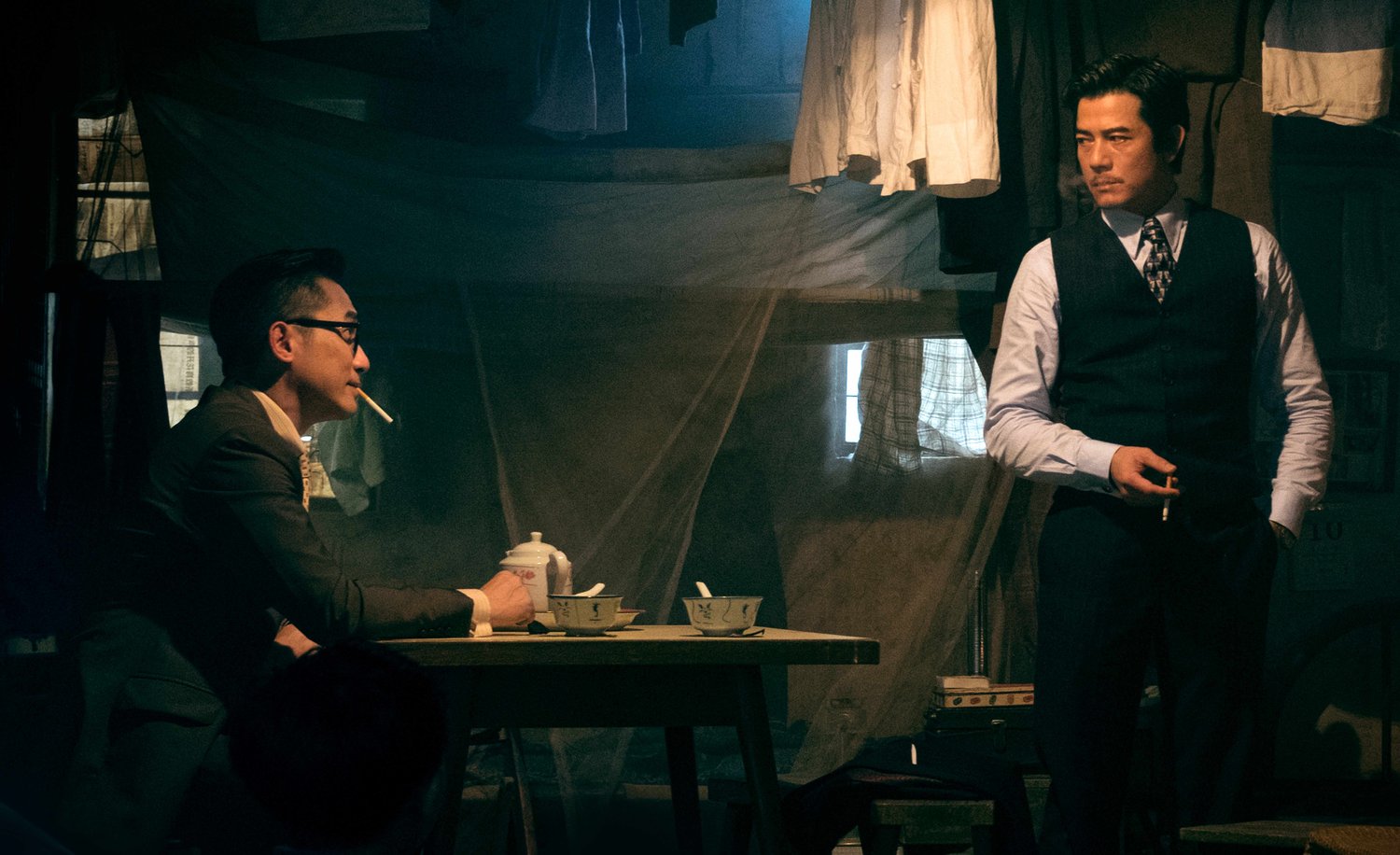
In any case, flashy cop Lok (Aaron Kwok Fu-shing) started out as an earnest bobby before the war who was shocked by the institutionalised corruption all around him and refused to participate in it. But his law abiding nature only made him a threat to other officers who needed him to be complicit in their crimes to keep them safe. After several beatings, he ended up accepting the culture of bribery just to fit in. In the present day, he and likeminded detective Nam (Tony Leung Chiu-wai) justify their dubious methods under the rationale that they’re helping to “manage” triad society by effectively licensing the gangs in taking protection money to leave the chosen few alone while enriching themselves in the process. 

Then again, the balance of triad society is disrupted by the arrival of a bigger Mainland outfit which later ends up backing Lok, with the assistance of his Shanghainese wife (Du Juan), to place him in a position which is the most beneficial to themselves. To quell riots by supporters of the KMT in 1956, Nam lies to the protestors that he secretly supports their cause and that if they do not disperse there is a chance the British Army will forcibly disperse them which he also describes as an inappropriate outcome because this is a matter that should be settled among the Chinese people not by foreigners. In the final confrontation with ICAC chief Lee, the British authorities rule out military or police action, though the rioters in that case are in fact policeman angry about increasing anti-corruption legislation. Ironically enough, Lee’s speech advocates for something similar to that which Nam had suggested, essentially saying that the Hong Kong people should decide their own future and that society in general should be more mindful as to the kind of Hong Kong their children and grandchildren will eventually inherit. 

In any case, the four sergeants are soon eclipsed by changing times while Lok and Nam are mired in romantic heartbreak in having fallen for the same woman who brands Nam an over thinker and implies she may have married Lok less out of love than in the knowledge he’d be easy to manipulate. For his part, Lok is damaged by wartime trauma which has left him cynical and nihilistic while filled with regret and longing for a woman he lost during the war in part because he did not have the money to pay for medical treatment which might have saved her. In this sense, it’s money that is the true corrupting force in a capitalist society in which, as Lee suggests, it might eventually become necessary that you’d have to bribe a fireman to save your house or an ambulance driver to get your ailing mother to a hospital. Then again, as Nam says power lies in knowing there are those weaker than yourself. Yung’s sprawling epic apparently rant to over five hours in its original cut before being reduced to three hours forty-five and then finally to the present 144 minutes leaving it a little hard to follow but nevertheless filled with a woozy sense of place and an aching longing for another Hong Kong along with a melancholy romanticism as a lonely Nam dances alone to a ringing telephone bearing unwelcome news. 


Where the Wind Blows screens in Chicago on March 14 as part of the 16th season of Asian Pop-Up Cinema.

Original trailer (Traditional Chinese / English subtitles)
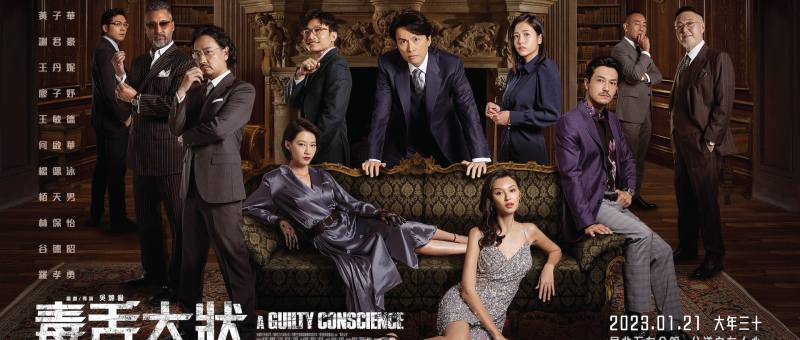
A Guilty Conscience (毒舌大狀, Jack Ng Wai-Lun, 2023)

“Something is wrong” a defence lawyer eventually asserts, witnessing a blatant attempt at perverting the course of justice right in front of her but otherwise unsure what to do about it when her opponents are so sure that they really are above the law. The directorial debut from screenwriter Jack Ng Wai-lun, A Guilty Conscience (毒舌大狀) is the latest in a series of films to put the judicial system on trial in pointing out that we are not in fact all equal before the law and the systems that are intended to protect us can often by subverted. 

Subverting the legal system was in a sense what the hero, fast-talking lawyer Adrian Lam (Dayo Wong Chi-Wah), had been trying to do. After years on the bench, his career as a magistrate is going nowhere and he doesn’t really bother to show up anymore which is why he’s abruptly demoted to a committee dealing with potentially obscene material. Cutting his losses, he decides to join the private sector working for a sleazy firm representing the rich and powerful. His first case is supposed to be a walk in the park, defending a woman, Jolene Tsang (Louise Wong Dan-Ni), accused of murdering her daughter. As usual, Lam assumes the case will be easy to win and doesn’t really bother putting the work in, especially once he finds out the mother was the mistress of a powerful man, Desmond Chung (Adam Pak Tin-Nam), and assumes sorting out the murder charge will help him get in with the elite. Only Lam badly miscalculates and owing to his own hubris sees his heartbroken client sentenced to 17 years in prison for a crime she almost certainly did not commit. 

It’s a huge wake up call for Lam who is suddenly snapped out of his cynicism and burdened by the guilty conscience of the title knowing that it’s his sloppiness that sent a bereaved young mother to serve out the rest of her youth in jail. Opening a small office of his own in a rundown part of town he resolves to serve a better kind of justice, but also determines to do what he can for Jolene in an effort to correct his mistake. He gets a chance when someone involved with the case dies and leaves a note explaining that they lied during the original trial, but as the wealthy Chung family is involved he finds himself frustrated at every turn. No one is brave enough to go against them, while their sleazy legal advisor Tung (Michael Wong Man-Tak) continues to manipulate the system to his own advantage. 

Lam may have to play a little dirty, appealing directly to the jury and wilfully breaking court procedure to make sure they hear evidence which is otherwise inadmissible, but does so in the interest of “truth” which according to Tung has no place in a court of law. Tung may well be correct, objective truth is largely irrelevant when rhetoric and legal argument hold sway. What’s morally wrong might not actually be against the law, while doing what’s right might also get you into trouble. That’s where the jury comes in, Lam answers, as a kind of check and balance using common sense to temper cold legality and decide what might best serve a kind of moral justice rather than simply answer if an offence has been committed under the law. 

But Tung calls the jury “laymen”, implying they are too stupid to understand legal complexities and are in fact a spanner in the works of justice. He objects to the introduction of “feelings” and preaches “fairness” while manipulating the system to his own advantage. Lam catches him out by needling at his elitism, pointing out that he may think he’s an elite now that he hobnobs with the rich and powerful but in their eyes he’ll never really be their equal in a world still ruled by old money. In a case Lam presided over in which a young man was accused of stealing a pair of ready meals from a convenience store where he’d previously been employed, he asks the defendant if he thought poverty was an excuse to do whatever he wanted, irritated by his attempt to manipulate his feelings by emotionally blackmailing him in claiming the meals were for his elderly parents and only taken because his boss had not paid his wages. Nevertheless, Lam had acted in the interests of “fairness” spotting that he was being asked to repay the full price in compensation when the meals he stole were actually heavily discounted and adjusting the amount accordingly. In effect Lam does something similar in defending Jolene, asking the rich if they think their power and status puts them above the law. The Chungs at least clearly think they do, doing their best to intimidate and frustrate the course of justice. 

“Everything is wrong” Lam adds during his closing speech, decrying the influence of wealth and power not only in the judicial system but in society at large. Tung thought he could manipulate the prosecutor (Tse Kwan-Ho) in knowing him to be a stickler for letter of the law, but even he knows that sometimes you might have to break the rules to do the right thing and to apply the law incorrectly would not be in the best interests of justice. With strong comedic undertones and warmhearted charm, Ng’s farcical courtroom drama discovers that the real culprits are privilege, elitism, corruption, and ambition but that justice can be served if only we apply a little common sense. 


A Guilty Conscience is in UK cinemas now courtesy of Magnum Films Global.

Original trailer (Cantonese with Traditional Chinese / English subtitles)

Hong Kong Family (過時·過節, Eric Tsang Hing-Weng, 2022)

“It doesn’t matter how the food is cooked. Let’s just enjoy it in the presence of each other and not think too much” a regretful grandmother advises giving perhaps the best advice for how to survive an awkward family gathering in Eric Tsang Hing-Weng’s autobiographically inspired familial melodrama Hong Kong Family (過時·過節). Coloured with the shades of exile, Tsang’s melancholy exploration of a fragmenting family unit ponders the limits of communication between those who should be closest along with the lingering resentments and toxic legacies that poison otherwise loving relationships. 

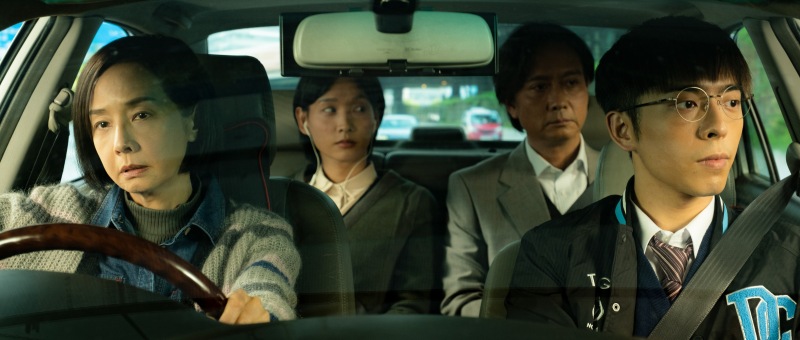
An opening sequence set eight years before the main action lays bare the tension between middle-aged housewife Ling (Teresa Mo Sun-Kwan) and her mild-mannered husband Chun (Tse Kwan-Ho) who sits silently in the back of the family car as she berates him for having recently lost his job and been unable to find another which is particularly inconvenient as they’ve just taken out a mortgage and bought a flat. 17-year-old Yeung (Edan Lui) sitting in the front passenger seat tries to keep the peace but refers to his parents as Mr & Mrs Chan, while his older sister, 20-year-old Ki (Hedwig Tam Sin-Yin), pretends not to hear escaping from reality by listening to music on her headphones. When they finally arrive at her mother’s home, a well appointed detached house out in the country, they are greeted by Ling’s brother Ming who has already fallen out with his mother (Alice Fung So-Po) in part because it seems she doesn’t like his wife who has declined to attend this Winter Solstice dinner. When his mother suspects him of stealing money, Ming angrily storms out vowing never to contact her again and provoking a similar row between Ling and Chun in which she asks for a divorce. Pushed past his limit, Chun starts hacking at a chair with a meat cleaver and eventually strikes peacemaker Yeung who then abruptly severs ties with his dad and moves out on his own. 

Yet eight years later it’s Yeung who seems to be looking for a way back to his family only he doesn’t know how to find it. He’s been working on a virtual reality “game” that would allow users to interact with AI versions of absent friends and relatives, helping them to communicate rather than offering an escape from reality though that may be in a sense what Yeung is doing in interacting with a simulacrum of his father rather than facing him directly. His parents did not divorce, but are clearly unhappy. Ling has found another simulacrum for familial life working as a housekeeper for a wealthy single father, while Chun is driving a taxi and secretly planning to start again by leaving for Mainland China and a job in a company set up by an old friend. According to grandma it seems their marriage may have been semi-arranged (by her) and years of trying have seemingly not improved their inability to communicate with each other. 

Ki, meanwhile, has been married and divorced since the fateful Winter Solstice dinner over which grandma kept trying to marry her off explaining that she married a random man to escape her family only to boomerang back two years later when it didn’t work out. She too is lying to her parents, pretending to go to work every day despite having lost her job and later drifting into an unexpected romance with a free spirited nomad from Malaysia who jolts her out of her sense of inertia in telling her to try to be true to herself. The return of Ming’s now teenage daughter Joy (Angela Yuen Lai-Lam) from exile in England offers the opportunity to repair their fragmenting bonds, but it seems some wounds run too deep to ever be fully healed. Chun is pulled towards the Mainland just as Uncle Ming had been pulled towards England, while Yeung just wants to go “home” but doesn’t know how and Ling frantically tries to preserve a sense of family just as Ki seems to have made her peace to go wherever her heart takes her.

That might be one reason that there are only women around the dinner table at another Winter Solstice, for some the first, each trying to salvage something and try to get along if only in a superficial show of togetherness while the men attempt to talk through their troubles agreeing to head towards the dinner table but in the end walking in circles. The elegantly lensed final scene may suggest that the family is in someways trapped by its history yet destined to scatter but echoes in its ambiguity offering the distant hope of a far off reconciliation but little promise of its arrival. 


Hong Kong Family is in UK cinemas now courtesy of Haven Productions.

Original trailer (Traditional Chinese / English subtitles)

Shadows (殘影空間, Glenn Chan, 2020)

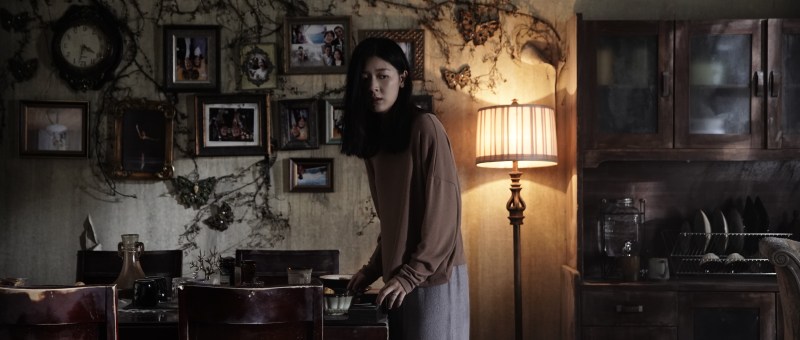
Are humans innately good or innately evil, and when we do good do we do it altruistically or to make ourselves feel better? These are all questions which occur to an idealistic yet conflicted forensic psychiatrist in Glenn Chan’s twisty psycho-noir, Shadows (殘影空間). Burdened both by a medical condition which apparently conveys a kind of superpower and by her own unresolved trauma, Ching (Stephy Tang Lai-Yan) wants to believe that people are at heart good but is herself caught in a complex web of manipulations in which even her well-meaning interventions may have unintended consequences. 

Ching’s big case is that of a 34-year-old social worker, Chu, who suddenly bludgeoned his entire family, three generations of women, to death with one of his many trophies which had a small heart on its top before calling the police and jumping over his balcony. As he only lived on the second floor, Chu survived but appears remarkably nonchalant about his crime. Police officer Ho (Philip Keung Ho-man) brings in Ching to figure out if Chu was really in a state of mental distress when he committed the murders, or if his certainly survivable suicide attempt is part of a smokescreen to help him evade justice. Possibly caused by a brain tumour, Ching’s special power is the ability to insert herself into her patients’ traumatic memories which is where she hears Chu recall a mantra that all humans are selfish and only think of themselves. This statement is meant not as censure but affirmation, Ching recalling a similar sentiment uttered by a rival psychologist, Yan (Tse Kwan-Ho), whom Chu had also been seeing, to the effect that mental imbalance lies in an inability to embrace one’s shadow self including “negative” impulses such egotism. 

In truth, the investigation into Chu’s case soon recedes into the background more or less forgotten as Ching embarks on an ideological battle with Yan who, we are told, has recently returned from many years living in the individualistic West and is peddling a kind of hyper individualist will to power which she regards as abetting his patients, a surprising number of whom go on to commit violent crime. Yan argues that humans are born evil and that the individual has the right to be selfish, abandoning conventional morality to pursue their own desires including those which necessarily harm others. Ching believes she’s doing the opposite, yet her attempt to help a victim of domestic violence by convincing her that she has the right and power to escape her abusive familial environment eventually places her in the same position as Yan. 

Given her own traumatic history, she may have to consider there’s something in Yan’s assertion that her intentions are also “selfish” in that she helps others in order to help herself feel better. When her investigation leads her, somewhat improbably, towards a serial killer with a Silence of the Lambs-esque taste for “beautiful” corpse tableaux she exposes him doing something much the same, claiming that he’s “saving” elderly people from the pain and suffering of old age but in reality trying to make himself feel better for failing to prevent the suffering of someone he loved while selfishly avoiding the pain of losing them. 

Determined to prove Yan is a serial killer by proxy manipulating his patients by encouraging them to embrace their darkest desires, Ching fails to see the degree to which she is also being manipulated, possibly for much longer than she might have realised. Yan’s patients refuse their responsibility towards others, rejecting the consequences of their actions in insisting that everyone makes their own choices. His hyper individualist philosophy might be seen as a stand-in for the increasingly selfish impulses of a previously collectivist society, a shift away from conventional morality towards the primacy of the self, yet it also darkly suggests that altruism is also cynical and born either of guilt or the selfish desire for reciprocity. In the end the verdict is in a sense left to a legitimate authority, Ho asked to decide if he thinks Yan is a crazed libertarian mad scientist, or if Ching is merely a traumatised and deluded woman pursuing some kind of personal vendetta. Featuring fantastic production design and stand out performances from Stephy Tang and Philip Keung, Shadows has no easy answers for the nature of the human soul but nevertheless casts its various protagonists on a noirish journey through the traumatic past guided only by duplicitous voices and ambivalent authority. 


Shadows screens at the BFI Southbank on 25th July as part of this year’s Chinese Visual Festival.

Original trailer (English subtitles)

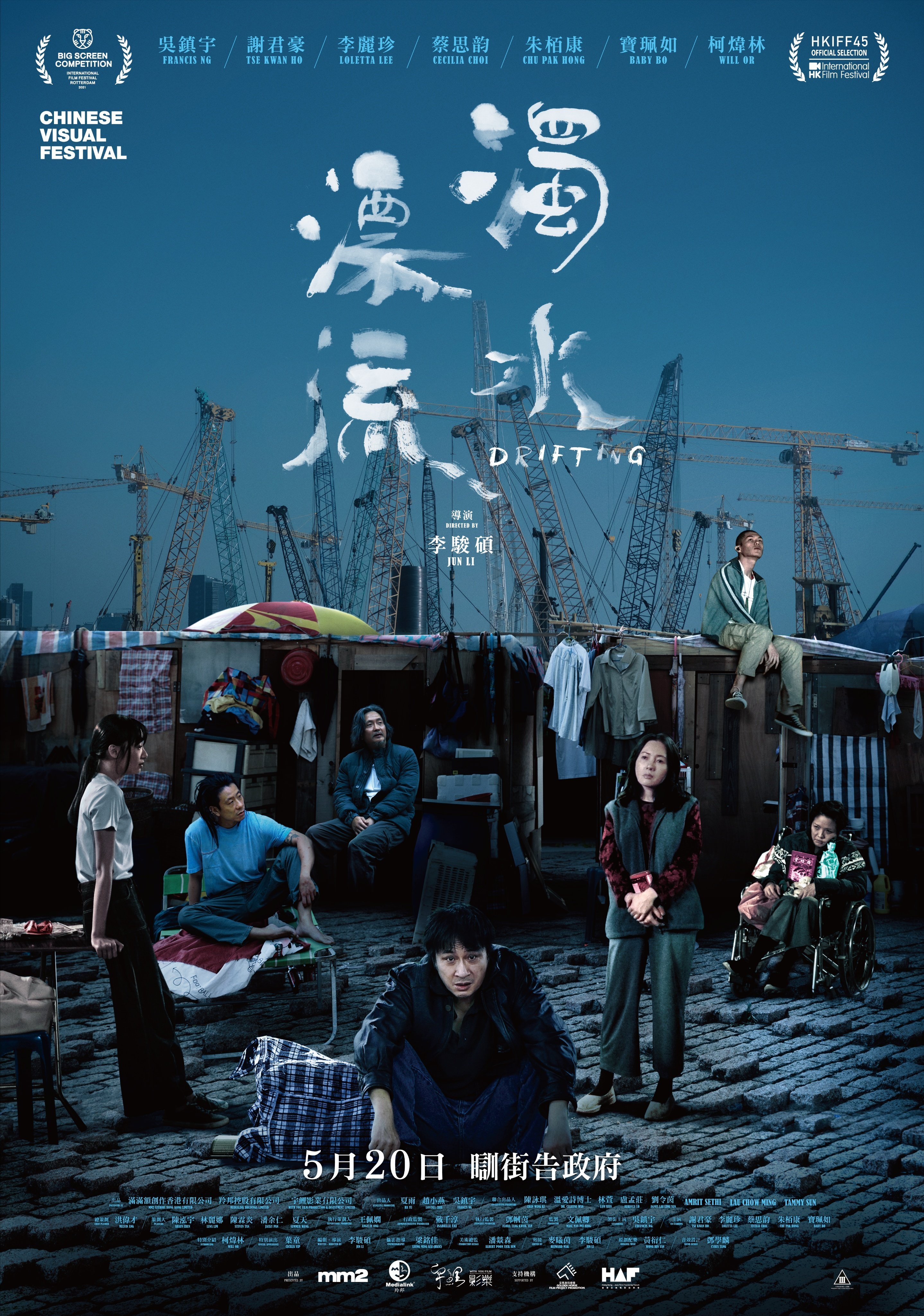
Drifting (濁水漂流, Jun Li, 2021)

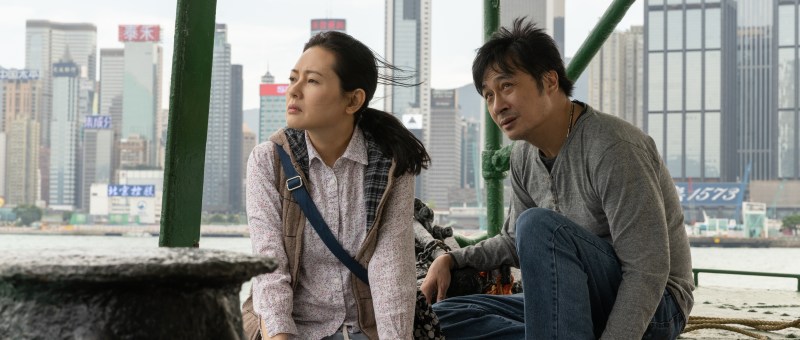
“It’s just a bigger prison out there anyway” a prisoner tells his jailer surprised by his lack of enthusiasm for “freedom”. Following transgender drama Tracey, Jun Li continues his exploration of the marginalised citizens of contemporary Hong Kong with Drifting (濁水漂流), in this case the growing numbers of the unhoused who find themselves unfairly victimised by an increasingly authoritarian regime all while the city’s famous housing problem sprouts new blocks of luxury condos daily further displacing those without the means to live in them. 

Released from prison Fai (Francis Ng Chun-yu) has nowhere else to go but back to the streets where he is welcomed by a ritualistic shot of heroin gifted by street godfather Master (Tse Kwan-ho), a refugee from Vietnam occupying a liminal status neither able to leave or remain owing to a criminal conviction which prevents his asylum in this or any other country. Fai’s attempts to rebuild his life are however frustrated when the community he is a part of falls victim to “street cleaning” in which uniformed officers turn up without warning to move them on, taking what little possessions they have and disposing of them as rubbish. This proves too much of an indignity for Fai who, along with the others and the help of social worker Ms Ho (Cecilia Choi Sze-wan), launches a law suit against the city both for damages against their stolen property and for an apology for the way in which they have been treated. 

“I am homeless. I am not worthless” runs the chant the small band of protestors recites outside the offices of government, but it’s a feeling that many of them find hard to internalise. Shing (Chu Pak-hong), a long time drug user, is originally afraid of the lawsuit because of the shame of people finding out about his drug use, relenting only when reminded he can file anonymously and thereafter wearing a medical mask just to be sure he can’t be identified. Fai, by contrast, agrees to be the face of the campaign but is frustrated by the approach of the media who, he feels, are not truly interested in publicising his case only in his “sob story” which he refuses to give them. Time and again, the homeless community is exploited by well-meaning do-gooders including a large number of students who either patronise them with ironic tasks or romanticise the homeless “experience”. 

Social worker Ms Ho is the only one who genuinely tries to help but even she finds her interventions sometimes cause more harm than good. While a friend of Fai’s darkly comments that her wheelchair gives her an advantage applying for public housing, Fai struggles to see a future for himself on the streets lamenting that no one’s going to hire him anyway and explaining that his drug use is a self-destructive way of killing time in an attempt to escape the boredom and despair of his futile existence. During the court case, he voluntarily enters rehab to try and come off drugs but also finds himself suffering with a serious illness for which he is afraid to get treatment because “hospitals are not a place for the living”. 

Echoing Fai’s distaste for the fetishisation of poverty, Li offers only sparse details of what brought these men and women to the streets save that many of them have been imprisoned which gives them a healthy scepticism when it comes to dealing with the justice system. Offered a settlement, most of the community want to accept but Fai is minded to hold out. The money is not so important to him, he’s replaced the things he needs, what he wants is his dignity in being given a proper apology and an acknowledgement as a human being. “Where can poor people live?” he asks, peering from the scaffolding on a half-completed luxury condo building witnessing gentrification in action as it towers over a slum knowing that its presence only means more “street cleaning” while people like him are pushed further into the margins, continually displaced by an economic prosperity to which they are not invited. “No one can save anyone” Fai finds himself admitting, the solidarity of the homeless community eventually shattered by their conflicting goals even as they continue to care for each other as best they can. Anchored by a standout performance from Francis Ng Chun-yu as the weary, defeated Fai battling his own traumas in addition to those of the world around him, Drifting paints a bleak picture of an increasingly unequal society seemingly content to abandon its most vulnerable citizens to the vagaries of a marginal existence. 


Drifting screens at the BFI Southbank on 15th July as the opening night gala of this year’s Chinese Visual Festival.

Original trailer (English subtitles)

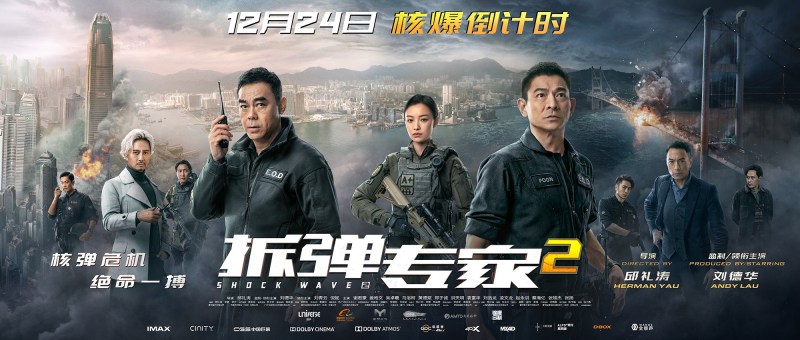
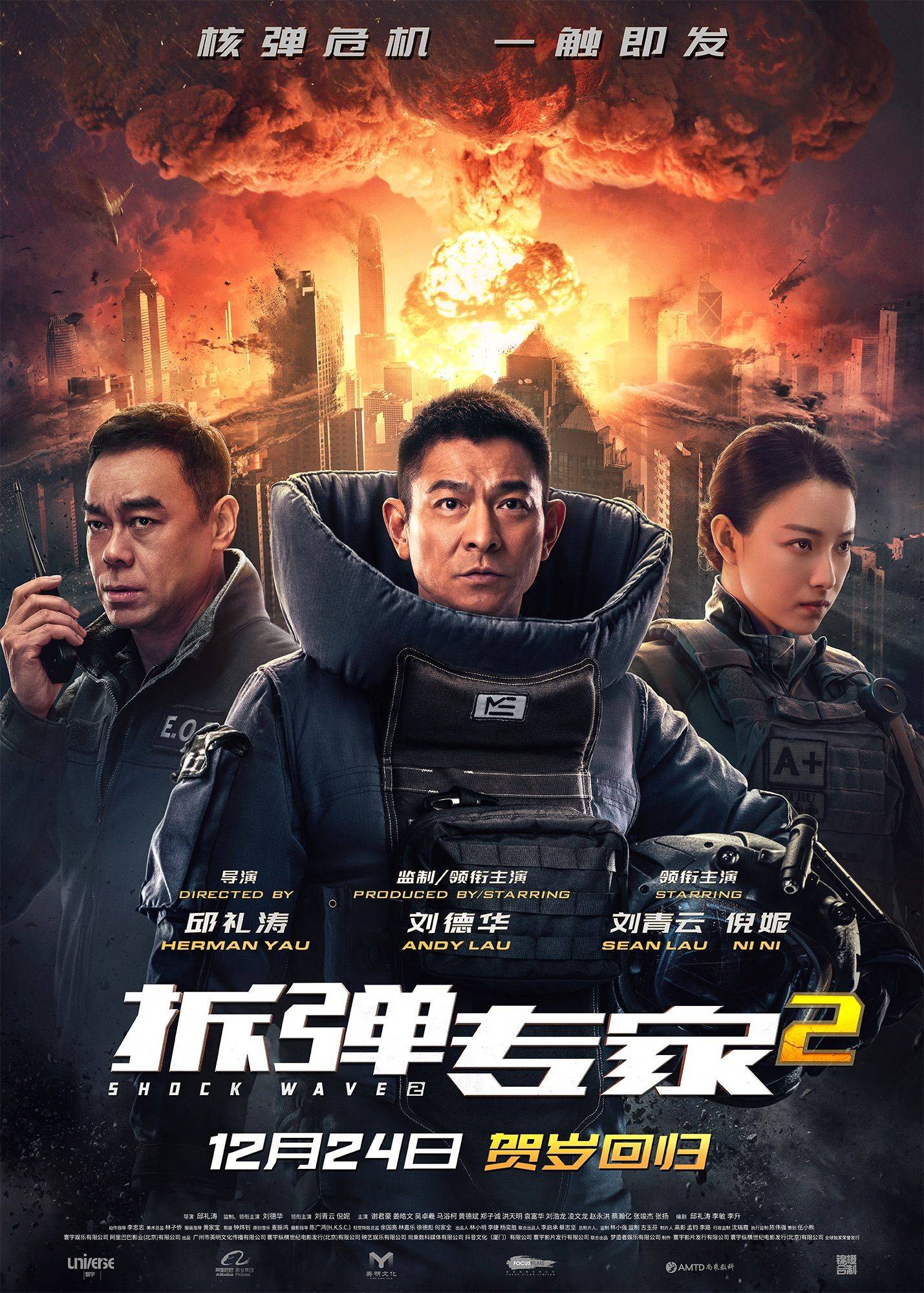
Shock Wave 2 (拆彈專家2, Herman Yau, 2020)

“Anger can destroy everything” according to the voiceover opening Herman Yau’s Shock Wave 2 (拆彈專家2), a thematic sequel to the original Shock Wave once again starring Andy Lau as a Hong Kong police bomb disposal officer battling serious threat to the island’s transport infrastructure but also picking up themes from the pair’s subsequent collaboration White Storm 2 in which the veteran actor had starred against type as a Batman-esque billionaire vigilante fighting a one man war on drugs. The villains here claim they want “change”, but in reality want little more than to burn the world, enraged by its refusal to recognise or remember them consumed as they are by wounded male pride. 

The hero, Fung (Andy Lau Tak-wah), finds himself suffering from amnesia after encountering the second serious accident of his professional life. When we first meet him, he’s essentially playing the same role as the first film, a cheerful, slightly cocky bomb disposal expert with a potentially reckless streak born of his willingness to risk his own life to save those of others. When he’s injured on a job, tricked by a random booby trap while trying to free a trapped cat, and loses his leg he reacts with characteristically upbeat stoicism quickly adjusting to his new prosthesis and determined to get back to work, training intensely with the help of his friend Tung (Sean Lau Ching-wan) who was also injured in the same blast only not so seriously. Despite passing all the fitness criteria Fung is fobbed off with an offer of a desk job in police PR, refused a return to the bomb squad as the panel quite openly admit not so much because they feel his disability impairs his ability to do the job as they fear public blowback should something go wrong and they be blamed for having hired a disabled person in the first place. 

It’s less a sense of discrimination than unfairness that fuels Fung’s growing sense of anger and resentment not only towards the police force but towards society in general which he now feels regards human beings as little more than disposable tools. He rejects the sense of himself as “disabled”, internalising a sense of societal shame keen to remind everyone that he is not impaired proving himself capable above and beyond the force’s criteria but is still rejected while Tung, who suffered only minor burns, is permitted to return to duty and even gets a promotion. His friends later recount that he became a different person after the accident, angry and embittered as if at war with the world. 

Yet after encountering a second accident, Fung loses his declarative memory which is to say he still has his everyday skills such as walking around (including using a prosthesis), getting dressed, brushing his teeth, using a computer and presumably the mechanics of bomb disposal but no longer remembers his own name or how he ended up in hospital now at least implicated in an act of major terrorism. Without his memories, Fung is a blank slate, freed from all the trauma and resentment that may have pushed him towards the dark side and returned to the innate goodness of a soul untouched by the world’s cruelty. The question is, which way will he turn, back towards the darkness or further into the light as the Fung they once new who willingly risked his life for others? In any case, he finds himself potentially misused by his well meaning ex Pong Ling (Ni Ni) who engages in some dubious psychology involving false memory implantation to convince him that he’s been working for the Hong Kong police undercover, hoping to engineer a softer landing for him than the realisation that he may be responsible for the deaths of at least 18 people as a member of an anarchist sect going under the apt name of “Vendetta”. 

Like Fung, the leader of Vendetta is an angry man resentful of having been forgotten by someone he cared about who had simply grown away from him. He rages against the world partly as a consequence of his aimless privilege having discovered his wealthy family made their money peddling opium with the assistance of the colonial authorities, but also as a direct result of childhood bullying and frustrated male friendship. Vendetta claims it wants to stop the world from getting “worse”, but all it really has is anger and the intense hurt of wounded pride. These men refuse to be “KO’d by this sick society” but in the end all they want is to be seen, to be recognised and remembered. To ease their sense of belittlement and impotence, they plan to burn the world by literally severing connections with it. 

Yau takes aim at the various systems which generate this kind of anger, hinting at the shockwaves of ingrained societal discrimination even if Fung internalises a sense of stigmatisation in his intense need to prove himself free of “disability”. Robbed of his memories, Fung’s anger dissipates allowing his natural capacity for selfless heroism to resurface along with a healthy desire to reflect on his own behaviour, at least as much as can he rely on the sometimes duplicitous vagaries of memory both his own and that of others as he searches for the truth of himself and his “vendetta” with the world. Torn between risking his life to save others and blowing it all to hell, Fung ends up doing both, sending shockwaves throughout his society in a deeply ambivalent act of personal and societal redemption. 


Shock Wave 2 is available to stream in the UK until 12th May as part of the Chinese Cinema Season. It will also be released on DVD/blu-ray on 7th June and digitally on 14th June courtesy of Cine Asia.

UK release trailer (English subtitles)

Ordinary Heroes (千言萬語, Ann Hui, 1999)

ordinary heroes posterThroughout her long career, Ann Hui has become adept at making subtle political points through addressing the struggles of the recent past. Ordinary Heroes (千言萬語) was released in 1999, just two years after the handover which signalled the end of British colonial rule. The Chinese title of the film is taken from a Teresa Teng song heard on a car radio and means “thousands of words, tens of thousands of languages” – a sentiment which could apply to the work of the activists as they work tirelessly to little effect, but the English title perhaps hints more closely at the film’s essential purpose as a tribute and pean to these ordinary people who dared to stand up to authority to fight for what they thought was right.

After a brief prologue from the street performer (Mok Chiu-yu) – inspired by the real life figure Ng Chun Yin, who will become the Brechtian narrator of the ongoing drama, Hui cuts to a title card reading “to forget”, only to open with the words “I remember”. The heroine has, however, forgotten her former life for reasons of which we aren’t yet sure. Sow (Loletta Lee) is a young woman and former activist being cared for by her friend, Tung (Lee Kang-sheng) who has been nursing a longterm crush on her ever since she pickpocketed him when he was in high school. Sow, however, had been involved with an activist, Yau (Tse Kwan-ho), who later married someone else, but remains committed to the cause, as hopeless as it might seem.

The cause is that of the Yau Ma Tei boat people. A historic community of former fisherman, the Yau Ma Tei boat people live off the shore of Hong Kong in what was constructed as a typhoon shelter after a fierce storm destroyed almost an entire fleet in 1915. During the 1950s, the community moved away from fishing and became a a kind of tourist spot and centre for petty crime. With their own distinctive accents, clothing, and isolated way of life the boat people were not always welcome on land but also faced an additional problem in that many of their wives were refugees from the mainland and technically illegal migrants forbidden from setting foot on Hong Kong proper. Though the government instituted an amnesty for the children of boat people, it took advantage of the women who came forward to get official birth certificates, deporting them back to mainland China and separating them from their families.

The boat people find few friends, but an Italian Catholic priest and, incongruously enough, committed Maoist, Father Kam (Anthony Wong) becomes a staunch defender, living with the boat people and providing education for the children as well as ministering to his flock. Yau and Kam work together to advance the cause of the boat people while Sow assists Yau and Tung follows Sow whilst also becoming close to Kam and influenced by his peculiar ideology. Kam, often to be found strumming his guitar and singing the Internationale, becomes a figurehead for the movement, even committing to a hunger strike in an attempt to get the authorities’ attention.

Structuring her tale in a non-linear fashion, Hui weaves the complex narrative of political descent in ‘70s Hong Kong, splitting her focus between the single issue activism of Yau and Kam and the wider leftist movement as recounted in the street theatre of Ng Chun Yin. Ng, a longterm leftist activist, was the founder of the Trotskyist Revolutionary Marxist League who later went to China to deliver a true Marxist, democratic revolution but ended up betraying his cause and being kicked out of his own movement. Such obviously left-wing agitation was, perhaps, difficult in the early 70s when news of the cultural revolution had discredited Chinese communism, especially as many residents of Hong Kong had arrived as refugees from the oppressive regime, but there are those who continue to believe in and fight for the values that they believe should be present North of the border.

Sadly these hopes are crushed by the Tiananmen Square incident in 1989 after which it was impossible to argue for the moral superiority of the Chinese state over the colonial government. The bursting of a political bubble runs in parallel with the sad love story of Sow and Tung who find themselves at odds with each other, never quite in the same temporal space. Hui signals the closing coda with another title card, this time reading “to not forget”, as Sow and Tung are forced to acknowledge their painful pasts as they look forward to an uncertain future. Forgetting and not forgetting become the central themes as the boat people plead for recognition, while there seems to be an active choice in play to decide to forget these “ordinary heroes” and the various sacrifices they made in the name of social justice as Hong Kong begins to look forward to its own uncertain future as one master is swapped for another and the silent majority sit idly by, opting for the consumerist revolution over the human one. Ng, in his opening statement, talks about heroes with unfulfilled missions. Tung and Sow find themselves at a new dawn with their illusions shattered, filled with thousands of words and nothing at all to say. 


Screened at Creative Visions: Hong Kong Cinema 1997 – 2017

Original trailer (Cantonese, no subtitles)

Teresa Teng’s Thousands of Words