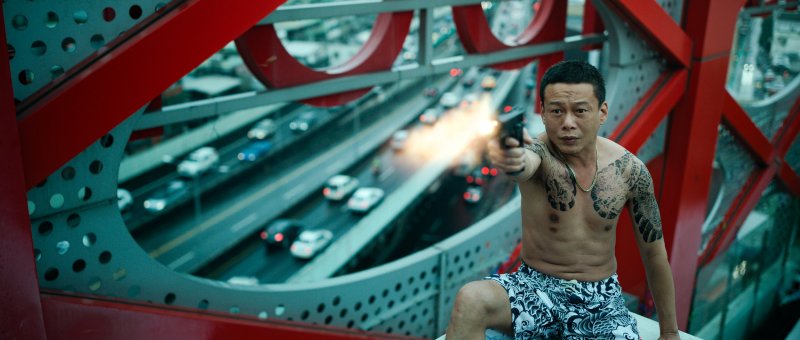
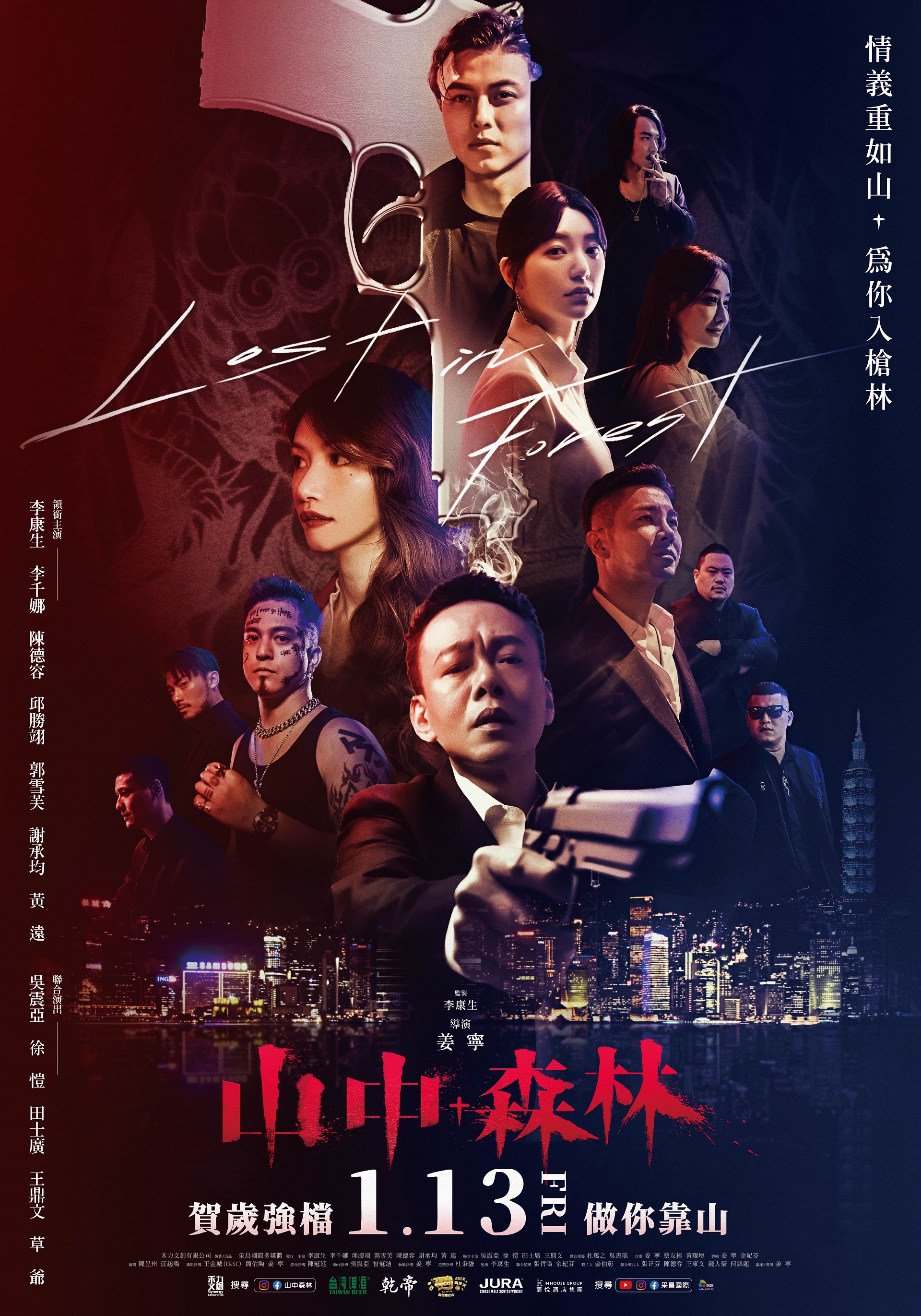
Lost in Forest (山中森林, Johnny Chiang, 2022)

History repeats itself for a former gangster recently released from prison in Johnny Chiang’s melancholy neo-noir, Lost in Forest (山中森林, Shān Zhōng Senlín). Set in a neon-lit Taipei, Chiang’s moody crime drama finds its hero displaced in the modern society unable to look either forward or back while meditating on all he’s lost and another less corrupt vision of his home city as symbolised by his late father’s missing sausage bike and the changing back streets where it was once parked.

This Taipei is however a less wholesome place as suggested by Chiang’s frequent cuts to Christian churches and the giant neon crosses that sit above them as if looming in judgement on the chaos below. 12 years previously, Sheng (Lee Kang-sheng) opened fire on rival gang members who’d kidnapped his best friend and comrade Seagull (Angus Hsieh) who has now taken over the outfit while he’s been inside. Customarily, Seagull should have had someone come to meet him on his release, but Sheng exits the prison alone and is given a lift back into the city by the entourage collecting his prison buddy Ji despite the fact they are headed to an entirely different part of the country. Without a phone and not knowing where the gang even is anymore, all Sheng can do is hole up in a hotel until he finds out what’s going on. All of which suggests that despite his sacrifice, Seagull may not be particularly glad to reunite with him.

The conflict exists on three levels. Sheng must necessarily doubt his old friend Seagull, especially on realising that his new business model involves exploiting vulnerable women by pressing them into debt via high interest loans and then forcing them into sex work, while simultaneously worried about his guys who claim they have not been well treated while Sheng was away. But then it also becomes clear that much like many contemporary Taiwanese crime dramas, the real villain is institutional corruption as Seagull’s alliances with corrupt politicians and shady businessmen continue to destabilise the underground society thanks to the machinations of anarchic street punk Monkey (Sean Huang) who engineers a gang war by giving the businessman’s son a kicking as leverage in a dodgy land deal. 

On the one hand, Sheng watches history repeat itself as a handsome foot soldier, Chenghao (Prince Chiu), vacillates over leaving the gang for his respectable girlfriend Alice (Puff Kuo), while on the other Sheng becomes attached to sex worker Jing (Lee Chien-na), one of Seagull’s exploited women working for him to pay for her father’s medical bills. Sheng’s former lover tells him that if he really cared about her, he shouldn’t have sacrificed himself for Seagull just as Chenghao shouldn’t put himself in harm’s way out of a pointless sense of loyalty for a gang that has no real loyalty to him. Before his release, the prison warden had advised Sheng not to let his sense of loyalty get the best of him, but as he says Sheng no longer has much of anything else. His parents died while he was inside, the woman he loved married someone else, and Seagull can’t even remember what he did with Sheng’s dad’s sausage bike which is his only path back to a more wholesome existence. 

In a certain sense he’s powerless, unable to escape the inexorable pull of gangland karma until finally forced to reckon with the destabilising force that is Monkey to restore some kind of order and undermine the system of corruption that has arisen between underworld thuggery, local politics, and big business. The warden had also pointed at the fish in his tank and asked Sheng if it was happier in there or back in the sea but Sheng had merely said that it’s up to the fish to decide, hinting that in a certain sense it’s all the same and it’s just that one prison is bigger than another. At least the fish gets fed and is kept safe from predators even in its lonely isolation, which might be more than can be said for Sheng who can never truly escape his past even as he tries to free Chenghao and Jing from a similar fate. A melancholy mood piece, Chiang shoots night-time Taipei as a land of neon emptiness set against a classic jazz score that echoes Sheng’s deadpan ennui in a modern world of electronic smoke and rueful nihilism in which there is no escape from karmic retribution. 


Lost in Forest screens in Chicago April 16 as part of the 16th season of Asian Pop-Up Cinema.

Original trailer (Traditional Chinese / English subtitles)
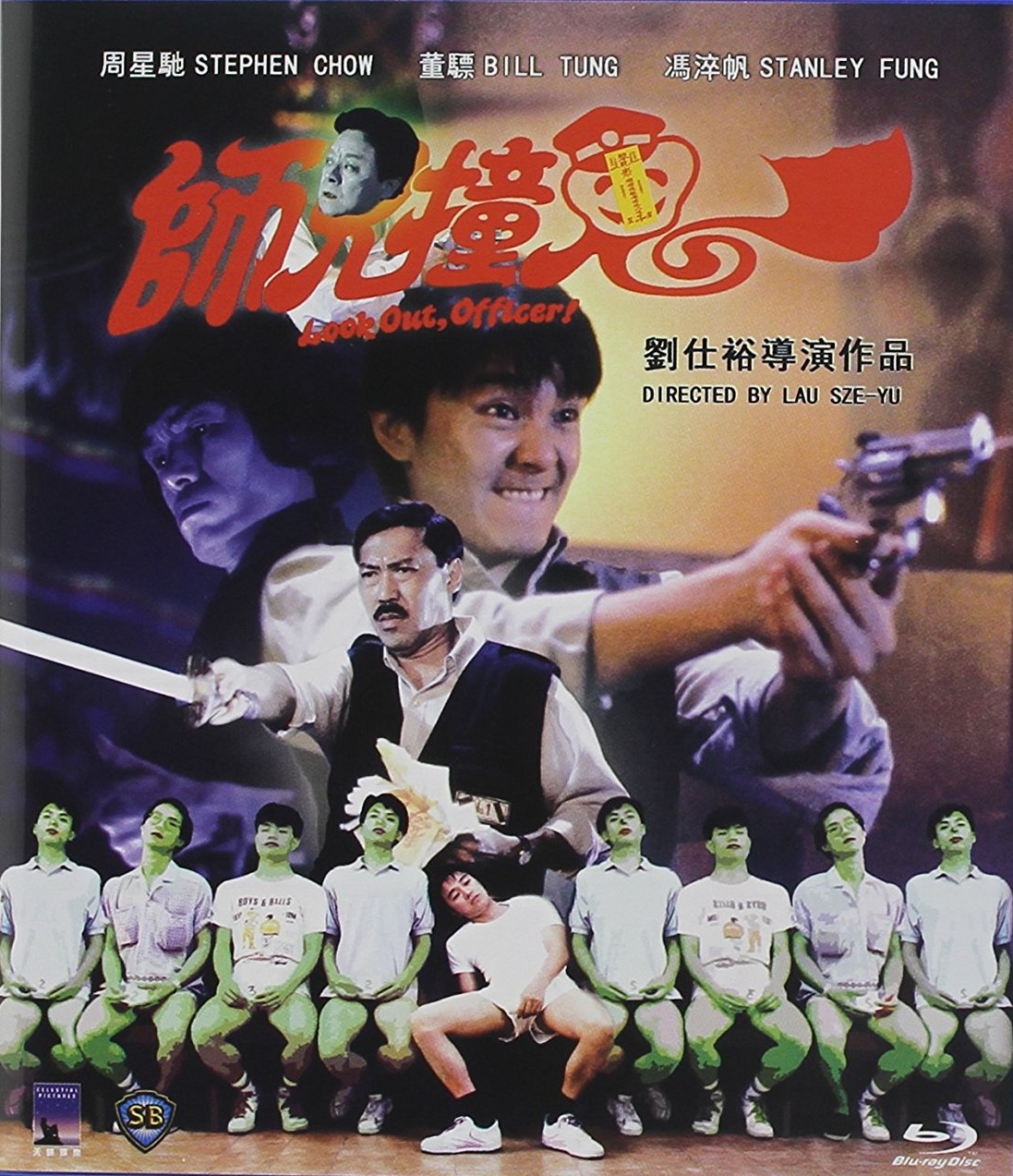
Look Out, Officer! (師兄撞鬼, Lau Sze-yue, 1990)

look out officer BD 1The thing about classic Hong Kong comedies is, they were made for a very specific time and place as a quick populist diversion not intended to have much of a life beyond their original release. Despite the thrown together, sketch show-style progression from one tenuously related set piece to the next held together by quick fire comedy, they could also be surprisingly subversive as in this 1990 comedy starring a young Stephen Chow. Look Out, Officer! (師兄撞鬼) is a silly buddy cop comedy and supernaturally tinged procedural but it also satirises the Hong Kong government’s response to the growing “boat people” crisis in which, as is declared in the film, those who’ve come from Vietnam for “economic reasons” will be regarded as illegal immigrants and deported. 

The film begins with two policeman as one berates the other for stopping to burn “ghost money” on the street, describing his need for ritual as like that of an old woman. The first policeman, Biao (Bill Tung), then gets a message on his pager to check out an abandoned warehouse. Piling into the police car, Biao and religious cop Chin (Stanley Fung) arrive but don’t find anything suspicious. Chin decides to leave while Biao wants to investigate further. Poking around, Biao finds himself directly above some kind of large scale drugs lab into which he heroically jumps and beats up most of the grunts waiting below before the head gangster turns up and throws him out of a window. Biao’s body lands directly on the top of Chin’s car who has returned after having second thoughts and wanting to make sure his partner is OK.

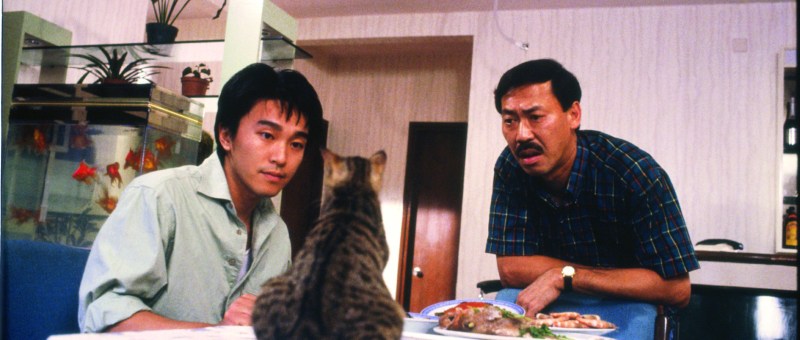
The “official” explanation is that Biao has killed himself because of his excessive gambling debts. Up in heaven he gets put on trial (alongside recently deceased dictators Ceausescu and Marcos) and the judges find that his death is indeed suicide despite his protestations. Eventually they agree to let him go back to Earth as a ghost to prove he was murdered and take revenge on the killer. Biao gets assigned a “saviour” whom he will know thanks to an unusual birthmark. The “saviour” turns out to be rookie cop, Sing (Stephen Chow), who is not exactly top of his graduating class but aided by Biao’s supernatural powers he just might be able to find the real killer after all.

As it turns out Chin dabbles in Taoist magic (to make his arms longer, for no particular reason) as do the gangsters who seem to have demonic forces on their side. Biao never saw the face of the man who killed him because he had him in a headlock, but he does remember his terrible body odour thanks to being shoved under his armpits. Victory in the final battle relies on conjuring a unique charm which consists of equally stinky ingredients including virgin’s urine, cat poo, and flatulence neatly bringing several of the film’s running jokes together into one satisfying punchline.

Running gags there are a plenty from the grumpy old cleaner at the police station they’ve nicknamed the 1000 year old virgin who likes to mop up the men’s toilets while they’re busy so she can assess the policemen’s “capabilities” for herself, to the cat who keeps defecting on the altar, and Sing’s general weediness. The supernatural procedural runs in tandem with the usual romantic comedy subplots including Chin’s over protective attitude to his grown up daughter who inevitably ends up in a relationship with Sing thanks to Biao’s supernatural wingman-ing. One of the “charms” Baio has been given to help him in his quest is a “lewd” spell which suddenly makes the victim randy for the first person they see. Biao uses this to get his own back on Chin for leaving him behind by making their austere superior officer suddenly come over all goey only to have her snap out of it and accuse him of sexual harassment.

The humour maybe distinctly lowbrow, but there is a degree of satire lurking in the background as Sing is sent into a “massage parlour” with a codeword in Vietnamese only to discover that all the girls in the place can understand it and immediately parrot back the recent ordinance of Vietnamese immigration. Later, a Vietnamese man threatens to commit suicide over the cruel and inhumane treatment he has received as a Vietnamese immigrant trying to make a life in Hong Kong, fearing he may be forcibly deported and will be killed if he has to go back to Vietnam losing everything he’s tried to build in Hong Kong.

When Biao eventually gets back to heaven they don’t want to let him in even though he’s cleared his name because heaven has a quota and he doesn’t meet the criteria. All is not lost, however, because you can buy your way in as an immigrant with ”special investor” status. In heaven, it seems, everything is fine so long as you have money. As above, so below. Another characteristically nonsensical, juvenile comedy from Shaw Brothers, Look Out, Officer! is as silly and of its time as one would expect but it is undeniably entertaining and unexpectedly moving in its final moments.


Remake of Philip Chan & Ricky Lau’s Where’s Officer Tuba? (1986)

Celestial Pictures trailer (English/traditional Chinese subtitles)