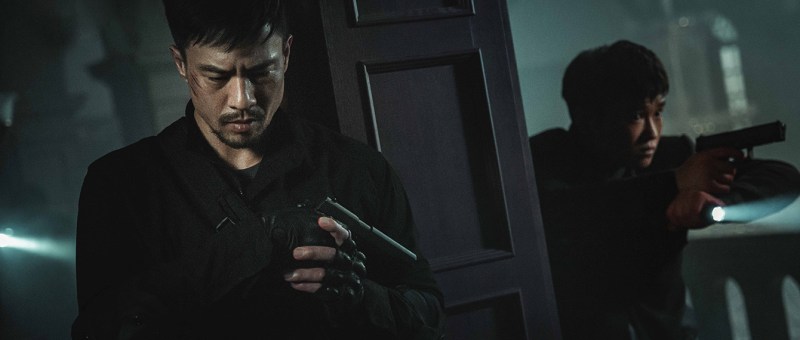
Blind War (盲战, Chris Huo Suiqiang, 2022)

After losing his sight in an explosion, a former swat officer must battle his way to the top of a human trafficking network in a fictional South East Asian nation in Chris Huo Suiqiang’s action drama, Blind War (盲战 máng zhàn). The film opens with an assault on justice, but the wounded cop must in effect turn vigilante to protect his daughter from a failure of the judicial process and pervasive misogyny in a culture in which women and girls can be sold at will while the corrupt police force do nothing.

In fact, the local cop Rama (Dou Dou) is played mostly for comic relief and is otherwise incredibly stupid, determined to nail blind former cop Dong (Andy On), whom he knows to be the father of a murdered girl from a neighbouring nation, as the king pin of the drug smuggling and people trafficking operation. Dong’s struggle runs concurrently with a succession drama in which Zha Kun (Qi Shenghan), son of drug dealer McQueen who was blown up in the dock in the opening courthouse sequence, seeks to cement his authority over the gang and get revenge on Cena (Yang Xing) for the death of father while she wants revenge on Dong for blowing up her husband. 

Dong is in fact dismissed from the police force in disgrace due to public opinion which blames him for the deaths of his men who were killed by the gang when he decided to check out a funny noise in the courthouse though he was only supposed to be guarding McQueen’s post-trial extradition. Having lost both his sight and his status as police officer, he begins to lose his mind becoming violent and paranoid with looking after his teenage daughter Yati (Cheng Sihan) his only other outlet. When she’s taken by the people traffickers, he’ll stop at nothing to get her back though it has to be said is not particularly interested in the other women or stopping the gang and in the company of Cena who is using him for her own revenge plot becomes increasingly corrupted in his willingness to use violence. 

Luckily, Dong was blessed with superior hearing to begin with and with the loss of his sight is largely able to navigate the world by ear alone, giving him an advantage over his opponents even if he can’t see them. The film sets him up with almost supernatural powers, at one point using a conveniently placed climbing rope to jump from one window to the apartment below. The fight scenes are often impressive and well choreographed, especially one tortuous sequence in which Dong is attached to Cena by chain and his position dictates whether or not she’s dunked in the water, and in terms of scale display impressive production values for a low budget streaming film.

Nevertheless, Dong is often eclipsed by the villainess, Cena whose tragic backstory makes her claim to vengeance just as valid as Dong’s as she battles to take down the gang that raped and controlled her after being sold by her father to a Thai warlord as a child. The local police seem to be much more interested in the drugs than the people trafficking, and Rama’s unintentionally ironic cries that Cena’s bumped off the only female officer they have, which is presumably why he had a crush on her, bares out the misogynistic attitudes in play in which female life is cheap and the only way to escape subjugation to oppress other women, like Dragon King (Qian Zhiyi), or to become crazed and cruel like Cena.

In any case, though it was never really in question, Dong’s fatherly devotion is eventually proved by his knowledge of his daughter which eventually enables him to save her, with the help of his loyal friend Yun (Wang Hanyang) who doesn’t really seem to mind that Dong went rogue and endangered his life while he’s been hanging around in the shadows the whole time in case anyone needs him. Perhaps in a concession to the censors, it’s clear that Dong is also paying for his transgressions though through his vigilante action is able to reclaim his position as a father and protector despite his career setbacks and the loss of his sight.


Blind War is available now in the US on Digital and Blu-ray courtesy of Well Go USA

Trailer (English subtitles)

Swordsman II (笑傲江湖之東方不敗, AKA The Legend of the Swordsman, Tony Ching Siu-tung, 1992)

Swordsman II still 1In a world filled with chaos, is the answer to all life’s problems retreat or attack? After the unexpected success of Swordsman which survived the withdrawal of legendary director King Hu to go on to be a box office hit, a sequel was quickly set in motion to be directed by action choreographer Tony Ching Siu-tung. Swordsman II (笑傲江湖之東方不敗) would be the second in a trilogy inspired by Louis Cha’s novel The Smiling, Proud Wanderer and largely dispenses with the cast of the original film for a virtual reboot led by action star Jet Li and actress Brigitte Lin as an extraordinarily sympathetic villain.

Picking up soon after the end of the first film, Ling (Jet Li) and his female comrade nicknamed “Kiddo” (Michelle Reis) are on the run with the intention of retiring from the world of martial arts to live simply among honest people. However, they are about to ride straight into the heart of conflict. At this particular point in history, the “Highlanders” feel themselves oppressed by the ruling “Mainlanders” and would be set on rebellion if they weren’t so busy fighting amongst themselves. Meanwhile, a number of Japanese troops are also holing up in China to wait out political strife in Japan. “Invincible” Dawn (Brigitte Lin), a Highlander, appears to have gotten a hand on the first film’s MacGuffin – the “Sacred Volume” which holds the key to untold martial arts power. Teaming up with the displaced Japanese, Dawn plans to use the powers of the Sacred Volume to dominate the Highlanders and then eventually take over the entire nation.

Dawn happens to be the uncle of a woman, Ying (Rosamund Kwan), with whom Ling began something like a romance back in the first film. Ying’s father, Wu (Lau Shun), the chief of Highlander tribe Sun Moon Sect, has gone missing – presumed taken prisoner by Dawn as a prelude to seizing power. Despite his desire to escape the duplicitous world of martial arts, Ling finds himself on a quest to save Ying’s father and with it the Sun Moon Sect if not the entire nation from the tyrant that Dawn seems primed to become.

Ling, as heroes go, is very much of the wine, women, and song, school. Indeed, he’s not much for anything without a good cup of booze – something that provokes an instant connection with the unusual figure of Dawn when he spots her bathing in a local pool and she offers him some of her upscale alcohol in a pretty bottle. The powers of the Sacred Volume come with a price – in order to embrace them, Dawn must transform herself into a woman (or in the less poetic rendering of the text, simply cut off her penis). Dawn’s transformation is a gradual process and she continues to play her male role as the head her clan, even parading her mistress in front of her captives in a noticeably salacious manner. However, Dawn is also caught off guard by an unexpected attraction to the cheerfully tipsy Ling and the transformation seems to accelerate – she begins wearing makeup, her voice changes into a more feminine register, and her sexual relationship with her mistress appears to be definitively over.

Meanwhile, Ling is fighting a romantic war on three fronts – he’s captivated by the mysterious woman who avoided speaking to him never knowing she is really his enemy, but is still half in love with Ying, and the subject of Kiddo’s unrequited crush. While Dawn wrestles with a deeper transformation, Kiddo is also trying to process her place as a woman among men in attempting to shed her tomboyish image by styling her hair in more classically female fashions and wearing makeup – something which can’t help but arouse mild hilarity among her comrades who collectively think of her as a tough little sister. Trying to explain her new persona to her mistress, Dawn insists that she will never forget her and that essentially nothing has changed, while the guys partially mock Kiddo’s new desire to embrace her femininity by avowing that male/female/non-binary gender is an irrelevance. Even so, on realising Dawn is the person he’d been looking for and was once Ying’s uncle, Ling’s parting questions are all about whether he might have accidentally slept with a man which he seems to find embarrassing. Nevertheless, it’s “femininity” which finally does for Dawn as she finds herself weakened by love and eventually pushed towards a “heroic” act of romantic sacrifice.

Having defeated one tyrant, Ling finds himself threatened by another as Wu’s maniacal need for revenge provokes a wide scale purge of those who had “betrayed” him. Ling’s desire to remove himself from this world of betrayals, violence, and complex moralities seems ever more understandable but cannot be his answer even as he finds himself unwillingly exiled. If you turn your back on trouble, it will eventually engulf you and everything you love – as will a failure to resist a trusted ally’s descent into darkness. Strangely affecting in its hero/villain symmetries and air of tragic romance, Swordsman II’s beautifully choreographed action sequences are only surpassed by its fierce commitment to fantasy.


Swordsman II was screened as part of An Evening with Tony Ching Siu-tung presented by the Chinese Visual Festival.

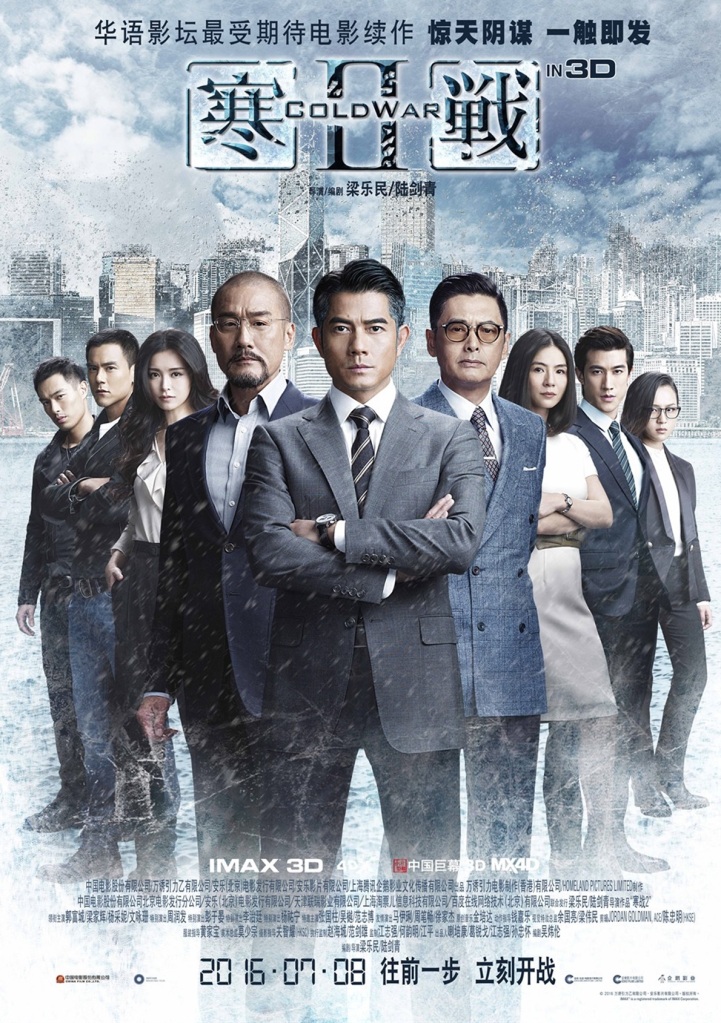
Cold War 2 (寒戰II, Longman Leung & Sunny Luk, 2016)

coldwar 2Cold War 2 (寒戰II) arrives a whole four years after the original Cold War rocked Hong Kong with police corruption scandals and fantastically convoluted internal plotting. Heroic policeman Sean Lau (Aaron Kwok) may have won the day, even if he ultimately had to compromise himself to do it, but the police van is still missing and MB Lee (Tony Leung Ka-fei) is still lurking in the background. As is his son, Joe (Eddie Peng) – languishing in prison but apparently still with the resources to cause trouble whilst behind bars.

Joe Lee has Lau’s wife kidnapped, forcing Lau to compromise himself by giving in to his demands all of which culminates in an intense subway set piece in which Lau inadvertently ends up handcuffed to an exploding smoke bomb while Joe Lee escapes. Embarrassing is not the word. Lau now looks bad, and old rivals have their eyes on the police chief’s chair. An enquiry is currently underway into goings on at police HQ lead by top lawyer Oswald Kan (Chow Yun-fat) but his impartiality is severely damaged when one of his own is caught in the crossfire whilst investigating Joe Lee’s nefarious activities.

Like the first film, Cold War 2 is an intense interpersonal thriller though this time the enemies are even closer as the old boys network becomes the means by which commissioners are unseated and installed. Service records are everything – Lau is unpopular with his colleagues because he started out at ICAC and has never served as a rank and file policemen. From one point of view, this makes him an ideal candidate because he has no personal ties to the body of serving officers but his rivals despise him for this very reason. He isn’t one of them, does not have first hand understanding of front line policing, and most importantly is not a part of their interconnected layers of military style brother-in-arms loyalties.

Lau’s predictable miscalculation regarding Joe Lee creates an opportunity to get rid of him and take back the force. “Save the police” is a message which is repeated over and over as the plotters attempt to win others over to their cause, insisting that Lau has lost the media battle for the hearts and minds of a public now trained to be afraid of their police force. Lau is the continuity candidate – mistakes have been made, but his stately manner and apparently steady hands may yet win the day. Those same hands are getting dirtier by the second, but they’ve been brushing the morally grey, not (yet, at least) immersed in the red of innocent blood like those of the corrupt top brass at police HQ.

If the plotting is intricate and filled with double crosses and betrayals, directors Luk and Leung have ensured a steady stream of explosive action sequences to accompany the ongoing cerebral games. Cold War also had its share of action packed spectacular set pieces but Cold War 2 may surpass them with the surprise factor alone including one shocking multi-car pileup inside a tunnel in which cars, buses and bikes go flying before an all out fire fight ensues. Lau’s constant gazing at the “Asia’s Safest City” signs which adorn police headquarters (right next to the metal detectors you need to pass through to get in) has never looked so melancholic and drenched in irony.

It’s a battle for the soul of the police service, but it’s being fought as a dirty war. Lau is the decent and honest man forced to behave in a slightly less honest and decent way, even if for the best of reasons. His rivals are running on pure ambition and pettiness. Despite their claims they do not have the interests of the people of Hong Kong as their foremost concern. The corruption stems far further back than anyone might have previously guessed and is more or less coded into the system. The police van and equipment are still missing and the central plotters are still in place. This is a partial victory at best but then what kind of action fest wouldn’t leave a door open for a sequel. The cold war maybe about to turn hot, but you can rely on the steely eyed Police Commissioner Sean Lau to be there, ready and waiting, when the first shots are fired.


Original trailer (English Subtitles)