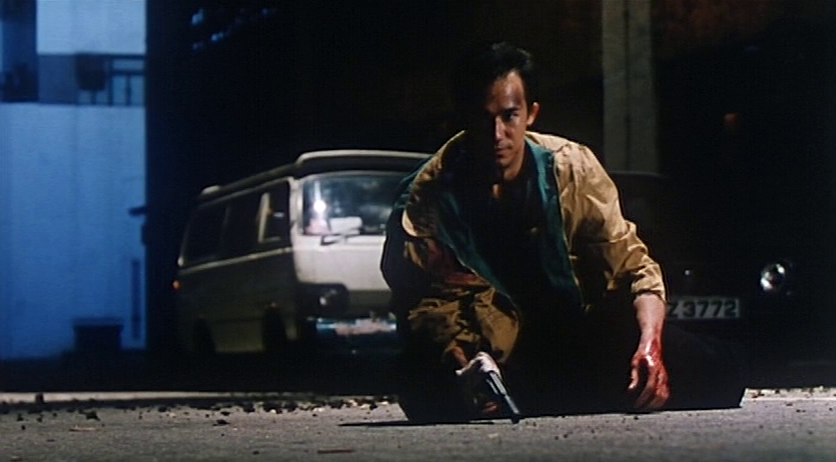
The Big Heat (城巿特警, Andrew Kam & Johnnie To, 1988)

A Hong Kong cop struggles with his sense of responsibility when faced with the fatalistic existential threat of the imminent Handover in Johnnie To’s first foray into the genre with which he would later become most closely associated outside of Hong Kong, the action crime drama. After a handful of Cinema City comedies, To is credited as a co-director along with Andrew Kam Yeung Wah though the production of The Big Heat (城巿特警), loosely inspired by the Fritz Lang film of the same name, was notoriously complicated passing through several hands over its unusually long gestation of almost two years, according to an interview with screenwriter Gordon Chan Kar-Seung, with producer Tsui Hark also heavily involved in the shooting. 

Tsui’s involvement is apparently responsible for the unusual level of explicit violence more usually found in horror exploitation rather than gangster noir, though there is perhaps something in the constant bodily destruction that aligns with the pre-Handover setting in which the “big heat” hanging over the city is an increasing existential panic which has created the maddening environment in which this surreal violence can occur as revealed in the opening dream sequence which features a drill piercing a man’s hand with small pieces of flesh speeding off it. The dream will turn out to be a prophecy foreshadowing the final shootout in which Inspector Wong (Waise Lee Chi-Hung) is shot thought the hand though at this point it signals both a psychological and physical fracturing. Owing to a neurological condition, Wong has lost full control over his right hand which leads him to question his ability to protect his city if he is unable to pull the trigger when needed which might also explain why he is frequently seen practicing his marksmanship at the firing range. 

Because of this anxiety, Wong had planned to resign but changes his mind on learning that his former partner who sustained an injury that Wong felt himself responsible for has been brutally murdered by Hong Kong gangsters in Malaysia after coming across a secret folder “by chance” containing photos used to blackmail a shipping magnate over his his homosexuality and an incriminating invoice. To do the right thing, Wong also temporarily breaks up with his forensic scientist girlfriend Maggie (Betty Mak Chui-Han) whom he was due to marry in a fortnight’s time suggesting that they not see each other until he’s solved his friend’s murder and then presumably plans to retire from law enforcement. 

Essentially, he deprioritises his personal, romantic relationships in favour of the homosocial brotherhood of the police both avenging his friend and dedicating himself to protecting Hong Kong from an oncoming threat represented by gangster Han (Paul Chu Kong) who is later revealed to be in cahoots with Russian mafia who ironically have a large portrait of Lenin on their boat and hammer and sickle flags everywhere while vowing to continue “selling drugs and capitalism” in the seemingly lawless environment of pre-Handover Hong Kong where everyone apparently wants to make enough money to be able to leave if the situation declines, “communist” Russians perhaps standing in for looming Mainland authoritarianism. Han even offers to sell “everything including Hong Kong” passing a list of names of “important people in the government” he apparently has access to in vast network of corruption. “Cheers to 1997” they ironically toast for their burgeoning business opportunity. 

It’s this corruption that is the source of Wong’s anxiety, fearing he doesn’t have the strength to stop it while his compromised hand is a symbol of both fate and an impotence that is later exorcised when he receives the corresponding physical injury yet is saved by a crucifix necklace that previously belonged to his girlfriend while in another instance of foreshadowing the corrupt policeman is eventually taken out by his own malfunctioning gun backfiring just like that which ruined an assailant’s hand in the drug bust in which Wong’s partner was injured. Having regained mastery over his hand, Wong is therefore more assured in his ability to protect Hong Kong from whatever it is that’s coming remaining within the police force while those who pay the heaviest price are an idealistic young rookie unable to adapt to the morally compromised world of pre-Handover Hong Kong, and Wong’s fiancée who becomes a symbol of that which he could not protect having prioritised his role as a police officer. Though somewhat disjointed having passed through so many hands, there are some typically To flourishes in the fluidity of the camerawork in the early stretches along with a gloomy romanticism in the fatalistic noir of the pre-Handover society even as he continues to find his feet as a purveyor of moody policier. 


Trailer (no subtitles)

Anita (梅艷芳, Longman Leung Lok-man, 2021)

“I have the spirit of Hong Kong in me, I won’t resign to fate so easily” insists Anita Mui in a television interview following a year-long career break after a slap in a karaoke bar earned by standing up to a drunken gangster sparked a turf war and sent her into a temporary exile in Thailand. Running away wasn’t something Anita Mui was used to, though she had been it seems humbled by the experience and in Longman Leung Lok-man’s perhaps at times overly reverential biopic of the star who passed away of cancer at 40 in 2003, primed to rise stronger than before with greater focus and determination to serve the people of her home nation. 

Leung does indeed paint Anita (Louise Wong) as a daughter of Hong Kong, opening with her childhood as a vaudeville double act with self-sacrificing sister Ann (Fish Lew) in 1969. Jumping forward to 1982, the pair enter a TV talent competition but only Anita makes through to the final and then eventually wins launching herself into superstardom and path to success that later seems to her to have been too easy. Indeed, Leung frequently cuts to montage sequences featuring stock footage of the real Anita Mui receiving a series of awards and eventually moving into a successful film career with her appearance in Stanley Kwan’s Rouge bringing her best friend Leslie Cheung (Terrance Lau Chun-him) with her as she goes. 

If there’s a defining quality beyond her defiance that Leung is keen to capture, it’s Anita’s generosity and kindheartness. In the opening sequence, the 6-year-old Anita goes to great pains to rescue a balloon trapped in a tree for a little boy who then runs off happily forgetting to say thank you. Ann tells her off for going to trouble for someone who couldn’t even be bothered to say thanks but as she said it makes no difference she’d just just have told him it was no bother and the whole thing would be a waste of time. Her path to fame is not one of ruthless, she is keen to pay it forward and to help others where she can. She is obviously pained when her sister is cut from the competition and mindful of her feelings while bonding with life-long friend Leslie Cheung after his performance at a nightclub bombs while hers is a hit thanks in part to her ability to charm her audience in three different languages switching from Cantonese to Mandarin for a contingent of Taiwanese guests and Japanese for a gaggle of businessmen sitting at the back during a rendition of classic unifier Teresa Teng’s Tsugunai. 

Then again, though we see much of Anita Mui’s post-comeback charity work including that to raise money for flood victims in Taiwan, we obviously do not see any of her pro-democracy political activism or role in assisting those fleeing the Mainland after Tiananmen Square. Such controversial aspects of her life may be taboo for the contemporary Hong Kong or indeed Mainland censor, as perhaps are any overt references to Leslie Cheung’s sexuality even if Anita’s other key relationship, her stylist Eddie, is played with a degree of camp by a fatherly Louis Koo. For similar reasons, despite the emphasis on supporting other artists her major protege Denise Ho, who was recently arrested for her support of Hong Kong independence, is also absent. 

Meanwhile, the film is otherwise preoccupied with a more literal kind of maternity in directly contrasting the course of Anita’s life with that of her sister Ann who married and had children but later passed away of the same disease that would claim Anita just a few years later. The film presents her life as one of romantic sacrifice, that she was forced to choose between love and career and never found true romantic fulfilment. The love of her life, according to the film, was Japanese idol Yuki Godo (Ayumu Nakajima) who was more or less ordered to break up with her because the Japanese idol industry is much more controlling of its stars than that of Hong Kong, only his real life counterpart Masahiko Kondo was actually involved in a fair amount of scandal a short time later having become engaged to a Japanese idol who broke into his apartment and attempted to take her own life after he broke up with her and began dating another pop star. Anita is often described as the Hong Kong Momoe Yamaguchi with whom she shares her low and husky voice as well as rebellious energy, though Momoe Yamaguchi in fact retired quite abruptly after marrying her on-screen co-star and devoted herself to becoming the perfect housewife and mother in an echo of the romantic destiny the film implies continually eluded Anita culminating in her decision to marry the stage during her final concert. 

At the end, however, the film returns to her as a daughter of Hong Kong embodying a spirit of rebellion it subversively hints is now in danger of being lost. Yet Anita refused to resign herself to fate, ignoring her doctor’s advice to stop singing after developing polyps in her vocal chords and again when told to stop working during her treatment for cancer. Her defiance and resilience along with the conviction that anything is possible if you want it enough echo the spirit of Hong Kong in 2003 though later wounded by her loss and that of Leslie Cheung who tragically took his own life a few months before Anita too passed away. Featuring a star-making turn from model Louise Wong in her first acting role, Leung’s brassy drama capturing the fervent energy of Hong Kong in its pre-Handover heyday is a fitting tribute to the enduring spirit of its defiant heroine. 


Anita screens at the Soho Hotel, London on 8th July as part of Focus Hong Kong’s Making Waves – Navigators of Hong Kong Cinema.

International trailer (English subtitles)

Teresa Teng’s Tsugunai

Momoe Yamaguchi – 曼珠沙華 (Manjushaka)

Anita Mui – 曼珠沙華