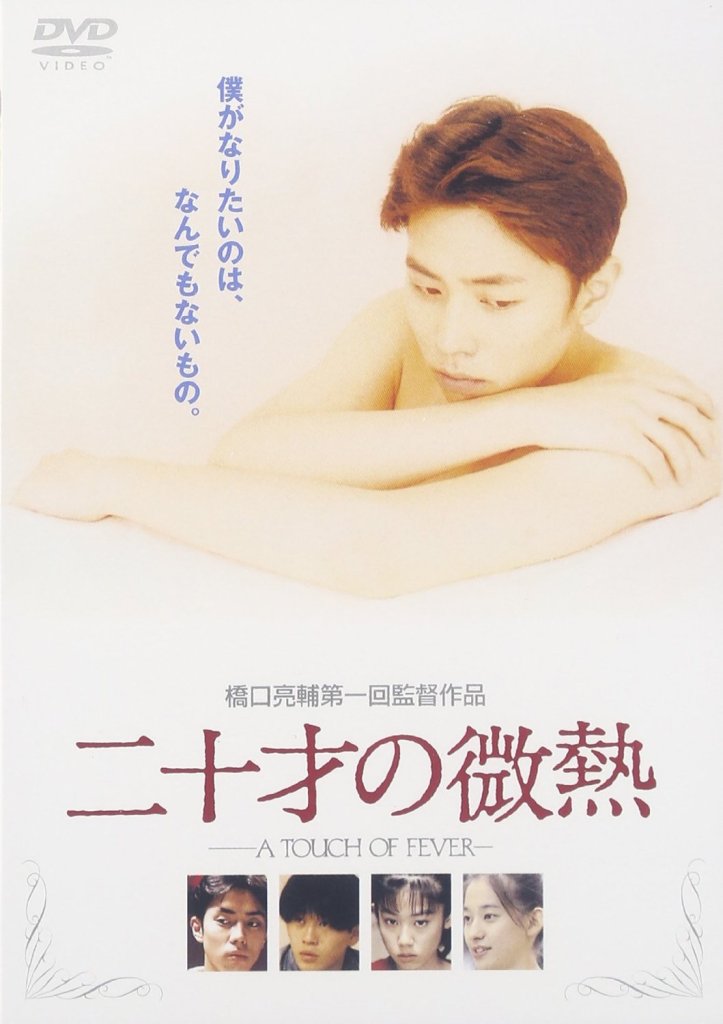
 Ryosuke Hashiguchi’s debut feature A Touch of Fever (二十才の微熱, Hatachi no Binetsu) proved a surprise box office hit in Japan and is also credited for helping to bring male homosexuality into the mainstream. A no-budget movie shot on 16mm, A Touch of Fever is the story of two ordinary boys each going about their everyday lives whilst also beginning to understand themselves in terms of their sexualities, mirroring each other perfectly in their inner confusion.
Tatsuru is a college student by day, but he spends his nights working at Pinocchio’s where he entertains male customers looking for some no strings action with a disinterested young man. Among the other youngish guys working at the club is Shin who is actually still in high school. Shin is out to his parents, but they haven’t taken it well so he’s couch surfing, leading to him to ask Tatsuru if he could temporarily move in with him. Along with all of the practical problems this may raise, Shin has something of a crush on his older colleague, but Tatsuru is filled with doubts about many things and his apartment is in no way big enough to contain this particular elephant in the room.
Tatsuru is about as detached as they come. He claims that he can separate love and sex and that for him his work is just a mechanical action that he happens to be pretty good at. The first client we see him with interrogates him about his non-compensatory love life, assuming that he must have a girlfriend. Tatsuru gives a non-committal answer about whether he also sleeps with women which offers the first indication of his slight resistance to the idea of being gay even if he has no problem earning a living through sleeping with men. Throughout the film he also conducts a parallel (platonic, if fliratious) relationship with an older female student, though when he decides to try and take things further she more or less shuts him down explaining that she’s confused about her feelings for him – she wants him in her life, but probably not in a romantic way. As if to underline the point, an attendant begins to spray cleaning fluid over the passenger side window of the car Tatsuru is sitting in, effectively painting him out of the picture.
Shin, on the other hand, is very clear about his sexuality but less so about the idea of selling it for money. Uncomfortable with the atmosphere at the club, Shin has decided he only wants to do it with people he likes, as impractical as that may turn out to be. What Shin wants is romance, but that’s exactly what Tatsuru is currently unable to acknowledge. When taken to task by one of Shin’s female friends, Tatsuru offers a series of justifications about different kinds of love but remains rational and closed down. At the moment it appears something may happen between the pair, it’s Shin who ultimately can’t follow through. Whether due to “chickening out” as his friend accuses, a lack of belief in his object of affection, or simple vulnerability, Shin is not quite ready to acknowledge his true feelings either.
Both boys have also become estranged from their families and particularly with their fathers. Tatsuru’s father leaves gruff answerphone messages and then when he finally gets through, suggests that his son is a drain on his resources that he could well do without. Having left Tatsuru’s mother for another woman, dad is now cash strapped – so much so that his new partner has had to have an abortion because of all the loans he’s taken out for Tatsuru’s fees. The final parting blow is to say that (contrary to the suggestion of a complete divorce between father and son) Tatsuru is now the sole heir of the Shinomori name which is yet another burden for guy who may be gay and therefore may not necessarily be looking to pass that name on. Shin’s father had something of an apoplexy when he found out his son was gay and threatened to have him sent away to the self defence force for some “toughening” up, going so far to trample all over Shin’s dreams of becoming a fashion designer and leading him to leave home at such a young age.
Hashiguchi’s first feature is his most melancholy but also oddly innocent. A theme which recurs throughout his career – that love is sad and ultimately impossible, rears its head during the film’s final scene in which Hashiguchi himself plays a sinister customer. This uncomfortably long sequence which breaks with the formalist camera movements of the the earlier part in favour of destabilising, unbroken handheld, acts as the climax of the film as the pair are once again symmetrically opposed. Tatsuru likes things impersonal but this guy wants to talk, whereas Shin craves connection but finds the customer unpleasant in his wheedling, direct and almost forceful approach. “You wouldn’t know the pain of being unable to speak out about how you really feel”, says the customer, oblivious to the obvious subtext. This long, strange, and uncomfortable encounter does at least lead both boys into the centre ground, making each clearer both about themselves independently and about whatever it is that exists between them.
Contrary to the customer’s assertion about the impossibility of true connection, the film ends on a note of hope as the boys walk home together with a little more lightness in their steps. When Shin enquires how much Tatsuru was paid for something that he previously disapproved of but seems to have got over now, he tells him he’s underselling himself and ought to value himself more. Tatsuru says he’ll bear that in mind – that has, after all, been the problem all along. In one sense, the “fever” has broken – a weight has been lifted, leaving both boys freer to go about their lives with more clarity and less angst. Perhaps it isn’t all so sad and impossible after all.
Original trailer (no subtitles)
 Nobuhiko Obayashi might be most closely associated with his debut, Hausu, which takes the form of a surreal, totally psychedelic haunted house movie, but in many ways his first feature is not particularly indicative of the rest of Obayashi’s output. 1984’s The Deserted City (AKA Haishi, 廃市), is a much better reflection of the director’s most prominent preoccupations as it once again sees the protagonist taking a journey of memory back to a distant youth which is both forgotten in name yet ever present like an anonymous ghost haunting the narrator with long held regrets and recriminations.
 Windows on Worlds