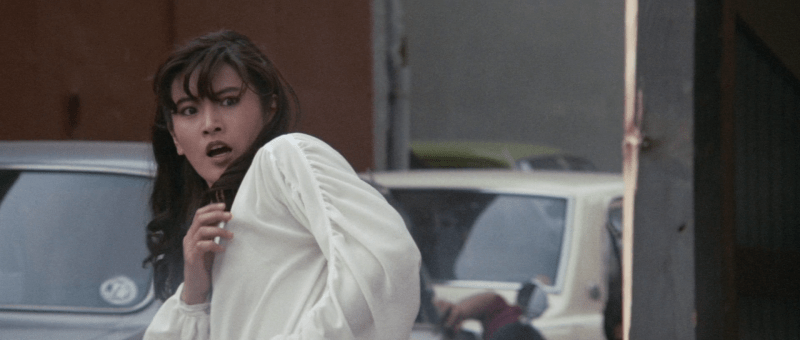
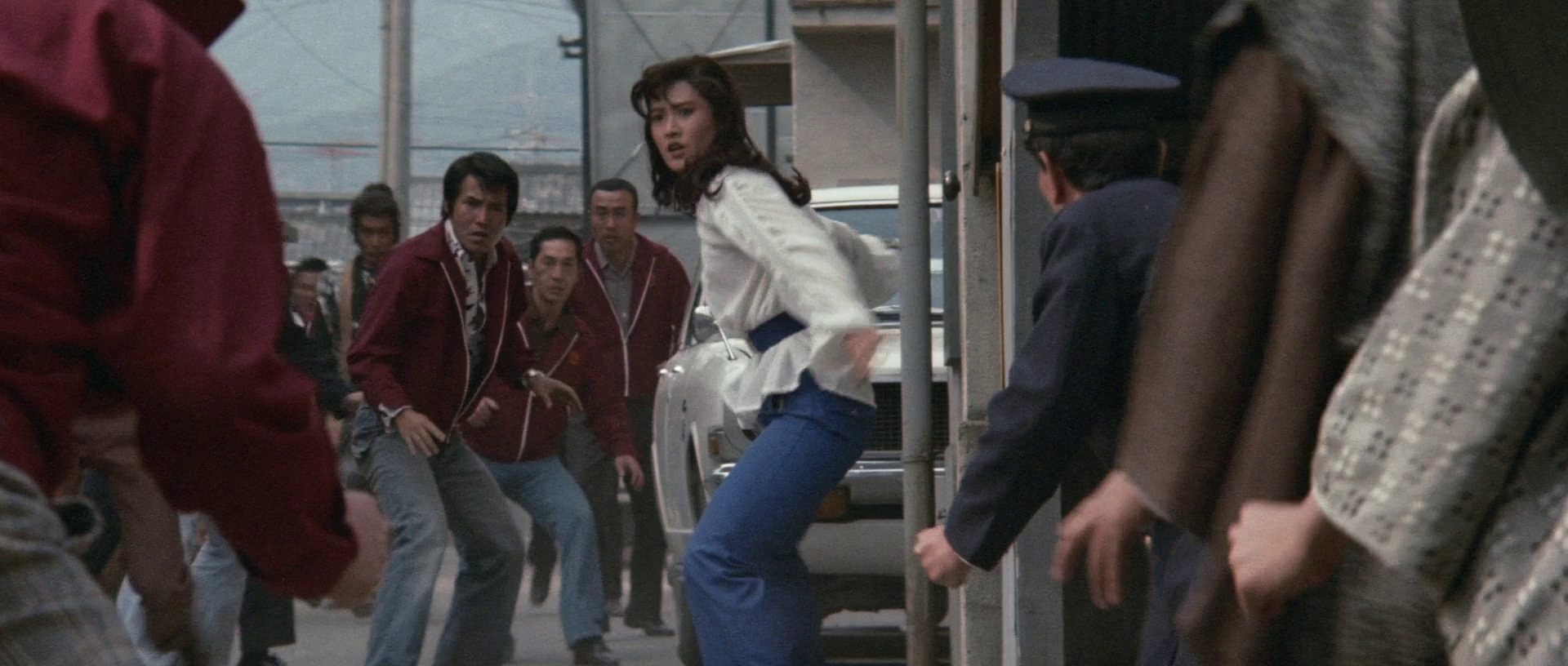
Sister Street Fighter: Fifth Level Fist (女必殺五段拳, Shigehiro Ozawa, 1976)

Though it’s tacked on to the Sister Street Fighter series, Level Five Fist (女必殺五段拳, Onna hissatsu godan ken) actually has nothing to do with it save borrowing a part of the title which is intended to signal the presence of its star. Thus, this is not really a martial arts movie but a much more conventional Toei action film in which the leading role is technically split between Etsuko Shihomi’s posh girl karate champ and Tsunehiko Watase’s sexist cop. It does however continue the smuggling theme with the drugs this time first being packed inside fish and then encased in Buddha statues to be exported to America.

Like many Toei films of the time, there is an underlying theme of anti-Americanism as the “Far East” big boss, posing as a Hollywood movie exec, is supposedly from there but has a strong accent suggesting otherwise. Meanwhile, the brother and sister at the film’s centre are a pair of children who were fathered by American servicemen at the bases in Okinawa who presumably took no responsibility for their upbringing. The brother’s father was black, while the sister’s was white, and though they have both suffered prejudice and discrimination because of their mixed ethnicity, it’s clear that Jim (Ken Wallace) has had it worse. Michi (Mitchi Love) makes good use of her native-level English abilities and martial arts skills to work as a bodyguard / interpreter for visiting dignitaries, but Jim seems to struggle to find employment and subsequently ends up working for a Korean gang run out of a local nightclub. 

The pair have a dream of saving up enough money to return to Okinawa, which was returned to Japan in 1971 after an extended period of US occupation, and opening a restaurant which the film positions as a desire to escape from the racism they experience on the mainland. When Jim says that Kiku (Etsuko Shihomi) is their only friend, he half implies that the discrimination they face is down to being Okinawan rather than their mixed ethnicity which would continue to be an issue even on the islands as it was in their childhood even if there may be more understanding given the continuing presence of the American military and larger numbers of mixed-ethnicity people. In any case, it’s true enough that even those from Okinawa do also experience discrimination on the mainland and are not always accepted as “Japanese” while their Okinawan identity is not respected either. 

Kiku is trying to protect her friends, but finds herself hamstrung by rigid cop Takagi (Tsunehiko Watase) who also happens to be the son of a friend of her father’s. Kiku’s father is apparently a self-made man and successful kimono merchant married to a more conservative woman with higher social ambitions. As the film opens, Kiku is dressed in a kimono and being subject to a formal omiai meeting for an arranged marriage with an admittedly promising candidate who graduated from an elite university and works for a prominent bank. But Kiku looks bored throughout and defiantly flouts social convention by suddenly claiming to have an appointment and walking out, much to her mother’s embarrassment. Her father lets her go and is apparently less bothered about this sort of propriety though later trying to put his foot down when she leaves the house dressed like a hippy rather than in a fine kimono which is not, after all, a very good advert for the family business. 

Her father also tries to set Kiku up with Takagi, but like her mother, Takagi also tells her to keep her nose out of the case and “try trusting a man for once”. He criticises her for saying that she doesn’t want to lose to a man and explains that men are attracted to women because of their “gentleness.” He adds that cooking and raising children are what make women happy, with the clear implication that Kiku is in the wrong for flouting conventional gender roles and should quickly conform by getting married and becoming a wife. Kiku appears to give him the benefit of the doubt and this confusion over gender roles is compounded when she poses as a boy and takes a job as a extra on the jidaigeki film set at the studio which turns out to be a front for drug runners. A queer-coded actor who is later told off for “stalking people again” tries to hit on her in a clear allusion to her masculinity. But unlike in the Sister Street Fighter films, she is ultimately defeated and tied to a log with a buzz saw coming at her only to be saved by the intervention of Takagi while the final scenes see her supporting him after he is (possibly fatally) injured defeating the bad guys.

All in all, it’s some rather confusing messaging but seems to come out on the side of male authority as represented by the police rather than Kiku’s father who is depicted as a weakened figure of masculinity owing to being henpecked by his wife and hoodwinked by his feisty daughter. Even the grinning sap from the gym who tried to put Chanel No. 5 on Kiku’s karate outfit, much to her annoyance, is later revealed to be an undercover cop. Which is all to say, that Kiku’s martial arts ability is almost a kind of joke and something that places her outside of conventional gender norms which should otherwise be “corrected” rather than praised, as it was in the Sister Streetfighter series which placed more emphasis on martial arts philosophy. Then again, the original trilogy ended on a similarly sour note in reaffirming Koyu’s maternity. It seems it’s less sisters doing it for themselves, than sisters doing as they’re told, which aside from anything else is a disappointing conclusion to one of the few female–led action franchises of the 1970s.


Original trailer (English subtitles)

Father of the Kamikaze (ゝ決戦航空隊, Kosaku Yamashita, 1974)

By the mid-1970s, Japanese cinema at least had become much more comfortable with critiquing the wartime past, considering it from a greater distance than the often raw depictions of war in the films from the previous two decades. 1974’s Father of the Kamikaze (ゝ決戦航空隊, A Kessen Kokutai), however, is among the few to skew towards the nationalist rather than the ambivalence or simple anti-war messages of other similarly themed films of its era. 

Starring ninkyo icon Koji Tsuruta who served in the air force himself, the film is a kind of biopic dedicated to Admiral Onishi who oversaw the kamikaze operations at the end of the war. As is pointed out, Onishi had been against the war in general terms even before its inception and is originally against the philosophy behind the kamikaze squadrons but as Japan’s fortunes continue to decline he becomes its biggest advocate citing a kind of sunk cost fallacy that it would be in someway unfair to the men that have already died to surrender while insisting that suicide missions are the only feasible way to turn the tide because one kamikaze could take out a hundred men by destroying battleships singlehandedly. 

The film in part attributes this extreme solution to the prevailing with your shield or on it philosophy of the contemporary society which placed extreme shame on the act of being taken prisoner. In the prologue that opens the film, a squadron of downed pilots whose heroic deaths have already been recorded is discovered alive in an American prisoner of war camp but as being a prisoner of war is so shameful and would reflect badly on the military, the decision is taken to fix the books by sending the men on a mission from which they are not intended to return. Onishi is opposed to the plan, he asks why they can’t find a way for the men to live, but the decision is already made. In any case, he describes the action of a suicide mission as a “beautiful ideal” even when insisting that a war cannot be fought in that way not least for purely practical reasons in that they do not have the resources to be wilfully sacrificing skilled pilots and their planes. 

Having come round to the idea, however, Onishi is a crazed zealot who cannot accept the idea of surrender and even goes so far as to barge into a cabinet meeting to urge ministers against a truce even though the war is clearly lost. To his mind, the only way to honour the sacrifices of those who’ve died is to fight to the last man. Kozono (Bunta Sugawara), another officer opposed to the kamikaze, eventually meets a similar fate in refusing to obey the order to lay down his arms and ending up in a psychiatric hospital. His objection had partly been that it’s wrong to turn men into ammunition, but also that the kamikaze project is itself defeatist and self-defeating when there are men such as himself who are committed to fighting on.  

In this the film leans into the image of militarism as a death cult in which dying for the emperor is the only noble goal of the whole imperial expansion. In its eventual lionising of Onishi’s image, his bloody suicide atop a white cloth resembling the flag of Japan while his parting words scroll across the screen in text, it does not shy away from his more problematic aspects in which he fails to object to a request from a junior officer that soldiers should be allowed to test their swords on American prisoners of war, roundly telling a subordinate who breaks protocol to insist that such a thing is not only morally wrong but will ruin their international reputation that he has no need to think of consequences because Japan will win this war. He claims to want to find a way of defeat that will satisfy the living and the dead, but in reality cannot accept it not least in that it would entail admitting that he sent 2600 young men to their deaths for nothing. 

Tsuruta brings the same level of pathos to his performance as he did in playing conflicted yakuza stoically committed to a destructive code, but there’s no getting away from the fact that the film focuses mainly on Onishi’s personal suffering as a man who sent other men to die for a mistaken ideal and then could not admit his mistake offering an apology only in his death in which he urged the young people of Japan to work to rebuild the nation in the name of peace. In switching to the present day and showing us Onishi’s dilapidated former residence and in fact the room in which he died with its tattered shoji and peeling paintwork, he veers towards the nationalistic in uncomfortably reinforcing the nobility of his death rather than the folly of war or absurdist tragedy of the kamikaze programme. Adopting a quasi-jitsuroku approach with frequent use of onscreen text, a narratorial voiceover, and stock footage of kamikaze in action Yamashita may portray war as madness in Onishi’s crazed devotion but cannot help depicting it as a “beautiful ideal” even in the undignified violence of Onishi’s ritual suicide. 


Onimasa (鬼龍院花子の生涯, Hideo Gosha, 1982)

onimasaWhen AnimEigo decided to release Hideo Gosha’s Taisho/Showa era yakuza epic Onimasa (鬼龍院花子の生涯, Kiryuin Hanako no Shogai), they opted to give it a marketable but ill advised tagline – A Japanese Godfather. Misleading and problematic as this is, the Japanese title Kiryuin Hanako no Shogai also has its own mysterious quality in that it means “The Life of Hanako Kiryuin” even though this, admittedly hugely important, character barely appears in the film. We follow instead her adopted older sister, Matsue (Masako Natsume), and her complicated relationship with our title character, Onimasa, a gang boss who doesn’t see himself as a yakuza but as a chivalrous man whose heart and duty often become incompatible. Reteaming with frequent star Tatsuya Nakadai, director Hideo Gosha gives up the fight a little, showing us how sad the “manly way” can be on one who finds himself outplayed by his times. Here, anticipating Gosha’s subsequent direction, it’s the women who survive – in large part because they have to, by virtue of being the only ones to see where they’re headed and act accordingly.
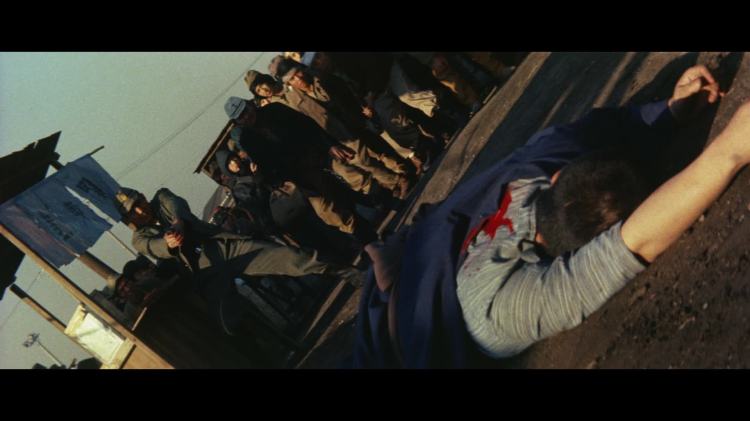
Beginning with its end, Onimasa’s story finishes with the discovery of the body of his only biological child, Hanako (Kaori Tagasugi ), in 1940. Found bled out and alone in the red light district of Kyoto, the suspected cause of death is a miscarriage. Tragically, our heroine, Matsue, arrives only a couple of hours too late after having spent years searching for her younger sister. We then skip back to 1918 when Matsue was adopted by Onimasa and his rather cool wife, alongside another boy who later ran away. An intelligent girl, Matsue earns her adopted father’s respect but neither he nor his wife, Uta (Shima Iwashita), are particularly interested in the emotional side of raising children. Things change when one of Onimasa’s mistresses gives birth to his biological child who awakens a sense of paternal interest in the ageing gangster beyond rule and possession.

Onimasa’s behaviour is frequently strange and contradictory. Originally intending to adopt only a boy, he and his wife come away from a poor family with two of their children, only for the son to run away home. Having picked her out like a puppy in a pet store window, Onimasa views Matsue as an inalienable possession. When a man arrives and wants to marry her, he goes crazy assuming the man must have been sleeping with her behind his back (despite the fact that this man, Tanabe (Eitaro Ozawa), has only just been released from prison where Onimasa had himself dispatched Matsue to visit him). Exclaiming that Matsue is “his”, has always been “his”, and no one else’s, he forces Tanabe to cut off his finger yakuza style to swear Matsue’s honour is still intact. However, this need for total control manifests itself in a less than fatherly way when he later tries to rape Matsue and is only brought to his senses when she threatens to cut her own throat with a broken glass. Despite this act of madness which he tries to justify with it somehow being for her own good, Matsue remains a dutiful daughter to both of her adopted parents.

Matsue’s innate refinement and reserve contrast’s strongly with Onimasa’s loose cannon nature. Commenting on the long history of “honourable” cinematic yakuza, Onimasa embraces an odd combination of traditions in believing himself to be the embodiment of chivalry – standing up for the oppressed and acting in the interests of justice, yet also subservient to his lord and walking with a swagger far beyond his true reach. All of this contributes to his ongoing problems which begin with a petty clan dispute over a dogfight which sees a rival leaving town in a hurry only to return and raise hell years later. Similarly, when his boss sends him in to “discourage” strike action, the union leader’s reasonable objections which point out the conflicts with Onimasa’s doctrine of chivalry and imply he’s little more than a lapdog, have a profound effect on his life. Severing his ties with his clan and attempting to go it alone, Onimasa does so in a more “honourable” way – no longer will he engage in harmful practices such as forced prostitution no matter how profitable they may be, but old disagreements never die easy and it’s a stupid ancient argument which threatens to bring his old fashioned world crashing down.

Despite concessions to the bold new Taisho era which saw Western fashions flooding into traditional culture from Onimasa’s trademark hat to the record players and whiskey glasses clashing with his sliding doors and tatami mat floors, Onimasa’s world is a childishly innocent one where honour and justice rule. Despite this he often excludes his own behaviour – one minute turning down the offer of his rival’s woman to pay a debt with her body, but later attempting to rape a young woman who had been his daughter in a drunken bid for a kind of droit du seigneur. The times are changing, it’s just that Onimasa’s traditionalist mind can’t see it. Tragically trying to rescue his daughter from a situation it turns out she had no desire to be rescued from he eventually spies the writing on the wall and puts down his sword, defeated and demoralised. Tragically, it seems Hanako may have needed him still though her rescue arrives too late to be of use.

The Onimasa family line ends here, as does this particular strand of history under the darkening skies of 1940. Out goes Taisho era openness and optimism for the eventual darkness of the militarist defeat. Matsue, now a widow – her left wing intellectual husband another victim of her father’s mistakes rather than political stringency, remains the sole source of light in her shining white kimono and pretty parasol even as she’s forced to identify the body of the sister she failed to save. The life of Hanako was a sad one, trapped by her father’s ideology and finally destroyed by her own attempts to escape it. Fittingly, she barely features in her own tale, a peripheral figure in someone else’s story. Slightly lurid and occasionally sleazy, Onimasa is another workmanlike effort from Gosha but makes the most of his essential themes as its accidental “hero” is forced to confront the fact that his core ideology has robbed him of true happiness, caused nothing but pain to the women in his life, and eventually brought down not only his personal legacy but that of everything that he had tried to build. The “manly way” is a trap, only Matsue with her patience backed up by a newfound steel inspired by her cool mother, Uta, is left behind but is now free to pursue life on her own terms and, presumably, make more of a success of it.


Original trailer (no subtitles, NSFW)

The Yakuza Papers Vol. 1: Battles Without Honour and Humanity (仁義なき戦い, Kinji Fukasaku, 1973)

Snapshot-2015-12-07 at 11_06_36 PM-930280086When it comes to the history of the yakuza movie, there are few titles as important or as influential both in Japan and the wider world than Kinji Fukasaku’s Battles Without Honour and Humanity (仁義なき戦い, Jingi Naki Tatakai). The first in what would become a series of similarly themed movies later known as The Yakuza Papers, Battles without Honour is a radical rebooting of the Japanese gangster movie. The English title is, infact, a literal translation of the Japanese which accounts for the slightly unnatural “and” rather than “or” where the “honour and humanity” are collected in a single Japanese word, “jingi”. Jingi is the ancient moral code by which old-style yakuza had abided and up to now the big studio gangster pictures had all depicted their yakuza as being honourable criminals. However, in Fukasaku’s reimagining of the gangster world this adherence to any kind of conventional morality was yet another casualty of Japan’s wartime defeat.

The story begins with a black and white image of a mushroom cloud with the film’s bright red title card and now famous theme playing over the top. This is Hiroshima in 1946. Things are pretty desperate, the black market is rife and there are US troops everywhere. Shozo Hirono (Bunta Sugawara) has just returned from the war (in fact he’s still in his uniform). He gets himself into trouble when he intervenes as an American soldier attempts to rape a Japanese woman in broad daylight in the middle of a crowded marketplace. He manages to cause enough of a commotion for the woman to escape but the Japanese cops just tell him not to mess with the GIs. Things don’t get much better as one of Hirono’s friends is assaulted by a yakuza. They get some rival yakuza to help them get revenge and in the commotion Hirono accidentally kills someone and is sent to prison for 12 years. In prison he meets another yakuza who wants to escape by pretending to commit harakiri and promises to get his yakuza buddies to bail Hirono out if he helps. From this point on Hirono has become embroiled in the new and dangerous world of the Hiroshima criminal underground.

Battles Without Honour and Humanity has a famously complicated plot entered around the various power shifts and machinations between different groups of yakuza immediately after the end of World War II. The film begins in 1946 and ends in 1956 though many of its cast of tough guys don’t last anywhere near as long. The picture Fukasaku paints of Japan immediately after the war is a bleak one. Even if some of these guys are happy to have survived and finally reached home, they’ve seen and done terrible things. Not only that, they’ve been defeated and now they’re surrounded by foreign troops everywhere who can pretty much do what they want when they want. They just don’t have a lot of options – if they don’t have connections to help them find work when there’s not enough to go around then it isn’t surprising if they eventually fall into to crime. Also, having spent time in the military, the yakuza brotherhood provides a similar kind of camaraderie and surrogate family that you might also find in an army corps.

It all gets ugly quite fast. Largely the yakuza are making their money profiting from the political instability, resenting the US occupation yet reaching deals with them to support their efforts in the Korean war and then selling new and untested drugs at home (with less than brilliant results). Betrayals, executions, assassinations in previously safe places like a bath house or the barbers – these are a long way from the supposedly honourable gangsters of old. One minute Hirono is offering to cut off his finger as a traditional sign of atonement (though no one knows exactly what you’re supposed to do in this situation and it all ends up seeming a little silly) and taking the rap for everyone else’s mistakes, but his friend faked harakiri to get out of jail and everyone is double crossing everyone else whichever way you look.

The whole thing is filmed in an almost documentary style with captions identifying the various characters and giving the exact time of their demise (if necessary) as well as a voice over giving background information about the historical period. The film is inspired by real life yakuza memoirs and there are parts which feel quite like a bunch of old guys sitting in a drinking establishment and recounting some of their exploits.

This new postwar world of heartless gangsters is a tough one and almost devoid of the old honour-bound nobility, however somehow Fukasaku has managed to make it all look very cool at the same time as being totally unappealing. You wouldn’t want to live this way and you definitely don’t want to get involved with any of these guys but somehow their self determined way of life becomes something to be admired. That said, there’s a sadness too – that even in the criminal underworld there used to be something noble that’s been obliterated by the intense trauma of the war. You can rebuild, you can move on from the destruction left by the war’s wake but there’s no going back to those days of “honour and humanity” – if they ever existed, they’re gone forever now.


Battles without Honour and Humanity is available in blu-ray in the UK as part of Arrow Video’s Battles Without Honour and Humanity: The Complete Collection box set.