Bloody Shuriken (赤い手裏剣, Tokuzo Tanaka, 1965)

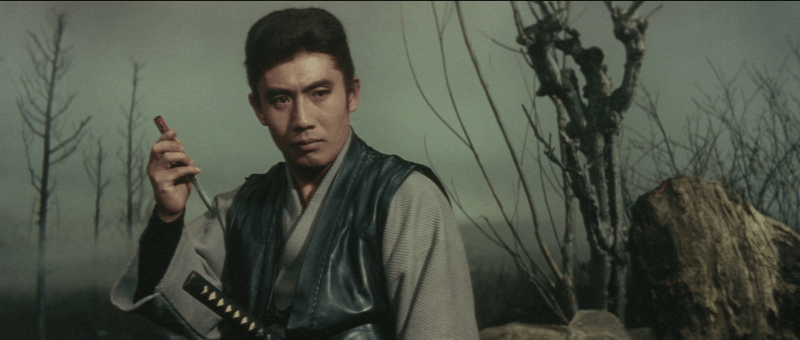
A cynical ronin spots a business opportunity when he rides into a town beset by gangsters in Tokuzo Tanaka’s samurai western, Bloody Shuriken (赤い手裏剣, Akai Shuriken). Despite the name, this is not a ninja movie. The title refers to the knives the hero throws with almost supernatural skill. Adapted from a short story by noir master Haruhiko Oyabu, the action may sound reminiscent of Yojimbo but there’s a different kind of irony in its humour and a lightheartedness to its cynicism even if its final message is that the wages of greed are death.

We can tell that Ibuki (Raizo Ichikawa) is both good man and bad in that he immediately breaks up a fight between rival gangs on entering town, depriving the men in question of their money, but then handing it straight to the owner of the bar they were fighting in to cover the damage. He’s concerned about his horse too, but can’t quite afford the lodging fees at the stable run by the grumpy Yuki (Chitose Kobayashi) who loathes samurai, and with good reason. After hearing about the complicated makeup of the town’s hierarchy, Ibuki decides to stay and make some money by essentially playing each of the three gang leaders off against each other so they end up taking care of themselves. 

So far, so Yojimbo. But this town seems to be even further out, much more like a decrepit western outpost filled with scum and villainy. When the wind picks up, the dust blows through as if signalling the murky air and sense of futility. We’re told that the leader of the biggest gang, Hotoke (Isao Yamagata), is also the police chief, while his rival Sumiya (Yoshio Yoshida) complains that he’s usurped his position as his family has been there longer. Hotoke arrived a starving man three years previously and got back on his feet thanks to the support of the community, but then he turned around and got rich running a gambling den targeting local miners. Kinuya (Fujio Suga) has been here a little longer, but is otherwise biding his time until the other gangs fall from grace.

Of course, Ibuki foments conflict and strikes deals with all of them, but the real trouble is some missing gold that was stolen from the government causing even more disruption in the town with inspectors targeting ordinary people who weren’t even involved. Bar owner Chinami (Masumi Harukawa) is one of many interested in finding out what happened to the money, but she’s also in a precarious position, on the one hand throwing her lot in with Hotoke but on the other hating him and approaching both Ibuki and moody ronin Masa (Koji Nanbara ) to help her be free of the troublesome gangster. 

The fact that the two most prominent business owners are women is perhaps uncomfortably intended to signal the breakdown of the town in which Ibuki becomes the only real “proper” man amid bumbling gangsters and crazed ronin. Yet Chinami is directly contrasted with the pure and innocent Yuki who hates all the gangsters, as well as the samurai and generally everyone who isn’t a horse. Cynical and greedy, Chinami wants the gold and she’s prepared to use her body to manipulate men into doing what she wants, whereas Yuki defiantly keeps her head down and refuses to participate in gangster nonsense because she just wants to run her stables in peace. Only later does she develop a fondness for Ibuki on realising that he’s not so cynical after all and is interested in a kind of justice and getting rid of the corruption in the town for reasons other than money. Having discovered the location for the gold, he leaves the knowledge to Yuki so she can avenge her father who was killed during the robbery. 

But in other ways, this is already a post-apocalyptic hellscape as Ibuki discovers on spotting a pair of crows feeding on a corpse in a river. Perhaps taking pity on one less fortunate than himself, he throws one of his darts and skewers them. Ibuki’s knife supply seems to be inexhaustible, and he never appears to go back and retrieve the ones he’s thrown though his skill does seem to lend him an almost supernatural quality. In any case, Tanaka injects a degree of weird humour in the strange town with its eccentric residents including ronin Masa who looks permanently evil yet has a strange love of dolls, while the fight scenes themselves are often somewhat comical as the gangs seem to clash like a pair of cats slapping each other. There’s even something quite funny about the way the film bluntly drops exposition at unexpected moments even in the midst of the farcical scheming between the gangsters and Ibuki running back and forth to stoke the fires of conflict. This land is so bleak, it seems to say, all you can do is laugh or you’ll end up face down in a river with crows picking at your back too, so you might as well ride off into the sunset like Ibuki looking for the next corrupt town to purify and onward towards the bounty on the horizon. 


Trailer (no subtitles)

Sword Devil (剣鬼, Kenji Misumi, 1965)

An orphaned son’s attempts to overcome his cursed destiny are poisoned by the duplicities of the samurai society in third part of Kenji Misumi’s loose “Sword Trilogy”, Sword Devil (剣鬼, Kenki). Perhaps unfairly dismissed by some as a mere genre craftsmen, Misumi was also an intense visual stylist, a quality very much on show in this vibrant drama which pits the beauty of the natural world against the samurai order but eventually finds its hero succumbing to cruelties of his age unable to outrun himself or his destiny. 

In the prologue which opens the film, shot in an arty theatrical style, a young peasant woman formerly a maid to the late Lady Makino gives birth to a “stranger’s” child after having been promoted and given a place in the women’s quarters as a reward for her loyalty in continuing to serve her mistress in the depths of her “madness”. Lady Makino claims that Kin’s kindness brought her back to reality and is keen to ensure she continues to be taken care of after her death, but also asks her to take charge of her precious pooch hoping that she will treat it “as herself”. This is perhaps why it is rumoured that the child, given the name “Hanpei” which ironically is in part inspired by the dog-like “Spot” coupled with a suffix which implies a lowly rank, is in fact the product of a taboo union between the maid and the dog (rather than admit he is almost certainly the illegitimate son of Lord Masanobu). For some reason this bizarre rumour persists throughout the boy’s life, cast out as he is from the palace and raised in an ordinary village as the son of a low-ranking samurai who appears to be kind and loving, worried enough about Hanpei’s (Raizo Ichikawa) future to advise him to find a special skill that will allow him to support himself and perhaps overcome some of the persistent prejudice against him after the old man’s death. 

The skill he perfects, however, continues to set him apart from his fellow men in that he chooses the cultivation of flowers. A particularly snotty neighbour describes Hanpei’s art as “annoying”, though others are impressed enough by his skill to marvel that they have such a man in their clan while also pointing out that in these times of peace becoming a samurai florist might be much more useful than perfecting the art of the sword. Ironically, however, it drags him back towards the court and intrigue when he’s invited to craft a flower garden to cheer up the present young lord who seems to be succumbing to the same “madness” as his mother. The trouble starts when the garden is completed to the lord’s satisfaction but marred by the sudden and apparently unexpected arrival of a bumblebee which damages the lord’s tranquility and provokes a violent outburst in which he begins to hack at the flowers hoping to punish the one which “rudely” invited the bee to the garden. Hiding behind a tree, Hanpei perfectly aims a rock at the lord’s head to prevent him destroying his precious work and is spotted by his chief retainer, Kanbei (Kei Sato), who earmarks him for future use in his nascent conspiracy. 

Hanpei finds himself at the centre of intrigue, increasingly seduced by promises of advancement that he might be “titleless” no more and perhaps in fact escape his lowly position as the son of a dog. He ingratiates himself by, like his mother, being one of the few servants willing to bear the lord’s violent rages in volunteering to accompany his horse even though he has none of his own and has to run along behind thereby demonstrating his slightly supernatural athletic ability that gives further credence to his canine origins. In similar fashion he learns by observation, captivated rather than appalled on witnessing an old ronin practicing his sword technique by cutting in half a butterfly in the forest. Preoccupied by his lowly status and consequent lack of sword skills, Hanpei is reassured by the man’s explanation that there’s nothing more to it than draw, strike, and sheath but takes yet another step towards the samurai dark side in accepting the gift of a sword. Later he breaks it, meaning to break with the cruel path on which fate has set him, only to pick up another, supposedly cursed sword to which he was attracted because of its “evil spirit”.

Osaki (Michiko Sugata), a kind and innocent woman seemingly attracted to Hanpei because of his difference in his gentle sensitivity in contrast to the rough men around her, refuses to believe the rumours he has become an assassin working for Kanbei because no one who loves flowers like he does could be a coldblooded killer. This is in fact what he has become, sent, like a dog, after Kanbei’s enemies killing without even knowing who it is who must die only to be remorseful on discovering he has killed someone known to him. There is division and sedition within the court caused by the lord’s madness, Kanbei and his associates keen to rule in his stead while keeping his mania secret from the shogun while others, a small group of lower samurai rebels, prefer to depose him in favour of his adopted heir. Hanpei is once again a pawn, taking no side in this debate but unthinkingly doing Kanbei’s dirty work in the service of his sword. He hopes that by taking the “evil” instrument in his hands he might double his bad luck to overcome his unhappy destiny, gazing at his distorted face in its reflection, but discovers himself merely outcast once again as the villagers begin to realise he is an obstacle to their rebellion and responsible for the assassinations of their loved ones. 

The ironic conclusion finds the hero’s planned flower garden, a shared endeavour with love interest Osaki, rendered a bloody graveyard, men cut down like weeds as Hanpei’s quick draw philosophy makes a mockery of their fancy samurai fencing. The poisonous samurai legacy, infected with madnesses literal and figural, destroys everything, all beauty and grace falling under Hanpei’s “evil” sword as he finds himself, quite literally, chased out of town like a stray dog condemned to wander exiled from human society. 


A Killer’s Key (ある殺し屋の鍵, Kazuo Mori, 1967)

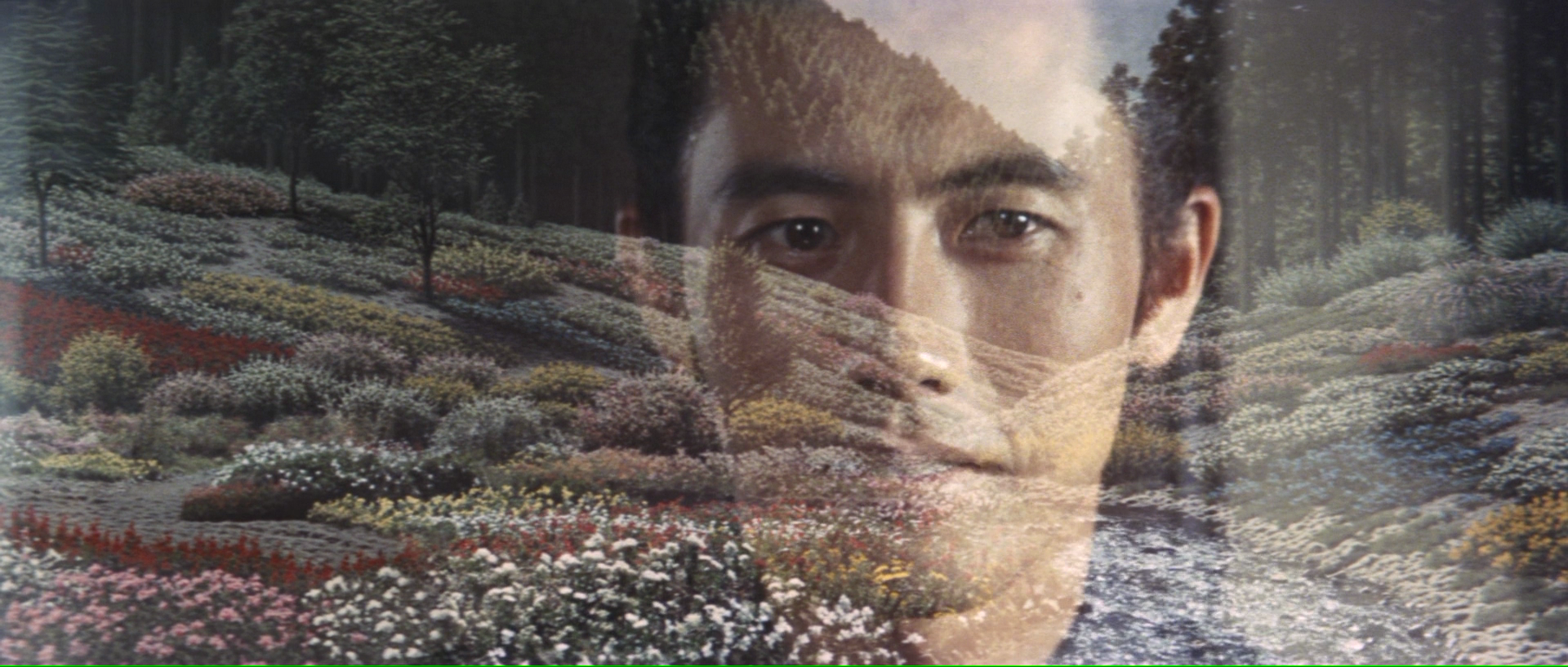
Raizo Ichikawa returns as the jaded ace assassin only this time a little less serious. Set some time after the events of A Certain Killer, A Killer’s Key (ある殺し屋の鍵, Aru Koroshiya no Kagi) finds Shiozawa (Raizo Ichikawa) having left the restaurant business to teach traditional dance under the name Fujigawa while known as killer for hire Nitta in the underworld. Like the previous film, however, he thinks of himself as a justifiable good, standing up against contemporary corruption while still burdened by his traumatic past as a former tokkotai pilot. 

Nitta’s troubles begin when a corruption scandal kicks off with a prominent businessman, or less generously loan shark, arrested for tax evasion. Asakura (Asao Uchida) knows too much and political kingpin Hojo (Isao Yamagata) is worried because he knows Asakura has hard evidence about a land scandal and might be persuaded to spill the beans, exposing a circle of corrupt elitists for their shady goings on. He wants Asakura knocked off on the quiet, as he heavily implies but does not explicitly state to his underling Endo (Ko Nishimura) who gets in touch with their yakuza support who in turn decide that Nitta is the only man for the job.

Petty yakuza Araki (Yoshio Kanauchi) sells the job to Nitta as a public service, pointing out how unfair it is that Asakura has been cheating on his taxes when other people have taken their own lives in shame because they weren’t able to pay. Conveniently, he doesn’t mention anything about petty vendettas or that he’s essentially being hired to silence a potential witness before he can talk so Nitta is minded to agree, for a fee of course (which, we can assume, he won’t be entering on his tax form). Unfortunately things get more complicated for everyone when the gangsters try to tie up loose ends by engineering an “accident” for Nitta which sends him on a path of revenge not only taking out the gangsters but the ones who hired them too. 

Nitta’s revenge is personal in focus, but also a reflection of his antipathy to modern society as a man himself corrupted by wartime folly who should have died but has survived only to become a nihilistic contract killer. He perhaps thinks that the world is better off without men like Asakura, the dim yakuza, spineless underling Endo, and corrupt elitist Hojo but only halfheartedly. His potential love interest, Hideko (Tomomi Sato), a geisha learning traditional dance, has fallen for him, she says because she can see he’s not a cold man though continually preoccupied and there is indeed something in his aloofness which suggests that he believes in a kind of justice or at least the idea of moral good in respect of the men that died fighting for a mistaken ideal. 

As Hideko puts it, Asakura made his money off the suffering of others, so perhaps it’s not surprising that he met a nasty end. She herself is a fairly cynical figure, aware as a geisha that she is in need of a sponsor and that it’s better to get the one with the most money though she too has her code and will be loyal to whoever’s paying the bills. Or so she claims, eventually willing to sell out Endo to protect Nitta but disappointed in his continued lack of reciprocation for her feelings. Echoing his parting words at the close of the first film but perhaps signalling a new conservatism he coldly tells Hideko that he doesn’t need a woman who stays with anyone who pays refusing to include her in the remainder of his mission.

Nitta is perhaps a man out of his times as a strange scene of him looking completely lost in a hip nightclub makes clear. He tries to play a circular game, stockpiling his winnings in different suitcases stored in a coin locker, but eventually finds that all his efforts have been pointless save perhaps taking out one particular strain of corruption in putting an end to Hojo’s nefarious schemes. More straightforwardly linear in execution than A Certain Killer, Killer’s Key is a less serious affair, resting squarely on an anticorruption message and easing back on the hero’s wartime trauma while allowing his needle-based hits to veer towards the ridiculous rather than the expertly planned assassination of the earlier film, but does perhaps spin an unusual crime doesn’t pay message in Nitta’s unexpected and ironic failure to secure the loot proving that sometimes not even top hit men can dodge cosmic bad luck. 


Update, 13th February 2025: now available to stream via Arrow Player.

Original trailer (no subtitles)