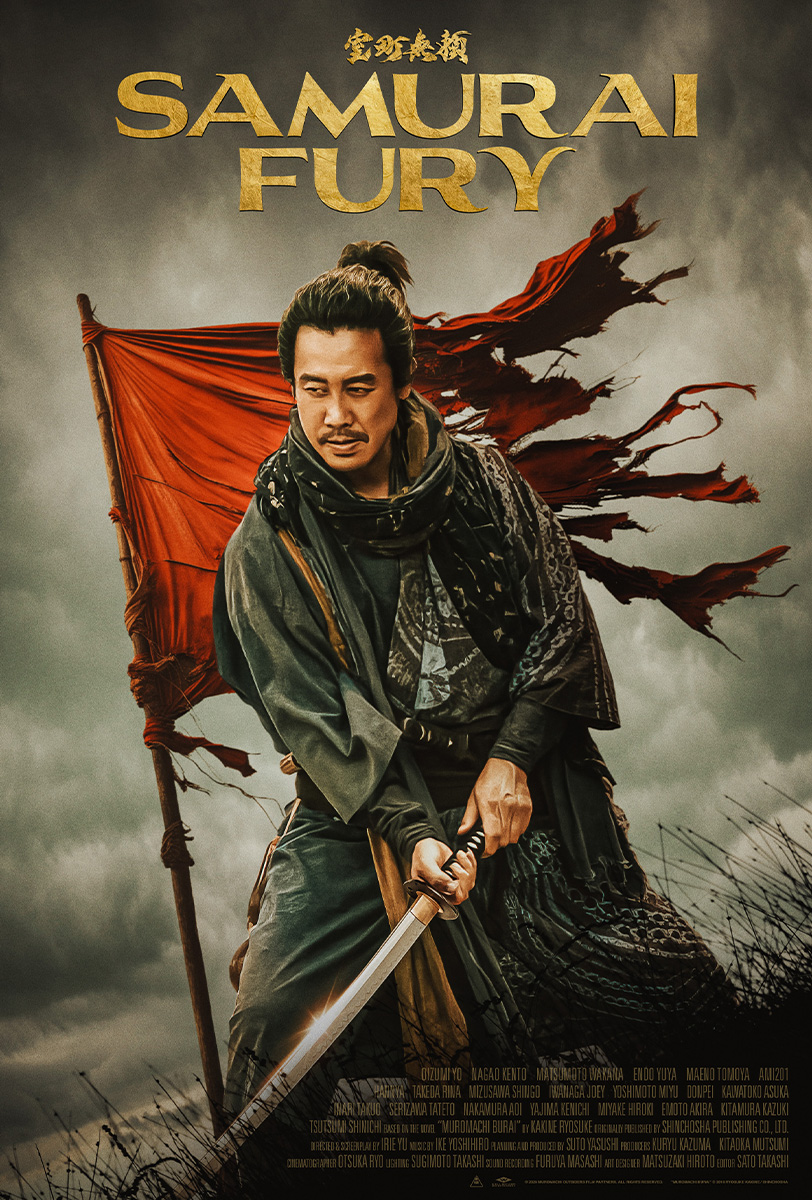
Samurai Fury (室町無頼, Yu Irie, 2025)

Retitled Samurai Fury (室町無頼, Muromachi Burai) for it’s US release, Yu Irie’s Muromachi Outsiders is indeed a tale of righteous anger though like many jidaigeki the rage is directed towards the corrupt samurai class and wielded by a ronin with a noble heart. Based on a novel by Ryosuke Kakine, it recounts a rebellion that took place five years before the Onin War that would lead to the end the Ashikaga Shogunate and initiate the Sengoku or warring states period that lasted until the Tokugawa era began. 

The cause is, really, the incompetent government of shogun Ashikaga Yoshimasa (Aoi Nakamura) who is largely seen here gazing out at his view from the palace in Kyoto which he is obsessed with rebuilding. Meanwhile, famine has taken hold following a period of drought that ended with a typhoon and flooding of the river Kamo, and the starvation has also led to a plague. Between the lack of food and disease, 82,000 people will die, but the government doesn’t really do anything because they don’t think the lives of peasants are all that important. This is of course very shortsighted because someone has to plant all that rice that gets delivered to the palace and they can’t do that if they’re too busy starving to death. In the opening sequences, peasants are whipped and beaten as they transport a giant rock for the shogun’s new garden, though when it gets there he doesn’t like it. Meanwhile, a giant pile of bodies in approximately the same shape is dumped at the edge of the river where they’re burning the dead.

The farmers are forced to take such onerous jobs for extra money because they can’t produce enough to pay their taxes which the samurai keep putting up. To make up the shortfall, they have to take out loans from usurious monks who seize their property or take their wives and daughters when they can’t pay. A young man pressed into working for debt collectors from the temple is told to kill a man who owed them money but hits the barrel beside him instead and exposes him for keeping his seed grain without which he won’t be able to plant more rice but they’re going to take that anyway which means that in the end everyone is going to starve. A village favoured by the hero, Hyoe (Yo Oizumi), is also subject raids from disenfranchised ronin who’ve taken to banditry to survive. 

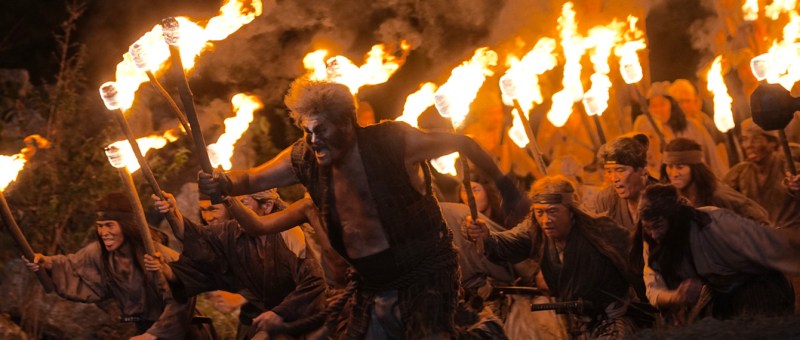
Hyoe is also a ronin, but in his life of wandering he’s found a kind of freedom even as he straddles an awkward line, sometimes working with an old friend from the same clan, Doken (Shinichi Tsutsumi), who has turned the other way and is now the security chief for the government in Kyoto with his own gang of bandit dent collectors. Hyoe’s role is, ostensibly, to stop peasant uprisings, which he does, but mostly because he knows they’re pointless and the farmers armed with little more than hoes and stolen armour will simply be massacred, but he’s also secretly plotting a giant rebellion of his own, harnassing the forces of the ronin and the fed up peasants to storm the capital, burn the debt agreements, and rescue the women taken in lieu of payment. 

But to do so means he’ll have to betray his oldest friend and that he likely won’t survive. Still he thinks someone’s got to do something about this rotten world and sees a better one beyond it if only they can throw off the yoke of the samurai class that thinks peasants are the same bugs to squeezed dry under their boots. That’s perhaps why he trains a young successor, knowing that can’t remake the world with just this one assault on the mechanisms of government and that even if they get rid of the drunken fool Lord Nawa (Kazuki Kitamura), someone not all that different will pop up in his place. “Tax is supposed to improve people lives,” one of the revolters screams at a young soldier, not pay for a new wing at the palace, though it’s a lesson the young shogun seems incapable of learning even as the city burns all around him. 

Taking a leaf out of The Betrayal’s book, the climax is a lengthy action sequence in which Hyoe’s apprentice Saizo (Kento Nagao) takes on half the Kyoto garrison single-handed armed only with his staff. Though the themes are common enough for jidaigeki, though in truth jidaigeki mainly refers to films set in the Edo era under the Tokugawa peace, Irie modernises the way battle is depicted to incorporate wuxia-style wirework and rooftop chases along with martial arts training sequences for the young Saizo who learns the way of the warrior from a cackling old man with a long white beard (Akira Emoto) who has also taken in a young Korean woman (Rina Takeda) who was sold to a brothel by her father in just another one of the injustices of the era but has now become a badass archer and another of Hyoe’s righteous avengers. Solidarity is it seems the best weapon, along with biding your time and knowing when to retreat because this is a war that’s never really won but only held back while the powers that be never really learn.


Samurai Fury is released Digitally in the US Oct. 7 courtesy of Well Go USA.

Trailer (English subtitles)

A Girl Named Ann (あんのこと, Yu Irie, 2024)

In the wake of tragedy, it’s easy to think that if only you had made a different choice then everything would be alright, but in reality it’s never as easy as that and blaming oneself is merely an act of vanity. There’s a peculiar kind of tradeoff that occurs to journalist Kirino (Goro Inagaki), that if he hadn’t written an article exposing a policeman who founded a support group for former drug users trying to integrate into mainstream society as a sex pest, then he might have gone on to help more people. Of course, he would have gone on abusing some of them too and his behaviour would probably have escalated into something much worse. The journalist begins to ask himself if it’s worth it for the net good, without necessarily examining the ramifications of the policeman’s actions.

Yu Irie’s bleak social drama A Girl Named Ann (あんのこと, An no Koto) draws inspiration from a real life case in which a young woman began to turn her life around only to reach a crisis point during the pandemic. The film’s title almost makes an everywoman of its heroine who is resolutely failed by the society in which she lives and in the end discovers only a sense of futility in realising that she will never fully be able to escape the clutches of her abusive mother (Aoba Kawai) who forced her into sex work at age 12. Ann never even finished primary school even though middle school is compulsory and is functionally illiterate. Her reading level is that of a small child which of course makes it near impossible for her to be employed in any kind of salaried job while when she does secure employment her mother steals all her money. 

Being arrested by Tatara (Jiro Sato), a policeman who at first seems well-meaning even if positing “yoga” as a means of turning Ann’s life around, finally gives Ann the encouragement to come off drugs and try to integrate into mainstream society. To his credit, Tatara does everything he can for her from providing a paternal presence to finally helping her escape her mother by getting her a place in an apartment complex set up for women who are being stalked or have experienced domestic violence. Living alone gives Ann a sense of confidence and positivity that allows her to imagine a better future for herself while confronting her past. But on the other hand, it remains true that Tatara may have been better to help her move to another city where her mother would be less likely to find her and derail her life at every conceivable opportunity rather than keeping her close at his own support group which is perhaps an act of vanity if not something worse. No one helps for free and Ann encounters only differing kinds of exploitation from the employers who take her on at poverty wages because they know how desperate she is and don’t think she deserves any better, to the conflicted journalist Kirino who is only really invested in his investigation of Tatara. Ann seems to resent him for exposing Tatara and taking him away from her, but neither of the men make much of an attempt to continue supporting her once the story breaks. 

Ann’s plight exposes how the weakest in society were disproportionately affected by the coronavirus pandemic. The care home she was working at, poignantly because she wanted to learn how to take care of her grandmother (Yuriko Hirooka) who had shielded her from her mother’s abuse, is forced to restrict the number of employees on site meaning Ann is let go while the classes she’d been taking to improve her literacy are also cancelled. Though the apartment requires no rent, she no longer has a means of feeding herself not to mention being stuck inside all the time with nothing to do but study, and not even that when all her pens run out of ink. People are often judgemental and there is no further social support available to her. Even Tatara had been overly fixated on her drug use and while it’s true that she would otherwise be unable to rejoin society without recovering, he otherwise fails to consider other factors such as Ann’s toxic home life or trauma from the long years of abuse she suffered that all contribute to the problems she is facing. 

Even so, unlike her mother Ann is a warm and caring person who is well liked at the care home and clearly has a lot of love to give but the universe won’t seem to give her a break. Perhaps it would be easiest to simply blame her mother, but something must have made her like that too and there’s no one there for her either. She sometimes calls Ann “Mama”, as if the roles were reversed and she were the child being parented by Ann rather than the other way round. In any case, she comes to embody the selfishness of an indifferent society which could have saved a girl like Ann if really wanted to but in the end did not.


A Girl Named Ann screens as part of this year’s Japan Foundation Touring Film Programme.

Trailer (English subtitles)

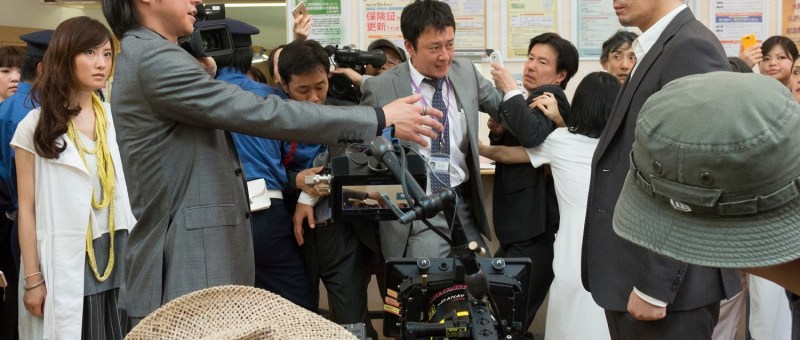
Images: ©2024 “A Girl Named Ann” Film Partners

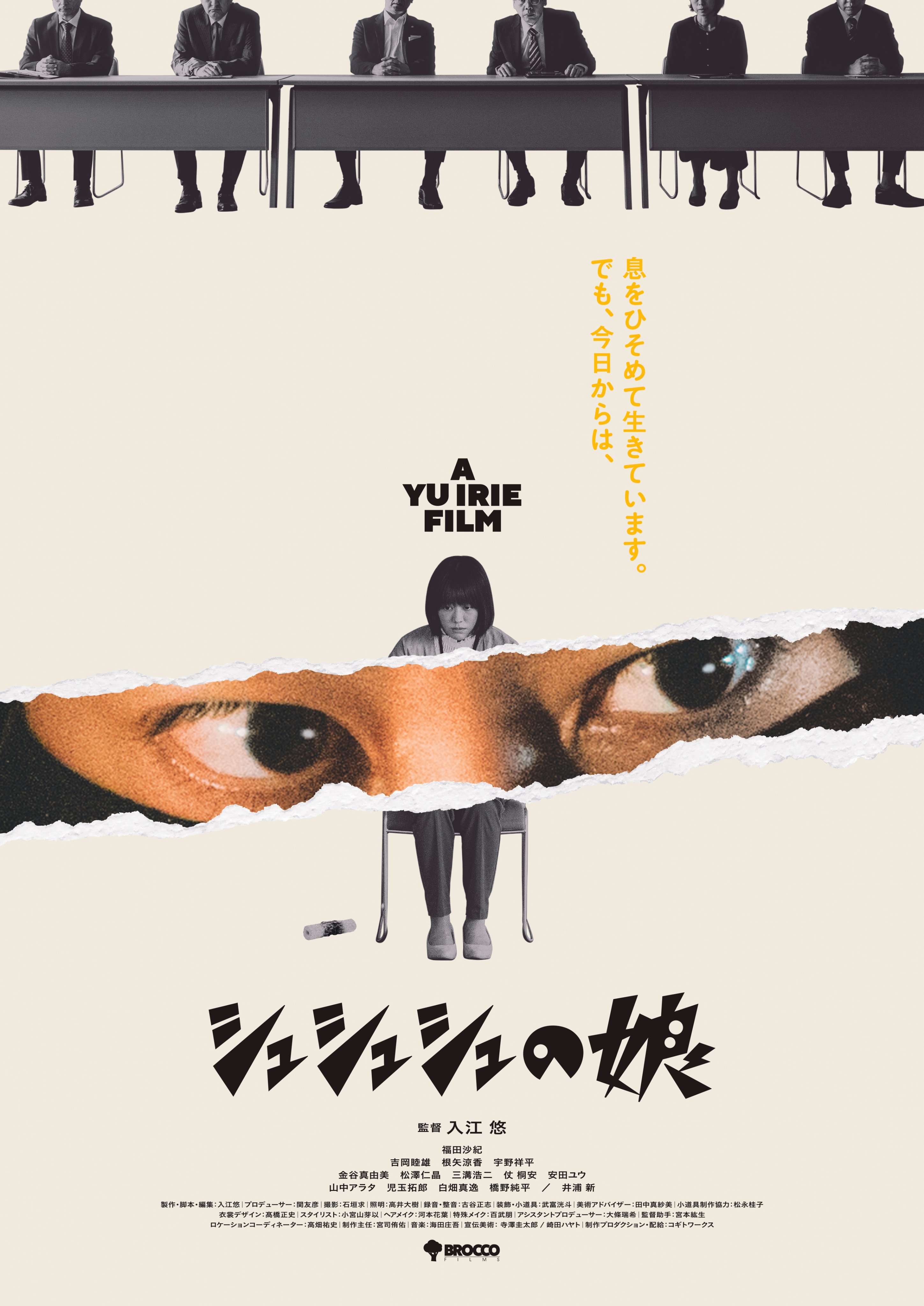
Ninja Girl (シュシュシュの娘, Yu Irie, 2021)

What can the ordinary person do when encountering injustice? Saying no is a start, but it might not be enough in the long run. According to the inspirational grandpa in Yu Irie’s Ninja Girl (シュシュシュの娘, Shushushu no Musume), if no one’s coming with you you’ll have to go on your own. Part coming-of-age drama, part political satire, Ninja Girl finds its reserved heroine coming into herself as she agrees to take on her grandfather’s unfinished mission and avenge the death of a family friend who took his own life in shame after being bullied into falsifying government documents in order to help a corrupt local council pass some overtly racist legislation. 

The reticent Miu (Saki Fukuda) takes care of her elderly grandfather (Shohei Uno) and has a steady job at the town hall, yet despite her ordinariness she is also a target for local shunning because of her grandfather’s intense resistance towards the “Immigrant Elimination Ordinance”. Miu isn’t in favour of it either, but is otherwise too shy to do much about it despite being harangued by her extremely unpleasant and intimidating supervisor Ms. Muteda (Mayumi Kanetani). On returning home one evening she overhears her grandfather talking to a family friend, Mano (Arata Iura), who appears depressed and talks of taking his own life after being strong-armed by Muteda among others to illegally alter and/or falsify official documentation in order to help them pass their odious bill. Mano then takes his own life in protest by jumping off the roof of the town hall, leaving Miu and her grandfather intent on avenging him by retrieving the evidence he’d preserved of governmental impropriety and exposing the mayor for what he is. Miu’s grandfather presents this as a “mission” he’s leaving to his granddaughter because he believes he’s not long left, revealing a long hidden family secret to the effect that Miu is actually descended from a long line of ninjas. 

Ms. Muteda tries to talk Miu round by insisting that the legislation is neither “discriminatory” nor “racist” which seems like a stretch when you’re using words like “eliminate”. After accepting her ninja legacy and using the book she’s found to make herself an authentic ninja outfit, Miu tries to do some digging all of which eventually takes her to a scrap yard mostly staffed by migrant workers whom Mano had been trying to help. Miu is originally turned away by the owner because of her association with local government but returns hoping to find the password for Mano’s thumb drive only to discover a weird gang of racist thugs dressed in lime green high visibility jackets beating up the scrap yard’s owner and spouting a lot of rubbish about how his workforce is taking jobs off Japanese people who apparently find themselves in need following the earthquake and coronavirus pandemic. 

For all of their talk about making Japan great again and keeping Japanese traditions in the hands of the Japanese, there’s a strange irony that their nemesis comes in the form of that most quintessentially culturally specific avenger, the ninja, and not only that a young female ninja rising up against oppression all on her own. Despite agreeing that she has no real skills, Miu’s grandfather thinks she’ll make a good a ninja because of her general invisibility while her childhood hobby of making blowpipes will also stand her in good stead. Accepting her “mission” gives Miu the kind of confidence otherwise lacking in her life to seize her own agency and stand up for what she believes in even when victory seems more or less impossible. Meanwhile, Muteda and her cohorts laugh loudly about how they’re only doing what the national government and other prefectures do in illegally altering their documents to make it look like they’re not doing anything wrong while they ride roughshod over the rights of ordinary people and pursue their xenophobic agenda. 

“Never again” Miu’s grandfather insists on recalling the pogroms which occurred after the 1923 Kanto earthquake leading to a massacre of Koreans, while finding himself branded a traitor to his nation. In another touch of irony, the cheerful children’s folksong Hana plays in the background as red balloons are launched to celebrate the Immigrant Elimination Ordinance in a nationalistic incongruity that seems to leave Miu more bemused than ever. Removing herself from this intensely corrupt social order and committing herself to ninja mastery while training alongside her her favourite collection of ‘80s pop hits, she determines to clean up town sending poison darts against the otherwise unopposed voices of disorder. Shot in a strangely comforting 4:3, Yu Irie’s quirky drama is drenched in the absurd but sends a very real message as its shy, reserved heroine steps into the shadows in order to resist societal corruption even while those all around her are content to stand by and watch as their freedoms are taken from them. 


Ninja Girl screened as part of this year’s New York Asian Film Festival.

Original trailer (no subtitles)

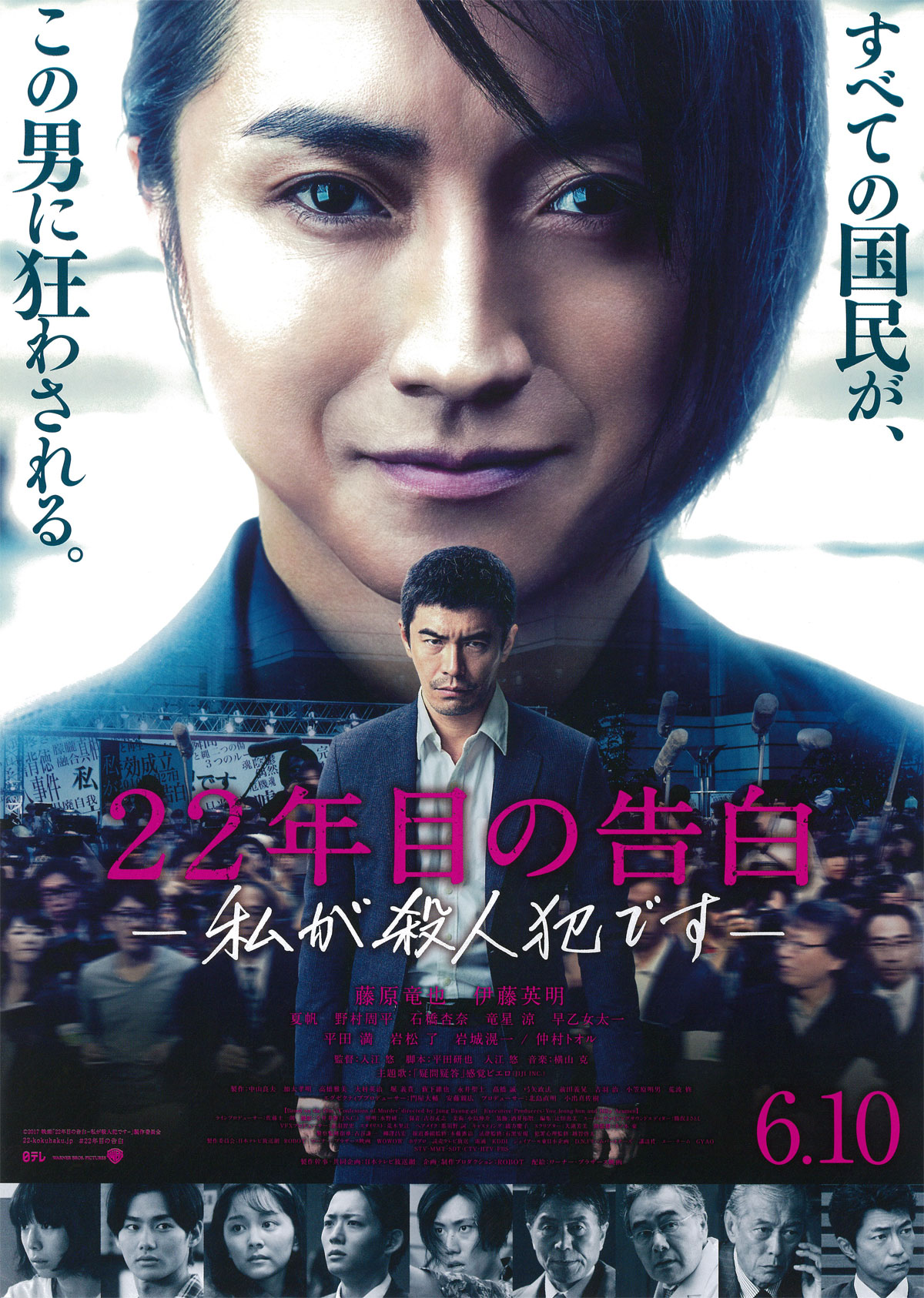
Memoirs of a Murderer (22年目の告白―私が殺人犯です―, Yu Irie, 2017)

Memoirs of a MurdererJung Byung-gil’s Confession of Murder may have been a slightly ridiculous revenge drama, but it had at its heart the necessity of dealing with the traumatic past head on in order to bring an end to a cycle of pain and destruction. Yu Irie retools Jung’s tale of a haunted policeman for a wider examination of the legacy of internalised impotence in the face of unavoidable mass violence – in this case the traumatic year of 1995 marked not only by the devastating Kobe earthquake but also by Japan’s only exposure to an act of large scale terrorism. Persistent feelings of powerlessness and nihilistic despair conspire to push fragile minds towards violence as a misguided kind of revenge against their own sense of insignificance but when a killer, safe in the knowledge that they are immune from prosecution after surviving the statute of limitations for their crimes, attempts to profit from their unusual status, what should a society do?

22 years ago, in early 1995, a spate of mysterious stranglings rocked an already anxious Tokyo. In 2010, Japan removed the statute of limitations on capital crimes such as serial killings, mass killings, child killings, and acts of terror, which had previously stood at 15 years, leaving the perpetrator free of the threat of prosecution by only a matter of seconds. Then, all of a sudden, a book is published claiming to be written by the murderer himself as piece of confessional literature. Sonezaki (Tatsuya Fujiwara), revealing himself as the book’s author at a high profile media event, becomes a pop-culture phenomenon while the victims’ surviving families, and the detective who was in charge of the original case, Makimura (Hideaki Ito), incur only more suffering.

Unlike Jung’s version, Irie avoids action for tense cerebral drama though he maintains the outrageous nature of the original and even adds an additional layer of intrigue to the already loaded narrative. Whereas police in Korean films are universally corrupt, violent, or bumbling, Japanese cops are usually heroes even if occasionally frustrated by the bureaucracy of their organisation or by prevalent social taboos. Makimura falls into hero cop territory as he becomes a defender of the wronged whilst sticking steadfastly to the letter of the law in insisting that the killer be caught and brought to justice by the proper means rather than sinking to his level with a dose of mob justice.

Justice is, however, hard to come by now that, legally speaking, the killer’s crimes are an irrelevance. Sonezaki can literally go on TV and confess and nothing can be done. The media, however, have other ideas. The Japanese press has often been criticised for its toothlessness and tendency towards self-censorship, but maverick newscaster and former war correspondent Sendo (Toru Nakamura) is determined to make trial by media a more positive move than it sounds. He invites Sonezaki on live TV to discuss his book, claiming that it’s the opportunity to get to the truth rather than the viewing figures which has spurred his decision, but many of his colleagues remain skeptical of allowing a self-confessed murderer to peddle his macabre memoirs on what they would like to believe is a respectable news outlet.

The killer forces the loved ones of his victims to watch while he goes about his bloody business, making them feel as powerless as he once did while he remains ascendent and all powerful. It is these feelings of powerlessness and ever present unseen threats born of extensive personal or national traumas which are responsible for producing such heinous crimes and by turns leave behind them only more dark and destructive emotions in the desire for violence returned as revenge. Focussing in more tightly on the despair and survivors guilt which plagues those left behind, Irie opts for a different kind of darkness to his Korean counterpart but refuses to venture so far into it, avowing that the law deserves respect and will ultimately serve the justice all so desperately need. Irie’s artier approach, shifting to grainier 16:9 for the ‘90s sequences, mixing in soundscapes of confusing distortion and TV news stock footage, often works against the outrageous quality of the convoluted narrative and its increasingly over the top revelations, but nevertheless he manages to add something to the Korean original in his instance on violence as sickness spread by fear which can only be cured through the calm and dispassionate application of the law.


Screened as part of the Japan Foundation Touring Film Programme 2018.

Screening again:

  • Showroom Cinema – 22 March 2018
  • Broadway – 23 March 2018
  • Firstsite – 24 March 2018
  • Midlands Arts Centre – 24 March 2018
  • Queen’s Film Theatre – 25 March 2018

Original trailer (English subtitles)