Girl with the Fire Banner (唄祭りかんざし纏, Kinnosuke Fukada, 1958)

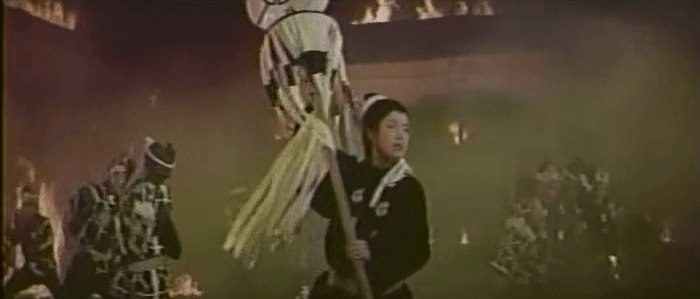
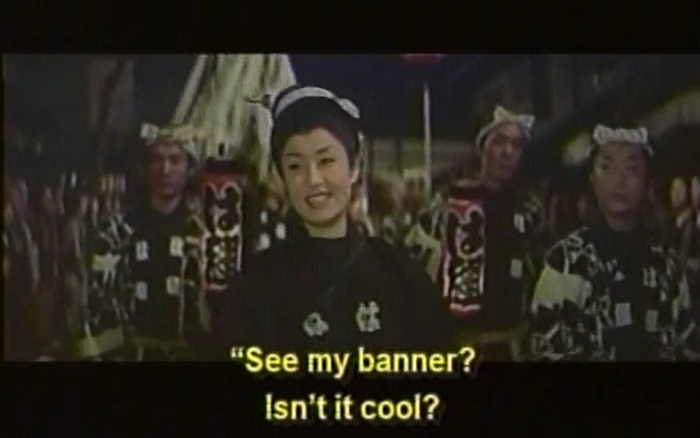
Hibari Misora puts out the fires of the Bakumatsu in another musical jidaigeki adventure, Girl with the Fire Banner (唄祭りかんざし纏, Utamatsuri Kanzashi Matoi). Once again co-starring with Chiyonosuke Azuma, Misora plays another feisty young woman taking over the family business from a sickly father only this time the business is the fire brigade and while she calmly points out to those of a differing opinion that firefighting is an equal opportunities, apolitical occupation, she also finds herself at the centre of a coming revolution caught between corrupt Shogunate loyalists and the imperialist advance. 

Set in Edo in the climactic year of 1868 in which the Shogunate ultimately falls, the action opens with a fire at a townhouse owned by a member of the Satsuma clan, the leaders of the imperialists aiming to topple the Tokugawa and restore power to the emperor. While Haru (Hibari Misora) and her top team of firefighters rush to the scene, others actively refuse to fight the fire even going so far as to try to stop her. While she reminds them that it doesn’t matter who the house belongs to they have a duty to fight fire if only to prevent it engulfing the rest of the town, a dashing young samurai turns up and fights off the loyalists before daringly retrieving their firefighter’s banner from a burning roof asking only five ryo in return. The mysterious man soon disappears only to turn up a few days later having attempted to charge them for a new kimono and a shave in order to ask for a job as a fireman. Haru tries to dissuade him, not least because of his samurai arrogance as he explains he’s not come to join at the bottom and serve out the three year probationary period but to lead, but eventually relents only to find him continuing to behave like an entitled twit flouting all of their rules. 

Nevertheless, as someone later puts it, Japan will shortly be a “classless society” or at least samurai privilege is about to dissolve. This appears to be the central preoccupation of the villainous lords who describe themselves as Shogunate loyalists but in reality care only for their own cause. Not content with running an obvious protection racket with local vendors, threatening to burn down their stores if they don’t agree to contribute to their fund for restoring the Shogunate, they’ve also been buying up rifles to sell at inflated prices to “young hotheads” eager to die for the Shogun, and stockpiling rice hoping to profit when the city burns as they assume it will when imperialist troops arrive. Realising that their gambles may not pay off as the Shogunate may be planning to cut a deal and surrender in order to protect the people of Edo, the lords, who are technically in charge of the fire brigades, consider burning the city to the ground themselves under the cover of avenging the Shogunate’s honour. 

Of course, Haru, a firefighter through and through, could never support such duplicity though it’s clear many of the others would have gone along with it if no one had resisted. In contrast to some of Misora’s other Bakumatsu-era movies, the Shogunate and more particularly the loyalists are definitely the bad guys though in a rather strange turn of events we also see real life sumo wrestlers Asashio Taro III and Wakamaeda Eiichiro arrive to stand up for justice by knocking some of the loyalists heads together, returning later armed with giant poles and dressed only in their mawashi loincloths while throwing hay bales followed by the actual cart (!) at the arsonist loyalists before physically holding them back with the firefighters’ ladders. 

Misora, meanwhile, remains largely on the sidelines uncharacteristically elbowed out of the fight by the guys while lowkey falling for Shintaro despite his samurai arrogance. Musical numbers are fewer than might be expected, the title Edo Firefighter song reprised at the end while Misora gets a second love song wistfully sewing a kimono for Shintaro in the company of a cat wearing a fancy ruff. Shintaro gets his own number before handing back to Misora for another reprise of the title song. Nevertheless, the pair manage to salvage Edo from the flames of the revolution purifying the corruption while furthering progress towards a more equal society even if the closing scenes leave us clearly still on the march. 


The Beauty and the Dragon (美女と怪龍, Kozaburo Yoshimura, 1955)

A clever princess takes advantage of a courtly crisis to save the kingdom and arrange her own marriage in Kozaburo Yoshimura’s adaptation of the well-known kabuki play Narukami, The Beauty and the Dragon (美女と怪龍, Kabuki Juhachiban: Narukami – Bijo to Kairyu), produced in celebration of the 25th anniversary of the Zenshinza kabuki troupe and starring many of its actors. Scripted by Kaneto Shindo, the film mines a deep seam of irony in the classic tale while allowing its heroine to take centre stage outwitting most of the feckless men from the palace with some clever manoeuvring and utilising the key asset of her femininity.

In a meta touch, Yoshimura opens in a kabuki hall where young lord Toyohide (Chiyonosuke Azuma) is called to perform a dance for the regent, Mototsune, only the show is soon interrupted by a procession of peasants who’ve come to protest the ongoing drought. The earth is cracked and the rivers run dry, but still they are told that they will be informed about the outcome of their petition at a later date. The peasants clearly believe that the emperor really is a god and expect him to fix this problem as soon as possible but in private Motosune is irritated if perhaps accurate in stating that the weather is not their responsibility and they can’t seriously be expected to deal with it. Annoyed by the noise of the protests around the palace, he orders that the peasants be sent away though his courtiers are more sympathetic and know that the peasants simply have no one else to turn to for help. If something isn’t done they will have no choice but to escalate their rebellion.

But as it turns out, the problem actually is their responsibility and is rooted in the misogynicistc patriarchy of the feudal world along with a dose of courtly intrigue. When shinto priest Narukami (Chojuro Kawarasaki) was consulted about the birth of a royal child and prophesied that it would be female, he was hired to alter its destiny and miraculously changed its sex to male through the power of prayer. In return, he was promised that a shrine would be built for him but now it’s 30 years later and he’s sick of waiting. Accordingly, he’s taken the Dragon God who brings the rains hostage and refuses to release him so the rain can return until he gets what he was promised. 

It seems that Mototsune has a very bad habit of promising people whatever their heart desires but conveniently forgetting about it once the job is done. This time though the problem is that disgraced prince Hayakumo (Kunitaro Kawarazaki) stopped the building of the shrine in fear of offending a rival temple, Ezian, which contains a large number of very intimidating bandit monks. Hayakumo is intent on using the courtly chaos to improve his own position, hoping that other lords will fall from favour leaving a space for him to fill. He’s also been obsessively courting princess Taema (Nobuko Otowa) who refuses him because he’s so obviously oily, and in any case she’s in love with Toyohide but can’t marry him seeing as he is already betrothed to another woman whom he does not care for. In a bizarre twist of fate, a scholar insists that the only way to break Narukami’s magic is by learning to read a scroll that once belonged to Taema’s grandfather so they charge her with deciphering it offering to give her whatever her heart desires if she ends the drought which is of course Toyohide’s hand in marriage. 

The ironic thing is that Taema doesn’t for a second believe that reading the scroll will make any difference to anything and quite clearly thinks the scholar they brought in who said it would is a charlatan who actively looks down on her. Yet she, like everyone else, does in fact believe that the cause of the drought is the Dragon God’s imprisonment and Narukami’s dark magic. Advised by her trusty maid, she learns to see opportunity in what could otherwise be a dangerous situation and ably out manoeuvres the foolish men at the court. She wields her femininity, the reason they discount her, as a weapon against the repressed masculinity of Narukami who is said to have been a monk since childhood and has never touched a woman. 

After getting her maid to do a sexy dance for his underlings so that they get drunk and pass out, she then sells Narukami a tragic love story pretending that she simply wants to wash some clothes that belonged to her late husband. Essentially she seduces him, but also targets his weakness in his repressed desires as a monk causing him to transgress his vows and in effect break his own magic by destroying his powers. On seeing her bared ankles he faints, and then ends up telling her how to break the curse after becoming drunk and randomly assuming they are now married. 

As she’d somewhat dangerously told Toyohide, the real problem is that the Regent is weak. Indifferent to the fates of his people and in any case an ineffective leader, he invites intrigue in the court. Yet court itself is weak precisely because it is rooted in patriarchy and defined by male weakness. Even Taema’s beloved Toyohide is preening and jealous, suddenly irritated to discover that Hayakumo had been courting her while later suspicious that she will be alone with Narukami. He was also denied romantic freedom in an inability to escape the marriage arranged for him by his father at three and reliant on Taema finding a way for them subvert the feudal order and be together. The play in fact ends with the rage of a scorned man as the aptly named Narukami is transformed into the god of thunder and vows vengeance against the woman who humiliated him. 

Taema, by contrast, is able to seize control ridding herself of Hayakumo while securing her marriage to a man she choses (the betrothed bride is herself similarly freed and appears not to mind the dissolution of her engagement having had no particular feelings for Toyohide, a man she barely knew) in addition to saving the kingdom along with the lives of peasants by unleashing the Dragon God. Having begun in the theatre, Yoshimura soon moves out to the court and then the country but eventually cycles back for the climactic dance of anger with which the film closes as if echoing a howl of pain from the wounded feudal era circumvented, if not ended, by a clever woman leveraging her only sources of power in a world defined by corrupted male authority. 


Ghost in the Well (怪談番町皿屋敷, Toshikazu Kono, 1957)

Ghost in the Well poster 2Love across the class divide threatens to overthrow the social order. Inspired by the classic folktale Bancho Sarayashiki, Ghost in the Well (怪談番町皿屋敷, Kaidan Bancho Sarayashiki) is indeed the story of a haunting though perhaps not altogether of the kind you might be expecting. This is a tale of romance, but also one of impossible love in which the only possible union is in death. The pure love of a servant girl is deemed incompatible with the oppressive world of samurai honour, and so she must die, but her lord cannot survive it. He cannot reconcile himself to having chosen to preserve his honour, his status, his lineage at the cost of her life and his love.

Rowdy samurai Harima (Chiyonosuke Azuma) loves making trouble in the streets. As the lord’s bannerman he knows he has a degree of status and likes to throw his weight around in the yoshiwara, much to the lord’s consternation. Harima has also taken a fancy to one of his maids, Okiku (Hibari Misora), who continues to reject his advances despite returning his affections because she knows the class difference makes a legitimate relationship between them impossible and a dalliance with her lord means losing the opportunity to marry anyone else. Harima tells her that there’s no such thing as status when it comes to love and that he doesn’t think of her as a passing infatuation. Eventually Okiku gives in and a kind of promise is made between them.

Nevertheless, it’s a promise which can’t be kept. The Aoyama family is in trouble and the obvious answer is to make a good match for Harima that will restore both status and wealth. When one of Harima’s friends is ordered to commit seppuku for the exact same petty punk antics Harima gets up to all the time matters come to a crunch. To keep him safe, Harima’s uncle arranges a marriage with an influential family. Harima tries to refuse but he too is more or less powerless even if he weren’t torn between the obligation to his samurai code and his illicit love for servant girl whom he would never be permitted to make his wife. To cement the match, Harima’s uncle has prepared 10 precious plates as a dowry, but Okiku, catching sight of Harima’s bride-to-be, drops one and breaks it in two. Her fate is sealed. Harima draws his sword on her and she backs away, eventually falling into the well and dying there.

The broken plate is, of course, a symbol of their broken covenant but also of Okiku’s shattered dreams as she watches a beautiful but haughty woman steal away her last hope of happiness solely through the accident of noble birth. As her friend tells her, a commoner cannot become the wife of a samurai and all Okiku can do is resign herself to her unhappy fate. Having broken the plate, however, all is lost. The men of the household admit their responsibility for entrusting the entirety of their future to a mere slip of a girl in the middle of intense heartbreak, but Okiku cannot go unpunished and Harima must claim his new life by destroying his past love.

Harima does what he’s supposed to do, if in passion and half by accident. Yet the marriage remains broken, the family in jeopardy, and Harima without hope of future. The ghost of Okiku, real or imagined, haunts him while he remains guilt ridden and filled with regrets. Despite his rowdiness and manly pride, he chose his samurai honour and condemned his one true love to a lonely death. Her love has, however, survived and resurrected her not as a demon of vengeance come to lead him to his doom but as a lovelorn woman keen to remind him of the promise he made and broke but which might be mended.

Harima pays for his transgressions, though more as a mischievous samurai who allowed his over inflated ego to convince him he had the right to oppress his fellow retainers than as a man who caused the death of an innocent woman, first by corrupting her and then by the same rigidity which has led to his present predicament. There can be no “love” in a such a society, let alone the love of a bannerman and a servant girl. Theirs is a blood wedding, uniting them in death, consumed by the impossibilities of the samurai era. At only 45 minutes, Ghost in the Well is perhaps a slight retelling of the tale and somewhat in imbalanced in its presentation of the fates of the two lovers but is nevertheless a refreshingly romantic take on an often dark story in which a scorned woman’s vengeance is reframed as a powerful condemnation of an oppressive society.