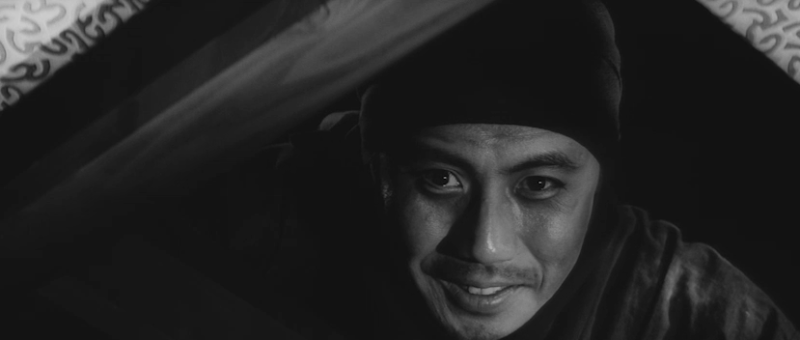
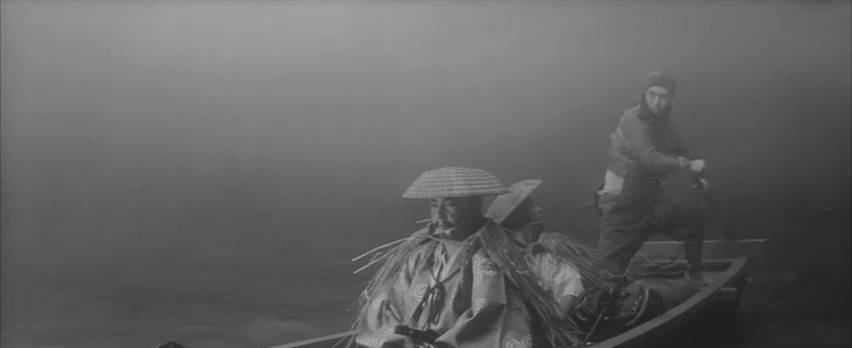
Shinobi No Mono 5: Return of Mist Saizo (忍びの者 続・霧隠才蔵, Kazuo Ikehiro, 1964)

At the end of the previous instalment, Saizo (Raizo Ichikawa) had escaped from the fall of Osaka Castle spiriting away Sanada Yukimura (Tomisaburo Wakayama) who, in contrast to what the history books say, did not die. The pair make their way towards Shimazu, where they are also not well disposed to Ieyasu (Eitaro Ozawa), but as Saizo is informed the Tokugawa clan will never die. Knocking off Nobunaga put an end to the Oda clan, getting rid of Hideyori took the Toyotomi out of the running, but killing Ieyasu will make little difference because another retainer will swiftly take his place.

As a reminder, that’s bad for Saizo because what he wanted was the chaos of the Warring States era back to restore the ninja to their previous status. Nevertheless, at the end of the previous film he claimed to have rediscovered a human heart in his devotion to Yukimura though it may of course be simply another ruse to meet an end. In any case, Ieyasu seems to be putting his ninjas to good use and is once again waiting it out apparently aware that Yukimura is alive and well in Shimazu.

Meanwhile, times are changing. Yukimura is convinced the future of warfare lies in firearms and whoever controls Tanegashima where the weapons are made will prove victorious. They think they can gain it by figuring out how they get access to high-quality iron when trading with anyone outside of Portugal is illegal and the Portuguese don’t have any. It’s access to foreign trade which is becoming a crunch issue as Ieyasu tries to solidify his power, later giving a deathbed order to ban Christianity to stop European merchants taking over the country. Saizo travels to Tanegashima to investigate and figures out that the secret is they’re trading with China, which is pretty good blackmail material, but also encounters two sisters who turn out to be the orphaned daughters of a Tokugawa ninja with vengeance on their mind.

In a surprising turn of events, it turns out that his main adversary is Hanzo Hattori (Saburo Date) but the fact he keeps outsmarting him eventually convinces Ieyasu that the ninja have outlived their usefulness. Hanzo becomes determined to kill Saizo to restore his honour, filling the palace with various ninja traps though unlike Goemon Saizo seems to be one step ahead of them. This lengthy final sequence is played in near total silence, and ironically finds Goemon just waiting, after dispatching several of Hanzo’s men, to see if his poison dart has taken effect and Ieyasu is on his way out. Only in the end Ieyasu just laughs at him. He’s 75. Saizo’s gone to too much effort when he could have just waited it out. Ieyasu has already achieved everything he wanted to. His control over Japan is secured given he’s just been appointed chancellor. He can quite literally die happy because nothing matters to him anymore. A title card informs us that when Ieyasu did in fact die, no one really cared. The Tokugawa peace continued. 

Here, once again, the Ninja too are powerless victims of fate despite their constant machinations. Yukimura tells Saizo to live and be human, advice he gives to the sisters in Tanegashima but does not take for himself staking everything on his revenge against Ieyasu which is, as he points out, pointless for Ieyasu was at death’s door anyway and his demise changed nothing. In his first of two entries in the series, Kazuo Ikehiro crafts some impressive set pieces beginning with a mist-bound underwater battle as Saizo and Yukimura make their escape by water to an epic flaming shuriken battle, though this time around the deaths are noticeably visceral. Men are drowned, stabbed, or caught on wooden spikes. Those who do not obey the ninja code are stabbed and pushed off cliffs while once again emotion is a weakness that brings about nothing more than death. Ikehiro’s frequent use of slow dissolves adds to the dreamlike feel of Saizo’s shadow existence even as the ninja themselves seem to be on the point of eclipse for what lies ahead for them in a world of peace in which there is no longer any need for stealth?
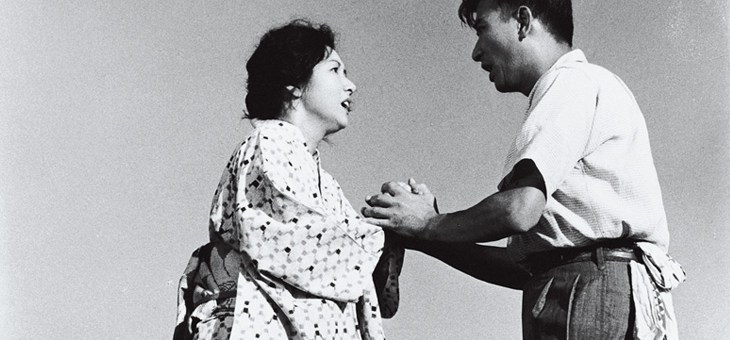

Immortal Love (永遠の人, Keisuke Kinoshita, 1961)

Patriarchal feudalism destroys not only the life of an innocent young woman but all of those around her in Keisuke Kinoshita’s embittered romantic melodrama Immortal Love (永遠の人, Eien no Hito). Scored to the impassioned beat of an incongruous flamenco and spanning almost thirty years of turbulent history from the tightening years of militarism to Anpo protests, Immortal Love finds its heroine imprisoned by the system within which she was raised but determining to free her children from the legacy of feudalism even while knowing that she traps herself in her intense resentment towards her husband and everything he represents. 

Heibei (Tatsuya Nakadai), the wealthy son of the village chief, returns home from military service in Manchuria after sustaining an injury that will leave him walking with crutches for the rest of his life. Though his father tells him that his is an honourable discharge and has organised a small parade complete with flag waving and a band to greet him, it’s obvious that Heibei feels ashamed to have returned home wounded and is unhappy that his father has made such a fuss. He’s doubly unhappy at his welcome home party on hearing the gossip that local beauty Sadako (Hideko Takamine) is in love with farmer’s son Takashi (Keiji Sada) to whom Heibei has always felt inferior, something which is only exacerbated by the fact Takashi is also at the front and apparently acquitting himself well. Cruelly calling her over, he tells Sadako that he met Takashi at a field hospital but that he was about to go off to a big battle so could very well be dead. 

Heibei’s true feelings, if you could call them that, remain unclear. Later, justifying himself, he claims that he really did care for Sadako and that all of his subsequent “immoral” acts were committed out of a love he was ill equipped to express, but that first night at the party it seems obvious that he only wants her because he knows she is Takashi’s. He tries to assault her when she is massaging his wounded leg, attempts to court her, and then finally resorts to rape with the help of his father who keeps Sadako’s dad occupied by forcing him to drink sake as his guest while making veiled threats about the status of his tenancy. Heibei had made a formal proposal which Sadako was about to turn down, further humiliating him, despite the pressure he’d piled on by threatening to throw Takashi’s brother off his land and potentially kicking her family off theirs too. By raping her and tricking her father into agreeing to the marriage he forces her to accept, wielding his feudal privilege like a weapon. 

Shortly before the marriage, Takashi returns on leave, a heroic soldier painted in glory. He too is resentful and heartbroken to learn that Sadako is to marry to Heibei, eventually hearing the truth of it from his brother. Sadako tries to kill herself rather than be forced into marriage with her rapist, and avoids seeing Takashi in thinking she is now “impure” and can no longer be his wife. Takashi assures her she is wrong, and that even if Heibei thinks he has “stolen” her in taking her by force, he can simply take her back. He proposes they elope, but fails to turn up, leaving Sadako standing sadly at the roadside until her father arrives with a letter explaining that Takashi has reconsidered and advises her to accept a life of material comfort as Heibei’s wife rather than one of hardship with him. 

Forced to marry the man who raped her, Sadako lives in quiet resentment, bearing three children the first of which she struggles to love because he is the result of the rape which condemned her to her present life of misery. Years later, Sadako learns that Takashi married too when his wife Tomoko (Nobuko Otowa) is evacuated to the village to stay with his brother. Heibei, ever cruel, offers Tomoko a job as a household servant, revelling in the idea that Takashi’s first love and current wife are both under his roof, telling her all about their strange romantic history and setting her at odds with Sadako whom she too resents knowing that her husband has never loved her because he can’t give up on his first love. A twisted bond arises between Heibei and Tomoko, united in resentment of Takashi and Sadako, but Heibei eventually tries to rape her too, once again trying to take what Takashi has, or possibly destroy it.  

Despite her despair and loathing for her husband, Sadako tries to rise above it and always makes a point of treating Tomoko with respect and kindness even when she is cruel. Later on the road, she tells her not to worry, that what she grieves isn’t Takashi but the life she lived before. Heibei is perhaps also a victim of the system, his masculinity undermined by his brash father while his sense of inferiority is exacerbated by his disability, but he is also innately cruel and selfish. There’s strange perversion in the act of healing which closes the film in that it forces Sadako to ask for an apology from Heibei, the man who raped her and ruined her life, for using his abuse as an “excuse” to go on hating him all these long years. Heibei characteristically paints himself as the victim, branding Sadako a cold and unfeeling woman, wondering who will look after him now that he has been abandoned by all his children. He tells her that his feelings were sincere even if his acts were immoral, implicitly blaming her for the abuse that he inflicted, but Sadako merely accuses him of romanticising the past in trying to justify this internecine bid for vengeance that ruined the lives of at least four people as a frustrated love story. 

“You and I may never be reconciled until one of us dies” Heibei admits, while Sadako tearfully tells a dying Takashi that it’s not too late for her to try to be happy. Tomoko was able to reconcile with her son and apparently lived out the last of her days in contentment. Naoko (Yukiko Fuji), Sadako’s daughter, eventually married Takashi’s son Yutaka (Akira Ishihama), breaking with the past both in rejecting the feudal class structure within which she was raised in marrying a working class man, and the patriarchal in ignoring her cruel father’s authority. A kind of healing has been achieved, freeing the younger generation from the cursed family legacy which claims that their ancestral wealth was gained by a literal betrayal of thousands of peasant farmers at the time of the siege of Osaka in 1615. The corruption of the war and a culture of hypermasculinty is visited on Sadako in the violent trauma of the rape, an event which echoes through not only her life but perhaps her children’s too. It is not she who should be asking for forgiveness, but she does perhaps begin to find it in herself, in making a kind of peace with the past which at least cuts the cord, allowing the younger generation to escape the net of feudal oppression for a brighter, freer, post-war future.


Immortal Love is available to stream in the US via the Criterion Channel.

Original trailer (no subtitles)

Bronze Magician (妖僧, Teinosuke Kinugasa, 1963)

Even when you’re the empress, a woman has little freedom. Teinosuke Kinugasa’s Bronze Magician (妖僧, Yoso) is loosely based on a historical scandal concerning Nara-era empress Koken/Shotoku and a Rasputin-like monk, Dokyo, who unlike his counterpart in the film, eventually tried to seize the throne for himself alone only to have his ambitions frustrated by the empress’ death and the fierce resistance of her courtiers. As the title implies, Kinugasa is more interested in Dokyo than he is in the perilous position of Nara-era women even in power, painting his fall from grace as a Buddhist parable about a man who pays a heavy price for succumbing to worldly passions. 

As the film opens, Dokyo (Raizo Ichikawa) emerges from a shallow cave amid many other caves after meditating for 10 years during which he reached a higher level of enlightenment and obtained mystic powers. Now he thinks it’s time to continue the teachings of departed mentor Doen and use his abilities to “actively do good and save the masses”. Before that, however, he does some not quite Buddhist things like turning a rat into a living skeleton, and twisting a snake into a tangle. In any case, he begins roaming the land, miraculously healing the sick. While reviving a thief who had been killed by samurai after trying to make off with a bird they shot, Dokyo is spotted by a retainer of the empress who brings news of his miracles back to her closest advisors. 

Empress Koken (Yukiko Fuji), in the film at least, was a sickly child and even after ascending the throne has often been ill. She is currently bedridden with a painful respiratory complaint that is giving her servants cause for concern. None of the priests they’ve brought in to pray for her (apparently how you treat serious illness in the Nara era) has been of much use. The empress’ steward Mabito (Tatsuya Ishiguro) orders that Dokyo be found and brought to the palace to see if he can cure Koken, which he does while stressing that he’s helping her not because she’s the empress but in the same way as he would anyone else. 

As might be expected, the empress’ prolonged illness has made her a weak leader and left the door open for unscrupulous retainers intent on manipulating her position for themselves. There is intrigue in the court. The prime minister (Tomisaburo Wakayama) is colluding with a young prince to depose Koken and sieze power. Left with little oversight, he’s been embezzling state funds to bolster his position while secretly paying priests to engineer Koken’s illness continue. Dokyo’s arrival is then a huge threat to his plans, not only in Koken’s recovery and a subsequent reactivation of government but because Dokyo, like Koken, is of a compassionate, egalitarian mindset. She genuinely cares that the peasants are suffering under a bad and self-interested government and sees it as her job to do something about it, which is obviously bad news if you’re a venal elite intent on abusing your power to fill your pockets while the nation starves. 

As the prime minister puts it, however, the empress and most of her courtiers are mere puppets, “naive children”. At this point in history, power lies in the oligarchical executive who are only advised by the empress and don’t actually have to do what she says. As she is also a woman, they don’t necessarily feel they have to listen to her which is one reason why the prime minister assumes it will be easy to manoeuvre the young prince toward the throne. Koken’s short reign during which she overcame two coups is often used to support the argument against female succession because it can be claimed as a temporary aberration before power passed to the nearest male heir. Nevertheless, Koken tries to rule, even while she falls in love with the conflicted Dokyo. Her right to a romantic future, however, is also something not within her control. Many find the gossip scandalous and use it as an excuse to circumvent her authority, especially after she gives Dokyo an official title which allows them to argue she has been bewitched by him and he is merely manipulating her to gain access to power. 

Dokyo, meanwhile, is in the middle of a spiritual crisis. After 10 years of study he as reached a certain level of enlightenment and attained great powers which he intended to use for the good of mankind. He is happy to discover that Koken is also trying to do good in the world but she is, ironically, powerless while the elitist lords “indulge in debauchery”, abusing their power to enrich themselves while the people starve. He begins to fall in love with her but the palace corrupts him. He accepts a gift of a beautiful robe despite his vows of asceticism, and then later gives in to his physical desire for Koken only to plunge himself into suffering in the knowledge that he has broken his commandments. He loses his magic, but chooses to love all the same while rendered powerless to hold back Koken’s illness or to protect her from treachery. 

The pair mutually decide they cannot “abandon this happiness”, and Dokyo’s fate is sealed in the acceptance of the extremely ironic gift of golden prayer beads which once belonged to Koken’s father. He is reborn with a new name in the same way as the historical Koken was reborn as Shotoku after surviving insurrection, embracing bodily happiness while attempting to do good but battling an increasing emotional volatility. The lords continue to overrule the empress’ commands, insisting that they are really commands from Dokyo, while Dokyo’s “New Deal” involving a 2 year tax break for impoverished peasants finds support among the young radicals of the court who universally decide that they must stand behind him, protecting the ideal even if they are unable to save the man.

This troubles the elders greatly. Declaring that Dokyo has used “black magic” to bewitch the empress, they determine to eliminate him, but Dokyo never wanted power. “Power is not the final truth” he tells them, “those blindly pursuing status and power only destroy themselves”. Yet Dokyo has also destroyed himself in stepping off the path of righteousness. He damns himself by falling in love, failing to overcome emotion and embracing physical happiness in this life rather than maintaining his Buddhist teachings and doing small acts of good among the poor. Nevertheless, he is perhaps happy, and his shared happiness seems to have started a compassionate revolution among the young who resolve to work together to see that his ideal becomes a reality even in the face of entrenched societal corruption.


Original trailer (no subtitles)

Super Express (黒の超特急, Yasuzo Masumura, 1964)

By 1964, Japan had returned to the world stage and was beginning to enter a new age of modernity as symbolised by the completion of the Shinkansen “bullet train” high speed rail network opened in time for the Tokyo Olympic Games. Behind the scenes, however, many were still trying to pull themselves free of post-war privation while others feared that the promised age of plenty had provoked a moral decline giving rise to widespread exploitation and rampant criminality. Yasuzo Masumura’s “Black” Super Express (黒の超特急, Kuro no Chotokkyu) was the last in a series of “Black” films (which also included the earlier Black Test Car) produced by Daiei in the mid-‘60s which exposed the seedy underbelly of the modern economy through tales of shady corporate shenanigans. Though in this case the hero finds himself in difficultly largely because of bad luck and his own poor judgement, he eventually exposes the cronyism and corruption which seem set to engulf the modern society. 

As the film opens, shady businessman Nakae (Daisuke Kato) approaches local real estate agent Kikyo (Jiro Tamiya) with an unusual business proposition. It seems that someone wants to build a factory on a large stretch of land currently owned by a number of farmers and other small concerns. Nakae wants to buy it up, but he’s afraid he won’t get a good price as an outsider and wants Kikyo to handle things on the ground. Kikyo is a little confused by Nakae’s intention to offer a significant sum of money to the farmers while proposing a sizeable commission to him, but eventually decides to go along with it. Everything goes to plan – it’s a not a scam, the farmers get their money, and everyone’s happy. Everyone except Kikyo, that is, who loses everything playing the stock market. It’s then he’s contacted by a disgruntled farmer who realises he might have been able to get more because it turns out the land wasn’t purchased for a factory, but for a second line on the Shinkansen. Nakae took their land and sold it on to the government at huge profit. 

Kikyo is extremely pissed off even though he was originally happy with the money he received and the reasons he lost it are nothing at all to do with Nakae. He gets straight on a train (not a Shinkansen) to Tokyo to confront him, but only gets the brush off and an offer of token hush money when Nakae realises Kikyo could cause a problem, something he is apparently keen to do because he starts connecting the dots between the elegant young woman he saw delivering envelopes to Nakae and a senior executive at the rail office. 

Needless to say, Nakae is a totally immoral, not quite conman chancer with the gift of the gab. He approached Kikyo with the job because he’d done his research and knew he’d take the bait. Kikyo already had a failed business behind him and desperately wanted to succeed. In the end he’d find it too difficult to resist the temptation of such a big contract even if he had his doubts, and his greed might prevent him asking too many questions. What Nakae didn’t bank on, however, was the depth of his resentment when he realised he’d been used and then cheated. 

“Large corporations are the new Daimyo” Kikyo tells his later accomplice, Yoko (Yukiko Fuji), Nakae’s former squeeze. He quit his salaryman job because he wanted to be his own boss, but feels like the world has pulled away from people like him, forever denying them a ticket on the Shinkansen, allowing them only to ride the now ironically named “super express”. Yoko feels something similar. She’s refused marriage after coming to the conclusion that men can’t be relied on – her father died in an accident when she was 11 after which her now bedridden mother raised her alone by working as a maid, and an ill-advised “affair” with a married university professor who took advantage of her naivety only further convinced her that she’s better off a free agent. Yoko wants total independence and the opportunity to start a business of her own, which is why she agreed to team up with Nakae to become the mistress of her boss at the rail company, Zaitsu (Eiji Funakoshi), who’d taken a liking to her and is the classic sad middle-aged salaryman with a wife suffering from TB he’d long since grown apart from. 

“There’s nothing more important than life” Nakae later grimly admits, trying to save his own skin, but it’s too little too late. Previously, he’d claimed he was “ready to commit any crime for money”, but mainly thrived on sadistic machinations setting up complex blackmail plots lined with little bombs he could set off if and when the occasion called. Kikyo takes him on at his own game, blackmailing the blackmailer, never really intending to expose the corruption only to parasitically profit from it. What he discovers is there was a much higher price to be paid than he realised because Nakae was only ever a middle man. The people at the top of the tree won’t want to pay at all and they think they don’t have to because “peasants” are expendable. Eventually turning to the police, he finds himself thanked for his service but is forced to admit that he only really wanted the money until he realised how far others were willing to go to get it. Spotting the shiny new Shinkansen rocketing past his widow seat on the super express, all he can do is lower the blind and try to get some sleep.