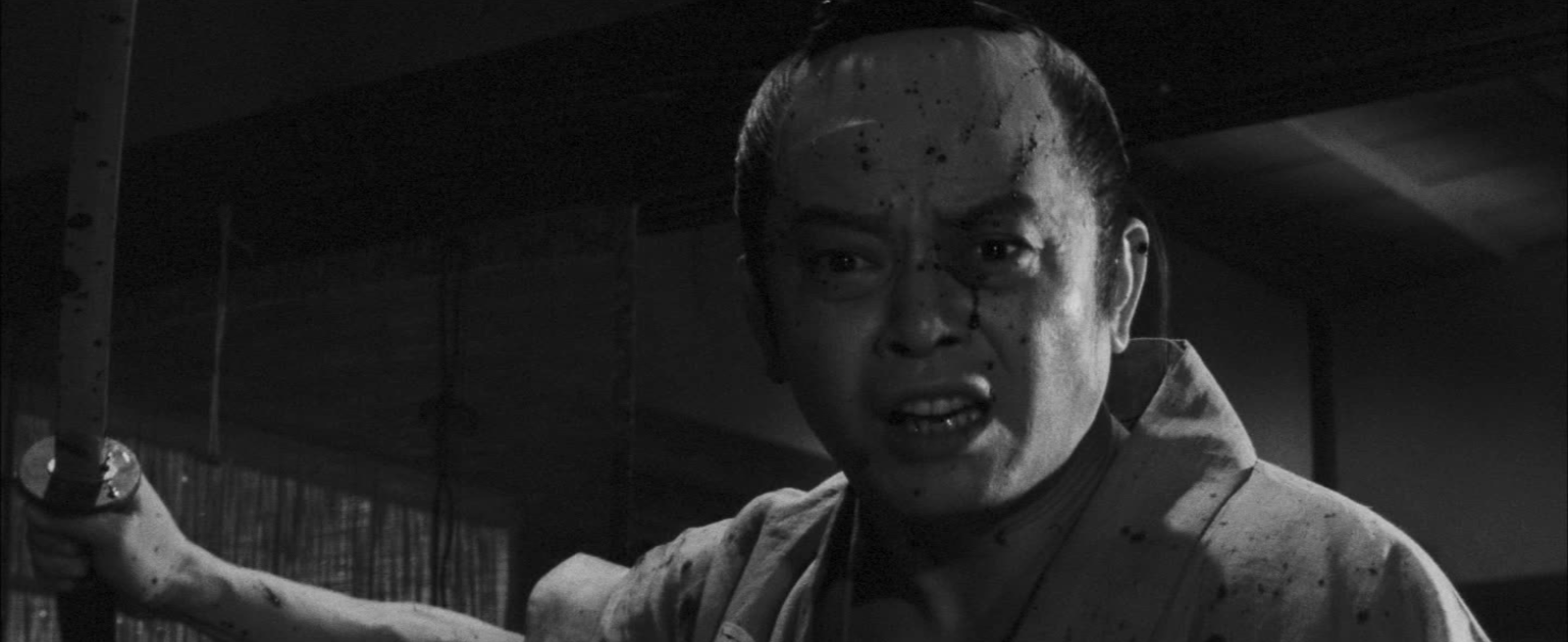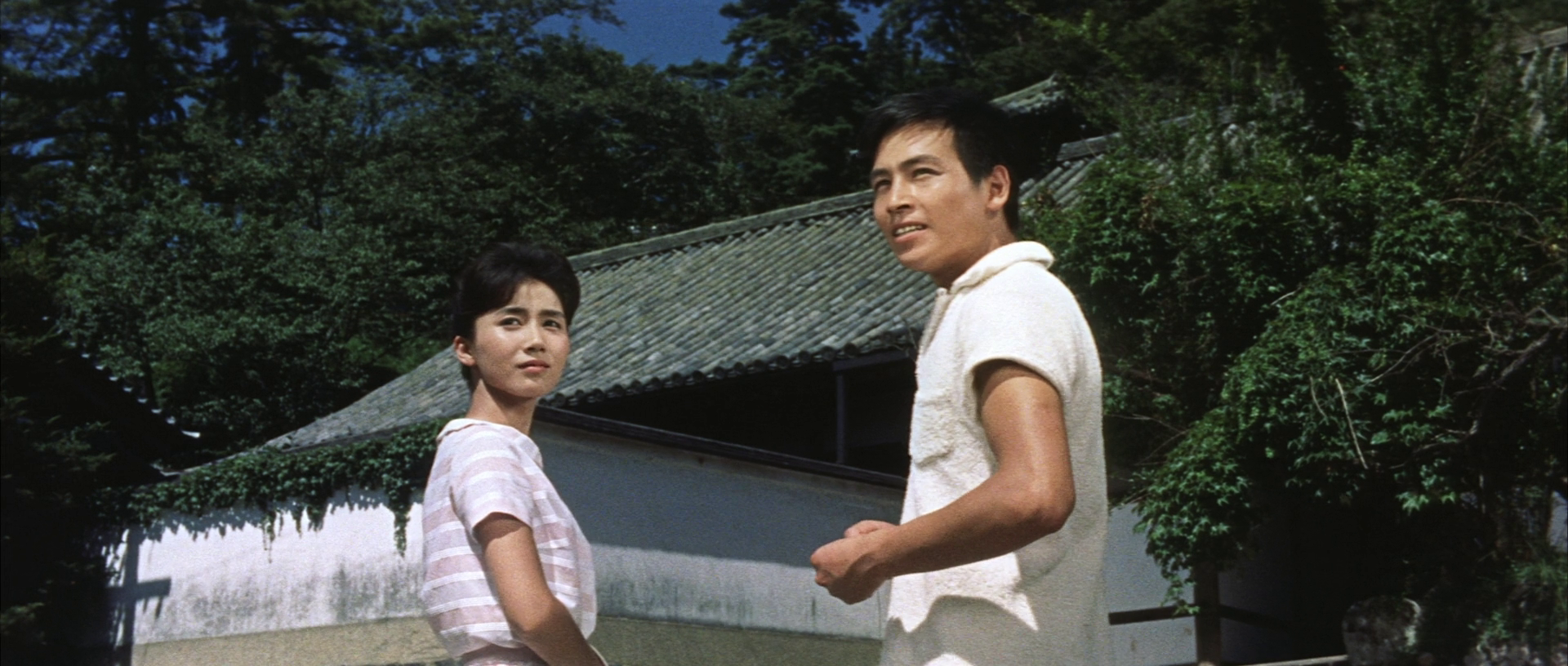
A Good Man, A Good Day (好人好日, Minoru Shibuya, 1961)

It’s funny, in a way, that life can hold so much goodness in it even with an underlying, barely visible melancholy. Goodness does indeed breed goodness for the sometimes misunderstood heroes of A Good Man, a Good Day (好人好日, Kojin Kojitsu) who struggle to adjust themselves to changing times but at the end of the day just want each other to be happy and for life to be blissfully dull and free of complication.

The obvious point of friction is that 20-something daughter Tokiko (Shima Iwashita) has had a proposal. She behaves as if it’s an arranged marriage, but in reality Ryuji (Yusuke Kawazu) is actually her boyfriend and the two of them have mutually decided to formalise their union but are doing things the “proper” way perhaps in part because Ryuji’s family run a 200-year-old ink shop and are intensely conservative. Though it’s Tokiko’s fuddy-duddy professor father Hitoshi (Chishu Ryu) who is often regarded as the sticking point, it’s equally Ryuji’s family and particularly his traditionalist grandmother (Tanie Kitabayashi) who isn’t sure that Tokiko is really good enough. She is however the only member of the family who thinks it’s not a big deal after discovering that Tokiko is adopted while others regard her with an increased suspicion and the prejudice often held towards orphans that they don’t want to let someone into their family whose familial lineage they don’t know.

It’s most likely for their benefit that Tokiko and Ryuji are intent on compromising by doing everything the “proper” way rather than as her mother Setsuko (Chikage Awashima) tells her just get married on their own without worrying about what anyone thinks. But in this awkward mix of tradition and modernity we can see that times have changed and Ryuji and Tokiko have decided their future for themselves. They firmly believe it will work out so they’re remaining patient, but should that patience run out they will decide to prioritise their own happiness. 

For his part, Hitoshi later says that he never actually objected to the marriage but just hates the idea of big weddings which he regards, not without reason, as stupid and pointless. In any case he warms to Ryuji when he loses his temper and calls him an “old fart,” realising that he’s a young man with a backbone and possibly worthy of Tokiko. A professor of mathematics, Hitoshi is an awkward man who doesn’t quite fit into polite society but has a good heart even if he has a funny way of showing it. When he wins an important medal from the government for his contribution to scholarship and it gets stolen, he won’t let the hotel owner report it because of his embarrassment but when the chastened thief brings it back he sends Tokiko after him with money for his train fare and a little more as a thank you. 

Still, he was probably not an easy man to live with and Setsuko’s not so secret sake habit is likely a result of the strain of dealing with him and his constant faux pas in the boredom of a rural life in which she says all she does is make pickles. But despite that, she still tells Tokiko that marriage is essential to a woman’s happiness if also encouraging her to fight for what she really wants. Tokiko is already doing just that, but has lingering doubts over her parentage and wants to know who her birth parents may have been partly out of curiosity but also a mild fear of the implications it may have. But what Hitoshi eventually tells her is that she is a war orphan which makes her a kind of everywoman and a symbol of the young, post-war generation which is making a break with the past. 

The film in fact includes a small satirical, anti-war sequence in which Hitoshi is accosted by a snooty nationalist who shouts out that he lacks “patriotism” for allowing the medal the emperor so generously gave him to be stolen. The man tells him he should face the direction of the Imperial Palace and apologise all which makes him look quite mad and paints Hitoshi as the figure of exasperated sanity. He also rejects contemporary consumerist culture in continuing to live like a student counting every last yen and rejecting the TV set Ryuji buys him because it would deprive him of going to the coffee shop to watch baseball games instead (though he does regret it later). In any case, Hitoshi’s guileless goodness does seem to ameliorate the world around him in making others, like the thief, want to live up to it as he, like Tokiko, defiantly does what he wants and though at times perhaps insensitive generally has his heart in the right place.

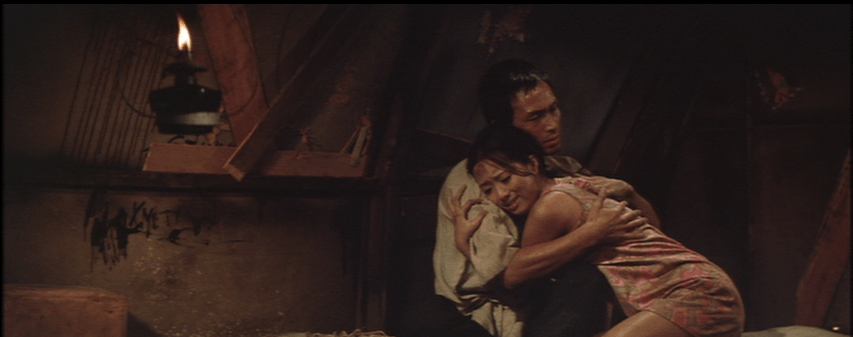
Genocide (昆虫大戦争, Kazui Nihonmatsu, 1968)

In the early 1960s, tokusatsu movies had begun to slide towards something which was much less serious than the early days of the genre, but as the decade went on others edged in the direction of the ‘70s paranoia thriller expressing a nihilistic view of contemporary Cold War geopoliticking. Given the rather provocative English title Genocide (昆虫大戦争, Konchu daisenso), as opposed to the more recognisably genre-inflected “great insect war”, Kazui Nihonmatsu’s wasp-themed disaster film is part anti-nuclear eco-treatise and part anti-US spy movie.

Then again, the film’s secondary hero, Joji (Yusuke Kawazu), a Japanese man obsessed with collecting rare insects he sends alternately to a researcher in Tokyo and a foreign woman living locally, cannot exactly claim the moral high ground. When he spots a US bomber falling out of the sky and runs to investigate the descending parachutes, he’s in the middle of tryst with Annabelle (Kathy Horan) while his wife waits for him patiently at home. Not only that, he picks up an expensive watch dropped by one of the airmen and attempts to sell it, he later claims to buy something nice for his wife, Yukari (Emi Shindo). Meanwhile, the voice of reason Dr. Nagumo (Keisuke Sonoi) is also seen conducting experiments on animals, injecting insect venom into a squirming guinea pig while explaining that the toxin affects the nervous system and causes madness and death. 

For all his own moralising, it’s this callous and selfish disregard for life which caused so many problems. The insects have apparently become fed up with human volatility and have decided that they don’t care what humans do to each other but they won’t go down with us in a nuclear war so the only solution is total eradication. The film’s true moral centre, the innocent Yukari, had tried to stop Joji capturing insects, reminding him that “insects have babies too,” while unbeknownst to him the insects he’d been capturing for Annabelle had been used for her sinister experiments to “breed vast numbers of insects that drive people mad and scatter them across the world.”

Annabelle’s quest is one of revenge, claiming that she doesn’t trust humans and likes insects because they don’t lie. She’s currently working with Communist spies supposedly researching deadly nerve toxins but with no loyalty to the regime, only the desire for the eradication of humanity in revenge for the murder of her parents in the holocaust. The Americans, meanwhile, only care about getting the H-bomb that the downed bomber had been carrying, eventually admitting that they’re considering simply detonating it to wipe out the insect threat in total indifference to the lives of those who live on the islands. When Nagumo challenges him, the American officer pulls a gun. One of the soldiers refuses the command to detonate, but is then killed. 

The Americans reject the idea that it was “insects” that brought the plane down, but tell on themselves on insisting that the airman onboard was hallucinating having become addicted to drugs to help him overcome his fear of combat situations. The insects do indeed cause him to hallucinate but with flashbacks back to his time in Vietnam, loudly exclaiming that he won’t go back there before asking for more drugs and being injected by a medic. The American officers claim they’re fighting for “freedom and independence,” but it rings somewhat hollow and is immediately challenged by Nagumo. “Sacrifices must be made in war,” they retort when he points out that detonating the bomb will not only kill everyone on the islands but irradiate the rest of Japan, wiping out the Japanese as if they too were merely insects. 

Even so, Nagumo too wants to wipe out the insects rather than consider the implications of their concern or find a way to live with them. Annabelle might have had a point when she said that human beings only knew hate despite her entirely twisted and exploitative plan to use the insects to complete her mission of eradicating humanity. In any case, in contrast to other similarly themed films, Nihonmatsu keeps things fairly realistic despite the outlandishness of the narrative, frequently cutting back to closeup footage of an insect biting into human flesh with its pincers before ending on an image of a nihilistic and internecine destruction that suggests there may be no real hope for us after all.


Curse of the Blood (怪談残酷物語, Kazuo Hase, 1968)

Vengeful ghosts in Japanese cinema usually originate from some kind of injustice. Generally, they’ve met a bad end through no real fault of their own while the person who killed them continues to prosper, though it’s also true that becoming a vengeful ghost means becoming an embodiment of vengeance which is itself indiscriminate and directed towards an unjust society more than one particular transgressor. In The Ghost of Kasane, for example, the curse extends to target the murdered man’s own daughter rather than just the descents of the man who murdered him.

Loosely based on the same tale, Curse of the Blood (怪談残酷物語, Kaidan Zankoku Monogatari) is indeed rooted in an injustice, but the emotions that create the ghost are greed and pettiness much more than a desire for retribution. A hatamoto lord has borrowed a large sum of money from a blind masseur evidently running a sideline as a loan shark. The monk, Sojun (Nobuo Kaneko), points out the term is coming to a close and the money should be repaid but Shinzaemon (Rokko Toura) doesn’t want to pay. Having just watched Sojun give his wife Toyo a sexually charged acupuncture session, he coldly remarks that he’ll be paying with his wife’s body. Toyo is obviously not really onboard with this plan, while Sojun at first declines only for Shinzaemon to state that he has the husband’s permission so it’s all fine. But Sojun then attempts to pay Shinzaemon with the improbably large sum of money he’s currently carrying, agreeing to sleep with Toyo but stating that the debt and interest will remain unchanged.

In any case, as soon as Sojun begins caressing his wife’s body Shinzaemon brutally cuts him down. He asks his recently returned grown up son Shinichiro (Masakazu Tamura) to help him dump the body in a nearby lake. Shinichiro complies, but it soon becomes evident that he disapproves of his father’s debauched ways and treatment of his mother. Despite being in debt to Sojun, Shinzaemon has a mistress and an illegitimate child with another woman he is also raising in his house. Shinichiro is painted as the good samurai son, one who behaves with the proper decorum and is unlike his father in his sense of righteousness. Shinzaemon even says as much, urging him to study Confucius and martial arts to one day restore the family he has ruined through his moral transgressions. 

But in taking a sword to the mistress, Shinichiro is himself corrupted. She merely seduces him and it seems to be this that pulls him over to the dark side. Some years later, Shinichiro becomes a bandit, conman, and murderer accidentally killing a woman during rough sex and then running off with the stash of gold from the home of the man who had taken him and promised him a respectable future. Then again, the man had run a pawn shop so perhaps he was’t as morally upright as he might seem despite his kindness to Shinichiro while it also transpires that he was extracting sexual favours from the maid, Ohana (Yukie Kagawa), who turns out to be one of Sojun’s two daughters. 

In another strange twist it was Ohana and her sister Suga (Saeda Kawaguchi) that Sojun had cursed when he died. He blamed them for somehow orchestrating his death and was insistent he was taking his money to hell with him, so they couldn’t have any of it. Suga takes him to task, decrying that he wasn’t fit to be a father and tormented their mother to death while otherwise complaining that he’s a sleazy old miser who doesn’t share his wealth with them so she’s taking it and running away. Suga’s determination to take the money is an attempt to seize autonomy, but she ends up using it in much the same way as her father, essentially as means of buying sexual companionship. Unbeknownst to her, she becomes besotted by Shinzo (Yusuke Kawazu), Shizaemon’s now grown-up illegitimate son, and binds him to her through her wealth.

Just like Shinichiro, Shinzo has been corrupted by the world around him and has little sense of humanity or morality. As he says, you’d have to be a fool to be honest in this world. Like his brother he has a caustic voiceover stating what he really thinks in contrast to his meek and obedient exterior, decrying Suga as an ugly old hag and expressing disgust at the idea of sleeping with her but also a willingness to put up with it in order to get his hands on her gold. Money lies at the root of all problems, but less so the need for it than simple greed. Shinzo has unwittingly entered a more romantic sexual relationship with Ohisa (Hiroko Sakurai), who turns out to be his half-sister, but her material desires outweigh his own and they are unable to move forward with their lives because they lack the economic stability to set up home. 

To that extent, money is a means of overcoming the barriers of social class or gender to pursue greater freedom that inevitably becomes a means in itself. Sojun does not appear often as a ghost but haunts all the same, an evil smile on his face each time he manifests and takes pleasure in the sight of those who robbed him of his wealth paying the price. Simply put, he remains jealous of his money and can’t bear the thought of anyone else having it so is determined to drag it all the way to hell. Shinzaemon may have cursed his family through his immoral behaviour, but Sojun is simply annoyed about the money. Then again, perhaps he’s just a product of the world in which he lives in which money is the only way to overcome the oppressive barriers of disability, social class, and gender for to be without it is to be a lonely ghost with no currency or agency in society ruled by a fiercely patriarchal hierarchy. Hase conjures some haunting ghost imagery and uses bouts of solarisation as if the world itself were being bleached by all this cruelty and cynicism, occasionally isolating each of the protagonists in a theatrical spotlight which doubles as a personal hell yet in the end suggesting that there really is no escape from the vengeful haunting of an unjust society.  


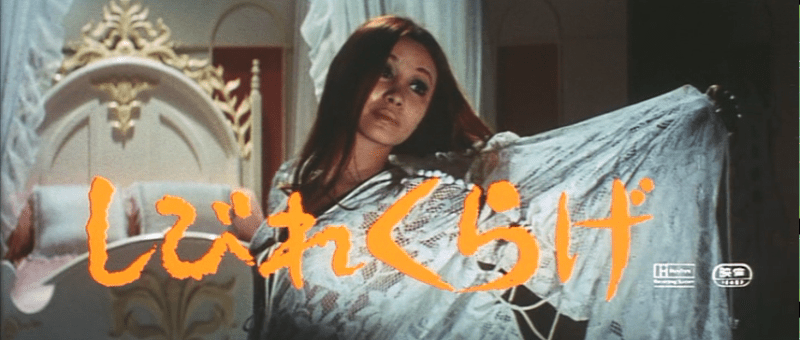
The Hot Little Girl (しびれくらげ, Yasuzo Masumura, 1970)

“Using women to make money is the same as a yakuza” a repentant gangster insists on confronting the real big bad of exploitative corporate power in Yasuzo Masumura’s ironic exploration of corruptions of a consumerist society. Ironically given the rather salacious title The Hot Little Girl (しびれくらげ, Shibure Kurage), the Japanese a more suggestive Numbing Jellyfish, Masumura’s spicy drama finds an exploited woman fighting back to reclaim her own image and agency by seizing the tools used against her in the company of a sensitive yakuza himself tiring of the amoral world of contemporary gangsterdom. 

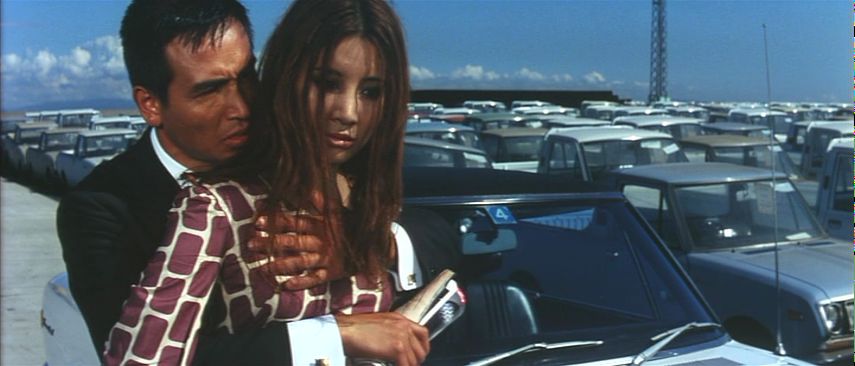
Once an ordinary coffeeshop waitress, Midori (Mari Atsumi) is now a successful model thanks to the efforts of her salaryman boyfriend Hiroshi (Yusuke Kawazu). Completely in love with him, Midori is convinced they will one day be married while Hiroshi is obsessed with corporate success and ultimately intends to buy his own advancement with her body by acquiescing to an indecent proposal from an American department store owner to strike a massive trade deal none of his colleagues had been able to broker. Shocked and disgusted Midori refuses but is later won over by Hiroshi’s rather dubious arguments that she must sleep with the American for the good of Japan along with their personal happiness, insisting that nothing will change between them while her sacrifice will buy a more secure footing for their mutual future. 

After the deed is done she seeks additional reassurance, heading straight to Hiroshi’s apartment where they again make love he insisting she is “clean” as the day she was born. In this instance he sells her body directly, though as others point out he was already doing something similar in selling her image for his own gain. Yet he is not the only person to do so, Midori’s feckless father who ruined himself embezzling money to spend on a bar hostess and thereafter going to jail, goes out on the town claiming to be a movie star and showing off Midori’s magazine spread to a woman at a bar who turns out to be there with a petty yakuza. They decide to run a scam on him, demanding compensation for messing with a yakuza’s girl while setting the amount so high they know he’ll never pay intending to press the pretty daughter, should he have one, into sex work in a fairly common gangster manoeuvre. 

The flaw in their plan is that the feisty Midori is less than attached to her dad who continues to ruin her life with his fecklessness, a drunken fool who steals her money and gets himself into trouble. It’s clear that he sees Hiroshi as something of a meal ticket, while Midori sees a marriage to him as a path towards a more stable, conventional life. Nevertheless, she finds herself unable to abandon her father, bravely standing up to the yakuza who threaten her and eventually saved by sensitive gangster Kenji (Ryo Tamura) who instantly sympathises with her situation having grown up with an abusive father he once tried but failed to kill. The gang he’s with are old school yakuza not yet part of the newly corporatising breed, still running petty scams pressing women into sex work through blackmail or parental debt. 

Yet those two worlds are, the film suggests, beginning to merge. The corporation is founded on an image of female exploitation, Hiroshi pimping out his girlfriend while his bosses giggle about it jokingly referring to her as a secret weapon for the company. On being confronted with her father’s problematic past, Hiroshi makes Midori an ultimatum to sever ties with her dad or break up with him because associating with the yakuza will ruin his career despite the fact that he is really no different himself in his desire to exploit her. Kenji’s boss Yamano (Daigo Kusano) instructs him to make Midori his woman and then put her work, but he refuses while Midori eventually opts for an ironic revenge that will quite literally buy her freedom not only from the corporate world but from yakuza threat in allowing Kenji to free himself. Together they determine to “become ordinary people again”, attempting to shake off both parental failure and the corruptions of a rabidly consumerist society to resist the commodification of body and image in world in which everything has a price and nothing any value. 


Ken (剣, Kenji Misumi, 1964)

Most closely associated with jidaigeki, Kenji Misumi’s only film to be set in the contemporary era, Ken (剣), shifts his persistent concerns into the modern day in the clash of the warrior ideal and the emotional costs of living, but also takes a sideways look at conflicted post-war masculinity as two young men vicariously lock horns in a quest for mastery over their desires. Adapting a short story by Yukio Mishima, Misumi dials back on the tragic romance of militarism painting the hero’s ultimate acceptance of nihilistic futility less as a noble sacrifice than a humanist failure of the society that failed to save him from his absolutist fallacy. 

Obsessed with strength and honour, Kokubun (Raizo Ichikawa) has convinced himself that he can capture “this spark of pure life” he saw in the sun through perfecting the art of kendo. An aloof and austere figure, he has foregone all else and dedicated himself to his skill alone. For this reason he is appointed captain of his university kendo club over his jealous rival, Kagawa (Yusuke Kawazu), who loses out because his sword is “sentimental” and there is a concern that he draws his power from “arrogance”. There is indeed something in that, and it’s Kagawa’s sense of male pride that partly sets him on a quest for vengeance and vindication in a obsessive desire to dominate Kokubun but there’s also an unspoken attraction as he later admits to a female acquaintance in remarking that he finds Kokubun’s way of life “infuriating” but despite himself also “refreshing”. 

Literal sword play, Kagawa’s obsession with Kokubun results in a vicarious seduction in which he attempts to corrupt him by enlisting the help of a female student to expose him as a fraud by rupturing his asceticism and thereby destroying his source of strength if not his sense of self. The quasi-sadomasochistic relationship between the two men is further borne out by the implication that Kokubun is in fact finding his sexual release in the intense act of repression, satisfying himself through physical exhaustion in the company of other men, Misumi’s roving camera fully capturing the homoeroticism of this intensely homosocial society. Humiliated by Kokubun who forces him into a public act of contrition through physical endurance after disappointing the club by breaking the rules smoking on the job at their part-time gig at a supermarket, Kagawa goes to the chairman to complain that Kokubun’s leadership style is far too intense, “feudalistic” as another member puts it shortly before quitting, claiming that all he wants is for his rival to wake up from his militarist dream and live in the real world though his final act of mutiny will engender consequences unforeseen in his conviction that Kokubun’s ideology is largely performative self-delusion. 

The team manager perhaps thinks something similar, reminding Kagawa that he is merely “more grown up” as if Kokubun is in a sense maintaining his childlike innocence in refusing to enter an adult world he regards as “ugly” and “corrupt”. His ideal is simplicity and he finds it in the primacy of the sword. There is in this something of an uncomfortable militarist throwback that finds a disciple in the ever loyal Mibu (Akio Hasegawa) who dutifully parrots back the quasi-facist philosophy to his quietly horrified mother and sisters who probably don’t help the situation by mocking his lack of masculinity in his inability to grow a proper beard while insisting on shaving every day anyway. Attracted by Kokubun’s dynamism and energy, he longs for strength through self denial. “We must move away from those empty desires” Kokubun instructs him while discussing the suicide of a young man who was discovered next to a selection of half eaten fruit. Rather than sympathy the man is largely mocked by his male peers, Kokubun dismissing him as “weak in mind and body” for having taken his own life apparently in fear of failure, but also stressing that suicide is a choice taken by the very strong as well as the very weak. 

In this brief exchange he opens the door to a notion of nobility in the choice to take one’s own life which leads straight back into the death cult of militarism, perhaps something that only Mibu as a fellow devotee is able to see. Yet Misumi perhaps undercuts this sense of nobility with a return to collective shame, eulogising Kokubun’s determination to preserve his “uprightness and strength” as Kagawa admits defeat in the face of Kokubun’s unbreakable purity, while placing the burden of failed responsibility on the kendo troupe not for their inability to live up to his ideal but for their lack of understanding in failing to free him of his moral absolutism. The way of the sword once again leads only to death and while there may be an uncomfortable beauty in such moral purity, in the end all there is is futility. 


Original trailer (no subtitles)

Sing, Young People (歌え若人達, Keisuke Kinoshita, 1963)

Keisuke Kinoshita has sometimes been dismissed by Western critics for his supposed sentimentality, but his mid-career comedies can be surprisingly cynical. Scripted not by Kinoshita but Taichi Yamada, 1963’s Sing, Young People (歌え若人達, Utae Wakodotachi) is in someways an exception to the rule, a breezy take on the student comedy updated for the present day, but underneath all the absurdist humour and jibs about youthful ennui is a real sense of adolescent hopelessness as these aimless young men ponder their “pitch-black” futures in a rapidly changing Japan where the best they can hope for is fulfilling the salaryman dream.  

Shooting in glorious colour, Kinoshita opens with a lengthly pan over contemporary Tokyo which the jaunty voice over describes as “the number-one city in the world” before homing in on the incongruous figure of a strangely dressed man holding a sign advertising “sensual massage beauties”. A relic of an earlier advertising age, the wandering sign man nevertheless catches sight of someone even “weirder” than he is, a student wearing a student’s cap! Kinoshita then takes us on a brief detour through Japan’s major universities demonstrating that no one is so uncool as to wear a student’s cap in the age of protest, drawing a direct contrast to the student comedies of old while showing us a series of scenes of students “playing” hard with part-time jobs in bands or as models, training hard in preparation for the upcoming Olympics, fomenting the revolution, or fighting in the streets. In the first of many meta touches, our hero, Mori, is eventually woken by the narrator after falling asleep in class, his eyes “gleaming with hopes for the future”. 

Or, perhaps not, he’s just tired. Mori (Tsutomu Matsukawa) is as he describes himself a man without hopes or dreams who believes that the road ahead of him is “pitch black”. Dropping a brush from the window washers’ platform at one of his part-time jobs, he asks himself if there shouldn’t be more to life than this. The only son of his widowed mother, he’s pinned everything on graduating from a top university but feels powerless and empty, adrift in the post-war landscape. Where his calculating friend Miyamoto (Yusuke Kawazu) fills the void with romance and a determination to “get lots of As” and then land a top job, his roommate Okada (Shinichiro Mikami) earnestly studies hard afraid to disappoint his austere family but also quietly resentful in his lack of autonomy, and the dopey Hirao (Kei Yamamoto) simply goes about being nice to people more or less forcing them to eat the traditional treats his loving mother is forever sending. 

Yet for all the bleakness Mori seems to see in his future, he only ever falls up. Luck follows him and he’s presented with ever more fantastic opportunities at every turn. In fact, it’s his slightly grumpy expression as he cleans the windows of an office building that leads to them snapping a picture and making him a cover star without ever bothering to ask his permission though they do eventually pay. Still Mori remains indifferent, telling a reporter who tries to interview him that he had nothing to do with the cover, he has no dreams or aspirations for the future but lives his life day by day. He describes himself only as “nervous”. His words run ironically over the magazine literally becoming tomorrow’s chip paper, used by a stall owner to wrap her croquettes, as a stand for a hot pot, and otherwise bundled up to be pulped. Nevertheless, the cover leads to great opportunities from a TV network looking for a fresh face to front their new youth-orientated drama serial. 

Despite all the promise, Mori remains indifferent, later irritating a new colleague and potential love interest (Shima Iwashita) when he idly suggests he might just give up acting and fall back on the salaryman dream. As she points out, she had to fight all the way to achieve her dreams of becoming an actress so hearing someone say they’re going to throw away a tremendous opportunity that came to them entirely by chance is mildly offensive. Miyamoto meanwhile is growing lowkey resentful, realising that maybe nothing matters after all it’s all just dumb luck. Mori deliberately didn’t do anything because he thought his life was pointless but everything has landed right at his feet while Miyamoto’s life is crumbling. He’s lost all his girlfriends and endured a lonely New Year alone in the dorm, coming to the conclusion that his future really is “pitch black”.

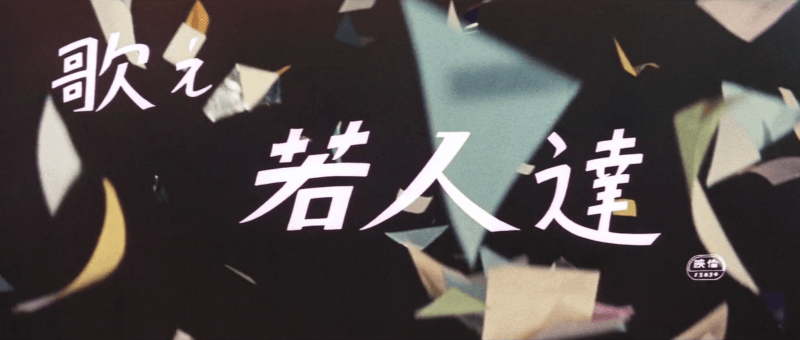
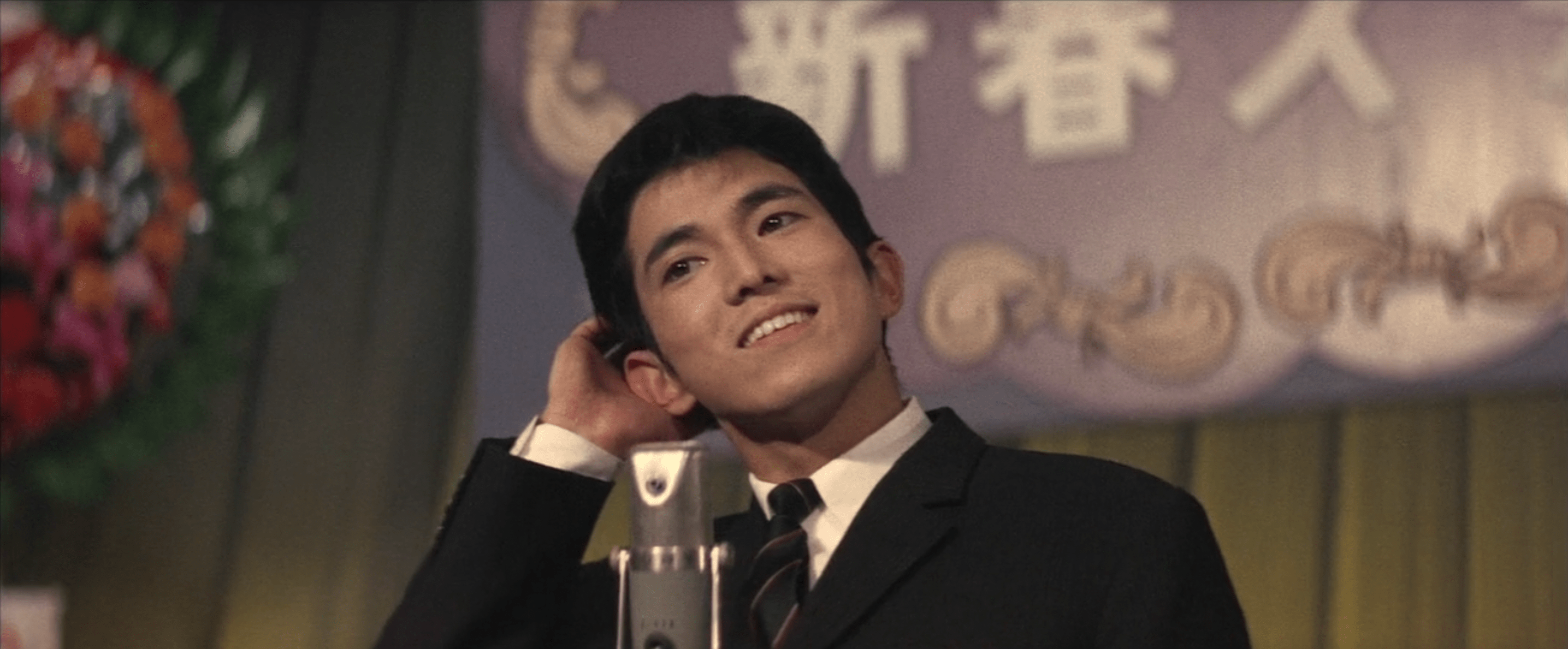
Nevertheless, it’s difficult to remain resentful about a friend’s accidental success and so each of the men eventually finds direction in even in directionlessness. Mori realises that he might as well ride his wave of fame for as long as it lasts, accepting in part at least his sense of powerlessness, while Okada does the reverse in deciding to rebel against his authoritarian family by marrying in secret. Miyamoto resolves to make a success of himself in his own way, and Hirao seemingly accepts the hand fate has dealt him with good humour. Kinoshita ramps up the meta comedy with Mori joining Shochiku, encouraged to try and work for that “excellent” director Keisuke Kinoshita, later referencing Garden of Women, while Mariko Okada and Keiji Sada turn up as onstage guests at an event launching him as a young actor. Playfully using outdated, quirky screen wipes and opening with an artsy title sequence featuring colourful confetti falling up, Kinoshita perhaps adopts a slightly ironic tone in satirising the all pervasive sense of confusion and hopelessness among the younger generation but does so with only sympathy for those coming of age in uncertain times. 


Cruel Story of Youth (青春残酷物語, Nagisa Oshima, 1960)

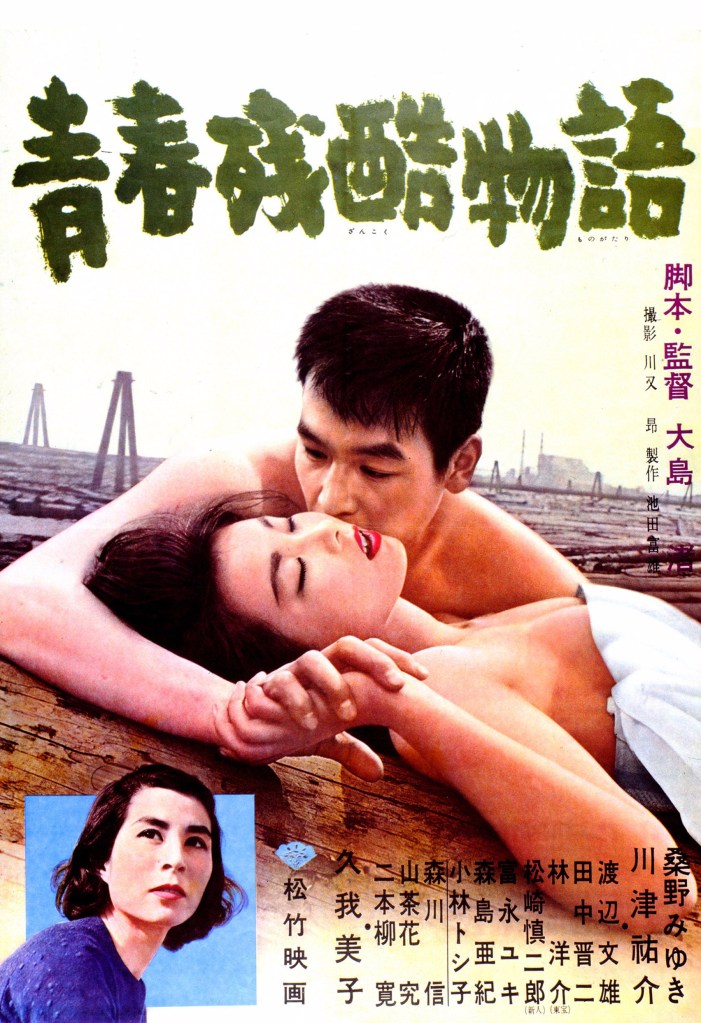
More interested in politics than cinema and never quite at home in the studio system, Nagisa Oshima began his career at Shochiku as one of a small group of directors promoted as part of the studio’s effort to reach a youth audience they feared their particular brand of inoffensive melodrama was failing to capture. Like The Sun’s Burial, Cruel Story of Youth (青春残酷物語, Seishun Zankoku Monogatari) is a nihilistic tale of a fracturing society, but it also looks forward to Night and Fog in Japan in its insistence that youth itself is a failed revolution and this generation is no more likely to escape existential disappointment than the last. 

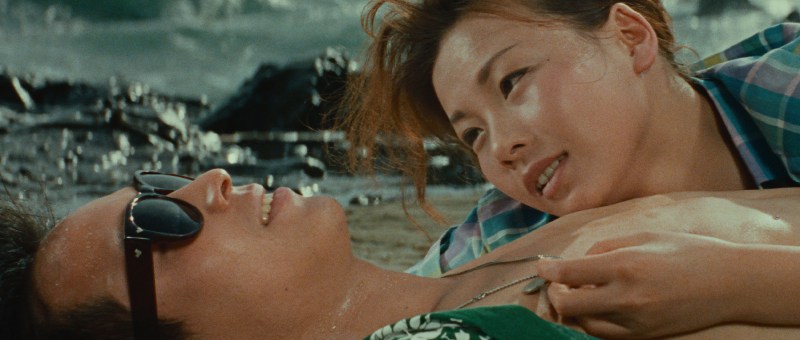
The film opens with teenager Makoto (Miyuki Kuwano) and her friend Yoko (Aki Morishima) trying to get free rides from skeevy middle-aged men rather than having to pay for a cab. As you might expect, that’s a fairly dangerous game and while it might be alright while there’s two of you, as soon as Yoko has been dropped off, the driver changes course and suggests going for dinner only to park in front of a love hotel and try to drag Makoto inside. Luckily, or perhaps not as we will see, she is “rescued” by young tough Kiyoshi (Yusuke Kawazu), a student and angry if politically apathetic young man. Struck by his manly white knight act, Makoto takes a liking to Kiyoshi but he too later rapes her under the guise of satisfying her curiosity about sex to which he attributes her ride hailing activities. After this violent genesis, they fall in “love” but continue to struggle against an oppressive society.

We assume that the “cruel story of youth”, and it is indeed cruel, that we are witnessing is that of Makoto and Kiyoshi, but it’s also that of her slightly older sister Yuki (Yoshiko Kuga) and her former lover Akimoto (Fumio Watanabe) who has become a conflicted doctor to the poor betraying himself by financing the clinic through charging for backstreet abortions. Yuki complains to her apathetic father that they were strict with her in her youth, that she’d get a hiding just for coming home after dark, whereas Makoto can stay out all night and not get much more than a stern look. Her father explains that times were different then, “We thought we had new horizons. We started again as a democratic nation, and it was a responsibility that went hand in hand with freedom. What can I say to this girl today?” admitting both the failures of the past and the mistaken future of a society that actively resists change. 

Yuki and Akimoto were part of the post-war resistance, left-wing students like the older generation of Night and Fog in Japan, who’d actively fought for real social change but had seen that change elude them. Yuki, we hear, left Akimoto for an older man but perhaps now regrets it along with her half-finished revolution. She may not approve of her sister’s choices, but she also on some level admires her for them or at least for the strength of her rebellion even if it will ultimately be as fruitless as her own. “This is a cruel world and it destroyed our love” Akimoto laments, mildly censuring the youngsters in suggesting that his love was pure and chaste because they vented their youthful frustrations through political action whereas this generation is already lost to the mindless hedonism of unbridled sexuality. 

He forgives them, because he feels that their plight is a direct result of his failure to bring about the better world, but there is also a suggestion that it is a lack of political awareness which is somehow trapping the young. Oshima cuts from footage of the April Revolution in Korea which is described as a “student riot” in the news to a protest against the Anpo treaty at which Kiyoshi and Makoto look on passively from the sidelines. “I think taking part in the demonstrations is stupid”, Makoto’s friend Yoko tells a prospective boyfriend, “why don’t we think about getting married instead?”, drawing a direct line between social conservatism and political inaction. 

Makoto and Kiyoshi rebel by using, or to a point not using, their bodies as a direct attack on the society. Following their rather odd and troubling meeting, the pair earn their keep through repeating the experience. Makoto picks up men who will inevitably have an ulterior motive, and Kiyoshi rescues her, extorting money from their targets. Yet it is Kiyoshi who is forced to prostitute himself, gaining financial support as a gigalo kept by a wealthy middle-aged housewife who is just as sad and defeated as Yuki and Akimoto, dissatisfied with the path her life has taken and in her case attempting to escape it through passion and control exerted over the body of a young man. Though the consequences of a becoming a kept man may be different than those Makoto would face should the less “nice” delinquents get their hands on her, they do perhaps fuel his sense of violent emasculation which he channels into a pointless act of revenge against the society in the form of its most powerful, wealthy middle-aged men whose misogyny he claims to abhor while simultaneously mirroring and directly exploiting.

“Someone needs to be responsible” a strangely sympathetic policeman insists, chiding Kiyoshi that at heart he’s just a petty criminal who liked having money no matter how he might have tried to dress it up. “You’re just like them, you’re a victim of money too”, he adds correctly diagnosing the flaws of an increasingly consumerist society. Only, no one takes responsibility. Kiyoshi’s lady friend pulls stings. It turns out her husband does business with Horio, one of Makoto’s pick ups who despite being nice and kind still had his way with her and then reported Kiyoshi for extortion. Akimoto explained that their failures would drive them apart, but Kiyoshi swore they’d always be together only to wonder if in his love for her the only thing to do is save Makoto from his corrupting influence though she does not want to leave him. We won’t be like you, Kiyoshi countered, because we have no dreams with which to become disillusioned. But youth itself is a failed revolution, and the force which destroys them is perhaps love as they meet their shared destinies at the hands of an increasingly cruel society.


Cruel Story of Youth is currently streaming on BFI Player as part of the BFI’s Japan season.

Original trailer (no subtitles)

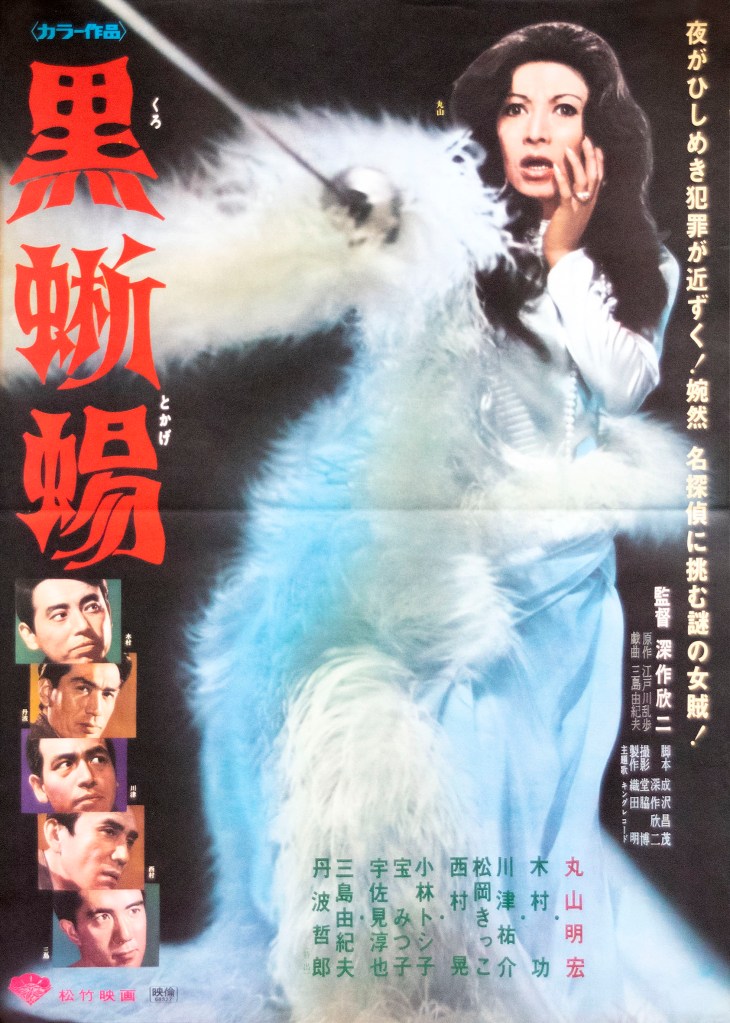
Black Lizard (黒蜥蝪, Kinji Fukasaku, 1968)

“Are you a critic?” asks the proprietress of of a lively night club, “Why?” replies a lonely man sitting at the bar, “Beauty fails to intoxicate you” she explains before wandering off to find a prettier prize. Nevertheless, a connection has been forged as two masters of the craft confront their opposing number. Black Lizard (黒蜥蝪, Kurotokage), based on the 1934 story by Edogawa Rampo, had been brought to the screen by Umetsugu Inoue in 1962 in a version which flirted with transgression but was frothy and fun, adding a touch of overwrought melodrama and gothic theatricality to Inoue’s well honed musical style.

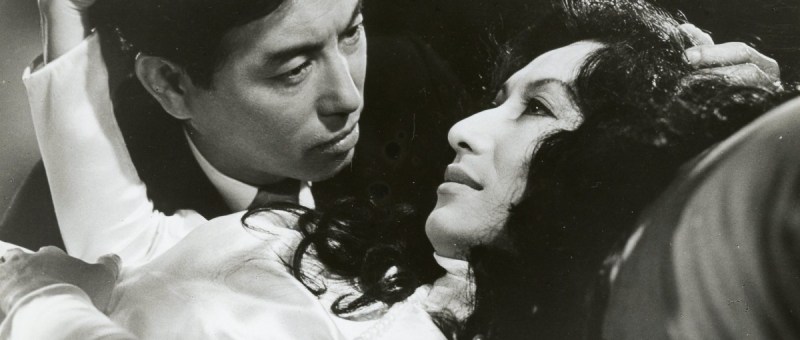
Inoue’s version had been co-scripted by Kaneto Shindo and Yukio Mishima who had also written the stage version. Once again crediting Mishima’s stage adaptation, Fukasaku’s 1968 take on the story is, as might be expected, far less interested in class connotations than it is in notions of love, beauty, and aestheticism. Consequently, we open in a much harsher world, dropped straight into Black Lizard’s edgy nightclub which Akechi (Isao Kimura), Edogawa Rampo’s famous detective, has visited on a friend’s recommendation. He is shocked to read in the paper the next day that a young man he saw in the club has apparently committed suicide, while another article also mentions the shocking disappearance of a corpse from the local morgue. 

Meanwhile, Akechi is brought in on a retainer to protect the daughter of a wealthy jeweller who has been receiving threatening letters informing him of a plot to kidnap her. Unlike Inoue’s version, Iwase (Jun Usami) is a sympathetic father, not particularly demonised for his wealth. Rather than drinking too much, he simply takes his sleeping pills and gets into bed without realising that his daughter is already missing. As transgressive as ever, however, Black Lizard (Akihiro Miwa) wastes no time sizing up Sanae (Kikko Matsuoka), running her eyes over the “splendid curve” of her breasts and lamenting that beautiful people make her sad because they’ll soon grow old. She’d like to preserve that beauty forever, convinced that people age because of “anxieties and spiritual weakness”. The reason she loves jewels is that they have no soul and are entirely transparent, their youth is eternal. Now Black Lizard has her eyes on the most beautiful jewel of all, the Egyptian Star, currently in the possession of Iwase which is why she’s planning to kidnap Sanae and ask for it as a ransom. 

Though the Black Lizard of Inoue’s adaptation had been equally as obsessed with youth and beauty, she was a much less threatening presence, never actually harming anyone in the course of her crime only later revealing her grotesque hobby of creating gruesome tableaux of eternal beauty from human taxidermy. This Black Lizard is doing something similar with her “dolls”, but she’s also cruel and sadistic, not particularly caring if people die in the course of her grand plan even running a sword firstly through a body she believes to be Akechi’s, and then through a minion completely by accident. She picks up Amamiya (Yusuke Kawazu) in the bar because of his deathlike aura, his hopelessness made him handsome, but once he fell in deep love with his “saviour” she no longer found him beautiful enough to kill. 

Akechi, meanwhile, is captivated by her in the same way Holmes is captivated by Irene Adler. He admires her romanticism, and recognises her as someone who thinks that crime should come dressed in a beautiful ball gown. She, by turns is drawn to him but perhaps as to death, each of them wondering who is the pursuer and who the pursued but determined to be victorious. Casting Akihiro Miwa in the female role of Black Lizard adds an extra layer of poignancy to her eternal loneliness and intense fear of opening her heart, finally undone not by the failure of her crimes but by a sense of embarrassment that Akechi may have heard her true feelings that leaves her unable to go on living. 

Meanwhile, Amamiya attempts to rescue Sanae not because he has fallen in love with her, but because he too is drawn towards death. Showing the pair her monstrous gallery of taxidermy figures of beautiful humans, she pauses to kiss one on the lips (played by Yukio Mishima himself no less), leaving Amamiya with feelings of intense jealousy and a longing to be a cold and inanimate shell only to be touched by her. “Sanae”, meanwhile, who turns out to be a perfect mirror in having being picked up at rock bottom by Akechi for use in his plan, guides him back towards life. They did not love each other, yet their “fake” love was set to be immortalised forever as one of Black Lizard’s grim exhibitions. She wonders if the fake can in a sense be the real, that they may free themselves from their respective cages through love in accepting a romantic destiny. For Black Lizard, however, that seems to be impossible. Akechi has “stolen” her heart, but she cannot take hold of his, holding him to be a cold and austere man who has “trampled on the heart of a woman”. “Your heart was a genuine diamond” Akechi adds, lamenting that the true jewel is no more. Black Lizard meets her destiny in a kind of defeat, too afraid of love and the changes it may bring to survive it, but paradoxically grateful that her love is alive while taking her leave as a romanticist in love with the beauty of sadness. 


Opening and titles (English subtitles)

The Eternal Rainbow (この天の虹, Keisuke Kinoshita, 1958)

Eternal rainbow poster 1Famously, towards the end of the war, Keisuke Kinoshita got himself into trouble with a dialogue free scene of a mother’s distress as she sent away the son she’d so carefully raised “for the emperor” towards an uncertain future in the midst of hundred of other, identically dressed faceless boys. Army might have showcased the director’s propensity for resistance, but one could also argue that there was just as much propagandistic intent in the post-war films as their had been in the militarist era even if the messages they were selling were often more palatable. 1958’s The Eternal Rainbow (この天の虹, Kono Ten no Niji) is a case in point. A portrait so positive one wonders if it was sponsored by Yahata Steel, The Eternal Rainbow is nevertheless conflicted in its presentation of defeated post-war hope, exploitation, and growing social inequality even as it praises its factory city as a utopian vision of happy industry and fierce potential.

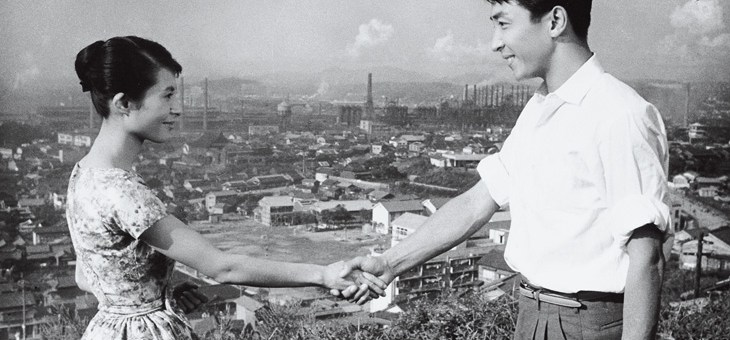
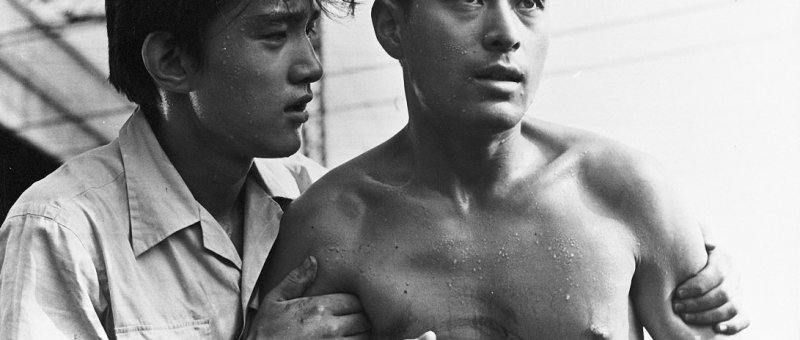
A lengthy opening sequence featuring voice over narration recounts the history of the Yahata Steel Works which began operations in 1901 in Northern Kyushu and now employs thousands of people, many of whom live nearby in the ever expanding company dorms the newer models of which feature bright and colourful modern designs in contrast to the depressing grey prefab of the traditional workers’ homes. Gradually we are introduced to our heroes – chief among them Mr. Suda (Yusuke Kawazu), a young man from the country who saw a factory job as his over the rainbow but is rapidly becoming disillusioned with its dubious gains. Rather than the company dorms, Suda rooms with the foreman, Kageyama (Chishu Ryu), and his wife Fumi (Kinuyo Tanaka) whose young son Minoru (Kazuya Kosaka) didn’t qualify for a factory job on account of his small frame and his been unable to stick at anything in the precarious post-war economy. Meanwhile, Suda has made friends with an older worker, Sagara (Teiji Takahashi), who has fallen for a secretary, Chie (Yoshiko Kuga), but her family are dead against her marrying a factory worker while she is also in a relationship with a college educated engineer, Machimura (Takahiro Tamura), but is beginning to doubt the seriousness of his intentions.

The drama begins when Sagara employs Kageyama to act as a go-between in a formal proposal of marriage to Chie’s parents, the Obitas. Kageyama didn’t really want to be a go-between because it’s gone badly for him before and he thinks this one is a non-starter too – women around here have their sights set on office workers, no one in the arranged marriage market is looking to marry someone on the shop floor. The Obitas feel much the same. Mrs. Obita is keen for Chie to marry up and is somewhat offended by the proposal, granting it only the customary consideration time to not seem rude in turning it down flat. Sagara is stoic about the matter, but the abruptness of the rejection greatly offends Suda who cannot stand for the Obitas snobbish put down of working people.

Herein lies the central conflict. Suda was a country boy who’d been sold an impossible dream. He believed that a job in the factory, for which he had to sit an exam and has been chosen out of thousands of other hopefuls, was his ticket out of rural poverty. Now that he’s working there he realises he is little more than a wage slave, working long hours for almost nothing with the only goal of his life being to earn enough to feed a family with a little (very little) left over for his old age. Minoru, the Kageyamas’ son, feels much the same and has already turned cynical and desperate. He can’t abide his father’s work ethic and wants more out of life than there perhaps is for it to give him. Suda repeatedly asks how people can learn to be happy in this sort of life, wondering if those that claim to be have simply given up their hopes and aspirations in resignation. When Minoru decides not to go to Tokyo it ought to be a victory, but then perhaps it is more that he has simply accepted that there is no hope there either.

Nevertheless, the depiction of Yahata as a place to work is ridiculously positive even as Kinoshita undercuts it with the disillusionment of both Suda and Sagara. A factory city, Yahata is characterised as a cornerstone of the burgeoning post-war economy, literally making the rails on which the new Japan will run. The works provides affordable accommodation for families, guaranteed employment, insurance, a “self service” supermarket right on site, social clubs, cultural activities, and festivals. They even get a large scale show from Tokyo every year.

Even so, an immense and seemingly unbridgeable gap exists between the steelworkers and the company men. Mrs. Obita might seem self serving and mercenary, but she’s had a hard life and perhaps it’s only natural that wants better for her daughter. Suda is angry to think a good man like Sagara who might be a bit old fashioned and unsophisticated but has taken the trouble to do things the “proper” way would be dismissed out of hand simply out of snobbery. His attitude is, however, somewhat problematic in that he begins bothering Chie to find out her reasons for declining the proposal, refusing to recognise that she doesn’t need to offer any reason besides her own will. Chie, meanwhile, is conflicted. A proposal of marriage from a man she doesn’t even really know is not something she was minded to consider in any case, but her feelings for Machimura are tested once she becomes aware that he is not quite in earnest and may have been messing around with his landlady while enjoying the attention he receives as an eligible bachelor around town.

Machimura, like Suda, Sagara, and Minoru, is somewhat listless and apathetic even if for the opposite reason in that his life is far too easy and he hasn’t had to make a lot of concrete decisions about his future. Chie doesn’t deny that his college education and urban sophistication are part of the reason she was attracted to him, but as she later tries to explain to Suda, she wasn’t simply angling to marry up – she just fell in love with someone who happened to be of a higher social class which isn’t the same as looking down on working people. She has a right to her feelings whatever political label an increasingly resentful Suda might like to put on them. Even so, if she had been trying to marry up who could really blame her for that? In a society in which women are still entirely dependent on a man, being largely prevented from pursuing a career in their own right, a marriage is effectively a job for life. Shouldn’t she pick the offer with the best benefits, just as Suda did when he chose to leave the country for a factory job?

Progressive factories are often presented as an ideal solution the problem of post-war poverty, but here Kinoshita does not seem so sure. Despite the emphatic tone of the infrequent voice over and the central messages that factory jobs are good jobs and looking down on manual work nothing more than snobbery, Suda and Sagara remain conflicted. This work is dangerous, pays little, and offers nothing more than false promise. If the vast cities like Yahata are the engines repowering the economic growth of a still straitened Japan, what will be the end result? Metropolis made flesh, the “eternal rainbow” is exposed as a self serving lie but what, Suda might ask, else is there for men like him in a society like this?


Original trailer (no subtitles)

The Sun’s Burial (太陽の墓場, Nagisa Oshima, 1960)

sun's burial poster

“Love and hope for the youth!” reads a prominent sign in the middle of a hopeless slum in Oshima’s bitterly nihilistic youth drama The Sun’s Burial (太陽の墓場, Taiyo no Hakaba). Then at Shochiku, home of polite melodrama, Oshima was one of a handful of youngsters (that also included Kiju Yoshida and Masahiro Shinoda) bumped up to director ahead of schedule in an attempt to find voices who could speak to youth in much the same way Nikkatsu was doing with its incendiary tales of the new bright young things. The Sun’s Burial would be Oshima’s penultimate film for the studio before he stormed out after they pulled his next film Night and Fog in Japan from cinemas fearing its fierce critique of a divided left torn apart by dogmatic rigidity and generational conflict was too on the nose in wake of the assassination of the Socialist Party leader by a right-wing nationalist.

Set in the slums of Kamagasaki, Osaka, The Sun’s Burial follows a collection of desperate adolescents trying to survive in an intensely hostile environment. Our “hero” the conflicted Takeshi (Isao Sasaki), is inducted into a street gang after getting beaten up by young tough Yasu (Yusuke Kawazu). Along with his friend Tatsu, he is originally quite taken with the idea of becoming a gang member, but blanches when he passes a room full of captive women, one of whom is being beaten for having conceived a child.

Meanwhile, across town, his polar opposite, the cynical survivor Hanako (Kayoko Honoo) is running a blood racket, literally bleeding the proletariat to sell their bodily fluids on to the cosmetics trade. Technically operating under the aegis of her petty thug father Yosematsu (Junzaburo Ban), Hanako is in business with a doctor and a couple of minions but later has her authority undercut by a mad old imperialist known as “The Agitator” (Eitaro Ozawa) who keeps insisting that the Russians are coming and they have to be ready.

Not permitted to maintain power in her own right, Hanako is forced to shuttle between male protectors, occasionally pitting one against the other in a bid to come out on top. In addition to her blood business, she also engages in casual sex work and seemingly has no qualms about wielding her sex appeal as a weapon in order to manipulate male power. Pushed out by The Agitator, she turns to gang leader Shin (Masahiko Tsugawa) for a temporary alliance. When he too cuts her out, she thinks about tipping off the area’s big Yakuza boss, Ohama (Gen Shimizu), to Shin’s whereabouts, always looking a few moves ahead while the callous Shin remains wary and ever vigilant.

In a move which surprises and disturbs the naive Takeshi who is nevertheless captivated by her cynical self assurance, Hanako is entirely indifferent to the suffering of other women, willingly co-operating with Shin while knowing that he runs an abusive prostitution ring. Takeshi’s loss of innocence comes early when he is sent to go out and find some victims with his friend Tatsu who convinces him to club a high school boy canoodling with his girlfriend over the head so they can rob him. Takeshi looks on in mild confusion and horror as Tetsu proceeds to rape the young woman, turning to Hanako for guidance but all she does is shrug. The high school boy later commits suicide, presumably unable to bear the shame of having failed to protect his girlfriend, leaving Takeshi feeling as if he has blood on his hands. To Hanako, however, the boy’s death is no one’s fault but his own, a product of his own weakness. A strong person, she posits, would have sought revenge. What sort of person ups and dies without a fight?

Meanwhile, back in the slum, a man hangs himself after falling victim to The Agitator’s latest scam – getting involved with a dodgy gangster’s exploitative scheme to buy up legitimate IDs from desperate people and sell them to even more desperate undocumented migrant workers. Full of tales of Empire, The Agitator declares that he’s going to march them all up to Tokyo and teach those noisy students a lesson, proving somehow that populist militarism is not yet dead in quiet corners of Japan. The Agitator has several followers among the middle-aged and older denizens of Kamagasaki, taken in by his bluster and lacking any other sources of hope. They follow him because he demands to be followed and because he made them a series of promises. Only when they realise his plans rest on exploiting people even more unfortunate than they are, and suddenly realising he never got round to paying them either, do they finally rebel, burning down the slum in protest of their hopeless circumstances.

Berated for her cynicism by the now compromised Takeshi, Hanako offers only the defence that she has survived and will continue to survive where others may not if they allow their consciences to take precedence over self-preservation. Bleak as it gets, Oshima ends on with a note of anxious industry as his determined heroine dusts herself off and gets “back to work”, escaping from the ruins of the burned out slum in the bright morning sun. “No hope for Japan now” an embittered member of the older generation laments, and Oshima, it seems, is apt to agree.


Original trailer (no subtitles)