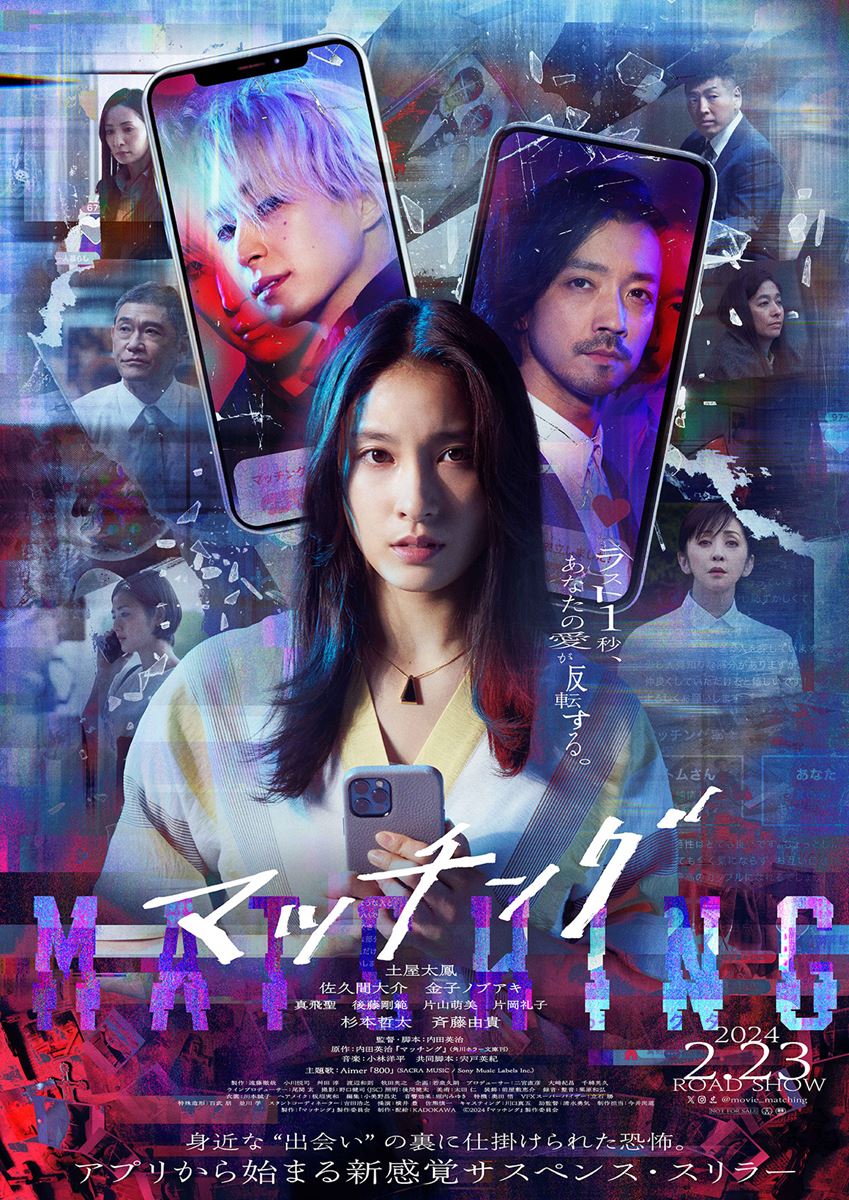
Matched (マッチング, Eiji Uchida, 2023)

The dangers of online dating are, as Eiji Uchida’s Matched (マッチング) suggests, a blurring of the lines between romantic fantasy and “real” organic love that threatens to spiral into dangerous obsession. Part stalking drama, part technophobic thriller, the film seems certain that dating apps are bad but perhaps also critiques another kind of romantic mania that leads people to believe there’s something wrong with not being coupled up and maybe it’s worth the risk of encountering someone dangerously unhinged in the desperation to find Mr. or Mrs. Right.

Rinka (Tao Tsuchiya) originally had no interest in dating apps, though she’s beginning to feel awkward about still being single at 29 and spending her free time drinking with her father (Tetta Sugimoto). His advice that romance isn’t really her thing and that’s alright doesn’t really go down all that well with her, yet the fact remains that on a baseline level it’s not really something she actively wants for herself. This is in part ironic as she works as a wedding planner running around satisfying her clients every whim to give them the big day they’ve always dreamed of only to see the man she’s long been carrying a torch for, her old high school teacher, marry a woman he met through an app.

Rinka’s intense resentment might cause us to wonder if she has something to do with the spate of serial killings targeting newly wed couples who got together through the Will Will dating app only after her friend signs her up on in, she too becomes a kind of victim after matching the decidedly creepy Tom (Daisuke Sakuma) who lurks around in the shadows declaring that he was born under bad star and abandoned in a coin locker as an infant. When the school teacher is murdered and she’s somehow linked to the case by a tabloid media article, Rinka’s life begins to spiral out of control while she can only believe that it must be Tom, who continues to stalk her relentlessly with ominous messages, that’s behind it with only the support of Will Will engineer Tsuyoshi (Nobuaki Kaneko) to rely on.

The really mystery is why Will Will doesn’t seem to have a block function or at least why Rinka wouldn’t use it unless she genuinely fears for her safety and thinks their message history will be good evidence. Her friend Naomi’s (Moemi Katayama) constant swiping hints at the superficiality of app-based dating, judging only by a photograph on gut feeling alone. To that extent, Rinka’s offline connection with Tsuyoshi should then be the rightful path to love but he’s a little odd too. Even given Rinka’s situation and his theoretical ability to help her because of his access to the app, he comes across as somewhat possessive and over eager announcing to Rinka in a record store after a single date that she need never fear anything again because he will protect her. 

It’s men that may be the problem, along with the inherent temptations presented by technology as evidenced by the legacy of a romance that bloomed during the chatroom boom and eventually turned about as toxic as it’s possible to get. The other problem with dating apps is that they’re full of people who are already attached and looking for romantic fantasy to escape from the monotony of their everyday relationships along with the stress and burden of responsibility that comes with having a family. These are sins that have quite literally been visited the children, but to come full circle the film may eventually suggest that you can’t really trust anyone and that people can often be callous and indifferent such as the young man inspecting the room where his uncle hanged himself and dismissively tossing away a photo of happier times. 

We never really find out the motives behind the serial killings beyond a suggestion of resentment that these people have supposedly found “love” online in a way others couldn’t having been rejected for what they see as superficial reasons. Meanwhile, the line between a devoted boyfriend and a controlling stalker already seems quite thin, and there are times when Rinka may think the stalker is the lesser of two evils no matter how creepy he might otherwise seem. In any case, love is serious business and you’ll pay a heavy price for betraying it. Ideally, it’s the fantasy and reality that have to match but Rinka at least seems a little lost between the two despite the increasing surreality of the events which have engulfed her.


Matching screened as part of this year’s Toronto Japanese Film Festival

Original trailer (English subtitles)
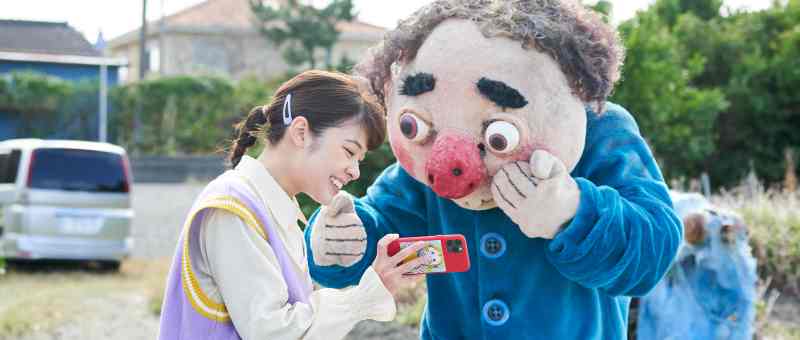
God Seeks in Return (神は見返りを求める, Keisuke Yoshida, 2022)

It’s perfectly natural a lot of the time to feel as if you expect nothing in return for helping someone, after all it’s only what you should do as a fellow human being. But really we do expect something even if it’s just acknowledgement and it can be hurtful and upsetting if don’t feel we get it while the sensation that we’re being taken advantage of can leave us feeling silly for having offered in the first place. Keisuke Yoshida’s Good Seeks in Return (神は見返りを求める, Kami wa Mikaeri wo Motomeru) revels in these human paradoxes as a self-confessed nice guy is pushed to breaking point by the fallout from all his attempts to be neighbourly which seem to have backfired exponentially. 

Then again, Tamogami (Tsuyoshi Muro) almost certainly does at least hope for something in return when he agrees to help out struggling YouTuber Yuri (Yukino Kishii) with her moribund channel by enlivening it with his skills in video editing and design. He isn’t helping her in order to engineer a sexual relationship, and in fact turns Yuri down when she suddenly disrobes exclaiming that it’s the only way she can repay him for his kindness, but does appear interested and is additionally irritated when she begins hanging out with a bunch of vlogger cool kids he thinks are just exploiting her naivety. Yuri had already payed him back with homemade beef stew, an offer that was accepted in the interest of friendship, but her constant references to repayment of a favour expose her idea of relationships as essentially transactional which to be fair they well may be. Even so, she appears somewhat guileless, opportunist rather than calculating and desperate for attention.

That might be why she can’t see that the reason she became unexpectedly popular after agreeing to a “body paint” stunt with a pair of more established YouTubers is that people wanted to see her naked which is why they’re always requesting more of the same. The first half of the film plays as quirky comedy, an offbeat romance between a nice middle-aged man and a dippy young woman who thinks she’s no good at anything and incapable of being alone. But things soon turn sour when one of Yuri’s stunts seems like it might have serious consequences for a local business owner and Tamogami has to muster all of his PR skills to put this particular fire out. The simple friendship between them that was brokered by a weird ogre-like mascot suit Yuri christens Jacob is disrupted by Yuri’s desire for fame as she undergoes a complete personality transformation after falling in with a group of more successful, media savvy YouTubers who have fancy design skills and marketing teams. She dismisses Tamogami as old-fashioned and joins in when the others make fun of him in rejection of the genuine friendship that had arisen between them.

When a friend he’d helped out financially and even stood guarantor on his debts takes his own life Tamogami is deep in the hole. Finally he wonder’s if he shouldn’t have something in return for all the unpaid labour he’s been doing for Yuri but she predictably brushes him off until he finally embarks on a weird vendetta trying to “expose” her YouTube channel for being founded on lies and exploitation. There may be something in her that’s regretful, wistfully looking at the sweater Tamogami had given her with cute illustrations of her and Jacob on it, while her new “god” Murakami openly mocks him leaving her conflicted about the dark side of their new internet endeavour effectively bullying a guy whose only crime was being nice and bit too dull and middle-aged for her new hipster friends sure to drop her like she’s hot as soon as something goes wrong.

Though not as extreme as some of Yoshida’s other films, God Seeks in Return suggests that nice guys never prosper but also that no one’s really as “nice” as they think they are. We wall want something in return even if it’s just a thank you and not to be belittled or taken advantage of. There can be something paradoxically selfish in niceness in which people do it more for their own gratification or to feel they are better than those they help and conversely the same in those who take advantage of others. In it’s way bleak and melancholy in its vision of human relationships, the film nevertheless holds out a faint hope in the reality of the genuine connection between its mismatched heroes no matter how dark and twisted it may eventually become.


God Seeks in Return screens 1st June as part of this year’s Nippon Connection

International trailer (English subtitles)

Tonkatsu DJ Agetaro (とんかつDJアゲ太郎, Ken Ninomiya, 2020)

Among the more prolific of young indie talents currently emerging in Japan with five features released since his 2015 debut Slum-Polis, Ken Ninomiya is fast becoming the go to chronicler of Tokyo’s contemporary club scene but unlike The Limit of Sleeping Beauty or Chiwawa, Tonkatsu DJ Agetaro (とんかつDJアゲ太郎) is a surprisingly wholesome take on the same phenomenon as an otherwise clueless young man begins to step into himself after accidentally falling love with the live house vibe. 

As his slightly amusing name implies, Agetaro (Takumi Kitamura) is the third generation heir to a tonkatsu (deep fried pork cutlet) restaurant. It’s not that he doesn’t want to take over the family business, but admits that he’d largely be doing it because he doesn’t know what else to do. His rather nerdy friends, all sons of small business owners in an area of Shibuya with a distinctly small-town vibe, are in much the same position. Ironically remarking that Agetaro always loses at The Game of Life as they hang out playing boardgames, the guys eventually find him with a pair of binoculars staring at a girl in an apartment opposite they are convinced inhabits a different word where people eat prosciutto and cheese and drink fancy wine. Agetaro gets an unexpected chance to meet his unobtainable crush, Sonoko (Maika Yamamoto), when he’s summoned to deliver a bento to a dance club after hours for a moody DJ, Oily (Yusuke Iseya), who describes tonkatsu as the area’s “soul food” and rates Agetaro’s dad’s as the very best. Allowed to step onto the dance floor, he finds himself blown away by Oily’s set and determines to become the very first tonkatsu chef/DJ partly in the hope of impressing Sonoko. 

Though set very much in the present day, there’s a pleasingly retro quality to Tonkatsu DJ Agetaro that recalls old school Showa-era musical youth movies in which young guys from humble backgrounds make something of themselves by working hard and staying true to their roots. Agetaro’s problem is that he’s caught in a moment of adolescent anxiety, resentful of his father (Brother Tom) whom he feels looks down on him, refusing to let his son anywhere near the fryer while making him chop cabbage all day and reminding him he doesn’t have to take over the shop if he doesn’t want to. Agetaro’s dad won’t teach him to fry because he thinks he doesn’t take anything seriously, and he might be right, but as his sister (Natsumi Ikema) says he’s worried about him too secretly trying to be supportive by standing at the back of the room when Agetaro gets his big break at the local club. 

Despite being mentored by Oily, however, Agetaro blows his first opportunity failing to get the crowd moving with a rather naff set designed to entertain his equally nerdy friends. But failure, crucially, only endears him to Sonoko who had previously been put off by his cheesy attempts to become a viral YouTube star with a series of gimmicky videos featuring himself and his friends wearing novelty “tonkatsu” outfits. Where he thought of giving up, Sonoko’s reminder that everyone makes a mess of things once in a while and no one should expect success right out of the gate helps Agetaro realise that what he needs to do is bring all of himself to his set which in this case means understanding that the thing is learning do something well and in that there’s no difference between frying the perfect cutlet and finding the perfect beat. Simply put, he needs to become the Tonkatsu DJ for real. 

Attracted to DJing because of the freedom it offers, Agetaro eventually finds his “heaven” on the dance floor marrying both sides of himself as he accepts his tonkatsu legacy and claims his space within the club scene which here is unproblematically joyful, a warm and welcoming space in which young people come together to enjoy good music, dance, and have wholesome fun. Simply put, it’s hard not to fall in love with a film which makes space for an unironic and unapologetically joyful moment of catharsis featuring Belinda Carlisle’s Heaven is Place on Earth. Shifting away from the slick music video aesthetic of his earlier work, Ninomiya hits lowkey charm in his tale of minor slacker success as his feckless hero finally figures himself out and learns how to cook up a storm in the store and on the floor. 


Tonkatsu DJ Agetaro screens on July 4/6/9 as part of this year’s Neuchâtel International Fantastic Film Festival (NIFFF)

Original trailer (English subtitles)

Romance Doll (ロマンスドール, Yuki Tanada, 2020)

According to an assistant at the factory where the hero of Yuki Tanada’s Romance Doll (ロマンスドール) is eventually employed, what were once called “sex dolls” or the euphemistic “Dutch Wives” (apparently named for a kind of bolster used by sailors) are now marketed as “love dolls”. The difference may be largely semantic, subsuming the physical within the emotional, but speaks to a discomforting dehumanisation of the female form something which barely occurs to the sculptor even as he slowly chips away at his patient wife, gradually erasing her as he dedicates himself to crafting the perfect love doll which is, it has to be said, a woman devoid of agency who can never talk back, challenge male authority, or wound the male ego. 

It’s this insecure fear of intimacy which eventually creates distance and loneliness in the marriage of the sculptor Tetsuo (Issey Takahashi) who hides the fact that he sculpts sex dolls for a living from his wife Sonoko (Yu Aoi) for fear that she will reject him. Tetsuo was himself “tricked” into taking the job as an unemployed graduate in need of work. He does so because he needs the money but also feels guilty, not because he finds the work morally objectionable, but because he has no investment in sex dolls as a craft while the man who’s just employed him, Kinji (Kitaro), has made the creation of the perfect model his life’s dream. 

One the one hand, Tetsuo and Kinji are craftsmen and so the fact of what they’re crafting is largely irrelevant, the important thing being the earnest pursuit of artistry in building beautiful devices whether they be sex aids or sewing machines. But others might not see it that way and in fact the dolls can only be sold as novelties with strict regulations in place to prevent “obscenity”. Concerned that the models lack realism, Kinji comes up with the idea of taking a mould of a real woman’s breasts but given all of the above they can hardly advertise what it’s for. Sonoko answers the ad because she thinks it’s for medical prosthetics, that she’ll be helping other women not providing masturbatory aids for lonely men. The moment Tetsuo touches her breasts he’s hit with a kind of epiphany and is moved to confess his real feelings as he says possibly for the first and last time in his life, while Sonoko too recounts that in his touch she could innately feel that he was an awkward but kind person which is why she fell in love with him. They marry and are happy, but he keeps the nature of his work a secret and becomes so consumed with the idea of capturing the perfection of the female form that he never looks beyond the surface of his wife and, ironically, begins to neglect her physically. 

It’s the secret keeping, the miscommunication and the fear of intimacy that eventually begin to drive them apart. She wants to tell him something important, but he doesn’t listen to her, never notices that she is unhappy or suffering and becomes petulant and resentful on realising that she has lied to him about where she was while she was away from home not realising that she felt unable to tell him because he is not and never has been emotionally available to her. He pours his “love” into the doll, and by doing so he depletes her. Sonoko becomes merely fuel for her husband’s artistic fulfilment until her metamorphosis into a doll is finally complete.

Told entirely from Tetsuo’s perspective, Tanada’s screenplay leans unexpectedly hard into a series of outdated patriarchal social codes which it ultimately reinforces rather than critiques. Tetsuo’s marital dilemma is reframed as a workplace conundrum over whether to pursue the new frontiers of elastomer or stick with the tried and tested silicone which is apparently fragile yet beautiful much like life as Tetsuo is forced to reflect on the transience of all things including love and romance. Something can be beautiful even as it rots, cherry trees still blossom even while they’re dying and there’s nothing that lasts “forever” except perhaps loss. Tetsuo tells himself that others saw Sonoko as the “ideal wife” in that she was “beautiful, a good cook, pristine, modest, and respects her husband” but apparently only he knew that she was also “nice and horny” which even if charitably taken as reclaiming her right to sexual agency is still a crass statement in the circumstances given that he has just reduced her to a literal receptacle for male desire. 

Tetsuo may feel a smattering of conflict when an early model proves successful enough to hit the mainstream media, a happy customer declaring that he’s giving up on real women, but continues to pursue his craft even while reflecting on the poetic symmetry that his wife is disappearing as his creation grows. It’s impossible to avoid the implication that what men want is a sex doll who can cook and clean, a vacant automaton who caters entirely to their desires with no interior life of her own because they are too insecure to want to deal with a real woman who is capable of hurting them emotionally. Straying uncomfortably towards a kind of sublimated necrophilia, Tetsuo only belatedly realises that his wife was more than mere object in the uncomfortable vacancy of the unresponsive silicone. Kinji had wanted to create a doll which looked as if it may come to life, as if it almost had a soul, but the key is in the almost. Rather than a meditation on the destructive effects of miscommunication and emotional insecurity, we’re left with a contemplation of art and the artist in which a man’s artistic fulfilment is valued above a woman’s life, his destruction of her permissible in the perfection of his art. Some things it seems don’t change, women are mere “romance dolls” valued only for their response to male desire be it in art or in “love”.


Romance Doll is currently available to stream via Netflix in the UK (and possibly other territories).

Original trailer (English subtitles)

Bright Future (アカルイミライ, Kiyoshi Kurosawa, 2003)

Bright future posterThe cinema of the late ‘90s and early 2000s is one defined by alienated youth kicking back against a stagnant society in which they see no place for themselves now that the dull and conventional salaryman world of their parents can no longer offer security in place of fulfilment. Kiyoshi Kurosawa’s early masterpieces had edged towards the nihilistic, embracing this sense of generational hopelessness but finding perhaps glimmers of possibility in the longing for escape no matter how far off. Bright Future (アカルイミライ, Akarui Mirai), shifting away from the genre fare which had made his name, does something much the same but perhaps even bleaker in its melancholy acceptance of intergenerational disconnection.

Our two heroes, Yuji (Joe Odagiri) and Mamoru (Tadanobu Asano), have workaday jobs at a factory which they find fulfilling only in their emptiness. The guys have found a fan in the factory’s ageing boss, Fujiwara (Takashi Sasano), who begins giving them special jobs and trying to hang out with them while promising a special signing bonus should they agree to become regularised employees. Bonding in their resentment towards men of Fujiwara’s age who romanticise their youth while exercising paternal authority and entitlement, the two hatch their revenge on an unforgiving society through the strange plan to acclimatise their pet jellyfish to life in modern Tokyo.

The jellyfish, closely associated with the ethereal Yuji, becomes a kind of symbol of the “bright future” the two young men fear will elude them. They, like the jellyfish, have tried to acclimatise themselves to living in the otherwise hostile environment of contemporary Tokyo but also accept that the ability to survive may not be enough and it may eventually be necessary to remove oneself from an unforgiving society until such time as it is possible to return.

This or something like it seems to be Mamoru’s key philosophy as the owner of the jellyfish and the chief architect of the “bright future” both men dream of – literally in the case of Yuji who is the idea’s unwilling prophet. Mamoru has, for reasons unknown, decided to take the strangely melancholic Yuji under his wing, eventually entrusting sole custody of the jellyfish to him in an attempt to force him to look after “himself”. In service of this ideal and perhaps of Yuji’s unwilling visions, Mamoru takes more immediate revenge against the literal Fujiwara – murdering his boss and his wife (Marumi Shiraishi) in their well appointed middle-class home (only their small daughter is spared). Yuji interprets this gesture as protective seeing as he himself had found the bodies after wandering into the Fujiwara home with violence on his mind, but misinterprets Mamoru’s intentions for him in disappointing his mentor by insisting that he is prepared to “wait” for him rather than take this cue to step up and take control of his own life’s direction. 

Yuji is indeed, like the majority of heroes in turn of the century Japanese cinema, entirely directionless. He appears to have no surviving family in the older generation, only an exasperated sister who does her best to help but doesn’t know how, attempting to straightjacket him into a salaryman world of conventional success with an office boy job at her understanding company. A strange young man, Yuji has has vivid dreams and a need for control and routine – it’s the closure of the local bowling lanes which sends him round to the Fujiwara’s in a calm yet violent rage while repeatedly losing in a video arcade to his sister’s boyfriend also sends his insecurity into overdrive. He once dreamt of a “bright future” but now sees only darkness. Stepping up onto the roof of a building in which he is learning to find a home, he is forced to admit that despite attempting to look far into the distance he can’t see much of anything at all from where he is right now.

Yet for all his resentment towards men like Fujiwara, it’s a father figure which eventually begins to push him in a more positive direction. Mamoru’s father Shinichiro (Tatsuya Fuji) takes his son’s vulnerable best friend under his wing, giving him a home and a purpose as he begins to teach him how to repair things that might ordinarily be thrown away. Shinichiro’s previous assistant quit because he saw no future in this line of work, but Yuji seems to delight in the repurposing of the previously useless for arcane ends even if his chief contribution is a continuation of his jellyfish experiments. Shinichiro, superficially supportive, cannot understand the obsession with the jellyfish. Attempting to reassure a thwarted Yuji, he asks him what exactly the jellyfish could achieve in a world so resistant to real change yet he also berates him with the impassioned impotence of age in decrying his contemptuous dismissal of the reality which, after all, belongs to men like Shinichiro who will demand respect while offering very little in return.

The jellyfish find they can’t live in Tokyo, but youth adopts a different solution as it runs rampant with out purpose or direction but seemingly delighting in meaningless anarchy. A group of teens Yuji runs into wear identical Che Guevara T-shirts while sporting light-up microphone headsets as they wander round the city kicking cardboard boxes and laughing as they go, like overgrown children with no clear forward path before them. Age and youth seem primed to exist in differing realities, perpetually unable to understand each other while youth struggles to find direction in the absence of parental guidance. Ironic in the extreme, the “bright future” here seems to exist only as a vague hope but, perhaps, the only guiding light in an ever darkening world.


Original trailer (English subtitles)
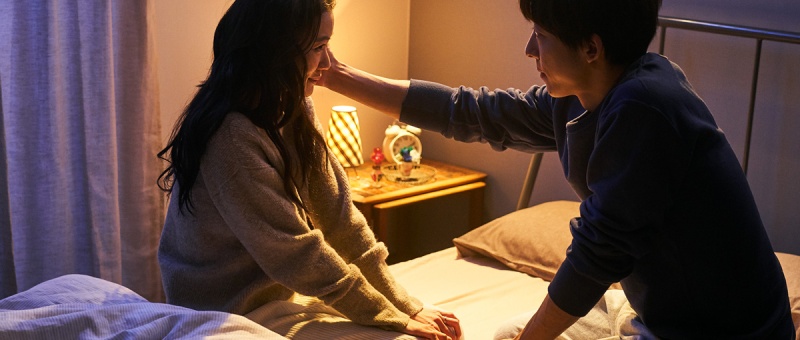
Thicker than Water (犬猿, Keisuke Yoshida, 2018)

Thicker than Water posterIn the long history of the Japanese family drama, the tensions are generally vertical rather than horizontal. Siblings are often engaged in trying to broker the peace or snatch a little bit of independent living away from an all consuming family environment. Then again, we meet most families when the kids are gown up and struggling with their approaching transition into other families or other lives. Kids fight, but grown up brothers and sisters are supposed to find a degree of civility at least even if the petty resentments of childhood never quite go away. For the parallel pairs of mismatched siblings at the centre of Thicker than Water (犬猿, Kenen), however, the reverse is true.

Older sister Yuria (Keiko Enoue) has taken over the family print shop now that her father is bedridden while her younger, prettier sister Mako (Miwako Kakei) is struggling to make it as an actress. Often resentful of her sister’s domineering, business-like attitude, Mako wilfully targets her weaknesses by making barbed comments about her weight and appearance of which she knows Yuria is insecure. Yuria, meanwhile, treats her sister as a foolish child, immediately taking over rather than let Mako do something “wrong” and thereby chipping into her insecurities about a lack of intelligence.

The spiky dynamic between the two sisters intensifies when Yuria develops a crush on a handsome young salaryman who makes regular visits to the shop to get his posters printed. Kazunari (Masataka Kubota), however, predictably falls for Mako (who is only interested in him as a way of annoying her sister). Meanwhile, he has sibling drama of his own in that his no good, thuggish older brother Takuji (Hirofumi Arai) has just been released from prison and made an unwelcome reappearance in his life.

What exists between the siblings isn’t quite “rivalry”, mostly they aren’t fighting over parental affection or esteem so much reacting against their obviously complimentary characteristics. Yuria envies Mako’s beauty, while Mako secretly envies her sister’s intellectual confidence even if she also resents her bossiness and affectation of superiority in order to mask her insecurity. Kazunari makes a show of his earnestness, that he’s doing everything “properly” – working hard, living within his means, paying off his parents’ debts and saving for his retirement, while underneath it all he envies his brother’s non-conformity even if its risks terrify him. Thus they snipe at each other. The thing about family is they know where all the buttons are and find pressing them extremely hard to resist.

That said, the familial bond is a strong one and perhaps they can snipe cruelly at each other precisely because it is unlikely to break. Nevertheless, when pettiness and cruelty intensify there can hardly be a positive outcome save perhaps to hit the reset button and send our warring siblings back to their idyllic childhoods in which they played together happily free from their adult resentments. Like children fighting over toys, each wants what the other has and seethes over the injustice of not being the one to have it. An extreme situation might seem to clear the air, repair the relationships and restore them to their original condition with each reaching an understanding of themselves and their opposite number, but old habits are hard to break and any thaw in relations is likely to be extremely temporary.

No stranger to extremes, Yoshida opens with a humorous sequence spoofing a trailer for a cheesy Japanese teen romance which is enthusiastically recommended by a series of vox pop champions, not least among them Mako who who somewhat unethically plays the part of a lovestruck young woman who over identifies with the movie’s themes. The trailer promises a “parallel love story” which, in truly Yoshida-esque irony, is more or less what we get as we witness the symmetrical tales of our two sets of warring siblings whose animosity almost tips over into co-dependency. Mirrors of each other, they love and loathe but remain unable to reconcile themselves to the various faults they see reflected in their opposing number and therefore unable to break free from the petty jealousies and resentments which define family life. There may be no escape from the intense self loathing unfairly projected onto an equally burdened sibling, but perhaps there is faint hope in the enduring continuity of their quietly simmering warfare even as it binds them in mutual misery.


Thicker than Water was screened as part of the 2019 Japan Foundation Touring Film Programme.

Original trailer (English subtitles)

Destiny: The Tale of Kamakura (DESTINY 鎌倉ものがたり, Takashi Yamazaki, 2017)

Destiny tale of kamakura posterJapanese literature has its fair share of eccentric detectives and sometimes they even end up as romantic heroes, only to have seemingly forgotten the current love interest by the time the next case rolls around. This is very much not true of Destiny: The Tale of Kamakura (DESTINY 鎌倉ものがたり, Destiny: Kamakura Monogatari) which is an exciting adventure featuring true love, supernatural creatures, and a visit to the afterlife all spinning around a central crime mystery. Blockbuster master Takashi Yamazaki brings his visual expertise to the fore in adapting the popular ‘80s manga by Ryohei Saigan in which the human and supernatural worlds overlap in the quaint little town of Kamakura which itself seems to exist somewhere out of time.

Our hero, Masakazu Isshiki (Masato Sakai), is a best selling author, occasional consulting detective, and befuddled newlywed. He’s just returned from honeymoon with his lovely new wife and former editorial assistant, Akiko (Mitsuki Takahata), but there are a few things he’s neglected to explain to her about her new home. To wit, Kamakura is a place where humans, supernatural creatures, and wandering spirits all mingle freely though those not familiar with the place may assume the tales to be mere legends. To her credit, Akiko is a warm and welcoming person who can’t help being “surprised” by the strange creatures she begins to encounter but does her best to get used to their presence and learn about the ancient culture of the town in which she intends to spend her life. Unfortunately, she still has a lot to learn and an “incident” with a strange mushroom and a naughty monster eventually leads to her soul being accidentally sent off to the afterworld by a very sympathetic death god (Sakura Ando) who is equal parts apologetic about and confused by what seems to be a bizarre clerical error.

Destiny’s Kamakura is a strange place which seems to exist partly in the past. At least, though you can catch a glimpse of people in more modern clothing in the opening credits, the town itself has a distinctly retro feel with ‘60s decor, old fashioned cars, and rotary phones while Masakazu plays with vintage train sets, pens his manuscripts by hand, and delivers them in an envelope to his editor who knows him well enough to understand that deadlines are both Masakazu’s best friend and worst enemy.

The creatures themselves range from the familiar kappa to more outlandish human-sized creatures conjured with a mix of physical and digital effects and lean towards the intersection of cute and creepy. The usual fairytale rules apply – you must be careful of making “deals” with supernatural creatures and be sure to abide by their rules, only Akiko doesn’t know about their rules and Masakazu hasn’t got round to explaining them which leaves her open to various kinds of supernatural manipulation which he is too absent minded to pick up on.

Yet Masakazu will have to wake himself up a bit if he wants to save his wife from an eternity spent as the otherworld wife of a horrible goblin who, as it turns out, has been trying to split the couple up since the Heian era only they always manage to find each other in every single re-incarnation. True love is a universal law, but it might not be strong enough to fend off mishandled bureaucracy all on its own, which is where Akiko’s naivety and essential goodness re-enter the scene when her unexpected kindness to a bad luck god (Min Tanaka), and an officious death god who knew something was fishy with all these irreconcilable numbers, enable the couple to make a speedy escape and pursue their romantic destiny together.

Aimed squarely at family audiences, the film also delves a little into the awkward start of married life as Akiko tries to get used to her eccentric husband’s irregular lifestyle as well as his childlike propensity to try and avoid uncomfortable topics by running off to play trains. Masakazu, orphaned at a young age, is slightly arrested in post-adolescent emotional immaturity and never expected to get married after discovering something that made him question his parents’ relationship. Nevertheless, a visit to the afterlife will do wonders for making you reconsider your earthly goals and Masakazu is finally able to repair both his old family and his new through a bit of communing with the dead. Charming, heartfelt, and boasting some beautifully designed world building, Destiny: The Tale of Kamakura is the kind of family film you didn’t think they made anymore – genuinely romantic and filled with pure-hearted cheer.


Screened at Nippon Connection 2018.

Original trailer (English subtitles)