China’s Van Goghs (中国梵高, Yu Haibo & Kiki Yu Tianqi, 2016)

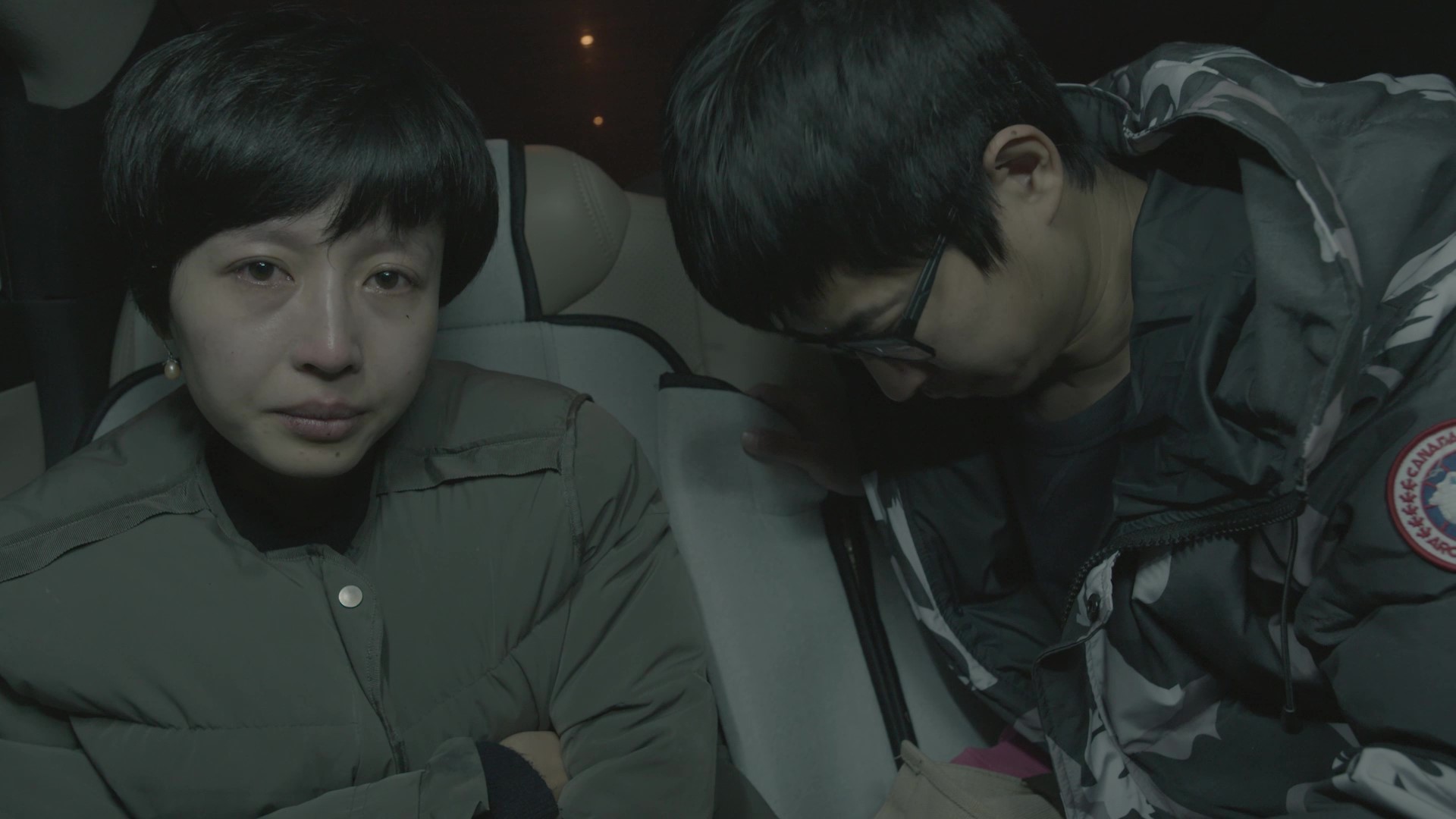
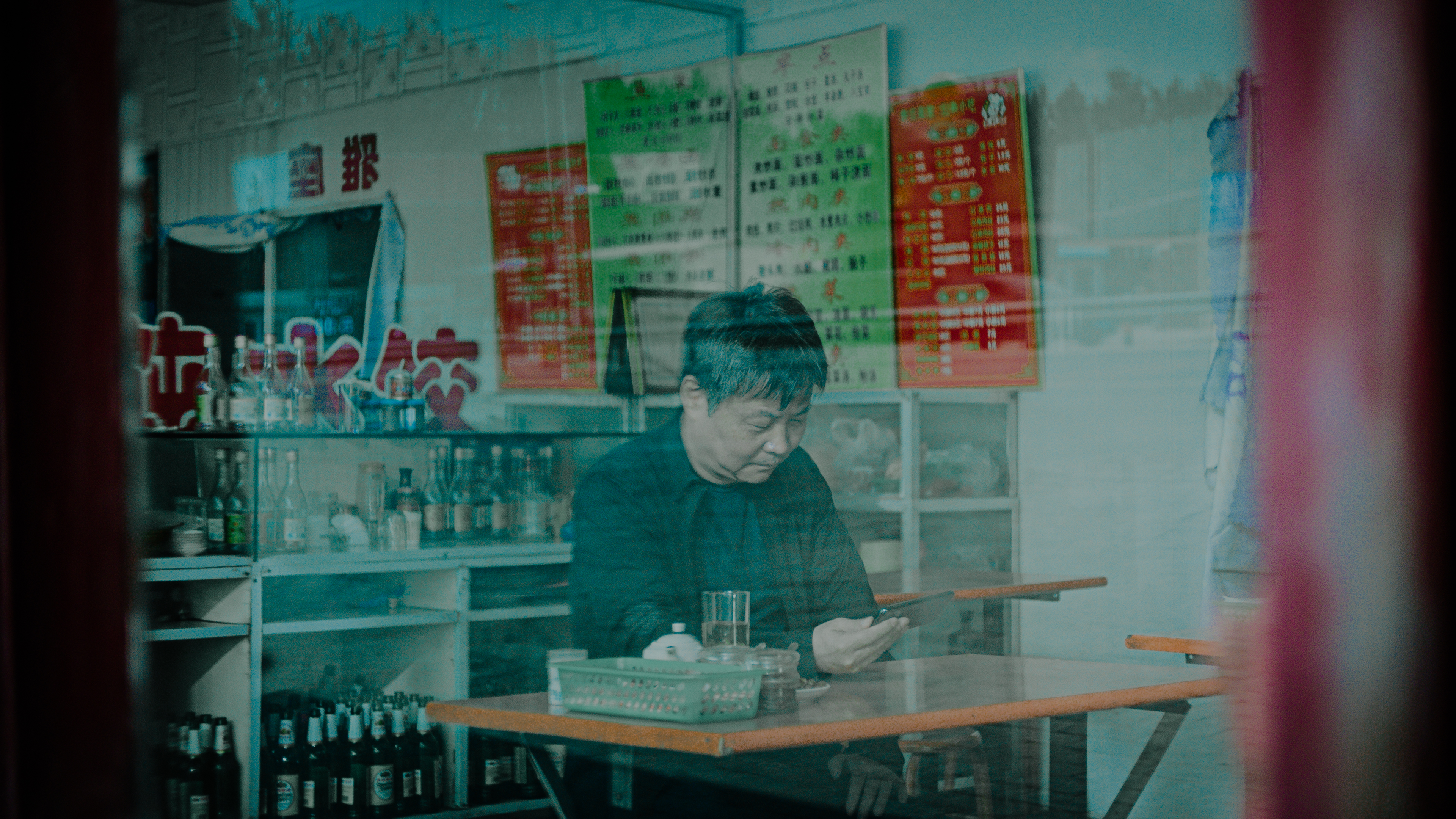
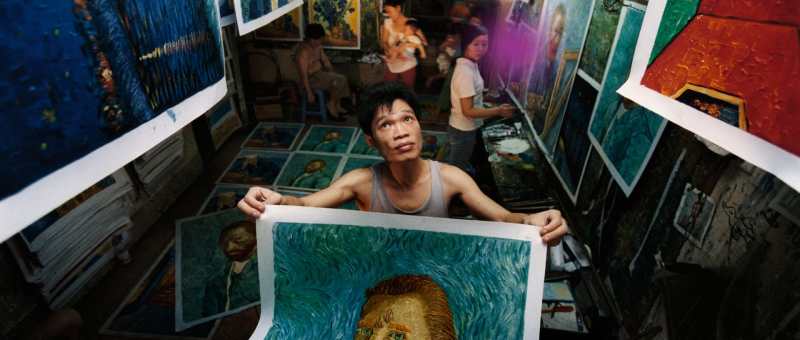
“You can just take a picture!” a frustrated driver calls out to “painter worker” Zhao Xiaoyong as he makes a long delayed attempt to express himself artistically by painting the streets of his rural hometown in the style of European artist Vincent Van Gogh. Xiaoyong is one of several men attempting to survive in a declining industry, a painter of knock off replicas of famous works of art produced for the foreign market in the small town of Dafen, Shenzhen known as one of China’s largest “oil painting villages” since an enterprising Hong Kong businessman kickstarted the movement back in the tumultuous year of 1989. 

Though the title may at first seem ironic, referring to the “fake” paintings at its centre, Yu Haibo and Kiki Yu Tianqi’s strangely moving documentary China’s Van Goghs (中国梵高, Zhōngguó Fán Gāo) explores the conflicts which continue to define the lives of the artists who as they put it paint to live but take their art extremely seriously and possess tremendous technical skill but are forced to stifle their own creative instincts while producing meticulous copies for a mere pittance. As Xiaoyong laments, they find it difficult to attract and keep apprentices because you can earn more at the factory, while one of his colleagues ironically admits that they had to set up a production line in order to complete an unusually large order though following the financial crisis those are largely thin on the ground. 

Xiaoyong is a Van Gogh obsessive, as are many of the artists of Dafen, and longs to visit Amsterdam in order to see the originals up close. Ironically enough, their biggest market is indeed the Netherlands, and his most important client has invited him to visit several times previously though Xiaoyong and his wife continue to argue over the expense. His eventual visit is however heartbreaking, his eyes a deep well of pain and confusion as he finds himself overcome with disappointment and disillusionment. He thought his client owned a fancy gallery, but his paintings are being sold in a pokey knock off souvenir shop for three times what he was paid to paint them which was only around €8 to begin with though they took many hours to complete. Later talking to another artist about his trip he remarks on how overcome he was seeing Van Gogh’s originals, but the experience also destroys the sense he had of himself as an artist, reminding him that he is “just” a craftsman making diligent copies while leaving him with the desire to create something meaningful of his own. 

Earlier in the film, Xiaoyong had travelled back to his rural hometown for the anniversary of his father’s death breaking down in tears while reflecting on the various ways his poverty has defined his life, denied an education and orphaned at young age. Back in Dafen, meanwhile, his teenage daughter who lives with grandparents in order to attend high school visits home and declares herself fed up with education, as if she’s wasting her time unable to keep with the curriculum silently crying in the corner while her parents continue working. Xiaoyong sympathetically laments he didn’t have the opportunity to learn very much but has taught himself to open his mind and has obviously become a skilled craftsman with canny business skills only to find himself falling for his own mystique serious about his craft but unaware of the various ways he is being exploited by the Western art economy.

What he’s doing may in a sense be dubious though no one seriously thinks they’re buying a Van Gogh original for €30, but who is to say what really is “authentic” art or suggest that Xiaoyong’s artistry is worth any less solely because someone painted what he painted before? Can a meticulous copy be in itself a separate work of art resplendent in its technical prowess? Xiaoyong says he fell in love with Van Gogh’s paintings because of his discovery of beauty in poverty, he and his friends tearfully watching the 1956 Hollywood biopic Lust for Life fiercely identifying with the artist’s struggles as they too try to accommodate painting to live with their desire for creative expression. In a strange moment, Xiaoyong recalls a dream he had in which he met Van Gogh and told the artist that he had almost become him, but Xiaoyong’s salvation eventually comes in a meeting of the two worlds, painting a portrait of his ageing grandmother her face a labyrinth of lines born of a long life of rural hardship. Sure, you can just take a picture, but it isn’t quite the same.


China’s Van Goghs is currently available to stream in the UK as part of the Chinese Cinema Season.

Original trailer (English subtitles)

The Reunions (吉祥如意, Da Peng, 2020)

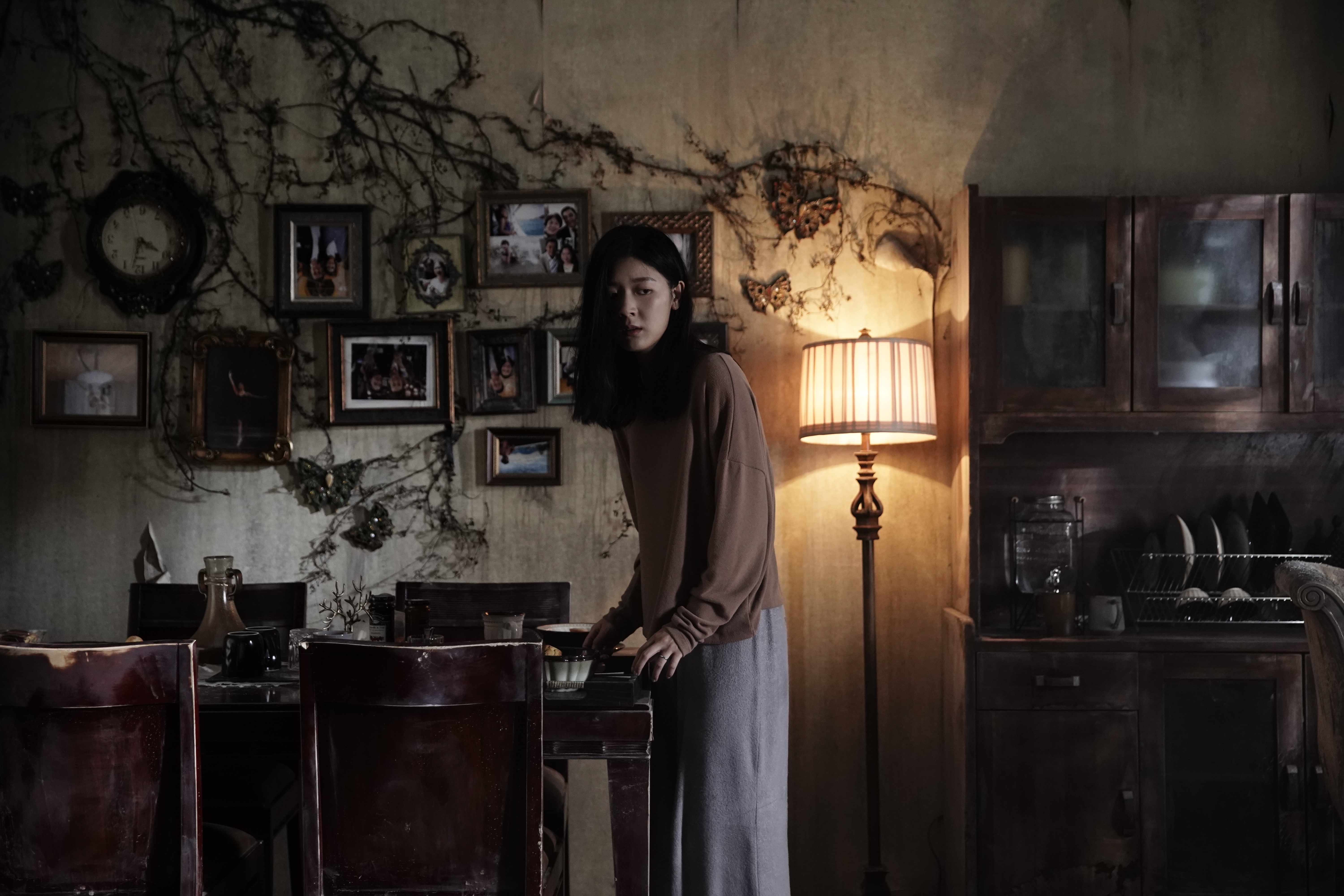
Comedian, actor, and general multi-hyphenate Da Peng (AKA Dong Chengpeng) scored box office hits with his first two features, superhero parody Jian Bing Man and musical dramedy City of Rock, but The Reunions (吉祥如意, Jíxiáng Rúyì), a reworking an earlier short, marks a definite shift in his personal style if not exactly devoid of laughs or warmth. Partly a muted personal meditation on the price of success and the compromises of the modern China, Da Peng’s Spring Festival movie in contrast to the sentimental norm finds a family on the brink of disintegration but discovers within that a sense of sad resignation rather than failure or disappointment. 

Comprising of Da Peng’s earlier short given the English title of “A Reunion”, the first 40 minutes or so act as a kind of verbatim docudrama starring a professional actress, Liu Lu, as Da Peng’s cousin Lili (who later features in the part two “A Final Reunion” making of redux) alongside members of his family including his mother and father playing themselves. Da Peng had apparently intended to film a kind of personal history/tribute to his grandmother exploring the various ways she lived her day to day life preparing for the Chinese New Year celebrations, but during his stay which was his first in many years his grandmother sadly passed away. During the making of sequence, he begins to wonder if his visit home to make the movie may have caused his grandmother’s health to decline or if he was simply unaware that she had already become ill because he failed in his duty as a grandson staying away so long. 

As he puts it, in the city he is a different person with a different life largely forgetting about his family back in rural China. The main crisis of the New Year period is not however his grandmother’s death but the pending decision of what to do with uncle Ji Xiang who suffered brain damage after an illness a few decades previously and is unable to take care of himself. Filial wisdom says the burden falls on Lili, but she too lives in the city and has her own life with a small child to take care of meaning that it would be difficult for her to take her father home to live with her, not to mention the potential difficulties of uprooting him from everything he’s known. The situation is further complicated by the fact that Lili and her father had long been estranged as her mother divorced him after the illness and moved to the city when Lili was a teenager. During the making of sequence, the actress playing Lili asks for clarification in her motivation stating that the one thing she doesn’t understand is why she hasn’t visited her family in over 10 years, but the only answer she receives is an awkward silence. 

Meanwhile, in the absence of the grandmother relations between the siblings begin to fray as old conflicts bubble to the surface, Da Peng’s uncle and aunt complaining that they cared for Ji Xiang and his mother all this time on their own and would appreciate some help but fail to see how any of the secondary suggestions of the other siblings pitching in as grandma had wished are realistic. Others insist that prior to his illness Ji Xiang was the most filial of the siblings, frequently helping out his brothers and sisters with jobs at the oil field where he worked and generally making sure to take care of everyone only to be semi-abandoned by them now he is no longer to look after himself. The presumably engineered argument from the movie later spirals out of control, the actress playing Lili pleading with the siblings to stop, while her real life counterpart looks on impassively from behind the camera, the fate of Ji Xiang still seemingly undecided. 

Yet quizzed by a fan at a Q&A after the screening of A Reunion, Da Peng doesn’t have an answer for why he decided to make the film, any messages he might have hoped to convey beyond a sense of loss and regret lost amid his desire to capture a moment of family life, his mother appearing on camera in a brief interview sequence avowing that she believes that with grandma gone this will probably be the last New Year, the siblings no longer having a common reason to come together. Someone even mentions that the family is only here this time because of Da Peng’s film, calling into question the ethical dimensions of his decision to put his relatives on camera. He closes on a poignant note with some home video from New Year 2008, presumably the last time he was home, featuring his grandmother and Uncle Ji Xiang in happier times harking back to an essential sense of loss in the all the missed opportunities of absent years now that there will be no more next times or home to go back to. 


The Reunions is currently available to stream in the UK as part of the Chinese Cinema Season.

Original trailer (English / Simplified Chinese subtitles)

All About Ing (小伟, Huang Zi, 2019)

A small family finds itself pulled in different directions in the wake of a medical emergency in Huang Zi’s poetic family drama All About Ing (小伟, Xiǎo Wěi). The three are perhaps in slightly different places, each longing for freedom from one thing or another but finding themselves bound by a sense of legacy while haunted by both past and future as they attempt to reorient themselves around their shared loss, searching for new ways forward while always looking back. 

Opening with the poignant image of an empty chair, Huang slowly walks us into the “Ing” home (not their name though each of their names contain it) as patriarch Weiming (Ko Hon-man) gets a haircut from his wife while his son Yiming (Howard Sit Lap-Yin) lazes on the sofa behind. The sense of familial harmony is however soon broken as mother Muling (Janis Pang Hang-ying) chases down her indifferent son while her husband has recently entered hospital with a condition that appears to be much more serious than he thought it to be. Firstly criticising the hospital unsure if he’s getting the best care because the place seems “too new”, Weiming is convinced there’s nothing seriously wrong with him because the doctor says he can go home in a few days. Muling, however, is aware the reality is a little different and has decided not to tell her husband that he has advanced liver cancer letting him believe he merely has “cirrhosis”. 

Divided into three arcs following each of the family members as they attempt to come to terms with the ways their lives will change, the first part of the film follows Muling as she finds herself carrying the burden of family all alone trying to keep them together while her son dreams of escaping abroad and her husband is in continual denial about the state of his health. Perhaps she wants to escape too, her friends at a factory cafeteria gossiping about a mutual acquaintance who was so set on going abroad that she apparently left her husband to marry a wealthy old man living in Cyprus. “What freedom? Is abandoning her son and husband freedom now?” her friend asks while Muling pensively stirs her soup thinking something much the same, later identifying with the lonely old granny who keeps wandering off from the flat next-door while her family it seems don’t even really bother to look for her. Will that be her future too, wandering all alone like a living ghost forgotten by those closest to her? 

A teenage boy Yiming is not particularly primed to see things from his mother’s perspective, longing for escape through studying abroad keeping the news of his acceptance at university in the US a secret from Muling just as she keeps the extent of Weiming’s illness a secret from him. He resents her for her thinking “something bad” will happen to his father while slacking off in class, rejecting her offer of an introduction to a cram school run by a friend but cheating on his homework by copying another girl’s answers. Like Muling’s friend, Yiming’s classmates are convinced there’s no future for them in China joking about jobs as security guards or successful shop merchants while determined to seek their fortunes abroad perhaps partly out of a sense of teenage rebellion against constraining family mores. Yet Yiming is also struggling to process the idea of death experiencing strange dreams of a ruined village he eventually visits with his father on a last trip back to his hometown. 

Weiming’s elderly mother looks not unlike the escaped granny framed vaguely from behind, while his brother too appears somewhat ghostlike as if frozen in time dressed in an old-fashioned donkey jacket and carrying a mysterious photo tube. The two boys he meets on a misty beach who do not acknowledge his presence appear like ghosts of their younger selves while Weiming himself has begun to haunt the landscape ominously looking in through a window at his wife and son on the other side. The family went back to visit Weiming’s family grave but they can’t find it, the town now in ruins while a holiday resort is currently under construction slowly taking over the mountain featured in a picture the family retrieve of Weiming’s father they will later hang on their living room wall. “I want to change the world” Yiming idly mutters on the train home though Weiming doesn’t hear him, the son poignantly turning round to share something with his father after they return home only to find his chair empty. Another his elliptical long shots, Huang closes by returning to his opening POV once again a ghost exiting the space as if returning to a familiar chair while the family attempts to repair itself, moving forward in memory of the past not trapped by it but carrying it with them as they go. 


All About Ing is currently available to stream in the UK as part of the Chinese Cinema Season.

Original trailer (English / Simplified Chinese subtitles)

Journey to the West (Voyage en Occident, Jill Coulon, 2016)

Ironically taking its title from the classic Chinese legend of the monk Xuanzang who travelled in order to bring Buddhism back to China, Jill Coulon’s Journey to the West (Voyage en Occident) follows a group of Chinese tourists on a 12-day coach tour through Europe which will apparently take them through six countries though they will be disembarking only infrequently. As the tour guide Huo explains during his opening speech, Chinese tourists were once greeted by vaguely offensive signs in their native language instructing them to avoid being noisy or spitting but these have now been replaced by those advising that their Chinese credit cards are readily acceptable. 

According to Huo only 8% of Chinese people currently hold a passport but more and more are venturing abroad. Nevertheless, they are still ambassadors for China and so he reminds them to be careful of the impression that they make. In any case, they will spend relatively little time on the ground, arriving in Rome at 9am they leave at 1.15 and though they appear to have a lot of free roaming time much of the trip is micromanaged with meals already booked in Chinese restaurants. Embedded with the travellers, Coulon does not spend much time getting to know them or discovering their various backgrounds and reasons for choosing this method of travel but some do speculate on the tendency of Chinese people to do everything at speed wondering if Europeans are more laidback because their societies are already “developed” and so they can afford to spend time in the present without feeling the need to forge the future. 

Bringing the 12-day trip down to an hour of viewing time adds a satirical bent to the breakneck speed, though it does seem that some travellers at least are mainly interested in ticking off the most famous attractions as quickly as possible. Offering commentary as they pass through the picturesque town of Lucerne, Huo points out the Rolex store before ironically juxtaposing the beauty of the Alps with the Hermès boutique directly opposite. Most of the tourists are indeed in it for the shopping, several picking up a luxury watch while one enviously observes that this seems to be a very wealthy town filled with exorbitantly priced sports cars as if the expense meant nothing to them at all. Passing through Paris we see the tourists laden with bags from top designer stores, one ironically wearing an Armani T-shirt with a little Chairman Mao pin directly underneath the logo. Some meanwhile tire of the ceaseless consumerism and defiantly decide to go somewhere different with no shopping opportunities if only to avoid other Chinese tourists. 

Despite his long years working in the tourist trade, Huo himself does not seem to be free of stereotypical impressions of Europeans, explaining that “true” French women are blonde with green eyes and that the French go on strike in the spring, holiday in the summer, and go skiing in winter leaving only the autumn for work all of which he describes as “bad capitalism”, implying one assumes that China’s excessive work culture is “good capitalism”. Another tourist however reflects enviously on the fact that the French apparently only work 150 days a year while her partner points out that if you count non-weekdays China also offers around 130 days off which doesn’t seem so bad to him even if he’s incredulous about four day weekends and getting a day in lieu if a public holiday falls on a Saturday or Sunday. This perhaps contributes to another tourist’s conclusion that the French are “lazy” because of the disinterested way a guard at a museum swiped his ticket, sitting with his legs crossed.

A pair of old ladies, meanwhile reflect on the way that European cities have preserved traces of their history with ancient ruins visible in local parks something she feels would have been regarded as a nuisance in China and destroyed either by the authorities or malicious persons. While Huo relates the various stereotypes he’s encountered from foreign tourists, that the Chinese people have no freedom and might not know what a washing machine is, another young woman enquires if they have internet up in the mountains only to be told that the internet and online shopping are not as developed in Europe because the prohibitive costs prevent an effective delivery infrastructure, she ironically adding that in China workers cost nothing. In his closing speech, however, Huo remarks on the awkwardness of responding to the accusation of wealth unable to answer either that he is very rich or very poor opting only for the disingenuous statement that “China is a developing country”. The tourists might not be looking for spiritual enlightenment like Xuanzang, but still as one puts it they have their goals and they have perhaps been achieved as they circle back around to Milan and the plane that will take them home.  


Journey to the West streams in the US until March 31 as part of the 12th season of Asian Pop-Up Cinema.

Original trailer (English subtitles)

Changfeng Town (长风镇, Wang Jing, 2019)

“One strange thing follows another in this town” according to a world weary saloon owner attempting to process the mysterious theft of a handful of billiard balls. Like a magical realist fable, the village at the centre of Wang Jing’s whimsical nostalgia fest Changfeng Town (长风镇, Chángfēng Zhèn) exists slightly out of time, located at the intersection of memory and longing filled both with a sense of existential ennui and the comforting aimlessness of childhood. Yet even here where time passes and doesn’t the ironies of small-town life pervade as the older hero reflects on the wilful secrets and everyday mysteries which exist even in those places where everyone knows everyone and gossip is the lifeblood of the community. 

Narrated by the young “Scabby” (Song Daiwei), so nicknamed because of a prominent scar on the back of his head, Changfeng Town weaves together several stories set across one theoretical summer as seen through the eyes of a group of small boys continually on their periphery. Set comfortably in a “nostalgic past”, the atmosphere of the town shifts from a restrained post-war, early ‘60s tainted innocence towards something perhaps closer to its more logical position somewhere in the early to mid 1980s which of course places it after the Cultural Revolution but before Tiananmen Square in a China filled with a sense of hope and possibility for a brighter future mirroring perhaps Scabby’s own sense of growing adolescent energy. 

Nevertheless, Changfeng Town is a strange place where strange things do indeed happen though less one after another than all at once. Missing billiard balls, a plague of mice, a purifying flood, arrivals and disappearances each changing the unchanging town in small but marked ways, it’s nevertheless a sense of loneliness that defines each of the intersecting tales most of which have to do with misplaced or unfulfilled love. Redhead (Pema Jyad), the teenage ringleader of the local kids nicknamed for his red rinse hairdo, pines for the most beautiful girl in the village, Cai-xia (Luo Wenqing), half-sister of Scabby’s friend Four Eyes (Liu Xinrong) and box office girl at the local picture house, yet she has taken a liking to lovelorn poet Guang (Tao Taotao) who has just had his heart broken by the local school teacher. Redhead’s widowed mother (Cui Nan), meanwhile, has been carrying on an affair with the married local dentist (Wei Xidi), apparently an open secret in the village, while beloved truck driver Xi-shan (Chen Gang) continues to carry a torch for her knowing his love is impossible because he was involved in the accident which killed her husband. 

Known only as The Mute (San Shugong), an old man travels to the station every day with his parrot presumably hoping to meet someone who never arrives. One of the boys says his mother told him that he does so because he mistakenly thinks he can travel to other places by watching the trains go by, but no one really knows because no one really bothers to try to communicate with him. Some attempt to leave the village, occasionally returning like the much changed Redhead now dressed like someone who’s been to the city bringing back with him gifts of modernity such as a remote control Transformer that provokes a falling out between Four Eyes and Scabby which adds to the narrator’s growing sense of disillusionment, but to return is in many ways to fail, to be consumed by nostalgia and unable to move forward. Changfeng Town is also a charming trap. Scabby will soon outgrow it as spring travels towards autumn, the bald spot on the back of his head which gives him his name fast disappearing rendering him Scabby no more. Yet it will always in a sense be there for him, its residents permanently happy even as people come and go. 

Mirroring the ending of The 400 Blows, one of several films playing in the local cinema which also include Spring in a Small Town, A Touch of Zen, Steamboat Bill, Jr, and Nights of Cabiria among others, Wang closes with a freeze frame leaving Scabby “running towards the unknown” abandoning nostalgia in search of the elusive happiness of those who remain behind. Shot with a wistful ethereality, Changfeng Town marries an earthy, small-town rurality with an ironic absurdism as the various stories of its melancholy protagonists weave in and out of each other while remaining strangely unknown in the ever constant, ever changing village of nostalgia.


Changfeng Town streams in the US March 24 – 28 as part of the 12th season of Asian Pop-Up Cinema.

Original trailer (English subtitles)

A Summer Trip (川流不“熄”, Feng Keyu, 2021)

Societal change and rising economic prosperity threaten the foundations of the family in Feng Keyu’s charmingly nostalgic intergenerational adventure A Summer Trip (川流不“熄”, Chuān Liú Bù “Xī”) elegantly lensed by Mark Lee Ping-Bing and boasting a typically whimsical score from Joe Hisaishi. In the run-up to the Beijing Olympics, the nation is in a celebratory mood but in a society where everybody works all the time something may be in danger of getting lost. Young Xiaosong (Hu Changlin) is going off the rails (in a fairly minor way) with both the school and grandpa, often left with childcare duties he feels might not quite be his responsibility, leaning towards blaming the parents who are simply not present enough in his life to be able to offer much in the way of guidance. 

A Korean War veteran, grandpa Zhang Dachuan (Yang Xinming) is beginning to feel as obsolete as the discontinued parts he needs to repair his ancient jeep. He can’t get his head round mobile phones, forever pressing hang up when he means to press answer and causing accidental offence in the process. Resenting the implication that he’s not got much to do all day, he finds himself enlisted by his overworked son to represent the family when his wayward grandson Xiaosong gets into trouble at school. This particular time, it’s apparently because he’s been bothering a female student by taking photos of her with a professional DSLR camera (the teacher later gives Dachuan an envelope to pass to his son and daughter-in-law which turns out to contain a love letter Xiaosong attempted to pass to the object of his affection). Slightly annoyed to be seeing Dachuan again instead of the boy’s parents, the teacher makes herself clear that the cause of Xiaosong’s poor behaviour and declining grades is most likely a lack of parental attention. Chastened, the parents discuss finding a cram school but nothing is really done about his problematic approach to romance, especially as they each need to return to work soon after dinner leaving grandpa sitting alone at the table. 

Perhaps strangely, Xiaosong seems to have forgotten that his grandpa even has a name, hanging up on a caller thinking they’ve got the wrong number only to realise they wanted grandpa and redial upon which Dachuan discovers that his greatest wartime friend has passed away in Beijing and the funeral is in a few days’ time. Though Xiaosong had technically been “grounded” for the summer, the idea was that grandpa was supposed to supervise him while he stayed home and studied. So begins their awkward road trip, passing first through the home of Dachuan’s daughter Ling (Dai Lele) in a town closer to the capital and a lengthy train ride away before pressing on to the city. 

As his opening voiceover explains, Xiaosong never really understood his grandfather thinking of him as a grumpy, stubborn old man stuck in the past. Yet as grandpa later sadly laments reflecting on his friend’s final days, people talk about the past a lot when they’re unhappy in the present. Everyone is always keen to pay respect to Dachuan and his wartime generation, though not all of them have good intentions such as the overfriendly young man they meet on the train who enthusiastically listens to his stories, or the older woman (He Zaifei) who reminds Dachuan of his late wife but leverages his desire to show off by getting him to pay for an expensive lunch. For his part, Dachuan resents his declining capacity and finds himself at odds with the modern world, unable to access technology or understand the changing nature of society. His quest to get to Beijing under his own steam is a way of rebelling against his age, proving he’s still capable and independent though his slightly narcissistic can-do attitude often backfires, his offer to fix a broken-down bus exposing his lack of acumen while his petulant decision to leave finds him stubbornly insisting on walking the remaining 30km to the capital. 

Highlighting the corporate obsession, meanwhile, another stranded bus passenger makes constant phone calls to his less than understanding boss to explain the delay. While Dachuan and his grandson experience set backs on the road, the boy’s father Jianguo (Tu Songyan) chases a reluctant client who won’t sign a contract and returns late to a dark and empty home while his wife (Yang Tongshu) works the nightshift as a surgeon at the hospital. Unbeknownst to Dachuan, Ling and her husband (Gong Zheng) are about to split up apparently because he spent too much time at work and the relationship has fallen apart as a result. Young Xiaosong says he wants to be a photographer to “document all the beautiful things and moments” lamenting that they never took a family photo with his late grandmother. In the absence of his father and son and forced to humiliate himself repeatedly at work, Jianguo comes to regret having deprioritised his family life and recommits himself to repairing their fractured bonds perhaps with a family holiday lamenting that they never got round to it while his mother was alive. The Olympics Opening Ceremony becomes, its own way, a second New Year with the TV broadcast taking the place of the Spring Gala as the family finally come back together again having gained new understandings of themselves and others through their various summer adventures. Society might have changed, those exciting KFC “family buckets” from the city apparently not going quite as far as you’d think, but the family can apparently still be saved with a little mutual understanding and a dose of self-reflection.


A Summer Trip screened as part of the 2021 Osaka Asian Film Festival.

Original trailer (Japanese subtitles only)

Back to the Wharf (风平浪静, Li Xiaofeng, 2020)

“How dare you want to live when your existence is pointless” a father admonishes his blameless son, deflecting his own willing complicity in the persistent decline of the modern China. Repeatedly abandoned and betrayed firstly by his society, then by his friend, and finally by his father, the hero of Li Xiaofeng’s moody neo-noir Back to the Wharf (风平浪静, Fēngpínglàngjìng) first chooses self-exile only to eventually return and wonder if his crime has been forgotten allowing him to live again before discovering that nothing really changes, there is no escape from the whims of the rich and powerful in an increasingly feudal society. 

Quiet and studious, Song Hao (at 17: Zhou Zhengjie / at 32: Zhang Yu) first wakes up to life’s unfairness in 1992 when he’s called into school on a holiday by his headmaster who breaks the news that he’s losing his guaranteed university place supposedly because his grades are good enough to get there on his own and others need it more. “I like to prioritise the collective over the individual” he explains, reminding him that an extra person from the school going to a top uni can only be a good thing though it’s obviously a blow to Hao not to mention his ambitious father Jianfei (Wang Yanhui) who immediately rings up to complain and discovers that the place is going not to a needy student but Hao’s best friend Li Tang (Lee Hong-chi), son of the local mayor. Angry and confused, father and son set off on circular journeys to confront their respective counterparts, but there’s a storm raging and Hao accidentally wanders into the wrong house after noticing the door flapping in the wind. After walking past a baby sleeping upstairs he runs into an old man who mistakes him for someone else and soon lashes out, shoving fruit into his mouth and trying to suffocate him at which point Hao picks up a knife and stabs his attacker in the belly. Taking flight in terror Hao believes he has just killed a man and orphaned a little girl, never knowing that his father arrived a few minutes later and finished the old man off to stop him talking or that Li Tang was watching the whole thing from a window in the opposite building. 

Returning 15 years later for his mother’s funeral, it’s Li Tang who is most pleased to see Hao when he runs into him by chance at the ruins of the scene of his crime now a future development site for the young real estate tycoon, that is if the now young woman (Den Enxi) the orphaned baby has become whom Hao had been following out of guilt-ridden curiosity would agree to vacate her family property. While Hao has been languishing as a lonely construction worker, Tang has prospered off the back of the 90s economic boom largely thanks to an entrenched network of local corruption that runs from his father the mayor through Hao’s father Jianfei who was handed a fat promotion presumably to placate him over the uni places scandal. Tang has, in a sense, stolen his future leaving him quite literally displaced wandering in the ruined landscape of a haunted past while his father, he discovers, had divorced his mother and remarried in order to have another son. “Your upbringing was a failure” he cooly explains, he needed another male heir to salvage the family reputation and restore his name. Jianfei has, however, done pretty well out of the arrangement now a wealthy man with a separate apartment Hao is not welcome to visit but planning to send his wife and child abroad and retire to Australia. 

Intending to leave as soon as possible, Hao nevertheless starts to wonder if it hasn’t blown over and he might in a sense be allowed to seek happiness, bamboozled into a romance with an old school friend (Song Jia) apparently carrying a torch for him all this time. The past, however, will not let him go. The corruption runs deeper than he even suspected as does Li Tang’s insecure greed and duplicity, attempting to force friendship through blackmail. An embodiment of post-70s fuerdai Li Tang is an amoral capitalist willing to do anything it takes in pursuit of wealth, but at heart a coward ashamed that he owes everything to his father’s machinations and perhaps projecting all of his resentment onto his old friend Hao whose future he so casually stole.   

Yet the message seems clear, men like Hao will always be at the mercy of men like Tang. Perhaps this is the bargain his father has made, but it’s one that Hao can no longer tolerate once Tang forces him to destroy the roots of his redemption. The only sane response to the madness of the modern China, he seems to say, is to go mad in one way or another. Even so, this being a Mainland movie, the nihilistic fatalism of the inevitable conclusion is somewhat undermined by the brief coda in which a policeman reassures a young woman that the crime has been investigated and the wrongdoers punished while the now familiar title card explains to us who went to prison and for how long for their many and various moral transgressions. Hao’s existence is rendered “pointless” because he is unable to live by the rules of a corrupt society, yet his self-destructive act of rebellion does perhaps bring about change if only in the names involved. Beautifully shot with brief flashes of expressionism amid the rain drenched streets of a decaying city to the melancholy strains of a noirish jazz score, Li’s fatalistic takedown of the inequalities of the post-90s society is an exercise in style but one which lets few off the hook as its nihilistic conclusion stabs right at the heart of patriarchal corruption. 


Back to the Wharf streamed as part of the Glasgow Film Festival.

Original trailer (simplified Chinese subtitles only)

Lotus Lantern (宝莲灯, Chang Guangxi, 1999)

“I only want to have a normal life” a wronged woman complains on discovering that it’s almost impossible to escape the tyranny of the celestial realm and most particularly if you are a goddess. Released in 1999, Lotus Lantern (宝莲灯, Băo Lián Dēng) apparently took over four years to produce requiring 150,000 animation cells and 2000 painted backgrounds, and like much of the Shanghai Animation Film Studio’s output is inspired by a well-known folktale celebrating filial love and in fact featuring the Monkey King himself in a small role. Unlike the studio’s earlier work however and despite its roots in Chinese folklore, Lotus Lantern perhaps owes much more to Disney’s ‘90s renaissance than it does to the nation’s animation history. 

Animated in a classic 4:3, the tale opens with a voiceover as a scarf elegantly falls to Earth and into the arms of a young man. Defying her brother Yang Jian’s (Jiang Wen) wishes, the goddess Sanshengmu (Xu Fan) has chosen to leave the realm of the immortals to be with the man she loves taking the famed Lotus Lantern with her in an attempt to evade his control. He however finds her and attacks the pair with his eye lasers. Sanshengmu’s lover is killed but she gives birth to a son, Chenxiang (at 7: Yu Pengfei / at 14: Yang Shuo), and lives happily with him in the mortal realm for seven years until the flame in the Lotus Lantern is extinguished allowing Yang Jian to track her down and kidnap Chenxiang to force her to return. She tries to bargain with her brother but as she later puts it Heaven Temple lacks compassion and so he imprisons her underneath a mountain and tells Chenxiang his mother is dead. Chenxiang does not believe him and is determined to get the Lotus Lantern back, especially after a cryptic visit from the God of Land hints the same fate as befell the Monkey King, who has since become a Buddha, may have befallen his mother. 

First and foremost a tale of filial love and devotion, Lotus Lantern is also another subversively anti-authoritarian rebuke against heartless celestial tyranny. We learn than Sanshengmu’s mother also loved a mortal, yet her brother refuses to forgive her for this apparent transgression against the law of heaven, burying her under a mountain while vowing to raise her son as his own in accordance with filial piety. Meanwhile, he’s also quietly terrorising a community of non-Han Chinese trying to force them to carve a colossal statue of him by kidnapping the chief’s daughter Ga Mei (Ning Jing) and keeping her in Heaven Temple as a maid. Yet Yang Jian isn’t the only problem. The God of Land tells Chenxiang to seek out the Monkey King (Chen Peisi) for advice on busting out of a mountain, but now that he’s become a Buddha Sun Wukong has no interest in helping. Indifferent to all things, he believes suffering is a path to enlightenment and sees no reason to help Chenxiang alleviate his by showing him how to rescue his mother. 

Then again, the mortal world’s not much better. The first person Chenxiang meets on his quest turns out to be a dodgy priest who claims he knows where to find the Monkey King and can even help Chenxiang with his training but predictably ends up kidnapping his pet monkey and exploiting it as part of a fairground act even members of the crowd complain is cruel and distasteful. Nevertheless, after reuniting with his monkey buddy Chenxiang trudges on looking for a way to release his mother from under the mountain, finally moving the Monkey King by needling him about his own sense of maternal abandonment in his apparently parentless genesis. In this unsteady world, it seems to say, the only true thing is a boy’s love for his mother though a conflict perhaps arises after another seven year jump reunites Chenxiang with Ga Mei who has been returned to her tribe and probably should be his love interest if he were not currently fixated on his filiality. 

Yet as the disembodied voice of his mother reminds him, only by embracing true love which is what Heaven Temple lacks can Chenxiang finally defeat it. Borrowing heavily from Western animation and particularly from classic Disney, Lotus Lantern may in some senses seem old fashioned even for 1999 in its still frame pans and unconvincing effects, but perhaps reflects a desire to take Hollywood on at its own game as the studio found itself needing to commercialise its output especially in its series of musical montages featuring a contemporary pop songs performed by top Mandopop stars while the faces of the A-list voice acting cast are also showcased during the end credits. The approach apparently paid off, Lotus Lantern proved a huge domestic hit and is credited with reinvigorating the Chinese animation industry which had gone into decline in the market-orientated ‘90s. Complete with adorable monkey sidekick there’s certainly no doubting its mass appeal in its warmhearted, family-friendly take on filial devotion.


Lotus Lantern is currently available to stream in the UK as part of the Chinese Cinema Season.

Nezha Conquers the Dragon King (哪吒闹海, Wang Shuchen & Yan Dingxian & Xu Jingda, 1979)

Chinese animation had entered a golden age in the mid-1950s. That however came to an abrupt end with the advent of the Cultural Revolution which saw most studios shut down and many cartoons banned for insufficiently reflecting socialist values or like Monkey King: Havoc in Heaven having subversively seditious themes. Nezha Conquers the Dragon King (哪吒闹海, Nézha Nào Hǎi), released in 1979, was the first feature completed by the Shanghai Animation Film Studio when production resumed following the end of the Cultural Revolution. Like Havoc in Heaven, Nezha Conquers the Dragon King is also inspired by classic Chinese mythology and features a rebellious hero standing up to oppression in defence of ordinary people at the mercy of corrupt authority. 

As in the classic legend, General Li’s wife has been pregnant for three years only to give birth to a weird fleshy egg that he splits with his sword revealing a lotus flower from which emerges a strange child already capable of walking and talking though little more than an inch high. Luckily, a wise sage soon arrives describing himself as “only an old man who likes to fight for justice and joke around”, and gives Nezha a pill that allows him to grow to a more normal height for a child of around seven. Master Taiyi also gifts him a scarf and golden ring before telling him to visit the Golden Light Cave if he ever runs into trouble. 

Meanwhile, the kingdom is currently experiencing a period of instability because of an ongoing drought caused by the dragon lord of the sea Ao Guang, one of four dragon lords (dare we say a “gang of four”) who just love causing trouble in the mortal realm because they’re awful. To appease Ao Guang, the people have sacrificed a banquet of luxury food, dumping it into the ocean to be conveyed to the Crystal Palace by turtle and stingray minions but all Ao Guang does is complain about the noise of the people protesting before asking an underling to remind General Li that he only wants sacrifices of small children. The sea warrior, however, jumps the gun by snatching one of Nezha’s friends whom he’d allowed to ride his magical deer on the seashore. As expected, Nezha doesn’t like that and gives the sea warrior a telling off though he fails to rescue his friend. Matters quickly escalate as Ao Guang sends his son Ao Bing to sort out Nezha but Nezha kills him in dragon form and strips out his spine to use as a whip so as you can imagine there is a sharp decline in diplomatic relations. 

Though children’s animation in this era was perhaps darker and bloodier the world over, it has to be said that the world of Nezha is especially extreme. Not only does Nezha use his enemy’s spine as a weapon, but his own father later tries to kill him to appease Ao Guang while he himself makes a brutal and unexpected act of self sacrifice in an attempt to protect his realm and his family from his apparently failed attempt to resist Dragon oppression. The problem, however, remains with the corrupt authority of the Dragon Lords who continue to expect child sacrifice as part of a celestial protection scheme. Thinking they’ve won, the Dragon Lords organise a huge feast at the Crystal Palace all while there is discord in the kingdom. Only the unexpected reappearance of Nezha, now complete with his fiery wheels, can challenge their corrupt rule and free the people from their oppression. 

Though less sophisticated in terms of animation style and more highly stylised, influenced both by social realist art and classical ink painting, Nezha like Havoc in Heaven also makes fantastic use of Peking Opera from the score to the choreography of the battle scenes as Nezha leverages his spear against the swirling Dragon threat. It is also, however, likely to prove disturbing to younger viewers especially in its unexpectedly visceral scene of child suicide not to mention dragon dismemberment and talk of child sacrifice. Nevertheless, it’s surprising that such themes could return so immediately after the end of the Cultural Revolution even if it’s true that Nezha, less mischievous than holding an extreme love of justice, challenges corruption rather than the system as he protects the people from overreaching elites. 


Nezha Conquers the Dragon King is currently available to stream in the UK as part of the Chinese Cinema Season.

Monkey King: Havoc in Heaven (大闹天宫, Wan Laiming, 1961/1964)

The late 1950s to mid-1960s would come to be known as a golden age of Chinese animation ushered in by the pioneering Shanghai Animation Film Studio under the aegis of Wan Laiming who along with his brothers had produced China’s very first animated feature Princess Iron Fan in 1941. Monkey King: Havoc in Heaven (大闹天宫, Dànào Tiāngōng) was conceived soon after Iron Fan’s release but its production was derailed firstly by the continuing Sino-Japanese War and then by the Chinese Civil War that eventually brought Mao Zedong to power. Produced in two parts released in 1961 and 1964 but screened together only in 1965, the film would ironically prove to be the studio’s last before being closed down during the Cultural Revolution. 

Most particularly in this context, the story of Sun Wukong might seem ill-advised even in its definitive cultural capital adapted like Princess Iron Fan from the well-known Journey to the West. The Monkey King as all know is a mischievous scamp forever causing trouble because of his resistance to following the accepted rules of mainstream society, something one might think anathema to a rigid, increasingly authoritarian regime. Yet in the Wans’ characterisation, Sun Wukong is also a good, socialist hero in the guise of a chaotic Robin Hood robbing the Heavens not for himself but to share with all the little monkeys waiting for his return on The Mountain of Flowers and Fruits certain that such luxuries should not be limited to the gods alone and seeking to redistribute them on Earth (if only among his friends). 

Even so, at the heart of the story is a challenge to the celestial authoritarianism of the Jade Emperor and the godly elites who live quite literally in another realm. Lamenting that he is unable to train the little monkeys properly because he can’t get his hands on a weapon befitting his majesty, Sun Wukong is advised to swim to the underwater palace of the East China Sea Dragon and ask him to find something suitable, which he does, but nothing proves up to the talents of the great Monkey King. Finally, hoping to get rid of him, the Dragon King shows Sun Wukong the Gold Cudgel which calms the sea and tells him he can have it if he can take it away. Annoyingly, the Cudgel responds exactly to Sun Wukong’s magic and becomes his trademark giant staff leaving the Dragon King with a problem he can only take to the Jade Emperor. Thereafter succeeds a continuing debate as to how to deal with the Monkey King problem which begins with the decision to tempt Sun Wukong to Heaven by offering him a fancy title and position so they can hopefully keep an eye on him. 

This is perhaps a minor irony and element of subversive satire amid the corruptions of a newly collectivist society in which flattery and title inflation are becoming a persistent problem. Put in charge of the stables, Sun Wukong immediately sets all the horses free which is less of a problem than it sounds and considerably improves conditions for all, only it annoys the austere Horse General who makes the mistake of revealing to Sun Wukong that he’s not really “in charge” at all, sending him right back down to the mountains where he offends the gods by appointing himself “Great Sage Equal to Heaven” in an affront not only to their majesty but the celestial order itself. Some still feel appeasement is the way, that humouring Sun Wukong by pretending to respect his made-up title and convincing him to come back with a better position is the best way to minimise his rebellion but they fail to learn their lessons. On being told he can’t eat the fruit in his garden until a banquet is held and then discovering he’s the only one not invited and everyone is merely humouring him with The Great Sage stuff Sun Wukong is once again offended, deciding he’ll go anyway and then getting extremely drunk and trashing the whole place. 

For this some feel he must die, but Sun Wukong refuses to expire even surviving being baked alive in a pot. Drawing inspiration from classic Peking Opera, the Wan brothers allow Sun Wukong to defeat each of the gods’ various challengers using both his cunning and agility in a series of beautifully choreographed action sequences which leave him standing defiant a thorn in the side of authoritarian power if perhaps one with his heart in the right place, living for the anarchic joy of sharing all his spoils with the ordinary monkeys of the Mountain of Flowers and Fruit. The 2012 restoration of the film keeps both halves together but also reformats the aspect ratio from the original 4:3 to a “modern” widescreen in addition to giving it a 3D makeover. Nevertheless, the flawless and inventive animation along with beautifully painted backgrounds drawing inspiration from classic ink paintings coupled with the use of Peking Opera instrumentation and choreography lend the film a charmingly timeless quality while the subversive themes of resistance to rigid authoritarianism seem to take on new import most particularly in the present day. 


Monkey King: Havoc in Heaven is currently available to stream in the UK as part of the Chinese Cinema Season.

Restoration trailer (no subtitles)