The Wild Goose Lake (南方车站的聚会, Diao Yinan, 2019)

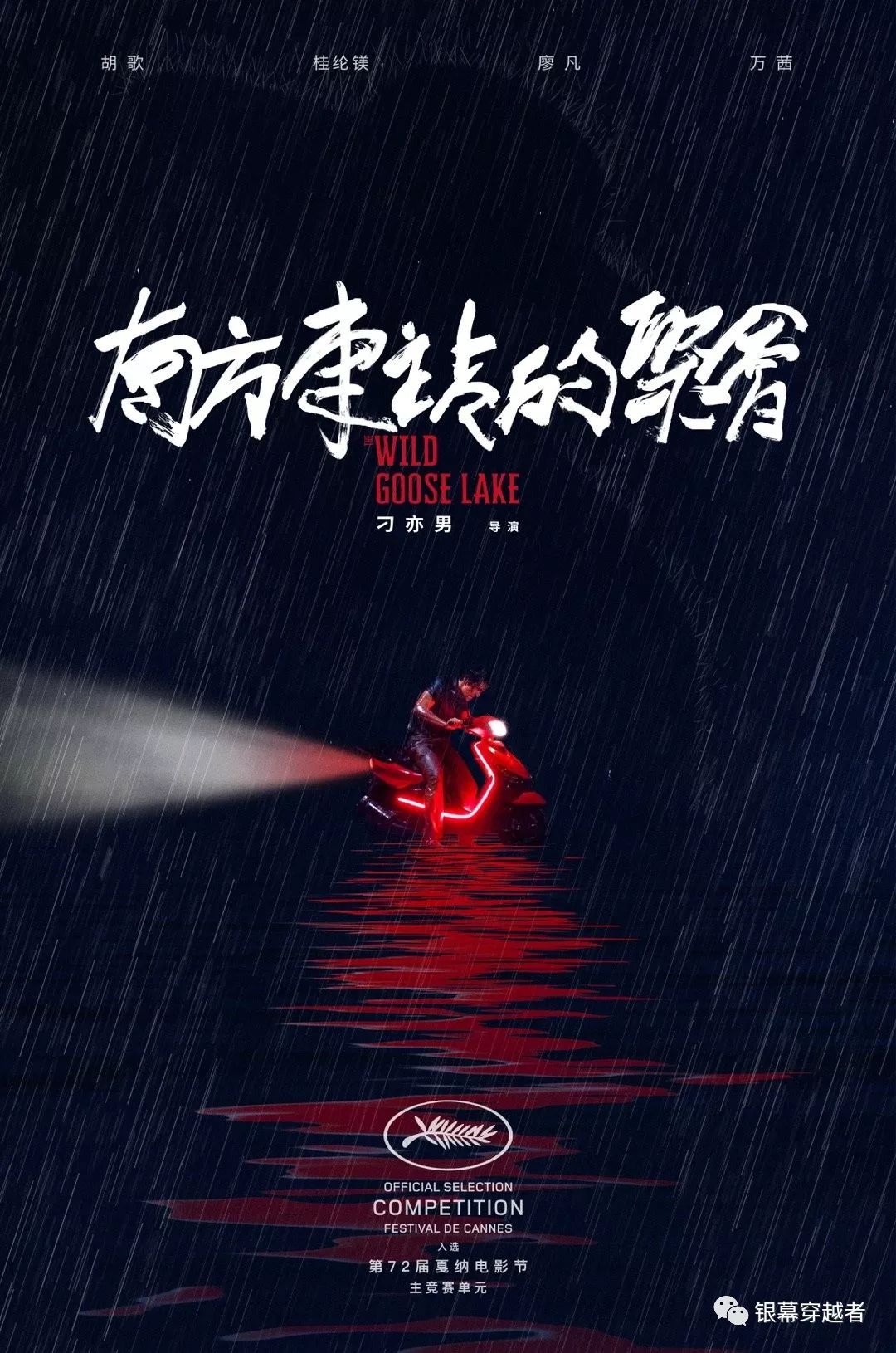
wild goose lake poster 1Chaos and desperation are about as far as it’s possible to get from the image of the modern China the nation’s cinema has been keen to project, but that’s exactly where we find ourselves in the murky world of The Wild Goose Lake (南方车站的聚会, Nánfāng Czhàn de Jùhuì). Diao Yinan’s Black Coal, Thin Ice followup finds the director in much the same territory only this time embracing the absurdity of existential flight as his twin heroes seek impossible escape in the garish neon of a provincial underworld.

Diao opens on the rain-drenched streets as sullen gangster Zhou Zenong (Hu Ge) waits impatiently for a rendezvous with his estranged wife Shujun (Wan Qian), only to be met by a stranger – “bathing beauty” Aiai (Gwei Lun-mei), who explains she won’t be coming. A lengthy flashback reveals that Zenong is currently on the run after getting embroiled in a dispute over turf assignments at some kind of gangster briefing session during in which one of his guys shot one of the Cat brothers’ men in the leg. To settle the matter, the boss proposes a good old-fashioned competition to see who can nick the most bikes in one night with the winner getting the prime spot, but Zenong doesn’t know he’s been set up and mistakenly kills a policeman after being attacked by Cat Eyes. Realising there’s no longer any way out for him, Zenong’s last hope is to keep the police at bay long enough to get back in touch with his wife and convince her to turn him in to the police so that she can claim the reward money.

Like many men of his generation, Zenong couldn’t find the kind of honest work that would allow him to provide for his family and so he left home. Too ashamed to own his no-good gangster ways, he stayed away for five years but all that’s on his mind is family and this is the only chance that he will ever have to provide for them. Shujun isn’t even really sure she wants anything to do with her absentee husband, but is dragged back into his orbit once again harassed by the police every step of the way.

In striking contrast to most Chinese crime dramas, these police are far from a force for order. Describing Wild Goose Lake as a lawless land, they have their very own briefing to formulate a plan to catch Zenong but aren’t averse to underhanded tactics like threatening Shujun and trying to undermine her attachment to her husband through a fabricated story about a pregnant girlfriend. The line between cop and thug isn’t so thick as you’d think it would be, and you can’t trust the police any more than brotherhood or honour amongst thieves.

Devoid of morality, Wild Goose Lake is indeed a chaotic place defined by shifting loyalties and unexpected betrayals. Fights break out without warning, plans change, and there are no safe spaces. Bumbling as they are, the police are everywhere watching everything and trying to blend in. Anyone might be a cop, or secretly working against you. Zenong is on the classic wrong man path, except that he’s the right man and he knows it. He might not have pulled the trigger if he knew it was a policeman he was firing at, but pull the trigger he did and now he’ll have to make peace with it. Trying to outrun the law only so long as to subvert it, he finds himself slipping past checkpoints distracted by pointless officiousness and consistently evading the net.

When Shujun is unable to make it to the rendezvous, Aiai offers to take her place by turning Zenong in and claiming the reward money to pass it on to Zenong’s wife (minus a small fee), meaning they will need to trust each other until the mission is completed. Aiai, a dejected young woman supplementing her income with casual sex work as one of the “bathing beauties” found at the lake, longs to escape her dead end existence, eventually telling the policeman she’d use the reward money to open a small store back in her hometown. Like Shujun, she lives in a fiercely patriarchal, unforgiving society  from which there is little sign of escape or independence. Yet, as afraid of everything Zenong represents as she eventually becomes, Aiai remains steadfast and true, keeping her promise and paving the way towards a brighter future for Shujun and her son away from the haphazard chaos of Wild Goose Lake. An absurdist fable drenched in neon, Diao’s conception of life on the margins of provincial China is as bleak as they come but eventually finds space for positivity on returning to a world more ordinary in which two women walk away from the traumatic past arm in arm and the law has to be content to let them go.


The Wild Goose Lake was screened as part of the 2019 London East Asia Film Festival.

International trailer (English captions)

Summer of Changsha (六欲天, Zu Feng, 2019)

Summer of Changsha poster 1Escaping from the traumatic past is fast becoming a favourite theme of Chinese cinema, but Summer of Changsha (Liù Yù Tiān) swerves away from the neon-lit, rain-drenched streets of your average melancholy police procedural for the fetid air of sun-baked provincial China where death haunts the shadows. Each dealing (or failing to deal) with guilt and responsibility, a depressed detective and seemingly emotionless doctor bond through a shared sense of impossibility only to discover that there may be a way out after all only not of the kind they might have assumed.

Detective Bin (Zu Feng) has already handed in his resignation but has no real plans for his post-police life. Consumed by powerlessness and regret over failing to prevent the death by suicide of his girlfriend who had been living with longterm depression, he cannot seem to find a place for himself back in the world. When a severed arm is fished up from a local lake, he gets a new sense of purpose and eventually connects the lonely limb to a missing persons ad found after trawling the internet which mentions a prominent scar on the right hand.

The ad was placed by a doctor, Li Xue (Huang Lu), who emotionlessly confirms to Bin and his earthier partner Lei (Chen Minghao) that she believes the hand to be her brother’s, shocking them by correctly guessing where they might have found it. Xue tells them that her brother Yi appeared to her in a dream and showed her where the rest of his body parts are – something later confirmed to be true when the three drive out to a remote spot and dig up a suitcase buried under a tree.

Strangely, Bin takes the “dream” theory at face value with only Lei seemingly unconvinced. He never quite entertains the obvious conclusion that Xue knows where the body parts are because she put them there, even after discovering that the pair were seen to be arguing recently and that their relationship became strained after a tragic accident during which Xue’s daughter, who was suffering with a heart condition, sadly passed away.

What draws Bin to Xue is a shared sadness, a deepening gulf of introspection which, ironically, convinces them they exist outside of regular society and should not permit themselves genuine human connections. Xue’s animosity towards her brother, it seems, was less because of what happened to her daughter than because of his conversion to Buddhism which had, she felt, allowed him to move on and start to forget about their past. By contrast, Xue condemns herself to a life of suffering as atonement, wilfully carrying on an affair with a married surgeon (Tian Yu) she doesn’t seem to like very much solely because his research area was closely connected to her daughter’s condition and if she’d lived he might have saved her. Bin, meanwhile, criticises his partner Lei for trying to ghost a girlfriend, cute as a button Ting Ting (Zhang Qianru), because he thought she was annoying, but finds himself doing the same thing after he sleeps with her when she approaches him for comfort only for her to become emotionally attached.

Ting Ting wants to help him overcome his emotional pain, but Bin isn’t sure he can. Like Xue, his grief and guilt have made him selfish and self-involved. Reconnecting with his late girlfriend’s family, he has the urge to make some kind of confession in order to ease his burden only for her sister (Liu Tianchi) to rightly round him for the cruelty of what he’s about to do. She was just starting to move on with her life, and now Bin’s sudden chattiness seems primed to stir everything up again. His desire to ease his conscience is entirely for his own benefit whatever he might say about wanting the family to know the truth. Each conflicted by their awkward connection, neither Xue or Bin can see a way out of their suffering because they don’t believe they deserve one.

To stave off the inevitable, they continue investigating the mysteries behind Yi’s death but the answers they find turn out to be depressingly banal. While a mysterious collective of Buddhists release fish back into the rivers (perhaps not as responsible as it first sounds), the pair remain similarly trapped in a solipsistic world of suffering little realising the consequences of their (in)actions on those around them. Yet solving the case in its entirety does at least offer the opportunity of new beginnings, however far they choose to take them. A detached exploration of the entrenched effects of trauma, guilt, and regret, Summer of Changsha is not quite the film it first appears to be but an icy journey from the cold heat of summer into the unexpected warmth of winter snow as its dejected leads learn to look for new directions towards a less uncomfortable future.


Summer of Changsha was screened as part of the 2019 London East Asia Film Festival.

Original trailer (English subtitles)
The Thousand Faces of Dunjia (奇門遁甲, Yuen Woo-ping, 2017)

Thousand faces of Dunjia poster 6The Dunjia has a thousand faces. Or maybe not. Yuen Woo-ping teams up with Tsui Hark for a “remake” of Yuen’s 1982 classic The Miracle Fighters retitled The Thousand Faces of Dunjia (奇門遁甲, Qíméndùnjiǎ), only it isn’t much of a remake at all and simply pinches the idea of supernaturally-charged heroes fighting for justice which, it has to be said, is hardly original or at least not enough to justify Tsui’s claim that the two films are linked by a desire to push the boundaries of the wuxia film. Nevertheless, Yuen does his best to craft a tale of brotherhood and rebirth for his noble warriors newly re-energised by a life-giving phoenix, but struggles under the weight of an otherwise incoherent narrative.

So, in fantasy medieval China, the land is beset by a stealth invasion from otherworldly powers. Our heroes, the Wuyin clan, are the last line of defence against the increasingly powerful alien marauders. In order to beat them, they need to unlock the mysterious power of Dunjia, which, according to a prophecy, can only be done by a very specific person. Accordingly, the clan’s “big brother”, Zhuge (Da Peng), has gone out looking. Unfortunately, not everyone is convinced by what he brings back – a young woman he found in some kind of institution who has a childish, ethereal quality and a surprising ability to suddenly morph into a giant colourful phoenix.

Yuen opens with a brief discussion of Qimen and the Dunjia which seems to have something to do with interdimensional co-ordinates but truth to tell it turns out not to be very important. The main thrust is that weird alien beings have been living amongst us for centuries and are quietly waiting for us to die out so that they can inherit the Earth. Only some of them have lost patience. The aliens might be about to get their hands on a world destroying device, something the Wuyin are desperate to prevent but the aliens keep using their abilities against them and their prospects look increasingly hopeless.

With the narrative in disarray, Yuen relies on the camaraderie between the members of the Wuyin to carry the film (which it largely does). There’s history between the de facto leader Dragonfly (Ni Ni) and healer Zhuge despite the Wuyin’s increasingly silly code which forbids affection between comrades and punishes it with mutual slapping. Accordingly the pair spend most of the film bickering while conflicted by the arrival of romantic rivals in the form of the mysterious Circle (Zhou Dongyu) and an earnest young policeman, Dao (Aarif Lee), who keeps stumbling on the activities of the Wuyin but has his memory wiped to prevent the truth getting out. Despite the plot holes and inconsistencies, the Wuyin are an intriguing bunch who do their best to earn our sympathies even whilst shouldered with a series of incomprehensible events.

Incomprehensibility is not necessarily a problem in a wuxia film, in fact it can sometimes be an asset, but the concept is continually let down by over reliance on poor quality CGI and bland production design. Yuen opens with an engaging, if surprisingly cutesy, sequence of Dao and Dragonfly enjoying a (re)meet cute while chasing a giant three-eyed fish through the streets of an ordinary city, but despite the resurgent beauty of Circle’s colourful phoenix the cartoonish battles between soulless alien mecha giants largely fail to convince.

Cartoonish though it may be, there is charm in Dunjia’s lowbrow humour as the gang bicker amongst themselves and engage in a comically romantic tug of war. Yuen breaks the tale into a series of chapters as if mimicking an old fashioned wuxia serial and there is certainly a strain of meandering fairytale nonsense in the film’s refusal to pick a direction and follow it even if it takes things too far with an all too abrupt ending designed only as an inelegant hook for an upcoming sequel. Ironically enough, Dunjia is a film about coming “full circle” and then being reborn anew like a phoenix from the flames but pushes itself too far in threatening to set the wheel turning again just when it ought to be hitting its stride. Flawed but intermittently entertaining, the first adventure fo the Wuyin clan is off to a rocky start but sheer charisma alone may be enough to ensure repeat custom.


Currently available to stream in the UK (and possibly other territories) via Netflix.

Original trailer (English subtitles)

To Live to Sing (活着唱着, Johnny Ma, 2019)

To Sing to Live poster 2“Boundless is the land for all to sing” according to the reverberating strains of a Sichuan Opera troupe practicing their art in the open air, ironically surrounded by the ruins of a decaying land. According to Chinese cinema at least, China is very much “under construction” though there is considerable ambivalence about the costs involved with such rapid “progress”. According to Johnny Ma’s second feature To Live to Sing (活着唱着, Hzhe Chàngzhe), Sichuan Opera maybe one of them though melancholy as it is and performed by real life opera stars, Ma’s film perhaps suggests that art’s transience is an unavoidable consequence of modernity.

We first meet our heroes, the Jinli Sichuan Opera Group, giving a small stage demonstration at a local cultural event straight after a team of high school girls in cheerleader uniforms inexpertly performing a traditional fan dance. Obviously running on a shoestring budget, the troupe gets around by means of a motorbike pickup truck which allows them to advertise on the road. Their main base, however, is a dilapidated theatre in a small corner of a rapidly depleting village.

The theatre, such as it is, is the only holdout surrounded by the rubble of the old town currently being “redeveloped” in keeping with the modern China. The wolf is quite literally at the door as the bulldozers’ claws tear through walls like an all powerful villain in an opera casting a spell of destruction over a disobedient kingdom. Leader of the company, Zhao Li has been ignoring the numerous “for demolition” tags all over the building hoping that something will come up, but now she’s had a letter to tell her that the end is nigh and she has no idea what to do.

Meanwhile, she’s also worrying about the future of the troupe seeing as they are all ageing and, according to her niece Dan Dan, Sichuan Opera isn’t “cool” anymore which why most of their audience members count themselves among the very elderly. Dan Dan, the troupe’s bright hope and leading lady, is conflicted in her role as a potential saviour. Mildly resentful at having been brought up in the trade, she both loves and rejects it, sorry to see it go but sure there is no future for traditional opera in the modern world. In her spare time she dances to K-pop hits alone in her room and, unbeknownst to Zhao Li until she’s guided by to the realisation by the manifestation of a stock Dwarf character, Dan Dan has taken a part-time job singing in a cabaret bar both to express herself and to earn a little extra money.

As the crisis deepens, the opera in Zhou Li’s head intensifies. Entering a dream stage, she finds herself once again in full costume valiantly battling villains only to emerge victorious but alone striking a heroic pose atop a pile of rubble. Worse, her fighting spirit threatens to harm those close to her including her beloved niece Dan Dan who longs to leave the world of opera behind but knows to do so would be to break her aunt’s heart. While her well-meaning husband goes behind her back to try and earn a few extra pennies by selling out the art of opera with a cheap “mask changing” act in a local hotpot restaurant, she makes use of a connection for a last ditch effort to get bureaucracy interested in her case by inviting a local dignitary to a show for which they’ll be pulling out all the stops, but also performing for free to make sure they get the punters in.

Zhao Li’s efforts prove fruitless. You can’t stop progress, after all. But, it’s not just the troupe who feel the sadness of something passing but the audiences too. With no performance scheduled, the old regulars dutifully show up to see the troupe off lamenting that there’s nothing left for them to do in this tiny, crumbling village. Sichuan Opera maybe be “uncool” to some, but it was the only splash of colour in an otherwise dull existence for many of the elderly residents and so it’s sad to say goodbye. At once signalling the tragedy of this moribund world and suggesting it’s time to let it go, Ma closes with a note of poignant, perhaps ironic positivity. “Boundless is the land for all to sing”, the Sichuan Opera troupe reminds us, rendering the ruined building that was its former home irrelevant as they offer their song to the open air for nothing more than the love of it.


To Live to Sing was screened as part of the 2019 BFI London Film Festival.

Clip (English subtitles)

So Long, My Son (地久天长, Wang Xiaoshuai, 2019)

So long my son poster 1“Time stopped moving for us a long time ago” the hero of Wang Xiaoshuai’s So Long, My Son (地久天长, Dì Jiǔ Tiān Cháng) sadly intones, a melancholy relic of another era lightyears away from the gleaming spires of the new China. Following two families over thirty years at the close of the 20th century, Wang’s film, perhaps unlike those of his contemporaries, is not so much quietly angry as filled with tremendous sadness and an unquiet grief for the things which were taken from those who found themselves betrayed by an unforgiving, rigidly oppressive regime.

In the early 1980s, two boys, brothers in all but blood, sit by a river. One is too timid to go in because he cannot swim, while the other, irritated, tries to coax his friend with the promise that they will stay by the shore and he will be there to protect him. Sometime later, we see that a boy has drowned, his parents running fast towards the hospital with the body in their arms but all to no avail. This single event, just one of many ordinary tragedies, is the fracturing point in lives of six previously close friends whose easy, familial relationship is instantly shattered by unspeakable guilt and irresolvable shame.

Liu Yaojun (Wang Jingchun) and his wife Wang Liyun (Yong Mei) have lost their only son, Xingxing, but as someone later points out he needn’t have been their only son if weren’t for the oppressive and needlessly draconian One Child Policy. Haiyan (Ai Liya), the mother of the other boy Haohao and wife of Yaojun’s best friend Yingming (Xu Cheng), rose quickly in the party hierarchy following the end of the Cultural Revolution, becoming ambitious and seduced by her own sense of power. On learning that Liyun had become pregnant with a second child, she marched her friend to the hospital and forced her to undergo an abortion during which Liyun almost died and was left infertile.

The couple lose both their children in the same room, passing underneath the single character for “quiet” that tries to silence even their grief in the face of such cruelty. Silence comes to define their relationships with their former friends who are by turns unsure how to speak to them in the wake of intense tragedy, and fully aware of their complicity. Yaojun and Liyun forgive all. Having lost their own son they only want the best for Haohao, hoping that he is young enough to simply forget the incident and go on with his life, but as the older Haohao later says the guilt became like a tree inside of him that grew as he grew. The silence, more than the guilt or the sorrow, destroys their friendship and makes reconciliation impossible.

Betrayed again, Yaojun and Liyun are two of many laid off from their previously guaranteed government factory jobs following the market reforms of the late ‘80s. To escape their grief they exile themselves to Fujian where they know no one and do not speak the dialect. We discover that they live with a rebellious teenager named Xingxing and wonder if somehow their son survived only to realise later that they have adopted an orphaned boy in a misguided attempt to replace the child they lost. Divided by their grief and frustrated hopes, Yaojun and Liyun grow apart. He drinks to escape his intense resentment towards his powerlessness in an oppressive society, while she yearns to repair their broken family but fears that Yaojun has already moved away from her.

Meanwhile, the modern China leaves them behind. Yingming starts a business and becomes a wealthy man, while Yaojun struggles on with a small repair shop. The couple return to their hometown and the flat they once lived in to find it exactly as it was when they left, improbably surviving while the rest of the factory complex has long been torn down. The statue of Chairman Mao is still there, but now he stands incongruously outside a giant shopping mall offering ironic comment on China’s rapid progress towards rampant capitalist consumerism. Haiyan, filled with shame and remorse, seeks reconciliation near the end of her life, but as others point out no one blames her for doing her job – she was a victim of the system too, if perhaps a willingly complicit one who allowed fear and need for approval to overrule her sense of humanity. Those were dark days in which one might be arrested and perhaps killed just for dancing. Following emotional rather than temporal logic, Wang’s non-linear tale bounces through 30 years of history as its stoic protagonists attempt to endure the cruelty of their times, but eventually lands on a note of hopeful restitution in which the “Everlasting Friendship” is finally restored and the family repaired, the silence broken and time in motion once again.


So Long, My Son was screened as part of the 2019 BFI London Film Festival.

International trailer (English subtitles)

My People, My Country (我和我的祖国, Chen Kaige, Zhang Yibai, Guan Hu, Xue Xiaolu, Xu Zheng, Ning Hao, Wen Muye, 2019)

My People My COuntry poster 3Oct. 1, 2019 marks the 70th anniversary of the People’s Republic of China. Supervised by Chen Kaige, My People, My Country (我和我的祖国, Wǒ hé Wǒ dě Zǔguó) presents seven short films by seven directors featuring several notable historical events from the past 70 years though not quite one for every decade (perhaps for obvious reasons). Though different in tone, what each of the segments has in common is the desire to root these national events in the personal as they were experienced by ordinary people rather than how the history books might have chosen to record them.

Told in roughly chronological order, the film opens with the founding of the Republic as comedian Huang Bo plays an eccentric engineer charged with ensuring the operation of an automatic flag pole doesn’t embarrass Chairman Mao at the big moment. In the context of the film as a whole which is fond of flags, this is rather odd because every other flag in the film is raised by hand usually by a soldier taking the responsibility extremely seriously. Yet the point is less the flag itself than the symbolic pulling together of the community to find a solution to a problem. Realising the metal on the stopper is too brittle, the engineers put out an appeal for more with seemingly the entire town turning up with everything from rusty spoons to grandma’s necklace and even a set of gold bars!

This same sense of personal sacrifice for the greater good works its way into almost all of the segments beginning with the story of China’s first atom bomb in the ‘60s for which a pure hearted engineer (Zhang Yi) first of all sacrifices his one true love and then the remainder of his life when he exposes himself to dangerous radiation all in the name of science, while in the film’s most charming episode a young boy is devastated to realise his crush is moving abroad and has to choose between chasing after her and fixing up a TV aerial so his village can see China beat the US at volleyball during the ’84 Olympics. Visions of flag waving glory eventually convince him where his duty lies, but his sacrifice is later rewarded twice over as he becomes a little local hero even if temporarily heartbroken in the way only a small boy can be.

Then again, some people are just a little self-centred like the hero (Ge You) of Ning Hao’s Welcome to Beijing who keeps trying to reconnect with his earnest teenage son only to end up connecting with a fatherless young boy during the 2008 Beijing Olympics. Chen Kaige’s sequence, meanwhile, is inspired by the story of two earthbound astronauts but similarly finds two roguish, orphaned young men connecting with a patient father figure who is able to bring them “home” by showing them a space miracle in the middle of the desert, and in the final and perhaps most directly propagandistic sequence, a tomboyish fighter pilot eventually overcomes her resentment at being relegated to a supporting role to rejoice in her colleagues’ success. Despite the overly militaristic jingoism of the parades with their obvious showcasing of China’s military power, Wen Muye’s “One for All” is in its own sense surprisingly progressive in its advancement of gender equality and mildly subversive LGBT positive themes were it not for a shoehorned in scene featuring a milquetoast “boyfriend”.

Sensitivity is not, however, very much in evidence in the sequence relating to the extremely topical issue of the Hong Kong handover. Out of touch at best, the constant references to the continuing reunification of the One China are likely to prove controversial though admittedly those they would most upset are unlikely to want to sit through a 2.5hr propaganda epic celebrating the achievements of Chinese communism. Nevertheless, it is a little galling to see the “return” to China so warmly embraced by the people of Hong Kong given current events in the city. This perhaps ill-judged sequence is the most overt piece of direct propaganda included in the otherwise unexpectedly subtle series which, despite the flag waving and eventual tank parade, tries to put the spotlight back on ordinary people living ordinary lives through the history of modern China. Of course, that necessarily also means that it leaves a lot out, deliberately refusing to engage with the less celebratory elements of China’s recent history, even as it closes with the fiercely patriotic song of the title performed by some of the ordinary heroes who have inspired its various tales of everyday heroism.


Original trailer featuring Faye Wong’s cover of the well known patriotic anthem from 1985 (no subtitles)

The Captain (中国机长, Andrew Lau, 2019)

The Captain poster 2Chinese cinema loves the miraculous, but it loves stories of ordinary heroism even more. Inspired by real events which occurred on 14th May 2018, not quite 18 months before the film’s release, The Captain (中国机长, Zhōngguó Jīzhǎng), is a classic story of everything going right after everything goes wrong. Implicitly praising the efficacy of a system which values military precision over individualistic handwringing, Lau’s dramatisation reserves its admiration for those who keep their cool and follow the rules in the midst of extremely difficult circumstances.

Beginning in true disaster movie fashion, Lau opens with a brief yet humanising sequence which sees the otherwise austere pilot Captain Liu (Zhang Hanyu) say goodbye to his little girl, promising he’ll be back in time for her birthday party that very evening. Thereafter, everything is super normal. The pilots and cabin crew arrive at the airport, get to know each other if they haven’t flown together before, and run through their drills. The cabin crew laugh through the “we’re professionally trained and are confident we can ensure your safety” mantra rehearsed in case of emergency hoping they’ll never actually have to say it, but disaster strikes a little way into the flight when the windscreen cracks, eventually shattering and sucking rookie co-pilot Liang Peng (Oho Ou) halfway out.

Of course, the story is already very well known so we can be sure that the plane will land safely with no one (seriously) hurt, but it’s still an incredibly tense time for all. As Liu explains to Liang Peng, everything in the cockpit must be done with the upmost precision. It’s when you get complacent that things will start to go wrong. A former air force pilot, Liu is not the most personable of captains with his permanently furrowed brow and serious demeanour, but he’s exactly the sort of person you need in a crisis, calmly and coolly making rational decisions under intense pressure. While he’s doing his best at the controls, the entirety of the Chinese air aviation authorities are springing into action to try and ensure the plane’s safe landing – airspace is cleared, the military monitor the situation, and the fire and ambulance services are already on standby in the hope that Liu can safely land at Chengdu airport.

Keeping the tension high, Lau resists the temptation to sink into melodrama, more or less abandoning a hinted at subplot about stoical cabin supervisor Nan’s (Quan Yuan) possibly unhappy home life while introducing a fairly random diversion in a group of aircraft enthusiasts furiously tracking the plane’s trajectory online and then heading out to the airport in the hope of witnessing a miracle. Before the potential catastrophe takes hold, the crew have to deal with unpleasant passengers intent on throwing their weight around, nervous flyers, and people travelling with small children, but do their best to provide service with a smile even in the most trying of circumstances. They are frightened too, but have to muster all of their professionalism in order to be strong for the passengers, keeping them calm and preventing them from creating additional problems while the guys in the cockpit try to find a solution that keeps everyone safe.

Released for National Day, The Captain’s brand of propagandistic patriotism is of the more subtle kind, only really rearing its head during the final moments during which awkward captain Liu suddenly starts singing a folksong in praise of the motherland while celebrating their lucky escape on its one year anniversary in the time honoured fashion of a group hot pot. Nevertheless, the point it’s making is in the virtues that Liu states after landing, valuing life and duty. Liu landed the plane because he followed procedure perfectly, kept his head, and made well-informed decisions. A master of understatement, his speech on landing is simply an apology to his passengers that he wasn’t able to take them safely to Lhasa. After waiting for the investigators, he thinks the passengers are hanging round outside the plane because they’re angry and want an explanation, little realising they are just overjoyed to be alive and wish to thank him for saving all their lives. A tense tale of selfless heroism aided by good training and immense professionalism, The Captain is a subtle endorsement of an authoritarian system but also of the importance of keeping cool in a crisis as the best weapon against catastrophe.


The Captain is currently on limited release in UK cinemas courtesy of Cine Asia, and in the US from Well Go USA.

Original trailer (English subtitles)
The Climbers (攀登者, Daniel Lee, 2019)

The Climbers poster 1“Because it’s there” George Mallory famously said when questioned why exactly he wanted to climb Mount Everest. The hero of Daniel Lee’s The Climbers (攀登者, Pāndēngzhĕ) who regards Mallory as his idol has a slightly more reasoned response when similarly questioned by a student, pausing before explaining that humans are always eager to climb towards the future. That will prove to be a rather ironic statement in that Fang Wuzhou (Wu Jing) is a man in many ways trapped by past injustice, unable to move on from simultaneously achieving his dream and being denied its glory.

Narrated by meteorologist and Wuzhou’s innocent love interest Xu Ying (Zhang Ziyi), the action begins in 1960 when the Chinese National Mountaineering Team makes an attempt to conquer Everest from the North Face in response to a territorial challenge from the other side. During the ascent, the team’s captain is killed leaving the three remaining members to press on to the summit alone. Having conquered the mountain, they are unable to record their achievement because they lost the camera during an avalanche and so their success goes unrecognised by the international community. This is particularly bad news for Wuzhou whose intensely romantic attempt to woo shy meteorology student Xu Ying is interrupted at the critical moment by the news they’ve been denied and all their dreams are dashed. Wuzhou becomes sullen and withdrawn, resentful at being thought a fraud. The failure costs him the courage he had mustered to pursue his romantic destiny, allowing Xu Ying to leave for many years of research in the Soviet Union without telling her how he really feels.

Xu Ying’s commentary opts for understatement when it briefly remarks that the nation entered a period of “darkness” following the “failure” of the Everest attempt after which the Chinese National Mountaineering Team was disbanded. Wuzhou is relegated to the boiler room in a factory while his surviving friends, Jiebu (Lawang Lop) and Songlin (Zhang Yi), pursue their separate destinies, Jiebu returning to his sheep farm and Songlin, whose foot was ruined by frostbite, joining a sports training facility. By 1975, times have changed and the powers that be see fit to mount another attempt on Everest in order to measure it “properly” and restore China’s international mountain climbing reputation.

For all that The Climbers is a propaganda epic filled with calls to “show the world what Chinese men can do”, it has its share of flawed heroes failing to measure up to a vision of themselves as fearless champions of their nation. Wuzhou is understandably an embittered man obsessed with the rejection of his first summit, but he’s also an emotional coward who ties the need to have his success validated with the right to speak his heart to the improbably patient Xu Ying who apparently continues holding a torch for him throughout her long years in Russia, only implying she can’t wait for him any longer by putting their relationship on a professional footing when she arrives to lead the meteorological department on the 1975 summit attempt. Nevertheless, the pair share an array of meaningful looks filled with poignant longing while Xu Ying laments the presence of the mountain which stands between them before seemingly deciding to sacrifice herself for Wuzhou’s dream in the forlorn hope of finally conquering it.

Songlin, meanwhile, is resentful not so much towards the mountain or the fact that he will never be able to climb it again but towards Wuzhou who saved his life and let the camera fall, thereby bringing shame on the Chinese nation. Later, a brave young man opts to sacrifice his life to ensure the camera’s survival, and as Songlin later comes to understand the climb is a heavy responsibility which puts young lives at risk for a fairly meaningless prize which may not bring the glory to their nation that the young men and women trying to reach the summit might expect. Nevertheless, they plough on regardless. 1960 leads to 1975, and then to 2019 in which intrepid Chinese climbers once again attempt to conquer Everest in the company of a (in some ways not terribly) surprising star cameo in order to reemphasise the nation’s manly prowess and overwhelming desire to protect what it sees as its territory. Lee makes the most of the snowy vistas for a series of death defying stunts as the team (repeatedly) encounter avalanches, rock falls, and dangerous storms, risking all to bring glory to China but remaining resolute in their determination to make it all the way to the top.


The Climbers is currently on limited release in UK cinemas courtesy of Cine Asia, and in the US from Well Go USA.

Original trailer (English subtitles)

The Enigma of Arrival (抵达之谜, Song Wen, 2018)

The Enigma of the Arrival posterChinese cinema has always had a fondness for melancholy nostalgia. Perhaps its natural enough to romanticise one’s youth and long for a simpler time of possibility, though that same desire for “innocence” has often been read as a rebuke on the “soulless” modern economy and critique of Westernising individualism of a China some feel has lost its way since the economic reforms of the ‘80s and beyond. Song Wen’s The Enigma of Arrival (抵达之谜, Dǐ Zhī Mí), seemingly borrowing a title from the novel by VS Naipaul, seems more straightforwardly personal in its universality as it locates a single fracturing point in the lives of a collection of young people forced apart yet eternally connected by tragedy and disappointment.

Song begins in the present day with his 40-ish narrator, San Pi (Liu Wei), who tells us that he is looking forward to reuniting with his old friends with whom he has largely lost touch. Falling into a reverie, he takes us back to their harbourside hometown some 15 years or so previously when he used to hang out with three friends from school – Feng Yuan (Dong Borui), Xiaolong (Li Xian), and Da Si (Lin Xiaofan). Young men, they spent their time watching “cool” Hong Kong movies like Days of Being Wild and A Better Tomorrow, which were always followed by a blue movie watched incongruously in public. The trouble starts when the guys meet local beauty Dongdong (Gu Xuan) and are all instantly smitten. Hoping to get themselves a more impressive motorbike, they make a fateful decision to steal some diesel and sell it on, only the fuel they steal belongs to gangsters which lands them in a world of trouble they are ill-equipped to deal with despite their adolescent male posturing. Dongdong disappears without trace leaving the guys wounded and confused.

As San Pi tells us in his opening monologue, things are not always as they seem, “Life is floating between fiction and reality”. It’s a particularly apt comment from him because, as we later find out, he was present only for the single climactic events not for the ones which preceded and followed them. He didn’t go with the guys when they, mistakenly, tagged along with Dongdong to an athletics tournament to which she only intended to invite Xiaolong, and as he left soon after Dongdong disappeared his memories of those times are not first hand. He invites us to assume that each of the men has their own narrative which necessarily places themselves at the centre and offers a flattering portrait of their actions which attempts to absolve them of guilt for whatever they did or did not do to lose Dongdong.

A case in point, though it seems that Dongdong favoured Xiaolong who has spent the remainder of his life pining for her, Fang Yuan always thought she fancied him while Da Si was technically dating her friend Xiaomei (Zhang Qiyuan) but seems to have developed some kind of protective sympathy towards her which may have an edge of puritanical resentment. San Pi is the only one who does not seem to have engaged in sad romance, a perpetual outsider looking on from the edges. That might be why he seems to be the one eulogising their friendship, less hung up on what happened to Dongdong than on the effect it had on the later course of his life and that of his friends. Reuniting in a Japanese-style onsen, an ironic reminder of their youthful dreams to see Japan, he wonders if they might return to their teenage intimacy but discovers that youthful innocence cannot be reclaimed once lost, some secrets must stay secret, and some betrayals are too much to bear. They will never go to Japan together, or even catch a movie in a rundown theatre. It would be embarrassing; the moment has passed.

Song frames his tale in a mix of hazy images and black and white, neatly symbolising the patchwork quality of narrative assembled from memory and wishful thinking, coloured by a single perspective that lacks the composite whole of accepting the reality of others’ perceptions. In contrast to the longing for the old China that marks many a youth drama, Song’s young guys yearn for the world – they worship Hong Kong tough guys, listen to Western music, and dream of seeing Japan, but their present life is one of settled middle-aged disappointment marked by the unresolved tragedy of their pasts which both binds them together and forces them apart. “No one is flawless” Xiaolong is reminded, but somehow that only makes it worse. A melancholy ode to ruined friendship and the nostalgia of bygone adolescent possibility, Enigma of Arrival is a suitably abstract effort from the founder of the XINING FIRST International Film Festival and signals a bold new voice on the Chinese indie scene.


The Enigma of Arrival screens in Chicago on Sept. 19 as part of the ninth season of Asian Pop-Up Cinema where director Song Wen will be present for an intro and Q&A.

Original trailer (English subtitles)
Paper Airplane (纸飞机, Zhao Liang, 2001)

Paper Airplanes posterCritiquing the modern China has become a persistent theme in contemporary Chinese cinema, but questions were being asked even in the immediate aftermath of the reformist period of the late ‘80s and ‘90s. Zhao Liang’s Paper Airplane (纸飞机, Zhǐ Fēi) is on the one hand a sort of celebration of the new freedoms, but it’s also fuelled by the sense of confused hopelessness which engulfed many of those who came of age post-Tiananmen and could no longer rely on the iron rice bowl of the communist era while new opportunities largely failed to appear.

Zhao embeds himself deeply within a group of friends and relatives living a fairly bohemian existence on the fringes of the Beijing music scene. The film opens with a young man, Wang Yinong, cleaning a syringe with water while a young woman chats on the phone. Yinong has agreed to wait in for a friend, but then suggests going out to escort the woman home, as if he doesn’t quite want her to be there when the friend arrives. Shortly after, a young man in a leather jacket, Zhang Wei, turns up apparently having procured a small amount of drugs. Yinong asks him when he’s going to “kick” (the habit), to which he replies “in a few days” prompting an exasperated sigh from the woman next to him who exclaims that’s what everyone always says.

The rest of the film pivots around the various friends and their complicated relationships with drugs and the law. They get caught, often as part of complex entrapment schemes operated by the police, and are either fined and released or sent for rehabilitation which in the worst case scenario involves being sent to a reeducation labour camp. Only one of the group, Fang Lei, manages to evade the law but is himself later arrested and subsequently determines to kick the habit for good.

Fang Lei, sorting through a collection of pirated cassette tapes he sells on the streets in an attempt to earn a living (or at least money for drugs), puts it best when he says that by the time you realise that drugs are no good it’s already too late because you no longer need anything else. His sympathetic father sitting off to the side directly engages Zhao in one of the film’s few direct to camera moments when he pauses to remark that people need to see the stories of men like his son who have been left behind by their society, floundering around unable to find jobs with no one looking out for them.

Fang Lei does eventually manage to kick the habit, partly because he feels guilty for worrying his parents with his precarious lifestyle and partly, he admits, because this time he really wanted to. After getting off the drugs himself, he wants to help others do the same but knows all too well that you can’t help someone who doesn’t want to be helped. Another young woman, Liang Yang, attempts suicide by overdose after suspecting her boyfriend, a punk musician and fellow drug user, of cheating. She knows the drugs are bad for her and make her even more unhappy than she might be without them, but somehow she can’t seem to make the choice to live a different life and always finds herself returning to heroin. Unable to find a sense of positivity or an independent reason for living, she continues to seek escape from an unfulfilling existence in brief moments of drug-fuelled relief.

She too has a supportive mother trying to push her towards a more positive path, but the contrast here is starker. Liang Yang’s mother lives a humble existence little minding that she eats her dinner off a tiny tray on the floor of her kitchen and has learned to be happy with what she has. She doesn’t quite understand why her daughter can’t do the same. Fang Lei and Liang Yang’s boyfriend try to help her, even threatening to report her to the police so that she’ll have to go into rehab, but eventually have to concede defeat by giving her the money to buy methadone but leaving the choice of what to do with it up to her.

The “paper airplane” of the title is neatly explained by Yinong who, having been absent for much of the film, makes a surprise reappearance at its conclusion in a much reduced state. From a hospital bed he tells Zhao that he should call his film paper airplane because they’re bits of folded paper which sometimes fly very high but only for an instant before falling to the ground, paying a high price just for the chance to soar. Zhao had begun his film with a sense of youthful rebellion as these nihilistic youngsters forged a community of the dispossessed kicking back against an oppressive society, but he ends on a note of despair and futility which paints them as in some way trapped by the false promise of the modern China which denies them both freedom and a future. In an attempt to escape the crushing sense of impossibility and confusing lack of forward direction, they found fulfilment only in the “intense relaxation” of drug-induced highs but all too soon find themselves back on the ground again in the exact same place as they started with nothing much to show for their experiences other than regret and anxiety.


Screened as part of the 2019 Open City Documentary Festival in conjunction with Chinese Visual Festival.