The Greatest Challenge of All (喜劇 一発勝負, Yoji Yamada, 1967)

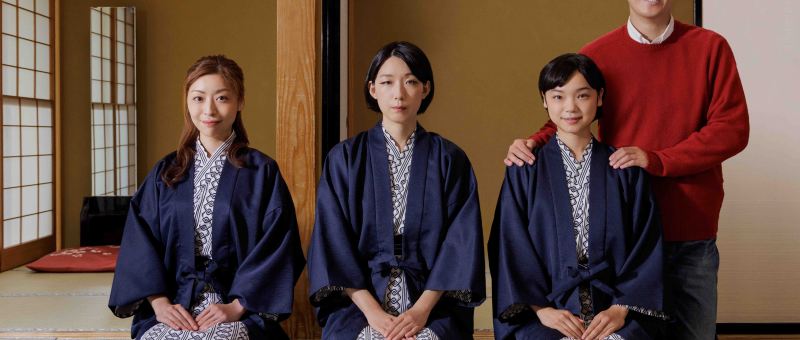
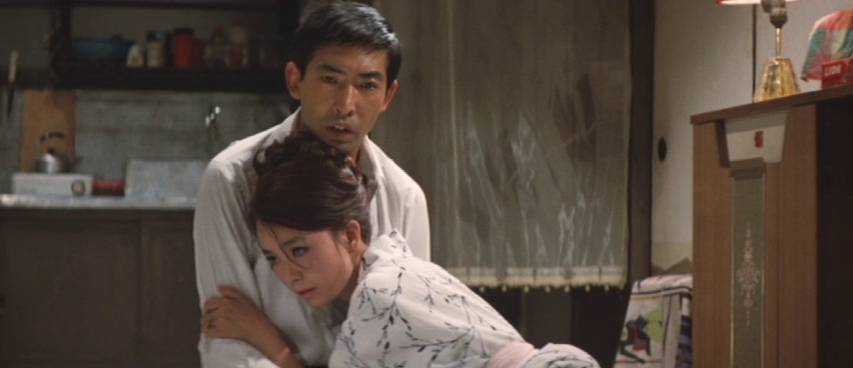
A prodigal son rocks the social order in Yoji Yamada’s anarchic nonsense comedy, The Greatest Challenge of All (喜劇 一発勝負, Kigeki: Ippatsu Shobu). The greatest challenge may be trying to manage Kokichi (Hajime Hana), a roguish Del Boy-like figure with an impossible dream of striking it rich. While in some senses he anticipates the equally  anarchic yet basically goodhearted Tora-san, he also represents a modernising and aspirant Japan determined to leave behind dusty old tradition for a new “deluxe” future.

Having taken to the road after being disowned by his conservative father (Daisuke Kato), Kokichi returns 15 years  later a middle-aged man with seemingly nothing to show for his many years of wandering. He has no idea that he has a daughter, Mariko, by a local woman that his parents took in and raised as if she were theirs which was not an especially uncommon solution to the problem of illegitimate birth in the post-war era. Nor did he know his mother had passed away before walking in on her annual memorial service. This sense of parental disconnection one level reflects a lack of filiality that marks him out as a “modern” man uninterested in these familial obligations or a sense of duty towards his family, but it’s also true that it’s to family that he’s returned having mellowed in middle-aged and in a way looking to settle down.

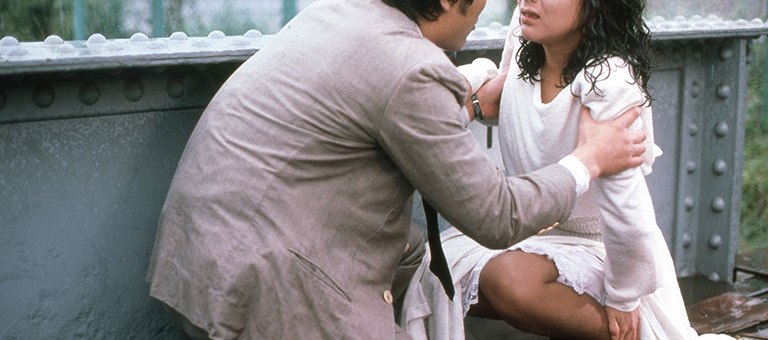
In any case, his life seems to have been a series of crazy episodes from briefly becoming a sumo wrestler to meeting a mysterious woman on a bridge who gets him a job as a snake charmer. When two yakuza types kick up a fuss about not being able to have their usual room at the inn during his mother’s memorial service, Kokichi manages to frighten them off just with bluster, hinting at the way he may have lived for the last 15 years. He also has two friends who turn up to see him, one of whom is a former yakuza who refers to Kokichi as if were his boss and they were a little trio of crime-adjacent buddies.

But it does appear that Kokichi has come with a business plan in mind, convinced that he can find the source of a hot spring in the town and build a resort hotel on top of it. To do this, he tries to convince his father to sell him his land and the inn the family run so he can knock it down and build a “deluxe” modern, Western-style hotel in its place. Kokichi’s father obviously isn’t keen. This inn has been in the family for generations, he really wouldn’t want to ruin that and especially not for one of Kokichi’s harebrained schemes. Yet again this brings us back to the battle between the conservatism of Koikichi’s father, and Kokichi’s own consumerist modernism that is more individualistic and no longer sees beauty in the past, only backwardness and stagnation. When he finally does find his hot spring, he builds a vast modernist complex with a botanical water park housed in a giant Hawaiian-themed conservatory complete with dancing hula girls. 

His corrupting presence is most discernible in the changing role of Fumi (Tanie Kitabayashi), the family’s housekeeper who generally dressed in kimono but on moving to Kokichi’s mansion she begins wearing Western dress. Fumi had at one time left the family because Kokichi had unwittingly forced her to betray it in helping him get his hands on a precious family heirloom to pawn as capital for his new business venture. Having done so brings her to a confrontation with the contradictions of her role within the family, both a surrogate mother to Kokichi and also a servant who is expected to abide by a certain code with not stealing from your employers a key tenet. She feels she can no longer look Kokichi’s father in the eye and must now return to her home in the country even though she has likely not seen it since she was a young woman. Having undergone this change, she can no longer return to the inn but is brought back to Kokichi’s modernist home once he strikes it rich. 

But Kokichi too is later confronted by hypocrisies of his own position as a free-spirited man and finally a father on learning the truth about Mariko. Hanging out at the hot spring, the 16-year-old Mariko has attracted the attentions of a couple of fashionable young men and wants to leave with them to visit Tokyo. Despite the intrusion of the modern in the hot springs resort, Mariko doesn’t want to stay in this “deadbeat” town and longs for the bright lights of the big city. Kokichi’s father understandably says no, but Kokichi is originally all for it, perhaps seeing his own desire to be free of his father’s oppressive authority. However, he soon changes his tune on assuming his paternity. He too tells Mariko she can’t go and strikes her for talking back. But just as he had, she leaves anyway. His modernity is no longer modern enough, and the young will always walk towards the future.

One exception might be Kokichi’s painter sister Nobuko (Chieko Baisho) who appears to be happy enough living at the inn and with seemingly no intention of marrying which might be her own kind of rebellion against traditional mores. While other similarly themed films may have emphasised the importance of hard work and the reality of the salaryman dream, this one suggests that it really is possible to bumble along and then strike it lucky but also that you never really travel as far from home as you might think. The desire for patriarchal control rises in Kokichi, but is now ineffectual. Though he didn’t raise her, Mariko is a child of the world he’s created and simply chooses to leave with a final sock in the eye to traditional filiality. 


Trailer (no subtitles)

Four Hours of Terror (高度7000米 恐怖の四時間, Tsuneo Kobayashi, 1959)

It seems quite strange now to think of a time when air travel was both new and exciting and as easy as catching a bus. It’s this juxtaposition that Tsuneo Kobayashi’s hijacking thriller Four Hours of Terror (高度7000米 恐怖の四時間, Kodo Nanasen Metoru: Kyofu no Yojikan) plays with as an armed fugitive takes a passenger plane hostage in an attempt to escape after committing a murder while those on board struggle to accommodate themselves to this new form of transportation. 

This sense of exoticisation is obvious from the opening voiceover which sings the praises of Haneda airport as the gateway to a newly internationalised Japan though in actuality the flight in question is a domestic service travelling from Tokyo to Sapporo. The voiceover also introduces us to each of the passengers which come from differing strata of society and even includes a middle-aged American couple. There are in fact three generations of couples on board who seem to represent different stages of life from the newly wed students so wrapped up marital bliss that they barely notice anything else, to a long-married reporter and his wife on their first holiday together since their honeymoon, and an elderly couple returning from a trip to the capital who are mystified by this new age of mass media and air travel. The newlyweds apparently won this free trip on an aeroplane after agreeing to have their wedding broadcast on television in an early example of reality TV, reinforcing the sense of irony that they weren’t necessarily supposed to be on this doomed flight after all. 

Neither was car saleswoman Kazuko (Hitomi Nakahara) who has apparently been pulled away to Sapporo by a short notice business opportunity. She gets a standby ticket, as does her boyfriend/rival Fujio (Tatsuo Umemiya) who is also on track to the same opportunity. Weirdly, Kazuko is not overly sympathetic having randomly kicked a basket containing a little dog about to be smuggled on the plane by its doting owner, but does perhaps represent something of a more independent post-war womanhood even as she effortlessly deflects unwanted attentions from a client she may also have been exploiting in order to obtain his business. Having boarded the plane, she ends up sitting next to another man who requested a standby ticket and was using a surname that was the same as hers but evidently turns out to have been assumed. So lax is the security, you don’t necessarily have to travel under your legal name. In any case, she briefly flirts with him as an overture to a business relationship and also to annoy Fujio before overhearing a news report about the escaped fugitive on her portable radio.

Kida (Fumitake Omura), the fugitive, is dressed like a stereotypical yakuza which makes it odd that no one treats him with suspicion until they spot he’s carrying a gun which he had no trouble at all bringing on board. Though hijackings are not exactly unheard of, they aren’t particularly common either so no one would really suppose anyone had any reason to take a domestic flight to the provinces hostage, and really that was never Kida’s intention merely a last resort after being discovered. Later he gives a partial justification for his life of crime in that his mother beat him and then threw him off a cliff which is why he has a false leg. In any case, there’s a small moment of potential redemption towards the end when the kindly old lady tells him he can’t undo what he’s done, but could still resolve to change assuming they all survive this difficult situation with the plane which now has mechanical problems thanks to the gun going off. 

Even so, it’s the passengers who tie Kida up after the pilot ,Yamamoto (Ken Takakura), manages to disarm him by weaponising the plane. By flying to a high altitude, they knock him out with the air pressure, but are then faced with the mechanical failure of the landing gear which seems to be linked to with Yamamoto’s wartime trauma. A secondary drama revolves around his stoical character with one of the stewardesses apparently in love with him while simultaneously wary of his iciness given that he apparently showed no emotion after receiving the news his wife had passed away but simply flew the plane home as normal. Some see this as his devotion to the aircraft which is in a way a commitment to his duty over his human feelings, the factor that perhaps allows him to save the plane and get the passengers home safely. He is however saved by his love for his late wife with the cigarette case that contains her photo saving him from the worst effects of a bullet. 

The same may go for the co-pilot Hara (Kenji Imai) who is dragging his feet over his marriage to Yamamoto’s sister because he wants to achieve 3000 flight hours before getting married so he can call himself a real pilot. Though the film plants the seeds of these random plot threads and the social commentary that goes with them, it does not particularly engage while the hijacking itself remains fairly low key given that Kida is not a particularly “bad” bad guy. He just wants to go to a random place where the police won’t be waiting for him, but otherwise refrains from harassing the passengers save threatening a little boy travelling on his own to return to his parents after visiting his grandfather in Tokyo. In essence, there’s a kind of innocence and naivety in play which speaks to something of post-war hopefulness and a wonder in the frantic pace of progress in which the day is saved by keeping calm and carrying on even in the face of severe adversity.


Trailer (no subtitles)

The Colors Within (きみの色, Naoko Yamada, 2024)

“If I could see my own colour, what kind of colour would it be?” the heroine of Naoko Yamada’s The Colors Within (きみの色, Kimi no Iro) asks herself. Yet there’s a curious pun in the film’s Japanese title in that the word “kimi” simply means “you” but it’s also the name of another girl by whom Totsuko (Sayu Suzukawa) is captivated though she doesn’t quite have the ability to articulate her feelings beyond the fact she feels “all sparkly inside”. 

In any case, Totsuko has the ability to see people as colours but largely keeps it to herself in fear that people will think she’s “weird”. Totsuko does indeed appear to be slightly otherworldly, though no one really seems to reject her for her ethereality save perhaps one classmate who describes her as that girl who sits in the chapel on her own all the time. What she’s mostly doing in there is reciting the serenity prayer to find “peace of mind,” and talking to the cool nun at her Catholic boarding school, Sister Hiyoko (Yui Aragaki), who tries probe gently into whatever it is that’s bothering Totsuko but equally avoiding pressuring her reveal anything before she’s ready. Then again, Totsuko may not quite know what it is that’s making her feel uneasy even if she remains upbeat and cheerful with a childlike sense of fun and innocence.

This quality of joyfulness is directly contrasted with the intense melancholy of Kimi (Akari Takaishi) with whom Totsuko becomes fascinated after catching sight of her “beautiful” and “clear” colours. When Kimi disappears from the school it’s rumoured she talked back to a teacher or that they found out she had a boyfriend, but it seems a Catholic education just isn’t a good fit for Kimi so she decided to drop out. Like Totsuko, Kimi has a secret but hers is that she can’t bring herself to tell her grandmother, who attended the same school and is over the moon about her going there, that it isn’t working out for her. What with it being a Catholic school, there’s also the implication that Kimi and also Totsuko may be struggling to define themselves within a repressive environment and reconcile their differences in the intense fear of not only being rejected by their community but damned to hell. 

After Totsuko checks every bookshop in town because someone said they saw Kimi working in one, she accidentally starts a band with her and a boy who just happened to wander in, Rui (Taisei Kido). Rui also has a secret which is his love of music which he fears conflicts with his responsibility of taking over the family medical practice. He isn’t exactly sure he wants this future that’s been forced on him and prevents him from following his dreams. In fact, none of the teens really wants the kind of life their parents wanted for them but they aren’t yet certain of the kinds of lives they do want or really who they are which is why Totsuko is still unable to see her own colour despite clearly discerning everyone else’s.

Through making music together, they discover new ways of expressing themselves and with it growing self-acceptance that allows them to be honest with themselves and others about who they are and what they want. Music in itself becomes an act of holy communion with the universe, a pure communication of one soul to another much like Totsuko’s synaesthetic ability to see people as colours. Even Sister Hiyoko insists that any song that is about goodness, beauty, truth or indeed suffering is itself a hymn and in the end Totsuko’s song is about all those things. Her joy, Kimi’s sadness, and Rui’s confusion coming together in a harmonised symphony as a consequence of “sharing secrets and feelings of love”. This sense of delicacy extends to the animation itself which has a watery, ethereal quality. Produced by Science Saru, this is the first of Yamada’s films not based on existing material and is underpinned by a tremendous empathy for its anxious adolescents as well as their uncertain adults along with a true sense of wonder for a world of colour and light hidden from most but visible to the ever cheerful Totsuko content to dance through life for the pure joy of it even if as she says she wasn’t very good.


The Colors Within screened as part of this year’s BFI London Film Festival and is released in UK cinemas on 31st January courtesy of All the Anime.

Trailer (Japanese with English subtitles)

Images: © 2024 “THE COLORS WITHIN” FILM PARTNERS

Castle of Owls (忍者秘帖 梟の城, Eiichi Kudo, 1963)

A surviving member of the Iga clan swears vengeance on Toyotomi Hideyoshi only to slowly come to the realisation that the best revenge is living well in Eiichi Kudo’s ninja drama, Castle of Owls (忍者秘帖 梟の城, Ninja Hicho: Fukuro no Shiro). Adapted from the novel by Ryotaro Shiba, the film is somewhat unusual in its positivity in allowing its hero to first reject the codes by which he was raised and then those of the prevailing times in eventually choosing love and happiness over the internecine obligation to gain vengeance against a corrupt social order.

Hoping to solidify his grip on power, Oda Nobunaga has his right-hand man Toyotomi Hideyoshi massacre the Iga clan of ninjas who are then almost entirely wiped out. Juzo (Ryutaro Otomo) and his friend Gohei (Minoru Oki) both survive, but Juzo’s entire family is brutally murdered while his sister takes her own life after being gang raped by Hideyoshi’s soldiers, using her final breath to tell her brother to avenge her. Overwhelmed by grief, Juzo is chastised by veteran ninja Jiroza (Kensaku Hara) for his show of emotion. He reminds him that a ninja should be as unbreakable as stone and that he should abandon all human sentiment. Juzo, however, insists that he may be a ninja but is also human and refuses to apologise for his feelings. 

This is it seems the major conflict. Jiroza has already signalled his own heartlessness and practicality when he advised the surviving ninja to flee, for escape is less dishonourable than death. Those who refuse are welcome to surrender, and those who cannot run must be left behind to their fate. For Jiroza, all that matters is survival for both himself and his small daughter Kizaru (Chiyoko Honma) who is currently tied to his back (no mention is made of her mother, perhaps she had already passed away). Now that his family are dead, Juzo has a new mission and reason for survival insisting that what the living can do for the dead is vengeance, though in his case it is personal rather than principled for he mostly wanted revenge for his sister rather than the Iga clan as a whole or anything it represents which he otherwise seems to be at odds with. 

10 years later, Oda Nobunaga has already been bumped off in an act of betrayal by one of his own men leaving Toyotomi Hideyoshi in charge and now the target for Juzo’s revenge. Around this time, Hideyoshi is planning an invasion of Korea against the advice of most of his courtiers in order to legitimise his rule through imperial ambition and military dominance. Juzo has been trying to assassinate him, and has apparently failed five times already. A surprise visit from Jiroza and his now teenage daughter involves a job opportunity promising a monetary reward should he succeed, but Juzo is wary. The merchant who hires him says he wants Hideyoshi out of the way because a war in Korea will damage his business prospects, but as Juzo points out Hideyoshi’s death will leave a power vacuum resulting in another civil war. The merchant, however, giggles childishly and remarks that domestic wars are good for business, leading Juzo to suspect he’s here on behalf of Tokugawa Ieyasu, the most likely to assume power in the event of Hideyoshi’s death.

The irony is though Juzo very definitely wants Hideyoshi dead, when someone else suggests it he becomes conflicted because he knows it will lead to another period of chaos in which even more people will die. Meanwhile, a ninja’s allegiance should belong to his client, who is always the highest bidder, so this is both a win-win situation and a mild conflict of interest. Conversely, Gohei (Minoru Oki), who was betrothed to Kizaru, has apparently betrayed the clan and taken a position as a retainer for one of Hideyoshi’s lords. He agrees to betray the Iga, inform on the plan to assassinate Hideyoshi, and even bring in Juzo in return for a 300-koku stipend and a shot of advancement under the new regime.

Now, on one level this might be understandable. Japan has emerged from a couple of hundred years of constant warfare, there’s no place for ninja in a world of peace as former Iga man Mimi (Tokue Hanasawa) remarks revealing that he’s survived the last 10 years through begging. It’s also understandable given that a ninja is expected to be duplicitous and act in self-interest. Even Juzo applaud’s Jiroza’s ninjutsu on realising that he’s teamed up with Gohei to betray him in order to take out the leader of the Koga ninjas. In essence, he’s only really done what Juzo later does but also the opposite in choosing his individual happiness through betraying those around him to throw his lot in with the person who murdered his entire clan. 

Juzo meanwhile is shaken by his unexpected attraction to female ninja Kohagi (Hizuru Takachiho), a daughter of the Koga,  who like him finds herself conflicted in her mission because of her growing affection for Juzo. Kohagi asks him if they really have to live on hate when they could live happily together instead, but even while conflicted Juzo can’t bring himself to let go of the idea of vengeance and is haunted by images of his friends and family dying. Even so, having decided to give up on a happy future and risk his life to kill Hideyoshi he finds that it ceases to matter. Confronting him, his hatred melts away. He begins to recognise the futility of revenge and that it would be silly to cause a war and make a merchant rich to prove a point. Gohei, meanwhile, pays a heavy price for his choices when his lord disowns him. Even when Juzo comes to rescue him from jail, he laughs that he’s caught him at last. Having escaped from the Iga life to live in the sun, he finds himself in darkness once again. Juzo, however, rides off into the sunshine with Kohagi to live in peace that’s divorced from the wider world. They choose to exile themselves from this world of darkness and duplicity, to live freely in the sunlight rather than be consumed by the internecine codes by which they were raised. Kudo films his ninja battles in near total silence with an almost balletic intensity and paints this world as one of infinite mistrust and uncertainty but equally affirms that it is possible to simply walk away and choose happiness over duty or hate.


Leaving on the 15th Spring (旅立ちの島唄~十五の春~, Yasuhiro Yoshida, 2013)

“How many of them will come back?” a man on the shore ominously asks as he watches the young people of his island ship out to pursue their education in the comparatively better equipped capital. Rural depopulation has become a minor theme in recent Japanese cinema, but the situation is arguably all the worse in the outlying islands of Okinawa. As the title of Yasuhiro Yoshida’s Leaving on the 15th Spring (旅立ちの島唄~十五の春~, Tabidachi no Shima Uta: Jugo no Haru) suggests, teens from the small island of Minami Daito (South Daito) must leave at 15 if they want to attend high school because there isn’t one on the island.

That said, there are more kids than you’d expect in young Yuna’s (Ayaka Miyoshi) middle school and it’s more than just a handful who leave the island each spring, many of them choosing to make lives for themselves in the wider world rather than return to their childhood home. On Minami Daito, the main industry is sugarcane but the prospect of Japan joining the TPP trade agreement has many worried that it will soon no longer be viable and with even fewer economic opportunities available many will have no choice other than to abandon the island for good. 

We’re often reminded just how far the island is from the Okinawan capital Naha and how difficult it is to get to. To leave, the kids are placed in a kind of cage and lifted onto a larger boat moored by a small jetty. Even to get to the next island Kita Daito (North Daito) it’s some time on a ferry which might not run if the weather is bad. Distance becomes a persistent theme, not just in Yuna’s impending exit but the scattering of her family. When kids leave for high school, a parent often goes with them as Yuna’s mother Akemi (Shinobu Otake) did when it was time for her sister Mina (Saori) to depart. But Mina is now a grown woman married with a child of her own and Akemi has not been back to the island for two years. This forcible separation continues to disrupt familial bonds as couples necessarily grow apart and children begin to choose their own paths in life which often take them away from their parents. 

It’s this sense of distance which plays on Yuna’s mind, a kind of countdown starting inside her as she witnesses another girl sing the Okinawa folk song “Abayoi” which means “goodbye” in the local dialect and recounts a young person’s sorrow as they must leave their family and childhood home behind on coming of age. Reminded that she’s next in only a year’s time, Yuna meditates on her past and future while reconsidering her relationships. Abandonment often occurs through a simple lapse in contact. Akemi now rarely phones home while Yuna’s nascent first love with a boy from Kita Daito falters when he abruptly stops calling or returning her letters. Eventually she finds out that despite their pledge to attend the same high school on Naha, he has decided to stay and take over his father’s fishing boat because of his dad’s ill health. 

Kenta has realised that his place is Kita Daito and he will remain there the rest of his life while harbouring a degree of resentment that he couldn’t go to high school or pursue his romance with Yuna. He feels their relationship is doomed simply from the fact that they’re from different islands. He won’t leave his, and she likely would not settle on Kita Daito preferring, either a life in the cities or her childhood home. It’s the same for her parents, Akemi deciding that she prefers life in the city and the degree of independence she has there while her father Toshiharu (Kaoru Kobayashi) would not survive off the island. Both of her siblings have already left, Mina returning with her infant daughter apparently on the verge of separating with her husband partly it seems because of the insecurity the separation of her family has left her with, while Yuna’s brother seems to be a harried workaholic with no family life to speak of. 

Rather childishly she thinks she can reunite her family and dreams of buying a big house on Naha for them all to live together, adult siblings included, without fully accepting that the relationship between her parents has been gradually worn away leaving them strangers to each other and each desiring different kinds of futures. What she comes to is perhaps an acceptance of the distance in her life, the longing for her island home where she says everyone is one big family, as she finds herself choosing independence. A picturesque vision of Minami Daito and its idyllic landscape along with the traditions of the island including its rich musical culture and Okinawan Sanshin, Yoshida’s gentle drama discovers that “abayoi” is a part of life that can’t be avoided but can be sweet as well as bitter once you’ve learned to accept it.


Trailer (English subtitles)

A Brother and His Younger Sister (兄とその妹, Yasujiro Shimazu, 1939)

A young man’s love of go ends up getting him into hot water at work in Yasujiro Shimazu’s surprisingly progressive shomingeki, A Brother and his Younger Sister (兄とその妹, Ani to Sono Imoto). It seems office politics might not have changed all that much in the last 80 years even if many other things have, but conversely the film seems to have more to say about the changing nature of gender roles and attitudes towards women in a time in which it was becoming possible for a woman to live a fully independent life. 

This window wouldn’t last very long and the situation largely reversed itself even amid the supposed equality enshrined in the post-war constitution, but Fumiko (Michiko Kuwano) at least has a well paying job as a secretary at a large company and consequently little desire to marry even at the comparatively late age of 24. Her earning capacity is later put forward as a reason that there “aren’t many opportunities” for marriage as men apparently feel threatened and embarrassed especially if their salary is lower than hers. It’s not exactly that she’s against marriage, but as she can support herself and is otherwise happy living with her brother Keisuke (Shin Saburi) and his wife Akiko (Kuniko Miyake). She doesn’t see the need to rush into such an important decision. Though she might change her mind if the right person came along, for the moment she just isn’t interested. Then again, Akiko’s sucking of her finger when she’s ironically cut by a thorn on a bouquet of roses from an unwanted admirer might suggest another reason marriage is not on her radar.

Her suitor, Michio (Ken Uehara), despite his handsomeness is a little creepy in his courtship and cannot seem to take a hint that Fumiko isn’t interested in him. A friend of her boss, he has a habit of dropping into the office for no real reason and attempts to ask her out when the boss isn’t there. She lies and tells him she’s married already (to a penniless painter!) but after the boss reveals the truth it doesn’t seem to occur to Michio that if she made up a story like that it’s because she doesn’t want to go out with him. We’re told that Michio studied at Oxford and is attracted to Fumiko because he’s impressed by her language skills, but he’s also some kind of stockbroker which quickly paints him as no good seeing as the film seems to have a minor message about how dabbling in stocks and shares is little better than gambling and definitely dangerous.

One of Keisuke’s colleagues has been given a warning because there’s a rumour that he’s into shares while another has apparently been demoted because it came to light that he had a fondness for horse racing. More than a moral judgement, it seems the reason is that these sorts of hobbies may eventually lead someone towards embezzling from the company to cover their debts. Keisuke’s supervisor is also worried that his 18-year-old son is refusing to go to university and apparently wants to join some kind of “investment society” which admittedly does not sound like a good idea so he wants Keisuke to talk him out of it. The big boss, meanwhile, who is also Michio’s uncle, turns out to be into shares himself which makes him a very compromised authority figure. 

Keisuke is not into shares, but he is very into the game of go which causes him to stay out until late at night playing with his bosses. He does this because he genuinely likes playing, but Fumiko worries that his colleagues will come to resent him assuming that he does so to curry favour. Apparently, something similar happened at his previous job which is why he ended up quitting abruptly. As he was quite lucky to get this one despite how impressed everyone seems by his capabilities, it would be better if that didn’t happen again. Nevertheless, the perspicacious Fumiko turns out to be right as as his co-worker Yukito (Reikichi Kawamura) becomes increasingly jealous of his success fearing that he will leapfrog him to take the shortly to open up supervisor position which he believes to be his simply because he’s been there longer (which is generally how things work at Japanese companies). Consequently, starts a series of rumours that Keisuke is a snitch who got the horse racing guy demoted and is only in his position thanks to schmoozing with the bosses.

This obviously leaves him with a huge dilemma when his boss asks him to put in a good word for Michio with Fumiko whom he is pretty sure won’t be interested. To his credit, Keisuke maintains that it’s up to her and his career is nowhere near as important as her happiness though he is also aware it’s going to be embarrassing for him when she says no. Fumiko knows this too, and it’s clear that she also feels incredibly awkward when he puts it to her but only asks for a few minutes to think before offering her primary justification for refusing which would be that she fears Keisuke’s colleagues will resent him even more if they come to the conclusion that he sold his own sister in the hope of career advancement. This does in fact turn out to be the case as Yukito has already started a rumour about a dynastic marriage that turns the rest of Keisuke’s colleagues against him especially as he’s given the promotion immediately before he was going to tell the boss Fumiko isn’t interested. 

Confronted by the horse racing guy, Keisuke ends up quitting again after getting into a physical confrontation with a seemingly remorseful Yukito who probably didn’t mean for it to go that far. Keisuke quits because he won’t have people think he was gossiping behind their backs and is offended by this attack on his integrity, but his decision is also a rebuke against this infinitely corrupt employment regime in which hypocritical bosses hand out jobs to their favourites and maybe do expect that Keisuke will persuade his sister to sacrifice herself for his career. She meanwhile is portrayed as an independent woman, but ironically rejects the marriage to save her brother’s reputation though perhaps equally she feared her “no” would not be enough on its own. Then again, she had apparently turned down several suitors already and no one really expected her to say yes this time unless she’d suddenly begun to feel anxious about her age and declining prospects. 

Nevertheless, it’s refreshing that the film does not force Fumiko into accepting marriage as so many others would and in fact legitimises her opposition to it and right to live as an independent woman for as long as she chooses. Keisuke is also in some ways rewarded for quitting his job at the corrupt company in immediately getting another one from a former co-worker who’s since started his own business and wants to expand to Manchuria. But this final scene almost seems tacked on for the censor’s benefit. It is perhaps a little unusual for 1939 that the film has so far made no mention of Japan’s imperial ambitions nor made any kind of patriotic appeal. It’s even been quite pro-internationalist in the talk of people speaking English and engaging in European trade (even if the currency trading Michio’s doing is definitely framed as bad). Fumiko spots a little patch of grass clinging onto the plane as they take off for Manchuria with Keisuke remarking that he hopes this little piece of Japan will take root on the continent. On one level, it suggests that contemporary Japan was too corrupt for an “honest” man like Keisuke to prosper while Manchuria will offer greater freedom for himself and the independent modern girl Fumiko (who declares she won’t marry until Keisuke’s successful), but it’s also of course an unpalatable advocation for the ongoing imperialist expansion which seems so out of keeping with everything that’s gone before. Even so, the message is clear that it’s Keisuke and Fumiko who are in the right and should be allowed to live just as they are in a society free of judgement and hypocrisy.


Nanayo (七夜待, Naomi Kawase, 2008)

Naomi Kawase had provoked a minor upset with her unexpected Grand Prix win for 2007’s The Mourning Forest and has since earned a reputation as a festival darling. Her followup film, 2008’s Nanayo (七夜待, Nanayomachi), however, failed to make much of an impact in the international festival scene and seems to have been more or less forgotten, considered among the most minor of Kawase’s disparate filmography. In some ways it picks up where The Mourning Forest left off as a young woman looks for meaning in the primitive beauty of nature, but it’s also a major departure in being the first of her films made outside of Japan and dealing with far broader themes from her familiar focus on familial disconnection to oblique references to the traumatic legacies of colonialism and the inefficiency of language as a tool for communication. 

The heroine, Saiko (Kyoko Hasegawa), arrives in Thailand it seems without much of a plan or a clear idea of where she’s going. Largely unable to communicate in any language other than Japanese, she wanders around lost looking for her hotel until someone is able to explain to her that she’s in completely the wrong place, and as the hotel is too far to walk she’d best take a taxi. The taxi driver, however, can’t understand her either but for some reason agrees to take her. Saiko falls asleep and wakes up sometime later to realise he’s driven her out to the middle of nowhere, belligerently insisting she get out of the car. Understandably fearing the worst, she manages to dodge past him and run off into the forest leaving her bags behind. Eventually she encounters a random Frenchman, whom she can’t understand either, who takes her back to the small guest house he’s staying at to learn Thai massage. Later the taxi driver, Marwin (Netsai Todoroki), turns up too and in a weird coincidence it turns out that he’s the brother of the woman running the massage school, Amari (Kittipoj Mankang). 

Despite having no common language, the four of them along with Amari’s half-Japanese son Toi (which in Japanese anyway means “far”) become an odd kind of family, relying on universal human gestures in an effort to communicate. To this extent, it is perhaps a shame that the film is subtitled in that the impossibility of true understanding through verbal communication seems to be a key theme. At one point, Frenchman Greg (Grégoire Colin) opens up to Saiko about his reasons for coming to Thailand, that he’d been in denial of his homosexuality and is finally beginning to accept himself. Perhaps he tells her precisely because she will not understand, but it’s an immense irony that her first question is to ask if the pretty bracelet on his wrist was a gift from a girlfriend. In their shared mix of broken English, she thinks he’s saying “lovely” when he’s really just trying to say that it looks like rain. 

Meanwhile, Amari has some Japanese, presumably learnt from Toi’s absent father of whom she gives no further details. Marwin later implies that she met him through some kind of sex work, and we later see him fall out with his daughter over something much the same in accusing her of being in a compensated relationship with a foreigner while she fires back that it’s none of his business seeing as he failed as a father in proving unable to support her financially. When Saiko makes the perhaps unwise decision to get in Marwin’s cab, it’s in the process of being vacated by a drunk and extremely rude Englishman who yells some vaguely racist abuse at him and then walks off with a Thai beauty. The prevalence of sex work appears as an extension of contemporary colonialism, something of which both Greg and Saiko may be accidentally guilty in coming to Thailand to look for something as nebulous as spiritual awakening, beckoned in by orientalist notions of Eastern mysticism. Amari, while never resenting Saiko, perhaps sees in her an echo of her absent lover, repeatedly asking her son if he’d want to meet his father or to visit Japan. The climactic fight which emerges seemingly out of nowhere is fought over Amari’s decision to send Toi to a temple to train as a monk, affirming that Saiko wouldn’t understand because her country is “beautiful and rich”, explaining that she wants her son to grow up rich spiritually not to be materialistic, though Saiko herself describes Japan only as “peaceful” lacking the warmth that she feels in the Thai people.  

Saiko of course cannot understand because she has absolutely no idea what anyone is saying, realising only that Toi has gone missing and everyone is so intent on arguing in several languages that no one’s bothering to look for him. She doesn’t understand why everyone’s shouting at her when she’s only a bystander, perhaps another comment on the legacy of colonialism, while to Marwin it seems obvious that the boy’s run off because he doesn’t want to be a monk and is sad thinking his mum doesn’t want him anymore. When Saiko finds him, it seems that he’s particularly preoccupied with whether or not his father loved his mother, perhaps beginning to understand the complexities of his birth and his dual nationalities. 

Once again adopting an elliptical structure, Kawase builds slowly towards the scenes which opened the film in which Toi and Marwin prepare to enter the temple as monks, the moment attaining a kind of spiritual catharsis which seems at odds with the conflicts of the preceding scenes which asked if Amari was right to separate from her son and force him to become a monk against his will. The temple scene is followed by a ritual dance similar to that in Shara in which Saiko seems to cast off her gloominess in spiritual release, building on earlier scenes in which she idly fantasised about intimate massages from a Japanese monk (Jun Murakami) apparently achieving an entirely different kind of enlightenment. Touch, Kawase seems to say, is the only true communication, leaving it to former soldier Marwin to expound on how we’re all different and speak different languages but we should love each other rather than kill in war. There is danger everywhere he explains, though Kawase’s gentle pan to the tranquility of life on the wide river might seem to contradict him.  


Trailer (no subtitles)

Genocide (昆虫大戦争, Kazui Nihonmatsu, 1968)

In the early 1960s, tokusatsu movies had begun to slide towards something which was much less serious than the early days of the genre, but as the decade went on others edged in the direction of the ‘70s paranoia thriller expressing a nihilistic view of contemporary Cold War geopoliticking. Given the rather provocative English title Genocide (昆虫大戦争, Konchu daisenso), as opposed to the more recognisably genre-inflected “great insect war”, Kazui Nihonmatsu’s wasp-themed disaster film is part anti-nuclear eco-treatise and part anti-US spy movie.

Then again, the film’s secondary hero, Joji (Yusuke Kawazu), a Japanese man obsessed with collecting rare insects he sends alternately to a researcher in Tokyo and a foreign woman living locally, cannot exactly claim the moral high ground. When he spots a US bomber falling out of the sky and runs to investigate the descending parachutes, he’s in the middle of tryst with Annabelle (Kathy Horan) while his wife waits for him patiently at home. Not only that, he picks up an expensive watch dropped by one of the airmen and attempts to sell it, he later claims to buy something nice for his wife, Yukari (Emi Shindo). Meanwhile, the voice of reason Dr. Nagumo (Keisuke Sonoi) is also seen conducting experiments on animals, injecting insect venom into a squirming guinea pig while explaining that the toxin affects the nervous system and causes madness and death. 

For all his own moralising, it’s this callous and selfish disregard for life which caused so many problems. The insects have apparently become fed up with human volatility and have decided that they don’t care what humans do to each other but they won’t go down with us in a nuclear war so the only solution is total eradication. The film’s true moral centre, the innocent Yukari, had tried to stop Joji capturing insects, reminding him that “insects have babies too,” while unbeknownst to him the insects he’d been capturing for Annabelle had been used for her sinister experiments to “breed vast numbers of insects that drive people mad and scatter them across the world.”

Annabelle’s quest is one of revenge, claiming that she doesn’t trust humans and likes insects because they don’t lie. She’s currently working with Communist spies supposedly researching deadly nerve toxins but with no loyalty to the regime, only the desire for the eradication of humanity in revenge for the murder of her parents in the holocaust. The Americans, meanwhile, only care about getting the H-bomb that the downed bomber had been carrying, eventually admitting that they’re considering simply detonating it to wipe out the insect threat in total indifference to the lives of those who live on the islands. When Nagumo challenges him, the American officer pulls a gun. One of the soldiers refuses the command to detonate, but is then killed. 

The Americans reject the idea that it was “insects” that brought the plane down, but tell on themselves on insisting that the airman onboard was hallucinating having become addicted to drugs to help him overcome his fear of combat situations. The insects do indeed cause him to hallucinate but with flashbacks back to his time in Vietnam, loudly exclaiming that he won’t go back there before asking for more drugs and being injected by a medic. The American officers claim they’re fighting for “freedom and independence,” but it rings somewhat hollow and is immediately challenged by Nagumo. “Sacrifices must be made in war,” they retort when he points out that detonating the bomb will not only kill everyone on the islands but irradiate the rest of Japan, wiping out the Japanese as if they too were merely insects. 

Even so, Nagumo too wants to wipe out the insects rather than consider the implications of their concern or find a way to live with them. Annabelle might have had a point when she said that human beings only knew hate despite her entirely twisted and exploitative plan to use the insects to complete her mission of eradicating humanity. In any case, in contrast to other similarly themed films, Nihonmatsu keeps things fairly realistic despite the outlandishness of the narrative, frequently cutting back to closeup footage of an insect biting into human flesh with its pincers before ending on an image of a nihilistic and internecine destruction that suggests there may be no real hope for us after all.


Drawing Closer (余命一年の僕が、余命半年の君と出会った話。, Takahiro Miki, 2024)

Takahiro Miki has made a name for himself as a purveyor of sad romances. Often his protagonists are divided by conflicting timelines, social taboos, or some other fantastical circumstance, though Drawing Closer (余命一年の僕が、余命半年の君と出会った話。, Yomei Ichinen no Boku ga, Yomei Hantoshi no Kimi to Deatta Hanashi) quite clearly harks back to the jun-ai or “pure love” boom in its focus on young love and terminal illness. Based on the novel by Ao Morita, the film nevertheless succumbs to some of genres most problematic tendencies as the heroine essentially becomes little more than a means for the hero’s path towards finding purpose in life.

17-year-old Akito (Ren Nagase) is told that he has a tumour on his heart and only a year at most to live. Though he begins to feel as if his life is pointless, he finds new strength after running into Haruna (Natsuki Deguchi) who has only six months yet to him seems full of life. Later, Haruna says he was actually wrong and she felt completely hopeless too so actually she really wanted to die right away rather than pointlessly hang round for another six months with nothing to do and no one to talk to. But in any case, Akito decides that he’s going to make his remaining life’s purpose making Haruna happy which admittedly he does actually do by visiting her every day and bringing flowers once a week.

But outside of that, we never really hear that much from Haruna other than when she’s telling Akito something inspirational and he seems to more or less fill in the blanks on his own. Thus he makes what could have been a fairly rash and disastrous decision to bring a former friend, Ayaka (Mayuu Yokota), with whom Haruna had fallen out after the middle-school graduation ceremony that she was unable to go to because of her illness. Luckily he had correctly deduced that Haruna pushed her friend away because she thought their friendship was holding her back and Ayaka should be free to embrace her high school life making new friends who can do all the regular teenage things like going to karaoke or hanging out at the mall. Akito is doing something similar by not telling his other friends that he’s ill while also keeping it from Haruna in the hope that they can just be normal teens without the baggage of their illnesses. 

The film never shies away from the isolating qualities of what it’s like to live with a serious health condition. Both teens just want to be treated normally while others often pull away from them or are overly solicitous after finding out that they’re ill but at the same time, it’s all life lessons for Akito rather a genuine expression of Haruna’s feelings. We only experience them as he experiences them and so really she’s denied any opportunity to express herself authentically. Rather tritely, it’s she who teaches Akito how to live again in urging him that he should hang in there and continue to pursue his artistic dreams on behalf of them both. Meanwhile, she encourages him to pursue a romantic relationship with Ayaka, in that way ensuring that neither of them will be lonely when she’s gone and pushing them towards enjoying life to its fullest.

Nevertheless, due to its unbalanced quality and general earnestness the film never really achieves the kind of emotional impact that it’s aiming for nor the sense of poignancy familiar from Miki’s other work. Perhaps taking its cues from similarly themed television drama, the production values are on the lower side and Miki’s visual flair is largely absent though this perhaps helps to express a sense of hopelessness only broken by beautiful colours of Haruna’s artwork. Haruna had used drawing as means of escaping from the reality of her condition, but in the end even this becomes about Akito with her mother declaring that in the end she drew for him rather than for herself. Even so, there is something uplifting in Akito’s rediscovery of art as a purpose for life that convinces him that his remaining time isn’t meaningless while also allowing him to discover the desire to live even if his time is running out.


Trailer (English subtitles)

Lumberjack the Monster (怪物の木こり, Takashi Miike, 2023)

Could being a psychopath actually be better? It might be an attractive thought for some, the absolute freedom of living without emotional or moral constraint. Emotion is after all a difficult thing to bear, though life without it might also be lonely and unfulfilling leaving a void often filled by other desires such as a lust for wealth, status, power, or proof of superiority. Based on a novel by Mayusuke Kurai, Takashi Miike’s Lumberjack the Monster (怪物の木こり, Kaibutsu no Mikori) finds its hero at a point of existential crisis no longer certain of his true nature or identity.

The film takes its title from a fairytale featured in a picture book being read by a small boy who has been abducted and illegally experimented on. A monster begins living as a lumberjack in a small town where he begins killing and eating the residents, only no one notices. Eventually it realises that he spends more time being the lumberjack than the monster and is confused about his identity. With no friends left to talk to (because it ate them all), the monster decides to move to another town to make more friends but ends up sneaking into the house of a lumberjack, stealing a baby, and fashioning after itself to create another monstrous lumberjack.

This is in a sense what’s happened to Akira (Kazuya Kamenashi), now a lawyer who discovers he has a “neuro-chip” in his brain that suppresses his emotions after he’s attacked by a masked figure and it breaks re-introducing him to an unwelcome humanity. This is quite inconvenient for him in that he’s done quite a lot to feel guilty about, firstly participating in a scheme with his “friend” Sugitani (Shota Sometani), a natural-born psychopaths, to facilitate his experimentation on live humans, and secondly that he murdered his boss who is also his fiancée’s father to take over his law firm. Though the fiancée, Emi (Riho Yoshioka), seems to be afraid of him, it’s also true that simple proximity to her warmth and kindness may have begun to reopen his heart.

Of course, it could be true that the mad scientists who abducted the children accidentally picked up a few who were already psychopaths but in this case it seems like the chip did its job on each of the victims of the axe-wielding assassin. Meanwhile, we also see “psychopathic” traits in lead investigator Toshiro (Nanao) who admits that she will do whatever it takes to get to the truth even if it includes throwing out the police rulebook. Akira asks her if her desire to solve the case isn’t also a roundabout means of vengeance for the death of her brother, leaving her not so different from the assassin who is also extracting vicarious revenge on man-made psychopaths, but she replies that that’s exactly how a psychopath might see it while also deflecting a similar question from embittered cop Inui (Kiyohiko Shibukawa) who remarks that if the killer’s only taking out psychopaths then why bother stop them?

In some ways, Akira is like the lumberjack. He was simply being what he was and knew no different, but gradually beginning to rediscover his humanity is burdened with guilt and remorse now acutely aware not just of the feelings of others rather than their consequences but of his own feelings too. The couple who abducted the children claimed they were doing it to save their son, trying to reverse engineer psychopathy so they could cure him though their actions were themselves psychopathic and like the lumberjack they created only more monstrous children like themselves. Akira has it seems rediscovered the person he may have been if he had been raised in the loving family from which he was abducted and is determined to search for the meaning of life, but he is also responsible for the decisions he made as a man who knew no guilt or remorse and may in fact have to pay for the moral transgressions he was not fully aware he was making. Miike conjures a sense of the gothic in the creepy, candlelit mansion where the children were kept and otherwise sticks to standard procedural for the “real” world, but finally lands back in the realms of fairytale as his hero finds himself part of neither one world nor another while faced with a choice that may earn him redemption but also loneliness and futility.


Trailer (English subtitles)