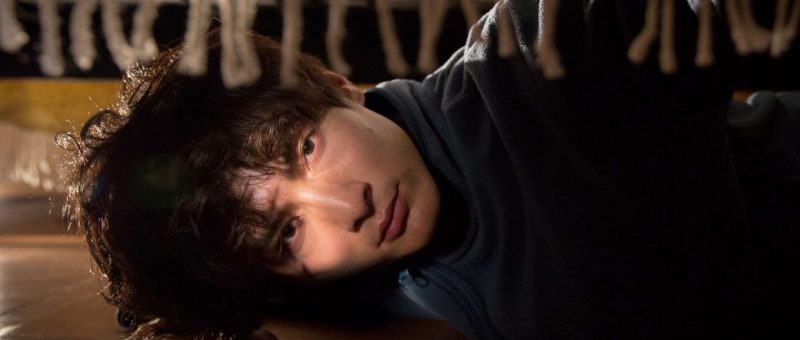
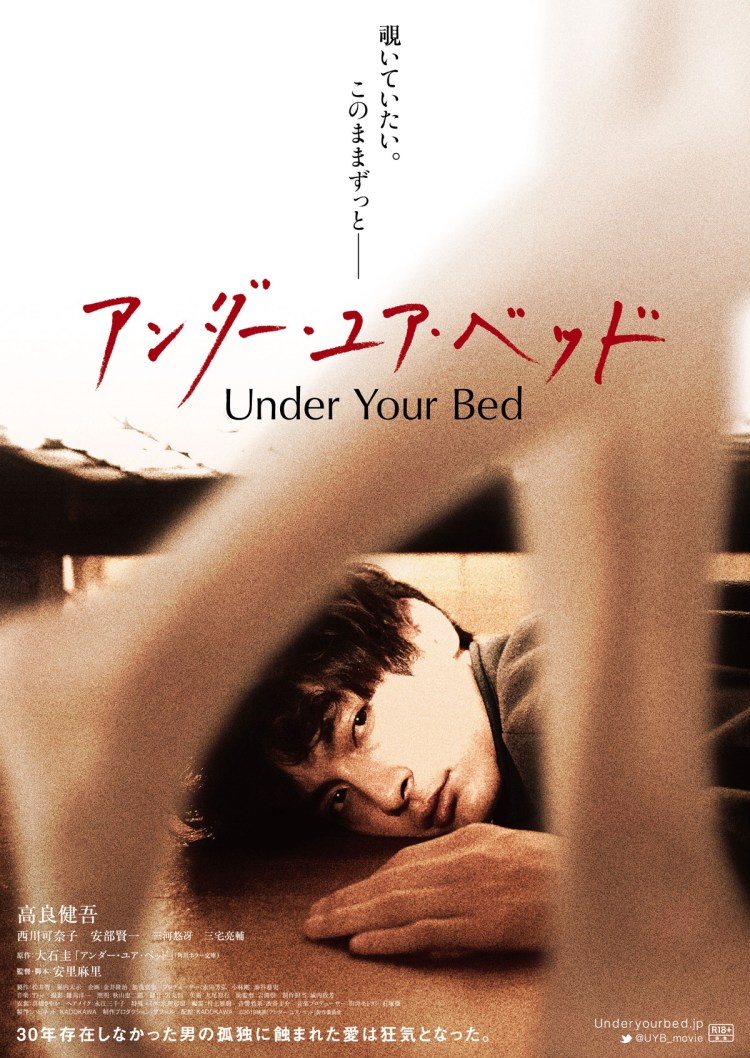
 Japanese cinema has something of a preoccupation with invisible men, but there’s rarely been as empathetic an exploration of benign alienation as Mari Asato’s Under Your Bed (アンダー・ユア・ベッド). Asato’s lonely stalker is a creep and a voyeur, but his problem is his innate passivity born of defeatism in which he has, despite his tendency to fantasise, already accepted that he lives in a kind of other world unable to touch his fellow humans from whom he remains painfully separated as if by a sheet of invisible glass.
Tropical fish enthusiast Mitsui (Kengo Kora) is one of those people who tend to be forgotten. He doesn’t feature in his high school graduation photo, and nobody, not even his parents, has ever noticed. Harbouring intense feelings of worthlessness linking back to a childhood memory of abandonment after almost dying when his father left him sitting in a hot car, Mitsui has no friends or much of a life to speak of and regards himself as a kind of non-person invisible to others. Longing to be seen, he treasures the precious memory of the only time he has ever heard someone else call his name which occurred 11 years previously when he was a university student.
Mitsui deeply believes that this memory is the only thing that gives his life meaning. Hiring a private eye to track down the woman in question, Chihiro (Kanako Nishikawa), he quits his job and opens a tropical fish store in the town where she lives, apparently now married with a baby. What he discovers, however, is that this Chihiro is quite different from the one of 11 years previously. Hoping to figure out why he begins watching her intensely, swiping a key to the house after she drops into the fish shop by chance and he offers to set her up with a tank full of colourful guppies. What Mitsui eventually discovers is that Chihiro is also living a somewhat invisible life as a victim of domestic violence unable to escape the tyrannical control of her respectable salaryman husband.
Facing a dilemma, Mitsui doesn’t so much want to rescue Chihiro as preserve his peculiar level of access to her even if seeing her subjected to such degrading and inhuman treatment quite obviously disturbs him. Mitsui can’t swoop in and save her because he’d blow his cover and lose the fragile connection to her life he’s convinced himself he has. Never daring to hope he could get her attention through an act of white knight salvation, he nevertheless fantasises about a different version of himself – one that is capable of providing comfort and protection rather than simply sitting and watching while others suffer.
Ironically enough, however, his passive presence seems to make a difference. Shifting to a brief voice over from Chihiro, we discover that the flowers Mitsui has been sending with a card wishing her happiness are the only thing that’s been keeping her going. What some might regard as a cause for concern has given Chihiro strength in proving that there’s someone else out there who cares about her. Yet this change or at least potential restoration also endangers Mitsui’s plan as Chihiro’s growing conviction that she can protect herself, spurred on by the invisible support of the flower sender and others, threatens to dissolve the fragile fantasy world he’s constructed.
Mitsui is forced to wonder if his obsession is equal parts delusion, that perhaps the very events which define his life are part fabrications. His intense conviction that he is a forgettable person is borne out when he realises that Chihiro not only does not recognise him, but apparently does not even remember anything that passed between them 11 years previously. To her, he is probably just a random guy she had coffee with one time, whereas to him she is the woman who changed his life by showing him what true happiness could feel like simply by saying his name. Spotting another invisible person like himself reminds Mitsui what he looks like from the outside and of the potential dangers of those like him when he finds out that the man later went out and stabbed his boss’ wife because she gave everyone except him a holiday souvenir. Yet there is a strange kind of positivity in Matsui’s gentle acceptance of his invisibility. Resenting nothing, it’s not revenge he wants but recognition and though he may eventually figure out that what he really desired was something more, all he needs is the possibility that Chihiro may one day say his name again.
An invisible man, Mitsui longs to “seen” but lives a bug-like existence, hiding in the places no one thinks to look. Proudly telling us that the guppies in his shop are the 34th generation of the guppies his mother once gave him, Mitsui reveals that he flushes the subpar males, with whom he inevitably groups himself, away in order to preserve the beauty of the whole rather than allow it to descend on a path towards mediocrity. Like his beloved fish, Mitsui remains trapped within an invisible tank unable to reach beyond the glass, resigned to looking but not touching. Nevertheless, his presence is eventually felt, unseen but recognised and finally rewarded with a single long-awaited word.
Under Your Bed was screened as part of the 2019 London East Asia Film Festival.
Original trailer (no subtitles)









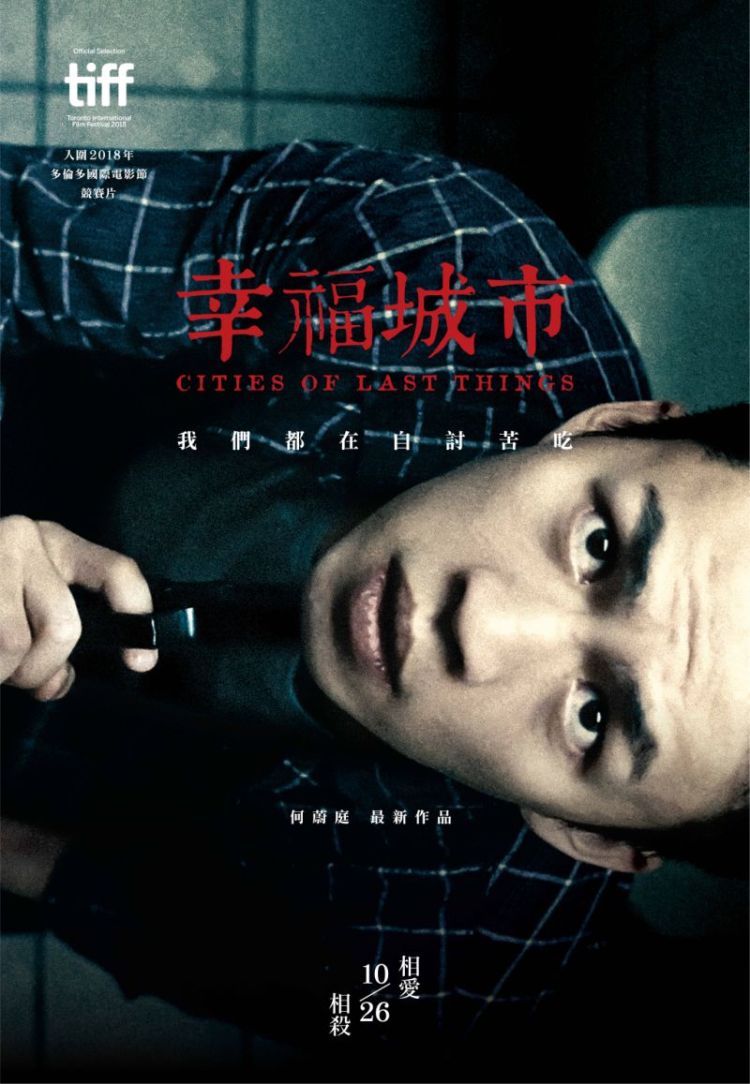 A sense of finality defines the appropriately titled Cities of Last Things (幸福城市, Xìngfú Chéngshì), even as it works itself backwards from the darkness towards the light. Still more ironic, the Chinese title hints at “Happiness City” (neatly subverting Hou Hsiao-hsien’s “City of Sadness”) but that, it seems, is somewhere its hero has never quite felt himself to be. Embittered by a series of abandonments, betrayals, and impossibilities, he grows resentful of the brave new world in which old age has marooned him.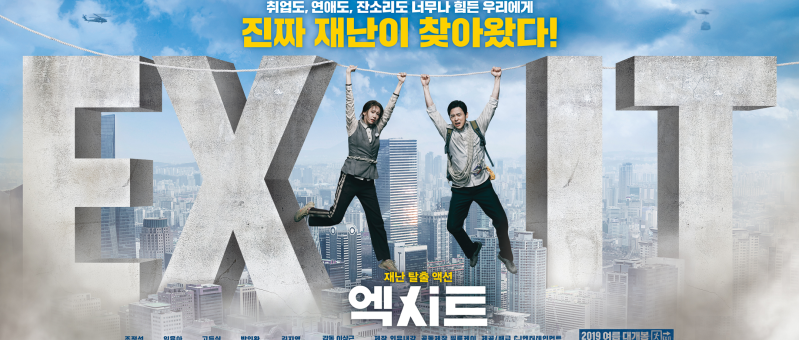
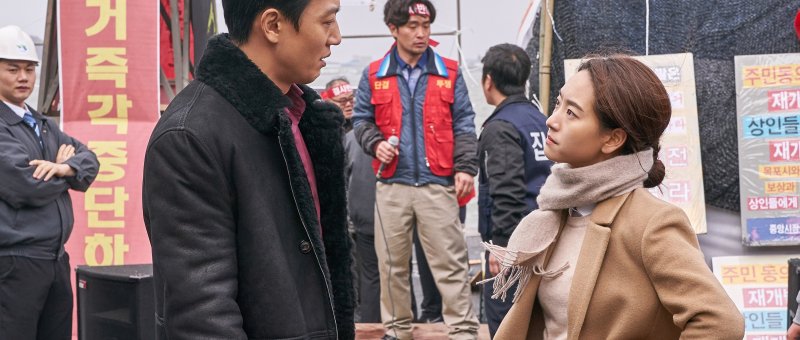
 “Hell Joseon” manifests as “toxic gas” in Lee Sang-geun’s Exit (엑시트). Millennial “slackers” losing out in Korea’s increasingly cutthroat economy find themselves consumed by their own sense of failure while those around them only compound the problem by branding them useless, no-good layabouts, writing off the current generation as lazy rather than acknowledging that the society they have created is often cruel and unforgiving. Yet, oftentimes those “useless” skills learned while having fun are more transferable than one might think and the ability to find innovative solutions to complex problems something not often found in the world of hierarchical corporate drudgery.
 Windows on Worlds