Lumberjack and Lady (與太者と小町娘, Hiromasa Nomura, 1935)

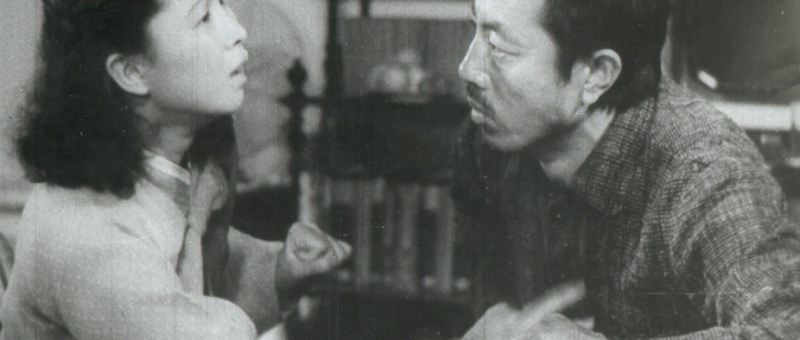
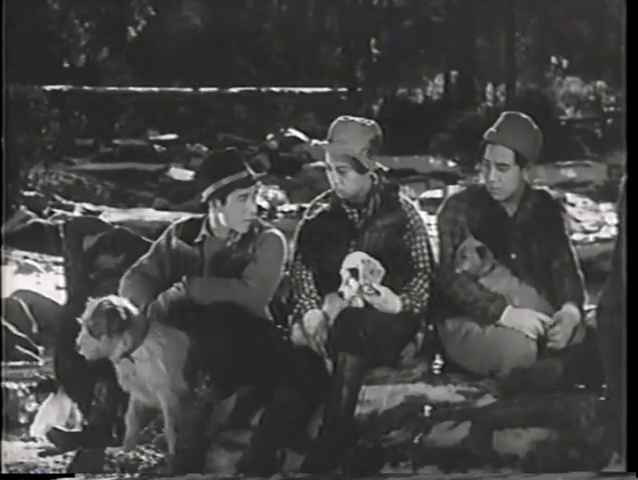
vlcsnap-2019-03-01-23h23m29s757Remembered mostly for his 1938 melodrama Aizen Katsura starring Kinuyo Tanaka and Ken Uehara, Hiromasa Nomura was a prominent studio director at Shochiku in the pre-war period before decamping to Shintoho in 1948 and then to Daiei in the mid-50s before shifting back to Shintoho and then to TV for the final part of his career. Much of his earlier work is presumed lost, but a late silent effort from 1935 Lumberjack and Lady (與太者と小町娘, Yotamono to Komachi Musume, AKA The Layabout and the Town Belle – part of the “yotamono” (layabout) series) seems to showcase a talent for slapstick comedy while perhaps engaging with the concerns of the time in its three heroes’ quest to defend their mountain against an evil upstart from the opposing peak.

The trouble begins when our three “stooges” get themselves stuck on a logging cart and accidentally end up on the other mountain where a rival logging group run by the fabulously moustachioed Torazou (Isamu Yamaguchi) are not exactly happy to see them. Just when things look grim for our heroes, Torazou himself shows up and saves the day, handing them a letter to take back to their boss, Kaheiji (Sojin Kamiyama). The letter, however, contains ill tidings – Torazou wants the hand of Kaheiji’s pretty daughter Kayo (Yoshiko Tsubouchi) and makes plain that he’s not about to take no for an answer.

The early part of the film revolves around the comical exploits of our three bumpkins who are always accompanied by their three adorable dogs. The guys are all, predictably, in love with Kayo but in a dreamy, innocent sort of way – there is no conflict between them over their shared love of the boss’ daughter, only a sort of pure hearted camaraderie and a desire to make sure the best is done for her which means putting paid to the evil Torazou once and for all.

In a mildly interesting twist, it’s clear that the Kaheiji gang are the poor but honest crowd. Our guys dress in torn and battered clothing, remaining unable to pay off their tabs with the wily old lady who runs the local store even after old Kaheiji has given them some money to go out on the town. Torazou’s boys, however, seem to be doing much better. Torazou himself is portly man in early middle age who is always accompanied by his bizarrely tiny henchman who is always ready to repeat whatever it was his boss just said only with additional menace. It’s clear we don’t want Kayo to fall into his clutches lest her innocence be polluted by his grubby little hands. A mustache twirling villain, Torazou is perhaps as close as you might be able to get in 1935 to a personification of the evils of the age as an exploitative capitalist fat cat who thinks he can do as he pleases because he has the most minions and the most friends in handy places. Not much of strategist, he thinks nothing of trying to force himself on the grieving Kayo as she bends over a grave, somehow convinced that this will be a surefire way to win her love and pave the way to a happy marriage.

The action takes an unexpected direction in the second act after a key player mysteriously falls off a cliff in true silent movie fashion. Realising they need to find a “suitable” husband for Kayo (i.e. someone not like them but of a higher social class), the guys run into “Mr. Yamazaki” (Den Obinata) from Tokyo who, unbeknownst to them, is Kaheiji’s chosen successor and a potential fiancé. Kenji brings some Tokyo class out to the mountains along with a little youthful hotheadedness in which he cannot help but refuse to back down in the face of Torazou’s continuous shenanigans – an act which accidentally puts Kayo in danger while he fixates on proving himself the bigger the man.

A light and fluffy escapade, albeit one which perhaps subtly reinforces some of the ideas many maybe seeking escape from, Lady and Lumberjack is largely built around the slapstick adventures of our three idiot heroes which are enlivened by the fresh mountain air and beautiful location shooting. Drawing inspiration from popular Hollywood silent comedies, Nomura perhaps fails to tie his series of set pieces together in a suitably coherent fashion but fully embraces the film’s sense of silly fun (mostly had at the expense of the decidedly dim, if essentially good, lumberjacks) while ensuring a victory for the honest little guy against the forces of selfishness and corruption.
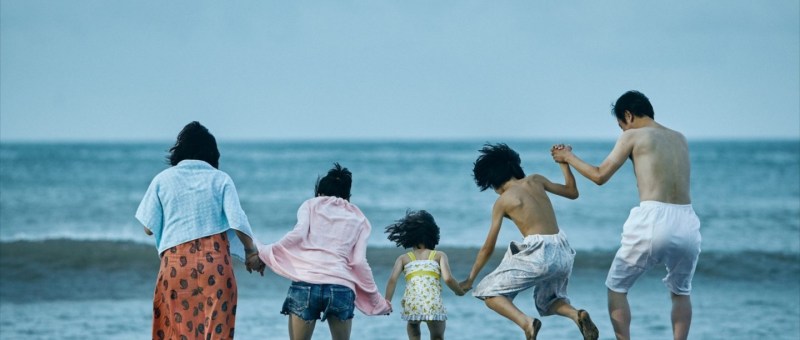
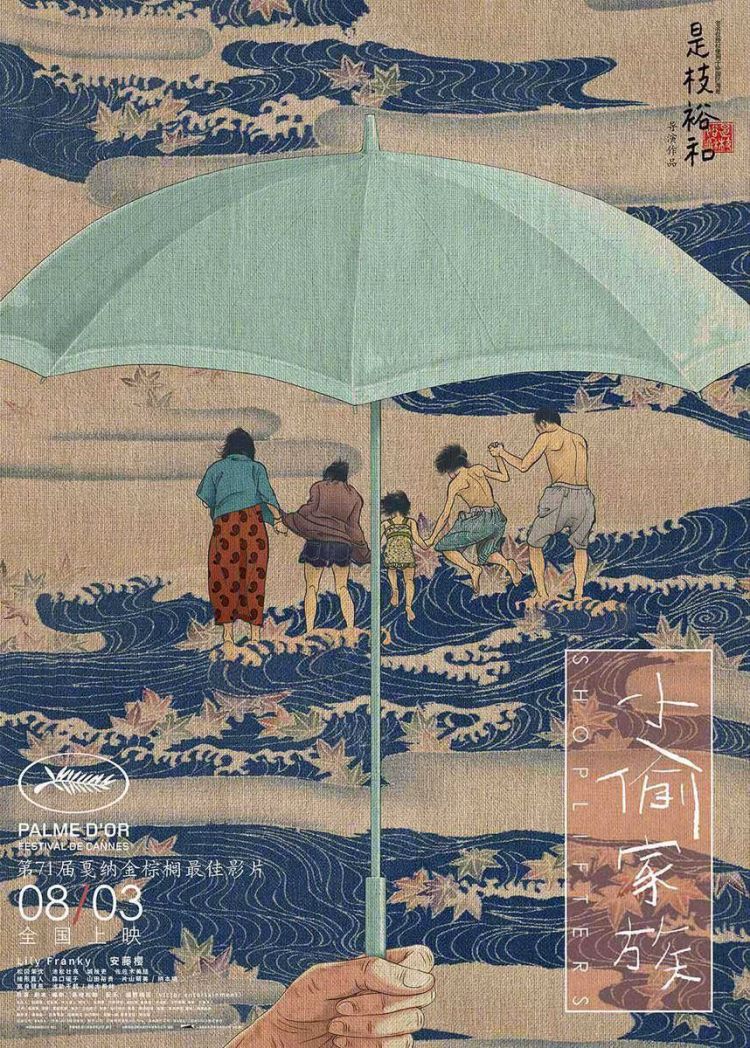
Shoplifters Sweeps 42nd Japan Academy Prize

Shoplifters poster 2The 42nd Japan Academy Prize was presented at Grand Prince Hotel New Takanawa on 1st March, 2019. Hirokazu Koreeda swept the board for a second year in a row with his Palme d’Or winning family drama Shoplifters which picked up eight awards including Picture, Director, Actress, and Supporting Actress. Meanwhile, Kazuya Shirashi’s retro gangster epic The Blood of Wolves picked up prizes for both of its leading men as well as a handful of technical awards.

Picture of the Year

Shoplifters still 2

Animation of the Year

Mirai banner

  • Dragon Ball Super: Broly (Tatsuya Nagamine)
  • Penguin Highway (Hiroyasu Ishida)
  • Mirai (Mamoru Hosoda)
  • Detective Conan: Zero The Enforcer (Yuzuru Tachikawa)
  • Okko’s Inn (Kitaro Kosaka)

Director of the Year

shoplifters still 5.jpg

Best Screenplay

Shoplifters still 6

Outstanding Performance by an Actor in a Leading Role

Blood of Wolves still 2

Outstanding Performance by an Actress in a Leading Role

Shoplifters still 3

  • Sakura Ando (Shoplifters)
  • Haru Kuroki (Every Day a Good Day)
  • Ryoko Shinohara (The House Where the Mermaid Sleeps)
  • Mayu Matsuoka (Tremble All You Want)
  • Sayuri Yoshinaga (Sakura Guardian in the North)

Outstanding Performance by an Actor in a Supporting Role

blood of wolves still 1

  • Ittoku Kishibe (Sakura Guardian in the North)
  • Dean Fujioka (Recall)
  • Hidetoshi Nishijima (Life in Overtime)
  • Kazunari Ninomiya (Killing for the Prosecution)
  • Tori Matsuzaka (The Blood of Wolves)

Outstanding Performance by an Actress in a Supporting Role

every day a good day still 1

Outstanding Achievement in Music

Shoplifters still 4

Outstanding Achievement in Cinematography

Shoplifters still 8

Outstanding Achievement in Lighting Direction

Shoplifters still 9

Outstanding Achievement in Art Direction

Blood of Wolves still 3

  • Tsutomu Imamura (The Blood of Wolves)
  • Takashi Nishimura (Recall)
  • Mitsuo Harada (Samurai’s Promise)
  • Kyoko Heya (Sakura Guardian in the North)
  • Keiko Mitsumatsu (Shoplifters)

Outstanding Achievement in Sound Recording

Blood of Wolves still 4

Outstanding Achievement in Film Editing

One Cut of the Dead still 1

Newcomer of the Year 

(awarded to all nominees equally – announced along with nominations)

  • Moka Kamishiraishi (A Forest of Wool and Steel)
  • Shuri (Love At Least)
  • Yurina Hirate (Hibiki)
  • Kyoko Yoshine (Kasane, Samurai’s Promise)
  • Kentaro (Cafe Funiculi Funicula)
  • Taishi Nakagawa (Kids on the Slope, Lock-On Love)
  • Ryo Narita (Stolen Identity, The Antique)
  • Ryo Yoshizawa (River’s Edge)

Special Award of Honour from the Association

(Lifetime achievement awards – technical fields)

  • Yasuo Otsuka (animator)
  • Tadashi Kanada (still photography)
  • Tsutomu Sakurai (producer)
  • Keisuke Chiyoda (costuming)

Special Award of Honour from the Chairman

(Lifetime achievement awards celebrating contribution to the film industry)

  • Mariko Okada (actress and producer)
  • Keiko Kishi (actress)
  • Junya Sato (director and screenwriter)
  • Kiju Yoshida (director and screenwriter)

Special Award from the Chairman 

(Lifetime achievement award presented to members of the film industry who passed away during 2018)

  • Isao Takahata (animation director)
  • Yuriko Hoshi (actress)
  • Masahito Tsugawa (actor)
  • Kirin Kiki (actress)
  • Sadaji Yoshida (cinematographer)
  • Mitsuru Kurosawa (producer)

In Memoriam 

(special section commemorating previous winners of the special awards who passed away in 2018)

  • Tadashi Sawashima (director)
  • Chuji Kinoshita (composer)
  • Shinobu Hashimoto (screenwriter, director, and producer)

Special In Memoriam 

  • Masayuki Nagare (world renowned sculptor and founding member of the Japan Academy Prize as well as the designer of the trophy).

Popularity Awards

(nominated by an All Night Nippon audience poll)

Movie: One Cut of the Dead

one cut banner

Actor: Kentaro (Cafe Funiculi Funicula)

Kentaro Cafe Funiculi Funicular

Source: Japan Academy Prize official website

Hurrah! For Freedom (自由万歲 / 자유만세, Choi In-kyu, 1946)

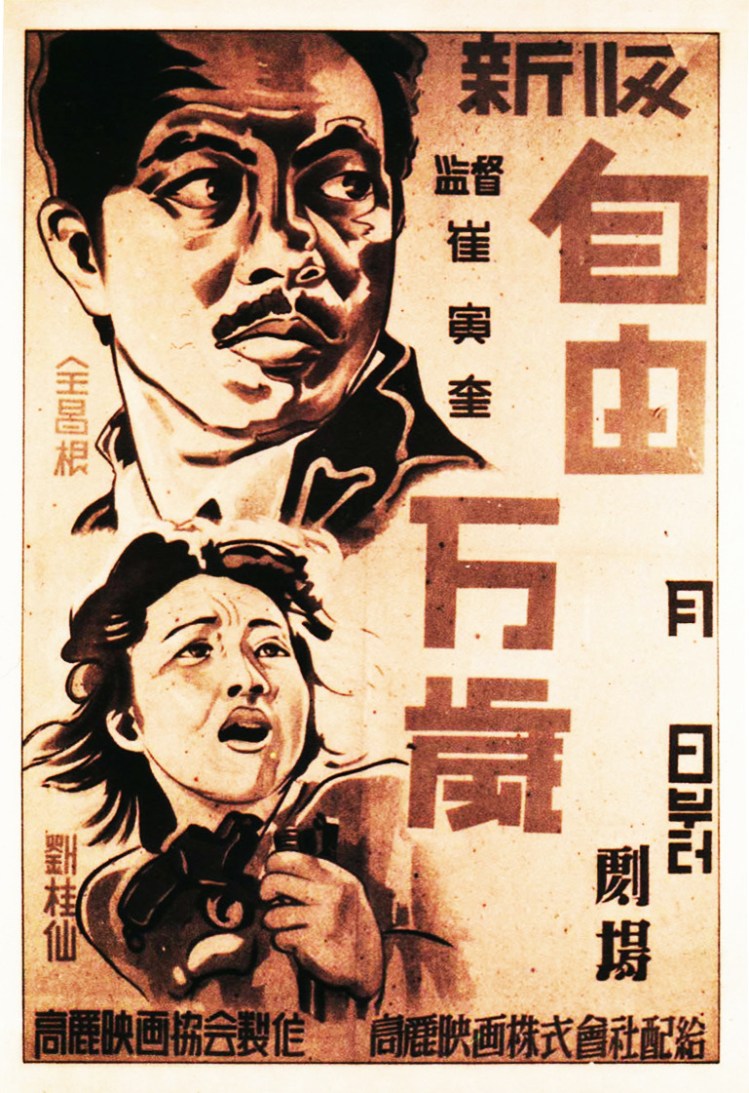
hurrah for freedom posterAttempts to foster a Korean film industry had often been frustrated during the colonial era throughout which aspiring filmmakers found themselves dependent on the Japanese film industry for financial and technological assistance while forced to produce increasingly overt Imperial propaganda under the ever tightening grip of the militarist colonial government. Hurrah! For Freedom (自由万歲 / 자유만세, Jayu Manse), the first film produced after the liberation, was then an aptly titled chance to start anew, create a new film language for a new young nation finally free of what some saw as decades of brutal oppression which made successive attempts to erase a national character.

Sadly, we cannot quite know exactly what director Choi In-kyu intended to create with this the first truly “Korean” film because so little of it survives intact, not because like much colonial cinema it was simply lost but because it bears witness to the next chapter in Korea’s unhappy 20th century history in undergoing severe editing during the oppressive era of Park Chung-hee’s military government who decided to remove scenes featuring popular pre-war actor Dok Eun-gi who, like many in his position, eventually defected to the North after the Korean war. As for Choi himself, he perhaps felt he had some atonement to do for having remained complicit with the Imperial machine. Following the completion of 1941’s Angels on the Street, he’d vowed to never to direct another pro-Japanese film but was eventually persuaded to return by the right-wing Han Hyung-mo (also the cinematographer on this film) and made a further three propaganda movies the last of them in 1945.

Nevertheless, Hurrah! For Freedom opens with a tribute to those brave Resistance fighters who gave their lives for liberty. Our hero is cell leader Choi Han-joong (Jeon Chang-geun – also the film’s scriptwriter) whose friend is killed while fleeing from Japanese police after being denounced by collaborator Nam-bu (Dok Eun-gi). Forced into hiding, Han-joong is lodged with a friendly nurse, Hye-ja (Hwang Ryuh-hee), who seems to have become fond of him though he remains distracted by his Resistance activities even if he does eventually notice the flowers that she bought him as a token of affection. While saving another comrade from the police and rescuing some explosives in the process, Han-joong ends up taking refuge in the flat of none other than Nam-bu’s main squeeze Mi-hyang (Yoo Kye-sun) who also develops a crush on him.

Though Nam-bu, an obvious bad guy antagonist, is sidelined by the demands of ‘70s censorship, the main thrust of the drama is conveyed by the melancholy figure of Mi-hyang who eventually becomes a symbol of betrayed, thwarted ambition and the relative impossibility of redemption for those who made “weak” choices during the colonial era (as you could perhaps accuse Choi himself along with the entire film industry of having done). Mi-hyang, having fallen for Han-joong’s passionate intensity, decides to betray Nam-bu by giving valuable information she has obtained from him to the Resistance, little knowing she has been weaponised in a plot laid by her vindictive former lover.

Nevertheless, her true love confession is rejected by Han-joong whose only lover is the revolution. Han-joong, reminding her that he is a man who could be killed at any moment flits between talking of his bright future and his dark end. He reassures Mi-hyang that, despite her past, she like everyone else has the right to start again but coldly insists that she does not have what it takes to join the cause and should return to her hometown and safety. Denied the right to be by his side in life, Mi-hyang affirms that she will be the one to tend Han-joong’s grave, suddenly returning this talk of new beginnings to the nihilistic struggle which seems to define Han-joong’s existence.

Nevertheless, in contrast with the defeated figure of Mi-hyang who must pay not only for her “weakness” in complicity with the colonial regime but also for her sexual transgression with an “enemy”, the saintly Hye-ja remains pure and brave – a brighter mirror for the gloomy Han-joong who seems surely destined to be her romantic hero as the pair of them fight earnestly for a freer future. Sadly, this is where we leave them – in media res as the film cuts out just at its most climactic moment as if affirming that this is a revolution very much in progress. Choi, shifting away from the realism that defined his earlier work, seems to be reaching for a new cinematic language with which to begin a new era free of colonial constraints. History, however, would defeat them all as this short period of hard won liberty would lead eventually to another conflict and another oppressive dictatorship. Choi himself went missing during the Korean War, presumably either killed or fled to the North. Nevertheless, what we can discern from the extant lessons of Hurrah! For Freedom is that there was perhaps more appetite for nuance than might have been expected even if sympathy for the collaborator does not quite extend to forgiveness.


Hurrah! For Freedom was screened as part of the Early Korean Cinema: Lost Films from the Japanese Colonial Period season currently running at BFI Southbank. Also available to stream online via the Korean Film Archive’s YouTube Channel.

What’s For Dinner, Mom? (ママ、ごはんまだ?, Mitsuhito Shiraha, 2016)

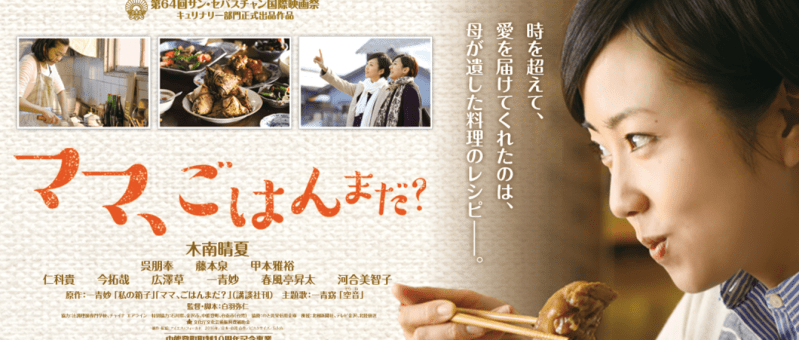
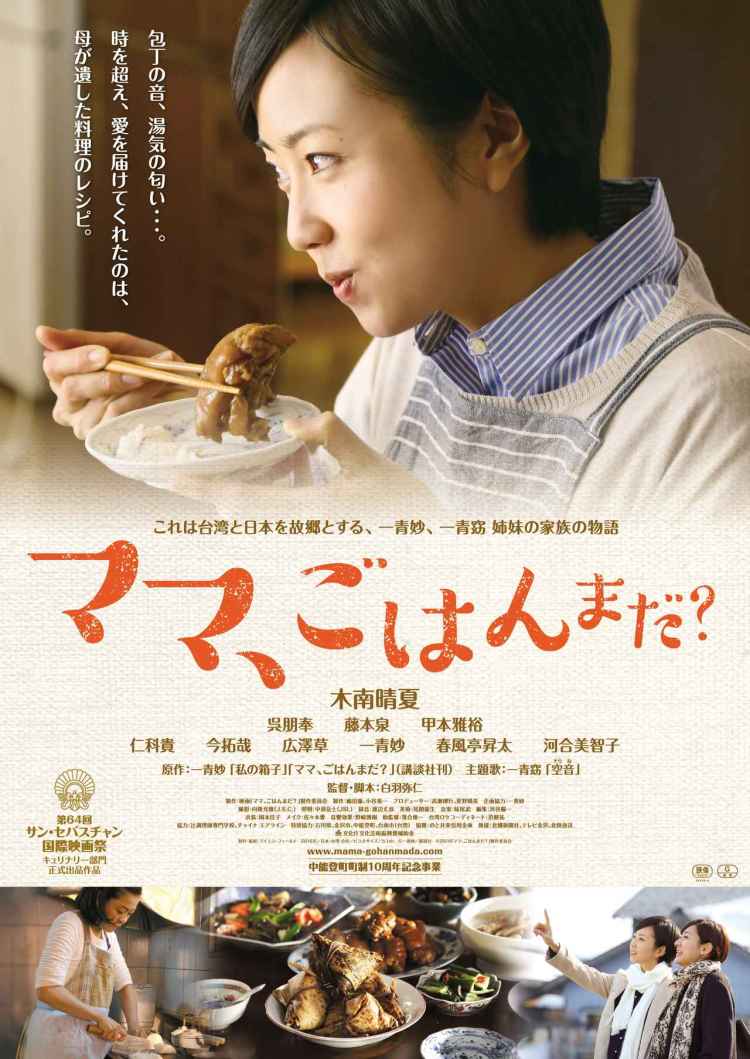
What's for Dinner Mom posterJapanese cinema has a preoccupation with mothers and the nature of motherhood, but the mothers of the typical “hahamono” tend to be either saintly, self sacrificing figures whose selfless love often goes unrecognised, or problematic matriarchs whose fierce love and desire to protect their children has caused them to transgress and perhaps lose their children’s love. The mother at the centre of What’s For Dinner, Mom? (ママ、ごはんまだ?, Mama, Gohan Mada?) falls into a more realistic category – loving, self sacrificing, imperfect and perhaps sometimes misunderstood but always doing the best for her two daughters even in difficult circumstances. Where What’s For Dinner, Mom? differs from the accepted pattern is in its use of the domestic world to ask questions about culture and identity, and about all the various ways one never quite knows one’s family.

Tae (Haruka Kinami) and Yo (Izumi Fujimoto), sisters and now middle-aged women, are preparing to clear their family home 20 years after the death of their mother (Michiko Kawai). What’s taken them so long to make the decision is never revealed but both are as happy as possible about the idea and it seems Tae and her husband plan to knock the house down and build their own on the same plot – not quite so radical a thing as it might sound, Japan has no real housing market and “modern” houses are often knocked down and rebuilt every 20 to 30 years. Whilst packing things away, Tae finds a small box full of her mother’s keepsakes – chiefly letters and photographs along with a handwritten recipe book she began keeping in 1972.

Though Tae has lived in Japan for all her adult life, she was born in Taiwan and is half Taiwanese. Tae’s father passed away from lung cancer when she was small, but was a depressed, sometimes difficult man with ambivalent feelings towards his home nation. His own family had come from the mainland, but he’d lived in Taiwan under Japanese rule and attended university in Japan. He felt himself to be Japanese and was constantly upset and angry about the turbulent political situation of the post-war nation, facing its own series of identity crises and a protracted period of oppressive martial law.

Nevertheless, after their unpredictable whirlwind romance, Tae’s mother Kazue moved to Taiwan to live with her husband’s family and became determined to adapt to the local culture – chiefly through food. After her husband died in Japan, Kazue kept Taiwan alive for her daughters through continuing to cook the dishes she’d learned from her friends and family in Taiwan (even though her intensely “Japanese” husband only ever wanted to eat yudofu). Though Tae at one point urged to her mother to stop cooking Taiwanese and give her stereotypically cute high school bento, she quickly realised her mistake and Kazue’s unusual Taiwanese cooking became a local hit (even boosting the availability of the previously unobtainable pig’s trotters).

Despite her love of the food, Tae has all but forgotten her Taiwanese roots since her mother’s death and doesn’t know how to cook any of the dishes herself. Tae’s mild identity crisis comes to the fore in the second half of the film, though it’s an oddly under developed plot strand given the centrality of the cuisine. When she eventually makes the decision to visit her father’s remaining family, Tae seems to understand Taiwanese Mandarin but usually replies in Japanese (her uncle, accompanying her, is fluent). Like Kazue’s diary, Tae’s reminiscences are accompanied by on screen intertitles written in Chinese characters drawn childishly (even the characters which are identical to those used in Japanese are somewhat awkwardly rendered), which points to a kind of duality but is never really resolved even if Tae is able to explain a strange childhood memory and bring a piece of her past home with her.

Through her food odyssey and return to source, Tae is able to appreciate her mother’s love and sacrifice from an adult perspective, no longer left with teenage resentment and unfair anger over her early death but reclaiming her happy memories and appreciating the hardship her mother must have faced as a single mother in pre-bubble Japan. Despite its warm and fuzzy tone, What’s For Dinner, Mom? occasionally seems as if it wants to do something bigger by briefly introducing larger themes – Tae’s father’s depression, illness, the difficult political situation of post-war Taiwan, and the complex interplay between the two nations, but is content to settle back into a comforting “hahamono” tale of selfless motherhood finally appreciated only when it’s too late. Nevertheless it does what it set out to do in telling the story of a warm and loving family anchored by a kind yet determined woman and tables full of wholesome home cooking offered with an open, internationalist, heart.


Original trailer (English subtitles)

Deep River Melody (風流深川唄, So Yamamura, 1960)

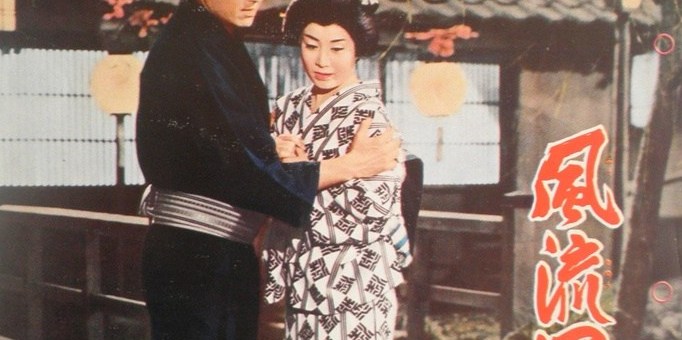
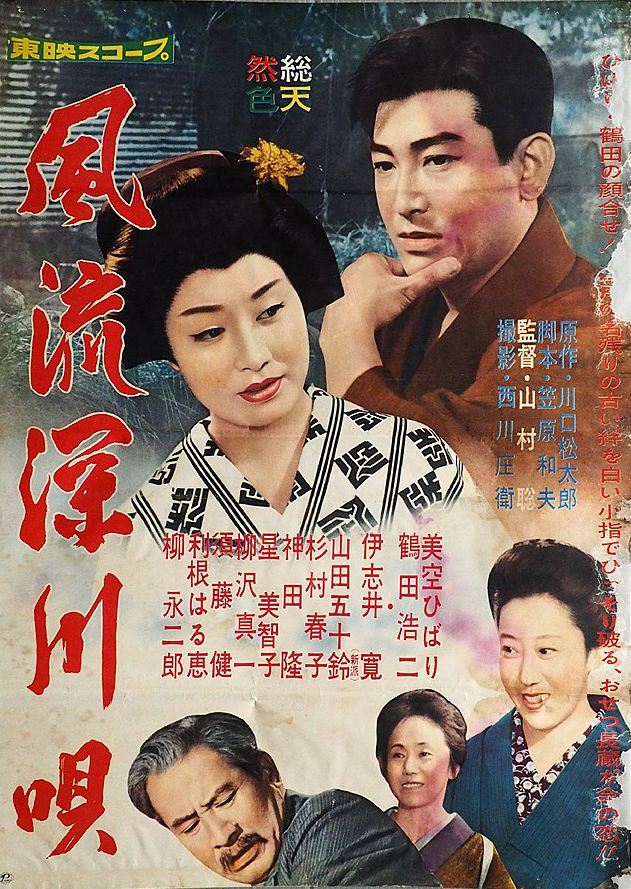
Deep River Melody poster 2An actor with a long and distinguished career, So Yamamura first stepped behind the camera in 1953 with an adaptation of the famous proletarian novel by Takeji Kobayashi, The Crab Cannery Ship (later adapted by Sabu in 2009), and eventually completed six features. Deep River Melody (風流深川唄, Furyu Fukagawa Uta), released in 1960 and adapted from a novel by Matsutaro Kawaguchi, was last among them and starred post-war singing sensation Hibari Misora in the leading role. Hibari Misora was a frequent presence at Toei through the ‘50s and ‘60s, appearing in a series of musical dramas both period and contemporary but Deep River Melody is among the small number of purely dramatic pieces in which she starred which do not feature any musical numbers even over the opening and closing.

Set in the early years of militarism, the story revolves around Setsu (Hibari Misora) – the daughter of a restaurant owner, and her head chef, Cho (Koji Tsuruta). Having grown up together, Setsu and Cho have quietly fallen in love but these are times in which it is difficult to state one’s feelings plainly. Luckily, Setsu’s father, Isaburo (Kan Ishii), and his warm hearted mistress (Isuzu Yamada), have noticed the growing affection between the pair and are only too happy for them. What could be better after all than the head chef marrying into the family? Despite some qualms on Cho’s side in breaking a class ceiling taboo, the matter appears to be settled and both he and Setsu are blissfully happy.

However, tragedy soon strikes. Isaburo unwisely agreed to become the guarantor of a loan taken out by Shunsuke Ohta (So Yamamura) – the leader of the communist party in Japan (not an easy thing to be amid the rising tides of militarism). He, of course, defaults on the loan putting the restaurant at risk. The other relatives, learning of the prospective marriage between Setsu and Cho are extremely unhappy, viewing it as improper for mere servant to inherit the restaurant. Isaburo stands firm, but matters are pushed to crisis point by grumpy uncle Koshikawa who is determined to act as a go-between for the wealthy son of a rival restaurant who has long had designs on Setsu.

Though this is definitively a pre-war story, many of the problems faced by Setsu and Cho are the same as those in Hibari Misora’s contemporary movies in that she, in particular, finds herself trapped by a series of outdated social codes in which her extended family expect her to consent to marry a man she does even like for money in order to save their “good” name. They believe Isaburo is a feckless fool who has lost the restaurant through a needless gesture of loyalty towards a man who had been good to him in the past and was now in trouble. Isaburo places human relationships above money and politics, remaining uninterested in the relatives’ insistence on class hierarchies and preservation of the family’s good standing. Though he may, to a degree at least, be sympathetic towards Ohta’s political intentions, he acts as guarantor out of respect and gratitude rather than deep belief in a cause.

Nevertheless, the barriers between Cho and Setsu are less physical than they are psychological. Cho, raised as a servant, feels himself inferior and has difficulty accepting Isaburo’s talk of marriage owing to their differing social status. Isaburo, somewhat embarrassed, has not yet spoken with Setsu, but then knows his daughter well and is right in assuming the pair will eventually sort things out on their own if given a gentle push. When the relationship is tested by the restaurant’s failure, Isaburo and Setsu stand firm. No one entered this relationship for the wrong reasons – Cho loves the restaurant and everyone who works in it, but he fell in love with Setsu independently and would marry her for nothing. He remains uncertain, however, if his devotion is selfish and if the best way to love her is to leave her and allow her to save her familial legacy by marrying a man with money.

Like many post-war films, Deep River Melody is essentially about learning to let go of outdated ideas and that the maintenance of tradition is less important than individual happiness. Setsu and her father are ready to let go rather than commit themselves to a course of lifelong unhappiness solely to please their snooty relatives. Cho, however, struggles to free himself of a feeling of social inferiority. His own family tell him that his desire to marry Setsu is not only wrong but dangerous, that they have built a life for themselves though being loyal servants and that crossing the class divide risks all of their futures. Conflicted, Cho remains unwilling to fight for his love because he does not believe he can win and not only that, he feels it would be inappropriate to even try. If the pair are to find true happiness, they will have to find the courage to move on from the past and build their own future free of feudal ideas but to do so will require both sacrifice and support in the belief that a better life is possible.


Running Wild (야수, Kim Sung-soo, 2006)

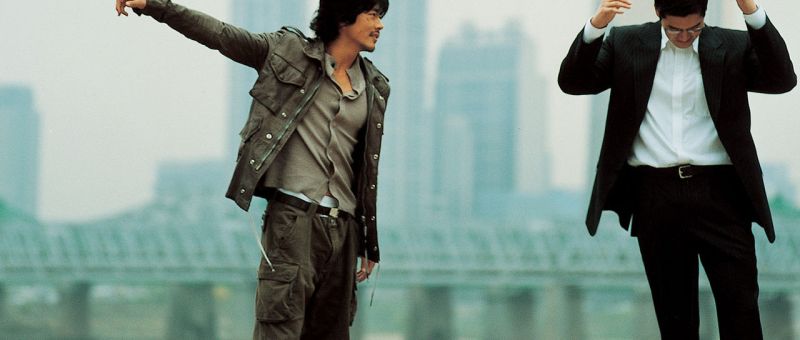
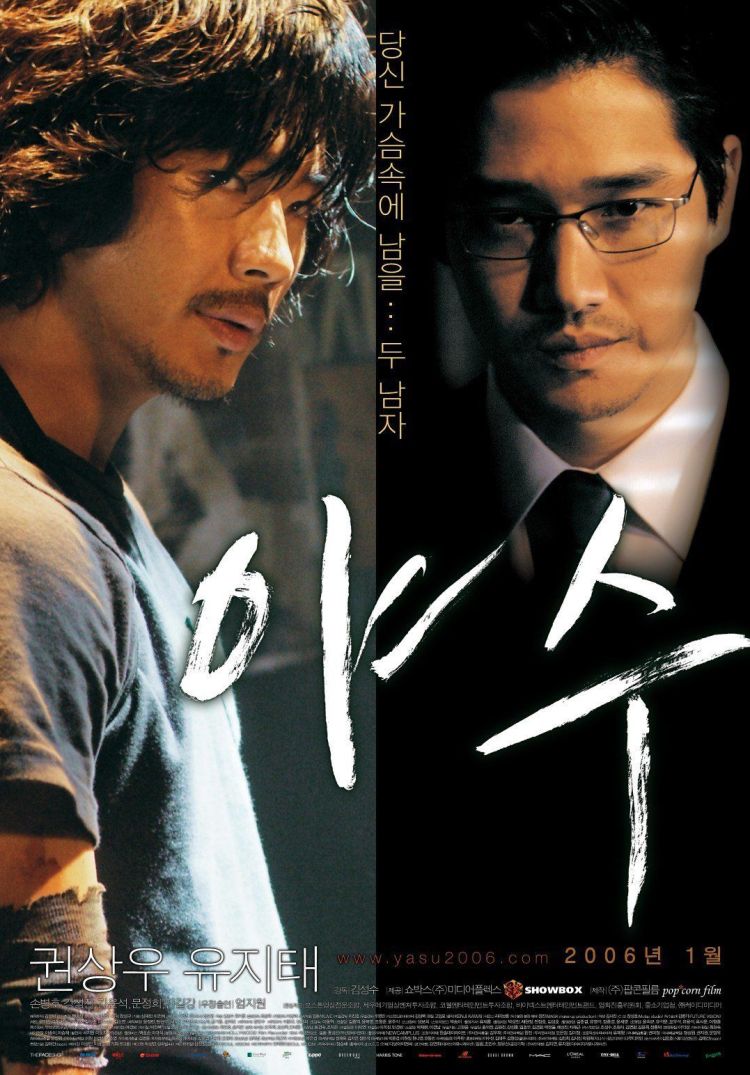
Running wild posterHeroic bloodshed meets corruption drama in the retro debut feature from Kim Sung-soo (b. 1971 – not to be confused with the director of Beat/Asura), Running Wild (야수, Yasu). Over the top macho action mingles with saccharine family drama as two seemingly very different law enforcement officials realise they aren’t that different after all as their relentless pursuit of a mob boss turned “legitimate businessman” with political aspirations becomes increasingly intense. Filled with typically 70s touches from split screens to zooms and descents into ridiculous displays of male aggression set against the pounding rhythms of an action score, Running Wild is a story of the law on fire but one which never quite knows which side it’s on.

Straight-laced prosecutor Oh (Yoo Ji-tae) has been slumming it in the boonies for the last few years after his attempt to bring down top gangster Yoo Kang-jin (Son Byong-ho) was derailed because of the dirt Yoo has on a selection of important people. Stopping only to take out a local big wig mobster, Oh is finally on his way back to Seoul with settling scores firmly on his mind. Meanwhile, maverick cop Jang (Kwon Sang-woo) collects his younger half-brother from jail and takes him to see their seriously ill mother in hospital. While Jang is busy meticulously filling in a lottery ticket, Dong-jik (Lee Joong-moon) is knifed by his old buddies and so Jang now has his own score to settle with the Dokang family.

Eventually teaming up to take down their common enemy, Jang and Oh have very different approaches to law enforcement. Oh hates the likes of Yoo because they break the social order while Yoo is a bully who profits from the suffering of others and laughs at the likes of Oh while he does it. Oh believes in the supremacy of the law, that the law is his greatest weapon and the one unassailable force that even men like Yoo will eventually have to submit to. Yoo feels differently. For Yoo the law is an irrelevance or even a symbol of other men’s naivety; he will overcome it and live outside of its control.

While Oh pins his hopes on the proper operation of the law, Jang pins his on his fists. Flailing wildly, Jang is more thug than cop – urging Oh to abandon his ridiculous righteousness and do what it takes to take the bad guys down even if that means planting evidence and beating information out of suspects. He is a classic angry man, frustrated by his powerlessness in the face of his mother’s illness and his inability to protect his makeshift family. Blaming himself for Dong-jik’s death and for failing to prevent his flirtation with criminality, Jang spars with his step-sister, half rejecting her role as primary care-giver to the mother he can’t save and part longing to see her as a true and permanent member of the family which constantly eludes him.

Family becomes a recurrent theme as both Jang and Oh ruin their respective relationships through their unconventional working lives. Despite finally getting back to Seoul, Oh’s wife plans to leave the husband whose obsession with his work, or more particularly his vendetta with Yoo, has consumed him while Jang’s family life remains a total mess. Yoo, by contrast, now a legitimised CEO playing golf with the rich and famous, enjoys lovely family meals with his elegantly dressed wife and cute little children who seem to adore him.

The law, it seems, is not robust enough to withstand the finagling of the corrupt criminal class who ride the waves of their power and influence all the way to the top. Oh steps further towards the edges of his noble goal, at which point he has to admit his quest is also one of personal revenge more than of truth or justice. Both men ruin themselves in stupid acts of self destruction, turning themselves into grenades thrown against a regime content to protect its inherent injustices. Running Wild, the pair fight fire with fire but also become victims of the system which oppresses them. Kim piles on the retro style but lets the old fashioned heroics run away from him abetted by the bombastic Kenji Kawai score. Nevertheless, Running Wild is a stylish enough calling card even if its aesthetics trump its sincerity.


Currently streaming on Netflix UK (and possibly other territories)

Original trailer (English subtitles)

A Boy and His Samurai (ちょんまげぷりん, Yoshihiro Nakamura, 2010)

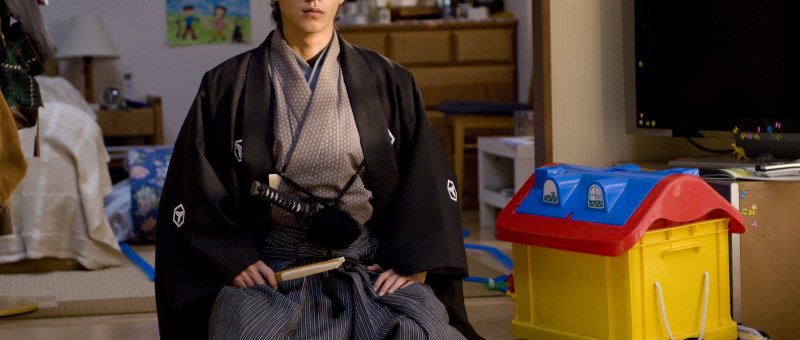
Boy and his samurai poster 1Edo/Tokyo – what difference can a name make? A lot, it seems, but then perhaps not so much as you’d think. “Edo” was the seat of power in Japan from 1603 until it was renamed “Tokyo” during the Meiji Restoration, heralding a brand new era of modernity following more than 200 years of self-imposed isolation. Logically, there must have been people who went to sleep in Edo and woke up in Tokyo, but most of them didn’t nap for nearly 200 years. The hero of A Boy and his Samurai (ちょんまげぷりん, Chonmage Purin) didn’t exactly nap either, but he’s fetched up 200 years in the future, which, you have to admit, is very disorientating.

Divorced single mother Hiroko (Rie Tomosaka) is late getting her 6-year-old son Tomoya (Fuku Suzuki) out of the house and on his way to school so she’s less than interested when he suddenly stops in the street to stare at a severe man in samurai dress standing outside a supermarket. Assuming it’s some kind of advertising stunt, Hiroko drags her son away, but the man turns up again later wandering around their apartment block and seemingly very confused. Hiroko tries to help him, but he is extremely rude and intimidating, eventually demanding to be taken back to her apartment almost at sword point. Nevertheless, once everyone has figured out the man, who says his name is Kijima Yasube (Ryo Nishikido) and he’s a samurai retainer, is either quite mad or a time traveller, the trio being living together and trying to bridge their very different social values.

Those values have obviously changed a lot, but in many ways not enough. Hiroko has a regular job at an advertising agency but is disrespected by some of her colleagues because she can’t work overtime and has to leave early to make sure someone picks up Tomoya. We learn that the reason she divorced her husband two years ago is that while he pretended to be modern and progressive, he was unwilling to share his portion of the domestic burden and secretly wanted his wife to quit work and look after the house despite superficially encouraging her with her career. Hiroko figured it made no difference if he was around or not, so she left him and took Tomoya with her. Hiroko likes her job, but working also reinforces her individual identity (even if blending into the corporate) aside from that of wife and mother which has all too often been all that a woman is in a rigid and conformist society.

Indeed, when Yasube first arrives he adopts a superior tone and refers to Hiroko only as “woman”, viewing her as necessarily inferior by reason of sex while also reasserting himself as a samurai communicating with someone he assumes to be of the lower orders. Yasube is stunned to learn that Hiroko has a surname – a reminder that those of the lower orders did not (officially) have surnames until the Meiji Restoration. He now thinks she must be very noble, adopts a suitably humble tone, and resigns himself to accepting her hospitality in the absence of other options. He can’t get his head around her family situation or process the various motions towards sexual equality the modern world has produced. To him women manage the house and men protect it from outside. He finds Hiroko’s desire for independence strange and this new world uncivilised.

Nevertheless, he decides to give the Tokyo way a go by stepping briefly beyond himself – in return for room and board, he’ll effectively become Hiroko’s “wife”, managing all the domestic chores while she concentrates on her career. Yasube finds a strange affinity for domesticity, quickly getting to grips with white goods and taking recipe notes from cooking TV (to write them down with ink and a brush using classical Japanese script). Despite never tasting them before, he finds himself a natural baker providing sweet treats for all. However, Hiroko perhaps disappoints herself by accidentally slipping into the role of workaholic salaryman, suddenly embracing the art of overtime and leaving everything at home in the capable hands of Yasube without really considering his feelings even if he never seems to resent it.

Trouble brews when Yasube gets the opportunity to build a career of his own as a pastry chef. Hiroko, true to her word, is encouraging and obviously wants to give him the opportunity to fulfil himself, but the same situation recurs – Yasube becomes obsessed with his professional development leaving little Tomoya brokenhearted and missing his surrogate dad. The problem isn’t so much gender roles as a reluctance to fully commit by agreeing to share domestic responsibilities equally in recognition of equal commitment to a mutual endeavour. Then again, Yasube disappoints – his Edo ethics reassert themselves. he answers Hiroko’s pleas that he spend more time with Tomoya by suggesting she quit her job so he won’t be lonely while his wages can support them as a family. He thinks he’s saying something nice, confirming his loyalty to them as a father figure who will protect and provide, but it’s the wrong the thing to say and only goes to show that his “ancient” way of thinking is sadly not quite archaic enough.

Likewise, his old-fashioned parenting style of fatherly authority advanced with shouts and stares would likely not be approved by most today but it does uncomfortably seem to be accepted by the film, as if Tomoya needs male parental input rather than just benefiting from having a mum who’s less tired and stressed out for having someone to share her life with. He does, however, soften on exposure to Tokyo liberality, willingly embracing modern equalities in realising that there’s nothing wrong with a man supporting a woman and a child in ways other than the financial even if he eventually goes back on it when presented with the opportunity to reassert his male pride as a provider, declaring that domestic matters “no longer concern” him now that he has “other duties”. “Tokyo” still has a ways to go (where doesn’t?), but it’s moving in the right direction even if there are some who are content to be slow in catching up.


Original trailer compilation (no subtitles)

Marriage (結婚, Keisuke Kinoshita, 1947)

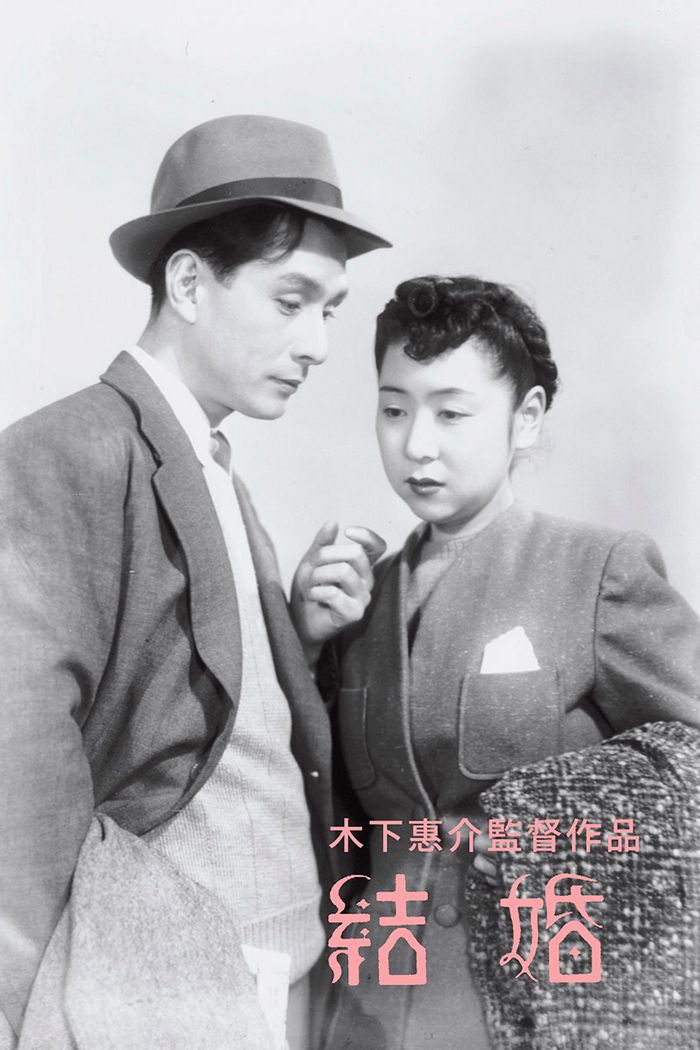
Marriage DVD coverGenerally speaking, the heroes in the world of Keisuke Kinoshita are those who stick steadfastly to their principles and refuse to become corrupted by the world around them. This is all very well but perhaps somewhat idealistic given the pressures of the post-war world. 1947’s Marriage (結婚, Kekkon) finds the director working with scriptwriter Kaneto Shindo whose view of humanity was perhaps a little more pragmatic than Kinoshita’s and therefore recasts his heroes as essentially good people who eventually come to the conclusion that their moral rigidity is causing more unhappiness than compromise might and that an acceptance of complicity may in fact be the only possible way forward.

Fumie (Kinuyo Tanaka) became engaged to Sugawara (Ken Uehara) before he went away to war and the couple have been waiting to marry ever since. Though Sugawara returned promptly, unharmed, and seems to be in regular employment, they have been unable to formalise their union because Fumie and her sister are the only members of her family currently working which means that they cannot do without her paycheck. Things begin to look up when Fumie’s father Kohei (Eijiro Tono), formerly an accountant who lost his job when his previous employer went bust, runs into an acquaintance who’s now the owner of a successful restaurant. Shimamoto (Eitaro Ozawa) promises him a job which has the family overjoyed, not least Fumie who may now finally be able to marry, but their happiness is to be short lived. Kohei realises that Shimamoto’s business is built on underhanded practices intertwined with black market profiteering and wants no part of it. The two men argue. Kohei refuses the job and storms out. Fumie is back to square one.

Though Sugawara reiterates that he understands the demands of the situation they find themselves in and will wait as long as is necessary, he too is under pressure from his family to bring the matter to a suitable conclusion. Sugawara’s mother is in poor health and wants to see him settled before she goes. She understands that he has someone in mind, but would rather he marry as soon as possible even if that means marrying someone else entirely – for example, a lovely girl from the village whose omiai photo his aunt has helpfully delivered. Sugawara bears all of this with good grace, but stands firm in insisting he will wait for Fumie even if that means he never marries at all.

The dilemmas are two fold and occur across two generations. Fumie finds herself torn between a duty to her family who are now almost entirely dependent on her as a breadwinner, and her romantic desire to become Sugawara’s wife – a promise made before the war which the post-war world conspires to make impossible. Despite their dire circumstances, the Matsukawas are a happy family doing their best to muddle through though there is obvious tension between teenage son Kei (Shozo Suzuki) and his father over Kohei’s rigid refusal to compromise himself as the times seem to demand. Kinoshita captures the atmosphere of a precarious household with easy confidence, an icy silence descending as Kohei returns with a face like thunder making plain that his job opportunity has not worked out as planned. Everyone is upset and disappointed, but no one has the energy for an argument and so silence is all there is.

Fumie becomes ever more conflicted, especially after a strained meeting with Sugawara’s aunt who seems nice enough but drops a few hints about the girl waiting in the country and Sugawara’s sickly mother. She begins to wonder if her romantic dreams are selfish in a world so wracked with ruin that it seems unlikely that she will ever be in a position to marry. Perhaps it would be more responsible, or just less painful, to end things with Sugawara for good so that he at least can move on. As things stand, the couple only have their Sundays which are endlessly prolonged with additional activities to put off the time that they must part as long as possible. The destabilising visit from the aunt is followed by an awkward, almost celebratory dinner in which sake pushes difficult emotions to the fore. Fumie vacillates, unable to dance she eventually decides to give things a go, affirming that she will simply hold onto and follow Sugawara – seemingly unaware of the wider implications of her statement. During the dance, however, in which she is literally swept off her feet, she changes her mind again, shamed by her brief moment of joy into feeling selfish and self involved as if all those around her suffer in service of her eventual romantic fulfilment.

Where Kinoshita might have introduced a deus ex machina in which the Matsukawas would be the beneficiaries of divine reward for their selfless goodness, Shindo makes way for a more realistic (though perhaps equally melodramatic) solution in which Kohei reassumes his role of the head of the family and chooses his daughter’s happiness over his principles. As such he recognises that he must make the sacrifice that will save them all in abandoning moral righteousness and becoming complicit with the murkiness of the world in which he lives. Pragmatism, this time, wins out but only as a lesser evil in which a compromise is made in the favour of happiness which might, in a round about way, produce a greater change in an already unhappy world.


Titles and opening (no subtitles)

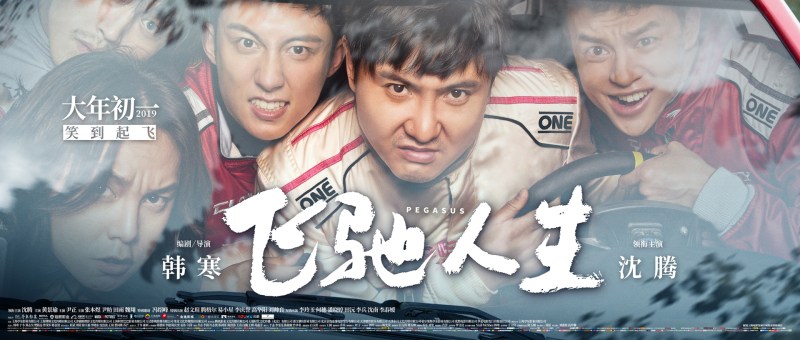
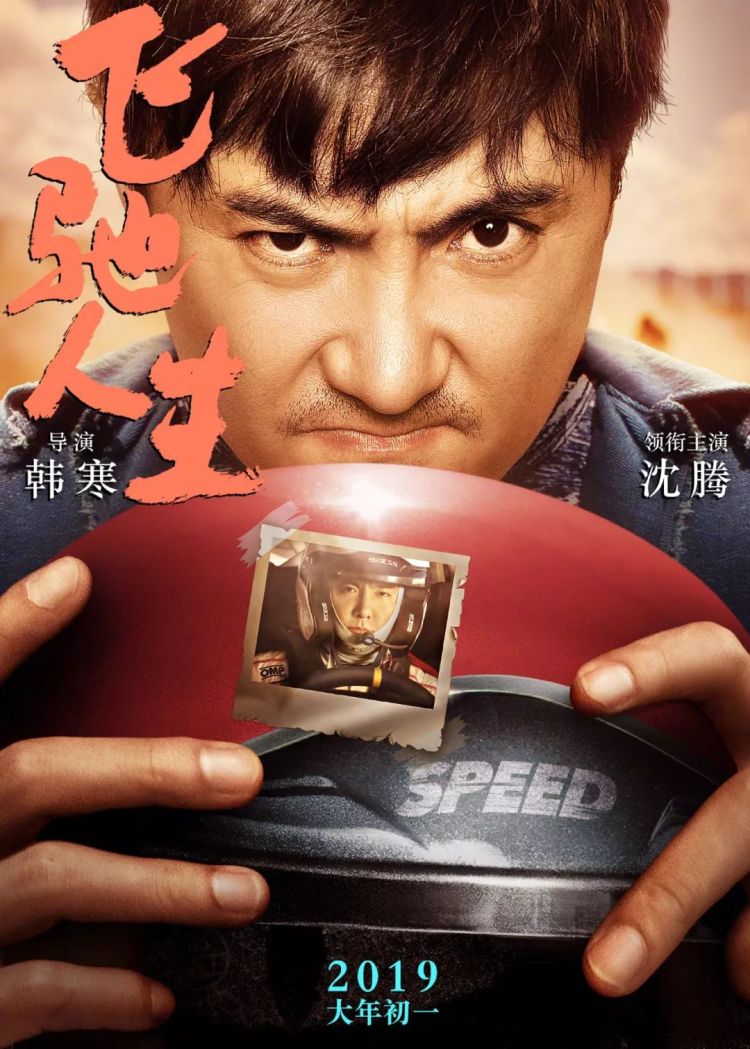
Pegasus (飞驰人生, Han Han, 2019)

Pegasus poster 1Traditionally speaking, New Year has often been a time for reconsidering one’s life choices, but can it ever really be too late to make up for past mistakes and charge ahead into a better future? The hero of Han Han’s New Year racing drama Pegasus (飞驰人生, Fēichí Rénshēng) is determined to find out as he tries to bounce back from disgrace and failure to prove to his young son that he was once a great man and not quite the hangdog loser he might at first seem. His battle, however, will be a tough one even with his best guys by his side.

Zheng Chi (Shen Teng) dreamed of racing glory and won it. He was a champion, the face on billboards across China, but a minor scandal put paid to his success and his driving and racing licenses have been suspended for the last five years during which time he’s been humbled and lived a workaday life as a fried rice stall vendor raising a young son alone. Now that his suspension is up for reconsideration, he’s beginning to wonder if he might be able to return to his rightful place at the centre of the podium but he’ll have to eat a considerable amount of humble pie if he’s to convince anyone that he’s a person worthy of respect now that he has nothing.

Director Han Han is, among other things, also a rally driver himself though his positioning of the sport within his tale of middle-aged loserdom is a slightly awkward fit. Racing is an expensive hobby, it quite literally relies on the involvement of those who have vast resources of disposable cash they can use to sponsor drivers so they can improve their equipment. Though a driver’s skill, and their relationship with a co-driver, are not insignificant parts of the equation, it is nevertheless true that money rules all when it comes to buying advantage (perhaps much like life).

Chi’s problem isn’t just his age, but that he’s up against extremely rich young guys with inherited wealth like his rival Zhengdong (Huang Jingyu) – a pretty boy with celebrity following and seemingly infinite resources. Han sets Chi’s struggle up as one of the chastened everyman – someone who came from nothing and made it only to crash and burn but still has the desire to get up and try again. He struggles on through various obstacles including bribing a driving instructor to get his licence back and charming a suspension board into letting him back in the game but discovers that friendships formed when successful might not survive a fall from grace. He can’t get the same kind of access as he could when he was riding high and no amount of chutzpah will make up for the disadvantage incurred through not having the kind of wealth that enables Zhengdong’s ongoing rise to glory.

Nevertheless, perhaps Zhengdong is simply a realist when he advises those looking for absolute fairness not to bother getting involved with racing. He’s not a bad guy, if somewhat insecure in feeling as if his own success has been enabled only by Chi’s fall from grace and perhaps he wouldn’t be top of the podium if the best driver hadn’t been hounded off the track. What we’re left with is an awkward admission that what makes the difference is men like Zhengdong deciding to feel philanthropic, though in this case he does so out of a sense of sportsmanship and a not entirely altruistic desire to prove himself by ensuring the participation of a worthy rival. Given this boost, Chi’s quest necessarily leaves the realm of the everyday loser and returns to the rarefied one of success enabled by privilege.

The final messages are also somewhat ambivalent in their death or glory, live full throttle intensity as Chi’s lectures on driving become lectures about life, affirming that those who win are the ones who drive fastest while making the fewest mistakes. Chi is not unencumbered, he has his son and therefore a responsibility to another which is sometimes forgotten in his own quest for glory which, we are reminded, carries risk and danger. Perhaps what we’re asked is if the gentle pleasures of a simple life selling fried rice for decades are worth giving up the hyper acceleration of a life measured in seconds following a dream. Chi might have found his answer, but it comes at a cost and he’s not the only one who’ll be paying it. As New Year messages go, it’s a decidedly mixed one which might not offer much positivity for the average middle-aged loser longing to relive their glory days in service of a dream which might long have flickered out in an increasingly unequal society.


Currently on limited release in UK cinemas.

Original trailer (English subtitles)

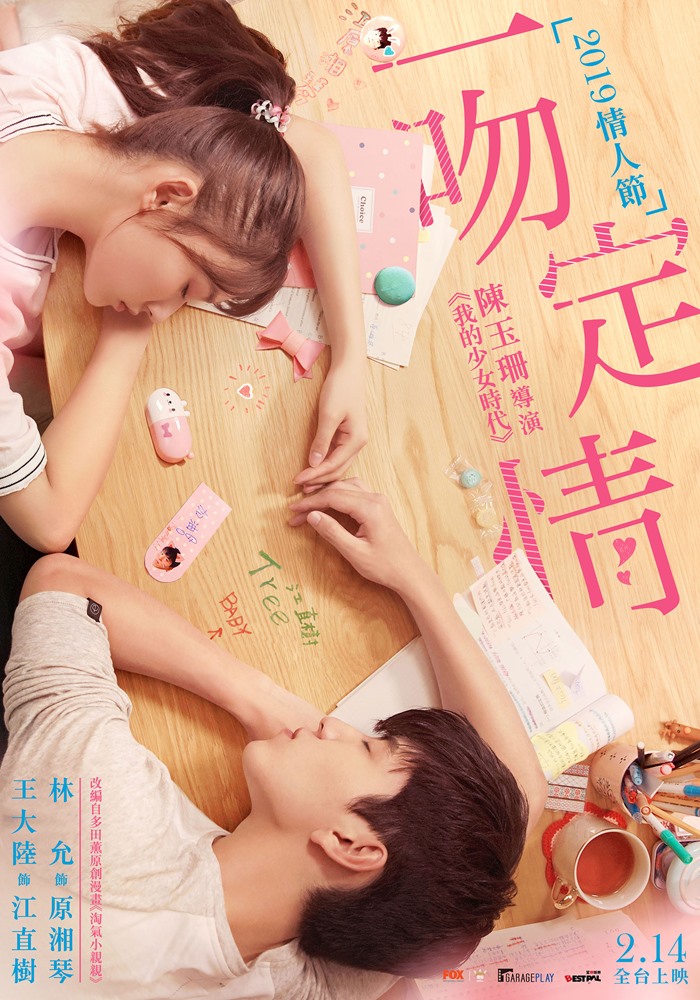
Fall in Love at First Kiss (一吻定情, Frankie Chen, 2019)

Fall in love at first kiss poster 2Our Times’ Frankie Chen Yu-Shan returns to the tricky world of high school romance with an adaptation of the perennially popular ‘90s manga, Itazurana Kiss. Fall in Love at First Kiss (一吻定情, Yī Wěn Dìngqíng) is in fact the third time the manga has been adapted in Taiwan following a hit 2005 TV drama and a remake in 2016. Updated for the present day, Chen’s adaptation retains the manga’s trademark zany humour and often questionable approach to romance but imbues it with characteristic warmth and mild social commentary.

Our heroine, Xiangqin (Jelly Lin Yun), falls hopelessly in love with high school superstar Jiang Zhishu (Darren Wang Talu) when she accidentally trips and kisses him on her first day. Zhishu is, however, somewhat untouchable to a Class F no hoper like Xiangqin – Class A students like him have their very own building inaccessible to those without the proper credentials. Despite outsmarting the system in order to hand him her letter of confession, Xiangqin is cruelly rejected with a video of Zhishu’s cool response going viral among her friends. However, when Xiangqin’s house is demolished thanks to an extremely localised earthquake, she finds herself moving into Zhishu’s family home (it turns out their dads are old friends) where she might perhaps be able to get to know him better.

Like the original manga, Fall in Love at First Kiss revolves around Xiangqin’s lovelorn existence as she becomes increasingly obsessed with her apparently unrequited love for the sullen Zhishu whose behaviour is often hard to read. Zhishu’s mother (Christy Chung), a highlight of any adaptation, is a woman much like Xiangqin which is to say extremely cute and cheerful. Having long wanted a daughter she is delighted to have Xiangqin move in with the family and is virtually painting a nursery in the hope that Xiangqin and Zhishu might one day end up together. This is however partly because she knows both her sons are objectively awful – a pair of self-centred, emotionless hyper rationalists and overachievers who might be popular thanks to their successes but have few friends owing to not being very nice. She hopes some of Xiangqin’s unsophisticated cheerfulness might help open them up to the pleasures of being alive.

Zhishu, however, blows hot and cold. He ignores Xiangqin’s attentions until the point she vows to move on, at which time he kisses her to prove that despite everything he is still the sun in her mad little solar system. This is obviously not a very healthy relationship dynamic even as it insists that Zhishu’s arrogance is part of his “cool” rather than a symptom of his insecurity. Even his final declaration of love is shot through with “you know you want me” logic rather than a heartfelt explanation of his reasoning for having been so cavalier Xiangqin’s feelings. Nevertheless, like every other “difficult” romantic hero, we eventually discover that Zhishu is just awkward rather than actually cruel as he finds himself continually conflicted in wanting to be nice to people but somehow thinking it would be inappropriate to do so.

This is largely because he and his brother are snobbish elitists who’ve been led to believe that social inequality is the proper order of things. Xiangqin, a proud Class F sort of girl, wants to show him that they are all “on the same page”, equals despite what the “rankings” might say. Nevertheless she does this in a rather odd way by remaining deferent to his supposedly admirable qualities and following him around despite his constant rejections. In any case, Zhishu’s class conflict is at the heart of his emotional repression as he struggles with his filial duty to inherit his father’s company when what he’d really like to do is become a doctor to be able to help people – a choice he doesn’t quite feel he has the freedom to make and one which feels too warm and fuzzy for the ultra-capitalist, success at all costs philosophy he seems to have been brought up with by everyone except his cheerful mother. 

Sadly Zhishu does not undergo much of a humbling and remains annoyingly successful and prince-like, while Xiaoqing does not suddenly discover her own worth or another purpose in life, but they do perhaps begin to find happiness in acknowledging their fated connection. Chen keeps the increasingly absurd action grounded as time moves on at frantic pace from high school first love to awkward grown up confession but manages to find the sweetness in a sometimes problematic romance as her lovestruck heroine does not much of anything at all other than remain true to herself in order to win her man.


Currently on limited release in UK cinemas.

Original trailer (English subtitles)